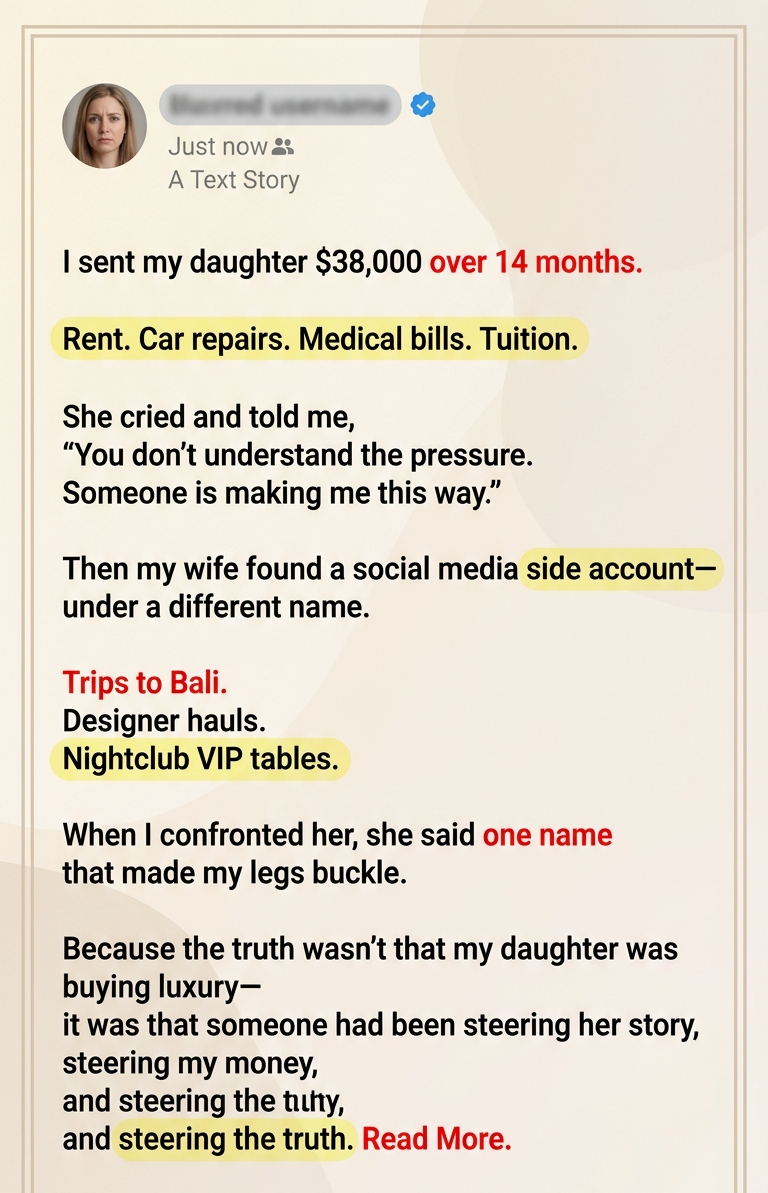
My daughter called me on a Tuesday that smelled like burnt toast and wet asphalt.
“Dad,” she said, and the word came out careful, like she was testing whether it would break. “I need help. Rent. It’s due in three days.”
I didn’t ask why she hadn’t lined things up months ago. I didn’t ask whether her job search was real or just a loop of applications sent into the void. I heard what I needed to hear: fear.
I heard the part of her voice that meant I can’t swallow pride anymore.
“Send me the details,” I said.
I told myself it would be temporary. A bridge. A rescue. Fathers do that when they still believe time can undo whatever got messed up.
When she sent the first transfer request, she attached a screenshot of her rent portal like proof could replace trust. The amount was $5,000—enough to keep the roof over her head and enough to keep me from spiraling.
So I did what I always did.
I sent it immediately.
The next month, she called again.
“Car repairs,” she said. “I need to get to interviews. I can’t— I can’t keep losing chances.”
She sounded even thinner than before, like she’d been living on the edge of a panic attack. She sent the second screenshot and asked for $3,000.
I sent it.
Then another month.
“Medical bills,” she whispered. “Please, Dad. It’s not optional.”
$2,000.
I sent that too.
Then tuition—because of course it was tuition, because the universe loves timing that punishes you for believing things might stabilize.
“Just this one,” she said. “I’ll catch up. I promise.”
$4,000.
Over fourteen months, my bank confirmations stacked like receipts in a lifetime I didn’t recognize.
$38,000.
That number should have felt like a cliff.
Instead, it felt like love—until it didn’t.
The first crack happened the morning my wife noticed something she shouldn’t have noticed.
It started with an innocently dumb scroll. She wasn’t hunting. She wasn’t suspicious. She was bored and tired and looking for a distraction that didn’t require conversation.
Then she saw a social media account.
Under a different name.
The photos weren’t random. They were curated. The kind of curation you can’t fake without either money or access—or a person who believes rules don’t apply to them.
Bali.
Designer shopping hauls.
Nightclub VIP tables where the lighting made every drink look expensive and every laugh look rehearsed.
My wife stared at the screen for too long.
Then she turned to me with the slow certainty of someone who’s already done the math.
“That’s your daughter,” she said.
I followed her finger.
It was the same face—my daughter’s eyes, her smile, her hair in that exact style she never managed to get right on her first try and always tried again anyway.
Except the person in the pictures wasn’t surviving.
She was spending.
In luxury.
In public.
My wife didn’t say “caught” or “liar.”
She said my daughter’s name like it was a question.
I tried to breathe through logic: maybe it was an old account, maybe the photos were from before everything fell apart, maybe it was someone using her look.
But none of the maybes mattered once my wife asked one simple question:
“Where do you think the money came from?”
I couldn’t answer.
Not because I didn’t know.
Because I did.
I’d seen the rent portal screenshots. I’d seen the “car repairs” estimate. I’d seen the “medical bill” PDF. I’d seen the tuition proof.
And in my head, every one of those documents had been a door I walked through—each time choosing to believe the story.
Now I realized I’d been walking through doors someone else held open.
The account didn’t match my daughter’s life.
So I confronted her that night.
Not with screaming.
Not with a courtroom tone.
With the kind of quiet that makes people reveal themselves, because they can’t hide behind noise.
“I saw an account,” I told her. “It’s under a different name.”
Her phone was in her hands. She hadn’t been expecting me to know where to look, and it showed—just for a second. Her eyes flicked down, then up.
“Dad… I don’t know what you mean.”
“I mean trips to Bali,” my wife said. Her voice was steady, but her hands were shaking. “Designer hauls. VIP tables.”
My daughter’s face went pale.
She tried to form an excuse and couldn’t find the right shape for it. Her lips moved like she was searching for a script she’d memorized.
Then she started crying—real tears, fast and helpless, like her body had finally given up pretending.
“You don’t understand the pressure,” she said.
Pressure.
I repeated the word like it was a foreign language. “Pressure?”
She stared at her screen like it might explain the truth for her.
“Someone is making me this way,” she whispered. “I didn’t choose it.”
My wife leaned forward. “Who?”
My daughter swallowed hard. Her gaze slid away from us and toward the phone again, like the phone controlled gravity.
Then she did something that made my stomach twist.
She opened a message thread and showed us the contact name.
Then she looked at me.
And said the name.
A name that made my legs buckle—not because I didn’t recognize it, but because I did.
I recognized it from something I trusted.
From kindness.
From help.
From the kind of person you let close because you’re grateful and tired and you want relief more than caution.
She had been managing her life with emergencies and fear, and the person steering her wasn’t a stranger shouting in the dark.
They were someone who looked like a professional.
Someone who knew how to talk.
Someone who knew which words to use to turn help into control.
My daughter kept crying, not pleading for mercy, but reliving the way the pressure had grown.
“It started when I got laid off,” she said. “I was desperate. I was embarrassed. I didn’t know what to do, and I didn’t want to tell you because I didn’t want you disappointed.”
She paused, shaking.
“And then they said they could help me. They said they could connect me with interviews. They said they had contacts.”
I didn’t interrupt.
I let her build the timeline the way victims always do—careful, incomplete at first, then suddenly precise when the memory stops hurting less than the truth.
“They sent me messages about what to do. They told me what to say when I talked to you. They told me to send screenshots like… like proof would make it okay.”
My wife’s eyes narrowed. “Did they ask for money?”
“Yes,” my daughter said. “Not as money at first. As ‘urgency.’ ‘Rent needs to be covered now.’ Then it was repairs. Then it was medical. Then tuition. They always made it sound like the one thing that mattered most.”
“How much did you know?” I asked, and the question felt like a blade because it wasn’t about money anymore.
It was about whether she’d been choosing this pain, or whether she’d been trapped inside someone else’s plan.
Her shoulders collapsed.
“I knew I was scared,” she said. “I knew it didn’t feel like me. But I also thought if I just kept up, it would stop.”
“Did you ever try to tell us?” my wife asked.
My daughter looked down.
“I tried,” she admitted. “I almost told you. But then the pressure changed. Then they started talking about what would happen if I didn’t follow directions.”
She looked up again, eyes red.
“They said you’d think I was lying. They said they had proof. They said I’d lose everything. They said I’d be exposed.”
My wife’s breathing went shallow.
Exposure.
That word landed like a threat wearing a normal voice.
I suddenly understood something I hadn’t wanted to understand: the luxury wasn’t a “mistake” or a “slip.”
It was bait.
It was a mask.
It was the part of the story that convinced my mind to stay calm—because it didn’t make sense for the person I believed to be desperate to also be living in luxury unless someone else was operating the narrative.
My daughter wasn’t spending my money on clothes.
She was being steered into making the money move.
And she was being frightened into silence when she tried to stop.
When I asked, “How did you end up with the side account?”
She flinched.
“I didn’t,” she said. “Not the way you’re thinking. Someone took over. Or… someone helped me set it up and then they controlled it.”
She wiped her face and continued.
“I would post when they told me to. I didn’t understand how it was happening. They’d send me instructions: upload this, send that, don’t ask questions, keep it consistent. If I didn’t, they’d threaten to ruin me.”
My throat tightened.
“Ruin you how?”
She hesitated.
Then she said, “By making you think I’m the kind of person you shouldn’t trust.”
That’s what broke me.
Not the luxury.
Not the money.
The possibility that the person controlling her also wanted to rewrite me—wanted me to become the person who stopped believing my own daughter and started believing the story they fed.
I realized the pressure wasn’t just financial.
It was psychological.
It was identity theft with a human voice.
That night, we didn’t start with anger.
We started with protection.
First, my wife locked down accounts. Password resets. Two-factor authentication. New numbers. Every place that connected her to money got checked. Every app that could move funds got watched.
Then we did what I should’ve done sooner:
We collected evidence.
Not because my daughter owed us “proof.”
Because evidence is what stops chaos from being the loudest story in the room.
My wife and I saved the transfer confirmations, the screenshots of rent portals and invoices, the message threads—every detail we’d taken as “requests.”
We compared them with what the side account showed.
We saw patterns: dates, language, repeated contact names, repeated urgency themes. We saw how the same phrasing showed up in the “emergency” money requests.
Then we contacted our bank and asked for a full review, disputing transfers as part of a coercion-based exploitation pattern. We filed fraud reports not as an accusation against my daughter, but as documentation that someone else had exploited her vulnerability and impersonated her.
We also contacted a lawyer.
Not to punish her.
To protect her.
Because the most dangerous part of scams isn’t just taking money.
It’s taking your ability to tell truth from performance.
When the authorities asked why the transactions were repeated for fourteen months, my daughter didn’t hide behind tears.
She explained.
She gave the names.
She gave the screenshots.
She gave the timeline.
And for the first time, the pressure in her voice changed.
Not because she felt safe instantly.
Because she no longer felt alone carrying a secret that had been designed to isolate her.
Weeks later, things began to shift.
Her accounts were cleaned and restored.
The side account was taken down.
And the person behind the pressure—someone we had trusted—became a target instead of a guide.
I still felt sick when I thought of how my daughter’s fear had been used like a lockpick.
But I also felt something else.
Relief.
Because it wasn’t my daughter who was guilty in the way my mind had started to accuse her.
It was the person who used the language of need.
It was the person who weaponized urgency.
It was the person who counted on my love to make me slow to doubt.
A year later, my daughter still gets nervous when her phone rings.
She hates uncertainty.
She still stares at notifications too long and flinches when she thinks the world might ask her to prove she’s real again.
But she has something now that wasn’t there before:
a process.
A plan.
A boundary.
And for me, the lesson was harsher than any apology.
Sometimes the “pressure” isn’t a crisis you caused.
Sometimes it’s a cage someone built around your willingness to help.
I don’t pretend money repairs anything.
But I do know this:
I won’t send help on blind faith anymore.
And I won’t let fear rewrite my understanding of my daughter.
Because the truth was never that she spent my money on luxury.
The truth was that someone tried to turn my love into permission.
And when my wife found the side account, when I confronted her, when we chose evidence over denial—
the pressure finally stopped working.