The concrete floor of Kennel 42 is always freezing, no matter what time of year it is. It’s a bitter, unforgiving cold that seeps through the soles of your boots and settles deep into your bones.
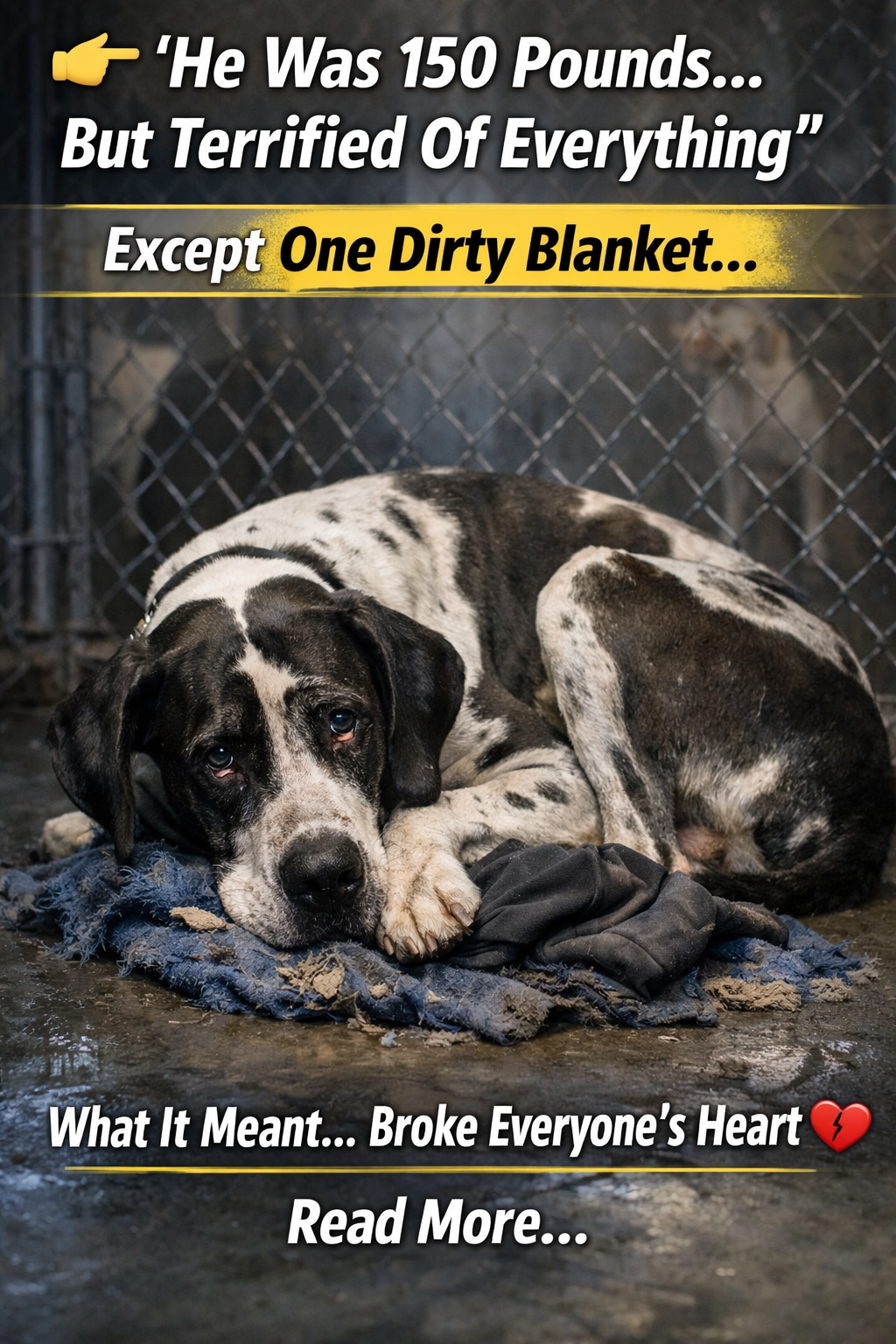
I was sitting on that very floor, my back pressed against the chain-link fencing, watching a one-hundred-and-fifty-pound Harlequin Great Dane try to make himself invisible. His name was Titan, though the name felt like a cruel joke now. Great Danes are bred to be majestic, towering figures, canine royalty that command respect just by entering a room. But Titan was nothing but angles and trembling muscle, a colossal architecture of fear.
For four days, he hadn’t eaten. He hadn’t slept, not really. Every time his heavy eyelids began to droop, the sharp bark of a terrier down the hall or the clatter of a food bowl being dropped would send him violently jolting back to reality, his massive frame slamming against the concrete wall in a desperate bid to escape.
But the most heartbreaking part wasn’t the shaking. It was the blanket.
Beneath his massive front paws was a piece of fabric that barely resembled a blanket anymore. It was a shredded, filthy, oil-stained patch of blue fleece. It smelled like gasoline, stale sweat, and old fear. It was disgusting, a biohazard by shelter standards, and my staff had been trying to remove it since Tuesday.
Every time a volunteer with a warm, clean orthopedic bed approached, Titan would emit a sound that chilled me to the bone. It wasn’t the aggressive, chest-vibrating growl of a dangerous dog. It was a high-pitched, desperate rattle—the sound of a creature begging for its life. If someone reached a hand toward the blue fleece, he would pull it desperately beneath his chest, curling his massive spine to shield it, his eyes wide, white-rimmed, and leaking stress tears.
“He’s guarding it,” one of our newest volunteers, a bright-eyed college student named Jenna, had told me on day two, rubbing her arm where she had jerked it back in fear. “He snapped at me when I tried to pull it out to wash it.”
I had looked into the kennel that day, watching the giant dog hyperventilate over a piece of trash. “He didn’t snap, Jenna,” I corrected her softly. “He warned you. There’s a difference. He thinks that blanket is the only thing keeping him alive.”
By day four, the situation was becoming critical. A dog of his size cannot go without food and water for this long without organ failure setting in. The shelter veterinarian was quietly mentioning the word ‘sedation,’ a risky prospect for a dog whose heart was already beating at a sustained, panicked rhythm.
I couldn’t let them dart him. Not yet. I needed to understand. And to understand Titan, I had to force myself to remember the house we had pulled him from.
I closed my eyes, the smell of shelter bleach fading, replaced by the memory of manicured lawns and the scent of expensive cologne.
It was a Tuesday afternoon when the animal control dispatch came through. A noise complaint, technically. Neighbors in an ultra-affluent gated community had called about a dog crying—not barking, crying—in a closed garage for hours on end. When my partner and I rolled our truck up the pristine, sweeping driveway, the contrast between the environment and the call was jarring. The house was a modern architectural marvel, all glass, steel, and flawless landscaping. There wasn’t a blade of grass out of place. It was the kind of neighborhood where suffering was supposed to be polite, quiet, and hidden behind heavy oak doors.
A woman answered the door. She was impeccably dressed, holding a crystal glass of sparkling water, looking at my uniform with a mixture of profound annoyance and mild disgust. I introduced myself and explained the complaint.
“Oh, for heaven’s sake,” she sighed, waving a manicured hand dismissively toward the side of the house. “It’s just the dog. The boys are in the garage with him. He’s fine. He’s just dramatic. We’re trying to rehome him anyway, he’s chewing the drywall and he’s practically useless as a guard dog. Too much of a coward.”
Her casual cruelty was an instant red flag. We walked down the side path to the massive three-car garage. The side door was propped open. Before I even stepped inside, I heard the laughter. It was the hollow, cruel laughter of teenage boys who had never been told ‘no’ in their entire lives.
I stepped into the dim light of the garage and my heart dropped into my stomach.
In the far corner, trapped between a gleaming silver Mercedes and a wall of expensive, disorganized sporting equipment, was Titan. He was pressed so hard into the corner he looked like he was trying to phase through the drywall.
Standing a few feet away were two teenage boys, maybe eighteen or nineteen years old. One of them, wearing a high-end lacrosse hoodie, was holding a compressed air horn—the kind you use at boating events. The other was holding an aluminum baseball bat. They weren’t hitting him. They were doing something much worse. They were dismantling his mind.
As I watched, frozen for a split second by professional protocol, the boy in the hoodie took a sudden, aggressive step forward and blasted the air horn. The sound was deafening in the enclosed concrete space. Titan didn’t just flinch; his entire body seized. He scrambled backward, his claws desperately slipping on the slick garage floor, his head slamming into the side of the Mercedes.
The boys erupted into hysterical laughter.
“Look at him!” the one with the bat choked out, leaning on the aluminum barrel. “He’s a hundred and fifty pounds and he’s afraid of a noise. What a freak.”
To prove his point, the boy dragged the metal bat across the concrete floor, creating a horrific, high-pitched screech. Titan whimpered, a sound so utterly broken it made my blood run hot. The dog tried to fold himself into a smaller shape, burying his massive head under his front paws.
“Hey!” I barked, my voice carrying the sharp, authoritative edge of a seasoned officer. “Step away from the dog. Right now.”
The boys turned, their smirks fading into looks of entitled indignation. “Relax, officer,” the one in the hoodie sneered, tossing the air horn onto a workbench. “We’re not touching him. We’re just messing around. He’s our dog. Or, well, my dad’s dog. But he’s stupid.”
I didn’t argue with them. You can’t argue with individuals who lack the basic neural pathways for empathy. I bypassed them completely, approaching the corner.
“Titan?” I spoke softly, crouching down. The dog didn’t look at me. He was trembling so violently that the chassis of the car next to him was vibrating. I noticed the environment around him. There were empty buckets, a snapped broom handle, a heavy metal trash can lid. None of it had blood on it. There were no physical lacerations on the dog. In the eyes of the law, this was the hardest type of abuse to prosecute. Psychological torture leaves no bruises for a jury to look at.
But I saw the damage. I saw a dog whose spirit had been methodically, purposefully shattered for entertainment.
“We’re seizing the animal,” my partner informed the mother, who had finally wandered into the garage. She didn’t argue. She actually looked relieved.
When I tried to slip the catchpole leash over Titan’s neck, he panicked. He didn’t snap, but he threw his weight against the wall. It took twenty minutes of agonizingly slow, whispered coaxing to get him to stand. And when he finally did, he reached down with his massive jaws and picked up a bunched-up piece of fabric from the corner. It was a shredded blue fleece blanket.
He held it in his mouth like a golden retriever holds a favorite tennis ball, but there was no joy in it. His grip was a vice. He refused to walk without it.
“Oh, he’s taking his binky,” the lacrosse kid mocked from the driveway as we loaded Titan into the transport truck. “Have fun with that broken mess. He pees himself if you drop a book too loud.”
I had stopped, my hand on the metal door of the truck. I looked dead into the teenager’s eyes. “He’s not broken,” I said quietly, the anger vibrating in my throat. “He survived you. There’s a difference.” I slammed the door shut, cutting off the boy’s laughter.
That was four days ago.
Now, sitting on the cold floor of Kennel 42, the memory faded, leaving me with the reality of the present. Titan was still guarding the blanket. He was watching me with those heavy, sorrowful eyes, expecting me to be exactly like the monsters in the garage.
I looked closely at the blue blanket. Really looked at it.
It was covered in dust, motor oil, and dog hair. But as I stared at it, a profound, sickening realization began to wash over me. I thought back to the garage. I thought about the air horn. The metal bat dragging on the floor. The snapped broom handle. The heavy metal trash can lid.
In that garage, every single object had been weaponized. The environment was a minefield of trauma. A bucket wasn’t a bucket; it was a drum they banged to keep him awake. A broom wasn’t for cleaning; it was for jabbing near his face to make him flinch. The teenage boys had turned his entire world into a haunted house, where everything was designed to elicit fear.
Except the blanket.
The blanket was soft. It made no sound when it was dropped. It couldn’t shatter, it couldn’t clang, it couldn’t screech against the concrete. It was the only object in his entire existence that hadn’t been used to hurt or scare him.
Tears pricked the corners of my eyes, blurring the harsh fluorescent lights of the shelter. I had been looking at it completely wrong. I thought the blanket was a comfort object, like a childhood teddy bear. It wasn’t. It was a shield. It was his sensory deprivation tank. When the noise became too loud, when the air horns blasted and the metal clanged, Titan would bury his head under that soft, silent blue fleece to block out the world.
My staff had been trying to take away his armor.
No wonder he was terrified. We were asking him to step onto a battlefield completely naked.
I let out a long, shaky breath. I unclipped my heavy shelter radio from my belt and slid it slowly across the floor, out of the kennel. I took off my metal nametag and set it aside. I took off my heavy boots. I stripped away everything on my person that could click, clatter, or shine.
Titan watched my every movement, his breathing shallow and rapid.
I didn’t move toward the blanket. Instead, I slowly took off my own uniform jacket—a soft, worn navy blue zip-up. I rolled it up into a small, soft bundle.
I didn’t look him in the eyes; direct eye contact is a challenge in dog language. I kept my gaze fixed on the concrete between us. Inch by agonizing inch, I slid my rolled-up jacket across the floor. I stopped when it was resting exactly three inches from the edge of his shredded blue blanket.
I didn’t ask for his blanket. I offered him an extension of his safe zone.
For ten minutes, the shelter was dead silent, save for the hum of the HVAC unit. My legs were cramping from the cold floor, but I didn’t dare shift my weight.
Slowly, so slowly it looked like a time-lapse video, Titan lowered his massive head. He sniffed my jacket. He smelled my scent—dogs, cheap coffee, and sweat. He didn’t smell fear. He didn’t smell the expensive cologne of his abusers.
He looked up at me. For the first time in four days, the white rims around his eyes softened.
He let out a heavy, shuddering sigh—a massive exhalation that seemed to deflate his entire body. The extreme tension in his shoulders melted away. And then, with the cautious grace of a giant, he uncurled his front leg. He reached out and rested his massive, heavy paw directly on top of my jacket, keeping his other paw firmly planted on his blue blanket.
He was bridging the gap. He was connecting his island of safety to me.
A single tear slipped down my cheek and splashed onto the concrete. I didn’t reach out to pet him. Earning the right to touch him would take weeks, maybe months. But as he slowly rested his chin on his front paws, his eyes finally fluttering shut in true exhaustion, I knew we had won the first battle.
They had broken his mind, weaponized his environment, and turned a majestic creature into a prisoner of fear. But they had made one fatal mistake. They had left him one tiny piece of the world that was soft. And from that one soft thing, we were going to rebuild his entire universe.
CHAPTER II
The chime above the shelter door didn’t just ring; it cut through the afternoon silence like a surgical blade. I was in the small glass-walled office just off the lobby, trying to finish a behavioral report on Titan, but the air in the room shifted the moment the door opened. I didn’t need to look up to know that the peace of the last forty-eight hours was over. I could smell the expensive, cloying scent of Bergamot and cold ash before I even saw the woman who wore it.
I stood up slowly, my joints aching from the hours I’d spent sitting on the concrete floor with Titan. My jeans were covered in his short, coarse hairs and the faint, metallic scent of the shelter. When I stepped into the lobby, I saw them. Eleanor Sterling looked exactly like the photos from the local society pages, though the anger in her eyes made her features sharper, less polished. She was flanked by a man who radiated the kind of calculated stillness that only comes with a six-figure retainer. He carried a leather briefcase that looked like it cost more than our entire medical budget for the month.
“Sarah Jenkins?” the man asked. He didn’t wait for me to answer. “I’m Marcus Thorne. I represent the Sterling family. We’re here for the animal.”
I looked past him to Eleanor. She wasn’t looking at me; she was scanning the hallway behind me, her lip curling in a faint expression of disgust as she took in the chipped paint and the distant sound of a barking terrier. To her, this wasn’t a rescue. It was a warehouse for lost property.
“The ‘animal’ has a name,” I said, keeping my voice level. My heart was a frantic bird trapped in my chest, but I kept my hands steady by gripping the edge of my clipboard. “Titan is currently under medical observation. He isn’t cleared for transport.”
“He isn’t here for a check-up, Miss Jenkins,” Thorne said, his voice smooth and utterly devoid of warmth. “He was removed from the Sterling estate under what we’ve discovered to be an improperly filed seizure warrant. The paperwork signed by the responding officer lacked the necessary judicial oversight for a private property entrance of that nature. Legally, the dog is still the property of my client. We’re here to take him home.”
I felt a cold drop of sweat slide down my spine. The ‘improper paperwork’ wasn’t just a legal loophole. It was a direct hit to the secret I’d been carrying since the night we got him. When the call had come in about a dog in distress, I hadn’t waited for the backup. I’d seen the gate code written on a discarded slip of paper in the driveway—likely dropped by a delivery driver—and I’d used it. I’d entered the Sterling’s garage before the police arrived, driven by a gut feeling that every second counted. If Thorne knew that—if he could prove I’d trespassed before the warrant was officially served—not only would Titan go back, but I’d lose my license. I might even face charges.
“This isn’t about property,” I said, my voice dropping an octave. “This is about a living being who was found in a state of extreme psychological distress. You haven’t seen him, Mr. Thorne. You haven’t seen the way he shakes.”
“I’ve seen the bill for his pedigree,” Eleanor Sterling interrupted, her voice like cracking ice. “Titan is a champion-line Great Dane. He was a gift for my son, Kyle. If the dog is ‘shaking,’ it’s because he’s been kept in this… this hovel for two days. My son is devastated. He wants his dog back, and I want this ridiculous circus to end.”
I looked at her, truly looked at her, and saw the same blank denial I’d seen in my own mother’s eyes years ago. I remembered being ten years old, watching my father throw a chair across the room, and my mother simply smoothing her skirt and asking me what I wanted for dinner, as if the splintered wood at our feet didn’t exist. That was my old wound—the silence that protects the abuser. I had spent my adult life trying to be the voice that broke that silence. I wouldn’t let it happen again. Not to Titan.
“Your son,” I said, the words tasting like copper, “is the reason Titan is here. I have documented evidence of the environmental stressors in that garage. The loud-frequency emitters, the heavy objects hanging by chains. Titan wasn’t just neglected, Mrs. Sterling. He was systematically broken.”
Thorne stepped forward, his presence a physical weight. “Documentation by a shelter worker is not a forensic psychological evaluation, Miss Jenkins. It’s hearsay. What is not hearsay is the fact that you are currently in possession of stolen property. If you don’t bring the dog out now, I have a sheriff’s deputy two minutes away ready to serve an injunction. We can do this quietly, or we can do it in a way that ensures this shelter never receives another dime of city funding.”
I looked at the lobby door. A few people had stopped on the sidewalk outside, peering through the glass. A local blogger, who often covered our adoption events, was already pulling out her phone. This was it. The public square.
“Fine,” I said, the word feeling like a betrayal. “Wait here.”
I turned and walked back into the kennel area. My knees felt weak. I went straight to Titan’s run. He was huddled in the corner, his massive head resting on that filthy, tattered blue blanket. He didn’t look up when I approached, but his tail gave a single, weak thump against the concrete.
“I’m so sorry, big guy,” I whispered. I reached out and gently took the edge of the blanket. He flinched, his eyes wide and showing the whites, but he didn’t growl. He let me pull it toward me. I tucked the blanket under my arm. It smelled of grease, old sweat, and the damp air of a garage. It was the only thing he had left.
I didn’t put a leash on him. I couldn’t bear to. Instead, I opened the gate and walked slowly toward the lobby. Titan followed me, his gait unsteady, his head tucked low between his shoulders. He looked like a ghost of a dog, a 150-pound shadow.
When we rounded the corner into the lobby, the atmosphere changed instantly. Eleanor Sterling took a half-step back, her eyes widening. Maybe she hadn’t realized how much weight he’d lost. Or maybe she’d forgotten how large his fear could be.
“There he is,” Thorne said, though he didn’t move toward the dog. “Mrs. Sterling, if you’ll just take the lead…”
Eleanor reached into her designer bag and pulled out a pristine, braided leather leash. She stepped toward Titan. “Come here, Titan. Come to Mommy.”
Titan didn’t move. He froze. His entire body began to vibrate with a fine, rhythmic tremor. He looked at Eleanor, then at the leash in her hand, and then his gaze dropped to the blue blanket tucked under my arm.
“He doesn’t seem to recognize you,” I said, my voice carrying to the small crowd now gathering at the glass door.
“He’s confused!” Eleanor snapped. She reached out to grab his collar—a heavy, studded thing that looked more like a restraint than a piece of tack.
As her hand moved, I did something I knew might be the end of my career. I didn’t stop her. I didn’t pull him away. I simply dropped the blue blanket on the floor between them.
“Titan, stay,” I commanded softly.
Titan didn’t stay. The moment the blanket hit the floor, he lunged for it—not with aggression, but with a desperate, frantic need. He buried his face in the filthy fabric, whining a high-pitched, keening sound that made the people outside gasp. He began to paw at it, trying to pull it over his head, trying to disappear into the only thing that hadn’t hurt him.
“What is that disgusting rag?” Eleanor cried, recoiling from the smell. “Get that away from him!”
“This ‘rag’,” I said, stepping forward so I was between her and the dog, “is the only object from your home that doesn’t trigger a terror response in him. Do you know why, Mrs. Sterling? Because it’s the only thing your son didn’t use to hit him or startle him. I found this in the corner of the garage where the floor was worn smooth from him pacing. He’s not a dog right now. He’s a victim of a crime scene, and you’re asking me to return him to the site of the crime.”
“You have no right—” Thorne started, but I cut him off.
“I have the right of a witness!” I shouted. My voice echoed in the lobby, startling the people outside. “I have the documentation of his heart rate every time a door slams. I have the video of him cowering when he hears the sound of a garage door opener. And now, everyone here can see the truth. Look at him!”
I pointed to Titan. He was flat on the floor, shaking so violently that his claws clattered against the tile. He was a 150-pound animal reduced to a shivering heap by the mere presence of his owner.
“You want to talk about property?” I asked, looking directly at the lawyer. “Then let’s talk about the liability of a family that knowingly keeps a dog in a state of induced psychosis. Let’s talk about what happens when this ‘asset’ finally snaps because he’s been tortured by a teenager with a noise-maker. If you take him today, I will personally ensure that every news outlet in this city sees the photos of that garage. I will tell them about the ‘improper paperwork’—I’ll tell them exactly how I found him, and I’ll let a jury decide if my trespassing was a crime or a rescue.”
I was bluffing about the jury, and I was outing my own secret, but the look on Thorne’s face changed. He wasn’t looking at the dog anymore. He was looking at the crowd outside, where two people were now filming the scene on their phones. He was looking at Eleanor, whose face had gone from red to a deathly, chalky pale.
“Eleanor,” Thorne whispered, his hand catching her elbow. “The optics… we need to go.”
“I won’t be talked to like this,” she hissed, but her voice lacked its previous bite. She looked at Titan—really looked at him—and for a second, I thought I saw a flicker of something like shame. Or perhaps it was just the realization that she couldn’t control this narrative anymore.
“The dog is… unstable,” Eleanor said, smoothing her coat with trembling hands. “If he’s this far gone, clearly he’s of no use to us. Kyle doesn’t want a broken animal.”
“He’s not broken,” I said, my voice shaking with a mixture of rage and relief. “He’s healing. And he’s staying here.”
Thorne pulled a gold pen from his pocket and scribbled something on a business card. He tossed it onto the lobby counter. “We will be filing a formal surrender to avoid further litigation. But if a single word of these accusations reaches the press, Miss Jenkins, I will bury this shelter in a mountain of defamation suits that will take decades to climb out of. Do we understand each other?”
I didn’t answer. I didn’t need to.
I watched them walk out, the glass door swinging shut behind them with a heavy thud. The crowd outside parted for them like water around a stone, their faces filled with a mixture of awe and judgment.
I sank to the floor next to Titan. He was still buried in the blanket. I reached out and rested my hand on his flank. He was still shaking, but the frantic rhythm was slowing.
“They’re gone,” I whispered. “They’re never coming back.”
I had won. I had saved him. But as I sat there on the cold tile, I felt a hollow ache in my chest. To save Titan, I’d had to admit to a crime. I’d had to put the shelter’s future on the line. I had played a high-stakes game of chicken with a woman who had more resources in her handbag than I had in my bank account.
And I knew, with a sinking certainty, that this wasn’t the end. People like the Sterlings don’t just walk away. They wait. They find the weak spot. And I had just shown them exactly where mine was.
I looked at the blue blanket. It was filthy, stained with the evidence of months of misery. It was a bridge to Titan’s past, but it was also a weight holding him there. I realized then that while I had secured his physical safety, the real battle—the one for his mind—was only just beginning. And in that battle, I was just as vulnerable as he was.
My phone buzzed in my pocket. It was a text from the board president of the shelter. *’Sarah, what’s going on? I’m seeing videos of the Sterlings in our lobby on Twitter. Call me immediately.’*
The adrenaline that had carried me through the confrontation drained away, leaving only a cold, numbing exhaustion. I had protected the dog, but in doing so, I had set a fire that was now spreading far beyond the lobby.
Titan finally lifted his head from the blanket. He looked at me, his deep amber eyes searching mine. For the first time, there was no panic in them. There was just a quiet, profound exhaustion that mirrored my own. He leaned his massive weight against my shoulder, a gesture of trust that should have felt like a triumph, but felt more like a burden.
I had promised him he was safe. Now, I had to figure out how to keep that promise when the walls were starting to close in on both of us. The secret of how I’d entered that garage was no longer just mine—it was a weapon I’d handed to my enemies, and I knew they wouldn’t hesitate to use it.
I pulled the blue blanket closer around him, tucking the edges in. It was a small, fragile shield against the world outside, but for now, it was all we had. I ignored the vibrating phone in my pocket and just sat there, breathing in the scent of wet dog and old grease, waiting for the next storm to break.
CHAPTER III
The law doesn’t care about a blue blanket. It doesn’t care about the way a dog’s ribs vibrate when he’s finally stopped shaking, or the specific, heartbreaking scent of cedar and old fear that clings to his fur. To the state of New York, Titan was property. To the Sterlings, he was a liability that needed to be reclaimed or erased. And to me, he was the only thing that made sense in a world that had suddenly turned its back on me.
I sat in my kitchen, the fluorescent light humming a low, mocking tune. On the table lay the papers. Criminal Trespass in the Second Degree. The ink was so black it looked wet. Marcus Thorne had moved faster than a fever. By the time I had reached my car after the confrontation at the shelter, the process server was already waiting at my apartment. He didn’t look me in the eye. He just handed me the envelope and walked away, his boots clicking on the pavement like a countdown.
Then came the phone call from Arthur Miller, the Chairman of the Shelter Board. Arthur was a man who measured morality by the balance sheet. He didn’t scream. Shouting requires passion, and Arthur only had protocol.
“Sarah,” he said, his voice as thin as a razor. “You’ve put us in an impossible position. Admitting to an illegal entry on a public record? We’re a non-profit. We live on the grace of the community and the legality of our charters. You’re suspended, effective immediately. Hand your keys to the night guard. Don’t go near the kennels.”
“Arthur, he’s terrified,” I whispered. My throat felt like it was filled with broken glass. “If I’m not there, he won’t eat. He won’t let anyone touch him. You know what happens to dogs like him in isolation.”
“What happens is no longer your concern,” Arthur replied. “The Sterlings are suing the shelter for a million dollars in damages. We are cooperating with the police. If you set foot on that property, I will have the sheriff there in five minutes. Do you understand?”
I hung up. The silence that followed was heavy. It was the sound of a door locking from the outside. I thought of Titan in Kennel 42. I thought of him huddled in the corner, staring at the door, waiting for the one person who didn’t smell like a threat. I knew I was being baited. Thorne wanted me to crack. He wanted me to do something desperate so he could finish me off. But the thought of Titan being handed back to Eleanor Sterling—or worse, being ‘humanely handled’ because he was too aggressive for the staff—was a fire in my chest I couldn’t put out.
I called a number I hadn’t dialed in three years. It belonged to a man known only as ‘Ghost.’ He ran the Waystation, an underground network of foster homes that didn’t exist on any map. These were people who took the dogs the system wanted to kill. No paperwork. No paper trail. Just high fences and quiet nights.
“I need a pickup,” I said when he answered. “A big one. 150 pounds of trauma. He’s hot. The police are looking for a reason.”
“Midnight,” Ghost said. His voice was gravel. “The old quarry road. If there’s a tail, keep driving. If I see a blue light, I’m gone.”
I didn’t sleep. I spent the hours packing a bag I knew I might never bring home. I felt like a ghost inhabiting my own life. I was a professional. I was a rescuer. But in that moment, I was a thief in the making. I was crossing a line, and I knew that on the other side, there was no way back.
At 11:15 PM, I drove to the shelter. I didn’t use my headlights. I parked two blocks away and walked through the woods, the damp branches clawing at my jacket. The shelter was a dark monolith against the sky. I knew the night guard, Leo. He was seventy years old and spent most of his shift watching old westerns in the breakroom. I had my spare key—the one I was supposed to have turned in. My hand shook as I slid it into the side gate.
The click sounded like a gunshot in the quiet. I slipped inside. The air smelled of bleach and wet fur. As I moved down the hallway, the low whimper of a dozen dogs rose up to meet me. They knew. They always knew when the energy changed.
When I reached Kennel 42, Titan wasn’t standing. He was pressed against the back wall, a shadow among shadows. When he saw me, he didn’t bark. He let out a sound I’d never heard from a dog—a soft, keening moan that broke my heart into a thousand pieces. I opened the gate and knelt down. He practically fell into me, his massive head burying itself in the crook of my neck. He was trembling so hard I thought his heart might burst.
“I’ve got you,” I whispered, tears blurring my vision. “I’ve got you, big guy.”
I grabbed the blue blanket. It was filthy and smelled of the garage he’d been trapped in, but it was his only anchor. I draped it over his shoulders like a shroud. We moved through the back exit. Titan walked with a strange, frantic grace, his body pressed tight against my hip. Every shadow was Kyle Sterling to him. Every rustle of the wind was a threat.
I got him into the back of my SUV. He climbed in and immediately curled into a ball on the floorboards, trying to become small. I drove. My eyes were glued to the rearview mirror. Every pair of headlights behind me felt like a predator. I took side roads, circling blocks, heart hammering against my ribs. I felt a strange, intoxicating sense of victory. I was doing it. I was saving him. The law was wrong, and I was right. That’s the lie we tell ourselves when we’re drowning.
The quarry road was a jagged strip of gravel and dust. I saw the silhouette of a van parked near the edge of the pit. No lights. I pulled up and killed the engine. The silence was absolute. I stepped out, my boots crunching on the stone.
“Ghost?” I called out softly.
A figure stepped from behind the van. But it wasn’t Ghost. It was a man in a well-tailored overcoat that looked absurd in the middle of a dirt quarry. Marcus Thorne. He was holding a tablet, the screen glowing against his face like a digital specter. Behind him, two other cars suddenly flicked on their high beams, blinding me. The blue and red strobes of a Sheriff’s cruiser cut through the dust.
“You really are a creature of habit, Sarah,” Thorne said. His voice was calm, almost disappointed. “We tracked your cell phone the moment you left your apartment. But I didn’t expect you to lead us right to your ‘underground’ friends. That’s a bonus for the District Attorney.”
I stood frozen, my hand on the door handle of my car. Inside, Titan began to growl—a deep, tectonic sound that vibrated through the metal.
“You set this up,” I breathed. “The suspension… the pressure… you knew I’d try to move him.”
“I knew you couldn’t help yourself,” Thorne said, stepping closer. “You have a savior complex that borders on psychosis. You didn’t steal this dog to save him. You stole him to prove you were better than us. And in doing so, you’ve committed a felony.”
Another door opened. Arthur Miller stepped out of the second car. He wouldn’t look at me. He was talking to a woman in a dark suit—an official from the Department of Agriculture.
“As Chairman of the Board,” Arthur said, his voice loud enough for the police bodycams to catch, “I am officially reporting this animal as stolen property. The shelter disavows all actions taken by Sarah Jenkins. We request the immediate seizure of the animal for the safety of the public.”
“Arthur, no!” I screamed. “They’ll kill him! You know what Thorne wants!”
“What I want,” Thorne interrupted, “is order. My client, Mrs. Sterling, has realized that the dog is a danger. She has graciously agreed to sign him over to the state for immediate evaluation. Which we all know is a death sentence for a dog that just ‘attacked’ its rescuer’s vehicle.”
The Sheriff stepped forward. “Step away from the vehicle, Sarah. Now.”
I looked at Titan through the glass. He was standing now, his hackles raised, his eyes wide with a terror that had finally turned into rage. He saw the uniforms. He saw the lights. He saw the very things that had haunted his dreams. He began to throw himself against the window, the glass bowing under his weight. He wasn’t a dog anymore; he was a trapped soul screaming for an exit.
“He’s not a danger!” I pleaded, reaching for the Sheriff’s arm. “He’s just scared! Please, let me talk him down!”
Two deputies grabbed me. They pulled my arms behind my back, the cold steel of the handcuffs biting into my wrists. I didn’t fight them. I just watched. I watched as the Animal Control officers approached my car with a catch-pole—a long, cruel stick with a wire noose at the end.
“Don’t use the pole!” I shrieked. “It’ll break him! Just give him the blanket!”
They didn’t listen. They smashed the rear window. The glass showered Titan like diamonds made of ice. He lunged, but the wire loop caught him around the neck. He thrashed, his massive paws skidding on the leather seats, his tongue turning blue as the wire tightened. He looked at me—just for a second. His eyes weren’t angry anymore. They were confused. He thought I had brought him here for this.
He thought I had betrayed him.
They dragged him out of the car. He hit the gravel hard, his legs buckling. They didn’t let him stand. They winched him into the back of a heavy-duty state van, the metal door slamming shut with a finality that echoed off the quarry walls.
Thorne walked over to me as the deputies began to lead me to the cruiser. He leaned in close, the smell of expensive cologne and peppermint sickeningly sweet.
“The funny thing is, Sarah,” he whispered, “Eleanor didn’t even want the dog back. She just wanted to see if you were as righteous as you claimed. It turns out, you’re just another thief. Kyle will be so happy to hear how this ended.”
He turned and walked away, his polished shoes untouched by the dust.
I was pushed into the back of the patrol car. The cage between the front and back seats felt like a mirror of Titan’s kennel. As we drove away, I looked out the back window. My SUV sat abandoned in the middle of the quarry, the door hanging open, the blue blanket lying in the dirt—a scrap of fabric that couldn’t save anyone.
I had tried to be his hero. Instead, I had become his executioner. I had played right into their hands, and the cost wasn’t my career or my freedom. The cost was the soul of a dog who had finally trusted the wrong person. The lights of the city blurred into a single, aching smear of red. I closed my eyes, but all I could see was the wire tightening around Titan’s throat, and the look in his eyes when he realized I wasn’t coming to help him.
CHAPTER IV
The holding cell was concrete and echoes. Cold seeped from the walls, a damp chill that settled deep in my bones. They’d taken everything – my belt, my shoelaces, my phone. Even the small silver cross my grandmother had given me. Stripped of any semblance of myself, I was just a body waiting.
The fluorescent lights hummed, a constant, irritating drone. Time seemed to stretch and compress at random. I had no idea how long I’d been there. Just the endless cycle of stale air and gnawing anxiety.
I replayed the moment at the quarry, Titan’s bewildered eyes, the leash yanked from my hand. His trust, so hard-won, shattered in an instant. The image burned behind my eyelids.
I knew what they’d do to him. “Euthanasia” was the sterile term, but I knew what it meant. The Sterlings would ensure it was slow, painful. A final act of control.
PHASE 1: THE PUBLIC REACTION
The first hint of the outside world came from a guard, a woman with tired eyes and a clipboard. She slid a newspaper under the cell door.
“You got popular,” she said, her voice flat.
The headline screamed: “RESCUER NABBED IN DOGNAPPING STING!” My picture, taken years ago at a charity event, was plastered across the front page. I looked like a criminal. The article detailed the charges, grand larceny, trespassing, and painted me as a reckless vigilante.
I scanned the article, my stomach twisting. The shelter was mentioned prominently. Arthur Miller was quoted, his words carefully chosen to distance the organization from my actions. “Ms. Jenkins acted independently,” he said. “Her behavior does not reflect the values of our shelter.”
He threw me to the wolves.
Online, the outrage was a tidal wave. Some people defended me, sharing stories of Titan’s abuse. But they were drowned out by the chorus of condemnation. I was labeled everything from a thief to a fanatic. The blue blanket became a symbol of my supposed extremism.
The Sterlings, of course, remained silent. Their lawyer, Marcus Thorne, issued a brief statement emphasizing their commitment to “responsible pet ownership” and their cooperation with authorities.
The shelter’s Facebook page became a battleground. Donations plummeted. Volunteers resigned. The board buckled under the pressure and announced its permanent closure. Years of work, gone. Lives of countless animals, put at risk.
My phone, when I finally got it back after the arraignment, was a graveyard of missed calls and hateful messages. My voicemail was full. Most ended with the same sentiment: I’d gotten what I deserved. That Titan was better off without me, a crazy woman.
Even my family was hesitant. My sister, usually my staunchest supporter, left a message filled with worry and thinly veiled disappointment. “Sarah, what were you thinking?” she asked. “You need to think about your future.”
The world I knew had vanished. My reputation, my career, my support network – all gone, swept away by the storm I had unleashed.
PHASE 2: PERSONAL COLLAPSE
Sleep was impossible. Every time I closed my eyes, I saw Titan. His confused, hurt expression as they dragged him away.
Guilt gnawed at me. Had I made things worse? Had my actions doomed him? The underground network, Ghost, Thorne… it all felt like a trap perfectly designed for me.
The arraignment was a blur. Marcus Thorne was there, his eyes cold and triumphant. He barely acknowledged me. The judge set bail at an exorbitant amount. I couldn’t afford it.
I was assigned a public defender, a young woman named Emily, who seemed overwhelmed by the case. She told me the charges were serious and the evidence was stacked against me.
“The Sterlings have a lot of influence,” she said, her voice barely above a whisper. “It’s going to be an uphill battle.”
Visits were limited. My parents came once, their faces etched with worry. They offered to help with the legal fees, but I refused. I couldn’t drag them down with me.
“I just wanted to save him,” I said, my voice cracking.
“We know, honey,” my mother said, squeezing my hand. “But you have to think about yourself now.”
But I couldn’t. All I could think about was Titan. Alone, scared, waiting for the end.
In the silence of the cell, I confronted the truth. My passion had blinded me. I had broken the law, acted impulsively, and put Titan in even greater danger. I had failed him.
The weight of that failure threatened to crush me.
The only moments of reprieve came from Emily. She managed to get me updates, small details about Titan’s condition. He was being held at a state facility outside the city. He was refusing to eat. He was withdrawn.
“They’re evaluating him,” she said. “For aggression.”
I knew what that meant. They were looking for any excuse to justify their actions.
The days bled into weeks. The trial date was set. My life was on hold, suspended between hope and despair.
PHASE 3: THE UNEXPECTED VISIT
One afternoon, Emily came to see me, her expression grim.
“I have bad news,” she said. “The Sterlings are pushing for immediate euthanasia. They claim Titan is a danger to the community.”
My heart sank. I knew I had to do something, anything, to stop them. But I was trapped.
“There’s one thing,” Emily said hesitantly. “Eleanor Sterling wants to meet with you.”
I stared at her in disbelief. “Why?”
“I don’t know,” she said. “But she’s insisting on it. She says it’s the only way she’ll consider… dropping the charges.”
It was a trap. I knew it. But I had no choice. I had to see her. For Titan.
The meeting took place in a small, sterile room at the courthouse. Eleanor Sterling sat across from me, her face impassive. She was impeccably dressed, her hair perfectly coiffed. She looked like she was attending a business meeting, not deciding the fate of an animal.
“Ms. Jenkins,” she said, her voice cold and precise. “I understand you’re concerned about the dog.”
“He has a name,” I said, my voice trembling. “It’s Titan.”
She ignored me. “I’m willing to make a deal,” she said. “If you publicly apologize for your actions and sign a statement retracting your allegations of abuse, I will… consider… allowing the dog to be transferred to a sanctuary.”
It was a lie. I knew it. But there was a sliver of hope, a desperate chance to save him.
“And if I don’t?” I asked.
“Then the dog will be euthanized,” she said, her eyes unwavering. “And you will face the full consequences of your actions.”
I looked at her, at the cold, calculating cruelty in her eyes. I knew she was enjoying this. She was reveling in my powerlessness.
“What do you want me to say?” I asked, my voice barely a whisper.
She smiled, a thin, predatory smile. “Just tell the truth,” she said. “Tell everyone you were wrong.”
I thought of Titan, his trusting eyes, his unwavering loyalty. I thought of the abuse he had suffered, the pain he had endured. I thought of the blue blanket, his only comfort in a world that had betrayed him.
And I knew what I had to do.
PHASE 4: THE WEIGHT OF TRUTH
“I won’t do it,” I said, my voice rising. “I won’t lie for you. I won’t let you get away with this.”
Eleanor Sterling’s face hardened. “You’re making a mistake,” she said.
“No,” I said. “I’m finally doing the right thing.”
She stood up, her eyes blazing with anger. “You’ll regret this,” she said. “You’ll lose everything.”
“I already have,” I said. “But I won’t lose my soul.”
She stormed out of the room, leaving me alone with my decision.
Emily rushed in, her face pale. “What happened?” she asked.
“I refused,” I said. “I couldn’t do it.”
She sighed. “I was afraid of that,” she said. “I’ll do my best, Sarah. But… you need to prepare yourself.”
The trial was a formality. Marcus Thorne presented a carefully constructed narrative, portraying me as a delusional animal fanatic who had endangered the community. Arthur Miller testified, distancing the shelter from my actions.
I watched the whole thing numbly, feeling like I was watching a play, not my own life.
Emily fought valiantly, but it was no use. The judge delivered the verdict: guilty on all counts.
As the bailiffs led me away, I caught a glimpse of Eleanor Sterling in the gallery. She was smiling.
The news spread like wildfire. The online vitriol intensified. I was a pariah, a cautionary tale.
Days later, Emily came to see me with the final blow.
“Titan was euthanized this morning,” she said, her voice barely audible.
I closed my eyes, and the world went black.
Justice, if it existed, felt like a cruel joke. I had wanted to save Titan, and instead, I had condemned him. My actions, driven by compassion, had led to his death. The cost of saving him was everything.
In the end, all that remained was the cold, hard reality of institutional power and the bitter taste of defeat. And the haunting image of a Great Dane with trusting eyes, betrayed by the one person who promised to protect him.
CHAPTER V
The cell door clanged shut, the sound echoing the emptiness inside me. Guilty. The word felt like a brand, seared onto my soul. I sat on the edge of the bunk, the thin mattress offering little comfort. Titan was gone. The shelter was closed. My life, as I knew it, was over.
Days blurred into weeks. The routine was monotonous – meals of flavorless slop, the clang of doors, the hollow faces of the other inmates. Sleep offered no escape, haunted by images of Titan, his big brown eyes filled with fear, then… nothingness.
Emily visited when she could. Her visits were brief, professional, but her presence was a lifeline. She brought news from the outside world, updates on the appeals process (or lack thereof), and a quiet, unwavering support that I didn’t deserve. “They closed the shelter, Sarah. Arthur Miller pushed it through. Said it was ‘in the best interest of the community,’ given the… circumstances.” Circumstances. A euphemism for my spectacular fall from grace. I just nodded.
One day, my sister, Carol, came. I hadn’t seen her since the initial arraignment. Her face was drawn, her eyes filled with a mixture of pity and… something else. Resentment? Disappointment? Probably both. “Mom and Dad wanted to come, but…” She trailed off, unable to finish the sentence. I knew what she meant. My parents were ashamed. I had always been the ‘difficult’ one, the one who challenged the status quo, the one who refused to play by the rules. Now, my rebellion had landed me in jail, a convicted felon. “They’re worried about you, Sarah. We all are. But… you really messed up.” “I know,” I said, my voice flat. “I messed up everything.” Carol sighed. “Why, Sarah? Why did you have to be so… extreme?” “Because someone had to be,” I replied, the words coming out sharper than I intended. “Titan deserved better. All of them do.” Carol shook her head. “There are other ways, Sarah. Legal ways. You could have worked within the system.” “The system didn’t work for Titan,” I said, my voice rising. “It failed him. It failed all of them.” Carol flinched. “Don’t you see, Sarah? You’re not a hero. You’re just… a mess.” She stood up, her eyes glistening with tears. “I don’t know you anymore.” And then she was gone.
That night, I lay awake, staring at the ceiling. Carol’s words echoed in my head. A mess. Was that all I was? A well-intentioned screw-up who had caused more harm than good? The thought gnawed at me, a relentless, corrosive acid. I thought of Titan, of his gentle nature, his unwavering loyalty. Had I failed him? Had my actions ultimately condemned him to a worse fate?
**PHASE ONE: Confronting the Irreversible Loss**
The trial was a blur, a formality. The evidence was stacked against me. Thorne had painted me as a reckless vigilante, a danger to the community. The judge, a stern-faced woman with weary eyes, handed down the sentence: three years in a state correctional facility. Three years to contemplate my failures. Three years to rot. As I was led away, I caught a glimpse of Eleanor Sterling in the gallery, a smug look on her face. Thorne stood beside her, a silent victor. My blood ran cold.
Prison was a different world, a brutal, unforgiving place where survival was the only currency. I learned to keep my head down, to avoid eye contact, to blend into the background. The other inmates were a mix of hardened criminals and petty offenders, each with their own story of bad choices and broken dreams. I spent my days in the laundry, folding sheets and towels, the repetitive motion a kind of meditation. At night, I lay on my bunk, listening to the sounds of the prison – the coughs, the whispers, the occasional scream – and wondered how I had ended up here.
One day, I received a letter from Emily. It was brief, but it contained a glimmer of hope. “There’s a new animal rescue group in town, Sarah. They’re small, but they’re dedicated. They’re calling themselves ‘Titan’s Hope’.” Titan’s Hope. The name brought a lump to my throat. Maybe, just maybe, something good could come out of all this. But I couldn’t allow myself to believe it. Not yet. Hope was a dangerous thing in a place like this.
Months passed. I became numb, detached. The world outside seemed like a distant memory. I stopped thinking about Titan, about the shelter, about my old life. It was too painful. It was easier to just… exist. One evening, I was called to the warden’s office. A woman was waiting for me, her face obscured by the shadows. “Sarah Jenkins?” she asked. I nodded. “I’m Dr. Ramirez, a psychiatrist. I’ve been asked to evaluate you.” I sat down, my body stiff. “Evaluate me for what?” “For parole eligibility,” she said. “The parole board wants to determine if you’re a threat to society.” A threat to society. The irony wasn’t lost on me. All I had ever wanted to do was help animals. Now, I was considered a danger to the very people I had tried to protect. Dr. Ramirez asked me a series of questions about my past, my motivations, my regrets. I answered them honestly, but I could see that she wasn’t convinced. “You still believe you did the right thing, don’t you?” she asked. I hesitated. “I believe I acted out of compassion,” I said. “But I also understand that my actions had consequences.” She nodded slowly. “Consequences that included the death of an animal,” she said, her voice flat. I closed my eyes, the image of Titan flashing through my mind. “Yes,” I whispered. “Consequences that included the death of an animal.”
**PHASE TWO: The Weight of Consequences**
I was denied parole. Dr. Ramirez’s report cited my “lack of remorse” and my “unwavering belief in my own righteousness.” I wasn’t surprised. I didn’t belong in the outside world. Not anymore. I was damaged goods, a pariah. I returned to my routine, folding sheets and towels, trying to disappear into the anonymity of prison life. But I couldn’t escape the memories, the guilt, the crushing weight of my failures.
One day, I received another letter from Emily. This one was different. It was filled with anger, with frustration, with a sense of betrayal. “I saw Thorne, Sarah,” she wrote. “He was at a gala, celebrating some award he had won. He was laughing, joking, surrounded by people who admired him. He hasn’t faced any consequences. None of them have. And you’re in here, paying the price for their cruelty.” I read the letter over and over, the words burning into my brain. Emily was right. I was paying the price for their sins. I was the scapegoat, the sacrificial lamb. And they were getting away with it.
Something inside me snapped. The numbness, the detachment, the resignation – it all vanished, replaced by a burning rage. I was done being a victim. I was done hiding. I was done being silent. I would not let them win. I started working out in the prison yard, lifting weights, running laps. I started studying law in the prison library, poring over legal texts, searching for loopholes, for ways to fight back. I would not let them break me. I would not let Titan’s death be in vain. I would find a way to make them pay.
I started writing letters to politicians, to journalists, to animal rights activists. I told my story, the story of Titan, the story of the Sterlings, the story of the corrupt system that had allowed them to get away with abuse. I didn’t expect anyone to listen. But I had to try. I had to do something. Anything.
To my surprise, some people did listen. A few journalists picked up my story, writing articles about the case, about the Sterlings, about the need for stronger animal protection laws. Animal rights activists organized protests outside the Sterlings’ mansion, demanding justice for Titan. The pressure started to mount. Thorne and Eleanor Sterling were forced to issue statements, denying any wrongdoing. But their denials rang hollow. The public had turned against them. Their reputation was in tatters. I felt a flicker of satisfaction. It wasn’t much, but it was a start.
One afternoon, I was summoned to the warden’s office again. This time, Thorne was waiting for me. He looked older, more haggard than I remembered. His eyes were bloodshot, his face pale. “I want you to drop the letters, Jenkins,” he said, his voice hoarse. “I want you to stop talking to the media. I’ll make it worth your while.” “Worth my while?” I laughed, a bitter, hollow sound. “You think I care about money? You think I care about anything other than justice for Titan?” Thorne sighed. “You’re making a mistake, Jenkins,” he said. “You can’t win. They’re too powerful.” “Maybe,” I said. “But I’m not afraid of them anymore. I’ve already lost everything. What else can they take from me?”
**PHASE THREE: Awakening to the System**
Thorne glared at me, his eyes filled with hatred. “You’ll regret this,” he said. “You’ll regret ever crossing me.” And then he turned and walked away. I watched him go, my heart pounding in my chest. I knew I had made an enemy, a powerful enemy. But I didn’t care. I was finally fighting back. I was finally standing up for what I believed in. And that was worth more than anything.
My sentence was eventually commuted, thanks to the efforts of Emily and the growing public outcry. I was released from prison after two years, a changed woman. The idealistic, naive rescuer was gone, replaced by someone harder, more cynical, more determined. The world didn’t look as bright anymore. It was grim, unforgiving, as it always had been. Leaving prison, Emily was waiting. We didn’t speak much on the drive, but her presence was comforting. We stopped at the empty lot where the shelter once stood. We stood there, silent, looking at the overgrown weeds. “What now?” Emily asked softly. “I don’t know,” I said, my voice flat. “But I’m not giving up.” I would not let Titan’s death be in vain. I would find a way to make a difference, even if it was just one animal at a time. The world didn’t change, but I did.
I moved to a small town, far away from everything that had happened. I got a job at a local vet clinic, assisting with surgeries and caring for sick animals. It wasn’t glamorous, but it was honest work. And it allowed me to be around animals, to give them the love and attention they deserved. I also started volunteering at a small, underfunded animal shelter in the town. The conditions were far from ideal, but the people who worked there were dedicated and compassionate. They reminded me of myself, before everything went wrong.
One day, a new dog arrived at the shelter. He was a Great Dane, just like Titan. He was skinny, neglected, and terrified. He cowered in the corner of his kennel, refusing to make eye contact. I sat down beside him, talking to him softly, gently stroking his fur. Slowly, hesitantly, he started to relax. He leaned into my touch, his big brown eyes searching mine. In that moment, I knew what I had to do. I adopted him. I named him Ghost. He was a reminder of what I had lost, but also a symbol of hope. A symbol of the possibility of redemption. A symbol of the enduring power of compassion.
**PHASE FOUR: Acceptance and a New Beginning**
Life wasn’t perfect. The scars of the past remained, a constant reminder of my failures. But I had learned to live with them, to accept them as part of who I was. I was no longer the naive idealist who believed she could save the world. I was someone who understood the limitations of individual action, the power of institutions, the cruelty and indifference of the world. But I was also someone who refused to give up, who refused to let the darkness win. I would continue to fight for the animals, one small act of kindness at a time. I would honor Titan’s memory by making a difference in the lives of others.
Years passed. Ghost grew old, his muzzle turning gray, his steps slowing. But his spirit remained strong. He was my constant companion, my loyal friend, my furry therapist. We went for walks in the woods, we played in the park, we cuddled on the couch. He filled the void that Titan had left behind. One evening, as I was sitting on the porch, watching the sunset, I received a phone call from Emily. “They finally did it, Sarah,” she said, her voice filled with emotion. “They passed the animal protection bill. It’s called ‘Titan’s Law’.” I closed my eyes, tears streaming down my face. Titan’s Law. A law that would protect animals from abuse and neglect. A law that would hold abusers accountable. A law that would honor Titan’s memory. It wasn’t the victory I had envisioned. It didn’t bring Titan back. It didn’t erase the pain of the past. But it was something. It was a sign that maybe, just maybe, my actions had made a difference. Maybe, just maybe, Titan’s death hadn’t been in vain.
The world didn’t change, not really. The cruelty, the indifference, the injustice – it was all still there. But I had changed. I had learned to navigate the system, to work within its limitations, to fight for what I believed in without sacrificing myself in the process. I had become someone stronger, wiser, more resilient. And I had found a way to live with the ghosts of the past, to honor their memory by making a difference in the present. I held Ghost close, burying my face in his fur. “Thank you, Titan,” I whispered. “Thank you for everything.” The sun dipped below the horizon, painting the sky in hues of orange and purple. The world was a beautiful, terrible place. And I was still here, fighting for the animals, one small act of kindness at a time.
The fight never ends, I know that now. The world will always have its Eleanors and its Thornes, people who care more about power and profit than compassion. There will always be animals who need our help, who suffer in silence, who are forgotten by the world. But as long as there are people like Emily, like the volunteers at the shelter, like me, there is hope. As long as we continue to fight, to advocate, to educate, we can make a difference.
The sound of Ghost’s gentle breathing filled the air, a comforting rhythm in the quiet evening. I stroked his fur, feeling the warmth of his body against mine. He was my anchor, my reminder of what was important. He was a symbol of hope, a testament to the enduring power of love and compassion. He looked at me with those big brown eyes, the same big brown eyes that Titan used to look at me with, and I knew that everything was going to be okay. Maybe not perfect, but okay. We would keep fighting, keep loving, keep hoping. Because that’s all we could do. And maybe, just maybe, that was enough.
I looked at Ghost, remembering Titan, and realized that sometimes, even when you lose everything, you can still find a way to make a difference. The fight never truly ends; it just changes shape. The world didn’t change, but I did.
And then, one day, while visiting the small animal shelter where I volunteered, I saw a young girl, no older than ten, carefully tending to a litter of abandoned kittens. She was gentle, patient, and completely absorbed in her task. I watched her for a moment, a lump forming in my throat. In her eyes, I saw a spark of hope, a flicker of compassion. A new generation of animal rescuers. And in that moment, I knew that Titan’s death had not been in vain. His legacy would live on, in the hearts of those who cared, in the actions of those who fought. Saving them cost me everything, but maybe, just maybe, it woke someone else up.
Years later, I still think about Titan every day. His memory is a constant reminder of the cruelty and indifference of the world, but also of the enduring power of compassion. I visit his grave often, a simple stone marker in a quiet corner of the local pet cemetery. I bring him flowers, I talk to him, I tell him about the animals I’ve helped, about the progress we’ve made. And I know that he’s listening. He’s always listening. He’s my guardian angel, my inspiration, my friend.
The world didn’t change, but I did.
It taught me that sometimes, the greatest victories are the ones you never see.
END.