At His Ceremony, He Mocked His Quiet Daughter—Then A General Rose.
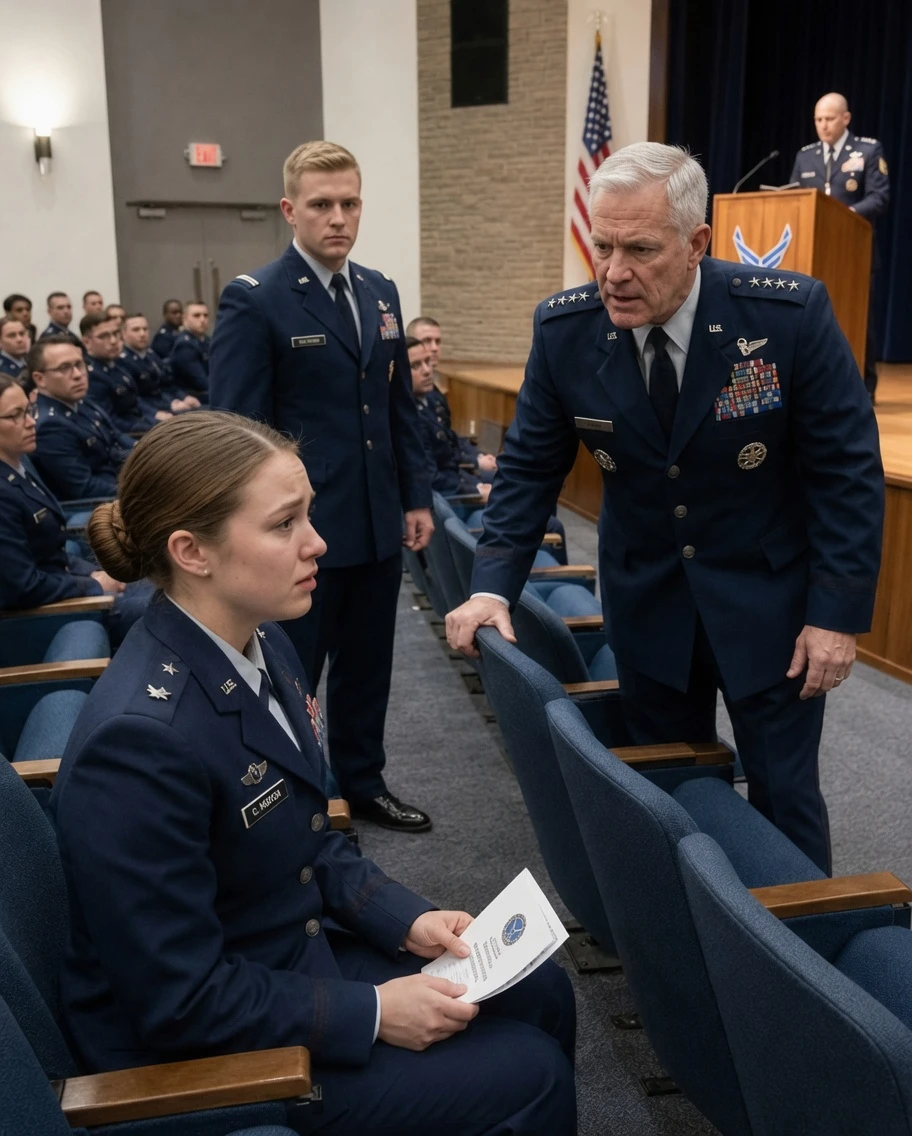
They called me Whisper long before I understood whether it was an insult, a warning, or the only name my family knew how to give a daughter who did not fight to be heard.
At first, I thought it meant I was easy to miss.
I was the girl who moved quietly through base housing with a paperback tucked under one arm, stepping around muddy boots in the entryway and listening for my father’s mood before I turned a doorknob.
Image
In our house, sound had rank.
Boots on tile meant someone important had arrived.
A truck door slammed in the driveway meant the day had followed my father home.
A belt buckle, a cleared throat, a chair pulled too sharply from the kitchen table, all of it told me more than most people said out loud.
My father believed volume was authority.
He had built a life around it, and men had answered him because of it.
On parade fields, in briefing rooms, in places where uniforms moved as one body, General Arthur Mendez spoke and people straightened.
That was the world he understood.
That was the world he respected.
I was not built for it.
I was built for the pause before the wrong word.
I was built for the tremor in a mother’s hands when she was trying not to cry in front of soldiers.
I was built for the quick glance between two men at a checkpoint, the one that told you one of them was scared enough to do something foolish.
I spoke seven languages, but at home I rarely spoke at all.
That morning, the Pentagon auditorium was colder than any room filled with that many people had a right to be.
The air conditioning moved over us in steady waves, sharp enough to make medals feel heavy against the chest and hands feel stiff around folded programs.
The place smelled faintly of polished wood, old carpet, aftershave, and coffee cooling in paper cups beneath rows of seats.
Uniforms filled the room in clean, disciplined lines.
Navy, gray, green, black.
Gold braid caught the light whenever someone shifted.
A cough sounded formal.
A whisper seemed to ask permission before it existed.
I sat in the tenth row with my shoulders straight and my hands folded over the ceremony program.
The paper had a dry edge that kept dragging against my thumb.
On the stage, an American flag stood beside the podium, its fringe still, its colors bright under the practical lights.
Above the stage hung banners with my father’s name printed large enough that no one could enter the auditorium without knowing whose day it was.
General Arthur Mendez.
Forty years of service.
Campaigns.
Commands.
Decorations.
Innovations.
Every achievement was arranged in a neat column, tidy enough to make a life look simple.
There had been a time when I would have memorized every line just to feel closer to him.
I would have carried those words home in my head and repeated them when I felt invisible.
I would have told myself that if I understood his victories, maybe one day he would understand mine.
That was before I learned that some people only call it pride when it looks exactly like them.
My brother Daniel stood in the VIP section near the front.
Major Daniel Mendez looked like the son my father had ordered from a catalog of military approval.
West Point.
Strong jaw.
Perfect posture.
A uniform that seemed to have been pressed by destiny itself.
He had the kind of face people trusted before he earned it, the kind of smile that made older officers clap him on the shoulder and say, “That one is going places.”
He was going places.
My father had said so for years.
He had said it during family calls, in front of relatives, in front of officers, in front of me and past me as if I were furniture that happened to breathe.
Daniel wore attention easily.
I studied it the way I studied dialects.
How he accepted praise with just enough humility to make people offer more.
How he lowered his voice when senior officers spoke.
How he kept his hands calm and his expression clean.
He had learned my father’s language perfectly.
I had learned everyone else’s.
My father had not looked at me once since I entered the auditorium.
Daniel had looked once.
It was not a greeting.
It was an inventory.
He saw my uniform, saw the seat I had chosen, saw that I had not brought anyone with me, and then his eyes moved away.
Just enough to notice me.
Just enough to dismiss me.
The ceremony began with the national anthem.
Everyone rose together.
The brass notes filled the auditorium and pressed through my ribs in a way that made breathing feel public.
I sang quietly, not because I lacked feeling, but because I had spent my life learning that too much feeling made other people uncomfortable.
When we sat again, the speeches started.
A colonel with a voice built for parade fields spoke of sacrifice.
An admiral spoke of legacy.
A civilian official spoke of leadership that shaped institutions.
They talked about my father the way people talk about monuments, as if weather, time, and human damage had never touched him.
My father sat in the front row, chin slightly raised, accepting praise like it was a briefing he had already approved.
Every so often, Daniel leaned close enough to murmur something to him.
My father would nod.
Not smile.
Nod.
For years I had mistaken that nod for love when it landed on Daniel.
It was approval.
Approval is not love, but from a distance it can wear the same uniform.
The master of ceremonies moved through the program with careful hands.
He turned pages.
He checked names.
He paused when the room expected him to pause.
The event had been processed, scheduled, printed, rehearsed, and recorded in the official rhythm of the Army.
Nothing in that room was supposed to surprise anyone.
Then he turned one more page.
His voice changed.
It did not grow dramatic.
It softened, and somehow that made me more afraid.
“Before we conclude this portion of the program,” he said, “we would like to recognize an officer whose contributions are less visible, but no less vital.”
My fingers tightened around the program.
I looked down.
The black letters on the page blurred for a second.
No.
“Through language, cultural intelligence, and crisis de-escalation,” he continued, “she has helped prevent loss of life in situations where force alone would have failed.”
The crease in my program deepened under my thumb.
The words should have felt like honor.
Instead, they felt like exposure.
I had sat in rooms where anger had a weapon within reach.
I had translated threats that were not threats at all, only grief wearing armor.
I had listened to dialect shifts so slight that a missed vowel could have moved soldiers into danger.
I had watched men twice my size decide whether to trust me because I knew the name of their village and the way their grandmothers pronounced it.
None of that looked heroic from a stage.
That was part of the work.
If I did it well, nothing happened.
No explosion.
No headline.
No flag lowered in a courtyard because a conversation failed.
The world did not clap when violence did not arrive.
“Captain Julia Mendez, Military Police Corps.”
The room shifted.
It was not loud.
It was worse.
It was the synchronized movement of a thousand eyes finding me.
Heat crawled up my neck.
I did not stand.
I did not smile.
My breath became careful.
I could feel the program in my lap, the seam of my sleeve against my wrist, the cold air across the back of my neck.
I had faced men who hated my uniform and wanted me to know it.
I had faced commanders who wanted clean answers from impossible situations.
I had faced grieving fathers who believed every uniform in the room belonged to the same enemy.
But hearing my own name in that auditorium, with my father sitting ten rows away, felt like stepping into open fire without a helmet.
The colonel at the podium continued.
“Captain Mendez is fluent in seven languages and has developed field methods—”
“That is enough.”
My father’s voice did not rise.
It detonated anyway.
Every head turned.
The colonel froze with his mouth half open.
A paper shifted in his hand, then stopped.
My father stood in the aisle, one hand gripping the back of his chair.
He was still in full dress uniform, medals bright, shoulders squared, face hard with the certainty of a man who had never imagined the room might not belong to him.
The auditorium seemed to shrink around him.
Rows of officers, officials, families, and staff held still.
The microphone at the podium caught the silence after his words and made it larger.
My father looked at me then.
For one foolish second, something in me reached toward the old hope.
Maybe he was startled.
Maybe he was overwhelmed.
Maybe pride felt strange on his face because he had never practiced it for me.
Then I saw his eyes.
He was not looking at his daughter.
He was looking at a mistake.
A correction to be made in public before it entered the record.
“My daughter is not a hero,” he said.
The words moved through the room with nowhere soft to land.
“She is a translator.”
The silence that followed was so complete I could hear the faint buzz of a light fixture overhead.
It sounded like an insect trapped behind glass.
My hands stayed folded because I ordered them to stay folded.
I could not control his voice.
I could control my fingers.
That was the first thing I did not give him.
He continued.
“She reads books. She studies dialects. She whispers to people who should be afraid of us.”
A few faces dropped.
A few officers looked at their programs.
One woman in the row ahead of me turned her head just enough that I saw her jaw tighten.
No one interrupted him.
That was how power worked in rooms like that.
People recognized wrong, measured rank, and waited to see who was allowed to say it first.
My father lifted his chin.
“This is the United States Army, not a library.”
There was a time when that sentence would have destroyed me.
There was a time when I would have gone home and rewritten myself in the margins of it, trying to become louder, harder, easier for him to respect.
But age has a way of turning certain wounds into evidence.
By then I knew what my books had done.
I knew what quiet had done.
I knew there were men alive because I had heard what no one else in the room understood.
I looked at Daniel.
It embarrassed me later, how quickly I still searched his face.
A sister should not have to ask a brother with her eyes to remember she is human.
But I did.
I looked for one crack in the marble.
One twitch.
One breath of shame.
Daniel stood behind our father with his expression smooth, almost bored.
He did not look surprised.
That hurt more than the insult.
My father had wounded me.
Daniel had expected it.
My father tightened his grip on the chair until his knuckles paled.
“I trained leaders,” he said. “I raised a son who understands duty.”
The words did not just lift Daniel.
They used him.
They held him up like proof that my father had made something worthy, and by comparison, I was the unfinished thing in the family.
I did not stand.
I did not defend myself.
I did not tell the room about the nights I stayed on interpreter lines until my voice cracked because one wrong phrase could have put a patrol in the wrong place.
I did not tell them about the people who stopped shouting when they heard their own words come back without contempt.
I did not tell them about the officer who later said, quietly, that force had been ready and I had bought them time.
Some truths do not become stronger because you shout them.
Some truths become stronger because they are still standing after someone tries to bury them.
My father took one more breath.
“Let us not confuse language tricks with courage.”
There it was.
Not disappointment.
Not misunderstanding.
Judgment.
Delivered in uniform.
Delivered at his own ceremony.
Delivered in front of every person whose opinion he had spent forty years earning.
The colonel at the podium remained still.
The master of ceremonies held his folder like a shield.
The audience looked trapped between discipline and decency.
The whole room had become a hallway too narrow for anyone to pass without touching the shame in it.
I looked down at the program in my lap.
There was a crease running straight through my name.
Captain Julia Mendez, Military Police Corps.
I wondered, absurdly, whether the ink had cracked.
My throat burned.
I pressed my thumb against the paper edge until it hurt.
Pain was simple.
Pain had one language.
For a moment, I could smell the old kitchen from base housing, dish soap and reheated coffee, my father at the table with Daniel’s report card in his hand and my own certificate lying face down near the mail.
I remembered vocabulary lists hidden under homework.
I remembered learning how to listen before I was praised for knowing what words meant.
I remembered my father saying, without looking up, “That is nice, Julia,” and then asking Daniel about practice.
Small things teach you where to stand.
Large things reveal whether you learned.
In that auditorium, I learned I had spent my life standing outside a door my father never intended to open.
Then a chair scraped from the front row.
The sound was ordinary.
Wood against floor.
Metal catching carpet.
In that silence, it was louder than a shout.
Heads turned before I did.
A four-star general was rising.
He was older than my father, with silver hair cut close and a face composed in a way that made anger unnecessary.
His uniform held more authority than my father had ever been able to borrow from a room.
He did not rush.
He did not glare for effect.
He stood with the calm of a man who knew every person present would understand the movement before he said a word.
My father’s shoulders stiffened.
Daniel’s eyes flicked toward the general, then back to our father.
The colonel at the podium lowered his folder.
For the first time all morning, the ceremony no longer belonged to General Arthur Mendez.
It belonged to the silence after him.
The four-star general turned slightly, looking first at my father, then at me.
I felt the room follow his gaze.
Not the way they had followed my name a minute earlier.
This time, their attention did not feel like exposure.
It felt like a witness finally stepping forward.
My father drew a breath.
It caught.
Just once.
Small enough that maybe no one else noticed.
I noticed.
I had been trained by that house to notice everything.
The general stepped toward the aisle, and even that small movement changed the room.
My father, who had spent forty years commanding rooms, suddenly looked like a man who had forgotten where the exits were.
The four-star general faced the podium microphone.
Then he looked straight past my father and into the tenth row.
When he spoke, his voice was not loud.
It did not need to be.
“Captain Mendez,” he said, “front and center.”
The room froze.
My father’s face lost color.
Daniel’s polished expression faltered at last.
And for the first time in my life, when my name filled a room, it did not sound like something I needed to apologize for.