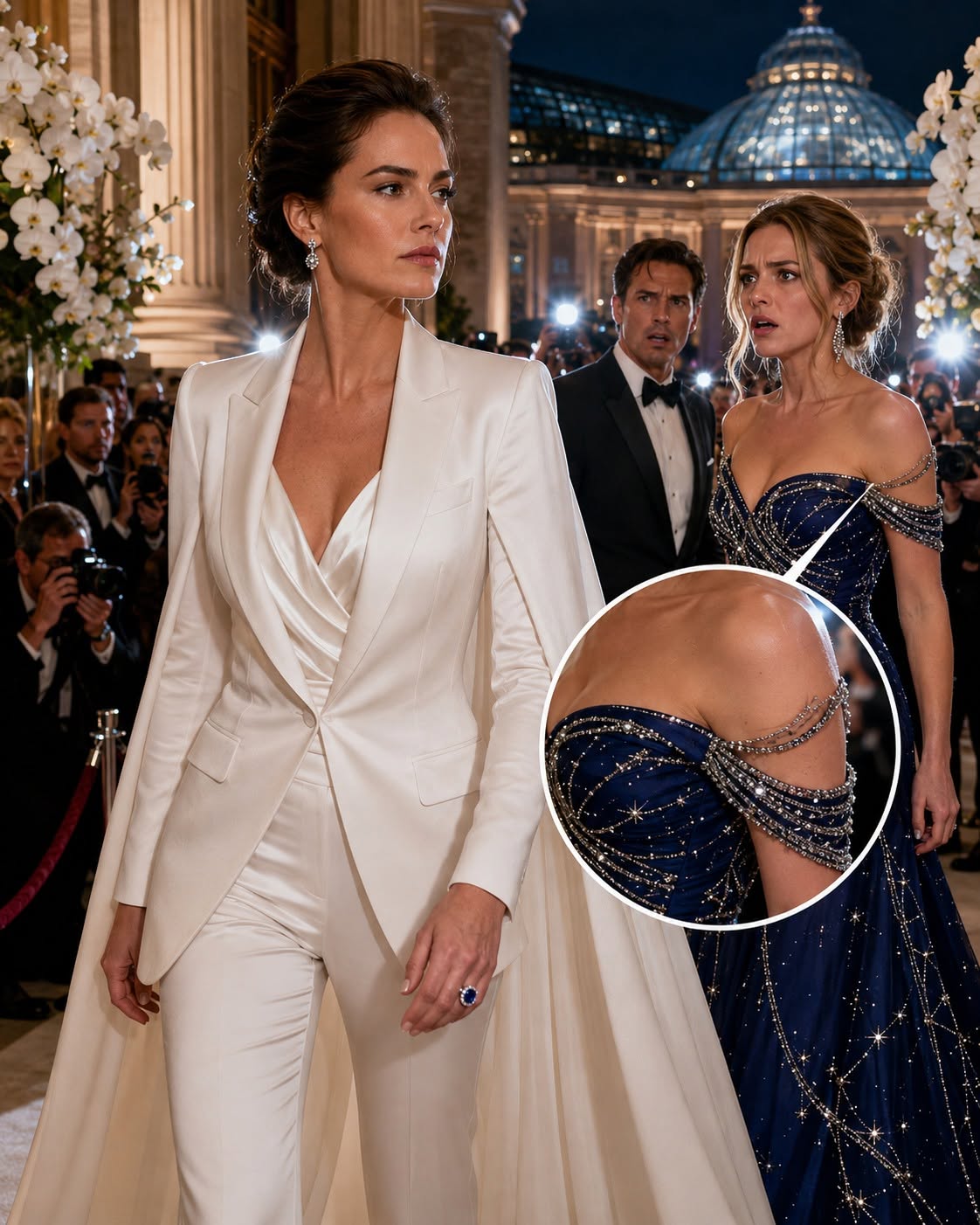
She stole the dress and lost the room.
My husband gave my seat at the Met-style gala to his mistress.
She walked the carpet in the couture gown I paid for while he told reporters I was “resting at home.” I watched the lie bloom beneath a hundred flashbulbs, watched him place his hand at the small of her back exactly the way he used to steady me when we first married, before the money, before the mansion, before his mother taught him that a wife could be useful as long as she was silent.
The gown was midnight blue, hand-beaded from collarbone to hem, cut like poured water and stitched with tiny silver constellations that only appeared when the wearer moved. It had taken six months to make. Three fittings in Paris. Two private consultations in New York. One handwritten dedication hidden in the lining.
It had been designed for me.
Yet there stood Sloane Whitaker, twenty-nine years old, glossy and smug, wearing my dress like she had stolen not just the fabric, but the life attached to it. Reporters shouted her name. Harrison Ashford smiled as if the world belonged to him. His father, his brothers, the board members, the museum trustees, the charity donors, the women who used to kiss my cheek at luncheons—all of them watched him introduce her as “the future of the Ashford Foundation.”
Then a reporter asked, “Where is your wife tonight, Mr. Ashford?”
Harrison’s smile did not move.
“Vivian is resting at home,” he said smoothly. “She has always preferred privacy.”
The crowd murmured with sympathy.
I stepped out of the black car behind them.
And then the designer took the microphone.
Chapter 1: The Empty Seat Beneath the Chandeliers
For ten years, people called me lucky.
Lucky to marry Harrison Ashford, the golden son of one of New York’s oldest real estate families. Lucky to live behind iron gates in a limestone mansion on the Upper East Side. Lucky to sit beside women with diamond bracelets loose around their wrists, women who spoke of summers in Nantucket and art acquisitions as if they were weather patterns.
They did not see the price of that luck.
They did not see me sitting alone at charity dinners while Harrison worked the room with a hand in his pocket and a lie ready on his tongue. They did not see me rewriting speeches he later delivered as his own. They did not see me soothing investors after his reckless deals nearly collapsed, or quietly moving money from my inheritance into the Ashford Foundation because Harrison’s family had built a kingdom on marble and debt.
They saw a quiet wife.
That was what Harrison wanted.
“You’re elegant when you don’t try too hard,” he told me once, fastening pearls around my neck before a gala. “Don’t compete with the room, Viv. You don’t need to.”
At the time, I thought it was tenderness. Later, I understood it was training.
The Ashfords loved women who knew how to disappear. Harrison’s mother, Beatrice, had perfected it into an art form. She smiled at her husband’s public affairs, hosted dinners for women who whispered about her behind floral arrangements, and taught me early that humiliation was part of being married to power.
“Men like Harrison are built for legacy,” she said to me during my first Christmas at Ashford House, while servants arranged silver candlesticks longer than my forearms. “A wife must understand the difference between pain and scandal. Pain is private. Scandal is unforgivable.”
I was twenty-six then. I nodded because I wanted to belong.
By thirty-six, I had learned that belonging to the Ashfords meant being owned.
The gala was supposed to be my one public moment.
For months, I had worked with the Metropolitan Arts Council to fund the restoration of the old Aster Hall, a glass-domed museum space on Fifth Avenue that had been closed for nearly two decades. The evening was called The Celestial Benefit, a black-tie event dripping with old money and newer cameras, honoring women patrons who had preserved American art.
My late mother had loved Aster Hall.
When I was a girl from Connecticut with scuffed Mary Janes and a library card, my mother used to take me there on winter Sundays. She would stand beneath the blue ceiling painted with stars and tell me, “Vivian, never let anyone convince you beauty belongs only to people who can afford it.”
After she died, I built the restoration fund in her name.
Not Harrison’s. Not Ashford’s.
Mine.
The money came from the Bennett Trust, my mother’s family foundation, which Harrison never respected until he needed it. He preferred to let people assume my quietness came from dependence. It suited him for the world to believe he had rescued me from ordinary life.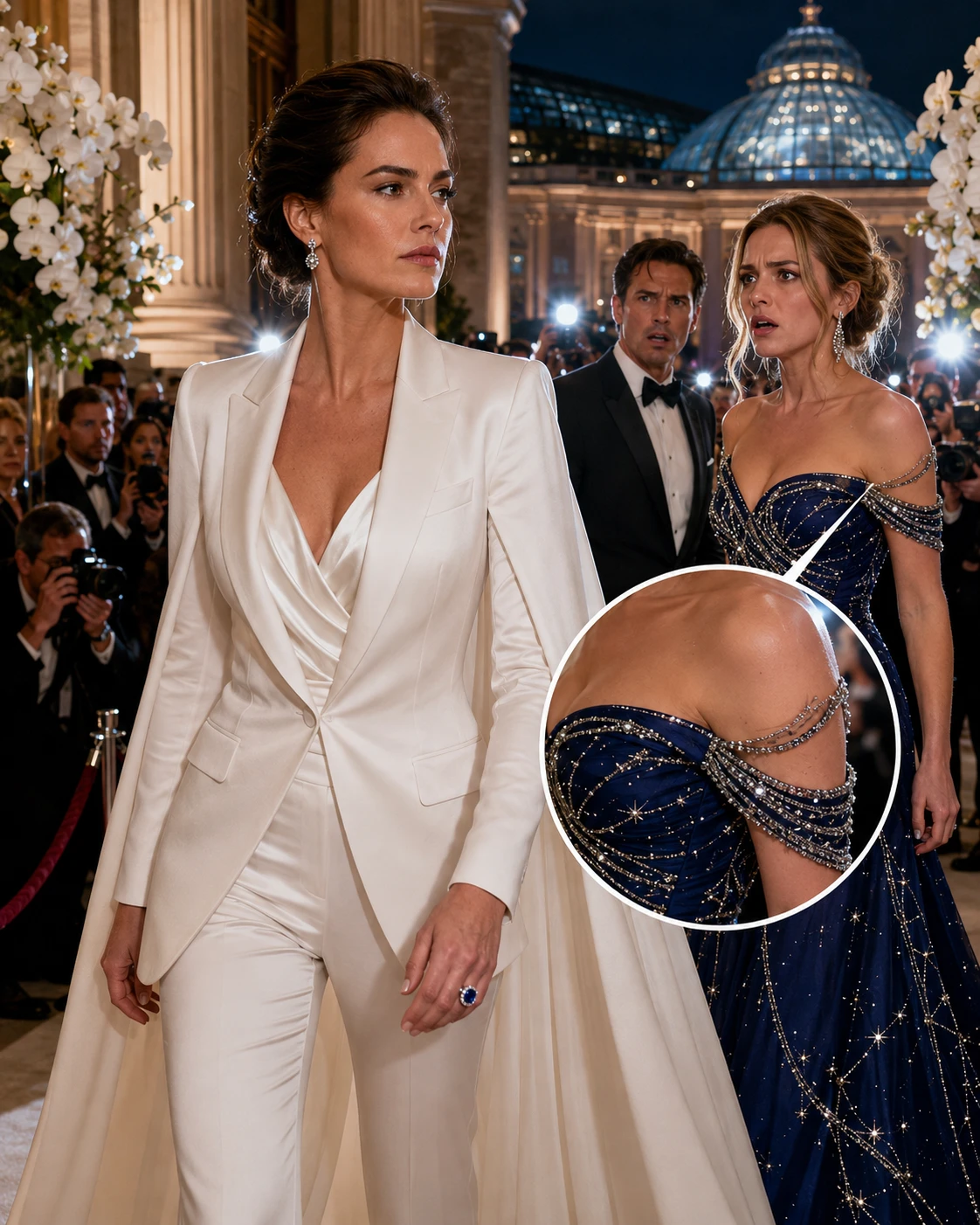
The truth was colder.
Without my money, the Ashford Foundation would have collapsed three years into our marriage.
Without my signatures, Harrison would have lost two hotels, a private clinic investment, and the Hamptons property where his family pretended to be old money while the plumbing failed behind silk wallpaper.
But I had allowed the myth to live because I believed loyalty meant protection.
Then Sloane Whitaker entered our lives.
She was hired as a “strategic image consultant,” which was Ashford language for someone pretty enough to make bad behavior look intentional. She had a laugh that rose like champagne foam and a way of touching men’s sleeves when she spoke. At first, I felt sorry for her. She seemed hungry for the kind of life that photographs well and destroys slowly.
Then I found her earring under my husband’s pillow.
Not in a hotel room. Not in a town car. In my house. In the bedroom where my mother’s quilt lay folded at the foot of the bed.
When I confronted Harrison, he did not deny it. That was the first cruelty.
The second was his boredom.
“Don’t make this provincial,” he said, pouring himself a drink at eleven in the morning. “You knew what marriage to this family meant.”
“I knew what your mother endured,” I replied. “I did not know you expected me to inherit her silence.”
He looked at me then with something like pity.
“You won’t leave,” he said. “You like being Mrs. Ashford too much.”
That was his mistake.
He thought Mrs. Ashford was a title he had given me.
He had no idea it was the last name I had been preparing to bury.
Chapter 2: The Woman in My Gown
The gown began as a memory.
I met Matteo Voss in a private atelier above Madison Avenue, where gowns hung like expensive ghosts and the mirrors were kinder than most people. Matteo had dressed actresses, queens, tech wives, and women who could buy silence by the hour. He was theatrical, sharp-eyed, and allergic to lies.
“What do you want the dress to say?” he asked me during our first appointment.
I looked at the sketch in his hand, the sweep of the skirt, the silver detailing at the bodice, the small constellation pattern he had drawn across the left shoulder.
I said, “I want it to say I was here.”
He did not smile. He only nodded, as if that was the most reasonable request a woman could make.
Together we created the Celestia gown. Midnight silk. Silver beads. A neckline modest enough for trustees and dangerous enough for gossip pages. Inside the lining, Matteo embroidered a sentence in thread so pale it could only be seen up close.
For Clara, who taught me the stars were not permission slips.
My mother’s name.
My memory.
My armor.
Two weeks before the gala, the final fitting was scheduled at Ashford House because Harrison said photographers were already watching the atelier. It was the sort of thing he said when he wanted control to sound like concern.
Matteo arrived with two assistants and a garment bag that required its own seat in the elevator. I remember standing in my dressing room as the gown settled over me, cool and heavy, and seeing a woman in the mirror I almost recognized.
Not the quiet wife.
Not the useful donor.
Not the woman who smiled when her husband forgot her birthday but remembered Sloane’s preferred champagne.
Me.
For one suspended moment, I saw my mother behind my shoulder. Not literally, of course. Grief doesn’t bring people back that gently. But I felt her. I felt her in the straightening of my spine and the way my eyes did not apologize for taking up space.
Matteo pinned the hem and stepped back.
“There she is,” he said.
Harrison appeared in the doorway.
His expression changed so quickly most people would have missed it. Pride first, because I did look beautiful. Then irritation, because he had not expected beauty to make me powerful.
“You look expensive,” he said.
Matteo’s eyes flicked toward him.
“She looks inevitable,” he corrected.
Harrison smiled thinly and left the room.
Three nights later, the gown disappeared.
Not misplaced. Not delayed. Stolen.
The locked cedar closet in my dressing room had been opened with a master key. The garment bag was gone. The security cameras outside my wing of the house were “temporarily offline.” Harrison acted surprised for exactly six seconds before offering a solution.
“Wear something else,” he said.
I stood in the doorway of his study, watching him sign place cards for the gala. One card read HARRISON ASHFORD. The one beside it read SLOANE WHITAKER.
My name was nowhere.
“You gave her my seat,” I said.
He did not look up.
“The committee felt Sloane should be visible this year. She’s been instrumental.”
“In what? Sleeping with you?”
His pen stopped moving.
“Careful, Vivian.”
There it was. The tone powerful men use when they have never been hit by consequences.
He leaned back in his chair and sighed, as though I were a tiresome meeting.
“I was going to tell you tomorrow, but perhaps now is better. You won’t be attending the gala.”
I laughed once. It sounded unlike me.
“I funded the gala.”
“You funded the restoration. The evening is more complicated.”
“No. It is not.”
His eyes hardened.
“I have spoken to Dr. Marren. He agrees you’ve been under significant emotional strain. We think it’s best for you to avoid public stress.”
Dr. Marren was the concierge psychiatrist Harrison kept on retainer for donors who needed discreet prescriptions and wives who asked inconvenient questions.
“You told people I’m unstable,” I said.
“I told people you’re exhausted.”
“You told them I’m crazy.”
He stood then, smooth and tall in his custom shirt, every inch the man magazines called disciplined and visionary.
“I told them what they needed to hear.”
Behind him, on the desk, I saw a cream envelope stamped with the Ashford crest. The top sheet inside was visible just enough for me to read two words.
Spousal transfer.
My body went cold.
Harrison followed my gaze and calmly covered the envelope with his hand.
“You should rest,” he said. “At home.”
The next morning, Beatrice Ashford came to my room with tea.
That was how I knew the cruelty had become official.
She sat at the edge of my bed, pearl earrings glowing against her silver hair.
“You must not make a scene tonight,” she said.
I looked at her carefully. “You know?”
“My dear, I have known everything for years.”
“Then you also know he stole from me.”
A faint irritation crossed her face, not at the theft, but at my lack of manners in naming it.
“You are thinking emotionally.”
“No,” I said. “For the first time in ten years, I am thinking clearly.”
Beatrice set the teacup down untouched.
“Harrison will tire of the girl.”
“I’m not worried about the girl.”
“You should be worried about yourself.”
She stood, smoothing the front of her ivory suit.
“This family can survive an affair. It cannot survive a wife who mistakes embarrassment for power.”
When she left, I waited until the house went quiet.
Then I called my lawyer.
Chapter 3: The Black Car Behind Them
By seven o’clock that evening, Aster Hall looked like a dream built by people who had never been told no.
The steps were covered in cream carpet. White orchids spilled from urns tall enough to hide children. Security guards in black suits held back photographers while guests emerged from town cars in velvet, diamonds, and practiced indifference.
Inside, beneath the restored glass dome, the ceiling shimmered with projected stars. Dinner tables circled a central stage where the Ashford Foundation logo glowed in silver against navy silk.
My logo.
My colors.
My mother’s stars.
But the world saw Harrison.
He arrived at 7:18 p.m. in a black Bentley, stepping out first, adjusting his cufflinks as if the night were an inheritance. Then he turned, extended one hand, and helped Sloane Whitaker out of the car.
The cameras lost their minds.
Sloane knew how to perform surprise. She lifted one hand to her chest, widened her eyes, and let the flashes catch the diamond bracelet Harrison had given her two months earlier. My bracelet. A tenth anniversary gift I had left in the safe after realizing the inscription had been ordered by his assistant.
Then she turned.
The Celestia gown moved around her like dark water.
For a second, even I understood why the crowd went silent.
The gown was magnificent.
That was the worst part. Theft does not always look ugly. Sometimes it looks like applause. Sometimes it glitters. Sometimes it smiles at cameras and calls itself destiny.
Harrison leaned toward the microphones.
“Sloane represents the next chapter of the Ashford Foundation,” he said. “She has brought energy, vision, and courage to our work.”
A reporter from a society magazine called out, “And where is Mrs. Ashford tonight?”
Sloane lowered her eyes, pretending restraint.
Harrison’s face softened into the expression he used for charity brochures.
“Vivian is resting at home,” he said. “She has always preferred privacy.”
Someone in the crowd made a sympathetic sound.
That sound, more than the lie itself, nearly broke me.
Because sympathy can be another kind of burial. A soft one. A polite one. A way of lowering a living woman into silence while everyone praises the flowers.
My driver, Mr. Alvarez, opened my car door.
I stepped out slowly.
I wore white.
Not bridal white. Not innocent white. A clean, architectural silk suit with a floor-length cape, my hair swept back, my mother’s sapphire ring on my right hand. No necklace. No borrowed diamonds. Nothing that could be mistaken for Ashford property.
The first photographer noticed me and stopped shouting.
Then another.
Then the silence spread down the carpet like ice cracking across a lake.
Harrison turned.
For the first time in our marriage, I saw fear touch his face before he could dress it as anger.
Sloane’s smile faltered.
I walked toward them.
Not fast. Not dramatic. Women like me are always accused of being dramatic when we simply arrive. So I took my time. I let every camera see me. I let every donor who had believed Harrison’s story understand that “resting at home” had just stepped onto the carpet in couture calm.
“Vivian,” Harrison said under his breath when I reached him. “Do not do this.”
I looked at Sloane.
Up close, the gown fit her almost perfectly. Almost. The left shoulder sat a quarter inch too low because it had been cut for my frame. The waist had been hastily adjusted, leaving the beadwork strained in a way Matteo would have called criminal.
“You wore it,” I said.
Sloane lifted her chin.
“Harrison said you didn’t want it anymore.”
A few reporters leaned closer.
“That is an interesting thing to say about a stolen dress,” I replied.
Her face pinked, but Harrison stepped between us with a smile meant for cameras.
“My wife has had a difficult week,” he announced, loud enough for the nearest microphones. “I would ask everyone to respect her privacy.”
There it was again. The cage disguised as concern.
He reached for my elbow.
I moved before he touched me.
“Don’t,” I said.
One word. Quiet. Enough.
Behind the wall of photographers, a man in a black tuxedo climbed the first step of the media platform. He had silver hair, round glasses, and the posture of a man who had spent forty years telling billionaires they were not special.
Matteo Voss.
The designer.
He took the event microphone from a confused publicist.
“Ladies and gentlemen,” Matteo said, his Italian accent cutting through the cold air with surgical elegance. “Before anyone photographs that gown further, I must correct the record.”
Sloane went still.
Harrison’s mouth tightened.
Matteo looked directly at the cameras.
“The Celestia gown is an original commission from the House of Voss. It was neither loaned nor gifted to Miss Whitaker. It was fitted, insured, documented, and embroidered for one client.”
He paused.
The crowd held its breath.
“For Mrs. Vivian Ashford.”
Chapter 4: The Envelope No One Was Supposed to Open
The first gasp came from someone behind me.
The second came from Sloane herself.
It was small, sharp, and deeply satisfying.
Harrison tried to laugh. “Matteo, this is hardly the place for a misunderstanding.”
“There is no misunderstanding,” Matteo said. “There is a contract.”
A security guard approached, uncertain whether he should remove the designer or the scandal. Matteo ignored him and lifted a slim leather folder.
“The gown was collected from Mrs. Ashford’s private residence without authorization. My atelier was informed by Mr. Ashford’s office that Mrs. Ashford was medically unavailable and had consented to Miss Whitaker wearing the piece in her place.”
Every camera turned back to Harrison.
He smiled with his teeth.
“That was an administrative error.”
A woman’s voice spoke from behind me.
“No, Mr. Ashford. It was fraud.”
Grace Holloway walked onto the carpet as if she had been born from a subpoena.
She was my attorney, though Harrison did not know that until that moment. Sixty-one, Black, brilliant, with silver locs pinned at the nape of her neck and a briefcase that had ended more marriages than adultery ever could. She wore a burgundy velvet suit and the expression of a woman who had already read the ending.
Harrison’s face drained.
“Grace,” he said carefully.
“Mr. Ashford.”
“You represent my wife?”
“I represent Mrs. Ashford, the Bennett Trust, and as of 5:42 this evening, the emergency board committee of the Clara Bennett Restoration Fund.”
The trustees began whispering.
Beatrice Ashford, who had just arrived at the top of the steps in diamonds and winter-white silk, froze with one gloved hand on the railing.
Grace opened her briefcase.
“This afternoon, Mrs. Ashford authorized the release of several documents in the event that Mr. Ashford publicly misrepresented her absence, her mental health, or her consent regarding foundation property.”
Harrison’s jaw flexed.
“Vivian,” he said softly, dangerously. “Think very carefully.”
I did.
I thought of ten years of swallowing words until they became stones in my chest.
I thought of my mother standing under the stars of Aster Hall.
I thought of the earring under my pillow, the missing gown, the place card with Sloane’s name where mine should have been.
Then I looked at Grace.
She nodded once.
The large screens above the carpet, which had been looping sponsor logos and glamour shots, flickered.
For a moment, the Ashford Foundation logo glowed over us.
Then Harrison’s voice filled the speakers.
Not his public voice. Not the careful baritone of donor luncheons.
His real one.
“She’ll sign if Marren says she’s unstable enough,” the recording said. “Vivian hates confrontation. Put the transfer in front of her after the gala. Tell her the board is concerned. She’ll panic.”
Sloane’s voice followed, airy and impatient.
“And the dress?”
“Wear it,” Harrison said in the recording. “It photographs better on you anyway.”
The carpet became a tomb.
The recording continued.
“My wife is sentimental. That’s her weakness. The gown, the hall, the dead mother story—she thinks all of this belongs to her because she paid for it. After tonight, donors will associate the new foundation era with you.”
Sloane laughed.
“And Vivian?”
Harrison’s reply came clear as glass.
“Vivian will be remembered as fragile. It’s kinder that way.”
No one moved.
Even the photographers stopped shooting.
There is a kind of silence that is not empty. It is full of endings. Careers ending. Marriages ending. Illusions ending. Men realizing too late that the room they built to worship them has become a courtroom.
Harrison turned toward me slowly.
“You recorded me?”
“No,” I said.
Sloane looked panicked.
Grace raised one eyebrow. “Miss Whitaker did.”
The crowd shifted.
Sloane whispered, “What?”
Grace removed a small device from an evidence pouch.
“Miss Whitaker signed an agreement with Mr. Ashford three months ago. A nondisclosure agreement. Unfortunately for both of them, the agreement included financial promises tied to the public elevation of Miss Whitaker as foundation ambassador. When Mr. Ashford delayed payment, Miss Whitaker began recording conversations for leverage.”
Sloane’s eyes darted to Harrison.
“You said it was normal,” she hissed. “You said everyone protects themselves.”
Harrison looked as if he wanted to strangle the air between them.
Grace continued, calm and merciless.
“Miss Whitaker’s attorney attempted to use the recordings to negotiate a settlement last week. The files were obtained through lawful discovery after Mrs. Ashford filed an emergency injunction this morning.”
I had not planned to destroy Sloane first.
That was the difference between Harrison and me. He enjoyed cruelty. I preferred accuracy.
Sloane had stolen my dress, yes. She had mocked me, yes. But Harrison had built the room, written the lies, and handed her the costume. She was responsible for her choices. He was responsible for the machine.
Grace turned to the trustees.
“As of this evening, Mr. Ashford is suspended from all activities connected to the Clara Bennett Restoration Fund. The Bennett Trust is also initiating proceedings to recover misappropriated assets, including but not limited to foundation funds, donor allocations, private medical payments, and unauthorized use of Mrs. Ashford’s property.”
A man from the board whispered, “Good God.”
Beatrice descended one step.
“Vivian,” she said, her voice trembling with fury masked as grief. “You are humiliating this family.”
I looked up at her.
“No,” I said. “I’m returning what was given to me.”
She flinched.
I had never spoken to her that way. Not in front of staff. Not in front of guests. Not even in private.
Harrison recovered enough to step toward the microphone.
“This is a marital issue,” he said loudly. “A private matter being exploited by an emotional woman and a lawyer who clearly—”
Grace lifted one finger.
The screen changed again.
This time, it showed a scanned document.
A prenuptial agreement.
Harrison stopped talking.
Grace’s voice was soft now, almost gentle.
“Section Twelve. Public defamation, medical coercion, financial misrepresentation, or reputational sabotage by either spouse triggers immediate forfeiture of contested marital claims attached to Bennett Trust assets.”
I watched Harrison read the text on the screen.
Watched him understand.
The hotels. The clinic shares. The Hamptons house. The foundation offices. The liquidity he had used to appear untouchable.
So much of his empire was tied to money he had convinced himself was already his.
Grace closed the folder.
“Mr. Ashford, you did not marry a quiet woman. You married a patient one.”
Chapter 5: The Name Sewn Into the Lining
Inside Aster Hall, dinner sat untouched.
Three hundred guests had come to watch the Ashfords be admired. Instead, they watched them become human.
There are few things more frightening to powerful families than witnesses.
The trustees huddled near the entrance, speaking in urgent, low tones. Donors stepped away from Harrison as if scandal were contagious. Beatrice stood rigid beside a marble column, her diamonds catching the light like ice chips. Sloane remained near the carpet, one hand pressed to the beaded waist of a gown that no longer made her look chosen.
It made her look caught.
Matteo approached her with two members of museum security.
“Miss Whitaker,” he said, “the gown must be removed from public display immediately.”
Her mouth fell open.
“You want me to take it off?”
“I want my client’s property protected,” Matteo replied.
A stylist from his atelier emerged with a black silk robe and a privacy screen that appeared so quickly I almost laughed. Of course Matteo had planned even this. He was not merely dramatic. He was prepared.
Sloane looked at Harrison.
He looked away.
That was when she finally understood what I had learned years earlier: a man who uses women as shields will never stand in front of them when the arrows come.
She disappeared behind the screen.
The crowd pretended not to watch.
I stood beneath the restored ceiling of Aster Hall, looking up at the constellations my mother had loved. For the first time all evening, my hands shook.
Not from fear.
From the delayed arrival of pain.
People think revenge feels like fire. Sometimes it feels like standing in a beautiful room with your heart split open, realizing that winning does not erase what happened. It only proves you survived it.
Grace came to my side.
“You’re doing well,” she said quietly.
“I don’t feel well.”
“That’s not the same thing.”
Across the hall, Harrison was speaking urgently into his phone. His face had the ashen, furious look of a man discovering that doors close from the other side too.
Beatrice approached me.
Up close, she looked older than I had ever seen her. Not fragile. Never fragile. But tired in a way that even diamonds could not distract from.
“I tried to warn you,” she said.
“You tried to teach me to accept it.”
Her lips pressed together.
“You have no idea what this family can do when cornered.”
“I know exactly what this family can do,” I said. “That’s why I stopped standing in the corner.”
For a moment, something passed through her face. Not regret. Not apology. Recognition, maybe. The bitter recognition of a woman who had spent her whole life calling a cage a mansion because the alternative would have destroyed her.
“You will be alone,” she said.
I thought of my mother. Of Grace. Of Mr. Alvarez waiting beside the car. Of Matteo guarding a dress as if it were a witness. Of the younger women in the room watching me with wide, stunned eyes, seeing perhaps for the first time that composure and surrender were not the same thing.
“No,” I said. “I won’t.”
She looked away first.
The program director, a nervous man named Elliot Crane, approached with a headset crooked over one ear.
“Mrs. Ashford,” he whispered. “The board is asking whether you would still be willing to speak tonight. Obviously, under the circumstances, we can postpone the dedication.”
I almost said no.
The old Vivian would have said no. She would have chosen dignity by disappearing, then cried in the back of the car and called it strength.
But across the room, workers were carrying the Celestia gown toward a secure exhibit case, no longer on Sloane’s body, no longer a stolen symbol. Just fabric again. Beautiful fabric. Mine.
I thought of my mother saying beauty did not belong only to people who could afford it.
And I stepped onto the stage.
The room settled slowly.
Not because they respected me. Not yet.
Because they were afraid of missing whatever happened next.
I stood at the podium beneath the blue light of the artificial stars. My reflection shimmered faintly in the glass dome above me, a woman in white surrounded by constellations and wreckage.
“I had a speech prepared,” I began.
A few people laughed nervously.
“It was elegant. Careful. Very appropriate for an evening like this. My husband was going to deliver parts of it as if he had written them.”
This time the laughter was real, quiet and shocked.
I looked down at the cards in my hand.
Then I set them aside.
“My mother brought me to this hall when I was nine years old. We did not have a driver. We did not have a table at galas. We had a train schedule, two wool coats, and a thermos of coffee she pretended was for both of us, though she never let me drink any.”
The room softened.
“She told me that public beauty is a promise. It says: you belong here, even if no one invited you. That is why I funded this restoration. Not for my husband’s name. Not for a family crest. For every person who has ever stood outside a beautiful room and wondered who decided they were not worthy of entering.”
I saw Sloane near the side door now, wrapped in the black robe, mascara shining beneath her eyes. For the first time, she looked young. Not innocent. But young.
“This evening has become something I did not intend,” I continued. “But perhaps truth has its own timing. Perhaps rooms like this are not ruined when lies are exposed. Perhaps they are finally restored.”
Grace smiled faintly.
I looked at Harrison.
He stood near the back, trapped between cameras and consequences.
“To the donors, trustees, artists, and students here tonight, the Clara Bennett Restoration Fund will continue. Beginning tomorrow, it will no longer operate under the Ashford Foundation. It will be independent. Transparent. And chaired by women who know the difference between silence and grace.”
Applause began somewhere near the middle table.
Then grew.
Then rose into something enormous.
I did not cry.
Not then.
Matteo stepped onto the stage beside me, holding the microphone he had taken earlier. The Celestia gown had been placed behind glass at the side of the hall, lit softly from above. Without a body inside it, the gown looked almost sacred. The silver constellations flickered as if breathing.
A reporter called out, “Mr. Voss, can you confirm who the gown legally belongs to?”
Matteo turned, calm as a blade.
“That gown was commissioned for Mrs. Ashford only.”
Conclusion: The Woman Who Walked Out Warm
By midnight, the story was everywhere.
Clips of Harrison saying I was “resting at home” played beside footage of me stepping out of the black car. Sloane’s stolen entrance was slowed down, zoomed in, dissected, pitied, mocked. Matteo’s microphone moment became the line people repeated in captions, comments, stitches, and late-night group chats.
She stole the dress and lost the room.
But viral moments are strange things. They turn pain into performance. They make strangers feel entitled to your wound because they applauded when it bled beautifully.
The next morning, I woke in a hotel suite overlooking Central Park, not Ashford House. Grace had insisted I leave immediately after the gala. Mr. Alvarez had driven me through a side exit while reporters shouted my name and Harrison’s lawyers called every phone I owned.
For the first time in years, I slept without listening for my husband’s footsteps.
When I opened my eyes, sunlight was moving across the white duvet. My phone had 1,247 unread messages. I read only three.
One from Grace: Injunction granted. Breathe.
One from Matteo: The gown is safe. So are you.
One from an unknown number: Mrs. Ashford, I was a server at the gala. My mom watched your speech this morning and cried. She said to tell you thank you.
That was the message that broke me.
I sat on the edge of the bed and cried so hard I made no sound.
Not because Harrison was finished, though he was. Not because Sloane had been exposed, though she had. Not because the Ashford family would spend years pretending they had always found him difficult.
I cried because somewhere, a woman I would never meet had watched me refuse to disappear.
And it mattered.
In the weeks that followed, the divorce became a headline, then a lawsuit, then a settlement Harrison fought until he realized discovery would be worse than surrender. Dr. Marren lost his license after three other women came forward. The Ashford Foundation fractured. Beatrice moved to Palm Beach and sent me one handwritten note on cream stationery.
It said only: You were braver than I was.
I kept it, not because it healed anything, but because truth should be preserved even when it arrives late.
Sloane sold interviews for a while, then vanished from public life. I did not hate her by then. Hate is a room that still keeps the other person inside with you. I had other rooms to build.
Aster Hall reopened that winter.
No carpets. No stolen seats. No husbands with microphones.
Just families, students, tourists, old women with museum memberships, children pointing up at the painted stars.
I went alone on a Sunday afternoon.
I wore jeans, a camel coat, and my mother’s sapphire ring. No one recognized me at first, which felt like a blessing. I stood beneath the restored ceiling and watched a little girl tug her mother’s sleeve.
“Look,” the girl said. “It’s like the sky came inside.”
Her mother smiled.
“Yes,” she said. “It is.”
I thought then that my mother had been right. Beauty was not permission. It was proof. Proof that something broken could be restored. Proof that a room could remember its purpose after years of being locked. Proof that a woman could be humiliated in front of the world and still walk out warmer than the people who tried to freeze her.
People still ask me about the gown.
They ask whether I ever wore it.
The truth is, I did.
Not to a gala. Not for cameras. Not for revenge.
On the first anniversary of the night everything changed, Matteo brought the Celestia gown to my new apartment downtown. Grace came over with champagne. Mr. Alvarez brought his wife, who made empanadas in my kitchen and told me I was too thin. We played old jazz. We opened the windows. We laughed like people who had all survived something, because in one way or another, we had.
Then I put on the gown.
It fit perfectly.
Of course it did.
Matteo fastened the last hook at the back and stepped away, his eyes suspiciously bright.
“There she is,” he whispered again.
This time, when I looked in the mirror, I did not see Harrison’s wife.
I did not see a scandal, a headline, a woman publicly humiliated and rescued by evidence.
I saw a daughter.
I saw a survivor.
I saw someone my mother would have recognized.
And stitched inside the lining, close enough to touch my skin, were the words that had always been true, even when I forgot them.
For Clara, who taught me the stars were not permission slips.
I smiled then, not because everything was perfect, but because everything was finally mine.
And somewhere beyond the city glass, beyond the old money mansions and the rooms where women are still told to be quiet, I imagined the echo of Matteo’s voice cutting through the coldest night of my life, returning me to myself in front of everyone.
“That gown was commissioned for Mrs. Ashford only.”