Part 2
The officer’s name was Detective Marcus Hale.
He had tired eyes, a clipped gray beard, and the careful voice of someone used to standing in rooms where people’s lives had just broken open. He pulled a chair close to mine, not too close, and sat with his folder balanced on one knee.
“Mrs. Russell,” he said, “I need you to tell me everything that happened today. From the moment you arrived at your son’s apartment.”
I wanted to say I couldn’t. I wanted to tell him my grandson was in a hospital crib with wires on his chest and my son had just whispered something no mother should ever hear.
Instead, I folded my hands together so tightly my knuckles ached.
“I got there at two,” I said. “Thomas and Ellie were going out. They said it was for errands.”
“Errands?”
“That’s what they said.”
“Did they say where?”
I shook my head.
Detective Hale wrote something down.
“And your son told you not to remove the baby’s clothing?”
“Yes.”
“Exact words?”
I swallowed.
“Don’t take his onesie off. He just got out of the bath.”
The detective’s pen paused.
“Did that seem strange to you at the time?”
“It felt strange,” I said. “But not enough. Not then.”
That was the cruelest part. The not enough. The little unease I had tucked away because the apartment was clean, because Thomas had smiled, because Ellie had kissed Mason’s forehead and adjusted his blanket like any loving mother would.
A nurse passed the doorway, moving quickly. Behind her, I saw Mason through the glass, so small inside the white hospital crib that the room itself seemed too large for him.
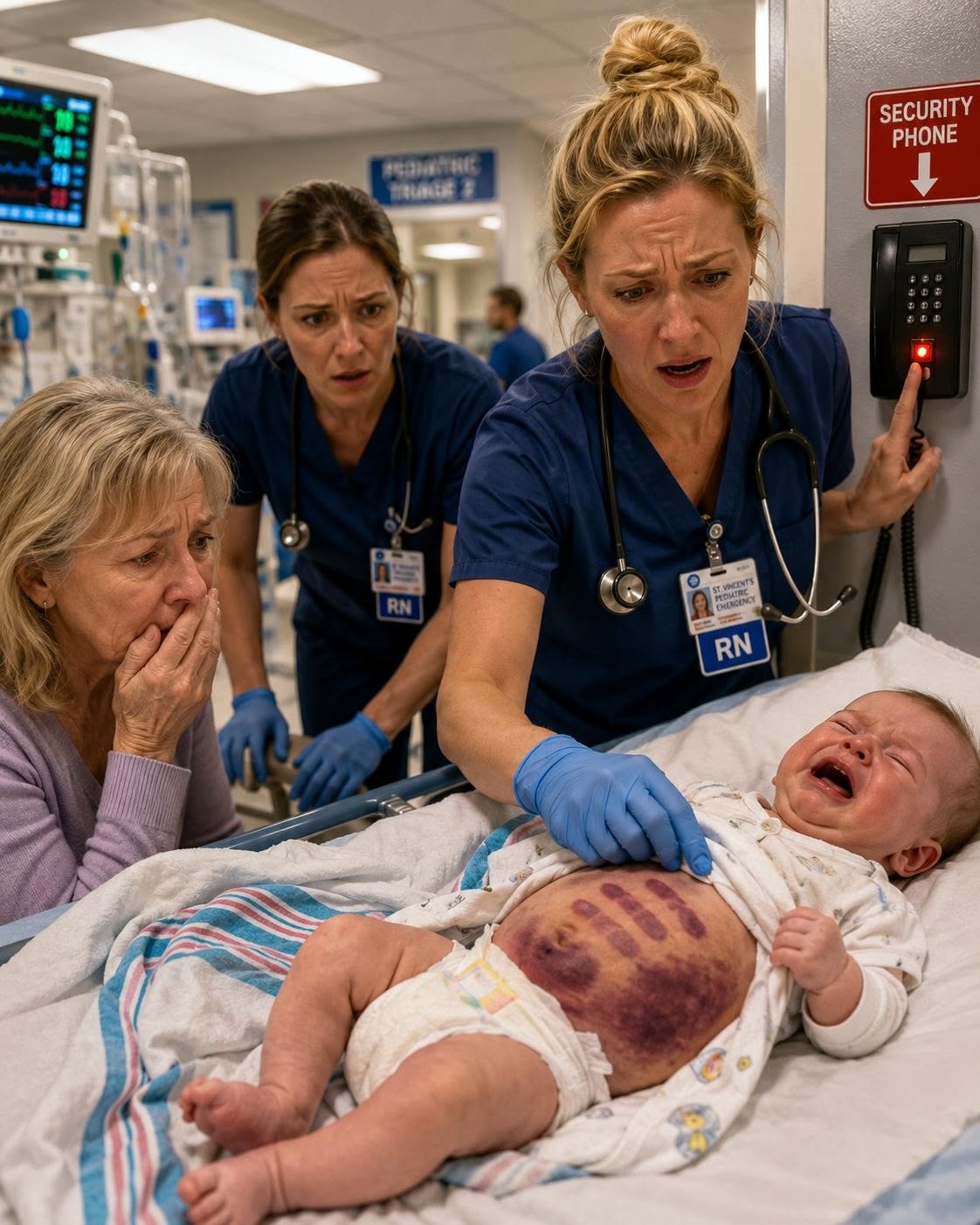
The doctor had said they were running more tests. He had spoken gently, but gentleness did not soften the meaning. Mason’s injuries were not normal. They were not accidental. They did not happen from rolling off a couch or bumping into a toy.
He was two months old.
He could not even roll yet.
Detective Hale closed his folder.
“Your son’s call,” he said. “You told him you were at the hospital.”
“Yes.”
“And he asked whether you had removed the baby’s clothes?”
I nodded.
“Then he said, ‘It wasn’t supposed to happen like this.’”
My eyes burned.
“Yes.”
“Mrs. Russell, do you know what he meant?”
“No,” I whispered. “But I’m afraid I’m going to find out.”
Before he could answer, another officer appeared at the door.
“They’re not at the apartment,” she said.
Detective Hale stood.
“The parents?”
“Gone. No vehicle in the garage. Neighbors haven’t seen them since they left earlier.”
My stomach dropped.
“They ran?” I asked.
The detective did not answer right away. That was answer enough.
He excused himself and stepped into the hallway. I watched him speak with the officer in low tones. Words drifted back through the doorway.
Search warrant.
Phone records.
Child Protective Services.
Possible flight risk.
Each phrase landed like a stone.
I sat there, alone except for the steady beeping from Mason’s room, and tried to reconcile the man they were talking about with the little boy I had raised.
Thomas had been my easy child. My gentle one. He rescued worms from sidewalks after rainstorms. He cried when our old dog died and slept with the dog’s collar under his pillow for weeks. At twelve, he had built a cardboard “hospital” for a bird with a hurt wing, feeding it crumbs until it flew away.
That boy had become the man who told me not to undress his baby.
A woman in a navy blazer came in carrying a tablet. Her expression was kind but guarded.
“Mrs. Russell? I’m Dana Moore with Franklin County Children Services.”
I stood too quickly and had to steady myself on the chair.
“Are you taking Mason away?”
“We’re making sure Mason is safe,” she said. “Right now, he is in protective custody while the investigation continues.”
Protective custody.
The words should have comforted me. Instead, they made the room tilt.
“He can stay with me,” I said. “Please. I’m his grandmother. He knows me.”
Dana looked at me carefully.
“That may be possible. We’ll need to do an emergency kinship assessment. Background check, home safety review, interviews.”
“I’ll do anything.”
“I believe you,” she said. “But we need to move step by step.”
Step by step.
Everyone kept saying things like that, as if there were ground beneath us.
Then Mason stirred.
His small mouth opened, and he made a weak, broken cry.
I moved toward the crib before anyone could stop me. The nurse glanced at Dana, then nodded.
I placed my hand gently beside Mason’s head, not touching the places where the doctors had worked, not disturbing the tubes or tape.
“Grandma’s here,” I whispered. “I’m right here, sweetheart.”
His eyelids fluttered.
For one second, his tiny fingers opened and closed around nothing.
I put my finger near his hand, and he gripped it.
That was when I broke.
I cried silently, because the room was full of professionals and I did not want to fall apart in front of them. But inside, something tore loose.
I had protected my children from storms, fevers, bullies, broken bones, bad dreams. I had believed, foolishly perhaps, that the love you poured into a child became part of them forever.
Now I stood beside my grandson and wondered whether love could disappear.
Or whether something darker had been hiding inside my son all along.
An hour later, Detective Hale returned.
“We found something at the apartment,” he said.
Dana asked the nurse to give us privacy. We stepped into a small consultation room with beige walls and a box of tissues no one wanted to use.
“What?” I asked.
The detective placed a photograph on the table.
It showed Mason’s nursery.
I recognized the pale green walls, the white crib, the stuffed giraffe I had bought before he was born.
But something was wrong.
A camera sat high on a shelf, partly hidden behind books.
“Did you know about this?” he asked.
“No.”
“There were cameras in the nursery, living room, and kitchen. The system recorded to a private cloud account under Ellie’s name.”
“Recorded?” I repeated.
He nodded.
“We’re working on getting access.”
My mouth went dry.
“So there’s proof?”
“There may be.”
May be. Another awful little phrase.
He laid down a second photograph. This one showed the bedroom closet. Inside were boxes stacked neatly from floor to ceiling.
“What are those?” I asked.
“Medical supplies. Infant medications. Printed feeding logs. And this.”
He set a clear evidence bag on the table.
Inside was a small notebook.
I leaned forward.
On the first visible page, written in Ellie’s neat handwriting, were words that made my skin crawl.
Mason reacts strongly to pressure. T cries when he hears it. Useful.
I looked away.
Detective Hale’s face remained still, but his jaw tightened.
“Do you recognize the handwriting?”
“Yes,” I said. “It’s Ellie’s.”
“You’re sure?”
“I’ve seen her write thank-you cards. Grocery lists. Birthday notes.”
He nodded.
“Mrs. Russell, what was Ellie like?”
I closed my eyes.
Beautiful. Polished. Soft-spoken. The kind of woman who remembered everyone’s coffee order and never had a hair out of place. She sent Christmas cards with matching pajamas and perfect lighting. She laughed quietly, never too loud. She called me “Mom” from the first year she and Thomas dated.
But there had been moments.
A dinner two years earlier when Thomas reached for another roll and she touched his wrist. Not hard. Barely anything. But his hand stopped.
A family barbecue where my daughter Claire joked that Thomas used to hate kale, and Ellie smiled without smiling.
“He likes what’s good for him now,” she had said.
At the time, we laughed.
Now I remembered Thomas’s face.
He hadn’t.
“She was controlling,” I said slowly. “But not in a way that looked controlling. Everything was wrapped in sweetness.”
Detective Hale wrote that down.
“And Thomas?”
“He seemed… smaller around her.”
The admission hurt.
I had seen it. I had noticed. I had told myself marriage changed people. Parenthood exhausted people. Adults made their own choices.
A knock came at the door before the detective could ask more.
An officer stepped in.
“We located Thomas Russell’s car.”
My heart lurched.
“Where?”
“Airport parking garage.”
Detective Hale’s expression hardened.
“And the parents?”
“Not yet. Security footage shows Ellie entering the terminal. Thomas was with her.”
I gripped the edge of the table.
“They’re leaving the state?”
“Maybe.”
The officer hesitated.
“There’s more. Thomas didn’t look like he was walking freely.”
The room went very still.
Detective Hale turned toward him.
“Explain.”
“On the footage, Ellie has one hand on his arm the whole time. He keeps looking behind him. At one point he stops, and she says something. He starts moving again.”
My mind flashed back to the phone call.
Mom, listen to me—
Then his whisper.
It wasn’t supposed to happen like this.
For the first time since I had opened Mason’s onesie, a new possibility formed.
One I did not want.
One I could not ignore.
“What if Thomas didn’t do it?” I asked.
Detective Hale did not answer quickly.
“We don’t know who did what yet.”
“But you think Ellie might have forced him?”
“I think,” he said carefully, “that the situation may be more complicated than it first appeared.”
Complicated.
My grandson was in a hospital crib. My son had run to an airport. My daughter-in-law had written about his crying in a notebook.
Complicated was too small a word.
By evening, the hospital lights had dimmed. Mason was stable, the doctor told me. Not fine. Not safe to leave. But stable.
I called my daughter Claire.
She answered on the second ring, cheerful and breathless.
“Mom? Hey, I’m at soccer practice with the twins. What’s up?”
I tried to speak.
Nothing came out.
“Mom?”
“Claire,” I said, and my voice cracked.
Ten minutes later she was sobbing in her car.
“I knew something was wrong,” she kept saying. “I knew it. I should’ve said something.”
“What did you know?”
There was a pause.
“Ellie called me last month.”
My fingers tightened around the phone.
“What?”
“She asked whether you had ever thought Thomas was unstable.”
I sat up straight.
“She what?”
“She said he was struggling with the baby. That he had these awful mood swings. She said she was worried he might hurt Mason by accident.”
The hallway seemed to narrow around me.
“Why didn’t you tell me?”
“Because she begged me not to. She said Thomas would be humiliated. She made it sound like she was protecting him.”
I closed my eyes.
Ellie had not just hidden something.
She had prepared people.
“She was planting the idea,” I whispered.
“What?”
“Nothing. Claire, listen to me. Did she say anything else?”
Claire breathed shakily.
“She asked if Dad ever had anger problems.”
My late husband, Robert, had been dead six years. He had been a patient man, a school principal who could silence a gymnasium with one raised eyebrow.
“What did you say?”
“I said no, of course not.”
“And then?”
“She got quiet. Then she said sometimes these things skip generations.”
I felt cold from scalp to fingertips.
After we hung up, I found Detective Hale near the nurses’ station and told him everything.
He listened without interrupting.
When I finished, he said, “That matches something we found.”
“What?”
He opened his folder and showed me a printed email.
The sender was Ellie.
The recipient was a counselor whose name I did not recognize.
The message was dated three weeks earlier.
I am afraid my husband may hurt our baby. I have no proof yet, but I am documenting everything.
No proof yet.
Yet.
I read the words again.
“She was building a case,” I said.
“Yes,” Detective Hale replied. “But whether it was truthful documentation or manipulation is what we need to determine.”
Before I could respond, his phone rang.
He stepped away, answered, listened.
His face changed.
Not much. Just enough.
When he returned, he said, “They found Thomas.”
I stood.
“Where?”
“An airport restroom. He was alone.”
“And Ellie?”
“Gone.”
The word struck like a match in darkness.
Gone.
“Is Thomas under arrest?”
“He’s being transported here for questioning. He asked for you.”
I nearly laughed. It came out as a broken breath.
“My son asks for me after all this?”
Detective Hale’s voice softened.
“He also asked about Mason.”
I turned toward the glass window of my grandson’s room.
Mason slept beneath the blue glow of machines, his tiny chest rising and falling.
For the first time that day, I did not know which feeling was stronger.
My fear of Thomas.
Or my fear for him.
They brought him in through a side entrance after midnight.
He looked nothing like the man who had handed me Mason that afternoon.
His face was pale. His hair was damp with sweat. There was a red mark near his wrist where someone or something had gripped too tightly. He wore the same gray sweater, but it hung strangely on him, as if he had shrunk inside it.
When he saw me, his face crumpled.
“Mom.”
I did not move toward him.
Detective Hale stood beside me, silent.
Thomas looked past us toward the hall.
“Is Mason alive?”
The question hit me so hard I had to hold the wall.
“Yes,” I said. “No thanks to whoever hurt him.”
He flinched.
“I didn’t do that.”
The words came fast. Desperate.
“I swear to God, Mom, I didn’t hurt him.”
“Then why did you tell me not to take off his onesie?”
He covered his face.
“Because she told me to.”
“Ellie?”
He nodded, shaking.
“She said if anyone saw, I’d go to prison. She said no one would believe me. She had videos.”
“Videos of what?”
He looked at Detective Hale.
“Of me losing my temper.”
My heart sank.
“With Mason?”
“No. Never with Mason.” His voice broke. “With walls. Doors. Myself. She would push and push until I snapped, then record the end.”
Detective Hale leaned forward slightly.
“Thomas, where is Ellie?”
“I don’t know.”
“You were seen entering the airport with her.”
“She said we had to leave. She said your call meant the police were involved. She said if I stayed, they’d take Mason and I’d never see him again.”
“So you ran.”
“I panicked.”
“You left your injured infant son in a hospital.”
Thomas looked at me, and for one terrible second I saw him at eight years old again, caught in a lie over a broken window.
“I thought he was safer with Mom than with us.”
The room went quiet.
Detective Hale asked, “What happened to Mason today?”
Thomas stared at the floor.
“I came home from the pharmacy. Ellie was in the nursery. Mason was crying. Not normal crying.” He swallowed hard. “She told me he had colic. She said I was making it worse by reacting. Then I saw—”
He stopped.
Detective Hale waited.
Thomas rubbed his hands over his knees.
“I saw the bruise.”
My throat tightened.
“What did you do?” I asked.
“I said we needed to take him to the hospital. She said if we did, they’d blame me.”
“Why would they blame you if you didn’t do it?”
“Because she’d made sure they would.”
He looked up then, eyes bloodshot.
“She had recordings. Emails. Notes. She told me she’d been talking to people for weeks. She said everyone already knew I was unstable.”
I thought of Ellie’s perfect kitchen. Ellie’s thank-you cards. Ellie’s gentle voice asking my daughter whether anger skipped generations.
Thomas continued, “Then she said there was another option.”
“What option?”
His voice dropped.
“She said Mom could watch him. Just for a little while. Long enough for us to figure out what to do.”
Detective Hale’s gaze sharpened.
“You let your mother take him knowing he was injured.”
Thomas closed his eyes.
“Yes.”
The word was a confession, but not the one I expected.
I felt both rage and grief rise in me.
“You handed him to me like he was a casserole dish,” I said. “You told me not to open his clothes.”
“I was scared.”
“He is your child.”
“I know.”
“No,” I said, stepping closer. “You don’t know. Because knowing would have meant carrying him yourself into that hospital no matter what happened to you.”
Thomas began to cry. Quietly. Shamefully.
For a moment, I hated him.
Not because I knew he had hurt Mason.
Because I knew he had failed him.
And sometimes failure leaves wounds of its own.
Detective Hale asked more questions. Thomas answered them in fragments. Ellie had become different after Mason was born. Not depressed exactly, not sad. Focused. Watchful. She kept lists of his feedings, sleep, cries. She corrected the way Thomas held him, the way he warmed bottles, the way he breathed too loudly near the crib.
“She said I made Mason anxious,” Thomas said. “Then she said maybe Mason made me anxious. Then she started saying I scared her.”
“Did you ever see her hurt him?” the detective asked.
Thomas hesitated.
“No.”
The answer disappointed me more than I expected.
“But I saw her stand over him while he screamed,” he added. “Not picking him up. Just watching.”
Detective Hale wrote that down.
Then he asked, “Why did she leave you at the airport?”
Thomas’s face changed.
“She said I was slowing her down.”
“Where was she going?”
“I don’t know. She had a boarding pass. Maybe two. I didn’t see the destination.”
“Did she have help?”
Thomas went still.
“What do you mean?”
“Did anyone meet her?”
He shook his head too quickly.
Detective Hale noticed.
“Thomas.”
My son’s lips parted, then closed.
“Her mother,” he whispered.
Ellie had told us her mother was dead.
At least, that was what I remembered.
A vague story told over dinner years ago. A difficult childhood. A mother who had passed away when Ellie was young. We had never pressed for details because Ellie had lowered her eyes in just the right way.
“Her mother is alive?” I asked.
Thomas would not look at me.
“She told me last year.”
Detective Hale leaned in.
“Name?”
“Vivian Shaw.”
The detective’s pen stopped.
I saw it.
A flicker of recognition.
“You know that name,” I said.
He did not answer me. He stepped into the hallway and made a call.
Thomas and I were left alone under the harsh hospital lights.
Neither of us spoke at first.
Then he said, “I’m sorry, Mom.”
I stared at him.
There were so many things those words could not reach.
Finally, I said, “Sorry is for broken dishes, Thomas.”
He nodded as if I had struck him.
A nurse approached to say Mason was awake. Only one family member could go in.
Thomas looked at the door.
Then at me.
“Go,” he whispered. “Please.”
I went.
Mason’s eyes were open, unfocused and dark. I sat beside him and hummed the same lullaby I had sung earlier, the one Thomas used to love.
Behind me, through the glass, I could see my son seated with his head in his hands while an officer stood nearby.
For a strange moment, time folded.
My baby outside the room.
His baby inside it.
Both damaged in ways I could not fully understand.
Near dawn, Dana Moore returned. She had spoken to her supervisor. If Mason was released from the hospital, I could be considered for temporary kinship placement pending formal approval.
I signed papers until my hand cramped.
Emergency contacts.
Medical consent.
Safety plan.
No unsupervised contact with either parent.
When I reached the line marked Relationship to Child, I wrote grandmother.
Then I stared at the word.
Grandmother used to mean cookies, rocking chairs, birthday cards with five-dollar bills tucked inside.
Now it meant locks on doors and court dates.
Detective Hale came back shortly after sunrise.
His face told me there was news.
“Vivian Shaw is not Ellie’s mother,” he said.
I frowned.
“What?”
“She is Ellie’s aunt. Legally, Ellie’s mother died when Ellie was nine. Vivian raised her afterward.”
“Why would Thomas call her mother?”
“Because Ellie does.”
I rubbed my temples.
“Does Vivian live here?”
“No. Last known address is in West Virginia. But we found something else.”
He slid a photo across the counter.
It showed Ellie at the airport, walking briskly through security.
Beside her was an older woman with silver hair and a long black coat.
Vivian.
Between them was a rolling suitcase.
Detective Hale tapped the image.
“This woman purchased Ellie’s ticket two days ago.”
“Two days ago?” I repeated.
Before Mason came to my house. Before the hospital. Before I saw the bruise.
He nodded.
“And the destination?”
He looked directly at me.
“Not out of state. Out of the country.”
My breath caught.
“Where?”
“Lisbon. Connection through New York.”
The hospital seemed suddenly too bright.
“She planned this,” I said.
“Yes.”
“But why leave Thomas behind?”
Detective Hale looked toward Mason’s room.
“That’s what we’re trying to understand.”
My phone buzzed in my purse.
I almost ignored it, thinking it was Claire again. But when I pulled it out, the screen showed an unknown number.
A text message.
No words.
Just a video.
My hand trembled as I opened it.
The video was dark at first. Then the image adjusted.
It showed Mason’s nursery.
The hidden camera angle.
The crib.
Ellie stood beside it, holding Mason wrapped in a pale blue blanket. Thomas entered the frame, upset, gesturing toward the baby. There was no sound.
Ellie turned her head toward the camera.
Not accidentally.
Directly.
As if she knew exactly where it was.
Then she smiled.
The video cut off.
A second message arrived.
This one had words.
Thomas was always weak. Mason was an opportunity. You should have minded your own family, Helen.
My blood turned to ice.
Detective Hale took the phone from my hand, read the message, and immediately called for his team.
But I barely heard him.
Because a third message appeared before the screen locked.
A photograph.
Not of Ellie.
Not of Vivian.
Of my house.
Taken from across the street.
My little blue house with the white porch.
The porch light was still on.
And taped to my front door was a yellow envelope.
Across it, written in Ellie’s perfect handwriting, were four words:
For Mason’s real grandmother.
…If you want to know what happened next, please type “YES” and like for more.