PART 1 — The Boy Who Walked In With a Secret
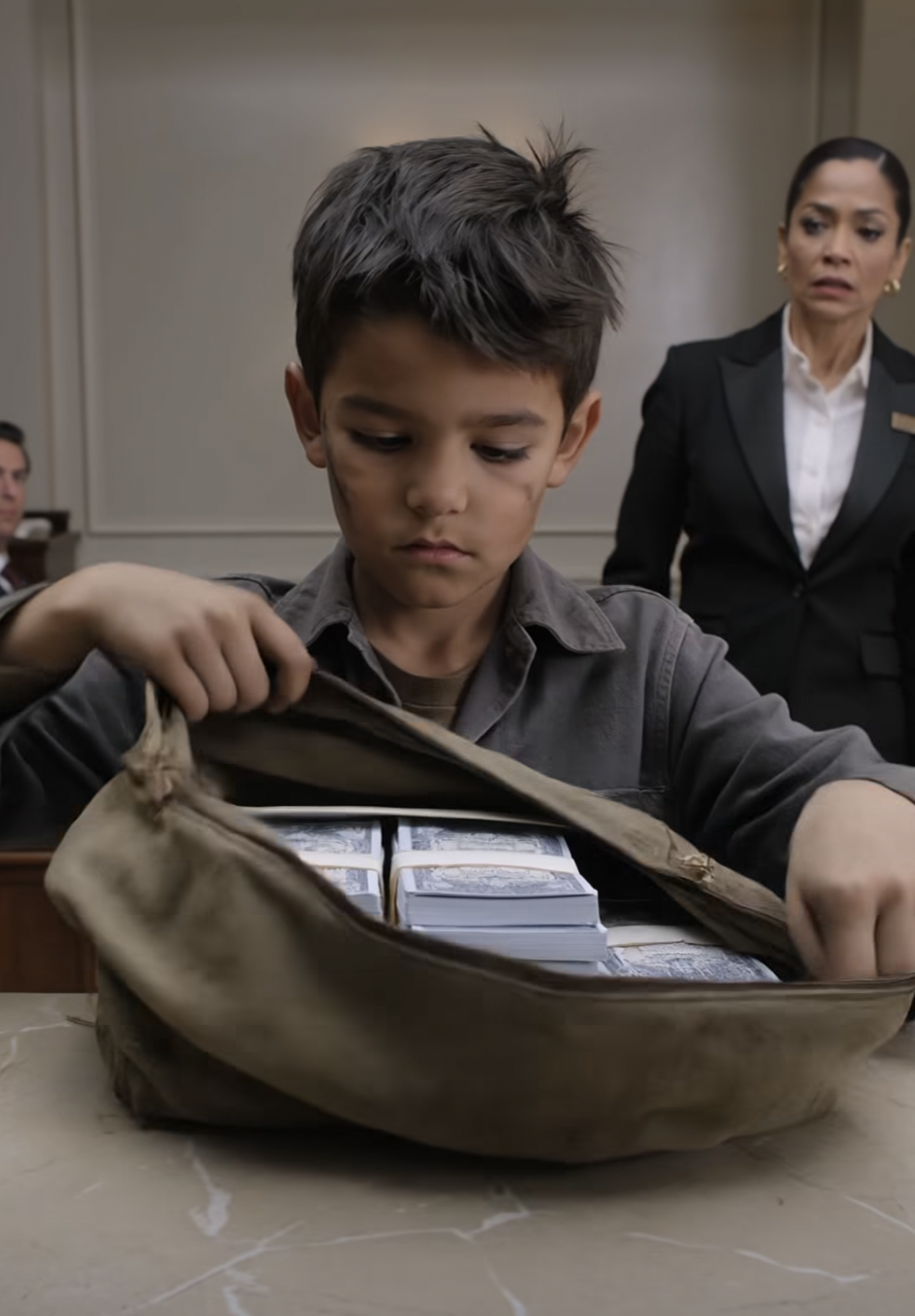
The boy didn’t look like someone who belonged in a bank.
He was small, maybe ten. Thin jacket too big for him. Dust on his shoes like he’d been running on roads that didn’t care about names.
But he walked straight up to the counter like he’d memorized the route with fear.
In front of him, the manager—elegant voice, professional smile—lifted her chin.
“Can I help you?”
The boy held out a small shopping bag with both hands.
“Someone told me to come here,” he said.
The words were quiet.
Not frightened.
Just tired.
The manager took the bag with a careful look, then guided him toward the side office because she could tell—instantly—that this wasn’t a simple deposit or an errand.
Her assistant hovered, confused, but no one stopped her.
In the private room, the manager placed the bag on the desk and asked the question she was already regretting:
“Do you have an envelope? A letter?”
The boy nodded.
He reached inside the bag with trembling fingers and pulled out a worn packet—creased, handled too often, like it had been a life raft.
He slid it across the desk.
“Please,” he whispered. “Open it for me.”
The manager stared at the envelope.
Her mouth went dry.
The handwriting—neat, exact, familiar in a way she couldn’t explain—made her freeze.
Because she recognized it from eighteen years ago.
And suddenly, the air in the office felt colder than the bank’s marble floors.
PART 2 — The Promise in the Envelope
The boy stood still as the manager grabbed the envelope with shaking hands.
For a long moment, she didn’t open it.
She just stared at the handwriting—how familiar it looked, how cruelly neat it was, like whoever wrote it believed time would behave.
Then she broke the seal.
The bank was so silent that even the sound of paper unfolding seemed too loud.
Her eyes rushed across the page.
Then suddenly—
they stopped.
Her face drained of color.
Her knees nearly buckled.
One hand flew to her mouth, the other gripping the letter so tightly the paper bent.
The boy watched her without blinking.
Not because he was calm.
Because he’d learned that if he looked away, he might lose the one chance left to find the truth.
“What does it say?” the employee asked nervously.
The manager didn’t answer.
She just looked at the boy again—this time not with shock, but with something deeper.
Recognition.
Pain.
Guilt.
The boy’s voice was small, but steady enough to survive trembling.
“My mother said you made a promise to her.”
The employee’s brow furrowed. “Promise?”
The manager’s lips trembled.
“She came here eighteen years ago,” she whispered. “In the middle of the night.”
She swallowed, as if the memory still scratched.
“She was terrified,” the manager continued. “She said if anything ever happened to her… one day a boy would come through those doors carrying the truth.”
The customers leaned in without realizing it.
The assistant looked around as if someone might tell her to stop listening.
The boy stood at the counter like a question the world had refused to answer for too long.
He swallowed hard and asked the question he’d carried for years.
“Who is my father?”
The manager closed her eyes.
Tears slipped down her face anyway.
Before she could answer, a door at the back of the bank opened.
An older man in an expensive suit emerged from a private office—calm at first, certain the commotion would end as soon as he arrived.
His gaze swept the room.
Then it landed on the boy.
And the man stopped dead.
Not slowly.
Not politely.
Like his body refused to accept what his eyes were showing him.
The manager slowly turned toward him.
The room froze again.
Because the boy had his eyes.
The exact same eyes.
The older man’s voice cracked.
“That’s impossible…”
The manager’s breath hitched.
“No…” she whispered. “It isn’t.”
The employee stared between them, mouth open in disbelief.
The customers looked like they might collapse.
The boy reached into the bag one last time.
He pulled out a faded photograph.
He placed it on the counter.
The older man stared at it—then went pale.
It showed him, years younger, holding the boy’s mother in secret.
And written on the back, in ink dark enough to still feel alive, were six words that destroyed the room:
You promised you’d come back.
PART 3 — The Man Who Tried to Rewrite the Past
Silence held the room captive.
The older man didn’t move at first.
His face had gone paper-white, as if the photograph had sucked the color right out of his body.
Then he took one step forward—slow—eyes locked on the image like he feared it would disappear if he blinked.
“That’s not—” he started.
But his voice broke halfway through the lie.
The manager’s hands shook on the edge of the desk.
“I tried,” she whispered. “I tried to stop her from coming. I told her… it wasn’t safe.”
The boy stared at the older man the way you stare at a locked door you’ve been hearing about your whole life.
“Where is she?” the boy asked.
His voice wasn’t angry.
It was worse.
It was certain.
The older man swallowed hard.
“She’s…” he began, then stopped.
His eyes darted to the manager, then to the assistant, then back to the boy.
Like he was calculating what truth could cost.
The boy’s jaw tightened.
“What’s my father’s name?” he demanded.
The question landed like a slap—clean, unavoidable.
The older man’s lips parted.
For a moment, he looked like he might finally tell the truth.
Then he saw the customers watching.
He saw the risk.
He saw reputation.
And he chose again.
His shoulders lifted slightly with practiced composure.
“My name doesn’t matter,” he said. “You don’t know what you think you know.”
The manager made a small sound—half grief, half warning.
The boy didn’t flinch.
He reached into the bag again and pulled out another item: a second envelope, smaller, sealed with a thin strip of tape.
“This one is for her,” he said quietly.
Then he held it out to the older man.
“From my mom.”
The older man hesitated, then took it like it might burn him.
The boy’s voice dropped lower, steadier.
“You promised you’d come back,” he said. “And you didn’t.”
The older man’s hands trembled as he opened the envelope.
Inside was a letter addressed to him—dated eighteen years ago.
He read a few lines.
His face contorted.
Because the letter wasn’t about love.
It was about accountability.
About a child born into silence.
About the promise he made in a bank office while pretending money could replace responsibility.
He looked up at the boy, and for the first time, his eyes held fear—not of punishment.
Of being seen.
PART 4 — The Manager’s Confession
The older man tried to speak again.
But the manager stood first.
She stepped in front of the boy as if protecting him from something invisible.
“I’m the one who handled the account,” she said, voice trembling but firm. “I’m the one who told your mother it was safe.”
The employee went pale.
The customers murmured, shocked.
The manager kept going, eyes wet.
“I thought—if I did my job quietly, if I kept everything confidential… she would eventually get tired and stop asking questions.”
Her throat tightened.
“But she didn’t,” the manager whispered. “She came back even after she was hurt. Even when she was scared. She told me she was doing it for you.”
The boy’s hands clenched around his bag.
“What happened to her?” he asked.
The manager swallowed.
“She died,” she said. “But not before she gave me one final instruction.”
She looked at the boy and spoke the words like a vow.
“If a boy came with proof, I was supposed to tell the truth immediately.”
The older man’s expression collapsed.
“You’re lying,” he said weakly.
But his voice had lost confidence.
The boy didn’t care about excuses.
He cared about answers.
“Why did you hide me?” he asked.
The older man’s lips moved as if searching for a story big enough to fit the damage.
“Because…” he started.
The manager cut him off.
“Because you were already married,” she said quietly.
The room broke into stunned silence again.
The assistant gasped.
A customer whispered, “Oh my God.”
The older man’s face tightened.
He looked at the boy as if hoping the child would soften the blow with ignorance.
But the boy didn’t.
He only stared.
“Did you know her?” the boy asked.
The older man’s eyes flickered.
His silence was an answer all by itself.
The boy turned toward the manager.
“Then tell me the rest,” he demanded, voice shaking now. “Tell me everything.”
The manager nodded slowly.
And finally—finally—she did.
She explained the late-night meeting, the coded account, the threat made to his mother, and the promise the older man begged for.
She explained how the promise became a cage.
She explained how the bank—how people—pretended that if they didn’t speak, nothing would be real.
By the time she finished, the older man looked like he might collapse.
And the boy looked like he might finally breathe.
PART 5 — The Boy Gets the Truth, Then Chooses What Comes Next
The bank officials called in a supervisor.
Legal counsel arrived.
Security appeared.
Phones came out and disappeared back into pockets.
But none of it mattered as much as the boy standing in front of the manager with his small, trembling hands.
The older man sat down hard in a chair like his body couldn’t keep holding him upright.
He didn’t beg.
He didn’t argue.
He looked at the photograph again and again, as if trying to undo time with guilt alone.
“I should’ve come back,” he whispered finally.
The manager’s eyes hardened with grief.
“You promised.”
The boy looked at the older man—not with hatred, but with clarity.
“What do I do now?” he asked.
It wasn’t a question about money.
It wasn’t a question about court.
It was a question about survival.
The manager crouched slightly so she was closer to his height.
“You decide where you want to belong,” she said softly. “And you never let anyone make you small again.”
The boy stared at the envelope in his hands, then at the photograph.
He thought about his mother—about the fear in her eyes, the way she’d said his name like it was a prayer.
Then he stood straighter.
“I want the truth recorded,” he said.
The manager nodded.
Then he added, voice shaking but determined:
“And I want her name cleared.”
The older man flinched.
The boy continued, words careful and final.
“Not for you,” he said. “For her.”
For a moment, the older man looked like he might argue.
But he didn’t.
Because the boy had taken the power that grown men usually keep for themselves:
the power to define what the past means.
When the bank paperwork was finally handled, when the confession was documented, when the truth stopped being private—
the boy walked out of the bank holding the photograph like it was something fragile and sacred.
Not because it proved a father.
Because it proved his mother was right.
Promises matter.
And if someone breaks them, the truth has a way of finding the person it was meant for.
PART 6 — The Son Walks In, the Father Finally Stops Running
The paperwork took weeks.
The bank sealed and re-opened records. Supervisors signed forms that felt heavier than their own names. Legal counsel stayed in rooms with closed doors and careful voices, as if the truth might bite.
But for the boy—no, for Ethan, as he finally began introducing himself to strangers—time didn’t move like that.
Time moved like the photograph in his hand.
Time moved like the handwriting on the envelope.
Time moved like his mother’s fear, replaying every time he closed his eyes.
On the morning the confession was finalized, Ethan returned to the bank.
Not with urgency this time.
With purpose.
He didn’t bring a weapon or a scream.
He brought something worse for liars:
proof with an ending.
The manager escorted him to the private office where the older man now sat alone, hands clasped too tightly, eyes fixed on nothing.
When Ethan stepped inside, the man looked up.
His face had aged in the time between the truth breaking and the truth being recorded.
“You shouldn’t have come back,” he said hoarsely.
Ethan set the photograph on the desk.
“I came back to watch you stop pretending you don’t understand,” he replied.
The older man’s throat worked.
“Eighteen years,” he whispered, like the number itself could excuse him.
Ethan shook his head.
“My mother didn’t spend her whole life hiding so you could hide again,” he said.
The man’s eyes glistened.
“I didn’t know if you’d forgive me,” he murmured.
Ethan stared at him for a long moment.
Then he said the simplest truth, the one that had kept Ethan alive all those years:
“I don’t need forgiveness to survive.”
The older man flinched—because that meant Ethan wasn’t offering him mercy.
He was demanding accountability.
Ethan reached into his pocket and pulled out a second item: a copy of his mother’s final letter, the one that had been sent to the bank as instruction. It included a line the manager hadn’t dared read out loud the first time, because it sounded too much like a threat to comfort itself.
Ethan held the page up.
“She wrote, ‘Tell him I kept my promise.’”
The older man’s hands began to shake.
“She… she knew,” he breathed.
Ethan nodded once.
“She knew you’d try to vanish behind your own reputation,” Ethan said. “She knew you’d be scared of being seen.”
For the first time, the older man didn’t look away.
He leaned forward, elbows on the desk, like confession might pull him out of a hole.
“I should have come back,” he said again. “I should have made sure you had a home. I should have been brave.”
Ethan’s jaw tightened.
“Should” wasn’t a home.
So Ethan asked the question he’d never asked because it scared him:
“Why didn’t you tell me?”
The older man swallowed.
“Because I was already married,” he admitted. “Because she was—because Elena—your mother—she wasn’t supposed to exist in my life without ruining everything I built.”
Ethan’s stomach turned at the word ruin.
Not love. Not protection.
Ruin.
Ethan’s voice stayed quiet.
“My mother wasn’t a ruin,” he said. “She was a person. And you treated her like she was disposable.”
The older man’s eyes squeezed shut.
“I know,” he whispered. “I know.”
Ethan waited.
Not for apology.
For decision.
The older man exhaled, defeated.
“What do you want now?” he asked.
Ethan looked down at the photograph, then back up.
“I want the truth to stay public,” he said. “I want what happened to my mother recorded with her name attached. Not buried. Not softened. Not hidden under confidentiality agreements.”
The older man’s shoulders dropped.
“Then you’ll destroy what’s left of me,” he said.
Ethan’s expression didn’t change.
“I didn’t come to destroy you,” Ethan replied. “I came to stop you from continuing the same harm with different paperwork.”
A silence settled—one with weight and consequence.
Finally, the older man nodded.
“Okay,” he said. “We do it right.”
The Announcement That Couldn’t Be Unheard
That afternoon, Ethan stood in the bank’s front lobby while security kept the entrance orderly. People arrived—customers, local reporters, community members who had heard rumors and now wanted the story to be real enough to matter.
The manager stood beside Ethan, hands folded tight in front of her, as if she still couldn’t believe she had survived speaking truth out loud.
The older man stood across from a lectern.
He looked smaller now.
Not because he had lost wealth.
Because he had lost the ability to control the narrative.
A legal representative read the statement first: timelines, documents, the promised instructions, the confession recorded and verified. Names spoken clearly. No euphemisms. No “misunderstandings.”
Then the manager stepped forward and read the part that hurt most—the part where Ethan’s mother’s letter was quoted and her promise was acknowledged as instruction, not as a story meant to tug heartstrings.
When she finished, the lobby was so quiet Ethan could hear the fluorescent lights hum.
The older man took the microphone.
His hands shook.
But he didn’t hide behind them.
“My name is—” he began, then corrected himself because he didn’t want the first sentence to sound like he was centering himself. “Her name was Elena Hart.”
He looked at Ethan.
“I failed your mother,” he said. “And I failed you.”
Ethan’s throat tightened. He didn’t interrupt.
The older man continued, voice breaking:
“I promised to come back. I didn’t. Not then. Not after. And I allowed my fear to decide for me until fear became a lifetime of silence.”
He swallowed hard.
“I will accept what comes next,” he said. “And I will make sure her story doesn’t stay hidden in my shame.”
Reporters expected tears.
Instead, Ethan spoke.
Not loudly.
Just clearly enough for truth to reach every corner.
“She wanted me protected,” Ethan said. “Not owned. Not erased. Protected.”
He looked at the crowd—at the manager, at the onlookers, at people who had once walked past gossip without thinking about what it left behind.
“And now,” Ethan said, “I want her name kept.”
The Final Gift: Where Elena Went
After the announcement, the manager requested privacy for Ethan and escorted him back to the archive room.
The older man accompanied them—not as a spectator, not as a rescuer.
As someone who finally understood that his presence didn’t earn forgiveness.
It only acknowledged responsibility.
In the archive, the manager pulled out a sealed folder—old, labeled, and nearly forgotten. It wasn’t fancy. It didn’t look like it carried the weight of eighteen years.
But when it opened, Ethan saw a note tucked beneath documents.
A location.
A burial site.
A final plan his mother had made when she knew fear wouldn’t stop without an ending.
The manager’s eyes filled.
“She said you’d come looking,” she whispered. “And she said you deserved to find her without being lied to.”
Ethan stared at the address until the letters blurred.
Then he nodded once.
“Take me,” he said.
So they did.
The drive took them outside the city, past neighborhoods where people spoke in whispers about what happened and then changed the subject when the conversation got real.
At the cemetery, the wind moved through trees like soft applause for something that had finally been honored.
Ethan stood at the headstone.
Elena Hart.
Crescent birthmark details.
Date of passing.
A line from her letter etched into stone because someone had chosen to keep it instead of burying it:
“Promises are meant to be kept—especially when it’s hardest.”
Ethan didn’t collapse.
He didn’t scream.
He just stood there with his hands clenched around the photograph—like he could press memory into his chest and keep it from escaping.
When he finally spoke, his voice sounded older than his age.
“You kept yours,” he whispered.
Then he turned slightly, not turning away from the grave, and looked at the manager and the older man.
“She didn’t want you to worship her,” Ethan said. “She wanted you to stop making the same mistake twice.”
The older man bowed his head.
“I’ll honor it,” he promised.
Ethan nodded, accepting the promise for what it was:
Not repayment.
Not closure.
A future.
Closing: Not a Rescue—A Life
That night, Ethan returned home to the help the town had offered—because the truth didn’t only demand accountability.
It demanded care.
Not charity.
Care.
The manager handed him a small envelope.
“What’s this?” Ethan asked.
“From your mother,” she said.
Ethan opened it carefully.
Inside was a simple card and one sentence written in the same handwriting as the first envelope—the one that had guided him to the truth.
“Now that you’re found, don’t let them turn you into a ghost.”
Ethan stared at the words until tears blurred them.
Then he wiped his face with the sleeve of his jacket, breathed in, and finally let himself believe something he’d refused to believe for years:
He wasn’t only the boy who survived silence.
He was the boy who could build a life.
And somewhere, the memory of his mother’s promise didn’t feel like a wound anymore.
It felt like a path.
THE END