Part 1
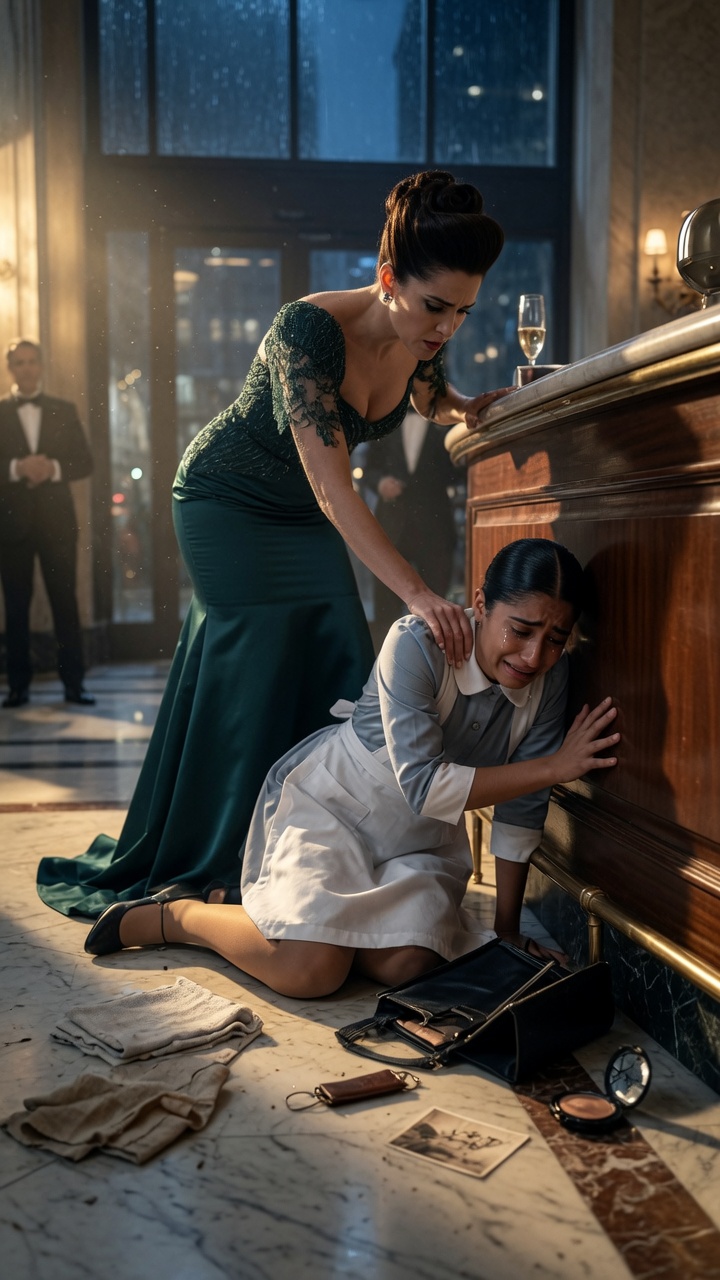
The maid’s service bag burst open across the marble floor like a secret finally giving up.
Cleaning cloths skidded under the reception desk.
A room key sleeve spun toward a pillar.
A cheap compact snapped open beneath a guest’s heel.
Then a tiny old photograph slid out and drifted through the gold lobby light.
The young maid was already crying.
She stood pinned against the polished reception desk by a woman in a dark emerald couture gown, too frightened to defend herself with anything but broken breath. One of her hands was trapped against the wood. The other trembled at her side.
Half the gala lobby watched.
Not helping.
Just watching.
“You disgusting liar!”
The socialite’s scream cut beneath the chandeliers.
“You stole my diamond brooch from the VIP suite!”
Champagne glasses stopped in midair. Faces turned. Phones lifted one after another, as if shame had become entertainment.
“I didn’t take anything,” the maid pleaded through tears. “Madam, please—”
But mercy did not come.
The woman shoved her harder.
Then she tore open what remained of the maid’s service bag and spilled everything across the marble floor, as if scattered belongings could prove guilt.
As if poverty itself were evidence.
“Look at this,” she snapped to the guests around them. “This is what happens when girls like her think they can touch things above them.”
The maid broke harder then.
Because the accusation had changed.
It was no longer only about a missing brooch.
It was class.
It was contempt.
It was a public lesson in making someone feel small.
Then an older guest bent down.
He picked up the tiny photograph.
At first, he only frowned.
Then he looked closer.
And the color drained from his face.
The raised phones lowered slightly. The music seemed to fade by itself. Even the woman in emerald turned.
The maid lifted her wet eyes, confused, shaking, still trapped in the silence everyone else had helped create.
The older man stared at the photograph in his hand.
Then at the maid’s face.
Then back at the image.
As if years had folded in half right there on the marble.
“This…” he whispered.
The lobby went still.
His fingers shook as he raised the picture.
“This was taken the night the hotel owner’s bride disappeared…”
A hush moved across the room.
Then he looked directly at the crying maid.
“Why are you in her arms as a baby?”
The socialite slowly stepped back.
The maid’s lips parted, but for a moment no sound came.
Then, through tears, she whispered:
“Because my mother said if they ever humiliated me here…”
Her eyes stayed fixed on the photograph.
“…I should finally ask what happened in room 417.”
Silence crashed over the lobby.
The older guest’s expression shifted from shock to dread.
He looked toward the gold elevator bank, then back at the maid.
“Because if your mother told you that number… then someone in this hotel has been lying since the night a bride vanished with a child no one was ever supposed to see.”
Part 2
Part 2 in the first comment.
For several long seconds, nobody in the lobby moved.
The chandeliers still burned above them.
The marble still shone.
The champagne still waited in crystal glasses held by hands that had suddenly forgotten how to lift them.
But the room had changed.
Only moments earlier, everyone had understood the scene in the easiest, cruelest way. A wealthy woman in emerald. A young maid in uniform. A missing diamond brooch. A public accusation sharp enough to make strangers lean closer.
Now the tiny photograph had made the brooch feel small.
Almost ridiculous.
The spilled service bag no longer looked like evidence of theft. It looked like the accidental opening of something buried.
Something expensive people had paid to keep quiet.
The maid slowly pulled herself upright, one hand still pressed against the reception desk. Her knees did not seem to trust the floor beneath her. Tears streaked her cheeks. A red mark was rising on her arm where the socialite had shoved her.
But her fear was no longer the same fear.
Before, she had been afraid of being blamed.
Now she looked afraid of being right.
The older guest held the photograph with both hands, as if even breathing too hard might damage it.
“I was there,” he said.
His voice was quiet.
Not dramatic.
Worse.
Certain.
“The night this was taken. The engagement dinner. Upstairs, near room 417.”
A murmur moved through the lobby.
The woman in emerald stiffened.
The older man looked at the maid, then at the photograph again. In the picture, a young woman held a baby close to her chest, her face turned slightly away from the camera. Elegant. Pale. Beautiful in the exhausted way of someone trying not to be seen.
“The owner was going to announce his marriage that evening,” he said. “Not publicly. Not yet. Only to a private circle.”
His eyes shifted toward the gold elevator bank.
“She was never fully accepted by his world. Too quiet, they said. Too unknown. Too inconvenient.”
That word made the air colder.
Inconvenient.
That was how powerful families described people before erasing them.
The maid swallowed.
“You knew my mother?”
The old man looked at her with something close to grief.
“No,” he said. “But I knew the woman holding you.”
The sentence landed across the marble like a dropped knife.
The socialite’s lips parted, but no sound came out.
The older guest continued. He said the bride had been kept mostly upstairs that night, away from the louder guests, away from the family members who smiled with their mouths and measured her with their eyes. A nurse had been hired to stay with the infant in room 417 until the dinner ended.
The child was not introduced.
The child was not mentioned.
The child was not supposed to exist in any room where inheritance had a voice.
“After midnight,” he said, “we were told the bride had become emotional and left the suite alone.”
Alone.
The word seemed to shame itself.
He lifted the photograph slightly.
“But this proves she was not alone.”
The maid’s breathing grew uneven again. She pressed one trembling hand against her chest.
“My mother worked as a cleaner,” she said. “And a seamstress. We moved constantly. She hated wealthy districts. She would panic if anyone mentioned old hotel families.”
Her eyes stayed on the photograph.
“She never explained why.”
A guest near the pillar lowered his phone completely.
Another woman covered her mouth.
Not out of kindness, perhaps.
Out of fear that she had laughed too early.
The maid continued, softer now.
“When she was dying, she gave me that picture. She told me if anyone in this hotel ever humiliated me in public, I should not defend myself first.”
Her voice broke.
“She said I should ask what happened in room 417.”
The older guest closed his eyes for one second.
As if a door inside his memory had opened and he wished it had stayed locked.
“What was your mother’s name?”
The maid told him.
His face went still.
Completely still.
Then he whispered, “She was the nurse.”
The lobby seemed to lose its breath.
Not the vanished bride.
Not the woman in the photograph.
The nurse.
The woman hired to remain upstairs with the infant while the family dinner unfolded below.
The maid stared at him.
And in that silence, the shape of her whole life shifted.
Her mother had not invented a fever story.
She had hidden a child.
She had carried a living secret out of a palace of marble and gold, then buried it under cheap rent, patched clothing, early mornings, and years of looking over her shoulder.
Poverty had not been the family’s origin.
It had been the disguise that kept the girl alive.
The woman in emerald suddenly found her voice.
“This is absurd,” she said.
Too quickly.
Too polished.
“She is a maid. She is repeating nonsense from a sick woman.”
No one answered immediately.
That was the first punishment.
Not shouting.
Not outrage.
Just the room refusing to return to her version of reality.
The older guest turned toward her.
“If there was never a child,” he asked, “why did the owner’s legal team demand every family-archive photograph from that night be destroyed?”
The socialite’s face tightened.
“I don’t know what you mean.”
“I think you do.”
He did not raise his voice.
He did not need to.
“A vanished bride is a scandal. A vanished bride with an infant daughter is inheritance.”
Inheritance.
The word moved through the lobby with lethal weight.
The maid looked down at her uniform. At the cheap fabric. At the cleaning cloths on the floor. At the compact cracked open beneath someone else’s shoe.
Only minutes ago, those objects had made her easy to accuse.
Young.
Poor.
Replaceable.
A girl with no protection but tears.
Now the same objects looked different beneath the chandelier light. Not shameful. Not dirty. They were the tools of a life built after another life had been stolen.
The older guest spoke again.
“Room 417 was sealed after that night. Not for grief. The order said it was to remain closed until all personal matters were resolved.”
He looked around the lobby.
“No guest stayed there again. The furniture was removed. The locks were changed. Inventory was transferred to private storage.”
He paused.
“But one object was never accounted for.”
The socialite’s hand moved almost invisibly toward her chest.
Too late.
Several people saw it.
“A blue velvet brooch case,” he said. “Belonging to the bride.”
Every eye turned toward the emerald gown.
The missing diamond brooch.
The accusation.
The violence.
The speed with which she had grabbed the maid, searched her bag, and made the lobby watch.
It no longer looked like suspicion.
It looked like panic dressed as authority.
The maid bent slowly and gathered her things from the marble. A cloth. A key sleeve. The broken compact. The photograph.
No one laughed now.
No one whispered loudly enough to be heard.
Cruelty is comfortable when it believes the victim has no name that matters. It becomes nervous the moment the name begins to return.
The older guest stepped closer, lowering his voice.
“The bride told me something that night,” he said. “Only once. I did not understand it then.”
The maid looked up.
“She said, ‘If anything happens to me, the woman in 417 will know which name belongs to the child.’”
The maid’s lips trembled.
Not from weakness.
From the terrible weight of finally being seen.
One by one, the phones lowered.
Not because the story was over.
Because everyone understood they were no longer recording a servant’s disgrace.
They were witnessing a buried daughter being pushed back into history by the very cruelty meant to silence her.
The maid turned to the woman in emerald.
The woman who had shoved her.
The woman who had emptied her bag.
The woman who had called her disgusting in front of people rich enough to pretend dignity was something they owned.
When the maid spoke, her voice was soft enough to force the room to listen.
“You didn’t think I stole your brooch.”
Her fingers closed around the tiny photograph.
“You were afraid someone would finally ask why a bride disappeared from room 417 with a child your world claimed never existed.”
No one moved.
No one defended the emerald gown.
And for the first time that night, the young maid was not the one trapped beneath the chandeliers.

