The Impact of Truth
Chapter 1: The Sound Before the Silence
I remember the sound of the tires first. It was a high, desperate screech against wet asphalt, the kind of noise that instantly pulls the air out of your lungs because your body knows, even before your brain does, that something terrible is about to happen.
Then came the horn. It wasn’t a warning. It was a declaration of impact.
The day my world shattered did not begin with sirens or fluorescent hospital lights. It began with the mundane, suffocating weight of my mother-in-law’s expectations. My name is Claire Donovan. I was thirty years old, and for six years, I had been the architect of my own silent prison, meticulously laying the bricks of compliance, politeness, and denial.
That morning, I was leaving a crucial client meeting downtown. I had a coffee in one hand and my phone tucked inside my leather tote. I was already calculating the hours I had left before the evening. It was Patricia’s birthday. Patricia, my husband’s mother, was a woman who didn’t just walk into a room; she occupied it, assessing its flaws and demanding its reverence. She had insisted on a formal dinner at our house for twelve guests. If she wanted twelve, I knew to cook for fifteen. If she found a lavish, impossibly complicated tablescape on a luxury lifestyle blog, I was expected to recreate it by midnight, sacrificing sleep for the illusion of domestic perfection.
My husband, Ryan Donovan, was a master illusionist. To the outside world, he was the gold standard of partnership. He held doors, charmed waitstaff, sent lavish floral arrangements to my colleagues on their birthdays, and played the role of the devoted husband with an Oscar-worthy finesse. People constantly told me how lucky I was.
But behind the closed oak door of our suburban home, the mask slipped. His patience evaporated the moment there were no witnesses. His affection was a transaction, strictly conditional on my submission. If Patricia criticized my roast, my career, my choice of dress, or the exhaustion etched under my eyes, Ryan would simply sip his wine, offer a nonchalant shrug, and whisper, “Don’t make a scene, Claire. It’s just family. Show some respect.”
And whenever my face betrayed the sting of his dismissals, he had a favorite word for me: Sensitive. It was a weapon he wielded to invalidate every boundary I tried to set. Over the years, the pattern grew so gradually that I became numb to it. I practiced neutral expressions in my bathroom mirror, learning to swallow my pride so no one could accuse me of ruining the evening.
Stepping out of the office building that morning, I checked my phone at the crosswalk. A message from Patricia glowed on the screen: Don’t be late tonight. The caterers for the appetizers are arriving at four.
A second message materialized right beneath it, this one from Ryan: We need to talk before dinner. Be home by three.
I sighed, rolling my eyes at the familiar knot of anxiety tightening in my stomach. I shoved the phone into my bag and stepped off the curb as the pedestrian signal flashed white.
Then, the world tore apart.
A dark sedan barreled through the intersection, running the red light by several seconds. I turned my head just enough to see the flash of chrome, the blurred outline of a windshield, and the devastating speed of a machine that had no intention of stopping.
The impact struck me on my left side. It felt as though a wrecking ball had swung out of the sky and crushed me. My coffee exploded into the air. My feet left the ground. Time dilated, stretching a single second into a grotesque eternity as my body was hurled through the air, violently striking the hard, unforgiving pavement.
My cheek scraped against the concrete, leaving a trail of fire. A sickening crack echoed in my ears as my ribs took the brunt of the fall. Blood instantly flooded my mouth, tasting of copper and dust. Every breath I tried to pull into my lungs felt like swallowing jagged glass.
Voices quickly swarmed around me, a chaotic chorus of panic.
“Oh my god, don’t move her!” a woman shrieked.
“Call an ambulance! Somebody get help!”
I wanted to speak, to tell them that my leg felt completely disconnected from my body, but my jaw refused to obey. The sky above me looked blindingly bright, vast, and horribly indifferent to the fact that I was bleeding out on the street.
Then, the edges of my vision darkened. The frantic voices, the distant wail of sirens, and the stinging pain all blurred into a heavy, suffocating static. I let go, drifting into the cold void.
When I finally opened my eyes, the harsh, sterile glow of hospital lights assaulted my retinas. My left arm was immobilized in a heavy sling. A massive brace encased my swollen knee. I felt the tight pull of fresh stitches above my left temple, and a deep, pulsing agony radiated from my chest with every shallow breath.
A doctor with exhausted eyes eventually stood at the foot of my bed, reviewing a chart. “You are incredibly lucky, Mrs. Donovan,” he murmured, his voice lacking any real warmth. “Two fractured ribs, a severe sprain, minor concussion. A few inches to the right, and that tire would have crushed your pelvis permanently. The police are treating it as a hit-and-run. The driver never even hit the brakes.”
Lucky. I lay there, staring at the textured ceiling tiles, shivering violently from the cocktail of adrenaline and heavy pain medication, wondering why surviving felt so much like a punishment.
I gave the nurse Ryan’s number. I waited, expecting the man who charmed the world to rush through those doors, terrified of losing me. I expected him to hold my hand, to kiss my bruised forehead, to tell me that nothing else mattered.
Nearly three hours passed.
When the door finally creaked open, my heart leaped in my chest. But as I turned my head to look at my husband, the hopeful relief died instantly in my throat. Because standing in the doorway, staring at my battered, broken body, Ryan didn’t look terrified. He didn’t look relieved.
He looked furious.
Chapter 2: The Anchor of Humiliation
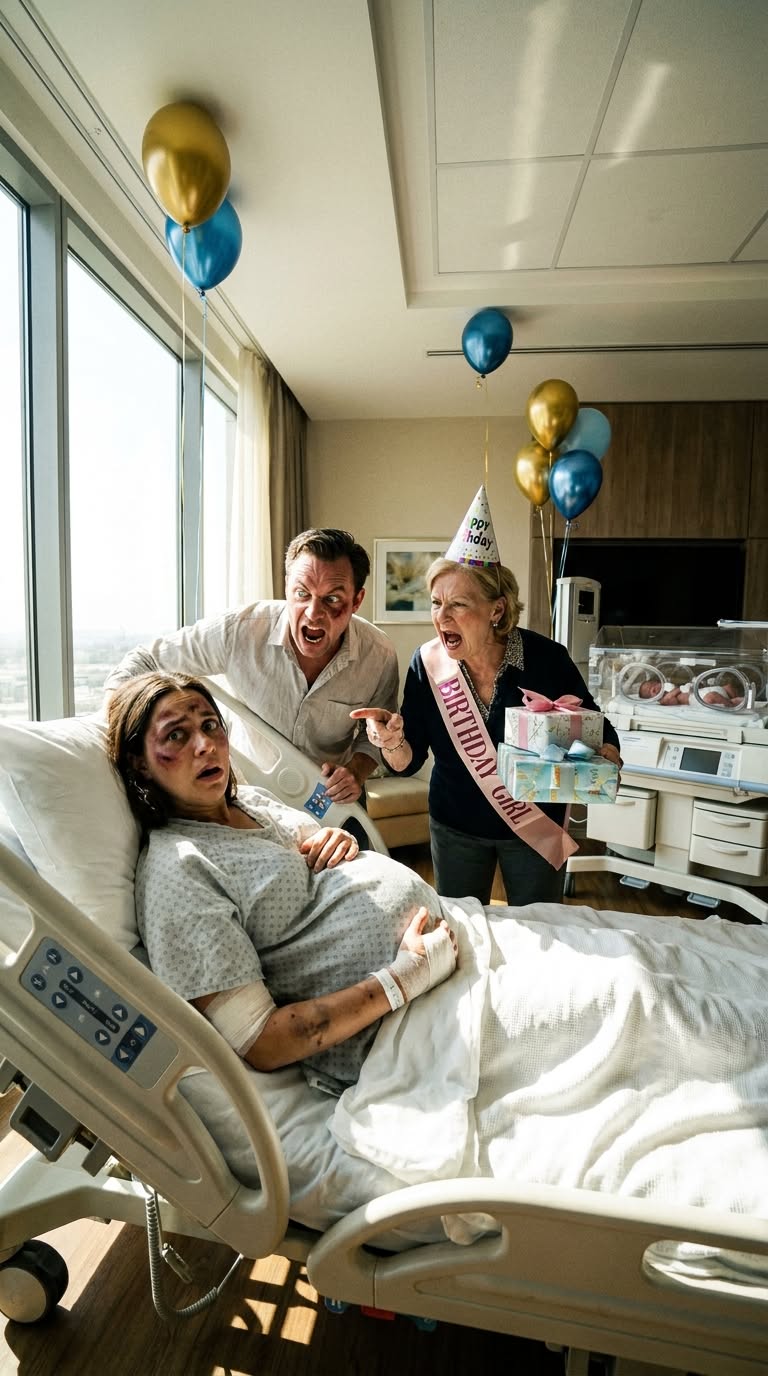
Ryan stepped into the room and let the heavy door swing shut behind him. He didn’t rush to my bedside. He didn’t ask the nurses about my vitals. He stood at the foot of my bed, dressed in his impeccable tailored suit, and let his eyes roam over the heart monitor, the thick sling strapping my arm to my chest, and the stitches tracking across my forehead.
His jaw locked. His eyes, usually warm hazel when in the company of our friends, were flat and cold.
“Drop the drama, Claire,” he said.
The words hung in the sterile air. For a fleeting second, my concussed brain tried to process the auditory input. Surely, the heavy dose of narcotics pumping through my IV had distorted his voice. Surely, my husband of six years hadn’t just looked at my bruised, shattered body and accused me of acting.
I blinked, my dry lips parting. “Ryan… what?”
His voice sharpened, cutting through the quiet hum of the machines like a scalpel. “My mother’s birthday dinner is tonight. You have fifteen people arriving in less than four hours. Get up. You still have to cook.”
I stared at him. The room suddenly felt sub-zero. The heart monitor beside my bed began to beep faster, a frantic, erratic rhythm. My body, operating purely on primal instinct, recognized the profound danger standing before me, even before my conscious mind was ready to accept it.
“Ryan,” I whispered, my voice trembling so violently it barely carried across the blanket. “I was hit by a car. The doctor said…”
He rolled his eyes, a dramatic, sweeping gesture of pure exhaustion, as if I were a toddler throwing a tantrum in a grocery store. “Claire, please. People get hit by cars every day in this city. You’re acting like you’re dying. You have a few bruises. I am not dealing with this today.”
A heavy, suffocating knot tightened in my throat. I wanted to scream. I wanted to hurl my water pitcher at his perfectly styled hair. I wanted to unleash a fury so profound it would shatter the windows of the hospital ward. But the pain in my ribs held me hostage, and six years of conditioned silence chained my tongue.
He moved closer, stepping into the small space between the bed and the IV pole. He lowered his voice.
That was always the worst part. The softer Ryan sounded, the more venomous he became.
“I am not wasting money on this hospital nonsense just because you want attention,” he hissed, leaning in so close I could smell his expensive cologne mixed with the metallic scent of my own blood. “If you need sympathy so badly, you can sit in a chair in my mother’s kitchen while you prep the appetizers. But you are not ruining her night.”
My uninjured right hand curled into the thin hospital blanket. “I can barely move,” I choked out, a hot tear finally breaking free and stinging the raw scrape on my cheek.
He let out a short, disgusted laugh. “And yet, you survived. So get up.”
Before I could brace myself, he reached out and violently yanked the heavy hospital blanket down to the foot of the bed.
The sudden rush of cold air was nothing compared to the white-hot agony that ripped through my fractured ribs as my body jerked in surprise. I gasped, a pathetic, broken sound, curling inward to protect my chest.
But Ryan wasn’t finished.
He grabbed my right wrist. He didn’t hold it; his fingers clamped around my bone like a vice. And then, he pulled.
Not gently. Not with the hesitation of someone helping a wounded animal. He yanked me toward the edge of the mattress as if I were a piece of stubborn luggage caught on a carousel.
“Don’t do this,” I begged, my voice cracking into a sob. “Please, Ryan. It hurts.”
“Get. Up.”
He hauled me forward. My bare feet dangled over the side of the bed and touched the freezing linoleum floor. The absolute second my weight shifted onto my injured, braced knee, the joint buckled.
A scream tore from my throat as a blinding flash of pain shot upward from my leg, meeting the agony of my ribs. I pitched forward, entirely breathless, the room spinning wildly out of control. I managed to throw my good arm out, barely catching the edge of the mattress to stop myself from face-planting onto the floor. I hung there, gasping, shaking, completely humiliated.
Instead of catching me, instead of apologizing, Ryan stepped back, looking down at me with utter contempt.
“See?” he hissed, his face twisted in a sneer. “Now you’re just trying to fall to make a point. Pathetic.”
And right then, suspended halfway between the bed and the floor, shaking with physical agony and absolute degradation, something inside of me went entirely still.
It wasn’t a broken feeling. It wasn’t despair. It was an awakening.
Pain is a liar. Pain can make you negotiate with reality, forcing you to excuse behaviors no human should ever excuse just to survive the day. But humiliation? Humiliation is a mirror. It freezes the ugly, undeniable truth in place until you can no longer blur the edges.
In that agonizing second, with my husband’s fingernail marks etched into my wrist, I finally saw my marriage not for what I desperately wished it was, but for what it truly was.
It wasn’t a “misunderstanding.”
We weren’t just going through a “stressful patch.”
It wasn’t something that my silence, my extra effort, or one more chance could miraculously repair.
It was cruel. It had always been cruel. And I had almost died on the pavement that morning without ever admitting it out loud.
Ryan huffed in annoyance and reached down, tightening his grip on my arm to drag me the rest of the way up.
Then, a heavy click echoed through the room. The door swung open.
Ryan turned on his heel instantly, the annoyance already melting off his face to be replaced by his signature, polite smile. He was undoubtedly expecting a nurse, someone he could easily charm and manipulate with a complaint about his difficult, medicated wife.
Instead, the fake smile froze on his face. His hand dropped from my wrist so quickly it left a phantom sting behind. The color drained from his cheeks, leaving him looking like a wax figure.
Standing in the doorway was not a nurse.
It was Detective Marcus Hale, a broad-shouldered, unsmiling man from the city’s hit-and-run unit, holding a thick, ominous manila folder.
And standing right beside him, his jaw clenched so tightly the muscle fluttered wildly near his temple, was my older brother, Evan Carter.
Evan looked from Ryan, down to me trembling on the edge of the bed. And I knew, in that terrifying silence, that the explosion was finally here.
Chapter 3: The Brother and the Badge
My brother, Evan, was three years older than me. For as long as I could remember, he had been the steady, immovable rock in the chaotic waters of our family. He was a criminal defense attorney, a career path he once joked he chose because he had learned to spot a lie before he learned to ride a bike.
Evan had never liked Ryan. From the day I introduced them, Evan had treated my husband with a cold, calculated tolerance strictly for my benefit. I knew Evan hated the way Ryan subtly spoke over me at dinners. He hated how Ryan could twist an ordinary disagreement into a public performance about how “difficult and emotional” women were. Most of all, Evan hated how quickly, how nervously, I would jump to defend Ryan’s behavior.
But Evan was a lawyer. He dealt in facts, and until today, he had never had proof.
Evan stood in the doorway, still wearing his dark, charcoal court suit. The silence in the hospital room was so profound I could hear the faint buzz of the fluorescent lights above us.
Slowly, deliberately, Evan’s sharp gaze took in the scene. He looked at the heavy bruising blooming across my cheek. He looked at the tears tracking through the dirt on my face. He looked at my bare, freezing feet dangling uselessly above the floor. Finally, his eyes locked onto the angry, red finger marks rapidly forming a bracelet around my right wrist.
When his eyes finally shifted to Ryan, the air in the room seemed to drop ten degrees. Evan didn’t yell. He didn’t lose control. His expression settled into something far more dangerous than rage—it was absolute, clinical precision.
“Get your hands off my sister,” Evan said. His voice was flat, carrying a deadly calm. “And step away from that bed.”
Ryan swallowed hard, his Adam’s apple bobbing in his throat. His polished exterior was cracking, but he frantically tried to glue it back together. He raised both hands in a placating gesture.
“Evan, listen, this is a massive misunderstanding,” Ryan stammered, stepping back. “Claire was trying to stand up, she’s disoriented from the meds, and I was just trying to catch her before she—”
“One more lie,” Evan interrupted, taking a single, heavy step into the room. “One more lie out of your mouth, Ryan, and I promise you, I stop being polite, and this gets unimaginably worse for you.”
Detective Hale, who had been watching the exchange with the quiet observation of a predator analyzing its prey, stepped inside and pulled the heavy door shut. The click of the latch echoed with a heavy, irrefutable finality.
Hale looked at my wrist, then at Ryan’s pale, sweating face, and finally at the heart monitor, which was still loudly broadcasting my panic.
“Mrs. Donovan,” the detective said, his voice surprisingly deep and gentle. “I need to ask you a few questions about the collision. But before we get to that, I need to know something else. Are you stating that this man attempted to force you out of this hospital bed against medical advice?”
Ryan couldn’t help himself. His need for control overrode his survival instinct. “Of course not! Officer, I am her husband. I was helping her. She is heavily medicated and doesn’t know what she’s saying right now.”
Evan completely ignored Ryan’s existence. He walked over, knelt by my side, and gently lifted my legs back onto the mattress, pulling the blanket up to cover my shivering frame. He looked me directly in the eyes.
“Claire,” Evan said softly. And for the first time that entire day, I heard genuine fear in a human being’s voice. Not fear of an inconvenient dinner. Fear for me. “Did he hurt you?”
I lay there, the hospital gown clinging to my cold sweat. I looked down at the red marks on my wrist, throbbing in time with my pulse. I looked at my brother, whose eyes offered a safe harbor I hadn’t realized I was desperately seeking. And then I looked at Ryan.
Ryan was staring at me with a desperate, silent command. Protect me. Do what you always do. Swallow the truth and protect me.
I took a shaky breath, the pain in my ribs sharp and brilliant.
“Yes,” I said. My voice was a rasp, but it was clear. “He tried to drag me out of bed. He told me I had to go home and cook for his mother.”
It was a small, simple truth. But saying it out loud felt like breaking the surface of the water after drowning for six years.
Ryan’s mouth fell open, genuine shock replacing his facade. He wasn’t used to defiance. He was used to my compliance.
Detective Hale nodded slowly, jotting something down in a small notebook he pulled from his pocket. “Understood.”
He closed the notebook and turned his full, imposing attention to my husband.
“There is another reason we came directly to your room, Mr. Donovan,” Hale said, his tone shifting from gentle to purely authoritative. “The hit-and-run unit moves quickly when we have cooperative witnesses and good city infrastructure. The vehicle that struck your wife this morning wasn’t just a random car. We have identified it.”
I saw something flash in Ryan’s eyes. It wasn’t anger. It wasn’t his usual patronizing contempt.
It was pure, unadulterated panic.
Hale slowly opened the thick manila folder he had been carrying. “And before either of you say another word, you should both know that we already know who the vehicle belongs to.”
Hale pulled out a glossy, 8×10 photograph and laid it gently on the rolling tray table beside my bed. It was a still image taken from a red-light traffic camera. The picture was slightly grainy, distorted by motion, but the details were undeniable.
Silver trim. A distinct, customized grille. A cracked right taillight.
My stomach plummeted so violently I thought I might be sick. I knew that car. I had washed it in our driveway. I had driven it when my own car was in the shop.
It was a 2021 Lexus RX.
It belonged to Patricia.
“No,” I whispered, shaking my head as the horrifying implication washed over me. “Patricia?”
Ryan immediately launched into a frantic, high-pitched defense, his hands waving erratically. “My mother lets people borrow that car all the time! She has a cleaning lady, a gardener, cousins who use it! You cannot prove she was driving. You cannot prove anyone in my family had anything to do with this!”
Evan leaned against the wall, his arms crossed, a dark, dangerous smile playing on his lips.
“That’s very interesting, Ryan,” Evan said softly. “Because nobody here said your family was involved. You just volunteered that.”
Ryan’s jaw snapped shut. The silence in the room grew deafening.
Detective Hale reached into the folder a second time.
“You’re right, Mr. Donovan. Patricia Donovan was not driving,” Hale said, his voice entirely devoid of emotion. “We know this, because ten minutes after the collision, the vehicle pulled into a private parking garage downtown. A garage equipped with high-definition security cameras at the ticketing booth.”
Hale slid a second photograph out and placed it next to the first.
The image was crystal clear. It showed the Lexus, its front right bumper heavily dented, the headlight smashed.
And visible through the driver’s side window, illuminated perfectly by the toll booth flash, was the driver. He was looking down, one hand on the steering wheel, the other frantically dialing a cell phone.
It wasn’t Patricia.
It was Ryan.
Chapter 4: The House of Cards
I stared at the photograph on the tray table until the edges of the paper blurred into a meaningless white square. The air in the room felt thick, like breathing underwater.
Ryan. My husband. The man who had vowed to protect me, had plowed a two-ton vehicle into my body, left me bleeding on the concrete, and then come to the hospital to berate me for ruining his mother’s dinner.
I looked up from the photo, my eyes locking onto Ryan’s.
He saw the exact moment the final piece of my love for him died. He saw the understanding dawn in my eyes, and like a cornered animal, he instantly changed tactics. The arrogant demands vanished, replaced by a sickeningly sweet, pleading desperation.
“Claire, baby, please listen to me,” Ryan begged, taking a step toward the bed before Evan’s sharp glare stopped him cold. “I panicked. I swear to god I panicked! It was raining earlier, the roads were slick, the light changed so fast, and you just stepped out into the crosswalk out of nowhere. I didn’t realize it was you—”
“It wasn’t raining, Ryan,” I said. My voice was eerily calm, devoid of the tears he expected. “The sun was shining. I had sunglasses on.”
His mouth opened and closed like a dying fish.
Detective Hale stepped forward, his presence dominating the space. “Let’s review the facts as we have them, Mr. Donovan. You ran a solid red light. You struck a pedestrian at high speed. You fled the scene of an injury accident. You hid the vehicle in a private garage. And then, you came to this hospital and actively attempted to physically remove the victim from medical care before uniformed officers could interview her without your presence.”
Hale tilted his head. “That isn’t panic. That is calculated evasion and witness tampering.”
Ryan looked at me, his hazel eyes wide with a frantic, begging energy. But there was no remorse in his gaze. There was only calculation. He was running algorithms in his head, trying to find the specific combination of words that would make me save him.
“Claire, I swear on my life, I didn’t know it was you. Not until I was already driving away and I looked in the rearview mirror. I was terrified. I was coming here to get you, to take you to a private doctor, to take care of you myself!”
I closed my eyes, letting the memory of the morning wash over me. The crosswalk. The sudden, terrifying blare of the horn. The split second when I had turned my head.
Through the windshield, just before the impact, I hadn’t seen a distracted driver looking at his phone. I had seen Ryan looking directly at me.
And then, another memory surfaced. Something small, something I had entirely dismissed because I had been rushing to cross the street.
My phone. The text messages.
First, Patricia demanding I not be late.
Seconds later, Ryan.
We need to talk before dinner. Be home by three.
A cold, terrifying realization began to spread through my veins, freezing the blood in my chest.
“Why did you text me?” I asked, my voice barely a whisper.
Ryan blinked, thrown off balance by the question. “What?”
“Why did you text me right before I stepped into the crosswalk?” I repeated, my voice growing stronger. “You texted me to be home by three. You knew exactly where I was. You were watching me leave my office building.”
Evan pushed off the wall, his attorney instincts fully ignited. He stepped directly into Ryan’s personal space. “Answer her. Why did you need to talk to her so urgently?”
Ryan dragged a trembling hand over his perfectly styled hair, ruining it. He looked trapped. “Because… because we needed to talk. About the house. About the money.”
Detective Hale looked up from his notebook, his brow furrowed. “What money?”
I turned my head to look at Evan, genuine confusion masking the pain in my ribs. “Evan, what house? What is he talking about?”
Evan looked at Ryan, his eyes narrowing into dark slits. “I suggest you start talking, Ryan. Because if you don’t tell us right now, the forensic accountants will find it by Tuesday.”
Ryan stayed silent. He looked at the floor, his jaw working furiously. And in that protracted, agonizing silence, the final layer of the lie peeled away.
He hadn’t come to the hospital to silence me just because of a hit-and-run. He had come because he hadn’t expected me to survive long enough to ask questions.
Detective Hale didn’t wait for Ryan to find his courage. He immediately stepped out into the hallway, his radio already clicking as he requested financial crimes units and a uniform detail to my door.
Over the next six hours, my hospital room became a war room. Evan brought in a colleague, a terrifyingly sharp family law attorney, while Hale dispatched officers to secure the Lexus and Ryan’s office.
Every time I tried to soften a detail—a lingering habit of protecting my abuser—Evan would look at me with such steady, heartbreaking disbelief that the truth kept tumbling out of me. I told them about the insults. The constant, psychological pressure. The way Ryan controlled the mail, ensuring I never saw the mortgage statements. The way Patricia treated my income as her personal slush fund, and my boundaries as personal insults to her legacy.
By sunset, the whole sickening truth was laid bare on my hospital bed.
Ryan had secretly submitted a second mortgage application on our home, using forged supplementary documents. He had been quietly hemorrhaging money into a disastrous commercial real estate investment that Patricia had aggressively pushed him into. The investment was failing, and they were drowning.
He needed a massive influx of cash before the bank seized his business assets. And to get that cash, he needed my signature on the final release papers.
I had refused to sign a vague, unexplained document the week before, simply because the numbers didn’t make sense to me. We had argued violently. He had called me stupid; I had slept in the guest room.
The text that morning had not been about finalizing an appetizer menu. He was desperate. He was watching me. He needed me out of the way, or he needed me so broken and dependent that I would sign anything he put in front of me just to make the pain stop.
The trap had snapped shut. But he was the one caught inside it.
Chapter 5: The Fall of the House of Donovan
Detective Hale could not definitively prove premeditated attempted murder that first night. Proving intent behind the wheel of a car is a complex legal maze. But what he could prove—with absolute, undeniable certainty—was that Ryan was driving, that he ran a red light, that he struck his wife, fled the scene, and then attempted to tamper with a victim in a medical facility.
And once the bank’s fraud department was notified by Evan, the rest of Ryan’s carefully curated life unraveled faster than he could spin his lies.
At exactly nine o’clock that night, the heavy doors of the ward swung open.
Patricia Donovan arrived.
She swept down the hallway wearing her signature pearls, a cashmere wrap, and a face locked in absolute, aristocratic outrage. She fully expected to find me cowering, to find her son annoyed, and to quickly manage whatever “inconvenient misunderstanding” had delayed her perfect birthday dinner.
Instead, she found two armed, uniformed police officers standing guard outside my room.
I watched through the glass partition as she tried to sweep past them, treating them like valets who had lost her keys. The officers immediately blocked her path.
Evan stepped out of my room into the hallway, pulling the door partially shut behind him, though I could hear every word.
“Evan, what on earth is going on?” Patricia demanded, her voice shrill and echoing down the quiet corridor. “Where is Ryan? Why are these men here? This is absurd, Claire always overreacts to everything. She probably tripped and is trying to ruin my evening!”
For six long years, hearing her voice speak about me with such casual, dismissing cruelty would have made me fold inward. I would have apologized. I would have taken the blame.
But lying there, battered, bruised, and stitched together, I felt something entirely alien blooming in my chest. It was hot, it was bright, and it was glorious.
It was absolute, unadulterated anger.
“Open the door, Evan,” I called out.
Evan glanced back, surprised, but he pushed the door wide open.
Patricia looked past him, her eyes finally landing on my broken body. But instead of sympathy, her lip curled. “Claire, tell these officers to leave. You are making a public spectacle of our family.”
“No,” I said.
My voice was hoarse from the intubation tube they had used briefly in the ER, but it was rock steady. It echoed in the small room.
Patricia blinked, genuinely taken aback. “Excuse me?”
“You heard me, Patricia,” I said, pushing myself up slightly against the pillows, ignoring the scream of my ribs. “For six years, I underreacted. I swallowed your insults. I cooked your dinners. I let you and your son treat me like a disposable appliance. We are done with that now.”
Patricia’s face flushed a deep, ugly crimson. She puffed up her chest, ready to unleash a tirade of venom. “You ungrateful little—”
“Save it,” Evan cut in, his voice cracking like a whip. “Your son is currently sitting in an interrogation room at the 4th Precinct. He is being charged with felony hit-and-run, reckless endangerment, leaving the scene of an accident, and financial fraud. And the SEC is going to be very interested in how you helped him move that money.”
Patricia froze. The haughty, untouchable matriarch seemed to age ten years in a single second. She looked at Evan, then back to me, her eyes darting around as she watched her son’s future, and her own comfortable life, collapsing from every direction.
For the first time since I had met her, Patricia Donovan had absolutely nothing useful to say.
“Leave,” Evan said, pointing down the hallway. “Leave right now, before I ask these officers to escort you out in handcuffs for interfering with a protected victim.”
She turned on her heel and practically ran down the hallway, the clatter of her expensive heels echoing like a retreating army.
Ryan was formally arrested the following morning. The charges piled up rapidly once the investigation widened, moving from traffic violations to severe domestic abuse-related charges and federal wire fraud.
Patricia was never criminally charged with the crash itself—she hadn’t been in the car. But the financial investigation pulled her down right alongside him. Her assets were frozen. The country club memberships lapsed.
She tried to call me once, three days later, leaving a weeping, manipulative voicemail demanding I drop the charges to save the “family name.”
She never called again after my new attorney—a shark Evan had hired for me—informed her that her next communication would be met with a restraining order and an harassment suit.
The hardest part of the entire ordeal wasn’t leaving Ryan. Leaving was a reflex once the truth was exposed.
No, the hardest part was the quiet, lonely nights in my new apartment, staring at the ceiling, crying as I admitted to myself just how long I had chosen to stay.
Chapter 6: The Crossing
Physical recovery took months. My ribs knitted back together long before my sleep did. For the first half-year, I woke up soaked in sweat, the phantom screech of tires echoing in my ears. I couldn’t stand near a crosswalk without my heart hammering against my newly healed ribs.
I moved into a sunlit, second-floor apartment near Evan’s house. I bought new furniture. I changed my number. I reveled in the glorious, mundane safety of locks that felt like actual promises, rather than just decorations on a cage.
I went to physical therapy twice a week to teach my knee how to carry my weight again. I went to trauma counseling every Thursday to teach my mind how to do the same.
At first, when acquaintances asked what happened, I offered the sanitized, socially acceptable version. There was an accident. My marriage ended. It was a complicated situation.
Then, one rainy afternoon, my therapist looked at me over her glasses and asked a simple question: “Complicated for whom, Claire?”
That question anchored me.
The truth wasn’t complicated at all. It was just ugly. It was humiliating. But above all, it was crystal clear.
A man had spent years meticulously teaching me that his comfort, his image, and his mother’s ego mattered infinitely more than my happiness or my pain. And when I stopped being a useful, compliant asset, they both treated me like something to be discarded on the side of the road. Literally.
My divorce was finalized eleven months after the accident.
Ryan took a plea deal. The mountain of evidence—the parking garage footage, the cell phone data, the forged bank signatures, and my documented medical injuries—made a trial a guaranteed suicide mission for his remaining freedom.
He admitted in court that he had been driving his mother’s car. He admitted he fled because he was “distracted and panicked.”
He never admitted that he hit me on purpose.
Maybe he didn’t. Maybe he only meant to swerve, to scare me, to establish dominance and remind me of his power, and he lost control. Some truths will forever live in the gray space between legal proof and moral certainty.
But I know this in my bones: after his car crushed my body, his first instinct was not horror. It was not to jump out and save the woman he claimed to love.
His instinct was inconvenience. His priority was damage control.
That told me everything I would ever need to know.
The last time I saw Ryan Donovan was in the courtroom on the day of his sentencing. He looked small. He wore a cheap suit, stripped of the designer labels his fraudulent money used to buy. He looked diminished without my constant silence holding up the fragile scaffolding of his ego.
As the bailiff led him away, he turned and tried to catch my eye. He gave me a look, a pathetic, lingering gaze, as if trying to trigger some old, dormant reflex of pity inside me. As if we still shared some private, tragic romance.
I looked back at him. My face was perfectly neutral. But this time, it wasn’t a mask I wore to protect him. It was a mirror, reflecting his absolute insignificance back at him. I held his gaze just long enough to ensure he understood that the space he used to occupy inside me was entirely, permanently empty.
Then, I turned my back and walked out.
Evan met me at the heavy wooden double doors of the courthouse. We walked out together into the blinding, brilliant afternoon light of the city.
The air was crisp. The distant hum of the city felt alive, not threatening. We walked down the wide granite steps and stopped at the corner of the intersection.
Cars sped past. The pedestrian signal glowed a solid red hand.
Evan looked at me, noting the slight tension in my shoulders. “You okay, kid?” he asked quietly.
I took a deep breath. My ribs gave a tiny, phantom twinge—a permanent reminder of the price of my freedom. But the suffocating terror was gone.
“Yeah,” I said, turning to him with a genuine smile. “I really am.”
He nodded toward the crosswalk as the light shifted. “Want to wait another cycle? We’re in no rush.”
I looked at the street. I looked at the cars idling behind the white line.
Then, I stepped forward into the crosswalk.
No one honked. No one rushed me. No one grabbed my wrist and dragged me into the dark. No one whispered in my ear that my pain was an inconvenience to their plans.
By the time I reached the safety of the opposite curb, I realized that the strangest, most profound part of survival wasn’t simply staying alive.
It was finally deciding what kind of life actually counted as living.
I used to think that the biggest red flag in my relationship was Ryan’s subtle temper. Or Patricia’s overwhelming, suffocating control. Or the way every single holiday and dinner became a rigged test I was expected to politely fail.
Now, standing in the sun, I know it was much simpler, and much more insidious, than that.
The biggest red flag was how often I was asked to doubt my own pain just to protect someone else’s comfort.
I don’t do that anymore. I will never do that again.
And if there is any aftershock that still follows me, any shadow that occasionally creeps into my mind when I remember the cold linoleum of that hospital floor, it isn’t fear.
It is a quiet, haunting question.
How many women are out there right now, lying to themselves in plain sight, waiting for something terrible enough to happen to finally make the truth impossible to soften?
If you want more stories like this, or if you’d like to share your thoughts about what you would have done in my situation, I’d love to hear from you. Your perspective helps these stories reach more people, so don’t be shy about commenting or sharing.

