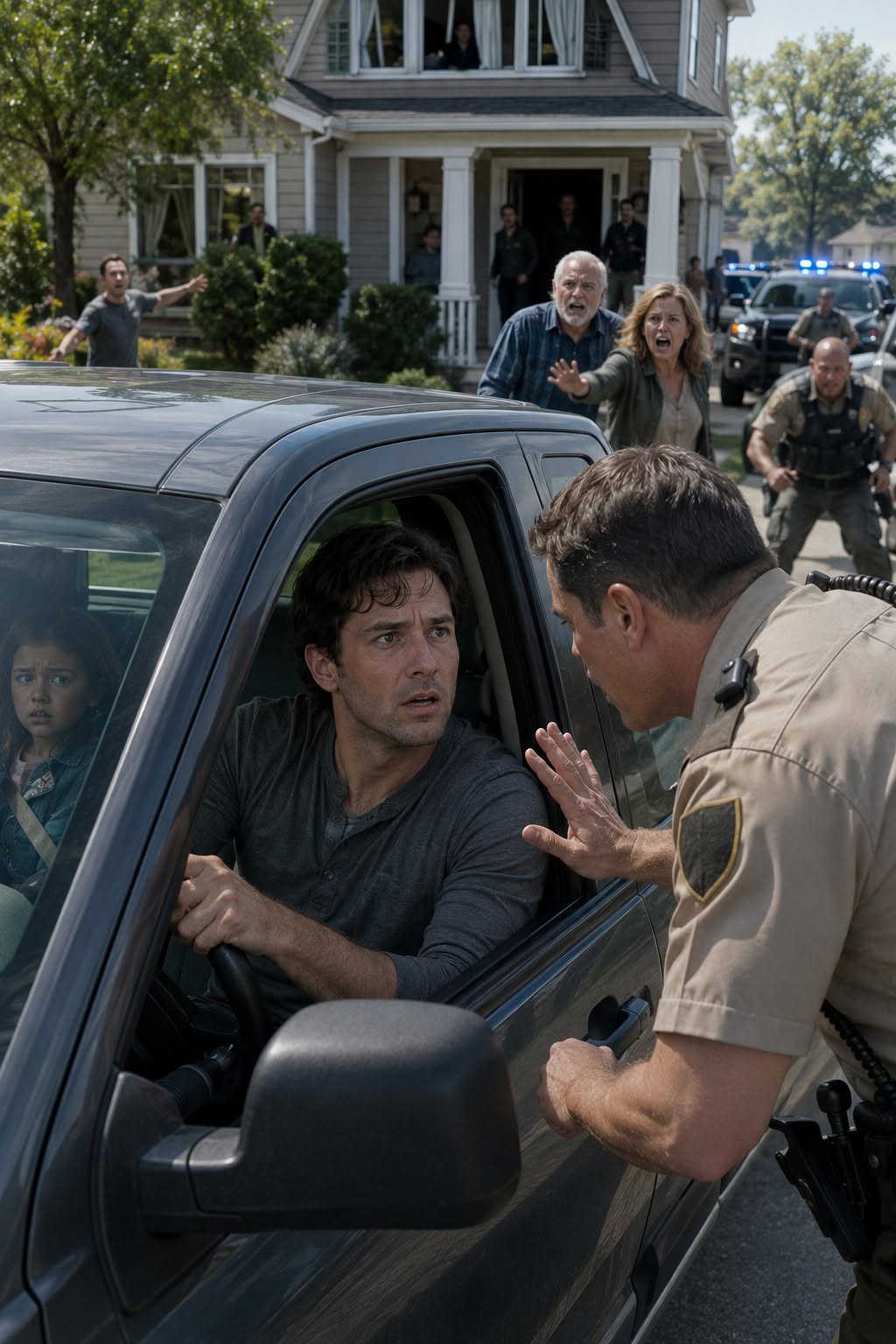
I Was Dropping My Daughter Off At My Father-In-Law’s House. A Sheriff Suddenly Stepped In Front Of Me Outside The House And Whispered: “Don’t Let Her Out Of The Car. Pretend Your Engine Won’t Start.” I Thought He Was Joking, But His Voice Turned Cold: “Please Do As I Say, There’s No Time To Explain.” Twenty Minutes Later…
The Sheriff Said, “Don’t Let Her Out of the Car”
### Part 1
The first thing I noticed was the porch light.
It was nine in the morning on a bright Saturday in April, the kind of morning when every lawn in Briar Ridge looked freshly combed and every driveway seemed to have a German SUV sleeping in it. Warren Bellamy’s house sat at the end of Wexford Lane behind two stone pillars and a black iron gate that never actually closed. The place had white columns, clipped hedges, and windows so polished they looked like they were judging you.
Usually, when I pulled into that circular driveway, my ex-wife Claire was already outside.
Arms crossed. Hair perfect. Mouth tight.
She liked to make the custody exchange feel like I was returning a rental car with scratches on it.
But that morning the porch was empty, and the porch light was on even though the sun was already high.
In the back seat, my six-year-old daughter, Ava, kicked her sneakers against the booster seat and hugged a stuffed fox named Captain Toast.
“Daddy,” she said, pressing her nose to the window, “do you think Grandpa Warren made waffles?”
“Maybe,” I said. “He does like showing off that waffle iron.”
“He puts too much butter.”
“That’s because Grandpa Warren thinks butter is a personality.”
Ava giggled, and for one soft second, I almost forgot how much I hated these drop-offs.
Two years earlier, Claire and I had signed divorce papers in a courthouse that smelled like old coffee and floor wax. She had moved back in with her father, Warren Bellamy, the kind of man who wore cashmere on weekdays and spoke to waiters like they were furniture. He had funded Claire’s custody fight with the same calm confidence other people used to pay for landscaping.
I had walked into that fight as a tired investigative reporter with a messy schedule, a cheaper lawyer, and a reputation for missing family dinners because corruption didn’t keep business hours. Claire’s attorneys called me unstable. Obsessed. Dangerous. They used every late-night assignment, every crime scene I had covered, every deadline I had chased, and turned it into proof that I loved work more than my daughter.
Maybe I had once.
That was the part that still burned.
After the divorce, I quit the newsroom and started freelancing. Less money. Fewer awards. More mornings making pancakes shaped like clouds. More afternoons at playgrounds. More nights reading Ava the same dragon book until she fell asleep halfway through chapter three.
Every other weekend, she went to Claire’s.
Every other weekend, I handed over my whole world.
I put the car in park.
Ava unbuckled one strap before I could stop her.
“Wait, bug,” I said.
She froze. “Why?”
I looked at the house again.
No Claire. No Warren. No housekeeper moving behind the front windows. No gardener trimming the already perfect boxwoods.
Just that porch light glowing uselessly in daylight.
Then a man stepped out from behind the left column.
He wore a sheriff’s uniform.
My hand tightened on the steering wheel.
I knew him, though not well. Sheriff Miles Harker. I had interviewed him years ago when I was still with the Chicago Ledger. Back then, he had testified against two deputies who were taking cash from a smuggling crew. He had looked old even then, not in the face exactly, but in the eyes.
He walked toward my car with purpose, but not with official calm.
He looked scared.
I rolled my window down two inches.
“Sheriff Harker?” I said.
He leaned in just enough for me to smell coffee and rain on his jacket.
“Don’t let her out of the car,” he whispered.
My throat tightened. “What?”
“Pretend the engine won’t start.”
I stared at him.
Ava leaned forward from the back. “Daddy, who is that?”
Harker’s eyes flicked toward her, then back to me.
“Mr. Price,” he said, voice low and hard now, “turn the key. Make it look like you’re having car trouble. Keep your daughter inside. Do not unlock the doors.”
Every bad story I had ever reported came back to me at once. The quiet street. The too-empty house. The strange official who wouldn’t explain himself.
“What’s going on?” I asked.
“No time.”
“Is Claire inside?”
His jaw moved once.
“Turn the key.”
I did.
The engine coughed, even though there was nothing wrong with it. I twisted the key again and let it grind. Ava stopped kicking the seat.
“Daddy?”
“Car’s acting weird,” I said, forcing my voice into something normal. “Give me a minute.”
Harker straightened and walked toward the front door, one hand near his belt, shoulders squared like a man stepping into a room he expected not to leave clean.
He knocked.
No one answered.
He knocked again, harder.
My phone buzzed in the cup holder.
Unknown number.
Stay in the vehicle. Do not approach the house. Help is already moving.
I looked at the message until the words blurred.
Then I saw movement through the upstairs curtain.
Not a person exactly.
Just the edge of a shadow slipping away.
And in that instant, with my daughter humming nervously behind me and the sheriff standing on my former father-in-law’s porch, I understood only one thing.
Something inside that house had been waiting for Ava.
And I had almost delivered her to it.
### Part 2
Twenty minutes can stretch until it feels like a sentence.
I kept one hand on the steering wheel and one near the lock button while Ava asked questions I could not answer.
“Can Grandpa fix the car?”
“Maybe.”
“Is Mommy sleeping?”
“I don’t know, sweetheart.”
“Why does that police man look mad?”
“He’s just working.”
I turned the key every couple of minutes, letting the engine complain and die. My car was a ten-year-old Ford with a coffee stain on the passenger seat and a crack in the dashboard, so the performance was believable. Still, sweat gathered under my collar.
More vehicles arrived without sirens.
First one unmarked sedan. Then two county SUVs. Then a state police cruiser that rolled silently to the curb like a shark.
Men and women in dark jackets moved across Warren Bellamy’s lawn with careful speed. One went around the side of the house. Two took positions near the garage. Someone spoke into a radio. Nobody looked at me for long, which somehow made it worse.
Ava hugged Captain Toast to her chest.
“Daddy, did I do something bad?”
That broke something in me.
I twisted around as far as the seat belt allowed. “No. Never. You didn’t do anything bad.”
“Then why can’t we go inside?”
Because a sheriff had whispered like a man trying not to wake a bomb.
Because your mother wasn’t on the porch.
Because rich houses can hide ugly things behind white curtains.
“I just need you to be patient,” I said.
She nodded, but her lower lip trembled.
At the front door, Harker stepped back. Another officer handed him something, and for a second their heads bent together. Then a heavy tool came out of a black case.
I turned Ava’s face toward me.
“Hey. Tell me about Captain Toast’s secret mission.”
Her eyes brightened a little. “He’s looking for the moon carrots.”
“The what?”
“Moon carrots. Foxes eat them when they want to fly.”
“That sounds classified.”
“It is.”
Behind me, the front door crashed open.
Ava jumped.
I started the engine for real, then killed it immediately, terrified that one wrong move would make someone point a weapon at us.
The officers disappeared inside.
The house swallowed them.
Silence came back, but it was not peaceful. It pressed against the windows. It got into my ribs. I watched the open front door and imagined Claire stepping out annoyed, asking what I had done now. I imagined Warren in one of his pale sweaters, calling this harassment. I imagined a misunderstanding.
I wanted a misunderstanding so badly I could taste it.
Then Sheriff Harker came out.
He was not running. That scared me more than if he had been. His face had changed. The urgency was still there, but buried now beneath something heavier.
He walked to my window and bent down again.
“Mr. Price,” he said, “I need you to drive away.”
“No.”
His eyes hardened. “Your daughter needs to leave this property now.”
“Where’s Claire?”
“Drive away.”
“Where is Warren?”
Ava whispered from the back, “Daddy?”
I lowered my voice. “Sheriff, you don’t get to stand there after telling me not to let my child out of the car and then give me nothing.”
Harker looked past me at Ava. His expression softened for less than a second.
Then he leaned closer.
“Your daughter was not supposed to come home from this visit.”
The street seemed to tilt.
My left hand went numb around the steering wheel.
“What does that mean?”
“It means you need to take her somewhere safe. Not your apartment. Not anywhere your ex-wife knows as a first guess. I will call you in one hour.”
I wanted to grab him by the collar. I wanted to force every answer out of him right there in Warren Bellamy’s perfect driveway.
Instead, I looked in the rearview mirror.
Ava’s eyes were huge.
So I nodded.
The engine started cleanly, almost obscenely. No cough. No hesitation. The lie was over.
As I backed out, Ava lifted one small hand and waved at the officers because she had been taught to be polite.
Nobody waved back.
I drove three blocks before I realized I was holding my breath.
“Daddy,” she said, very quietly, “am I still going to get waffles?”
I pulled into the parking lot of a closed garden center, put the car in park, and reached back for her hand.
“No, bug,” I said. “Not today.”
She squeezed my fingers.
On my phone, the unknown number sent one more message.
Tell no one where you are going.
I looked at those words and felt the first clean edge of terror slide under my skin.
Because only a few people knew about our Saturday drop-off.
And one of them was Ava’s mother.
### Part 3
I took Ava to a diner twelve miles away, the kind with chrome stools, cracked red vinyl booths, and a waitress who called everyone honey without looking up from the coffee pot.
Ava ordered silver-dollar pancakes with blueberries. I ordered coffee I never drank.
Every time the bell over the door jingled, I looked up too fast.
Ava colored a paper placemat. She drew Captain Toast with wings, then drew me beside him with giant square shoulders and a smile I did not deserve.
“Why are you watching everybody?” she asked.
“I’m just tired.”
“You look like when you forgot the oven was on.”
“That was one time.”
“It smelled bad.”
“It did.”
She smiled, and the normalness of it almost ruined me.
At 10:46, my phone rang.
Unknown number.
I stepped outside where I could see Ava through the window.
“This is Nolan Price.”
“Are you alone?” Sheriff Harker asked.
“My daughter’s inside. I can see her.”
“Can you take her to someone you trust? Someone not connected to Claire or Warren?”
“My friend Mason. He and his wife live in Glen Park.”
“Take her there. Then come to the county station. Alone.”
“What happened in that house?”
A pause.
“Mr. Price, not on the phone.”
“I’m done being handled.”
“You’re a father. Be that first. Be angry after she is safe.”
I hated him for being right.
Mason Rudd opened his front door twenty minutes later wearing sweatpants, a Northwestern hoodie, and the confused face of a man whose Saturday had just been ambushed. His wife, Talia, appeared behind him with flour on her cheek.
“Nolan?” Mason said.
“I need Ava to stay here for a few hours.”
He looked past me at my daughter, then back at my face.
His confusion vanished.
“Of course.”
Ava ran inside when Talia mentioned cinnamon rolls. I crouched in the doorway and kissed her hair.
“Be good for Mason and Talia.”
“Are you coming back soon?”
“Yes.”
“You promise?”
The word hit me hard.
“I promise.”
Mason followed me to the porch.
“What’s going on?”
“I don’t know all of it yet.”
“That’s not comforting.”
“I know.”
He gripped my shoulder. “Tell me what to do.”
“Don’t post anything. Don’t answer questions. Don’t let anyone pick her up unless it’s me. Not Claire. Not Warren. Not anybody.”
His face went pale.
“Nolan.”
“I’ll explain when I can.”
The county station sat beside a courthouse and an auto parts store, all brick and flagpoles and sun glare. Inside, a deputy led me to a conference room where Harker waited with a state detective named Simone Reyes.
She was maybe forty, with a sharp bob, tired eyes, and a folder thick enough to ruin lives.
“Mr. Price,” she said, “I’m sorry we had to bring you in this way.”
“Where is Claire?”
Neither of them answered fast enough.
“Where is my ex-wife?”
Reyes opened the folder.
“Claire Bellamy Price and Warren Bellamy were taken into custody this morning.”
The room went quiet except for the hum of the fluorescent light.
“For what?”
Harker leaned forward, elbows on knees.
“Conspiracy. Financial crimes. Obstruction. And a planned offense involving your daughter.”
My stomach turned.
“Planned offense?”
Reyes slid a photograph across the table.
It showed a gray van parked beside a warehouse. Ordinary. Dirty. Forgettable.
I pushed it back.
“No. Say it plainly.”
Reyes looked me in the eye.
“We believe Warren arranged for Ava to disappear from his home today. The public version would have been a stranger abduction. The real plan was that she would never be found alive.”
For a second, I heard nothing.
Not the light. Not the hallway. Not my own breathing.
Then my chair scraped backward and I was standing, though I did not remember standing.
“Claire knew?”
Reyes’s face did not change, but her voice softened.
“We have evidence she participated.”
I pressed both palms flat on the table.
“My daughter is six.”
“I know.”
“No, you don’t know. Six means she still asks if clouds get lonely. Six means she saves the marshmallows in cereal because she thinks they’re the treasure. Six means she thinks the moon follows our car because it likes us.”
Harker looked down.
Reyes let me run out of air.
Then she said, “Mr. Price, we need to ask you something. Did Ava ever mention a room in Warren’s house? A locked room, a storage room, a basement office, anything like that?”
My anger stumbled.
Two months earlier, Ava had come home from Claire’s weekend quiet and clingy. At bedtime, she had asked if grown-ups could get in trouble for having too many medicine boxes. I had asked what she meant. She said Grandpa Warren had a blue room downstairs with shelves and labels and men who didn’t smile.
I called Claire the next morning.
She laughed and said Ava had probably seen cleaning supplies.
I had let it go.
I sat back down slowly.
“She saw something,” I whispered.
Reyes nodded.
And that was when guilt found the one open place in my chest and drove a knife straight through it.
Because my daughter had told me the truth.
And I had handed her back anyway.
### Part 4
Detective Reyes did not give me everything at once.
She gave it to me in pieces, maybe because she thought I would break if she dropped the whole weight on the table.
Warren Bellamy, respected medical supply consultant, charity donor, hospital board member, had spent years moving restricted pharmaceuticals through a network of fake invoices, shell companies, and friendly professionals who knew how to make paper look clean. He hid behind clinics, warehouses, consulting agreements, and men who never used their real names twice.
Claire had helped with the money.
That sentence did something strange to me.
Not because I thought Claire was innocent. I had divorced her, not sainted her. She could be cruel. She could be cold. She could turn a room against you with one raised eyebrow.
But laundering her father’s money while fighting me for custody?
Helping him protect a machine that ruined strangers’ lives?
Letting that machine turn toward Ava?
No part of me knew where to put that.
Reyes showed me bank transfers, property records, calendar entries, messages written in careful half-language. There were no dramatic confessions. No villain speeches. Just numbers, initials, times, and coded references to “inventory,” “cleanup,” and “family risk.”
Family risk.
That was what they had called my daughter.
Harker told me the tip had come three weeks earlier from someone inside Warren’s circle. The tipster did not know the whole plan, only that something was supposed to happen during the custody exchange and that Ava was the reason.
“So you watched the house?” I asked.
“Seventy-two hours,” Harker said. “We were hoping to identify everyone involved before the exchange. We almost pulled you over before you arrived, but we needed to see whether someone inside made contact.”
“You used my daughter as bait?”
His jaw tightened.
“We made sure she never left the vehicle.”
I wanted to hate him for that.
I tried.
But all I could see was his face at my window, the urgency in his whisper.
Don’t let her out of the car.
“What happens now?” I asked.
“Formal charges,” Reyes said. “Search warrants. Federal involvement. Your statement. Emergency custody order.”
“And Warren?”
“He has money. Lawyers. Friends.”
“That wasn’t my question.”
Her eyes held mine.
“He’ll fight.”
Of course he would.
Men like Warren Bellamy did not confess. They rebranded. They adjusted. They found other men in better suits to say the facts were complicated.
By the time I left the station, the afternoon sun was too bright. I stood in the parking lot beside my Ford and tried to breathe through the taste of metal in my mouth.
Then I drove back to Mason’s.
Ava was in the kitchen wearing one of Talia’s aprons, rolling dough with total seriousness.
“Daddy!” she shouted. “I made a cinnamon snake!”
“That sounds dangerous.”
“It is. But tasty.”
I hugged her too hard. She squirmed.
“You’re squeezing my bones.”
“Sorry, bug.”
That night, after I got Ava home and checked the locks three times, she fell asleep with Captain Toast tucked under her chin. I sat on the floor beside her bed until my knees ached. Every shadow in her room looked like a warning. Every car passing outside made my spine stiffen.
At midnight, I went to my desk.
The old reporter in me was awake now.
Not the man who had missed birthdays and lived on coffee and adrenaline. Not that version. This was something colder. Cleaner.
I pulled public records. Corporate filings. Property transfers. Campaign donations. Charity boards. Lawsuits. Licenses. Every old skill came back through my hands.
Warren’s empire looked respectable from a distance.
Up close, it was mold behind wallpaper.
I found companies nested inside companies. Warehouses leased through cousins of accountants. Consulting firms with no employees. Donations made right after suspicious transfers. Names repeating in places they should not repeat.
At 2:18 a.m., I found the first name that made me sit up.
Elena Voss.
Former executive assistant to Warren Bellamy. Resigned eight weeks ago. No new employment. Condo paid in cash through a limited liability company connected to one of Warren’s side firms.
I searched her image.
She appeared beside Warren at galas, hospital fundraisers, ribbon cuttings. Always smiling. Always one step behind him.
In one photo, she wore a silver pendant shaped like a small bird.
Ava had drawn that same bird in the corner of a picture two months ago.
When I saw it, the room seemed to shrink around me.
Because Ava had not just seen Warren’s blue room.
She had seen Elena there too.
### Part 5
The arraignment took place Monday morning under a sky the color of dirty dishwater.
By eight, news vans had already filled the courthouse parking lot. Reporters stood in clusters with paper cups and frozen smiles, waiting for someone else’s disaster to walk past their cameras. I used to be one of them. I knew the posture. Alert but casual. Hungry but polished.
This time, I went in through the side entrance with Mason beside me and Sheriff Harker ten steps behind.
Ava was with Talia.
Safe.
That word had become less like comfort and more like a job I had to keep doing every minute.
Inside the courtroom, Warren Bellamy sat at the defense table in a navy suit, not jail orange. Of course he did. His lawyer had moved fast. Warren looked thinner than he had on Saturday, but not frightened. Irritated. As if the legal system were a flight delay.
Claire sat two chairs away in a beige county jumpsuit.
That stopped me.
Warren had dressed himself in money.
Claire had not.
Her hair was pulled back badly. Her face had no makeup. She looked around the room once, and when her eyes found mine, something passed over her expression.
Fear.
Not guilt. Not sorrow.
Fear.
I sat in the back row and kept my hands folded because if I did not give them something to do, they might start shaking.
The prosecutor laid out the charges in careful language. Financial conspiracy. Distribution through unlawful channels. Laundering proceeds. Obstruction. Conspiracy to harm a minor witness.
Minor witness.
Ava had become a legal phrase.
Warren’s attorney, a silver-haired man named Preston Kline, stood and described his client as a philanthropist, a widower, a respected businessman with deep community ties. He said Warren had no reason to flee. He said the allegations were built on panic, speculation, and the word of criminals trying to save themselves.
When he mentioned Ava, he did not use her name.
He called her “the child.”
My vision narrowed.
Claire’s public defender asked for reasonable bail. Kline did not look at her once.
The judge set Warren’s bond high enough to make people gasp.
Warren posted it before lunch.
Claire stayed in custody.
That was the first crack.
Men like Warren protected assets, not people. Claire had mistaken blood for loyalty. I had made the same mistake once, just in a different direction.
Outside the courthouse, reporters surged toward Warren. Kline spoke for him.
“Mr. Bellamy denies these outrageous allegations. He looks forward to clearing his name and returning to the charitable work that has defined his life.”
Warren stood behind him, solemn and offended.
He performed innocence beautifully.
Then his eyes slid toward me.
For the first time in all the years I had known him, Warren Bellamy smiled at me without pretending it was polite.
It was small.
Private.
A promise.
I took out my phone and photographed the man opening Warren’s car door. Tall. Broad. Black suit. Green watch face. Security, not driver.
I sent the picture to an old contact, Marcus Hale, a private investigator who had once owed me a favor and had made the mistake of answering his phone the night before.
His reply came twenty minutes later.
Name: Dean Larch. Former private protection. Expensive. Not subtle. Why are you following this guy?
I typed back.
Because he works for the man who tried to kill my daughter.
Marcus called immediately.
“Tell me that sentence was emotional exaggeration.”
“It wasn’t.”
A long silence.
Then: “What do you need?”
“Warren’s movements. His visitors. His companies. His assistant Elena Voss. Anything the police don’t already have.”
“I don’t do revenge jobs.”
“Good. This is reporting.”
“Nolan.”
“Marcus, I’m not asking you to break laws. I’m asking you to find facts.”
He sighed. “Facts are usually worse.”
Over the next four days, facts arrived.
Warren had increased security at his house. He had moved meetings from offices to private clubs. He visited two banks, one attorney, and a medical warehouse that had supposedly been empty for months.
And every Thursday at 2 p.m., he visited Elena Voss’s condo.
He stayed exactly ninety minutes.
On Friday night, Marcus sent me a photo taken through a lobby window. Warren entering Elena’s building. Elena waiting inside. No smile this time. Her arms wrapped around herself like she was cold.
Then Marcus sent another image.
A close-up of Warren’s hand on her shoulder.
Not fatherly. Not professional.
Possessive.
I stared at the photo until the screen dimmed.
Elena Voss was not just an employee.
She was a secret.
And secrets, in my experience, either opened doors or buried bodies.
### Part 6
I did not approach Elena right away.
A younger version of me would have. He would have knocked on her door, shoved a recorder forward, and turned pressure into a weapon. That version had gotten good quotes and ruined dinners. He had also lost a marriage in slow motion.
Now I waited.
I watched.
I read.
Elena Voss had grown up in Peoria, put herself through community college, and worked five administrative jobs before Warren hired her. Her mother had unpaid medical bills. Her brother had a sealed arrest record. She had no husband, no children, no visible social life after joining Warren’s company.
Six years in his orbit had made her richer, better dressed, and more alone.
I found the condo purchase. Hidden, but not hidden well enough. Paid through a company connected to Warren’s consulting network. I found jewelry receipts. Travel reservations. A private clinic visit in Denver. A hotel in Milwaukee where Warren had booked two rooms and used one.
Then I found something better.
Elena had notarized documents for three of Warren’s shell companies. Her signature sat beside names I had already seen in Detective Reyes’s folder. She had touched the machine. Maybe lightly. Maybe unwillingly. But she had touched it.
On Monday morning, I sent her a message from an email account with no personal history.
Subject: Warren will not protect you.
The message was short.
You know what the blue room was. You know who met there. You know my daughter saw it. Warren left Claire in jail while he went home to clean up his own life. He will do the same to you. Talk before he decides you are another risk.
I did not sign it.
By noon, I had read the message thirty times and hated myself a little more each time.
At 4:07 p.m., she replied.
Lincoln Park. South garden. Wednesday. Come alone.
I went early.
Not because I trusted her. Because I didn’t.
The garden smelled like wet soil and crushed leaves. Mothers pushed strollers along the path. A man in running shorts stretched beside a fountain. Two teenagers shared earbuds on a bench.
Elena arrived wearing sunglasses too large for her face and a gray coat buttoned to her throat.
“You shouldn’t have contacted me,” she said.
“You came anyway.”
Her lips pressed together.
I kept my hands visible. “I’m not here to threaten you.”
“You already did.”
“I told you the truth.”
She laughed once, sharp and humorless. “People always call it truth when they want something.”
“What do you know about the plan for Ava?”
Her face changed.
Not enough for most people to notice.
Enough for me.
“I didn’t know it was a plan,” she said.
“What did you think it was?”
“I heard things. Fragments. Warren was angry that your daughter talked too much. Claire was crying one day in his office. He told her children forget if adults stay calm. I thought he meant custody. Moving. Boarding school. Something rich people do when they want silence.”
“Boarding school?”
“I’m telling you what I told myself.”
A squirrel skittered across the path. Somewhere behind us, a child laughed.
Elena flinched at the sound.
“What happened two months ago?” I asked.
She looked down at her hands.
“Ava got lost. She opened the basement door. I was coming out with a folder. She saw shelves. Boxes. Men she didn’t recognize. Warren grabbed her arm too hard.”
My jaw locked.
“Elena.”
“I told him to stop.”
“You told him to stop?”
Her eyes filled.
“She looked at me like she thought I could help her.”
That sentence landed softly and did the damage slowly.
“Why didn’t you?”
“Because I was afraid.”
“Of Warren?”
“Of losing everything. Of being charged. Of people finding out what I had signed. Of him telling everyone I was some pathetic mistress who helped because she wanted gifts.”
“Did you?”
She deserved the question. I deserved the answer.
Her mouth trembled.
“At first, I didn’t know. Then I knew enough to leave. Then I stayed anyway.”
I took a breath.
“Detective Simone Reyes. Talk to her.”
“Warren will destroy me.”
“He’s already started. You just don’t know which version of the story he’s writing.”
She wiped beneath her sunglasses.
“There’s a storage office in an old billing company downtown. He kept duplicate calendars there. Not the official ones. The real ones. Meetings, initials, pickup windows, payments. If he hasn’t moved them, they’re in a gray file cabinet behind a fake wall panel.”
My pulse changed.
“Why tell me?”
“Because on Friday, Warren asked me whether I had ever mentioned Ava’s name to police.”
Her voice dropped.
“He smiled when he asked.”
I felt the garden, the people, the spring air all pull away from me.
Elena looked straight at me through those dark lenses.
“I think your daughter isn’t the only loose end he plans to erase.”
### Part 7
I called Detective Reyes from the sidewalk outside the garden.
She did not sound surprised when I said Elena’s name.
That told me enough.
“Do not go to that storage office,” Reyes said.
“I’m sending you the address.”
“Good. Send it. Then stay away.”
“She might run.”
“We’ll move fast.”
“I know what ‘move fast’ means in law enforcement.”
“And I know what freelance reporters do when they think they’re the only ones with urgency.”
A bus hissed at the curb. People stepped around me, carrying groceries, coffee, lives untouched by Warren Bellamy.
“My daughter was almost killed because everyone moved carefully,” I said.
Reyes went quiet.
Then she said, “Your daughter is alive because Sheriff Harker moved carefully. Remember that before you mistake restraint for weakness.”
I hated that she was right.
Again.
But I also knew institutions. Warrants took time. Supervisors asked questions. Federal agencies protected cases like jealous dragons. Evidence could vanish while good people filled out forms.
So I did something halfway between obedience and stupidity.
I called Marcus.
He answered on the second ring. “I can hear bad judgment in your breathing.”
“I need eyes on a downtown storage office. No entry. Just tell me if anyone goes in.”
“That’s still bad judgment.”
“But not illegal.”
“Barely.”
An hour later, Marcus parked across from the old billing company on West Armitage, a narrow brick building wedged between a print shop and a nail salon. The company name had been scraped off the glass, leaving ghost letters behind.
At 7:12 p.m., Marcus texted.
Black SUV arrived. Two men. One is Dean Larch.
My fingers went cold.
Another text.
They have boxes.
I called Reyes again.
“They’re moving evidence.”
“We’re two minutes out,” she said.
Two minutes.
The longest unit of time in the world, after twenty.
I was already in my car.
I do not remember deciding to drive there. I remember the city lights smearing across my windshield. I remember my breath sounding too loud. I remember thinking that Ava was at Mason’s again, safe, eating grilled cheese, unaware that her father was chasing ghosts through Chicago traffic.
By the time I reached the block, police vehicles had sealed both ends.
No sirens.
No chaos.
Just controlled motion.
I parked badly and got out.
Reyes saw me immediately.
Her face could have cut glass.
“I told you to stay away.”
“I did. From the building.”
She pointed toward my car. “Stand there. Do not move.”
I stood there.
Mostly.
Officers brought Dean Larch out first. His green watch flashed under the streetlight. He looked bored until he saw me. Then recognition flickered across his face.
The second man came out carrying nothing, hands cuffed behind him.
Then an evidence tech emerged with a gray metal file box.
Reyes looked at it.
Then at me.
Her anger did not disappear, but something else joined it.
Later, at the station, she allowed me one cup of terrible coffee and exactly seven minutes of information.
The storage office had contained duplicate calendars, payment ledgers, private correspondence, and a folder labeled with my last name.
Price.
I stared at her.
“What was in it?”
“We’re still processing.”
“What was in it?”
She exhaled through her nose.
“Custody records. Your old articles. Photos of your apartment. Your daughter’s school schedule. Notes about your routines.”
The room got smaller.
“Why?”
“We think Warren’s original plan included making you look connected to Ava’s disappearance.”
I laughed.
It came out wrong.
“Connected how?”
“Unstable father. Financial stress. History covering violent crime. Possible obsession with former wife. They had a narrative ready.”
A narrative.
That was my language.
My weapon.
Warren had planned not only to take Ava from me, but to turn me into the monster afterward.
“What about Claire?”
Reyes hesitated.
“What?”
“There are notes in her handwriting.”
My chest tightened so sharply I had to look away.
“Of course there are.”
“One more thing,” Reyes said. “Elena is coming in tonight. She wants immunity consideration.”
“She deserves prison.”
“Maybe. But her testimony may put Warren away for the rest of his life.”
I thought of Elena in the garden saying Ava looked at her like she could help.
“Then use her.”
Reyes studied me.
“You were a reporter. You know this part. Cases are built with imperfect people.”
“Yes,” I said. “And families are destroyed by them.”
When I got home after midnight, Ava was asleep on the couch under Mason’s old college blanket. Talia had left a plate of food for me in the microwave.
I carried Ava to bed.
Halfway down the hall, she stirred.
“Daddy?”
“I’m here.”
“Did Mommy call?”
I stopped walking.
“No, bug.”
Her eyes barely opened.
“Is she mad at me?”
Something inside me cracked so quietly no one else would ever hear it.
“No,” I whispered. “You didn’t do anything wrong.”
She fell asleep again against my shoulder.
I stood there holding her, staring into the dark hallway, wondering how I would ever explain that her mother’s silence was not anger.
It was guilt wearing handcuffs.
### Part 8
The first article went live on a Thursday at 6:00 a.m.
I had not slept.
Dana Pierce, my old editor from the Ledger, had taken one look at the documents and said, “This is either the biggest story of your life or the lawsuit that kills us both.”
“Can it be both?” I asked.
She did not smile.
For two weeks, we verified every line. Corporate records. Court filings. Interviews with former employees. Donation trails. Warehouse leases. Public health complaints. Lawsuits that had settled quietly. Families who had lost sons, daughters, brothers, mothers after pills moved through channels no respectable businessman would admit existed.
We did not publish names we could not support.
We did not include details that could damage the criminal case.
We did not mention Ava’s school, her routines, or anything that would put her in danger.
But we told enough.
Warren Bellamy, public benefactor, had built a fortune on misery and hid it beneath charity luncheons.
Claire Bellamy Price, his daughter, had helped move money through clean-looking books.
And a six-year-old girl had nearly become the cost of doing business.
Dana changed Ava’s name in the piece.
I still threw up after reading that paragraph.
By 8:30 a.m., every local station had it. By noon, national outlets were calling. By dinner, Warren’s name was everywhere, tied not to hospital wings and scholarship funds, but to ledgers, shell companies, and a planned crime against his own granddaughter.
The phone did not stop.
I ignored most calls.
At 4 p.m., Sheriff Harker came to my apartment.
Ava was at school, then going home with Talia. I had arranged pickups, passwords, backup passwords, and a list of people authorized to breathe in her direction.
Harker stood in my kitchen, hat in hand, looking too large for the room.
“Hell of a piece,” he said.
“That sounds like praise wearing a warning.”
“It is.”
I poured coffee, then forgot to offer him any.
“Federal prosecutors are furious,” he said.
“They’re always furious.”
“You exposed things they wanted sealed.”
“I exposed things Warren wanted buried.”
“You also painted a target on yourself.”
I leaned against the counter.
“Sheriff, the target was already there. It had my daughter’s name on it.”
His expression shifted.
“I understand that better than you think.”
I waited.
He looked at the table, at the crayon drawing Ava had left there that morning. A purple fox flying over a house with too many windows.
“My sister married a man like Warren,” Harker said quietly. “Not rich like him. Just convinced people were objects. By the time we understood how bad it was, she had stopped asking for help.”
“I’m sorry.”
He nodded once, accepting without inviting more.
“I’m telling you this because rage feels like a plan when grief has nowhere to go. But it’s not always a plan.”
“It is for me.”
“That’s what worries me.”
Before I could answer, someone knocked.
Not the doorbell.
Three firm knocks.
Harker’s hand moved toward his sidearm.
I went still.
Another knock.
“Nolan Price?” a man called from the hallway. “Package.”
I had ordered nothing.
Harker moved silently to the side of the door and looked through the peephole.
His face hardened.
He opened the door fast.
The hallway was empty.
On the mat sat a small white bakery box tied with red string.
Harker held up one hand to keep me back.
An evidence unit came twenty minutes later. The box did not contain anything explosive, poisonous, or physically dangerous.
That almost made it worse.
Inside was a single waffle, carefully wrapped in wax paper.
Beside it was Ava’s school picture.
On the back, someone had written:
You cannot watch her every second.
I read it once.
Then again.
The handwriting was not Warren’s.
It was Claire’s.
Harker took the photo from me before I could crush it in my fist.
“Nolan,” he said.
But I was no longer listening.
Because until that moment, some damaged part of me had still wanted to believe Claire had been dragged into her father’s darkness.
Now I knew she had walked in.
And she still knew where to hurt us.
### Part 9
The emergency custody hearing happened behind closed doors.
No cameras. No reporters. No dramatic speeches in front of a packed gallery.
Just a family court judge with silver glasses, two attorneys, Detective Reyes, Sheriff Harker, me, and a stack of evidence thick enough to make the air feel heavier.
Claire appeared by video from county jail.
When her face filled the screen, I felt nothing at first.
That scared me.
I had expected rage. Grief. Some leftover echo of the woman I married.
Instead, I looked at her and saw someone standing behind glass in a museum of bad decisions.
Her lawyer argued that the criminal allegations had not yet been proven. He said Claire still had parental rights. He said Ava needed stability and should not be alienated from her mother.
The judge’s mouth tightened at that.
Then Detective Reyes described the folder found in the storage office. My routines. Ava’s school schedule. Notes in Claire’s handwriting. The staged narrative they had prepared about me.
Then Sheriff Harker described the waffle box.
Claire’s lawyer objected.
The judge overruled him so sharply he sat down halfway through his own sentence.
Finally, the judge looked at me.
“Mr. Price, do you wish to make a statement?”
I had written one. Three pages. Careful. Controlled. Dana had helped me cut the anger down to something a court could hear.
But when I stood, I did not look at the paper.
“I used to think custody meant time,” I said. “Weekends. Holidays. Pickup. Drop-off. Who gets Christmas morning. Who signs the school forms. But now I understand custody means being the person standing between your child and whatever wants to harm her.”
Claire’s face flickered on the screen.
I kept going.
“My daughter is not a bargaining chip. She is not an inheritance problem. She is not a witness to be managed. She is a little girl who likes foxes and blueberry pancakes and believes every dog wants to be her friend. Her mother and grandfather turned her life into a risk calculation.”
My voice almost broke there.
I held it.
“I am asking this court to make sure they never get close enough to calculate again.”
The judge granted me full emergency custody before lunch.
Claire’s visitation was suspended indefinitely.
All contact had to go through court review.
When it was over, I stepped into the hallway and put one hand against the wall because my legs had gone weak.
Not from fear.
From the sudden terrible relief of being believed.
That afternoon, Claire requested a private call.
I said no.
Then I said yes because some part of me needed to hear her try.
The call came through her attorney’s office. I sat at my kitchen table with a recorder running, because love had once made me careless and I was done being careless.
“Nolan,” she said.
Her voice was smaller than I remembered.
“What do you want?”
“I need to explain.”
“No. You want to explain. Those are different things.”
She inhaled shakily.
“My father controlled everything. You don’t understand what it was like growing up with him.”
“You’re right. I don’t.”
“He made things seem normal. He said Ava was too young to remember what she saw. Then he said if she kept talking, the investigation would reach all of us. He said you would use it to take her away from me.”
“You helped him prepare to frame me.”
“I was scared.”
“You mailed her school picture to my apartment.”
Silence.
The refrigerator hummed beside me.
“That wasn’t supposed to scare Ava,” she whispered.
I closed my eyes.
“Listen to yourself.”
“I just wanted you to stop publishing.”
“You wanted me afraid.”
“I wanted my life back.”
There it was.
Not Ava.
Not truth.
Not remorse.
Her life.
“You don’t have one anymore,” I said.
She started crying then.
I had heard Claire cry before. During our marriage, her crying could turn me inside out. It could make me apologize for things I had not done and forgive things she had not admitted.
This time, it sounded like weather in another state.
“Nolan, please. I’m her mother.”
“No,” I said quietly. “You gave birth to her. Then you chose money, fear, and your father over her life. Don’t confuse biology with motherhood.”
Her breath hitched.
“You can’t erase me.”
“I don’t have to. You did that yourself.”
I ended the call.
For a long time, I sat at the table staring at Ava’s purple crayon drawing.
Then my phone buzzed.
A message from Marcus.
Found something you need to see. It’s about Warren’s charity money.
Attached was a scanned donor agreement from Briar Ridge Children’s Hospital.
At the bottom, beneath Warren Bellamy’s signature, was a clause naming the new pediatric wing after him permanently.
The Bellamy Family Hope Center.
I stared at that name until anger came back, steady and useful.
Warren had nearly stolen my daughter’s future.
Now I was going to take his name off every wall that pretended he had ever cared about children.
### Part 10
Warren loved his legacy more than he loved any living person.
That was not an insult. It was a fact, as plain as the marble plaques with his name on them.
The Bellamy Family Hope Center.
The Warren Bellamy Research Fellowship.
The Bellamy Garden for Healing.
The Bellamy Lecture Series.
His name appeared on buildings, donor boards, scholarship pages, glossy annual reports, and gala invitations printed on paper thick enough to stop a small knife. He had purchased virtue in installments and collected gratitude like interest.
So I wrote letters.
Not angry letters. Anger is easy to dismiss.
I wrote clean, documented, impossible letters.
To hospital boards. University presidents. Museum directors. Foundation chairs. Charity trustees. Every institution that had taken Warren’s money and polished his name for public display.
I included public records, financial links, court filings, and excerpts from our investigation. I did not ask them to believe me. I asked them to ask themselves what they were willing to defend.
Dana published a follow-up piece about charitable institutions accepting money from men whose fortunes had hidden costs. Warren was not the only example, but he was the center of it. The headline did not shout. It did not need to.
Within forty-eight hours, one university announced a review.
By the end of the week, the hospital removed his name from its website.
A museum paused a planned donor event.
Two foundations returned recent gifts.
The Bellamy Garden for Healing became simply the East Courtyard.
I printed that announcement and put it in a folder.
Not because I was proud.
Because I wanted a record of each wall losing his shadow.
Warren’s lawyer issued statements about due process, presumption of innocence, and the dangers of trial by media. He called me vindictive.
He was right.
He also called me dishonest.
That was a mistake.
Dana answered with documents.
On Sunday morning, Marcus called.
“You still want to know where Warren goes when he thinks nobody useful is watching?”
“Yes.”
“Oak Hill Cemetery. Every Sunday. His wife’s grave.”
I knew about Marianne Bellamy.
Claire’s mother had died four years earlier after a long illness. I had met her only a handful of times before she got sick. She was quiet, warm, and better than that house deserved. Ava had been too young to remember much, but Marianne had once sent her a hand-sewn blanket with tiny yellow birds on it.
Warren visited her grave at nine every Sunday.
Alone except for security at the car.
I arrived at Oak Hill at 7:30 the next Sunday with coffee I did not drink and a small bunch of yellow tulips. The cemetery rolled over gentle hills, wet grass shining in the morning light. Birds moved through the trees. Somewhere, a maintenance cart buzzed like an insect.
Marianne’s headstone was simple.
Marianne Ellis Bellamy
Beloved Wife and Mother
A Gentle Heart Remembered
I placed the tulips beside it.
Then I sat on a bench and waited.
Warren arrived at 9:08.
Dean Larch stayed by the black SUV.
Warren walked with flowers in one hand and a cane in the other, though I suspected the cane was for sympathy more than support. When he saw me, he stopped.
For the first time, he looked old.
Then the mask returned.
“You have no right to be here,” he said.
“I have more right than you.”
His eyes moved to the tulips.
“Do not perform grief for my wife.”
“I’m not here for you.”
He stepped closer. “You’ve made your point.”
“No. I’ve made several.”
“You think destroying my name saves your daughter?”
I stood.
“Keeping her away from you saves her. Destroying your name is for everyone else.”
His mouth curled. “You always were small. That was Claire’s complaint, you know. Small apartment. Small paycheck. Small ambitions dressed up as principles.”
“Claire’s in jail.”
His face twitched.
“You left her there,” I said.
“She made her choices.”
“So did Ava?”
For a second, something dark and impatient broke through.
“That child opened doors she was told not to open.”
The air seemed to go still.
There it was. Not a denial. Not outrage. Blame.
“She was six.”
“She was a liability.”
The word came out before he could dress it up.
I felt my pulse in my teeth.
Behind him, Dean Larch shifted near the SUV.
“You should leave,” Warren said.
“I will. But first, I want you to understand something. Ava is going to grow up. She’ll have birthdays. Sleepovers. School plays. Bad haircuts. Favorite songs. She’ll learn to drive. She’ll choose a college or not. She’ll become whoever she wants. And you won’t be there for any of it.”
His face hardened.
“I am her grandfather.”
“You are a cautionary tale.”
His hand tightened around the cane.
“I built this family.”
“You tried to bury it.”
For a moment, I thought he might swing the cane.
Part of me wanted him to.
Instead, he leaned close enough for me to smell mint and expensive aftershave.
“You think you won because the public clapped for your little articles?” he whispered. “There are things you still don’t know.”
My skin went cold.
“What things?”
He smiled.
Then he turned and walked back to the SUV.
I watched him leave, anger mixing with dread in my stomach.
Because Warren Bellamy did not bluff when he was cornered.
And if there were things I still did not know, one of them might already be moving toward Ava.
### Part 11
For three days after the cemetery, I barely slept.
Every sentence Warren had spoken replayed in my head until it lost shape.
There are things you still don’t know.
I checked Ava’s school route. Changed our grocery store. Bought a door camera. Installed window alarms. Made Mason promise not to roll his eyes when I asked him to check the street before bringing Ava home from soccer.
He did not roll his eyes.
That scared me too.
Detective Reyes told me Warren was trying to shake me.
“Men like him throw smoke when they’re out of doors,” she said.
“And if it’s not smoke?”
“Then we find the fire.”
The fire came from Elena.
By then, she had entered protective housing and given hours of statements. Her attorney negotiated. The prosecutors pressed. Elena cried, contradicted herself, corrected dates, remembered names, and slowly became the kind of witness defense lawyers hate: flawed but documented.
She asked to speak with me once.
Reyes advised against it.
I went anyway.
We met in a state police interview room with a camera in the ceiling and a box of tissues on the table. Elena looked smaller without sunglasses, younger and older at the same time.
“I remembered something,” she said.
I sat across from her but did not remove my coat.
“About Warren?”
“About Claire.”
My hands tightened in my lap.
“The day after Ava saw the basement room, Claire came to Warren’s office. They argued. I couldn’t hear everything, but Claire said, ‘She’s my daughter.’ Warren said, ‘Then act like her mother and secure her future.’”
I tasted bitterness.
“Elena, don’t soften this for me.”
“I’m not. Claire asked about money. The trust.”
“What trust?”
Elena looked at Reyes through the glass, then back at me.
“Warren set up a trust for Ava when she was born. Publicly, it was five hundred thousand for college. Privately, there was another structure. Much larger. If Ava reached adulthood, she controlled part of Marianne’s estate.”
I stared.
“Marianne’s estate?”
“Warren didn’t own everything. Marianne came from money too. She left assets for Claire and Ava. Warren managed them. If Ava died before adulthood, Claire’s share increased and Warren maintained control longer.”
The room tilted.
All this time, I had thought Ava was a witness first and an inconvenience second.
But she had also been an obstacle to money Warren believed should remain his.
And Claire had known.
“Elena,” I said slowly, “did Claire know what Warren planned for the custody exchange?”
Elena’s eyes filled again.
“Yes.”
The word did not explode.
It sank.
“She knew,” Elena whispered. “She didn’t want details. She kept saying, ‘I don’t want to hear the mechanics.’ Warren told her that was fine. He said all she had to do was be away from the house and answer questions afterward like a grieving mother.”
I stood up so fast the chair legs shrieked.
Reyes entered immediately.
“Nolan.”
I could not breathe.
Grieving mother.
Claire had planned to mourn my child.
In public.
For sympathy.
For money.
For freedom.
I walked out before I said something that would become evidence against me.
The trial began six weeks later.
By then, Warren’s public life was rubble. His name had come down from buildings. His partners had scattered. His accounts were frozen. Men who once returned his calls within minutes now released statements through attorneys saying they had barely known him.
The courtroom was packed every day.
I testified on the third.
The prosecutor asked about Ava’s comment regarding the blue room. The custody exchange. Sheriff Harker’s warning. The fake engine trouble. The way Warren and Claire had reacted when I had raised concerns months before.
Warren watched me the whole time.
Claire did not.
When her attorney cross-examined me, he tried to paint me as obsessed. A reporter hungry for the biggest story of his career. A bitter ex-husband. A man who had hated Warren long before there was evidence.
I answered calmly.
Mostly.
Then he asked, “Isn’t it true, Mr. Price, that your career benefited from this tragedy?”
The courtroom went silent.
I looked at Claire.
Then Warren.
Then the jury.
“My daughter is alive,” I said. “That is the only benefit I recognize.”
The prosecutor called Elena after lunch.
She wore a navy dress and looked terrified.
Warren’s attorney tore into her for accepting gifts, signing documents, sleeping with her employer, and asking for immunity. He called her unreliable. Self-serving. Morally compromised.
She took it.
Then the prosecutor put the duplicate calendars on the screen.
Dates. Initials. Payments. Meetings.
Elena’s testimony became a map.
Brett Soren, the man hired to stage Ava’s disappearance, testified the next day. I did not look at him for long. He spoke in a flat voice about instructions, timing, and payment. He never said Ava’s name. Maybe he had been told not to. Maybe he did not want to make her real.
It did not matter.
She was real enough to put him away.
The jury deliberated for less than seven hours.
When they returned, Ava was at school, making a paper butterfly, according to a photo Talia had texted me.
I stood in the courtroom and listened.
Guilty.
Guilty.
Guilty.
Warren’s face did not change until the final count.
Then his mouth opened slightly, as if the world had made a clerical error.
Claire began sobbing.
Not softly.
Not beautifully.
She folded over herself and made a sound I had never heard from her before.
I felt no pity.
Only a strange, exhausted emptiness.
Because the truth had finally stood up in public.
And it had Claire’s fingerprints all over it.
### Part 12
Sentencing came in November.
The trees outside the courthouse had gone bare, and the wind pushed dead leaves along the curb like little brown warnings.
Warren arrived in a wheelchair.
No one believed it.
His lawyer spoke about age, illness, charitable work, and the humiliation Warren had already suffered. He mentioned hospitals. Scholarships. Community leadership. He tried to rebuild the old statue one sentence at a time.
Then the prosecutor spoke about the people harmed by Warren’s business. Families who had trusted doctors. Patients who became customers. Communities flooded through back doors while Warren smiled at ribbon cuttings.
Then she spoke about Ava.
Not as “the child.”
Ava.
My daughter’s name entered the room like a bell.
The judge sentenced Warren to thirty-eight years.
At seventy-one, it was a life sentence wearing math.
Claire received twenty-two years.
Brett Soren received fourteen after cooperation.
Others received their own numbers, their own consequences, their own stunned walks out of court.
When deputies moved Warren away, he turned his head toward me.
No smile this time.
No threat.
Just hatred without power.
That was the first moment I felt something close to peace.
A month later, Claire sent a letter.
Her attorney forwarded it. Cream envelope. Careful handwriting. My name written the way she used to write it on birthday cards, back when we still believed love could survive neglect if nobody named it.
I left it unopened for two days.
Then Ava went to bed, and I sat at the kitchen table.
Nolan,
I know you hate me. I know I deserve it. I have replayed everything so many times that I can barely tell where my father’s voice ends and mine begins. I was raised to believe survival meant staying close to power. I told myself I was protecting Ava’s future. I told myself she would not suffer. I told myself details I refused to hear were not my responsibility.
That was cowardice.
I chose wrong. I chose money. I chose fear. I chose my father. I did not choose my daughter when it mattered.
I am not asking forgiveness.
But please, when Ava asks about me, do not make her carry the whole truth too young. Let her hate me later, when she is strong enough. Or let her forget me. That may be kinder.
I am sorry.
Claire
I read it once.
Then again.
I waited for grief to come.
It did, but not the kind she deserved. I grieved the woman I had invented when I married her. I grieved the family photo that had never matched the family. I grieved the fact that Ava would one day have questions no decent answer could satisfy.
But I did not forgive Claire.
Some betrayals are not wounds you heal from by reopening the door.
Some people come back sorry only after the bridge has burned behind them.
I put the letter in a sealed folder with court documents, news clippings, and copies of the evidence that mattered. Not for Ava now. For Ava someday, if she wanted the truth from paper instead of rumor.
Life did not become normal all at once.
It returned in pieces.
Ava went back to school. She lost a front tooth and wrote a note to the tooth fairy asking whether foxes had baby teeth. She played soccer badly and joyfully. She stopped asking for Claire every night, then every week, then only sometimes when something reminded her.
I found a therapist who specialized in children and trauma. Ava called her “the feelings doctor” and liked the basket of smooth stones in her office.
I kept freelancing.
Dana offered me a staff position twice.
I said no twice.
I still wrote investigations, but I picked Ava up from school at three. I cooked bad dinners. I learned which laundry settings did not shrink sparkly sweaters. I became, slowly and imperfectly, the father I had once claimed I was too busy to be.
Sheriff Harker checked in every few weeks under the excuse of paperwork. Mason and Talia became family in the way people become family when they show up without asking where the cameras are.
In spring, almost one year after the driveway, Ava asked to visit her grandmother Marianne’s grave.
I had told her stories by then. Soft ones. True ones. Marianne sewing yellow birds onto a blanket. Marianne feeding stray cats behind the hospital. Marianne sending Ava a music box shaped like a carousel.
We brought tulips.
Ava wore rain boots even though the ground was dry.
At the grave, she placed the flowers carefully.
“Daddy,” she said, “was Grandpa Warren bad to Grandma too?”
I looked at the headstone.
“I think Grandma Marianne saw good in people,” I said. “Sometimes more than they deserved.”
Ava thought about that.
“Like you did with Mommy?”
The question went through me clean.
I knelt beside her.
“Yes,” I said. “Like I did with Mommy.”
She touched the carved letters on the stone.
“Do I have to love people who do bad things because they’re family?”
“No, bug.”
Her eyes lifted to mine.
“You don’t?”
“No. Family should mean love that protects you. If someone hurts you and calls it family, you’re allowed to step away.”
She nodded slowly, as if filing that somewhere important.
Then she took my hand.
“Can we get waffles?”
I laughed before I could stop myself.
Real laughter. Rusty, but real.
“Yes,” I said. “But not too much butter.”
She gave me a look.
“Daddy. Butter is a personality.”
And just like that, Warren lost another piece of himself.
Not in court.
Not in headlines.
In a cemetery, through a child’s joke he would never hear.
### Part 13
A year later, I drove down Wexford Lane again.
Not for a custody exchange.
Not for Claire.
Not for Warren.
The Bellamy house had been seized, fought over, emptied, and finally listed for sale by a bank that described it as “a distinguished colonial estate with timeless charm.” The listing did not mention the basement. It did not mention the porch light. It did not mention a sheriff whispering through a car window while my daughter hugged a stuffed fox in the back seat.
I parked across the street.
Ava sat behind me, taller now, still too small for all the truths waiting in the world.
“Is this Grandpa Warren’s old house?” she asked.
“It was.”
“Who lives there now?”
“Nobody.”
She looked at it for a while.
The hedges had grown wild. One shutter hung crooked. Without Warren’s money polishing every surface, the house looked less like a mansion and more like a thing pretending not to rot.
“Can we go?”
“In a minute.”
I had come because I needed to see it without fear.
For months, that driveway had lived inside me. In dreams, I heard the engine grinding. I saw Sheriff Harker’s face. I heard Ava asking if she had done something bad. I woke reaching for a door lock.
Therapy helped.
Time helped.
Ava’s laughter helped most.
But some places have to be faced in daylight.
Ava leaned forward.
“Daddy?”
“Yeah?”
“Did something bad almost happen here?”
I watched the empty porch.
“Yes.”
“To me?”
I closed my eyes for one second.
Then I turned around.
“Yes.”
She did not cry. She did not ask the biggest question. Not yet.
Instead, she held up Captain Toast, now worn soft and missing one button eye.
“But it didn’t.”
I smiled a little.
“No. It didn’t.”
“Because the sheriff helped?”
“Yes.”
“And you helped?”
“I tried.”
She frowned like I had given a wrong answer on homework.
“You came back.”
I looked at her.
“What?”
“When Mommy used to get mad, you always came back for me. Even when you looked sad. Even when the car smelled like old coffee. You came back.”
The world blurred.
I had spent a year measuring myself against the moment I almost failed her. Against the phone call I should have pushed harder after she mentioned the blue room. Against every late night from my old job. Every missed dinner. Every crack Claire’s lawyers had widened in court.
But Ava, in the simple arithmetic of childhood, had counted something else.
I came back.
“Yes,” I said, voice rough. “I always will.”
She nodded, satisfied.
“Can we go now? This house feels grumpy.”
I laughed and started the car.
It turned over cleanly.
On the way home, we stopped for waffles at a diner with fogged windows and a waitress who remembered Ava’s extra blueberries. Ava colored on the placemat. I drank coffee that had been sitting too long on the burner.
Normal things.
Holy things.
Later that week, Dana published my final piece connected to Warren Bellamy. Not an exposé. Not a takedown. A quieter essay about systems, silence, and how evil often survives because people mistake wealth for virtue and fear for wisdom.
I did not name Ava.
I did not quote Claire’s letter.
I did not give Warren one more inch of my daughter’s life.
When the piece went live, I closed my laptop and made dinner.
Mac and cheese from a box. Apple slices. Carrots Ava did not eat.
After bedtime, I stood in the hallway outside her room and listened to her breathing. Captain Toast lay beside her pillow. A night-light threw small stars across the ceiling.
My phone buzzed.
A message from Sheriff Harker.
House sold. New owners take possession next month. Thought you’d want to know.
I typed back.
Thank you.
Then I added:
For that morning too.
His reply came after a minute.
That morning, you listened. That mattered.
I stood there holding the phone, feeling the old terror loosen another notch.
Warren Bellamy would die in prison with his name stripped from buildings and his money tied up in restitution. Claire would spend years with nothing but time and the knowledge of what she chose. Elena would rebuild whatever life truth allowed her to keep. The men who helped Warren would count their days in cells, not boardrooms.
I did not forgive them.
I did not need to.
Forgiveness was not the price of peace.
Peace was Ava sleeping safely in the next room.
Peace was waffles on a Saturday with too much butter.
Peace was knowing that when darkness waited behind a rich man’s front door, someone whispered a warning, and I listened.
The next morning, Ava woke me by climbing onto my bed and pressing cold feet against my leg.
“Daddy,” she said, “Captain Toast had a dream.”
“Oh yeah?”
“He dreamed we lived in a house with a backyard and a tree swing.”
“That sounds like a good dream.”
“And no grumpy houses.”
“The best kind.”
She rested her head on my shoulder.
“Can dreams become real?”
I looked toward the window where sunlight was coming through the blinds in clean gold lines.
A year ago, I would have thought of bills, court dates, danger, deadlines, all the reasons a dream had to wait.
Now I thought of a little girl who had survived people who should have protected her.
I thought of a sheriff’s whisper.
I thought of an engine pretending not to start.
“Yes,” I said. “Some dreams can.”
Ava smiled against my shirt.
“Good.”
And for the first time in a long time, I believed it too.
THE END!
Disclaimer: Our stories are inspired by real-life events but are carefully rewritten for entertainment. Any resemblance to actual people or situations is purely coincidental.