I have been an animal control officer in this crumbling rust-belt county for seventeen long, exhausting years, but absolutely nothing prepared me for what I found waiting on the back steps of that faded yellow foreclosure on Elm Street. When Dispatcher Sarah’s voice crackled over my truck radio that humid Tuesday morning, her tone was stripped of its usual bureaucratic detachment. She sounded shaken. She told me the neighbors had been calling non-stop about a massive dog that had been sitting perfectly still on the concrete back steps of an empty, locked-up house for thirty-one hours straight. No shade. No water. Just staring at the back door.
By the time I pulled my county truck onto the overgrown gravel driveway, the oppressive August heat was already radiating off the asphalt in visible, shimmering waves. The neighborhood was quiet, the kind of heavy, suffocating silence that settles over streets where half the houses have plywood nailed over their windows and foreclosure notices stapled to their front doors. I turned off the engine, grabbed my heavy leather gloves and my catchpole, though I rarely used the pole anymore unless absolutely necessary. I walked around the side of the house, my boots crunching loudly on the dead, yellowed grass.
And then I saw him.
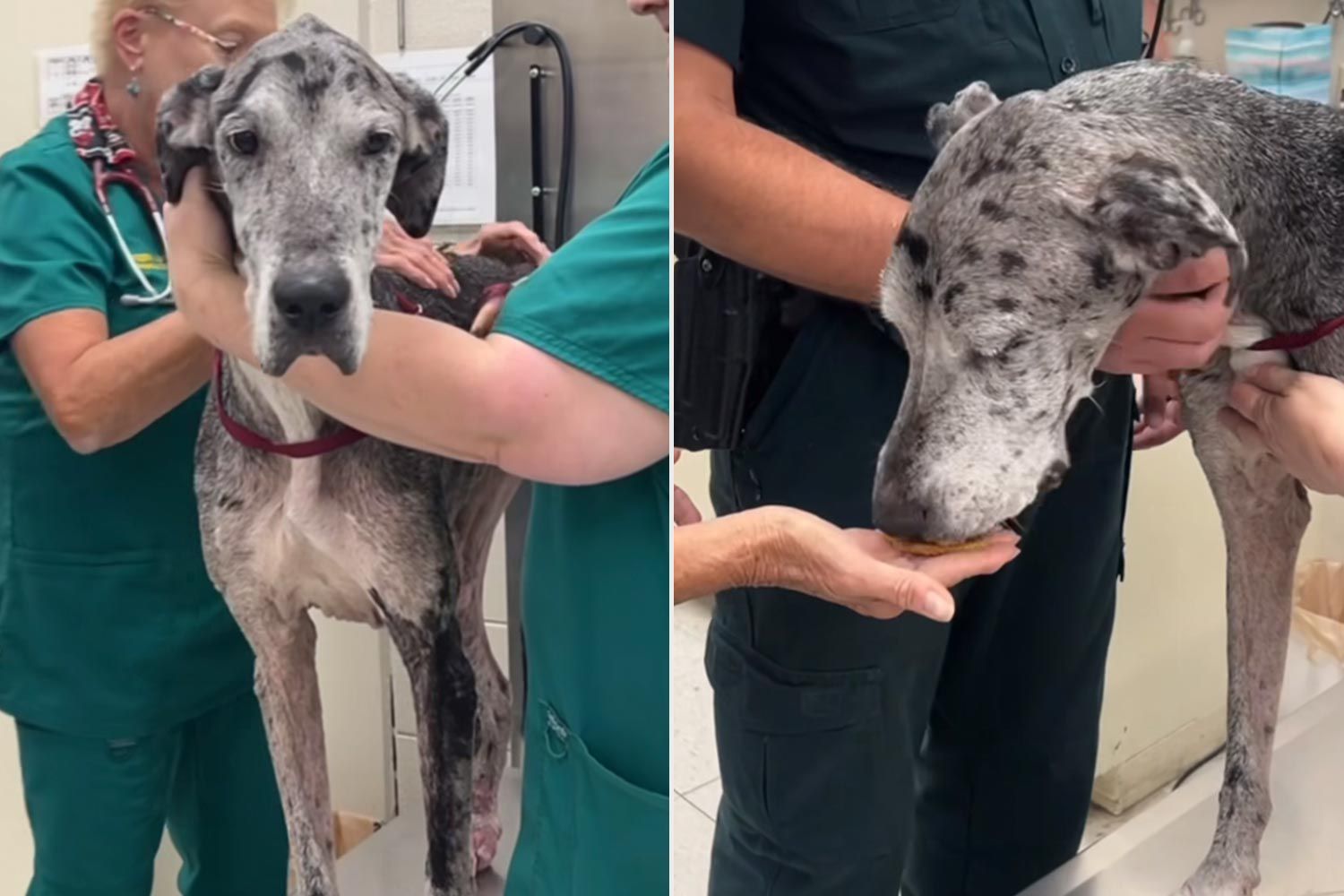
Even from thirty feet away, the sheer, imposing scale of the animal took my breath away. He was a Great Dane, a breed known for its quiet majesty and gentle giant demeanor, but this dog was a walking tragedy. A standard male Great Dane of his towering height should easily weigh nearly two hundred pounds, a solid wall of muscle and grace. This poor creature was a jagged landscape of bone. He weighed perhaps a hundred and forty-eight pounds, and I could tell immediately because there was absolutely no fat, no muscle left to hide his skeletal frame. Every single rib protruded sharply against his thin, brindle coat. His hip bones jutted out like the corners of a wooden crate hidden beneath a velvet sheet. His massive head seemed entirely too heavy for his withered neck to support.
Yet, despite his obvious physical collapse, he was sitting up rigidly, his broad chest pressed firmly against the peeling white paint of the back door. He did not bark when I approached. He did not growl. He simply turned his massive, heavy-jowled head to look at me, and in his sunken amber eyes, I saw an ocean of profound, quiet sorrow that immediately made my throat tight.
I stopped walking, slowly lowering the aluminum catchpole to the grass. You learn quickly in this job that animals don’t lie. They wear their trauma on their sleeves. This dog wasn’t aggressive; he was desperate.
From across the chain-link fence, an elderly neighbor in a floral housecoat—Mrs. Gable, she later told me—called out in a hushed, nervous voice. She said he had been out there since dawn the day before. The people who rented the house had packed up a moving van in the middle of the night and vanished, leaving behind months of unpaid rent and a house full of garbage. They had left the dog in the yard. But the dog hadn’t tried to jump the fence. He hadn’t roamed the streets looking for garbage to eat. He had walked straight up to the back door and planted himself there.
I walked closer, speaking in the low, steady cadence I reserve for traumatized animals. I told him he was a good boy. I told him I was there to help. I reached into my cargo pocket and pulled out a foil pouch of wet food—something no starving dog can usually resist. I peeled back the lid and set it on the bottom step, the rich smell of gravy wafting up in the stagnant air.
The Great Dane looked at the food, his nostrils flaring slightly, but he did not move. He swallowed hard, a dry, painful click in his throat, and then turned his head back to the door.
That was when the ice cold realization began to creep into my veins. Starving dogs do not ignore food. Survival instinct overrides everything. Unless there is something far more important overriding that survival instinct.
I stepped onto the concrete porch, the wood of the steps groaning under my weight. The dog flinched but held his ground, his massive body trembling with exhaustion. I knelt down slowly, keeping my eyes averted to show submission, and gently placed my bare hand on his bony shoulder. He felt like a bag of hot stones. He leaned into my touch for just a fraction of a second, letting out a low, heartbreaking whimper, before pressing his nose hard into the gap between the door and the frame.
I looked closely at the door. It was an old solid-core wooden door with a deadbolt. Then, I looked down at the dog’s massive paws. My heart dropped into my stomach. The pads of his front feet were raw and bleeding. The paint on the bottom half of the door was completely shredded, deep gouges of wood torn away by frantic claws. He hadn’t been sitting here waiting for his owners to come out. He had spent the last thirty-one hours trying to tear his way back inside. He was locked out.
And something he loved desperately was locked in.
I stood up quickly, my heart hammering against my ribs. I pounded my fist against the door, pressing my ear to the hot wood. The house was dead silent. I yelled out, identifying myself as county animal control, but only the hollow echo of an empty house answered me. The legal protocol dictates that I call law enforcement, wait for a sheriff’s deputy, and potentially wait hours for a warrant to breach a locked, private residence. But looking down at the bloody paws of this giant, starving dog who had literally worn himself to the bone trying to save whatever was inside, I knew we didn’t have hours. I knew that whatever was inside that house was suffocating in the stagnant, oven-like heat of a closed-up home in August.
I pulled my heavy steel flashlight from my belt. I wrapped my jacket around my fist, aimed at the small glass pane near the deadbolt, and smashed it inward. The glass shattered with a loud crash, the sound echoing through the empty neighborhood. The Great Dane scrambled backward, his weak legs giving out momentarily, but he immediately surged forward again, whining frantically.
I reached through the jagged hole, ignoring the sharp sting of a glass shard slicing through my sleeve, and flipped the deadbolt. I pushed the door open. A wave of stagnant, suffocating heat hit me instantly. It smelled of stale dust, abandoned rotting food, and the distinct, sharp ammonia scent of animal urine.
The house was stripped bare, garbage strewn across the linoleum floor of the kitchen. But the Great Dane didn’t stop in the kitchen. He didn’t run to the empty food bowls kicked into the corner. He pushed past my legs, his bony frame brushing against my knees, and scrambled desperately down the narrow hallway.
I followed him, my boots crunching on discarded mail and broken glass, my flashlight beam cutting through the gloom of the boarded-up windows. He stopped at the end of the hallway, throwing his massive weight against a closed door. It wasn’t a bedroom door. It was the door to the basement.
I jogged over to him. He was scratching frantically at the wood again, letting out a sound that wasn’t a bark, but a high-pitched, human-like scream of pure panic. I reached for the brass doorknob, turning it hard. It spun uselessly.
I looked closer and felt a surge of pure, unadulterated anger flood my chest. The doorknob wasn’t just locked. Someone had installed a heavy steel hasp on the outside of the door, screwed deeply into the frame, and secured it with a thick, heavy-duty Master padlock. Whoever left this house didn’t just lock the basement door. They intentionally barricaded it from the outside. They wanted to ensure that whatever was down there could never, ever get out. And they wanted to ensure that this loyal dog could never get to it.
I radioed dispatch immediately, my voice shaking with a rage I hadn’t felt in a decade. I screamed at them to roll police and fire to my location immediately, code three. Then I dropped the radio, grabbed a heavy metal crowbar from my tool belt, and wedged the flat end behind the steel hasp. The Great Dane sat right beside me, his rapid, shallow breaths ghosting over my hands.
I threw all my weight into the crowbar, the muscles in my back screaming in protest. The wood splintered, cracking loudly in the silent house, but the screws held fast. I adjusted my grip, planted my boot against the wall, and pulled backward with everything I had.
With a violent, ear-splitting tear of metal and wood, the hasp ripped free from the doorframe. I threw the broken lock to the floor and grabbed the doorknob. The Great Dane let out a massive, trembling breath, his entire body shaking as if the anticipation was too much to bear. I took a deep breath of the stifling air, braced myself for whatever horror awaited us in the dark, and pulled the basement door wide open.
CHAPTER II
The moment the padlock hit the floor with a heavy, metallic thud, Titan didn’t hesitate. He didn’t wait for me to clear the way or shine my light. He lunged into the darkness of that basement with a desperation that nearly knocked me off my feet. I heard his claws skidding on the wooden stairs, a frantic, rhythmic scratching that echoed in the hollow space below. It wasn’t the sound of a predator; it was the sound of a soul trying to outrun its own shadow.
I clicked on my Maglite, the beam cutting a violent white path through the thick, stagnant air. The smell hit me then—not just the rot of a foreclosed house, but something sharper, more clinical, the smell of slow, quiet decay. My boots creaked on the first step, then the second. I felt a familiar coldness settling in my chest, a weight I hadn’t felt since I was ten years old, standing in the doorway of a house that had long since stopped being a home.
At the bottom of the stairs, the light found Titan. He wasn’t barking. He was whimpering, a high-pitched, keening sound that made the hair on my neck stand up. He was huddled in the far corner, his massive, emaciated frame shaking so hard I could hear his bones clicking. And there, tucked beneath the curve of his ribcage, was the reason he had spent thirty-one hours tearing his paws apart on the back porch.
It was a dog. Or it had been. A Golden Retriever, though her coat was so matted with filth and floor dust that she looked like a heap of discarded rags. She didn’t move when my light hit her. She didn’t even flinch. It was only when I moved closer that I saw her eyes. They were clouded over, two milky orbs of cataracts that stared at nothing. She was completely blind. She was also skeletal, her breathing so shallow I thought for a moment I was looking at a ghost.
Titan was licking her ears, his long tongue trying to wash away the weeks of neglect. He looked up at me, his eyes catching the reflection of my flashlight, and for the first time in my career, I felt a dog plead with me. He wasn’t asking for food anymore. He was asking for her life.
I knelt down, the damp concrete biting into my knees. The air down there was heavy, like it was made of lead. I reached out a hand, and the Golden—Molly, I’d later find out her name was—shivered. She didn’t growl. She didn’t have the strength to. She just leaned her head into Titan’s flank and waited.
Seeing them like that brought it all back. The old wound I’d spent twenty years trying to cauterize. I remembered the weekend my father went on a ‘fishing trip’ and forgot that I was still in the house. I remembered the silence of the third day, the way the walls seemed to shrink, and the way I’d sat by the door, just like Titan, waiting for a sound that wouldn’t come. I remembered the shame of being forgotten, the realization that to the people who were supposed to love you, you were just an object that could be misplaced.
I called for backup, my voice sounding foreign and raspy in the small room. I told dispatch I needed a vet transport and a crime scene unit. This wasn’t just a foreclosure anymore. This was a crime.
While I waited, I began to circle the basement. I needed to understand how this happened. In the corner, I found a small, plastic bowl, bone dry and licked clean until the plastic was scored with teeth marks. Next to it was a single, tattered tennis ball. But it was what I found on the workbench that turned my blood to ice.
It was a calendar. July and August were marked with neat, precise X’s in blue ink. The X’s stopped five days ago. Next to the calendar was a legal pad with a handwritten list. ‘Pack the china. Call the movers. Cancel the papers.’ And at the very bottom, underlined twice: ‘Leave the old one. Titan will stay out. Lock the door.’
It wasn’t an accident. They hadn’t ‘forgotten.’ They had calculated the death of a blind, helpless animal as if it were a utility bill they didn’t want to pay. They had locked Molly in the dark, knowing she couldn’t find her way out, and they had locked Titan outside, knowing his loyalty would keep him there until he starved.
By the time the paramedics and the other officers arrived, the sun was beginning to dip, casting long, bloody shadows across the overgrown yard of Elm Street. I watched them carry Molly out on a stretcher. She looked so small, a fragile bundle of fur that barely made a dent in the fabric. Titan refused to leave her side. He walked right next to the stretcher, his head low, his bloody paws leaving faint prints on the sidewalk.
Detective Sarah Vance pulled up in a black sedan, her face a mask of professional neutrality that I knew hid a temper as hot as mine. She looked at the house, then at me.
‘Neighbors say the Millers moved out on Saturday,’ she said, flipping through a notebook. ‘Arthur and Elena Miller. He’s a high-end realtor. She’s on the board of three different charities. They moved to the North Shore. New luxury condo.’
‘They left a blind dog in the basement, Sarah,’ I said, my voice shaking. ‘They padlocked the door from the outside.’
‘I saw the photos, Marcus,’ she replied quietly. ‘We’re on it.’
But ‘on it’ wasn’t enough for me. I had a secret of my own, one I’d kept since I joined the force. I didn’t just want a conviction. I wanted them to feel the weight of that basement. I knew where the North Shore condos were. I knew the kind of people who lived there—people who cared more about the thread count of their sheets than the life of a creature that had given them a decade of devotion.
We tracked them down within three hours. It wasn’t hard. Arthur Miller had been posting updates on his public social media page all afternoon. Pictures of a glass-walled living room overlooking the lake. Pictures of a chilled bottle of champagne. And the final blow—a photo of a brand-new, purebred puppy they’d just bought. The caption read: ‘New beginnings. Fresh starts.’
I followed Sarah to the address, a gleaming tower of steel and glass that stood in mocking contrast to the rot on Elm Street. We didn’t go in the back way. We walked right through the marble lobby, our boots clanking on the polished floor. The doorman tried to stop us, but Sarah just flashed her badge and kept moving.
The elevator ride felt like an eternity. I could see my reflection in the mirrored walls—a man covered in the dust of a dead house, smelling of sweat and despair. I looked like the ghost of the life the Millers had tried to leave behind.
When the door to Penthouse B opened, the smell of expensive candles and sea breeze wafted out. Arthur Miller stood there, wearing a cashmere sweater and a look of mild annoyance. He was holding a glass of wine. Behind him, Elena was laughing at something on her phone.
‘Can I help you?’ Arthur asked, his voice smooth and untroubled.
‘Mr. Miller,’ Sarah said, her voice like a whip. ‘We need to discuss the property on Elm Street.’
The change was instantaneous. The blood drained from his face, and for a split second, I saw the cowardice behind the expensive clothes. He tried to close the door, but I stepped forward, my boot catching the frame.
‘We found her, Arthur,’ I said. My voice was low, vibrating with a rage I was struggling to contain.
‘I don’t know what you’re talking about,’ he stammered, his eyes darting to the hallway where his neighbors were beginning to peek out of their doors. ‘We sold that house. It’s a bank matter now.’
‘It’s a felony animal cruelty matter now,’ Sarah interjected. ‘And we have the calendar. We have the list. We have your handwriting, Arthur.’
This was the triggering event. It was public. The hallway was filling with the very people the Millers spent their lives trying to impress. Their perfect, curated world was cracking open in the middle of a Tuesday evening.
‘It was a mistake!’ Elena cried out from behind him, her voice shrill and panicked. ‘She was old! She was sick! We didn’t think she’d last the weekend anyway. It was supposed to be a mercy!’
‘A mercy?’ I stepped into the foyer. The new puppy, a tiny thing that didn’t yet know the cruelty of its masters, yapped at my heels. ‘You padlocked a blind dog in a dark basement without water and left her to die in her own filth. That’s not mercy. That’s a slow-motion execution.’
‘Get out of my house,’ Arthur hissed, his facade finally crumbling into a sneer. ‘You have no right to be here without a warrant.’
‘The warrant is being signed as we speak, Mr. Miller,’ Sarah said, stepping forward with the handcuffs. ‘But right now, you’re coming with us for questioning. Both of you.’
The scene was chaotic. Elena began to scream about her reputation, about the ‘misunderstanding.’ Arthur tried to push past me, but I didn’t move. I stood there like a mountain, the memory of my own cold, dark weekend twenty years ago fueling my resolve. I wanted them to feel the handcuffs. I wanted them to feel the eyes of their neighbors—the judgment that would never go away. This was irreversible. The news would have it by morning. The charities would drop her. The clients would drop him. They would be the people who left the dog in the basement.
But as they were led away, Arthur looked at me, a flicker of pure, unadulterated spite in his eyes. ‘You think you’re a hero?’ he whispered as he passed. ‘You’re just a dog catcher with a badge. You think that animal matters? She’s already dead in every way that counts.’
I felt the urge to swing. My hand balled into a fist, my knuckles white. The moral dilemma screamed in my ear: I could break him right here. I could show him the violence he’d inflicted on Molly. It would feel so good to let the rage take over, to finally punish the kind of man my father had been. But if I did, the case would die. The Millers would walk on a technicality, and Molly would never get the justice she was owed.
I let my hand go limp. I watched them disappear into the elevator, their voices fading into the hum of the building.
I drove back to the emergency vet clinic in silence. The adrenaline had faded, leaving me with a hollow, aching exhaustion. When I walked into the sterile, white-tiled back room, the vet, a woman named Dr. Aris, was sitting on the floor.
Titan was there, too. He was lying down next to a large, heated kennel. Inside, Molly was hooked up to an IV. She had been shaved to remove the mats, revealing a body that was nothing but skin stretched over a frame of bone. She looked even smaller now, but she was breathing.
‘She’s stable,’ Dr. Aris said, her voice tired. ‘For now. But she’s severely dehydrated. Kidney function is questionable. And Marcus… the darkness she was in… it wasn’t just the basement. She’s been neglected for a long time. The cataracts were treatable a year ago. Now, she’ll never see again.’
I sat down next to Titan. He rested his heavy head on my knee, his tail giving a single, weak thump against the floor. He was exhausted, but he wouldn’t close his eyes. He was still on guard.
‘The Millers are in custody,’ I told the room, though I was mostly telling myself. ‘They aren’t getting her back. They aren’t getting anything back.’
But the triumph felt thin. I looked at Molly, a creature who had done nothing but exist and love, and I thought about the X’s on that calendar. I thought about the secret I’d been carrying—the fear that no matter how many animals I saved, the world would always produce more Millers. The fear that the basement was the only truth there was.
I stayed there all night. I watched the IV drip, a slow, steady rhythm of survival. I thought about the moral choice I’d made at the penthouse. I’d chosen the law over my own anger, but as the sun began to rise through the clinic windows, I wondered if it was enough. The Millers had lawyers. They had money. They had a story to tell.
Molly didn’t have a voice. She only had Titan, and for some reason, she had me. And as I looked at her, I realized the hunt wasn’t over. The legal battle was just the beginning, and I knew, deep in my gut, that the Millers wouldn’t go down without trying to tear everything else apart first.
I reached into the kennel and gently touched Molly’s paw. It was cold, but it was clean. She didn’t flinch this time. She just leaned into the touch, a tiny, flickering flame of trust in a world that had tried its best to blow it out.
I looked at Titan. ‘We’re not done,’ I whispered.
He looked back at me, his eyes wise and heavy with the weight of what we’d seen. We weren’t just witnesses anymore. We were the only thing standing between Molly and the people who wanted her to disappear. And in that quiet, morning light, I knew that I would do whatever it took to make sure the Millers never had a ‘fresh start’ again.
CHAPTER III
The paperwork arrived on my desk not with a bang, but with the dry, sterile rustle of high-grade bond paper. It was a formal notification of a civil suit. Arthur and Elena Miller weren’t just defending themselves against the animal cruelty charges; they were suing me personally, and the department by extension, for ‘illegal search and seizure’ and ‘malicious defamation.’
My Captain didn’t look me in the eye when he handed it over. He looked at the coffee rings on his desk. He told me to go home. He told me I was on administrative leave, effective immediately. The Millers had hired a legal team that cost more per hour than I made in a month. They were spinning a story of ‘humane abandonment.’ They claimed they had left the dogs with what they believed was enough food and water for a ‘short transition’ and that an emergency had detained them. They were making me out to be a rogue cop who broke into a private residence because of a personal vendetta.
I went to the vet clinic instead of going home. I couldn’t be in my apartment. The silence there felt like it was judging me. Molly was in a specialized recovery suite. She looked like a ghost of a dog, a frame of bones covered in thin, patchy fur. Her eyes, clouded by cataracts, followed the sound of my boots. I sat on the floor of the kennel. I didn’t touch her at first. I just let her know I was there.
“They’re going to walk, Molly,” I whispered. The words felt like ash in my mouth. “They have the money, and the lawyers, and the right friends. They’re going to walk, and they’re going to say I’m the bad guy.”
Molly let out a soft, wet huff. She rested her chin on my knee. She didn’t care about the legalities. She cared that the floor was warm and that she wasn’t alone in the dark anymore. But I cared. I cared so much it felt like a physical weight in my chest, a pressurized heat that made my hands shake.
I went back to the Elm Street house that night. I shouldn’t have. I was on leave. My badge was in my locker at the precinct. But I still had the keys the bank had given the department. The yellow crime scene tape was fluttering in the wind, a pathetic warning that meant nothing to people like the Millers.
I entered through the back door. The house smelled different now. The rot was gone, replaced by the scent of industrial disinfectant and stale air. I didn’t turn on the lights. I used a flashlight, the beam cutting through the gloom like a scalpel. I wasn’t sure what I was looking for, but I knew I had missed something. The ‘death-trap’ calendar hadn’t been enough. The moving list hadn’t been enough.
I went to the basement. The space where I’d found Molly. I knelt on the cold concrete. I started tapping the walls, looking for a hollow sound. It felt like a movie cliché until it wasn’t. Behind a stack of discarded moving boxes, I found a small, built-in wall safe. It wasn’t hidden well. It was just forgotten.
I spent three hours trying to crack it. I’m not a safecracker. I’m just a man who didn’t have anything else to lose. I used a crowbar from the garage and a lot of redirected rage. When the door finally groaned and popped, I didn’t find jewelry or cash. I found a leather-bound ledger and a stack of digital memory cards.
I sat on the basement floor and started reading. My flashlight was dying, the beam flickering to a dull yellow. The ledger was a meticulously kept record of ‘investments.’ But the investments weren’t stocks. They were animals. Purebreds. High-value breeds.
The Millers didn’t just own dogs. They ran a high-end, underground ‘rescue’ scam. They would ‘rescue’ designer breeds from overseas, claim they were rehabilitating them, solicit massive tax-deductible donations from their wealthy social circle, and then… the animals would disappear. The ledger didn’t say ‘dead.’ It used the word ‘liquidated.’
Titan and Molly weren’t just pets they forgot. They were the last two pieces of a failed investment. The Millers had over-leveraged themselves on a shipment of Great Danes that had arrived sick. They had dumped the rest and kept Titan and Molly as a front until the house was foreclosed. They weren’t just cruel. They were predatory. They were using the suffering of animals as a tax shelter.
I felt a surge of cold, sharp clarity. This wasn’t just about neglect. This was racketeering. This was fraud. This was something that could actually put them away for a long time. But I had found it while on administrative leave. I had entered the house without a warrant. I had broken into a safe without a warrant.
I knew what I had to do. Or rather, I knew what a good cop would do. They would call Sarah. They would try to find a way to make this evidence legal. They would play the long game.
But I looked at the spot where Molly had been chained to the pipe. I thought about the three other dogs mentioned in the ledger under the heading ‘Liquidated – July.’ I didn’t want a long game. I wanted them destroyed.
I made my fatal error. I didn’t call Sarah. I didn’t call the Captain. I took the ledger and the cards, and I drove to the Millers’ luxury penthouse. I told myself I was going to give them a chance to confess. I told myself I was going to use it as leverage to get them to sign over Molly and Titan and plead guilty to the lesser charges.
It was a lie. I was hunting.
I waited in the lobby. The doorman tried to stop me, but I shoved my ID in his face—the ID I was supposed to have surrendered. He let me through. I rode the elevator up to the 22nd floor, my heart hammering against my ribs like a trapped bird.
When Arthur Miller opened the door, he didn’t look scared. He looked annoyed. He was wearing a silk robe and holding a glass of scotch.
“Officer,” he said, his voice dripping with condescension. “I believe you’ve been told to stay away from us. My lawyers will be delighted to hear about this.”
“I found the ledger, Arthur,” I said. I held it up.
The change in his face was instantaneous. The arrogance didn’t vanish; it curdled. It turned into something sharper, something more dangerous. He didn’t deny it. He didn’t ask what I was talking about. He just stepped back and invited me in.
“Elena,” he called out. “The policeman has found our accounting.”
Elena Miller walked into the living room. She looked at the ledger in my hand, then at me. Her eyes were as cold as the marble floors of their apartment. She didn’t look like a socialite. She looked like a CEO.
“How much?” she asked.
“How much what?” I said.
“How much to make that disappear? You’re clearly not here to arrest us, or you would have brought your little partner and a team of recorders. You’re here because you’re a small man with a small paycheck, and you’ve realized you’re holding a winning lottery ticket.”
She walked toward me, her heels clicking on the stone. She wasn’t afraid of me. She saw me as a commodity. Just like Molly. Just like Titan.
“I don’t want your money,” I said. My voice was shaking, but not from fear. It was the effort of not reaching out and grabbing her. “I want you to sign the dogs over. I want you to plead guilty. I want you to go to prison.”
Arthur laughed. It was a dry, hacking sound. “Prison? For what? Tax discrepancies? We’ll pay a fine. We’ll hire better accountants. As for the dogs… they’re property, Officer. Our property. And we’ve already filed the motion to have them returned to us for ‘private veterinary care.’ Or, more likely, to be humanely put down to end their suffering. Which we will document, of course. For the donors.”
The world went gray at the edges. I saw the ledger in my hand, and I realized it wasn’t a weapon. In my hands, right now, it was a liability. By bringing it here, I had tainted the evidence. I had signaled that I was open to negotiation, even if I wasn’t. I had destroyed the chain of custody. I had played right into their hands.
“You’re not going to touch them,” I said.
“We already have,” Elena said, smiling. “The court order was signed an hour ago. A transport team is on the way to the clinic right now. Molly is coming home, Officer. And then she’s going to sleep.”
I didn’t think. I didn’t plan. I lunged.
I didn’t hit her. I grabbed her by the shoulders, shaking her, my face inches from hers. I wanted her to feel the terror she had put into those animals. I wanted her to see the darkness Molly had lived in for months.
“You monster,” I hissed. “You absolute monster.”
Arthur was on the phone instantly. He wasn’t calling the police. He was calling his lawyer. “He’s here. He’s attacking my wife. Yes. We have it on the security cameras. Send everyone.”
I let her go. She stumbled back, a look of triumph on her face. She wasn’t hurt. She was victorious. I had given them exactly what they needed: a physical assault to go along with the illegal search.
I turned and ran. I didn’t go for the elevator. I took the stairs. I needed to get to the clinic. I needed to get to Molly. My mind was a chaotic mess of sirens and Molly’s blind, trusting eyes. I had ruined everything. I had tried to be the hero, and I had become the villain of their narrative.
I reached the ground floor and burst through the lobby. I ignored the doorman’s shouts. I got into my car and tore out of the parking lot, tires screaming.
I was halfway to the clinic when the blue lights appeared behind me. Not one set. Four. They weren’t just stopping me for speeding. This was a felony stop.
I pulled over. I didn’t have a choice. I put my hands on the steering wheel. I watched the side mirror as my own colleagues stepped out of their cruisers, their faces grim, their hands on their holsters.
“Marcus! Get out of the car! Slowly!”
It was Sarah. Her voice was cracking. She looked devastated.
I stepped out. I didn’t resist when they pushed me against the car. I didn’t say a word when the handcuffs clicked shut. The cold steel felt familiar. It felt like justice, just not the kind I had wanted.
“What were you thinking?” Sarah whispered in my ear as she patted me down. “The Millers called the Commissioner directly. They said you tried to extort them. They said you assaulted Elena.”
“The ledger, Sarah,” I gasped. “In the front seat. Look at the ledger.”
She looked. She saw the book. But she didn’t pick it up with a look of hope. She looked at it with pity.
“You broke into their house, Marcus. You stole this. It’s useless. It’s worse than useless. It’s the reason they’re going to get away with everything.”
They put me in the back of the cruiser. I sat there, staring at the back of the front seat, the smell of vinyl and old coffee filling my nose. I had lost. I had lost my badge, I had lost the case, and I had lost Molly.
But as we pulled away, the radio crackled. It wasn’t the precinct. It was the high-priority channel.
“All units be advised, State Attorney General’s Office is requesting a hold on the Miller transport. Repeat, all actions regarding the Miller case are to be stayed by order of the State Attorney. New evidence has been submitted via an anonymous whistleblower.”
Sarah hit the brakes. The cruiser lurched to a halt. We both stared at the radio.
“What whistleblower?” she asked the air.
I felt a strange, hollow thump in my chest. The memory cards. I had left the memory cards on the dash of the car when I’d stopped for gas on the way to the Millers. I had thought I lost them. But I hadn’t. I had dropped them into the mail slot of the local news station’s van that was parked at the pump. I had done it without even thinking, a reflex of desperation I’d forgotten in the heat of the confrontation.
But the intervention didn’t feel like a victory.
Because as the radio continued to chatter, the truth started to leak out. The whistleblower hadn’t just sent the financial records. They had sent the videos.
The twist wasn’t that the Millers were scammers. It was that they weren’t the ones in charge.
The video files, already hitting the local news cycle’s ‘breaking news’ alerts, showed the ‘liquidations.’ And in the background of the footage, directing the process, was a man I recognized.
It was the Judge who had signed the search warrant for the Elm Street house. The same Judge who had been fast-tracking the Millers’ civil suit against me.
He wasn’t just their friend. He was a partner. He was the one who ensured the ‘disappeared’ animals never resulted in police reports. He was the one who turned the legal system into a meat grinder for the very creatures it was supposed to protect.
The power that had intervened wasn’t just the State Attorney. It was the sheer, overwhelming force of public outrage as the videos began to play on every screen in the city. The images of Molly, young and healthy, being used as a prop for a ‘charity’ gala, and then the cut to her skeletal form in the basement.
The social authority had shifted. The Millers were no longer the victims of a rogue cop. They were the faces of a systemic evil that reached into the very heart of the city’s power structure.
But I was still in handcuffs.
I was still the man who had broken the law to find the truth. And as we drove toward the station, I realized that while the Millers might burn, they would take me with them. The system doesn’t forgive the people who expose how broken it is, even if they’re right.
I looked out the window. People were already gathering on the street corners, holding their phones, their faces illuminated by the blue light of the screens. They were angry. They were screaming. The city was starting to wake up, and it was thirsty for blood.
I closed my eyes. I thought of Molly. I hoped the State Attorney got to the clinic before the Millers’ transport team. I hoped she was still alive.
That was the only thing that mattered. The rest of it—the badge, the career, the reputation—it was all gone. I had burned my life to the ground to save a dog that couldn’t even see me.
And as the cruiser pulled into the precinct garage, I knew the real fight hadn’t even started yet. The Millers were just the beginning. The Judge, the system, the layers of corruption… I had pulled a thread, and the whole world was unravelling.
I was led into the station, not as an officer, but as a prisoner. The silence in the squad room was deafening. Every eye was on me. Some were filled with disgust. Some with fear. And a few, just a few, were filled with something that looked like respect.
But the Captain was waiting in his office, and he looked like he wanted to kill me.
“You’re done, Marcus,” he said, his voice a low growl. “Regardless of what’s on those cards, you’re done.”
“I know,” I said. And for the first time in my life, I meant it. I was done with their version of justice. I was done with the rules that only applied to the people without silk robes and luxury penthouses.
I was done being a cop. I was finally just a human being.
And it was the most terrifying thing I had ever felt.
CHAPTER IV
The world changed while I sat still. Four walls, one steel door, and the echoing clang of injustice – that was my reality as the news exploded. They called it a scandal, a reckoning, a systemic failure. I just called it Tuesday. The TV in the corner, perpetually tuned to the news, became my window to a city convulsing with outrage. The State Attorney General, a woman named Ramirez, was on every channel, promising investigations, reforms, and accountability. Her words felt hollow, projected through the bars of my cage.
My lawyer, a young, sharp woman named Sarah, visited that morning. “They’re offering a deal,” she said, her voice tight. “Reduced charges. Obstruction, maybe. A slap on the wrist.” Obstruction. As if I’d obstructed anything but a criminal enterprise that had been thriving for years. “And Halloway? The Millers?” I asked. “Indictments are coming. RICO charges. It’s… big, Marcus.” Big. It was always big to everyone else. To me, it was Molly, her ribs showing through matted fur, her eyes pleading. “What about Molly?” I asked. Sarah looked down. “That’s… complicated. Halloway signed the euthanasia order before the stay was processed. They’re saying it’s legal, procedural.” My blood ran cold. Procedural death. The words tasted like ash.
I refused the deal. Sarah argued, pleaded, but I was unyielding. My freedom meant nothing if Molly was dead. “Get me out of here,” I said. “There has to be a way.”
The public fallout was swift and brutal. The Millers’ reputation, once untouchable, was shredded. Their socialite friends scattered like cockroaches under a flashlight. Their businesses crumbled, their assets seized. Arthur Miller, face gaunt and eyes hollow, was photographed being escorted into court. Elena, once a picture of icy perfection, now looked like a ghost, her designer clothes hanging loosely on her frame. Judge Halloway, the pillar of the community, was exposed as a fraud, his career and legacy reduced to dust. The news ran stories of his past rulings, highlighting inconsistencies, biases, and questionable decisions. The edifice of justice had cracked, revealing the rot beneath.
The animal ‘rescue’ organizations the Millers fronted were raided, their records seized. The scope of the scam was staggering – millions of dollars in fraudulent insurance claims, countless animals trafficked and abused. The ledger I’d found was the key, a detailed record of their crimes. I became a reluctant hero, the whistleblower who had exposed the corruption. People rallied outside the jail, chanting my name, demanding my release. But inside, I felt no triumph, only a gnawing fear for Molly’s life.
Then came the silence. Days bled into weeks. The media frenzy subsided, replaced by the slow grind of the legal system. The rallies dwindled, the chants faded. People moved on, their attention drawn to the next scandal, the next outrage. I was left alone in my cell, haunted by the image of Molly, waiting for a death sentence signed by a corrupt judge. Sarah visited less frequently, her face etched with worry. “They’re still fighting the stay,” she said. “Halloway’s people are… entrenched. It’s not over, Marcus.”
The personal cost was immense. My career was over, my reputation tarnished, my future uncertain. My relationship with my family, already strained, was fractured. My father, a retired cop, visited once, his face a mask of disappointment. “You went too far, Marcus,” he said. “You broke the law.” I didn’t argue. He wouldn’t have understood. He lived in a world of black and white, of rules and order. I had stepped into the gray, into the murky depths where justice was a commodity and the law was a weapon.
The isolation was the hardest. The weight of my choices, the consequences of my actions, pressed down on me, suffocating me. I replayed the events in my mind, searching for a different path, a different outcome. But there was none. I had acted on instinct, driven by my own trauma, my own need to protect the vulnerable. And in doing so, I had destroyed my life.
One evening, Sarah arrived with a frantic look in her eyes. “They’re moving Molly,” she said, her voice trembling. “They’re transferring her to a different facility, one outside the city. Halloway’s people are pushing it through. They’re going to euthanize her, Marcus. Tonight.” My heart stopped. This was it. The system was closing in, crushing Molly under its weight. “I need to get out of here,” I said, my voice hoarse. “Now.”
Sarah shook her head. “It’s impossible. There’s no legal way.” “Then find an illegal one,” I said, my eyes burning with desperation. “I don’t care how. Get me out of here, Sarah. Or Molly dies.”
That night, a new event unfolded, born from the chaos I had unleashed. A correctional officer, a young man named David, approached my cell. He looked nervous, his eyes darting around. “I can help you,” he whispered. “But you need to be quick.” David had seen the news, had heard the stories. He had a dog of his own, a scruffy terrier he loved fiercely. He couldn’t stand by and watch Molly die. He was a small cog in the machine, but he had a conscience. And that was enough.
David helped me navigate the labyrinthine corridors of the jail, avoiding cameras and guards. He led me to a back exit, a rarely used service entrance. “There’s a car waiting,” he said. “A friend of Sarah’s. He’ll take you where you need to go.” I hesitated. “What about you?” I asked. David shrugged. “I’ll deal with the consequences. Just save that dog, Officer.”
I slipped out into the night, into a city still reeling from the scandal. The car sped through the deserted streets, heading towards the animal control facility where Molly was being held. My mind raced. I had no plan, no strategy. Only a burning determination to save her life.
The facility was a grim, sterile building, surrounded by a high fence. I scaled the fence, ignoring the razor wire that tore at my clothes. I broke into the building, navigating the dark hallways, guided by the sound of barking and whimpering. I found Molly in a small, concrete cell, her eyes filled with fear. She barked weakly when she saw me, her tail thumping against the floor.
A vet technician, a middle-aged woman with tired eyes, stood by her side, holding a syringe. “I’m sorry,” she said, her voice barely above a whisper. “I don’t want to do this.” I grabbed the syringe, throwing it against the wall. “Get out of here,” I said, my voice trembling with rage. “Get out and don’t come back.”
The technician fled, leaving me alone with Molly. I unlocked the cell, and she bounded into my arms, licking my face, her body shaking with relief. I carried her out of the building, back into the night, back into the chaos I had created. As I held her close, I realized that I had lost everything – my career, my reputation, my freedom. But I had saved her. And in that moment, that was all that mattered.
Standing outside the facility, Molly safe in my arms, I saw flashing lights approaching. I knew they were coming for me. I had broken the law again, had defied the system, had become a fugitive. But I didn’t care. I had found my moral compass, and it was pointing towards Molly.
The police arrived, sirens wailing, lights blinding. They surrounded me, their guns drawn. I didn’t resist. I surrendered, knowing that I would face the consequences of my actions. But as they led me away, I saw a figure standing in the shadows, watching. It was David, the correctional officer who had helped me escape. He gave me a small nod, a silent acknowledgment of our shared act of defiance. In that moment, I knew that I wasn’t alone. That even in the darkest of times, there were still people who believed in justice, who were willing to risk everything for what was right.
The moral residue was bitter. I had exposed the corruption, but I had also broken the law. I had saved Molly, but I had jeopardized my future. Justice had been served, but it felt incomplete, costly. The system was broken, and I had become a casualty of its dysfunction. But as I sat in my cell, waiting for my trial, I knew that I had done the right thing. I had stood up for the vulnerable, had fought against the powerful, had exposed the truth. And that, I realized, was worth more than any job, any reputation, any freedom.
The news cycle had moved on, but the consequences lingered. The city was still grappling with the scandal, still trying to rebuild its trust in the justice system. The Millers and Judge Halloway faced a mountain of charges, their lives irrevocably shattered. But the real victims were the animals who had suffered, the people who had been betrayed, the community that had been damaged. And their healing, I knew, would take time.
Sarah visited me, looking worn but determined. “They’re offering a new deal,” she said. “A reduced sentence, community service. And… they’re establishing a fund for animal welfare, in your name.” I looked at her, surprised. “They’re trying to make me a hero,” I said. Sarah shrugged. “Maybe. Or maybe they’re just trying to make things right.” I thought about Molly, safe and sound, recovering from her ordeal. I thought about David, the correctional officer who had risked his career to help me. I thought about all the people who had been affected by the scandal, the victims and the perpetrators, the innocent and the guilty.
“I’ll take the deal,” I said. “But on one condition. The fund has to be used to help animals in need, not to line the pockets of corrupt officials.”
Sarah smiled. “I’ll make sure of it, Marcus.”
In the end, I served a reduced sentence, performed community service, and became an advocate for animal welfare. I never went back to being a cop, but I found a new purpose, a new way to serve. I rescued Molly, and in doing so, I rescued myself. I found a moral compass, and it led me to a place of healing, of hope, of redemption.
One evening, I visited Molly at her new home, a small farm outside the city. She ran to greet me, her tail wagging furiously, her eyes filled with joy. I knelt down and hugged her, feeling her warmth, her love, her gratitude. In that moment, I knew that I had made the right choice. I had stood up for what was right, and I had found my way back to the light. The scars remained, but they were a reminder of the battle I had fought, the price I had paid, and the victory I had won.
CHAPTER V
The clang of the cell door still echoes in my head, even though it’s been six months since I walked out a free man – or at least, as free as I’ll ever be again. The badge is gone. The uniform hangs unworn in a box somewhere. I try not to think about it. What’s harder to shake is the feeling of uselessness that claws at me when I wake up in the morning. Used to be, I had a purpose, something to protect. Now? I’m just Marcus, the ex-cop who went rogue for a dog.
My apartment feels different now, too. Smaller, somehow, even though nothing’s changed. Maybe it’s because the weight of what I did has settled in, pressing down on everything. The silence is deafening, broken only by the occasional siren in the distance, a sound that used to be a call to action, now just a reminder of what I lost. The city had been my responsibility, and now, I have nothing.
Sarah calls often. She’s been a rock through all this, navigating the legal mess, shielding me from the worst of the media frenzy, and somehow managing to keep a sliver of hope alive when I felt like drowning. She still believes in me, probably more than I believe in myself these days.
“How are you holding up?” she asks during one of our calls. Her voice is warm, laced with a concern that makes my chest ache.
“Fine,” I lie, the word tasting like ash in my mouth. “Just… fine.”
I can hear the doubt in her silence, but she doesn’t push. “The foundation paperwork is almost done. We should have the animal welfare fund up and running by next month.”
That’s the deal I made. A reduced sentence in exchange for setting up a fund to protect animals, a small victory carved from the wreckage of my career. It’s something, at least. A purpose, however small, to cling to.
I spend my days volunteering at the local animal shelter, cleaning kennels, walking dogs, anything to keep my hands busy and my mind quiet. The animals don’t judge me. They don’t care about the scandal or the headlines. They just need a warm hand and a kind word, and that’s something I can still offer.
Molly is here too, of course. She’s blossomed since I rescued her. The fear in her eyes has faded, replaced by a playful spark. She runs and leaps with a joy that I find myself envying.
One afternoon, while I’m cleaning Molly’s kennel, Arthur Miller shows up. I recognize him instantly, despite the baseball cap pulled low over his face. He looks smaller, somehow, deflated. The arrogance that radiated from him during the trial is gone, replaced by a haunted weariness.
“I want to see her,” he says, his voice barely a whisper.
I hesitate. Part of me wants to slam the door in his face, to unleash all the anger and resentment that’s been festering inside me. But another part, the part that used to believe in justice, in redemption, tells me to listen.
“Why?” I ask, my voice flat.
“I… I need to see that she’s okay,” he says, his eyes fixed on Molly, who’s watching us with cautious curiosity.
I unlock the kennel and step aside. Miller slowly approaches Molly, his hand outstretched. She sniffs his hand tentatively, then nudges it with her nose.
“She… she looks good,” he says, his voice thick with emotion. “Better than she ever did with us.”
“You know you messed up,” I say, stating the obvious.
“Messed up?” He gives a hollow laugh. “I destroyed everything. My reputation, my marriage… everything.”
He reaches down and gently strokes Molly’s fur. “I never understood,” he says, his voice cracking. “I never understood what it meant to truly care for something other than myself.”
I don’t say anything. What is there to say? He made his choices, and now he’s living with the consequences.
“Thank you,” he whispers, finally meeting my gaze. “Thank you for saving her.”
He turns and walks away, a broken man. I watch him go, a strange mix of satisfaction and pity swirling inside me.
That night, Sarah comes over with takeout. We sit in silence for a while, the only sound the clinking of our forks against the cardboard containers.
“He came to see Molly today,” I tell her.
She looks up, her expression unreadable. “And?”
“He seemed… different,” I say. “Like he finally understood the harm he caused.”
Sarah sighs. “Understanding doesn’t undo the damage, Marcus.”
“I know,” I say. “But it’s a start, right?”
She reaches across the table and takes my hand. Her touch is warm and reassuring.
“You did a good thing, Marcus,” she says. “You saved Molly, and you’re going to help a lot of other animals with that fund.”
“It doesn’t feel like enough,” I say, the words tumbling out before I can stop them. “I lost everything, Sarah. My career, my reputation… what was it all for?”
She squeezes my hand tighter. “You lost your badge, Marcus, but you found something more important. You found your purpose.”
Her words resonate within me, a flicker of hope igniting in the darkness. Maybe she’s right. Maybe this isn’t the end. Maybe it’s just a new beginning. It has to be.
The animal welfare fund becomes my life. I work tirelessly, raising money, organizing events, advocating for stricter animal cruelty laws. It’s exhausting, frustrating work, but it’s also incredibly rewarding. Seeing the difference we’re making in the lives of these animals, giving them a second chance, makes all the sacrifices worthwhile.
The media attention eventually fades, replaced by a quiet respect. People start to see me not as the rogue cop who broke the law, but as the champion of the voiceless. It’s weird. The change is jarring.
One day, I receive a letter from Judge Halloway. It’s a short, handwritten note, filled with regret and remorse. He admits that he was wrong, that he allowed his personal connections to cloud his judgment. He’s resigned from the bench and is now volunteering at a local soup kitchen.
I don’t know what to make of it. Can people truly change? Can forgiveness truly heal? I don’t have the answers. But I do know that holding onto anger and resentment will only poison me from the inside out.
Sarah and I grow closer. We spend hours talking, sharing our fears and our hopes. I find myself drawn to her strength, her compassion, her unwavering belief in justice. There’s a connection between us, a spark that I can’t ignore.
One evening, after a particularly long day at the shelter, I walk Sarah back to her apartment. We stand on the doorstep for a moment, the silence thick with unspoken feelings.
“Thank you,” I say, my voice husky. “For everything.”
She smiles, her eyes sparkling in the dim light. “You don’t have to thank me, Marcus. I believe in you.”
I lean in and kiss her. It’s a tentative kiss at first, but then it deepens, becoming more passionate, more real. It’s a kiss that speaks of shared pain, of resilience, of hope for the future. It’s a kiss I never imagined could happen.
“Maybe… maybe we could try this,” I say, pulling back slightly.
She nods, her cheeks flushed. “I’d like that, Marcus. I really would.”
It’s a sliver of hope, a light in the darkness. I cling to it, letting it guide me forward.
Months turn into years. The animal welfare fund thrives, saving countless animals from abuse and neglect. I’m no longer haunted by the past. Not completely. The scars are still there, but they’ve faded, softened by time and healing.
I visit the animal shelter often. It’s become my sanctuary, a place where I can find peace and purpose. The sounds of barking and laughter no longer grate on me. Instead, they fill me with a sense of joy and belonging.
Today, I watch Molly playing in the yard with a group of other rescued dogs. She’s older now, her muzzle graying, but her spirit is as vibrant as ever. She runs and leaps, chasing after a tennis ball with boundless energy. Her missing dog days are far behind her.
I smile, a genuine smile that reaches all the way to my soul. I may have lost my badge, my career, my old life, but I gained something far more valuable. I found my purpose, my passion, my place in the world. I finally found the missing dog.
I see Sarah walking towards me, a warm smile on her face. She loops her arm through mine, and we stand together, watching the dogs play.
“Happy?” she asks softly.
I nod. “More than I ever thought possible.”
We stand there for a long time, in comfortable silence, the sun warm on our faces, the sounds of happy dogs filling the air. It’s a perfect moment, a testament to the power of resilience, of forgiveness, of hope.
My life is different now. It’s not the life I imagined for myself, but it’s a good life. A meaningful life. A life filled with love and purpose. A life where I can finally make amends for the mistakes of the past.
I look at Molly, her eyes bright and full of life, and I know that everything I’ve been through was worth it. Because sometimes, the greatest victories are the ones that come from the deepest losses.
END.