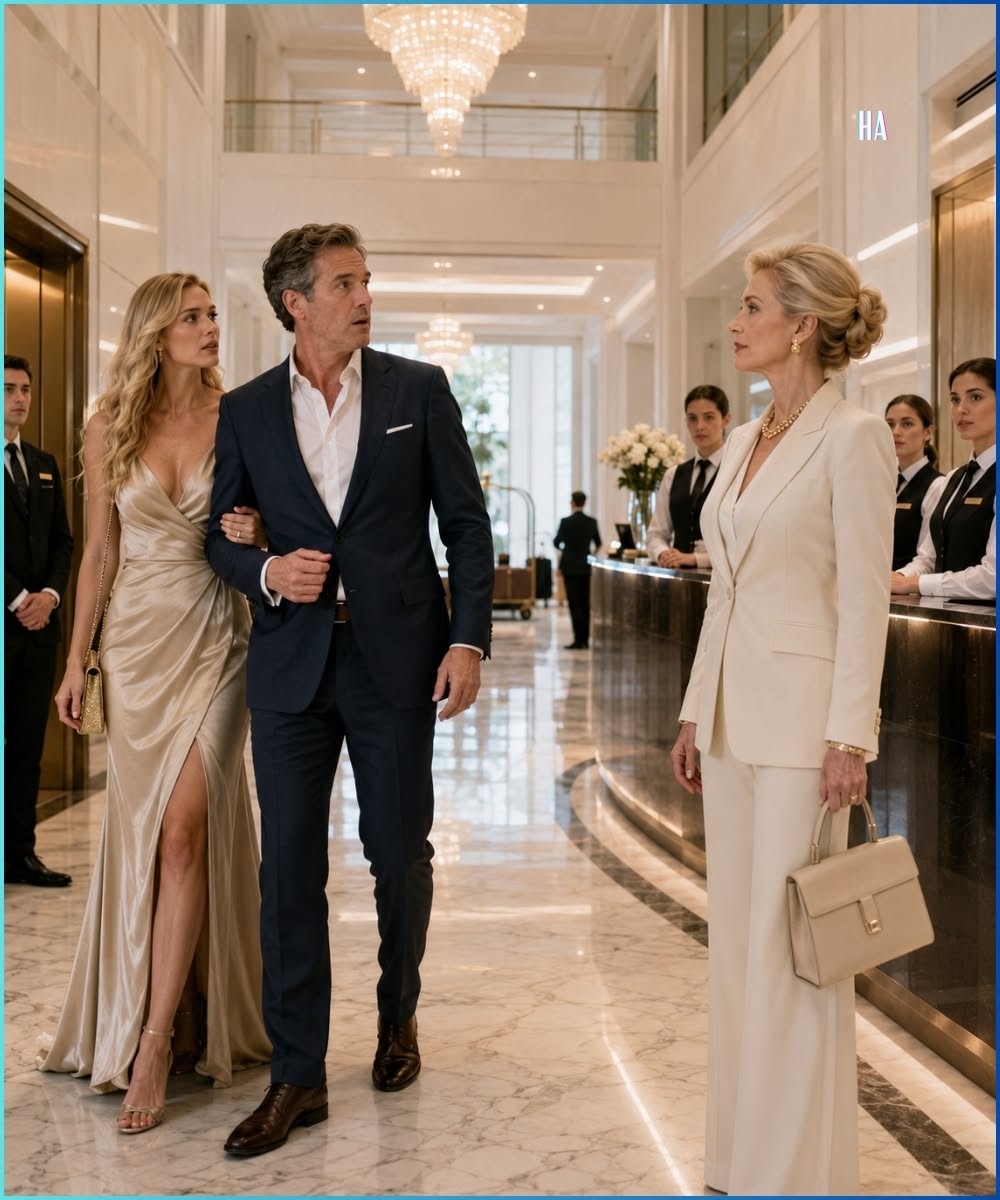
The bartender looked at him for a beat too long.
“Sometimes,” he said. “When she does, everyone knows.”
Nathan waited for more.
The bartender only polished a glass.
Back upstairs, Savannah was sitting cross-legged on the bed in a silk robe, scrolling through her phone.
“You were gone a while,” she said.
“Had a drink.”
She smiled. “Without me?”
“You were busy turning the bathroom into a spa.”
She laughed, but Nathan heard the hollowness in his own voice.
He walked to the window and looked out over the park.
Eight years.
That was how long he had been married to Evelyn.
If someone had asked him what his wife did, he would have said, “Real estate stuff.”
Not because he meant to be cruel.
Something worse.
Because he believed it was enough.
Evelyn had tried to tell him, in the beginning.
She had come home with contracts, sketches, zoning approvals, financing challenges, partnership agreements. She had talked about properties with the kind of intensity other people reserved for children or art or war.
Nathan had nodded while checking emails.
“That’s great, Ev,” he would say.
Or, “You work too hard.”
Or, worst of all, “We don’t really need the money, you know.”
As if that was the point.
As if Evelyn’s ambition was a hobby she had taken too seriously.
As if she was building something only because he had not given her enough to decorate.
Eventually, she stopped telling him.
Not dramatically.
Not with a slammed door.
She simply learned the shape of his indifference and stopped trying to fit her joy inside it.
Three years earlier, she had stood in their living room while Nathan watched a playoff game with a glass of bourbon in his hand.
“Nathan,” she had said. “I want to show you something.”
“Now?”
“It matters.”
He had sighed and muted the TV, just enough to make clear what an act of generosity he was performing.
“What kind of mattering?”
Evelyn had held a folder to her chest.
“I bought a building.”
Nathan had looked at her.
“A building?”
“Yes.”
“What, like an apartment building?”
“An old hotel property near Bryant Park. It’s been abandoned for years. I’m restoring it.”
Nathan had laughed softly, not meanly, which somehow made it worse.
“Do you have the money for that?”
Evelyn had gone very still.
“Yes, Nathan,” she said. “I do.”
The game had resumed in the background. He remembered the announcer shouting.
He had turned back toward the screen.
“Okay,” he said. “Tell me later.”
Later never came.
The hotel opened that spring.
Evelyn sent him a photo from the ribbon-cutting ceremony.
She had written one word.
Done.
Nathan had replied with a thumbs-up emoji during a golf trip in Palm Beach.
That memory returned now, faint and uncomfortable, like a bruise he had forgotten pressing.
Behind him, Savannah said, “Are you coming to bed?”
Nathan turned.
The suite glowed around her. Soft lamps. White sheets. Champagne waiting.
He smiled because smiling was easier than thinking.
“Yeah,” he said. “I’m coming.”
But when Savannah turned off the light, Nathan stayed awake longer than he expected.
Outside the window, the city glittered.
Somewhere beneath him, the bellflower mark shone on walls and doors and uniforms.
Somewhere in his phone, Evelyn’s silence waited.
Part 2
The next evening, Nathan Whitmore took his mistress to dinner in his wife’s restaurant.
He did not know that yet.
He knew only that The Bellamy Grand’s rooftop dining room had a three-month reservation list, and the concierge had “managed” to secure him a table by the window. He liked the idea of that. Doors opened for him. People accommodated him. The world, in his experience, had a habit of rearranging itself around his comfort.
Savannah wore a red dress that made three men turn their heads before she reached the host stand.
Nathan noticed.
So did she.
The dining room sat on the twenty-second floor, wrapped in glass, with Manhattan blazing below. Candles floated in shallow bowls of water. The tables were spaced far enough apart that privacy itself felt expensive. A pianist played softly near the bar.
Savannah leaned over the menu.
“There are no prices,” she whispered.
Nathan smiled. “That usually means you’re not supposed to care.”
She laughed.
He ordered wine without reading the list.
The waiter nodded and disappeared.
For the first twenty minutes, Nathan almost relaxed.
Almost.
Then something changed.
It began with the maître d’ pausing mid-sentence near the entrance.
A small thing.
A flicker.
Then the floor manager straightened.
A hostess moved quickly to adjust a table near the far window.
The chef himself appeared from the kitchen doors and looked toward the entrance.
Nathan noticed because Nathan was trained to notice when attention left him.
Savannah noticed too.
“Who is that?” she murmured.
Nathan followed her gaze.
A woman had entered the restaurant.
She wore gray tailored pants, a cream blazer, and no jewelry except a thin gold wedding band. Her hair was swept into a low knot. She carried no designer bag, no flashy coat, nothing that demanded notice.
And yet the room noticed.
The maître d’ bowed his head slightly.
Not servile.
Respectful.
The woman smiled and said something quiet. The maître d’ looked relieved. The chef approached her, and she touched his arm briefly as they spoke. A server passed and straightened as if instinctively remembering his posture.
Savannah stared.
“She must be famous,” she whispered.
Nathan looked down at his wineglass.
“No idea.”
But he did.
Not fully.
Not consciously.
Some part of him knew before his mind allowed it.
The woman crossed to a table by the window and sat alone. A cup of tea appeared almost instantly, without her ordering. She opened a leather folder and began reading.
Nathan’s throat tightened.
The tilt of her head.
The way she held a pen between two fingers.
The stillness.
Savannah glanced between Nathan and the woman.
“You okay?”
“Fine.”
“You look pale.”
“Headache.”
He drank water.
At the far window, the woman turned a page. A manager came by with a tablet and leaned down beside her. She pointed at something with her pen. The manager nodded quickly, taking notes.
Savannah’s voice dropped.
“Nathan.”
“What?”
“That woman looks like—”
“Don’t.”
The word came out too sharp.
Savannah blinked.
Nathan forced a smile. “Sorry. Headache.”
But then the woman at the window looked up.
Directly at him.
For two seconds, Evelyn Whitmore held her husband’s gaze across the restaurant he had entered with another woman.
She did not gasp.
She did not stand.
She did not cry.
She simply looked at him.
And in that look, Nathan saw the end of his life as he had understood it.
Savannah’s fork froze halfway to her mouth.
“That’s your wife,” she whispered.
Nathan stood so quickly his chair legs scraped the floor.
“I need the restroom.”
He walked out before Savannah could answer.
In the hallway, away from the candles and glass and watching eyes, Nathan gripped the edge of a side table and tried to breathe.
No.
No, no, no.
It had to be coincidence. Evelyn could be meeting someone. She could be a guest. She could be there for dinner with a client. Rich people went to rich places. New York was enormous and somehow constantly too small.
He walked toward the lobby, then stopped.
From the corridor outside the dining room, through a glass partition, he could still see Evelyn.
A staff member had approached her again.
Not like a guest.
Like a superior.
Nathan went cold.
He rode the elevator down to the lobby and crossed to the front desk.
A young man in a navy suit looked up.
“Good evening, Mr. Whitmore.”
Nathan stiffened.
“You know my name?”
“You’re checked into the Bellamy Suite, sir.”
“Right.”
The young man smiled professionally.
Nathan lowered his voice. “The woman upstairs. Cream blazer. Sitting by the window. Is she staying here?”
The receptionist’s expression did not change.
“I’m sorry, sir. We don’t discuss guests.”
“Is she a guest?”
“I can assist you with your reservation, transportation, dining requests, or any other hotel service.”
Nathan stared at him.
The answer was there, not in the words, but in the refusal.
She was not a guest.
Nathan walked away.
The gallery hallway pulled at him like a dare.
He stood in front of the ribbon-cutting photograph again.
This time, he took out his phone.
He zoomed in.
The image sharpened.
The woman in the ivory dress smiled beneath falling confetti, gold scissors in hand, the Bellamy ribbon split in front of her.
Nathan’s stomach turned.
It was not someone who looked like Evelyn.
It was Evelyn.
He lowered the phone and saw his reflection faintly in the glass over the photograph.
For one awful moment, he looked like a stranger trespassing in the museum of his wife’s life.
When he returned to the table, Savannah was no longer smiling.
Evelyn’s table was empty.
“Where did she go?” Nathan asked before he could stop himself.
Savannah leaned back slowly.
“She left about two minutes after you did.”
Nathan sat down.
Savannah looked at him as if seeing him clearly for the first time.
“Did you know?”
“Know what?”
“That your wife owns this place.”
His mouth opened.
Closed.
Savannah laughed once, softly, without humor.
“Oh my God,” she said. “You didn’t.”
Nathan grabbed his wineglass.
“Keep your voice down.”
“You brought me to your wife’s hotel and you didn’t even know?”
“I said keep your voice down.”
Savannah’s face changed.
For months she had seen Nathan as impressive. Powerful. Bored with a marriage beneath him. A man choosing her because she was exciting, young, alive.
Now she saw something else.
A man who had slept beside a woman for eight years and had not known the shape of her life.
The waiter came by.
“Is everything satisfactory, Mr. Whitmore?”
Nathan almost laughed.
Satisfactory.
The word felt obscene.
“Yes,” he said.
The waiter’s eyes flicked once toward the empty window table.
Then back to Nathan.
“Very good, sir.”
They finished dinner in a silence that had nothing elegant about it.
In the elevator, Savannah crossed her arms.
“So what happens now?”
“Nothing happens.”
She looked at him.
“Nathan.”
“I’ll handle it.”
“Like you handled knowing what your wife does for a living?”
He turned sharply.
But there was nothing to say.
When they reached the suite, Savannah went straight to the bedroom and began gathering her things.
Nathan watched from the doorway.
“What are you doing?”
“Leaving.”
“Don’t be dramatic.”
She turned, holding one heel in her hand.
“Dramatic? Nathan, I just spent the night in a hotel owned by your wife. The staff has probably known since check-in. Your wife saw us at dinner and didn’t even bother causing a scene. Do you understand how humiliating that is?”
“Humiliating for you?”
“Yes,” she snapped. “For me. Because I thought I was with a man who knew what he was doing.”
That landed harder than Nathan expected.
Savannah zipped her bag.
“I don’t want to be part of whatever this is.”
“You already are.”
“No,” she said. “I was part of your lie. I’m not staying for your consequences.”
She walked past him.
At the door, she paused.
“For what it’s worth, your wife looked incredible.”
Then she left.
Nathan stood alone in the Bellamy Suite.
For the first time since he had arrived, he looked around and truly saw it.
The curved brass lamp near the sofa.
The handmade ceramic bowl on the coffee table.
The carefully chosen books on the shelf.
The view.
The silence.
This was not just luxury.
It was Evelyn’s taste. Evelyn’s restraint. Evelyn’s ability to turn emptiness into atmosphere.
He walked slowly through the suite like a man examining a crime scene and realizing the crime was himself.
On the desk, beside the welcome booklet, was a card embossed with the bellflower symbol.
Welcome to The Bellamy Grand, a place restored with patience, courage, and care.
Nathan sat down.
Patience.
Courage.
Care.
Three things Evelyn had given the building.
Three things he had stopped giving her.
He did not sleep.
At 5:47 a.m., he opened his laptop and searched The Bellamy Grand owner.
The first result was a profile from an architecture and hospitality magazine.
Evelyn Bellamy Whitmore: The Woman Who Turned a Dead Landmark Into New York’s Most Intimate Luxury Hotel
Nathan stared.
Bellamy.
Her maiden name.
He had forgotten, somehow, that the name of the hotel was also the name she had carried before she became his wife.
No.
Not forgotten.
Ignored.
He clicked.
The article opened with a photograph of Evelyn standing in the restored lobby, one hand on the marble front desk, smiling with a softness he had not seen in years.
The story was long.
He read every word.
Evelyn had purchased the old Harrington Building after three developers abandoned it. The structure had asbestos problems, legal disputes, unpaid liens, and a reputation for swallowing money. She had used her own capital, secured private investment, fought the city over permits, replaced a dishonest contractor, and nearly lost everything twice.
Nathan read that sentence three times.
Nearly lost everything twice.
He remembered a year when Evelyn came home late almost every night. He remembered her sitting at the kitchen island with papers spread out, her hair falling loose around her face, rubbing her temples.
He had asked, “Everything okay?”
She had said, “I’m handling something.”
He had kissed her cheek and gone upstairs to watch television.
Handling something.
Lawsuits.
Debt.
Contractors.
Millions of dollars.
Her future.
Something.
He kept reading.
The article quoted her.
People sometimes fail to see what doesn’t exist yet. I learned not to be angry at them for that. Their lack of vision is their limitation, not mine.
Nathan pushed the laptop away.
He stood and walked to the window, but the city looked blurred.
Another article.
Another profile.
Another photograph.
At the grand opening, Evelyn stood with the mayor, investors, chefs, architects, community leaders. Nathan recognized the date.
He had been in the Bahamas on a boys’ trip.
He remembered Evelyn texting him a picture.
Done.
He remembered replying with a clapping emoji, then jumping off the back of a boat with a beer in his hand.
He sat down again.
There was a business note from the previous year.
The Bellamy Hospitality Group reportedly declined a $42 million acquisition offer from a major international hotel brand. Founder Evelyn Bellamy Whitmore said only, “Some things are worth more than an exit.”
Nathan leaned back.
Forty-two million dollars.
His wife had turned down forty-two million dollars, and he had not known.
He remembered that week. Evelyn had been quiet at dinner. He had asked if she was tired.
She had said yes.
He had believed her because believing her required nothing of him.
At 7:12 a.m., there was a knock at the suite door.
Nathan froze.
Another knock.
He opened it.
A hotel employee stood in the hallway with a garment bag and a sealed envelope.
“Good morning, Mr. Whitmore.”
Nathan looked at the envelope.
“What is this?”
“Mrs. Whitmore asked that this be delivered.”
His fingers tightened.
He took it.
The employee nodded and left.
Nathan closed the door.
For a long moment, he only stared at Evelyn’s handwriting.
Nathan.
Inside was a single sheet of cream stationery.
Meet me for breakfast downstairs at 8:00. Come alone.
Evelyn
No accusation.
No explanation.
No threat.
That was worse.
At 7:59, Nathan walked into the Bellamy Grand’s breakfast room wearing the same suit from the night before.
He saw her immediately.
Evelyn sat near the windows with tea in front of her. She wore a navy dress now, simple and exact, her hair down over one shoulder. Morning light rested on her like it had been invited.
She looked up as he approached.
Not surprised.
That was what broke him first.
The absence of surprise.
She had known he would come.
She had known he would be late to the truth and still early enough to be frightened by it.
Nathan sat across from her.
For several seconds, neither spoke.
Around them, the room lived peacefully. Coffee poured into white cups. A child laughed at a nearby table. Silverware touched porcelain. Staff moved with quiet grace.
Finally Nathan said, “You knew.”
“Yes.”
“Since when?”
“The reservation.”
He swallowed.
“How?”
“The system shows the cardholder and guest notes. You used your corporate account.”
Nathan closed his eyes.
Of course he had.
Careless, arrogant, stupid.
“Why didn’t you call me?”
“And say what?” Evelyn asked.
Her voice was gentle, which somehow made it unbearable.
He looked at her.
“I don’t know.”
“No, you don’t.”
The words were not cruel.
They were simply true.
Nathan leaned forward.
“Evelyn, I didn’t know this was yours.”
“I know.”
“I mean—I didn’t know any of it. The hotel. The articles. The money. The offer. I didn’t know.”
Evelyn held her tea with both hands.
“You didn’t know because you never asked.”
There it was.
No shouting.
No shattered glass.
Just one sentence sharp enough to cut through eight years.
Nathan looked away.
“I thought you would tell me.”
“I tried.”
He said nothing.
“I tried in the beginning,” Evelyn continued. “I tried when I bought the building. I tried when the permits came through. I tried when we broke ground. I tried when the first contractor stole from us. I tried when I almost lost the financing. I tried when we opened.”
Her eyes remained steady.
“Do you remember what you texted me the day this hotel opened?”
Nathan’s throat closed.
“A clapping emoji,” she said. “Then nothing.”
He stared at the table.
“I was in the Bahamas.”
“Yes.”
“I’m sorry.”
“I know you are.”
He looked up quickly, desperate.
“You do?”
“Yes.”
For one brief, foolish second, hope moved through him.
Then Evelyn said, “But your regret doesn’t change what your absence did.”
Part 3
Nathan Whitmore had negotiated billion-dollar contracts with less fear than he felt sitting across from his wife at breakfast.
The strange part was that Evelyn did not look angry.
He could have defended himself against anger. He had done it many times in life. Anger gave him something to push against, something to call unreasonable, emotional, exaggerated. He knew how to survive anger.
But Evelyn’s calm left him nowhere to hide.
She was not performing pain for him.
She was not begging him to understand.
She was simply done.
A waiter approached their table and set down a fresh cup of tea beside Evelyn. He did not ask what she wanted. He already knew.
“Thank you, Marcus,” she said.
The waiter’s face softened.
“Of course, Mrs. Whitmore.”
Nathan watched the exchange.
The warmth in it.
The familiarity.
The respect.
It struck him with sudden cruelty that the staff of this hotel knew Evelyn better than he did. They knew how she took her tea. They knew when to approach and when to give her space. They knew what her silence meant.
Nathan had spent eight years beside her and mistook her silence for convenience.
“Evelyn,” he said, “please.”
She folded her hands on the table.
“I’m not here to punish you.”
He almost laughed, because it felt exactly like punishment.
“I’m here because this is my hotel,” she continued, “and because what happened last night involved my staff, my property, and my reputation.”
“Your reputation?”
“Yes, Nathan. Mine. The one I built while you were too busy to notice.”
He flinched.
She did not apologize for the blow.
“I spoke to legal this morning,” she said. “My attorney will contact yours by the end of the week.”
His stomach dropped.
“Divorce?”
Evelyn looked at him as if the word was not a door opening, but one that had been closed for a long time.
“Yes.”
“Because of Savannah?”
“No.”
Nathan blinked.
Evelyn glanced toward the window, where early sunlight crossed the floor in pale rectangles.
“Savannah is not the reason. She is evidence.”
He sat very still.
“The affair hurts,” Evelyn said. “Of course it does. I won’t pretend it doesn’t. But this marriage was dying long before you brought another woman into my hotel.”
He wanted to deny it.
He wanted to say they had been fine.
But memory, once awakened, had turned traitor.
Evelyn eating dinner across from him while he answered emails.
Evelyn standing in the doorway of his office, waiting for him to look up.
Evelyn saying, “Can I show you something?” and him saying, “In a minute.”
Evelyn no longer asking.
Evelyn becoming quieter year by year, not because she had less to say, but because he had trained her not to expect a listener.
Nathan rubbed both hands over his face.
“I loved you,” he said.
Evelyn’s expression changed then.
Not much.
Just enough.
“I believe you loved the version of me that didn’t require your attention,” she said. “The wife who came home, looked beautiful at dinners, remembered birthdays, handled the house, asked about your day, and didn’t make too much noise about her own.”
“That’s not fair.”
“It is fair,” she said. “That’s why it hurts.”
His mouth closed.
Evelyn leaned back.
“Do you know what the worst night was for me?”
Nathan shook his head.
“The opening.”
He closed his eyes.
“I stood right outside this building with scissors in my hand. Reporters were there. Investors. Friends. People who had watched me fight for years. Everybody clapped when the ribbon fell.”
She smiled faintly, but there was no joy in it.
“And for one second, I looked into the crowd for you.”
Nathan felt something inside him cave.
“You weren’t there. I knew you wouldn’t be. I told myself I was fine with it. I told everyone you had business out of town. And then later, after the last guest left, I came up to the penthouse suite alone.”
Her eyes lifted to his.
“The same suite you booked.”
Nathan went pale.
“I sat on the floor by the window in my dress and cried. Not because I hadn’t succeeded. I had. That was the problem. I had succeeded so completely that there was no excuse left for your absence.”
He gripped the edge of the table.
“Ev—”
“Please don’t call me that right now.”
The softness of the request was worse than a slap.
He nodded.
“I’m sorry,” he whispered.
“I know.”
“I can change.”
Evelyn looked at him for a long moment.
“Maybe.”
Hope returned, fragile and humiliating.
“But not with me,” she said.
The words landed quietly.
Final.
Nathan stared at her.
“You don’t know that.”
“I do.”
“How can you be so sure?”
“Because I changed already,” Evelyn said. “And you didn’t notice.”
He had no answer.
She took a breath.
“I spent years hoping you would become present. Then I spent years becoming okay without you. That is a journey, Nathan. You are arriving at the beginning this morning. I am standing at the end.”
Around them, breakfast continued.
A woman laughed softly near the buffet. A businessman took a phone call by the entrance. A little girl spilled orange juice and her father quickly covered it with a napkin.
The ordinary world had no idea Nathan’s life had just split open.
“Was there ever a chance?” he asked.
Evelyn’s eyes softened.
“Yes.”
That hurt most of all.
“When?”
“So many times.”
He looked down.
“When I asked you to come see the building before renovations,” she said. “When I came home crying and you didn’t ask a second question. When I sent you the opening invitation. When I asked if we could take a weekend away and you said you were too busy. When I stopped reaching for your hand at night and you didn’t notice. When I stopped saying your name first when I walked into a room.”
Nathan’s eyes burned.
“I didn’t know.”
“No,” Evelyn said. “You didn’t.”
She reached into her bag and removed a slim folder.
Nathan stared at it like it might explode.
“This isn’t the divorce filing,” she said. “That will come properly. This is the hotel policy report from last night.”
He frowned.
“What?”
“The staff followed protocol. They respected your privacy. They did not gossip in public spaces. They alerted management because your reservation created a conflict involving ownership. I reviewed everything.”
He almost could not understand her.
Even now, she was protecting the people who worked for her.
Even now, she was making sure no one else paid for his choices.
“I don’t want anyone fired,” Nathan said quickly.
“No one will be fired,” Evelyn said. “They did their jobs well.”
He looked at her then, really looked.
This was why people respected her.
Not because she had money.
Not because she owned marble floors and rooftop dining rooms.
Because she was the kind of person who could be humiliated in her own hotel and still think first about whether her employees were safe.
Nathan had spent years mistaking restraint for weakness.
He saw now that it was discipline.
“Savannah left,” he said, though he did not know why.
Evelyn’s face did not change.
“I assumed she would.”
“That’s all?”
“What would you like me to say?”
“I don’t know.”
“That seems to be a theme this morning.”
He almost smiled because once, years ago, that dry edge in her voice had made him fall in love with her.
Then he remembered he had spent years letting it disappear.
Evelyn stood.
Nathan stood too, too quickly.
“Please,” he said. “Can we talk again? Not about lawyers. Just us.”
“There is no us to discuss today.”
“Tomorrow?”
She looked at him gently.
“Nathan.”
That one word stopped him.
Not because it was loud.
Because it sounded like goodbye.
“I hope you become the kind of man who notices what is in front of him,” Evelyn said. “I really do. But I will not spend the rest of my life standing in front of you waiting to be seen.”
She picked up her bag.
“Take care of yourself.”
No hatred.
No bitterness.
That was how Nathan knew he had lost her completely.
He watched her walk across the breakfast room.
Staff greeted her as she passed. Not theatrically. Not because she was rich. Because they meant it.
“Good morning, Mrs. Whitmore.”
“Morning, Daniel.”
“The architect called to confirm ten.”
“Tell him I’ll be in the boardroom.”
“The florist asked about the lobby arrangements.”
“White tulips this week. Something clean.”
“Yes, ma’am.”
She moved through the hotel like she belonged not because she owned it, but because she had earned every inch.
Nathan sat back down after she disappeared.
His coffee had gone cold.
He ordered another.
It went cold too.
Upstairs, the suite felt different in daylight.
Less romantic.
More honest.
Savannah’s perfume lingered near the bed. Her champagne glass sat abandoned on the nightstand. The robe she had worn was folded over a chair, not neatly, not carelessly, just left behind.
Nathan packed slowly.
In the bathroom mirror, he saw a man with expensive clothes, tired eyes, and no idea what remained after charm stopped working.
He checked out at 10:06 a.m.
The same receptionist stood behind the desk.
“Was everything satisfactory with your stay, Mr. Whitmore?”
Nathan looked at him.
The question was professional. Neutral.
But Nathan heard what lived beneath the surface.
We know.
We saw.
We served you anyway.
He swallowed.
“Yes,” he said. “The hotel is extraordinary.”
The receptionist nodded.
“Mrs. Whitmore will be glad to hear that.”
Nathan almost corrected him.
My wife.
But the words did not belong to him anymore.
So he only said, “She should be proud.”
For the first time, the receptionist’s expression softened by a fraction.
“Yes, sir,” he said. “She is.”
Outside, Manhattan was loud and bright. Horns. Steam from grates. People hurrying with coffee and phones and purpose.
Nathan stood on the sidewalk with his overnight bag in his hand and looked up at the building.
The Bellamy Grand rose above him, restored stone glowing in the winter sun, the bellflower symbol mounted above the entrance.
He had walked into that hotel thinking it was a backdrop for his pleasure.
He walked out knowing it was a monument to everything he had failed to see.
Across town, Evelyn did not spend the day collapsing.
That surprised people later, when they heard pieces of the story. They imagined a woman crying in her office, shattered by betrayal, broken by the humiliation of seeing her husband with another woman.
But Evelyn had already cried.
She had cried years earlier in kitchens, cars, bathrooms, empty suites, and silent bedrooms.
By the time Nathan finally saw the damage, Evelyn had already survived it.
At 10:00 sharp, she sat at the head of the Bellamy Grand boardroom with architectural drawings spread across the table.
The project was in Charleston, South Carolina—an old waterfront building with cracked brick, rusted balconies, and a history everyone said was too complicated to touch.
Evelyn loved complicated things.
Complicated meant there was still something to save.
Her lead architect, Martin Hayes, pointed at the rendering.
“If we preserve the original staircase, we lose six guest rooms.”
“Then we lose six rooms,” Evelyn said.
Martin glanced up.
“That staircase is the soul of the building.”
Evelyn smiled faintly.
“Exactly.”
The meeting continued.
Budgets.
Timelines.
Permits.
Risks.
Evelyn listened fully.
That was one of the things people said about her. When Evelyn Bellamy Whitmore sat in a meeting, she was actually there. Not half-checking her phone. Not waiting for her turn to speak. Present.
She had learned presence from its absence.
She had spent years beside someone who could look straight at her and still be somewhere else. She had promised herself she would not become that kind of person. Not in business. Not in friendship. Not in love, if love ever returned.
And love would return.
She knew that now.
Not because she needed it.
Because she no longer feared being alone.
There is a difference between loneliness and peace, and Evelyn had paid dearly to learn it.
At noon, Marcus brought her tea without asking.
“You okay, Mrs. Whitmore?” he asked quietly.
Evelyn looked up.
Marcus had worked at the hotel since before opening. He had been there when rain leaked through the lobby ceiling, when inspectors threatened delays, when the first staff training went wrong and everyone ate pizza on the floor because the kitchen was not finished.
He had also been there the night before.
Evelyn knew what he was asking.
“I am,” she said.
Marcus nodded once.
“If anyone says anything, they answer to me,” he said.
Evelyn laughed softly.
“Marcus, I own the building.”
“Yes, ma’am,” he said. “But we love you in it.”
For the first time that day, her eyes stung.
“Thank you,” she said.
He left before emotion could embarrass either of them.
In the afternoon, Evelyn walked through the courtyard.
The bronze plaque glowed in the pale light.
This courtyard was restored in honor of the vision and determination of the woman who saw beauty where everyone else saw ruins. Opened 2021.
She stood before it, not out of vanity, but memory.
She remembered the day the courtyard had been nothing but weeds, broken bottles, and cracked concrete. She remembered standing there in muddy boots while a contractor told her it would be cheaper to cover the whole thing with stone.
“No,” she had said. “People need somewhere to breathe.”
He had laughed.
They always laughed in the beginning.
Then later, when the fountain was installed and the ivy took root and guests began calling it their favorite place in the hotel, they called her brilliant.
Evelyn had learned not to build her identity from either reaction.
Not their doubt.
Not their applause.
At 3:00 p.m., she signed the Charleston acquisition documents with the same fountain pen she had used for The Bellamy Grand.
There was no husband beside her.
No one holding champagne.
No one telling her she had done well.
For a second, the old ache appeared.
Then it passed.
Evelyn signed her name.
Evelyn Bellamy Whitmore.
Strong.
Clear.
Hers.
In a town car stuck in Midtown traffic, Nathan sat with his phone in his hand and Evelyn’s contact open.
The cursor blinked in the message box.
I’m sorry.
He erased it.
I didn’t know how much I hurt you.
Erased.
Can we talk?
Erased.
He stared out at the cars, the pedestrians, the city moving without caring that he had finally become aware of his own life.
There were no words large enough.
That was the punishment.
Not public humiliation.
Not screaming.
Not revenge.
The punishment was understanding too late.
It was seeing, finally, what had been in front of him when seeing no longer changed the outcome.
Nathan locked his phone and set it on the seat beside him.
For once, he did not reach for a distraction.
He sat in silence.
Not the empty silence of neglect.
The painful silence of presence.
Weeks later, the divorce became public only because people like Nathan could not remain private forever.
There were whispers, of course.
There always are.
Some said Evelyn had destroyed him.
Others said Nathan had been foolish.
A few tried to make Savannah the center of the story, because people love turning women into villains when a man’s weakness needs somewhere to hide.
Evelyn never commented.
She did not need to.
The Bellamy Grand continued to fill every room.
The Charleston project broke ground by summer.
A hospitality magazine put Evelyn on its cover in October, standing in front of the old waterfront building with her sleeves rolled up and dust on her shoes.
The headline read: She does not rescue buildings. She teaches them to stand again.
When Nathan saw the cover in an airport lounge, he bought the magazine.
He read the article on a flight to Chicago.
This time, he did not skim.
This time, he read every word.
At the end, the interviewer asked Evelyn what she had learned from restoring places other people had abandoned.
Her answer was simple.
“Some things can be saved,” she said. “But only if the people responsible show up before the structure collapses.”
Nathan closed the magazine.
Outside the airplane window, clouds stretched white and endless.
He did not cry.
But he finally understood.
Evelyn had not become powerful because he failed to see her.
She had always been powerful.
His failure was believing that because he refused to look, there was nothing there.
And Evelyn, who had once begged silently to be noticed, no longer needed the eyes of a man who had mistaken her patience for permanence.
One year after Nathan checked into the Bellamy Suite with another woman, Evelyn stood in the lobby of her second hotel on opening night.
The restored Charleston staircase curved behind her, polished and gleaming, saved exactly as she had insisted.
Guests filled the room.
Cameras flashed.
Marcus had flown in for the event and stood near the bar, pretending not to look proud.
Martin Hayes handed Evelyn the gold scissors.
“Ready?” he asked.
Evelyn looked at the ribbon.
For just one heartbeat, she remembered another opening. Another ribbon. Another version of herself searching a crowd for a man who was not coming.
This time, she did not search.
She looked at the staff, the friends, the people who had stood beside her in the dust before the applause arrived.
Then she smiled.
“Ready,” she said.
The ribbon fell.
The room erupted.
And Evelyn Bellamy Whitmore did not look back.
THE END