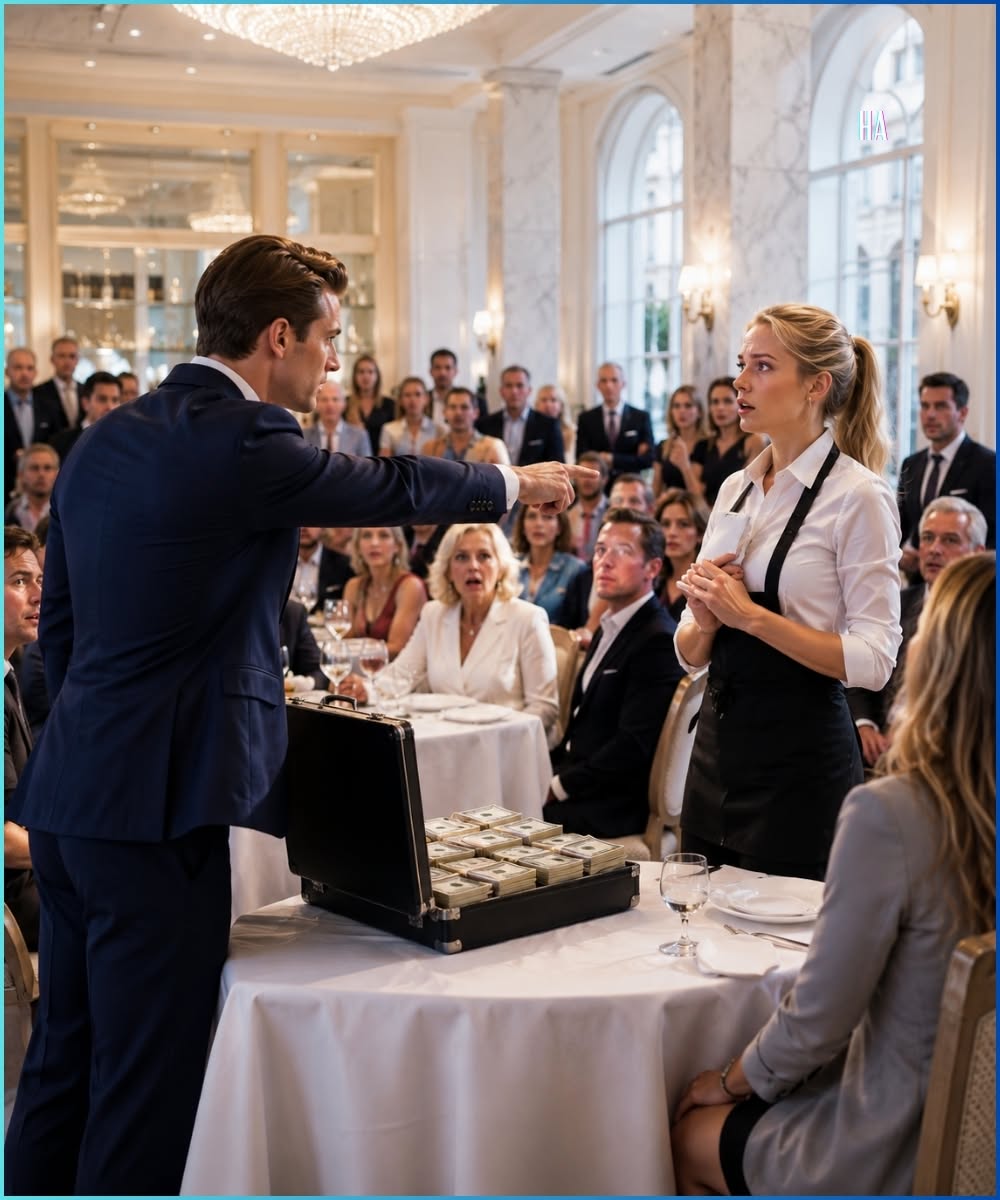
Whitney retied her apron, though it did not need tying.
“I’m working.”
“That’s not what I asked.”
She looked at him then.
Derek had been at Harmon & Vine for six years. He was the kind of man who noticed who cried in the walk-in, who skipped staff meals, who needed an extra ride home after a double shift. He had never treated Whitney like furniture.
“He bet I couldn’t speak Chinese,” Whitney said. “He didn’t bet I wouldn’t.”
Derek shook his head, almost smiling.
“You know he’s connected.”
“I know.”
“He could make things hard.”
“He already did.”
Before Derek could answer, Douglas appeared at the kitchen door.
“Whitney,” he said gently. “Mr. Shu asked for you.”
Her chest tightened.
“For what?”
Douglas’s mouth curved slightly.
“Not as a server. As an interpreter.”
The kitchen went still.
Whitney glanced toward the dining room. Through the small window, she could see Gerald’s table, the candles, the white plates, the men in expensive jackets pretending they had not just witnessed a shift in gravity.
“She can say no,” Derek said.
Douglas nodded. “She can.”
Whitney inhaled once.
Then she walked back out.
The change was immediate.
Before, she had stood beside the table as a waitress. Now Victor Shu rose slightly when she approached. His wife offered a warm nod. One of the associates moved his chair to make room.
Gerald did not stand.
But he had to speak through her.
That was the humiliation he had created for himself.
The woman he had tried to remove had become the only reason he could continue the conversation.
For the next forty minutes, Whitney did not merely translate. She interpreted intention.
When Gerald said, “We like to move fast in America,” Whitney softened it before rendering it in Mandarin, changing the meaning into something closer to, “We value momentum, but we respect the time needed for trust.”
Victor Shu relaxed instead of stiffening.
When Mrs. Shu asked about the environmental impact of the waterfront project, Whitney kept the formality intact, making sure Gerald understood it was not a casual concern.
When an associate referred to a zoning issue without a clean English equivalent, Whitney explained the closest American legal parallel in three crisp sentences.
Raymond Cross watched her like a man recalculating an investment.
Gerald watched her like a man watching his own reflection betray him.
By the time dessert arrived, the ninety-million-dollar deal was no longer dying. It was breathing again.
And everyone knew why.
Douglas approached the table after the main course.
“Mr. Shu,” he said, “I want you to know something about Miss Sawyer. She has been on my team for two years. She is reliable, disciplined, and clearly far more gifted than I realized.”
Whitney looked down.
Douglas continued.
“Whatever she has contributed tonight, it is not a surprise to me that she had it in her. It is only overdue that the rest of us saw it.”
That was not exactly true.
Douglas had not known the full extent of Whitney’s talent. He had known she was sharp. He had known she never missed a shift unless her grandmother was sick. He had known she handled difficult guests better than servers twice her age.
But Mandarin legal interpretation? Classical phrasing? Cross-cultural business instincts?
No, he had not known.
But he understood something Gerald did not.
Sometimes leadership means standing beside someone at the exact moment the world finally notices them.
Victor Shu reached into his jacket and withdrew a business card. He held it with both hands, offering it with formal respect.
“Miss Sawyer,” he said, “my firm employs more than two hundred bilingual consultants. Not one of them translated tonight with your instinct. I would like to offer you a position on my cross-cultural advisory team.”
The room stilled again.
Whitney’s breath caught.
The card hung between them like a doorway.
“I’m honored,” she said. Her voice was steady, but her hands were not. “May I have a little time to think?”
“Of course,” Victor Shu said. “But not too much.”
Gerald stared at the table.
His waitress had just been offered a global consulting job by the man he had spent half a year trying to impress.
Then Lillian Covington rose.
For most of the night, she had been silent. Beautiful, composed, polished in the way wealthy wives were expected to be polished. But there was something strained behind her eyes, something that had looked familiar to Whitney even before Lillian spoke.
She found Whitney near the service station a few minutes later.
“Miss Sawyer?”
Whitney turned. “Yes, ma’am?”
“I want to apologize for my husband.”
“You don’t have to apologize for someone else’s words.”
Lillian swallowed.
“I know. But silence is its own kind of word, isn’t it?”
Whitney did not answer.
Lillian’s eyes glistened.
“I should have said something. At the table. Years ago, maybe.” She gave a small, sad laugh. “Tonight I watched you refuse to shrink. I had forgotten people could do that.”
Whitney’s expression softened.
“You still can,” she said.
Lillian looked at her for a long second, as if those three words had found some locked room inside her.
Then she squeezed Whitney’s hand once and walked away.
In the staff hallway, Whitney called her grandmother.
Evelyn answered on the fourth ring, breathless, probably having crossed the apartment too quickly.
“Baby?”
“Grandma,” Whitney said, leaning against the wall. “Someone offered me a job tonight.”
“What kind of job?”
“A real one. With a consulting firm. Because I spoke Chinese.”
The line went quiet.
Whitney heard a television murmuring in the background, a neighbor’s dog barking through thin walls, the soft hum of the old refrigerator in the apartment where she had grown up.
Then Evelyn said, “I always told those ladies at the grocery store you listened better than anybody.”
Whitney closed her eyes.
“I was so angry, Grandma.”
“Good,” Evelyn said.
Whitney laughed through sudden tears. “Good?”
“Anger is not always ugly. Sometimes it tells you where your dignity is.”
Whitney wiped her cheek with the back of her hand.
“I don’t know what to do.”
“You do,” Evelyn said. “You just need a minute to hear yourself.”
When Whitney returned to the dining room, Gerald had changed.
Not improved.
Changed.
He sat straighter, jacket buttoned, face carefully arranged. His third scotch sat half-empty beside his plate. He was no longer openly furious. That made him more dangerous.
He tapped his phone on the table.
“All right,” he said. “I admit she speaks Chinese.”
No one responded.
“But I made a bet,” he continued. “One hundred thousand dollars. And I am a man of my word.”
Raymond Cross looked tired.
Gerald held up his phone. “So let’s make it official. I’m calling a certified Mandarin interpreter. If Miss Sawyer passes a professional-grade translation test right here, legal, medical, and cultural, I’ll write the check tonight.”
Whitney stared at him.
Gerald smiled.
“But if she fails even one section, she admits this was a performance, apologizes to my guests, and leaves this restaurant permanently.”
Douglas stepped forward. “No.”
Whitney raised a hand.
The whole room looked at her.
Gerald’s smile sharpened. “Afraid?”
Whitney placed her tray on the nearest service stand.
“Call them.”
Two words.
No tremor.
No drama.
Just a woman who had been preparing for this moment since she was nine years old on a plastic stool behind a Chinatown counter.
Gerald dialed.
A woman appeared on the screen: Dr. Pamela Greer, court-certified Mandarin interpreter, twenty years of experience in federal courts, trade hearings, and international arbitration.
Gerald explained quickly, polishing his version of events until it barely resembled the truth.
Dr. Greer listened, then looked past him toward Whitney.
“Miss Sawyer,” she said, “I’ll administer three challenges: legal, medical, and cultural. Are you ready?”
Whitney stood in the center of the dining room.
“Yes, ma’am.”
The legal passage came first.
Dense. Technical. Full of fiduciary obligations, liability structures, and subordination language.
Whitney translated clearly, section by section. She did not decorate. She did not overreach. She matched the register, preserved the meaning, and explained where English legal vocabulary required a functional equivalent instead of a literal one.
Dr. Greer’s face changed.
“Accurate,” she said. “Excellent register.”
Gerald did not move.
“Challenge two,” Dr. Greer said. “Medical.”
This one was harder.
A patient intake report from a hospital in China. Specialized terms. Similar-looking characters. Diagnoses that could become dangerous if mistranslated.
Whitney moved steadily until she reached one phrase.
She stopped.
Gerald leaned forward.
There it was.
The crack he had been waiting for.
Whitney closed her eyes for two seconds. In her mind she saw the old grocery store, the owner’s wife teaching her radicals after closing time, breaking characters apart like little houses made of meaning.
Then Whitney opened her eyes.
“Hepatic portal hypertension secondary to biliary atresia,” she said.
Dr. Greer stared.
“That is a term many professionals would need to look up.”
Gerald’s shoulders sank back.
“Challenge three,” Dr. Greer said, softer now. “Cultural and idiomatic.”
She read a passage from a classical Chinese essay.
Not everyday Mandarin.
Not business Mandarin.
Old, layered language full of metaphor and historical memory.
Whitney listened with her hands still at her sides.
When Dr. Greer finished, Whitney did not translate word for word. That would have killed it. Instead, she carried the meaning across. She found the English beneath the ancient structure. She gave the passage dignity without pretending it belonged to her.
When she finished, Dr. Greer removed her glasses.
“In twenty years,” she said, “I have never seen this level of fluency from someone without formal training in the language. Miss Sawyer, wherever you learned, you learned completely.”
For a second, nobody breathed.
Then Victor Shu stood.
Part 3
Victor Shu began clapping first.
Slowly.
Deliberately.
Not like a man applauding entertainment, but like a man recognizing excellence.
His wife stood next. Then his associates. Then Raymond Cross. Then the woman by the window who had been recording under the table. Then the couple celebrating an anniversary. Then the birthday table near the back wall. Then the servers by the kitchen door.
One by one, chair legs scraped against the floor.
Within half a minute, all sixty people in Harmon & Vine were standing.
The applause was not wild. It was deeper than that. Heavier. The kind of applause that comes when people are ashamed they almost stayed quiet, and grateful someone else did not.
Whitney stood in the middle of it, black apron tied at her waist, name tag catching the candlelight, her eyes shining despite every effort to hold herself together.
Gerald sat alone.
Standing would have looked like surrender.
Remaining seated made him look smaller.
Slowly, he reached into his jacket and pulled out a checkbook.
No speech.
No apology.
Just the sound of paper sliding across linen.
He wrote the check in hard, sharp strokes.
One hundred thousand dollars.
Then he tore it free and placed it on the table.
It landed beside the twenty-dollar bill.
That little bill had stayed on the floor for nearly two hours, until someone, perhaps a busboy, perhaps a diner, had quietly picked it up and set it near Gerald’s plate like evidence.
Twenty dollars beside one hundred thousand.
The first number Gerald thought Whitney was worth.
The second number he never believed he would owe.
Whitney looked at both.
Then she picked up the check.
She folded it once.
After that, she picked up the twenty-dollar bill and placed it directly in front of Gerald.
“Keep it,” she said. “You need it more than I do.”
A gasp moved through the room.
Then the applause returned, louder this time.
Gerald’s face hardened, but something in his eyes had changed. Not enough to make him kind. Not enough to make him good. But enough to show that, for one night at least, the world had not obeyed him.
Douglas waited until the room softened.
Then he stepped toward Whitney and removed a small gold pin from his lapel. It was shaped like a vine leaf.
Only a few people at Harmon & Vine had ever worn it: Douglas, his late wife, the original chef, and three employees who had stayed since the restaurant’s first year.
Douglas pinned it gently above Whitney’s name tag.
“You have been staff for two years,” he said quietly.
The room went still.
“Tonight,” Douglas said, “you became family.”
Whitney touched the pin with one finger, as if checking whether it was real.
Victor Shu stepped forward again, holding his business card with both hands.
“This offer is real,” he said. “My Shanghai office will expect your call. You have a rare gift, Miss Sawyer. Not only for language. For people.”
Raymond Cross rose next.
“I’ve spent twenty years in private equity,” he said. “I’ve sat across from MBAs, lawyers, consultants, and men who charged more per hour than most people make in a week.” He looked at Whitney. “Very few of them could have done what I watched you do tonight. If you ever want to consult, call me.”
He placed his card beside Victor Shu’s.
Then something strange happened.
The woman by the window walked over and introduced herself as the director of a nonprofit language program in Oakland.
She placed her card down.
A man who owned a translation agency followed.
Then a woman in international education.
Then a couple who ran community language schools in the Bay Area.
By the time the movement stopped, eleven business cards lay on the white tablecloth in front of Whitney.
Eleven doors that had not existed before dinner service.
Gerald stood.
The room became quiet again.
He buttoned his jacket and looked at Whitney for a long moment.
“I underestimated you,” he said.
Whitney did not answer.
Gerald’s mouth tightened.
“That is the most expensive mistake I’ve made in a long time.”
Then he walked toward the door.
Lillian did not follow immediately.
She came to Whitney, took her hand, and squeezed it. No performance. No speech. Just a quiet apology from one woman who had watched another woman say the thing she herself had swallowed for too long.
Then Lillian left with her husband.
The doors closed behind them.
The restaurant seemed to exhale.
For a minute, no one knew what to do. The spell had broken, but the room had not returned to normal. It could not. Some nights rearrange the furniture inside people. This was one of them.
Whitney looked at the check in her hand.
A hundred thousand dollars.
More than she had made in years.
Enough to pay the eleven thousand she still needed for graduate school. Enough to fix her grandmother’s leaking bathroom ceiling. Enough to breathe.
But as she looked at the faces around her—the dishwasher wiping his eyes with the back of his wrist, the hostess still clapping softly, Derek standing in the kitchen doorway with pride written all over his face—Whitney knew money had entered the room, but it had not been the real prize.
She turned to Douglas.
“I want to use half for my graduate program,” she said.
Douglas nodded. “Good.”
“And the other half,” Whitney continued, “I want to start a fund. For kids like me. Kids who grow up between languages. Kids translating bills at nine years old. Kids sitting behind counters, learning things nobody thinks to ask them about.”
Douglas’s eyes softened.
“I’ll match it.”
Victor Shu spoke immediately.
“So will I.”
Raymond Cross lifted his hand. “Count me in too.”
Whitney pressed her lips together, but the tears came anyway.
Not because Gerald had lost.
Because something larger had been found.
The Evelyn Sawyer Bilingual Youth Initiative began with a folded check, a gold vine pin, and a promise made in a restaurant that still smelled like duck glaze and lemon polish at midnight.
That fall, Whitney enrolled in the graduate linguistics program at San Francisco State. She kept living in her small apartment in the Sunset District with the uneven kitchen table where she had practiced Chinese characters for years on napkins she brought home from work.
She consulted remotely for Victor Shu’s firm twice a week, helping American companies understand that translation was not swapping words. It was carrying meaning safely from one world to another.
She still visited the grocery store on Stockton Street. The owner’s wife cried when Whitney showed her the first scholarship announcement. The old fish-counter aunties argued over which of them had corrected Whitney’s tones the most.
Evelyn Sawyer attended the first scholarship ceremony in a navy dress Whitney bought her, sitting in the front row with a tissue folded in her hand.
Twelve students received awards that spring.
A boy who spoke Tagalog at home and English at school.
A girl who translated Spanish medical forms for her mother.
A Chinese American teenager who had been told his accent made him sound “confused.”
A Vietnamese girl who could switch between three dialects before breakfast.
Kids the world had called distracted, difficult, foreign, too quiet, too loud.
Whitney called them what they were.
Gifted.
Gerald Covington closed his waterfront deal three months late, with less favorable terms and far less control than he had expected. He never returned to Harmon & Vine.
Lillian Covington made an anonymous donation to the Evelyn Sawyer Fund six months later. Whitney never asked how much. She only smiled when the envelope arrived, because she recognized the handwriting.
Raymond Cross left Gerald’s firm within a year and started his own advisory company. Whitney became his first cultural strategy consultant.
Derek Tolles was promoted to floor manager. On his first day, he taped a handwritten note inside the staff locker room.
If you speak something, speak up.
Douglas framed a photo behind the bar.
In it, Whitney stood in the middle of the dining room on the night everything changed. Her black apron was still tied at her waist. The gold vine pin gleamed above her name tag. Her eyes looked overwhelmed, proud, and a little afraid of the future opening in front of her.
Under the photo, a small brass plate read:
Talent does not wait to be invited.
Years later, people still told the story.
A millionaire made a bet.
A waitress answered in Mandarin.
A room full of strangers stood up.
But Whitney always corrected them gently.
“That’s not the whole story,” she would say.
Because the truth was not that Whitney Sawyer suddenly became brilliant at table twelve.
She had been brilliant behind grocery counters.
Brilliant on city buses with library audiobooks pressed to her ears.
Brilliant beside her grandmother at government offices.
Brilliant in kitchens, hallways, classrooms, and hospital waiting rooms where nobody important was watching.
The room did not create her gift.
The room finally saw it.
And that was the lesson Whitney carried for the rest of her life.
The world is full of people serving coffee, folding napkins, cleaning floors, stocking shelves, driving cabs, watching children, translating for parents, surviving quietly with entire universes hidden inside them.
Most of them are not waiting to be saved.
They are waiting to be seen.
And sometimes, all it takes is one cruel bet, one steady voice, and one room with no choice left but to listen.
THE END