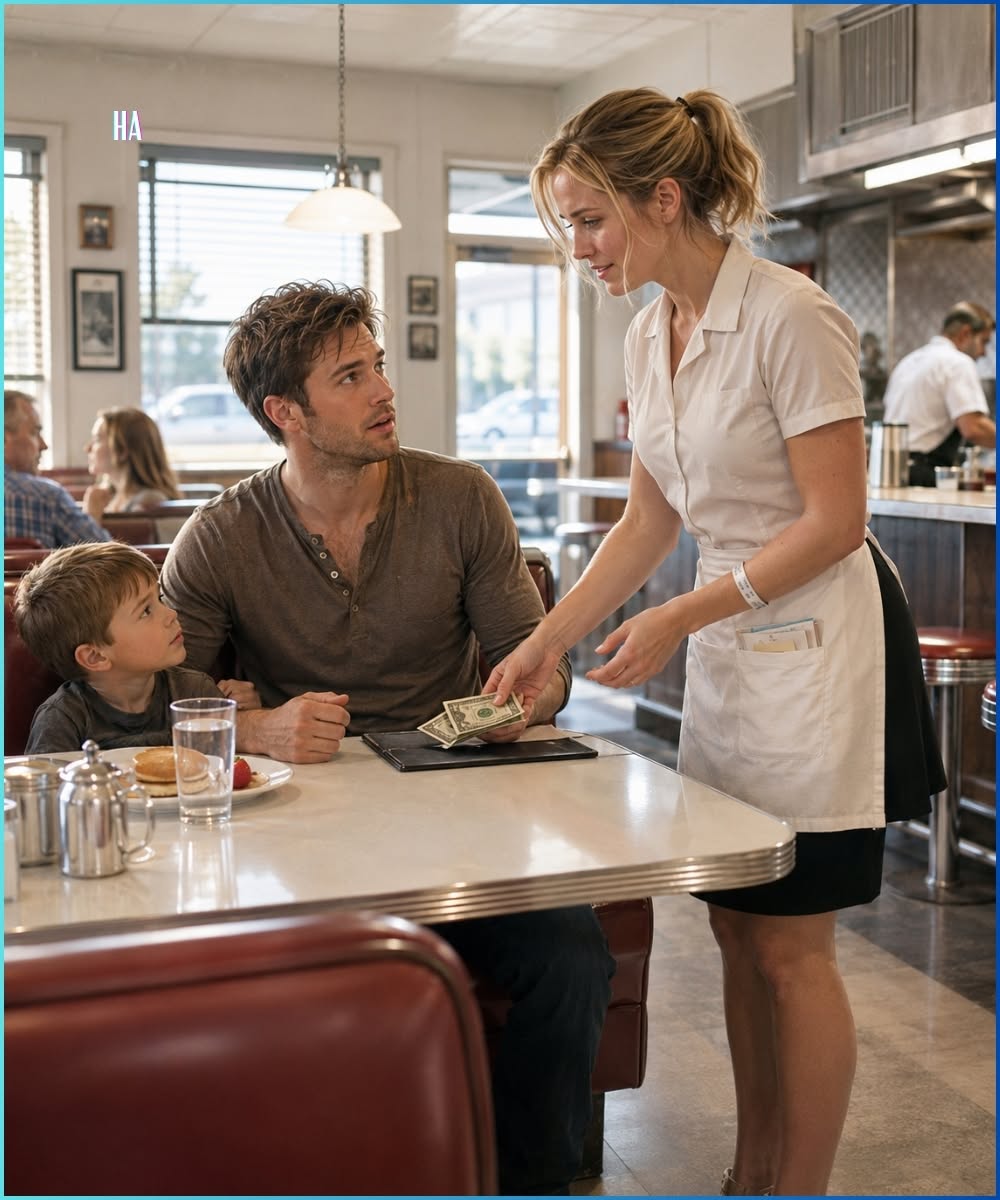
“Little bit.”
He cleared his throat. “I wanted to ask if you’d maybe want to get coffee sometime. Somewhere that isn’t here.”
Nora set the pot down and studied him.
The shadows under her eyes had not faded since Friday. A Band-Aid wrapped one thumb. Another cut marked her knuckle.
“I work seventy hours a week between here and the grocery store on Habersham,” she said carefully. “My brother needs me. I don’t really have time for dating.”
“Just coffee. Thirty minutes. You pick when and where.”
She looked at him like she was searching for the catch.
“Thursday afternoon,” she said finally. “There’s a park two blocks east. Bring your own coffee, though. I’ll be off the clock.”
Thursday afternoon, Garrett sat on a park bench with two gas station coffees and hands that would not stay still.
This was still the test.
Still controlled.
Still safe.
Then Nora arrived in jeans and a sweater mended at both elbows, her brown hair down for the first time, and the script in Garrett’s head went blank.
“Sorry I’m late,” she said, breathless. “Ethan had physical therapy and it ran over.”
“Ethan?”
“My brother. He’s fifteen.” She took the coffee and sat beside him. “Degenerative muscle condition. Progressive. Some days he can hold a spoon. Some days I feed him.”
She said it plainly. Not fishing for sympathy. Not performing tragedy. Just telling the truth.
“Our parents died in a car accident three years ago,” she added. “I’m all he’s got.”
Garrett’s throat tightened.
“That must be hard.”
“It is what it is.”
She took a sip of coffee and grimaced.
“God, this is terrible. Why did I tell you to bring your own?”
Garrett laughed before he could stop himself.
He told her the version of himself he had rehearsed.
Small apartment. Boat work. A daughter named Lily. A life that was simple because he had removed all the expensive parts.
Then he told her something true.
“My wife died,” he said. “Clare. Cancer. It was fast.”
Nora turned toward him, her expression softening but not pitying.
Garrett looked at the river beyond the trees.
“My daughter once asked if her mom left because she didn’t love her anymore,” he said. “I still hear that question at night.”
Nora was quiet for a moment.
Then she said, “Loss doesn’t have an expiration date.”
Garrett looked at her.
“Don’t let anybody tell you to move on like it’s a decision you make.”
In two and a half years, no one had said anything that simple or that true.
Thirty minutes became two hours.
Nora jumped up when she saw the time, cursing softly because her grocery store shift started in twenty minutes.
“Can I see you again?” Garrett asked.
She slung her bag over her shoulder.
“I can’t afford dinners or movies,” she said. “Every dollar I make goes to Ethan’s medical bills or keeping a roof over us.”
“Then we do this,” Garrett said. “Parks. Bad coffee. Talking.”
“I’m not exactly rolling in money either.”
Nora searched his face again.
Whatever she was looking for, she seemed to find it.
“Okay,” she said.
Garrett watched her hurry toward her second job of the day and told himself this was still a test.
For the first time, he did not believe it.
Part 2
Three weeks passed, and Garrett’s lie became heavier every time Nora smiled at him.
They met in parks. On walking trails. Once at a free outdoor concert in Forsyth Park, where Nora fell asleep on his shoulder during the second song. Garrett sat motionless for forty-five minutes, afraid to breathe, thinking about what seventy-hour workweeks did to a body.
He wondered when she had last slept through the night without an alarm, a bill, or a call from Ethan’s night nurse.
One Wednesday, Nora invited him to dinner.
Her apartment was on the second floor of a converted Victorian, with creaking stairs and a porch light that flickered when the wind blew. The furniture was a mixture of thrift-store finds and things that had clearly belonged to her parents. The carpet was worn but clean. The kitchen smelled like garlic, tomato sauce, and home.
Ethan sat in a wheelchair at the small dining table, dark hair falling over eyes that missed nothing.
“So you’re the one my sister smiles at when she’s texting,” he said.
Nora turned the color of the sauce. “Ethan.”
“What? I’m being observant. That’s what you keep telling me to do.”
Dinner was pasta with sauce from their mother’s handwritten recipe book.
Garrett ate and realized it was the best meal he had had in years.
Not because of the food.
Because of the laughter between courses. The way Ethan argued that Pluto deserved full planetary status. The way Nora stood in the kitchen doorway drying a pot with a threadbare towel, smiling like she had forgotten she was exhausted.
A week later, Lily met Nora at a street fair on Broughton Street.
Garrett had resisted this as long as he could, because introducing his daughter meant this was no longer something he could walk away from.
Nora crouched to Lily’s height.
“What’s your favorite planet?”
“Saturn,” Lily said immediately, “because of the rings.”
Then she explained the Roche limit for eight uninterrupted minutes.
Nora listened to every word.
She did not check her phone. She did not pretend to understand. She asked questions.
“So the rings are kind of like a moon that got too close and broke apart?” Nora said.
Lily’s face lit up.
“Yes! Exactly!”
She grabbed Nora’s hand and pulled her toward a booth selling handmade bracelets.
Ethan, wheeling beside Garrett, said quietly, “You make my sister smile.”
Garrett looked at him.
“She doesn’t smile enough,” Ethan added. “So thanks, I guess.”
Something inside Garrett broke.
Not the controlled crack he could manage.
A full break.
That night, Lily lay in her bed beneath the glow-in-the-dark stars Clare had stuck to the ceiling years ago.
“Daddy?”
“Yeah?”
“Miss Nora is like Mommy.”
Garrett’s throat closed.
“How?”
“Not her voice,” Lily said sleepily. “The way she listens.”
After Lily fell asleep, Garrett stood in his penthouse surrounded by furniture worth more than Nora’s annual income, art worth more than her apartment, and a view that stretched to the horizon.
None of it meant anything.
He thought about the twenty dollars Nora had pulled from her apron.
Money that might have bought Ethan’s medication.
He had forty-three million dollars and had let her pay.
Garrett decided to tell her.
He rehearsed the words everywhere.
In the shower.
In the car.
In the elevator.
I lied. I have money. I was testing you.
But each time he saw her, the words stalled.
He was not afraid of her anger.
Anger he could survive.
He was afraid of the empty booth afterward. The unanswered calls. Lily asking where Miss Nora went. The penthouse at midnight with nothing but the river and the ghost of Clare’s breathing.
Their eighth date was at a small Italian restaurant on Whitaker Street, the kind of place with candles, handwritten specials, and waiters who knew when to disappear.
Garrett planned to pay.
He had his real card ready.
But when the check came, the server smiled.
“It’s already been taken care of.”
Nora shrugged across the table.
“I got a raise this week,” she said. “Twenty-five cents an hour. Big money.”
She meant it as a joke.
Garrett heard the pride underneath.
Twenty-five cents an hour mattered when you counted every dollar. It meant a few extra dollars a week before taxes. It meant choosing between Ethan’s medication and the electric bill became slightly less impossible.
A few days later, over coffee at The Lantern, Nora told him she had almost cried in the walk-in freezer because a customer left a fifty-dollar tip.
“I can finally buy Ethan that science textbook he’s been asking about,” she said. “I stood between the frozen peas and the chicken tenders crying like an idiot.”
Garrett’s hands tightened under the table until his knuckles ached.
He could buy a thousand textbooks.
He could buy the bookstore.
The weight of that truth sat on his chest, sharp and unbearable.
Then Victoria Harrow walked into The Lantern.
She entered the diner as if the room had been waiting for her and had disappointed her by existing. Cashmere coat. Red-soled heels. Perfume that announced her three seconds before she arrived.
Clare’s oldest friend.
Chair of the Savannah Arts Foundation.
A woman who treated every gala guest list like a census of human value.
Victoria had known Garrett for nine years. She had stood beside Clare at their wedding. She had delivered a eulogy at the funeral. She considered herself the guardian of Clare’s memory, the way certain people claimed ownership of the dead.
She spotted Garrett in a Goodwill jacket, sitting across from a waitress in a diner with taped booths, and her face tightened with recognition, confusion, and offense.
When Nora left to refill coffee, Victoria slid into the booth.
“Clare would be heartbroken seeing you like this.”
Garrett’s jaw tightened. “Hello, Victoria.”
“Thrift-store clothes. Diner food. Playing house with the help.” Her eyes flicked toward Nora. “What game are you playing?”
“It’s none of your business.”
“I was Clare’s best friend.”
“That doesn’t make this your business.”
Victoria leaned closer.
“You are Garrett Mercer. You don’t belong in places like this.”
Garrett looked at Nora across the diner. She was pouring coffee for Mr. Bell, smiling as if every person mattered the same.
“Maybe that’s the problem,” he said.
Victoria left, but at the door, she turned back and looked at Nora.
It was not jealousy.
It was calculation.
That night, Marcus called.
“Victoria knows about Nora,” he said.
Garrett closed his eyes.
“She called me asking questions. She won’t leave this alone.”
“I’ll tell Nora tomorrow,” Garrett said. “Before Victoria does.”
A long pause.
“You’ve been saying that for two weeks.”
Garrett planned the confession for Sunday afternoon.
Their bench. Two bad coffees. The words he had rewritten so many times they no longer sounded like language.
He changed clothes three times that morning.
Standing in his walk-in closet surrounded by suits worth more than Nora’s monthly rent, he finally put the Goodwill jacket back on because it was what she knew.
It felt like a costume now.
Like something an actor wore in a play that had run too long.
He left the penthouse at 1:30 and sat in the parking lot near the park for twenty minutes, engine running, hands gripping the steering wheel.
He arrived fifteen minutes late.
Nora was already there.
She sat very still, hands folded in her lap.
Something about her posture stopped him six feet away.
She was not calm.
She was controlled.
The kind of stillness that came after something had already broken.
“I need to tell you something,” Garrett said, sitting beside her.
“Forty-three million dollars,” Nora said.
Garrett stopped breathing.
“Penthouse on the eighteenth floor,” she continued. “Company sale. Forbes profile. Fourteen women before me.”
The world seemed to tilt beneath the bench.
“Who told you?”
“It doesn’t matter who told me.” Her voice was steady, which was worse than shouting. “What matters is that you didn’t.”
Victoria had come to The Lantern two hours before Nora’s shift ended.
She brought an iPad loaded with a three-year-old business profile, photos of Garrett’s penthouse from a real estate feature, and the smug expression of a woman delivering punishment she called truth.
“She told me I was experiment number fifteen,” Nora said.
Garrett had no defense.
“I don’t care if you have forty-three million dollars or forty-three cents,” Nora said. “I care that you sat in my kitchen and ate pasta my mother taught me to make. You listened to me talk about sleeping in my car for six months after my parents died so Ethan could keep the apartment. And you knew. You knew you would never have to do anything like that.”
“Nora—”
“You let me pay for your pie with tip money.” Her voice cracked for the first time, but she pulled it steady again. “Money I needed. You watched me count quarters for gas. You listened to me celebrate a fifty-dollar tip like it was a miracle. And the whole time, you had millions in the bank.”
Garrett stared at the ground.
“You were a tourist in my life,” she said.
That landed harder than any scream could have.
Because it was true.
He had borrowed poverty like a costume. Worn struggle like camouflage. Stepped into her world protected by the knowledge that he could leave it whenever he wanted.
Nora stood.
“I need to go.”
He rose too. “Please. Let me explain.”
She looked at him then, and the pain in her face almost brought him to his knees.
“You already did,” she said. “Every day you didn’t tell me.”
Then she walked away.
Her steps were even and measured.
The walk of someone holding herself together through force of will.
Garrett sat on the bench long after she disappeared.
The coffees went cold.
A tugboat horn sounded on the river.
For the first time, it sounded lonely.
For seven days, Garrett called fourteen times.
The number was not lost on him.
Fourteen calls for fourteen tests.
Nora did not answer.
He texted twice.
I’m sorry.
Three days later:
I understand if you never want to see me again. But I need you to know what I felt was real.
Delivered.
No response.
On the third day, he drove to The Lantern.
A woman he did not recognize stood behind the register.
“Is Nora working today?”
The woman looked at him like she knew exactly who he was.
“She called in sick.”
“Is she okay?”
“First time in three years,” the woman said. “What do you think?”
At home, Lily asked the question he had dreaded.
She was doing math homework at the kitchen island when her pencil stopped.
“Where’s Miss Nora?”
Garrett swallowed. “I don’t think she’s coming this weekend, sweetheart.”
“Why not?”
“We had a fight.”
“Did you apologize?”
“I tried.”
Lily looked at him with Clare’s eyes.
“Try harder, Daddy. That’s what you always tell me.”
On the fourth day, Marcus came to the penthouse without calling.
He used his spare key and walked into the living room where Clare’s absence still hung like a frequency only family could hear.
“I watched you do this for two and a half years,” Marcus said. “The costumes. The tests. The dates you designed to fail.”
Garrett said nothing.
“I kept quiet because I thought you were grieving, and I owed my sister’s husband that patience. But this isn’t grief anymore, Garrett. This is cruelty wearing grief’s clothes.”
Garrett looked down.
“You took your pain and turned it into a weapon,” Marcus said. “Then you used it on fifteen women who didn’t owe you anything for what happened to Clare.”
“I loved her,” Garrett whispered.
“I know,” Marcus said, voice softer but not less firm. “But Clare would be ashamed of this.”
That was the sentence that finally broke him.
Part 3
On the fifth evening, Garrett drove to The Lantern at closing time.
He parked across the street and waited.
The neon sign flickered off at 10:00.
At 10:12, Nora came through the front door with her apron folded over one arm and her keys in hand.
She saw him leaning against the car and stopped.
She did not tell him to leave.
She did not cross the street.
She stood ten feet away, arms folded, chin lifted, and waited.
Garrett spoke before fear could silence him.
“You were right,” he said. His voice cracked on the second word, and he let it. “I was a tourist. I wore Goodwill clothes like a costume and drove a broken car like a prop. I turned my grief into an excuse to test everyone I met, and I used it on the only person who didn’t deserve to be tested.”
Nora’s face did not change.
“I’m not asking you to forgive me,” he said. “I don’t deserve that just because I’m sorry. I just need you to know that everything I lied about—the job, the car, the wallet—none of what I felt was a lie.”
A car passed, headlights sliding across the diner windows.
“Lily asks me every night where Miss Nora is,” he said. “And I don’t have an answer. That’s the truth I have.”
Nora was quiet for a long time.
Then she said, “I need time.”
He nodded.
“Not days,” she said. “Not a week. Real time.”
Then she unlocked the diner door, went inside, and turned the lock behind her.
Garrett stood on the sidewalk listening to the river before he drove home.
For three weeks, he did not call.
He did not text.
He did not drive past The Lantern.
He honored the distance Nora had asked for, and honoring it was its own kind of pain. Deliberate. Daily. The opposite of every test he had designed.
Those tests had been about control.
This was surrender.
He went to Marcus on a Tuesday morning.
They sat in Marcus’s modest office above a tax preparation firm on Bull Street.
“I want to use the money the right way,” Garrett said. “Not to buy forgiveness. Not to prove anything to Nora. Because it’s the right thing to do, and I should have been doing it all along.”
Together, they established a community health fund for families in Savannah caring for someone with a chronic illness.
It covered medical equipment, physical therapy copays, prescriptions, transportation, the quiet expenses that insurance ignored and families swallowed until they drowned.
No gala.
No press release.
No plaque.
Anonymous.
Not as a disguise this time.
As a principle.
Garrett sold the Honda Civic to a college student for fifteen hundred dollars. He packed the Goodwill clothes into black bags and donated them back to the same store where he had bought them.
For the first time in two and a half years, he wore his own shirts, drove his own car, and walked into rooms as himself.
The therapist Marcus had been recommending since Clare’s funeral had an office on Drayton Street, third floor, with a window overlooking a live oak draped in Spanish moss.
Her name was Dr. Chen.
She asked questions Garrett did not want to answer.
About Clare.
About Lily.
About the tests.
About what he had really been afraid of underneath the costumes and the fake declined cards.
The answers did not make him feel better.
They made him feel real.
That was harder.
Victoria called on a Tuesday evening.
“I hear the waitress isn’t returning your calls,” she said. “I told you, Garrett. She wasn’t your kind of people.”
Garrett held the phone and felt nothing but tired clarity.
“You told Nora because you thought you were protecting Clare’s memory,” he said. “But Clare would never have hurt someone the way you did. She would have been ashamed of both of us.”
“Garrett—”
“Don’t call me again.”
He hung up.
On a Saturday afternoon in the third week, Garrett stood in his kitchen with Lily and made pecan pie.
Nora had taught him once after the diner closed.
Pecans roasted first. Ten minutes at 350. A splash of bourbon in the filling because her mother believed it brought out warmth.
Lily stirred the batter with flour on her nose and her tongue poking out in concentration.
The pie came out with burned edges and filling that did not quite set.
Lily tasted a corner piece and considered it seriously.
“It’s not like Miss Nora’s,” she said. “But it’s still good.”
Garrett placed the pie in a brown box.
At 9:45, he drove to The Lantern and left it by the back door.
No note.
No knock.
Just the pie.
Twenty minutes later, Nora opened the back door to take out the trash and found the box on the concrete step.
The edges were burned. The filling sloshed. The crust sagged on one side.
She stood beneath the buzzing fluorescent light, holding the worst pie anyone had ever left her, and did not move for a long time.
The bell above the boat shop door rang on a Thursday morning in the fourth week.
Garrett looked up from the hull of a seventeen-foot skiff he was sanding.
Nora stood in the doorway.
Jeans. Diner T-shirt. Hair pulled back. Expression unreadable.
She had never been here before.
The shop was small. Two bays. A cluttered workbench. Tools on pegboard. Sawdust on every surface. A radio playing jazz nobody had requested.
This was the only part of Garrett’s life that had never been a lie.
He fixed boats because he liked wood grain beneath his hands, marine varnish in the air, and the honest satisfaction of repairing something broken.
Nora walked to the workbench and set down a white envelope.
Inside were eleven dollars.
A ten and a one.
“You owe me,” she said. “Remember?”
Garrett stared at the envelope.
Then he laughed.
Not politely.
Not carefully.
A real laugh. Raw, shocked, and unguarded.
Nora tried to keep her serious face. The corner of her mouth betrayed her. Then the other corner. She pressed her lips together, but it was too late.
They stood in the boat shop surrounded by sawdust and half-finished hulls, and for the first time in weeks, the silence between them had room to breathe.
Garrett told her everything.
About Dr. Chen.
About Marcus.
About the health fund.
About selling the Civic and donating the clothes.
About how strange and terrifying it felt to be himself again.
Nora listened with her arms folded, leaning against the workbench.
When he finished, she said, “I was angry at you for three weeks. Angry enough to decide I might never speak to you again.”
Garrett waited.
“Then I ate that pie you left.”
He winced. “That bad?”
“The filling didn’t set. The edges were burned. It was genuinely the worst pecan pie I’ve ever had, and I’ve eaten gas station pie.”
Despite himself, he smiled.
“But,” she said, and the word changed the air, “you listened when I taught you. You remembered the pecans go in first. You remembered the bourbon. You remembered the temperature.”
She looked down at the envelope, then back at him.
“You can fake being broke. You can fake a car. You can fake a watch. But you can’t fake remembering how someone’s mother made pie.”
Garrett’s eyes burned.
“I haven’t finished forgiving you,” Nora said. “That might take a long time. Longer than either of us wants. But I’m willing to try if you’re willing to show me the real person. Not the dress-up version. Not the penthouse version. The actual one.”
“The actual one fixes boats,” Garrett said quietly. “Makes terrible pie. And is afraid of losing you.”
Nora looked around the shop.
The oil-stained floor. The tools. The raw wood exposed beneath old paint.
“This is real?”
Garrett nodded.
“This is real.”
Nora pulled a stool from under the bench and sat.
“Then show me how you fix that boat.”
Garrett picked up the sanding block.
For twenty minutes, neither of them spoke.
And the silence felt like the park bench, the riverfront, the bad coffee, the free concert.
The same.
But without the wall.
Two months later, Garrett pushed through The Lantern’s screen door at 7:30 on a Friday evening.
He wore a plain button-down and the Casio watch he had never replaced. Not because it was part of an act, but because he had worn it so long it felt like his.
He had driven the Tesla, which looked ridiculous in the gravel lot.
Nora glanced up from the counter and shook her head, smiling.
“You’re still wearing that watch.”
“I like it,” Garrett said. “Keeps better time than the Patek.”
He slid into the corner booth.
His booth.
The vinyl seat had a crack that fit exactly against his left knee, and he had stopped noticing it.
Nora brought two slices of pecan pie and two cups of coffee, then sat across from him. Her shift was over. The last customers were settling checks. The diner hummed with closing sounds: plates stacked, grill hissing, coffee pot clicking.
Her phone buzzed on the table.
She answered, and Ethan’s voice came through on speaker.
“Garrett promised pizza. Don’t let him forget.”
Nora slid the phone toward him. “Tell him yourself.”
Garrett picked it up. “Pepperoni?”
“Obviously,” Ethan said. “No pineapple. That’s my last remaining boundary.”
Garrett laughed easily.
The kind of laugh that came from belonging to the joke.
Then the front door swung open.
Lily burst in, backpack bouncing, hair half escaped from its ponytail. Marcus followed two steps behind, looking like a man who had spent thirty minutes trying to keep up with an eight-year-old and had lost badly.
Lily ran straight to Nora and wrapped both arms around her waist.
Not the tentative hug of a child being polite.
The automatic embrace of someone who had done this a hundred times.
Nora held her, chin resting on Lily’s head, and closed her eyes for one brief second.
Marcus caught Garrett’s gaze across the diner.
He nodded once.
Small. Quiet.
Heavy with everything he did not need to say.
Clare would understand.
Lily climbed into the booth beside Nora and pulled out a crayon.
“I’m drawing your diner,” she announced. “But I changed the name. See? The Lantern: Best Pie in Georgia.”
Nora laughed and pulled her closer.
Marcus said goodnight and left.
The diner emptied.
The neon sign buzzed in the window.
And then it was the three of them.
Garrett. Nora. Lily.
Nora looked across the table.
“No more tests.”
Garrett reached for her hand.
“No more tests.”
She pushed the pie plate toward him.
He ate.
The filling was perfect. The crust golden. The pecans roasted exactly right.
Nora’s pie was always perfect.
Lily yawned and leaned against Nora’s side.
Nora stroked her hair without thinking, the way you touch someone who belongs to you, and who you belong to.
Garrett watched them: the waitress he had tested, and the daughter he had been trying to protect in all the wrong ways.
He understood then that he had spent two and a half years searching for proof that the world could not be trusted.
Proof that people left.
Proof that love was a transaction with a price tag and an expiration date.
But the proof to the contrary had been here all along, in a booth by the window, under a broken neon sign, in a diner that smelled like pecan pie, old coffee, and something he had almost forgotten the name of.
Home.
The millionaire single dad who tested fifteen women finally understood that love was not a test anyone passed.
Love was someone choosing to stay.
Not because you met their conditions.
Not because you hid your wounds well enough.
But because they saw all of you—the lies, the fear, the burnt pie, the forty-three million dollars, the cheap Casio watch—and chose to stay anyway.
THE END