My sister deleted my 11-year-old’s high-stakes admission project — the one she spent five months working on — just hours before the deadline. “Screens are evil,” my sister said casually. “You’ll thank us later,” my mother added. I didn’t shout. I did this. Three weeks later, their faces went pale…
If anyone had asked me that night how my day was going, I would have said fine. In that automatic, lying-through-your-teeth way tired moms say it.
I was just driving over to Mom and Dad’s to pick my daughter Mia up.
Nothing dramatic, nothing unusual.
Except the moment I stepped out of the car, I felt it.
That wrongness, like the last note of a song was off-key, but everyone kept pretending it wasn’t.
My nephew Ryan was outside in the driveway, throwing a ball with some kid I didn’t recognize. He glanced at me, then looked away like he had somewhere more important to be.
Fine, whatever.
Eleven-year-old boys are allergic to eye contact.
But Mia wasn’t there.
And that was the first crack.
I walked into the house, and Mom practically pounced.
“Oh, Erica, thank God you’re here,” she said, pressing a hand to her chest like she’d been through some war. “Your daughter has been impossible today.”
I froze.
“Where’s Mia?”
“Locked herself in the bathroom,” Vanessa answered, stepping out from the living room like she’d been waiting for her cue.
Her voice had that sharp, triumphant edge she gets when she thinks she’s right.
Spoiler, she always thinks she’s right.
Dad didn’t even look up from whatever he was stirring on the stove.
“She threw a tantrum over a computer. It’s not normal.”
My stomach clenched.
“What do you mean, a computer?”
Mom waved her hand.
“Sweetie, she was glued to that screen all day. We took it away. She needs to learn to be a kid again.”
Vanessa nodded with faux wisdom.
“Honestly, Erica, she’s addicted. It’s not healthy. We were doing you a favor.”
Oh, a favor.
Right.
Like setting fire to your house to help with heating.
“Where is she?”
“Bathroom,” Vanessa said. “Crying, screaming, total meltdown.”
That did it.
I didn’t bother arguing.
I knew my child.
Mia didn’t melt down.
She didn’t withdraw.
She got quiet when overwhelmed, which was worse.
I walked down the hallway, each step louder than it needed to be.
I knocked.
“Mia, it’s me.”
A choked sob came back.
Not a tantrum.
Not even close.
“Sweetheart, open the door.”
A tiny click.
The door opened an inch.
Then a little more.
Mia stood there with her laptop clutched against her chest like it was a wounded animal.
Her face was blotchy and wet, her whole body shaking.
My heart dropped.
“Mom,” she whispered, and the word cracked in the middle. “They… they deleted it.”
I crouched down.
“Deleted what, baby?”
She burst into fresh tears.
“My project. My whole project. They took my laptop, and I tried to tell them, but they said screens were bad and I needed to go outside. And then Aunt Vanessa said she deleted everything I had open because she thought it was games. And Mom, it’s gone. All of it. Five months gone.”
The world went completely still.
Like a vacuum.
Like nothing existed except Mia’s shattered voice.
I pulled her into me and stood, holding on to her because I wasn’t sure which one of us might collapse.
“Show me,” I said, trying to keep my voice level, even though I could taste metal in my mouth.
We walked back into the dining room, where Vanessa stood like she was waiting for applause.
“Oh, Erica, don’t overreact,” she said, rolling her eyes. “I deleted whatever she had open. Kids don’t need that much screen time. You should be thanking me.”
Mom nodded.
“Exactly. It was for her own good.”
For her own…
I couldn’t finish that sentence.
There were too many possible endings, all of them involving profanity.
Mia sat at the table and opened the laptop with shaky fingers.
Clicked the folder.
Clicked again and again.
Empty.
Empty.
Empty.
She let out this quiet, broken sound, like she’d been punched in the chest but didn’t have the air to cry.
For real.
Vanessa shrugged.
“She’ll get over it. It’s just files. Not the end of the world.”
Not the end of the world.
For her, of course.
I stared at her, and something inside me, something I’d kept folded and quiet for years, lifted its head.
Mia touched my arm.
“Mom, what do I do? The deadline’s tomorrow morning.”
Her voice was so small, I almost didn’t hear it.
I put my hand over hers.
“We’ll figure it out.”
Vanessa smirked in the doorway.
“Honestly, Erica, if she’s crying like this over a computer, maybe it’s good we intervened. Kids these days need grounding.”
Grounding.
Right.
I looked at her.
Really looked.
And Mom and Dad, standing together, united in their smug certainty, as if they hadn’t just gutted an 11-year-old’s future.
At the time, I thought they were just ignorant, careless, dismissive, maybe cruel, but nothing more.
I didn’t know yet.
I didn’t know how deep the betrayal went.
I didn’t know what they were hiding.
I didn’t know how far they’d already gone.
Not then.
But I’d find out soon enough.
And what I discovered in the weeks that followed would change everything.
I didn’t tell Mia this part that night.
Honestly, I didn’t want her to see how much it shook me.
But as I drove home with her sobbing in the back seat, clutching her empty laptop like a broken limb, one truth kept burning through my skull.
They didn’t just delete files.
They deleted her future.
Five months ago, Mia got the packet for the scholarship admission project.
Not a cute little “write about your favorite animal” assignment.
No.
This was the kind of project private schools used to decide which kids were worth investing in.
The kind of thing parents brag about on Facebook for two years straight.
The kind of opportunity my daughter, a shy, brilliant, STEM-obsessed kid, had been preparing for like it was her Olympic event.
It was writing, research, coding, presentation design, creativity, logic, the whole academic buffet.
And Mia had devoured every inch of it voluntarily, joyfully.
Meanwhile, Ryan spent that time leveling up in whatever game he was obsessed with that week.
Vanessa called that normal childhood development.
But here’s the thing.
My family has a long history of breaking things.
This time, they just broke something that belonged to a mother who’s finally done being polite.
And if I wanted to understand how they became experts at pretending this behavior was normal, I had to rewind.
Growing up, I was always the, well, the other daughter.
Vanessa could set the house on fire, and Mom would explain why the matchstick had provoked her.
Meanwhile, if I breathed wrong, I’d get a lecture about attitude.
My entire childhood was one long “why can’t you be more like your sister” soundtrack.
And the sick thing?
I believed them.
I believed I was the problem.
Vanessa was the golden one.
I was the one who needed to try harder.
There was never a moment, not one, where anyone chose me.
By adulthood, I should have grown out of it, right?
You’d think motherhood and a mortgage would earn me a graduation certificate from dysfunctional family academy.
But nope.
The pattern just evolved.
Vanessa became the perfect mother with the perfect son.
I became the background utensil whose job was to smile, help, and accept criticism while they praised their living room shrine to Ryan’s achievements.
He got a B in math.
He’s gifted.
Meanwhile, Mia could cure cancer, and they’d ask if she remembered to say thank you.
I spent years brushing it off.
“It’s just family,” I’d tell my husband, Daniel. “They don’t mean anything by it. I’m probably imagining it.”
But deep down, I knew the truth.
And the truth tasted a lot like bile.
When the scholarship competition was announced, both kids were excited.
Something they could do together, supposedly.
Ryan made a Canva slide and got bored after an hour.
He announced at dinner that he was dropping out because it’s dumb.
Vanessa praised his self-awareness.
Mia, meanwhile, lit up like someone plugged her into a generator.
She spent five months building something incredible.
She never complained, never bragged.
She was excited.
And my parents knew.
Vanessa knew.
Everyone knew how much work she’d poured into it.
Which is why when they took her laptop and deleted everything, I thought, naively, that it was just ignorance.
Just them not understanding.
Just them being careless.
I told myself they didn’t mean to destroy her chances.
They didn’t think it through.
They just didn’t understand how important it was.
Back then, that’s genuinely what I believed.
But the truth, the truth crawled in later.
Slow.
Ugly.
Heavy.
And every new piece of information felt like a bruise forming under the skin.
We didn’t talk on the drive home.
Not because I didn’t want to, but because Mia was sitting in the back seat like someone had unplugged her soul, arms wrapped around her laptop, eyes staring at nothing, breathing too quiet.
By the time we stepped through the front door, my chest hurt.
Like an actual physical ache, the kind only rage and helplessness can make.
Mia sat on the living room rug and opened the laptop before I’d even taken my shoes off.
“Okay,” I said softly. “Let’s just look.”
She clicked the project folder.
Still empty.
She swallowed hard.
“Maybe… maybe it’s in the trash,” I suggested, kneeling beside her.
My voice was too bright, like a kindergarten teacher trying to distract a child from a gaping wound.
Mia clicked.
Trash.
Empty.
Her lip trembled.
“Why would she empty the trash? Who empties the trash?”
“Apparently your aunt,” I muttered.
Dry humor.
My only survival mechanism.
She made a choking noise, half sob, half laugh, like her last nerve had snapped in half.
“Okay,” I tried again. “Okay, let’s think. Maybe it’s backed up somewhere.”
Mia blinked at me, eyes huge and terrified.
“Where?”
I didn’t have a clue.
But moms aren’t allowed to say I don’t know during crisis.
“Maybe in your email,” I said. “Did you ever send anything to your teacher?”
Mia opened her email, scrolled.
For a moment, I held my breath so hard I thought I’d explode.
Then Mia whispered, “Mom, look.”
An attachment.
A file.
Old, incomplete, but real.
The January version.
Not the final one.
Not even close.
But something.
Mia’s shoulders sagged with relief and horror at the same time.
“This is all we have,” she said quietly.
And somehow, that was worse.
I sat down on the floor next to her.
“We’ll rebuild it.”
She shook her head.
“Mom, it’s too much. It took months.”
I put my hand over hers.
“Then we’ll do months in a night.”
She looked up at me.
The tiny, exhausted tilt of her chin nearly destroyed me.
But she nodded.
We opened the old file, and the real work began.
The first hour was mostly tears.
Mia’s.
Mine.
Both of ours.
Hard to tell.
She’d scroll down and gasp, “I wrote a whole section here. I can’t remember it.”
And then crumble.
Or, “I had charts here. I had diagrams.”
Before burying her face in her hands.
Every time she cried, something inside me cracked.
And every time something cracked, something else hardened.
Vanessa hadn’t just deleted files.
She’d deleted pieces of my daughter’s confidence one click at a time.
Around midnight, we had about one quarter of the project reconstructed.
It looked like a skeleton, recognizable but sad and bare.
Mia stared at the empty sections like they were crime scenes.
“I hate this,” she said softly. “It’s not good. It’s not the same.”
“No,” I said. “It’s not.”
She blinked at me like she wasn’t expecting honesty.
“But it’s still yours,” I added. “And we’re still submitting something. We’re not letting them take that, too.”
She wiped her nose on her sleeve.
“What if it’s not enough?”
“It’ll be enough to prove you showed up,” I said. “And sometimes that’s half the war.”
She snorted.
“That’s not comforting.”
“Good,” I said. “It wasn’t meant to be comforting. It’s meant to be true.”
She actually laughed.
A tiny, exhausted puff of a laugh.
Then she kept typing.
Around 2:00 a.m., she hit a wall.
Her fingers froze above the keys.
She whispered, “Mom, I can’t remember the last part. The whole ending. It’s gone.”
Her voice sounded like glass cracking.
I gently pulled the laptop toward me.
“Let me try.”
I typed until my eyes burned.
Badly, awkwardly, like a raccoon trying to write a thesis.
She leaned on my shoulder, reading silently, eyebrows pinched in pain.
“It’s not what I wrote,” she murmured.
“I know,” I said. “But we’ll fix it.”
She didn’t believe me.
I barely believed myself.
By 4:00 a.m., she was slumped sideways against me, cheeks sticky with old tears.
Her little hands rested on the keyboard like they were too tired to try anymore.
I kept typing and typing and deleting and typing again.
Somewhere around 6:00 a.m., Mia fell asleep curled against my hip.
I didn’t dare move.
At 7:52 a.m., she woke up long enough to hit submit.
Then she whispered, “I don’t even want to know the result.”
The next two weeks were long, quiet, and filled with the kind of tension you feel in waiting rooms.
Even my husband moved more gently, like the air around Mia might break if touched wrong.
But the silence was worse than crying.
Worse than rage.
It was the silence of a child who’d lost something she built with her entire heart.
And I was waiting for something, too.
The moment my parents or Vanessa would show a flicker of remorse, a crack, a hint of guilt.
Nothing.
They didn’t call.
They didn’t text.
They didn’t check on Mia.
They moved on like they’d simply cleaned out a junk drawer, like nothing significant had happened.
And that silence was its own kind of answer.
Something was off.
Something was wrong.
Something didn’t add up.
But I kept pushing the thought away because the alternative, the darker explanation, was too painful to consider.
Not yet.
Two weeks later, Mia walked into the kitchen holding her Chromebook like she’d found a bomb.
“Mom,” she said. “They posted the finalists.”
I dried my hands and took the laptop.
Her name wasn’t there.
Ryan’s was.
I stopped breathing.
I couldn’t blink.
I couldn’t speak.
It felt like someone opened the front door of my brain and punched me in the face.
Mia stared at the ground.
“He… he didn’t even want to keep going.”
I swallowed.
My mouth tasted like metal.
“Let’s… let’s see the description.”
She clicked.
I read.
The back of my neck prickled.
My stomach dropped.
The room tilted.
The project topic, the formatting, the phrasing, the concept.
I knew it.
I had read it.
Lived through it.
Because Mia wrote it.
“Mia,” I whispered. “I… I don’t know what this means yet, but something isn’t right.”
I drove to my parents’ house with Mia beside me, silent and trembling.
Vanessa opened the door like she’d been practicing her expression in the mirror.
Sympathetic, condescending, and smug all at once.
“Oh, Erica,” she said. “What’s up?”
I didn’t answer.
I walked past her.
Mom and Dad were in the living room pretending to be surprised.
“What’s going on?” Dad asked.
I held up the flyer.
“Explain this.”
Mom squinted.
“Oh, Ryan got in. Isn’t that great?”
“Where did his project come from?” I asked.
Dad frowned.
“Are you accusing us of something?”
“I’m asking,” I said, “what he submitted.”
Vanessa’s smile flickered.
A crack.
A glitch.
Then she smoothed it over.
“You’re being ridiculous,” she said. “Mia is upset she didn’t get picked. You’re feeding it.”
Mia stepped behind me, gripping my shirt.
I turned to Vanessa.
“Tell me the truth.”
She crossed her arms.
“There’s nothing to tell.”
Lie.
Mom clasped her hands.
“Erica, don’t ruin this for Ryan.”
And there it was.
The slip.
The truth buried inside the phrasing.
“Ruin what?” I asked quietly.
No one answered.
I walked out.
That night, after Mia was finally asleep, I sent the email.
I attached the old draft, screenshots, dates, timestamps, everything we still had.
No accusations.
Just facts.
The kind that cut deeper than any insult.
The committee replied in the morning.
We will review this.
That was it.
No promises.
No reassurance.
But I didn’t need reassurance.
I just needed the truth.
Two days later, the school posted a flyer.
Finalist presentations open to the public.
Ryan’s name was at the top.
Vanessa texted me, don’t come. Seriously, don’t embarrass yourself.
I stared at the message.
Then I turned my phone off.
I wasn’t planning to embarrass myself.
But someone else was about to be embarrassed, and they had no idea what was coming.
If you’ve never walked into an auditorium knowing a bomb is going to go off, but no one else realizes they’re standing five feet from the blast radius, let me tell you, it’s a special kind of adrenaline.
Mia and I stepped through the doors, and the air practically crackled.
People chatting, programs rustling, families taking photos.
Normal, innocent chaos.
Meanwhile, I felt like I was walking in with a live grenade tucked under my arm.
Vanessa spotted us first, her face pinched like she’d bitten a lemon dipped in battery acid.
She whispered something to her husband, Trevor, who looked like he wanted to dissolve into the chair, and then hissed across the aisle.
“I told you not to come.”
I smiled sweetly.
“Oh, Vanessa, you know I never listened to you.”
Mom whipped around.
“Erica, don’t start.”
Dad followed with, “Let’s keep things civil today.”
Civil.
Right.
Apparently, stealing a child’s five-month project and passing it off as your son’s is the new definition of civil.
Mia squeezed my hand.
She looked nervous, but strangely composed, like she’d decided she’d rather face a firing squad than be afraid of Vanessa ever again.
Good.
She was growing up beautifully.
Ryan’s name was called halfway through the program.
He walked on stage looking like someone had shoved him there with a cattle prod.
Pale, sweaty, eyes darting everywhere.
I almost felt bad for him.
Almost.
Until I remembered the night Mia cried herself sick because her entire future was wiped out by adults who thought she didn’t matter.
He cleared his throat into the mic.
“This is, um, my project. It’s about community things improving stuff.”
Inspirational.
He clicked to the next slide like it might explode in his hands.
Judges leaned forward, clearly confused when the boy who supposedly created a multi-layer urban planning model couldn’t explain what a community anchor point was.
His voice shook.
“Uh, it’s like people and things.”
Professor-level analysis.
Then a judge asked, “What was the most challenging part of your research process?”
Ryan froze.
He looked at Vanessa like he expected her to run on stage and rescue him.
She stared back, smiling at him like an airbrushed refrigerator magnet.
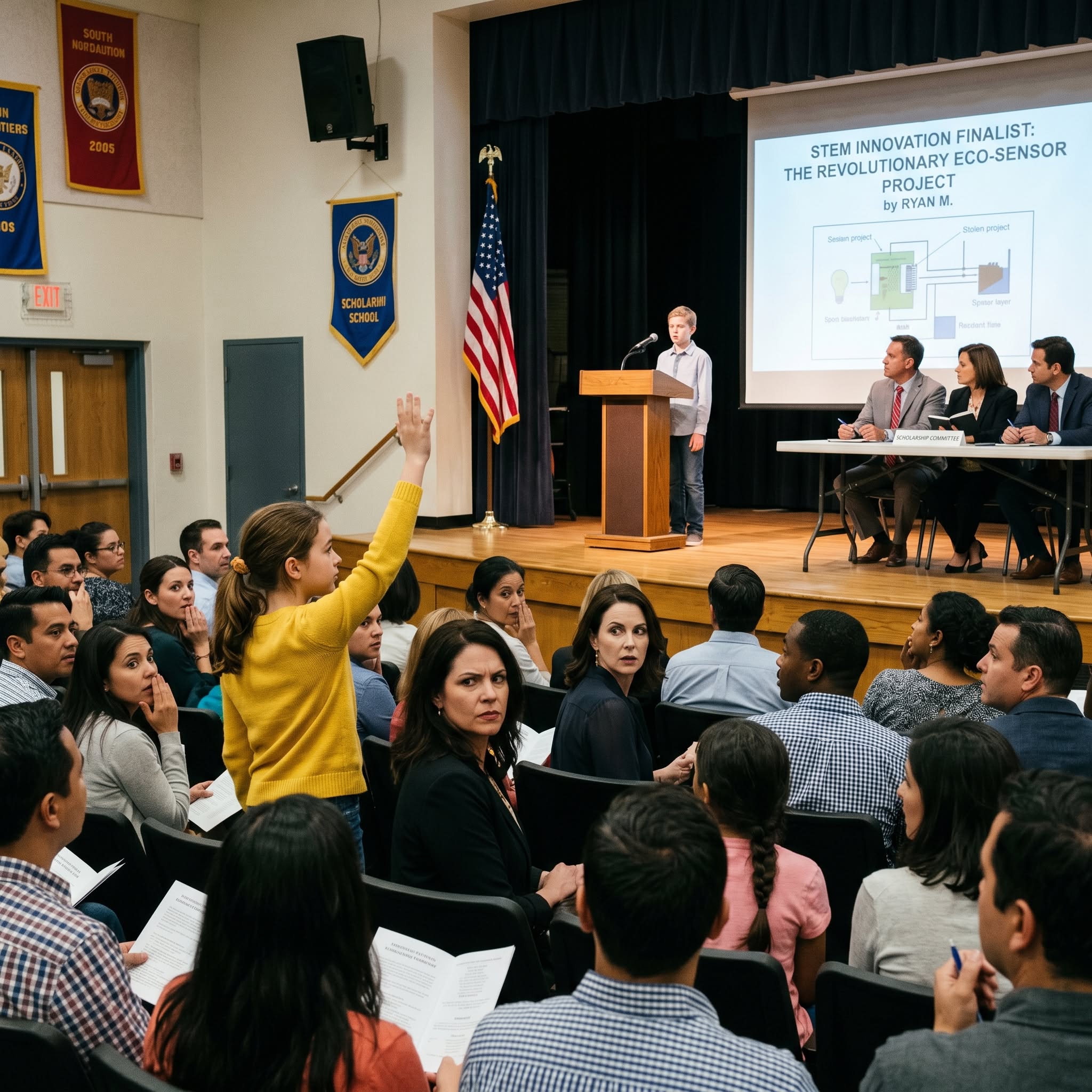
Then Mia raised her hand.
Not timidly.
Not reluctantly.
Like a girl who had been quiet long enough.
A judge blinked at her.
“Yes?”
Mia stood.
Her voice trembled for one second.
Just one.
Before she steadied.
“You’re asking about the research process?” she said. “For this project?”
Ryan’s eyes widened.
Vanessa’s head snapped toward us so fast I heard something crack.
The judge nodded slowly.
“Yes.”
Mia launched into an explanation so clean, sharp, and articulate that the entire auditorium seemed to lean in.
She described demographic mapping, survey modeling, community use patterns, all the things she worked on for months.
She spoke like someone who breathed the material.
Ryan spoke like someone who had learned English yesterday.
A wave of murmurs washed through the crowd.
Vanessa hissed, “Sit down, Mia.”
Mom added, “This is embarrassing.”
Dad muttered, “Such a showoff.”
I ignored them.
By the time Mia finished, the judges exchanged looks.
The kind of looks that said, ah, we see exactly what happened here.
One of them stood.
“Could we see both families backstage, please?”
Vanessa’s face went corpse white.
Trevor’s soul left his body.
Mom clutched her purse like she might throw it at someone.
We followed the judges into a side room where one of them, Dr. Harris, folded his hands.
“We have reason to believe this project was not created by Ryan.”
Silence.
Thick.
Electric.
I unlocked my phone, pulled up the drafts, the timestamps, the emails.
“This is Mia’s work,” I said. “Every version. Every step.”
Vanessa lunged forward.
“That is a lie. Erica manipulated those. She taught Mia to say those things.”
Dr. Harris raised an eyebrow.
“You’re alleging fabrication?”
“Yes,” Vanessa shrieked. “Yes. They stole my son’s work.”
My mother, who apparently followed us into the room without invitation, chimed in.
“Erica always wants attention. She’s making me a liar.”
Dad nodded.
“This is harassment. Our family won’t be slandered.”
And then a judge quietly asked Ryan.
“Did you make this project?”
Ryan stared at the floor.
His chin quivered.
His hands shook.
“Ryan,” Mia whispered softly. “It’s okay.”
Vanessa snapped.
“Don’t talk to him.”
Ryan broke.
“Mom made me,” he sobbed. “She said Mia doesn’t deserve everything. She said… she said I had to win. She said she’d be disappointed if I didn’t. I didn’t even want the scholarship.”
Trevor closed his eyes like he was begging God to erase his entire marriage.
Dr. Harris exhaled slowly.
“That settles it.”
Vanessa sputtered.
“He’s lying. He’s being manipulated. I—”
Dr. Harris raised his hand.
“Ryan is disqualified, effective immediately.”
Mom gasped like he’d announced the earth was ending.
And he added, “Because this scholarship carries financial value, we are required to file an official fraud report.”
Vanessa’s mouth hung open.
Trevor whispered, “Oh my God.”
Mom grabbed Dad’s arm.
“Do something.”
Dad answered, “What? Bribe them?”
For once, he sounded sane.
And Dr. Harris continued, “Given the testimonies and the pressure placed on Ryan, we are referring this to CPS for review.”
Vanessa looked like someone had unplugged her brain.
I felt a strange calm settle over me.
Not joy.
Not triumph.
Just a deep, exhausted relief that someone finally saw what my family really was.
A judge turned to Mia.
“You are the rightful creator. You will receive the scholarship.”
Mia’s eyes filled.
Not with the same tears she’d cried in that bathroom weeks ago.
These were different.
She nodded quietly.
It’s been six months, and every morning Mia heads into school with a confidence I used to only see in glimpses.
She’s in the gifted program now, the one the scholarship earned her a spot in, and she talks about it like it’s her second home.
She comes back every day with things I don’t fully understand.
Half-built engineering prototypes, research assignments that look like graduate-level work, group projects with kids who love learning as much as she does.
She has friends who challenge her, teachers who actually see her, and a spark I was terrified had died the night her laptop was wiped.
And she’s happy.
Really, truly happy.
My family, their timeline looks different.
Ryan ended up switching schools.
“Mutual decision,” Vanessa claims, even though every parent in their old district knows the truth.
Fraud sticks.
Even at the new school, people whisper.
Invitations dried up fast.
Vanessa now has an official fraud note on her record.
Nothing dramatic, but enough to block certain jobs and shred her PTA ambitions.
CPS still checks in from time to time after what Ryan confessed.
Mom and Dad lost most of their social circle.
Turns out sabotaging a child doesn’t make you very popular at potlucks.
We’re no contact now.
Peaceful, quiet, honestly better.
Mia is thriving.
Their lives, not so much.
So, what do you think?
Did I go too far or not far enough?
Let me know in the comments and subscribe for more.
If you came here from Facebook because of this story, please go back to the Facebook post, hit like, and comment exactly “Amazing story” to support the storyteller. That small action means more than it seems, especially for stories about protecting a child’s hard work, and it helps give the writer motivation to keep bringing more stories like this to readers.