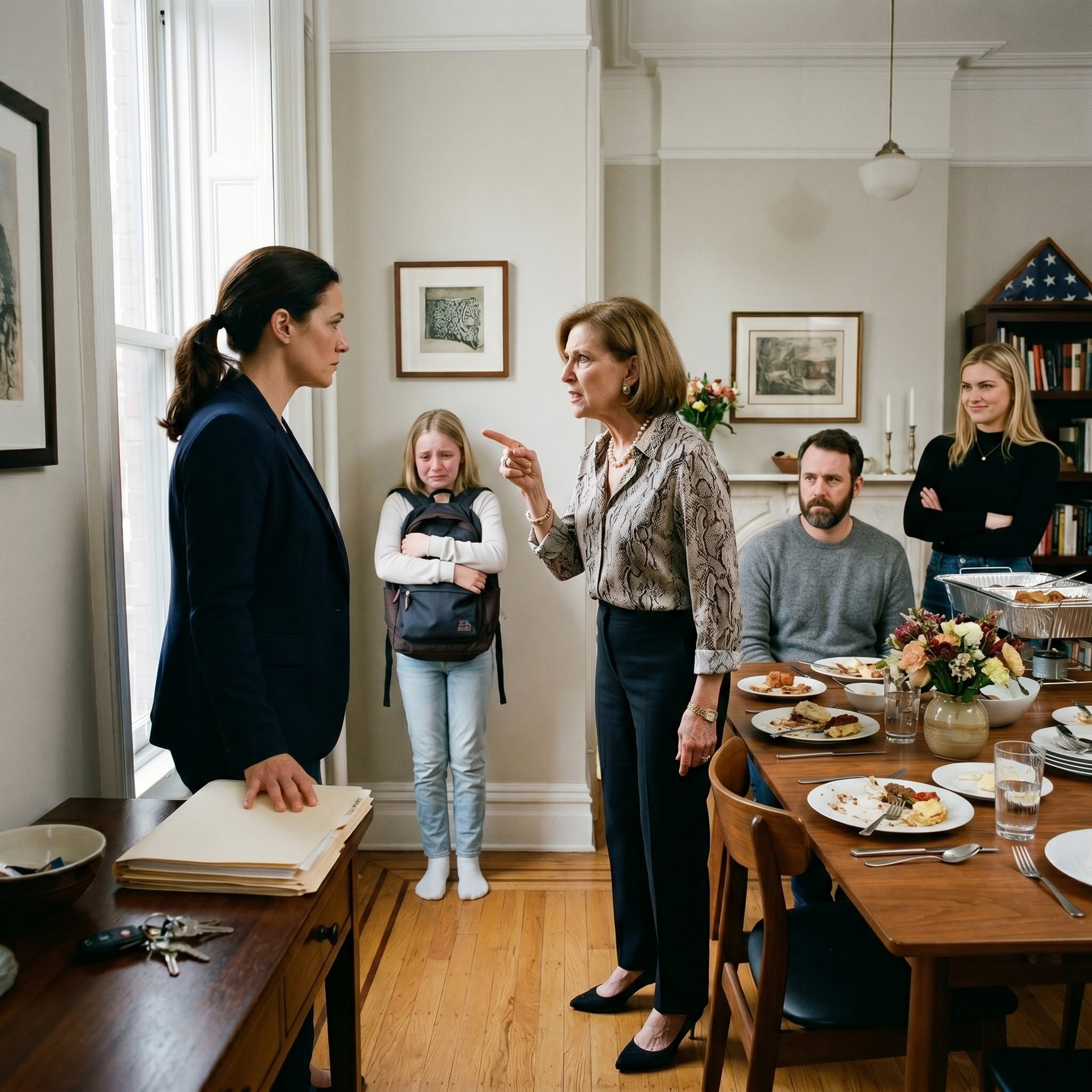
My mother-in-law pointed at my 12-year-old and announced, “Your daughter is a nobody in our family.” Then she said, “So take her — and get out.” I just smiled and replied this. Her face drained of color when she realized that the house was …
People think you can feel when you’re about to become the villain in someone else’s story.
Like you’ll get a warning, a dramatic soundtrack, a sign from the universe.
Nope.
For me, it started with groceries.
Not the fun kind.
The kind where you’re standing in a Brooklyn supermarket late at night comparing prices on oatmeal because someone upstairs thinks generic is a moral failing.
That was my life.
My name is Claire Callahan.
I’m an art conservator, meaning I make damaged, priceless things look like time never happened to them.
In other words, I fix messes for a living.
I just didn’t expect to marry into one.
We lived in a brownstone in Brooklyn Heights, one of those tall, narrow houses people photograph and call charming, while ignoring the fact that it’s basically a money pit with nice windows.
Judith, my mother-in-law, called it the Callahan home, like it came with a family crest.
In reality, it came with a mortgage, property taxes, insurance, utilities, repairs, and a steady stream of emergencies Judith announced like she was reading breaking news.
My husband, Andrew, was a junior architect at a small firm.
Good guy in public.
Polite, quiet in private.
He had a talent for turning into furniture whenever his mother entered a room.
His dad, Harold, had suffered a stroke about a year and a half before everything really detonated.
He used a wheelchair, needed daily meds, therapy exercises, and constant routines.
Judith treated his care like an insult she’d personally been handed.
So the routines became mine.
And quietly, so did most of the bills.
It wasn’t that Andrew didn’t contribute.
He did.
But the heavy, ugly parts, the parts that kept the house running, those were mine.
The autopays, the insurance calls, the pharmacy refills, the co-pays.
Judith didn’t call it help.
She called it your responsibility because Andrew was her son.
Harold was her husband.
The brownstone was her home.
And I, I was the woman Andrew had brought into the family, which in Judith’s mind meant I owed them interest.
The only person in that house who consistently treated me like a human being was my daughter, Paige.
Paige was 12.
Funny, observant, the kind of kid who could tell you what mood someone was in just by the way they shut a cabinet.
She wasn’t Andrew’s biological child.
That detail mattered to exactly one person on Earth.
Judith.
Judith didn’t say it outright at first.
She didn’t have to.
It was in the way she introduced Paige to strangers.
“This is Claire’s daughter,” she’d say, as if Paige belonged to the lost and found.
Not my granddaughter.
Not even our family.
Just Claire’s.
Like Paige came with me the way a carry-on comes with a flight.
And Judith didn’t like carry-ons.
In that house, love was measured in bloodlines and obedience.
Paige had neither.
She still tried.
She’d hold doors, pick up her own plate, help Harold with a blanket if it slipped.
Normal kid things.
Judith would stare at her like Paige was attempting fraud.
Then she’d look at me and say, “She’s very comfortable here,” which was Judith speak for, “Your kid is taking up space.”
Andrew would give me that look, the one that said, “Please just ignore it. Don’t start.”
So I ignored it.
Because I wasn’t trying to start anything.
I was trying to keep my daughter safe and my credit score alive.
I told myself it was temporary.
I told myself Andrew would grow a spine.
I told myself Judith would soften with time.
That was adorable of me.
And then Samantha came home.
Samantha arrived on a rainy Thursday in late spring, like a storm system with luggage.
She was Andrew’s younger sister, 30, divorced, dressed like she was walking into a photo shoot, not moving back in with her parents.
She showed up with three oversized suitcases, each one with shiny gold hardware like it had its own ego.
Judith rushed to her like she’d been waiting at a train station for a soldier returning from war.
“My baby,” she sobbed, squeezing Samantha’s face.
“My poor baby!”
Samantha sniffled dramatically.
“They were monsters,” she said, collapsing onto the entryway bench.
“His mother made me do dishes every day.”
Judith gasped like Samantha had just described torture.
“They don’t deserve you,” Judith hissed.
“You’re home now. You’ll rest.”
Then she turned, same tone, same certainty, and pointed at me.
“Claire,” she said, “juice, and take her bags upstairs.”
No hello.
No how are you.
Just a task list.
I didn’t move right away because I was holding Paige’s hand.
Paige had been doing homework at the kitchen table and wandered over when she heard the commotion.
She looked at Samantha’s suitcases like they might explode.
Samantha noticed Paige and smiled.
Not a warm smile.
A smile like a cat noticing a bird.
“Well,” she said, dragging out the word.
“Who’s this?”
Judith answered before Paige could.
“This is Claire’s daughter,” she said.
“Paige.”
Just the name.
No affection attached.
Samantha’s eyes flicked over Paige.
Her backpack, her sneakers, the way she stood close to me.
Then she looked at me.
“So,” she said lightly, “she helps around the house, right?”
It was a question shaped like a statement.
Paige’s fingers tightened around mine.
“She’s 12,” I said.
Samantha shrugged.
“I was babysitting at 12. It builds character.”
Judith nodded like she’d just heard scripture.
“Exactly,” she said.
“Paige needs discipline.”
Paige’s face went still.
She was used to Judith’s little digs, but this one was different.
This one was about ownership.
Andrew appeared in the doorway, startled.
“Sam,” he said.
Samantha launched herself at him with a squeal, crying into his shoulder.
Andrew hugged her awkwardly and glanced at me like he was waiting for instructions.
I didn’t give him any because I knew how this worked.
Samantha would cry, Judith would rage, Andrew would fold, and I would be expected to make everything smooth.
The first demand came before dinner.
Samantha walked into my studio.
I should explain the studio.
It was a converted back room on the first floor with big windows and a locked cabinet for chemicals.
It wasn’t a cute craft corner.
It was my workspace.
Solvents, varnishes, documentation, gloves, the whole system.
And on my easel was a 19th-century seascape I was restoring under contract.
The kind of painting people insure for more than my annual salary.
The kind of painting you don’t touch unless you like lawsuits.
Samantha stepped in like she owned it.
“Oh,” she said, scanning the room.
“This is bright. I like it.”
I stood up slowly.
“Hi,” I said.
She turned, startled, like she hadn’t expected the room to have a person in it.
“Judith said I can have this room,” she chirped.
I blinked once.
“Judith doesn’t get to assign my studio,” I said.
Samantha pouted.
“It’s just a room,” she said.
“I need light and space. I’m healing.”
“You can heal in the guest room,” I said.
“Or the upstairs office.”
She wrinkled her nose.
“That office smells like old man.”
I didn’t respond.
She smiled again.
That same cat smile.
“Okay,” she said brightly.
“I’ll tell Mom.”
Of course she would.
Judith arrived 10 minutes later, footsteps heavy in that old hallway, and stared at my easel like it offended her.
“You’re painting again,” she said, like I’d taken up gambling.
“I’m working,” I corrected.
Judith scoffed.
“Pictures,” she said.
“You act like you’re curing cancer.”
I didn’t argue.
I just said, “Samantha can’t have this room.”
Judith’s face tightened.
“She needs it,” she snapped.
“She’s my daughter.”
“And this is my studio,” I said.
Judith’s eyes narrowed.
“And whose house are you in?” she demanded.
I held her gaze.
The funny thing about that question?
I could answer it honestly, legally, with receipts.
But I didn’t.
Not yet.
Instead, I said, “Paige is not going to be your maid either.”
Judith blinked, surprised.
“Oh, don’t be dramatic,” she said.
“A few chores won’t kill her.”
“No,” I repeated.
Judith’s voice dropped.
“You’re getting mouthy,” she warned.
I smiled slightly.
Because mouthy is what people say when they’re losing control.
And Judith hated losing control.
That night at dinner, Judith served Samantha first, then Andrew, then Harold, then herself.
Paige got her plate last, slid over like an afterthought.
After dinner, Judith snapped her fingers.
“Paige,” she said, “clear the table.”
Paige looked up.
Her eyes flicked to me.
I said gently, “You can take your plate to the sink.”
Paige did.
Judith’s nostrils flared.
“And the rest,” she insisted.
“No,” I said, still gentle.
Judith slammed her fork down.
“This is why she’s spoiled,” she said, pointing at Paige like she was evidence.
Paige froze.
Andrew stared at his plate.
Harold stared out the window like he’d left the room without moving.
Samantha smirked.
And that was the moment I realized something important.
They weren’t going to stop.
Not with the studio.
Not with Paige.
Not ever.
Unless something forced them.
So I started watching, listening, collecting.
Because if there’s one thing I’m good at, it’s restoration.
And sometimes restoration begins with removing rot.
The next few weeks were a slow-motion lesson in entitlement.
Judith woke up every morning with a new plan for my time.
One day, it was Samantha needs breakfast in bed.
Another day, it was Samantha needs her laundry done properly.
Samantha started leaving her dishes in the sink like a protest.
Wet towels on the hallway floor.
Borrowed my hair dryer and complained it wasn’t salon quality.
Paige tried to stay invisible, which is what kids do when adults act unsafe.
She spent more time in her room.
Read, drew, stayed quiet.
And then Judith started assigning her.
Not politely.
Not help me, sweetheart.
Orders.
“Paige, bring Samantha water.”
“Paige, take the trash out.”
“Paige, vacuum the stairs.”
The first time Paige obeyed, she did it with that careful expression kids wear when they’re trying not to make someone angry.
I stopped her halfway down the stairs.
“Hey,” I said softly.
“Come here.”
She looked up at me like she was in trouble.
“You don’t have to do anything for Samantha,” I said.
“Not unless you want to.”
Paige swallowed.
“She said I have to,” she whispered.
“I say you don’t,” I replied.
Paige’s shoulders relaxed a fraction.
Then she frowned.
“But it makes her mad.”
“I know,” I said.
“Let me handle that.”
Paige nodded.
Judith did not enjoy being handled.
The next confrontation came on a Sunday morning.
Judith barged into the kitchen with a notepad and slapped it down in front of me.
“15 people,” she announced.
“Brunch next Saturday at noon.”
I stared at the page.
Menu items, decorations, timing, everything mapped out like a military operation.
“You’ll do it,” Judith said.
“This is family.”
“Order catering,” I said.
Judith blinked like I’d spoken another language.
“What did you say?”
“I said, order catering,” I repeated.
“Or Samantha can cook for her friends.”
Judith’s mouth tightened.
“You’ll do it,” she said again, sharper.
“You live here.”
Andrew wandered in half awake and did the thing he always did.
Tried to smooth the air without solving the problem.
“Claire,” he murmured.
“It’s just brunch.”
“It’s labor,” I corrected.
Samantha appeared in the doorway wearing a silk robe like she’d stepped out of a perfume commercial.
She’d clearly been eavesdropping.
Her eyes got wet on cue.
“She hates me,” Samantha wailed.
“She wants me to suffer.”
I didn’t even blink.
“I want you to stop treating my daughter like staff,” I said.
Judith slammed her hand on the counter.
“Listen to me carefully,” she said, voice low and sharp.
“As long as I’m alive, I run this house.”
Then she looked toward Paige, who was standing in the hall holding her backpack like a shield.
“You are lucky I let you in,” Judith snapped.
Paige went pale.
And I felt that clean, cold clarity settle in.
The part of you that stops pleading and starts planning.
Two nights later, it happened.
I stepped out of my studio to wash my hands.
Two minutes.
That’s all.
When I came back, the studio door was ajar.
My stomach tightened.
I walked in.
Samantha was standing over the easel holding my solvent bottle.
Her phone was propped up on a shelf recording.
“Guys,” she was saying to the camera, “I’m literally watching her restore this antique painting.”
I froze.
“Samantha,” I said flat.
“Put that down.”
She jumped.
The bottle tilted.
A thin stream of solvent splashed onto the lower corner of the canvas.
Time did something weird.
Everything slowed like the air thickened.
The solvent started lifting pigment.
A smear, a bloom, the beginning of a disaster.
Samantha looked at the wet patch like it was someone else’s problem.
“Oh my God,” she whispered.
“It’s fine, right? It’s just cleaner.”
“It’s not cleaner,” I said quietly.
Paige appeared behind me in the doorway and froze.
Samantha’s eyes darted to Paige, and because Samantha couldn’t help herself, she tried to redirect.
“Why is she even in here?” Samantha snapped.
“She shouldn’t be allowed around chemicals.”
I turned slowly.
“Get out,” I said.
Samantha stormed out, already rehearsing how to be the victim.
Paige stayed silent.
I crouched down in front of her and took her hands.
“You didn’t do anything wrong,” I said immediately.
Paige swallowed.
“She’s going to blame me.”
“She can try,” I said.
“But I saw it. I know what happened.”
Paige nodded, eyes glossy.
Then my phone buzzed.
A bank alert.
Transfer complete.
I frowned, confused.
Then my stomach dropped.
I opened my banking app.
My savings account, my emergency fund, was missing.
Not a few hundred.
A full chunk gone.
I walked into the living room where Andrew was sitting, staring at the TV without watching it.
I held up my phone.
“Where is my money?” I asked.
Andrew’s throat bobbed.
“It was for Samantha,” he said.
I blinked once.
“For Samantha,” I repeated.
“She needed it,” he rushed.
“She’s going through a divorce, Claire. She doesn’t have access to her accounts. Mom was freaking out.”
“You stole my savings,” I said very clearly.
Andrew’s face went red.
“I didn’t steal,” he snapped, defensive.
“We’re married.”
“That account is in my name,” I said.
“You moved money without my permission.”
Andrew looked away like shame was a lighting issue.
“She needed a lawyer,” he muttered.
I stared at him for a long moment.
Then I said, “Did you know she just damaged a painting in my studio?”
Andrew froze.
His mouth opened, then closed.
Judith’s voice drifted from upstairs.
She was on the phone telling someone how unstable I’d been lately.
Andrew’s shoulder sagged.
“We’ll fix it,” he whispered.
I tilted my head.
“You?” I asked.
“Or me?”
He didn’t answer.
And that was the moment I stopped trying to save the marriage.
Because it’s hard to stay married to someone who treats you like a resource.
And it’s impossible to stay married to someone who lets your child be treated like disposable.
That night, Paige slept in my bed.
Not because she was scared of the dark.
Because she was scared of the people in the house.
I lay awake listening to the creaks of an old building and the quiet hum of my own thoughts.
And I made a decision.
Not a dramatic one.
A practical one.
Some damage isn’t accidental.
It’s intentional.
And you don’t repair intentional damage by being nicer.
You remove the source.
The next morning, Judith acted like none of it mattered.
Like the painting was just a picture.
Like my savings were family money.
Like Paige was a nuisance ruining the vibe.
That weekend, the brunch happened anyway.
Not because I cooked, because I didn’t.
Judith ordered catering last minute and screamed until it appeared.
Samantha wore a satin dress and filmed herself walking down the staircase like she was in a reality show.
At one point, Samantha shoved a tray toward Paige.
“Hold this,” she said without looking.
Paige glanced at me.
I shook my head.
Paige stepped back.
Samantha’s eyes narrowed.
“Excuse me,” she snapped.
Paige’s voice was small but steady.
“No,” she said.
Judith swooped in immediately.
“What did you just say?” Judith demanded.
Paige swallowed, trembling.
“I said no,” she repeated.
Judith turned her fury on me like a spotlight.
“Teach your child manners,” she hissed.
“My daughter has manners,” I said.
“She’s not your server.”
Judith’s lips curled.
“She’s not my anything,” Judith said coldly.
The room felt too quiet for a second.
Then Judith pointed.
Not at me.
At Paige.
Like Paige was a stain on the carpet.
“Your daughter is a nobody in our family,” Judith said loud enough that someone near the doorway stopped moving.
Then she added like she was issuing a verdict.
“So take her and get out.”
Paige’s face crumpled.
Not into tears.
Into shock.
Andrew inhaled sharply.
“Mom,” he started.
Judith cut him off with a glare.
Samantha smirked.
And I, I smiled.
Not a sweet smile.
Not a fake keep-the-peace smile.
A calm one.
“I’m flying to LA,” I said pleasantly.
Judith blinked.
“What?”
“I said, Los Angeles,” I repeated.
“Good luck.”
Then I turned to Paige.
“Go pack a bag,” I said gently.
“Just your essentials.”
Paige hesitated, eyes wide.
“We’re leaving?” she whispered.
“Yes,” I said.
“Right now.”
Judith recovered enough to scoff.
“You don’t scare me,” she snapped.
“This is my house.”
I tilted my head.
“Is it?” I asked.
Judith stiffened.
“What did you say?”
I didn’t answer immediately.
I walked to the entryway table where mail was stacked in Judith’s usual chaotic pile.
And I picked up a folder, the one I kept there deliberately, because Judith never touched my paperwork.
She hated paperwork.
She hated anything she couldn’t bully into submission.
I pulled out copies.
Deed, mortgage statements, and held them up.
My name right there, right beside Andrew’s and Judith’s.
Judith’s face changed.
Not anger.
Recognition.
Fear.
Andrew went pale.
Samantha’s phone lowered.
“You’re bluffing,” Judith whispered.
I shook my head.
“I’ve been paying the mortgage,” I said calmly, “from my account for years.”
Judith’s mouth opened.
Closed.
“No,” she said sharply.
“You wouldn’t.”
I smiled.
“I already did,” I said.
I held up my phone.
Autopay canceled.
I’d done it that morning.
Quietly.
After booking two one-way tickets.
Brooklyn to LA.
Judith’s face drained of color.
Andrew stared at me like the floor had vanished.
“You’re going to ruin us,” Judith whispered.
I shrugged.
“I’m not ruining anything,” I said.
“I’m just not saving you anymore.”
Paige came downstairs with her backpack and a small duffel.
She looked terrified.
I took her hand.
Judith stepped forward like she was going to block the door.
Andrew didn’t move.
He just watched.
Because that’s what he did.
I looked at Judith.
“You should have thought about this before you called my daughter a nobody,” I said.
Then I opened the door and we walked out.
The first week after we left, my phone didn’t stop.
Judith called.
Andrew texted.
Samantha sent voice notes, long sobbing performances where she claimed she was being targeted.
I didn’t answer.
Not because I was being dramatic.
Because I was busy.
I had a one-year contract in Los Angeles at a conservation lab.
Good pay, serious work, professional respect, and something I hadn’t had in a long time.
Air.
Paige adjusted faster than I expected.
Kids do that when they finally feel safe.
She stopped flinching every time a door shut hard.
She slept through the night.
She started humming while she did homework.
Little things that make you realize how much fear she’d been carrying quietly.
Back in Brooklyn, the house started falling apart almost immediately.
Not physically.
Financially.
Overdue notices, late fees, calls from the loan servicer.
Judith tried to fix it the only way she knew how.
By screaming at customer service.
It did not work.
Harold’s routines fell apart, too.
Med refills slipped.
Appointments got missed.
Something went wrong.
He ended up in the hospital again.
Andrew called me from a waiting room, voice raw.
“Dad’s in trouble,” he whispered.
I closed my eyes.
Not because I didn’t care.
Because I did.
“Is he stable?” I asked.
Andrew swallowed.
“They don’t know yet,” he said.
“Mom says she didn’t know what to give him.”
I was quiet for a second.
Then I said, “I did know.”
Andrew’s breath hitched.
“Claire, please,” he whispered.
“We need you.”
I stared out the window of my temporary apartment in LA, watching palm trees sway like they had no idea what Brooklyn stress felt like.
“I’m not your emergency plan anymore,” I said softly.
Then I hung up.
Samantha’s situation didn’t improve either.
Because Samantha’s divorce crisis wasn’t just emotional.
It was financial.
Credit cards, loans, people who wanted their money back.
Collectors started calling the house.
Samantha started spiraling.
The brownstone turned into a pressure cooker.
Judith blaming Andrew.
Samantha blaming everyone.
Andrew drowning in it all.
Months passed.
I didn’t go back.
Not for Judith’s guilt trips.
Not for Andrew’s apologies that didn’t come with action.
I focused on work.
On Paige.
On rebuilding a life that didn’t revolve around managing other people’s chaos.
Then one afternoon, my attorney called.
Matthew Collins, a calm voice with sharp paperwork.
“They’ve been served with a pre-foreclosure default notice,” he said.
“Foreclosure is moving forward.”
I leaned back in my chair.
Paige was at the counter doing homework, chewing a pencil like she could intimidate fractions.
“Okay,” I said.
Matthew paused.
“You’re not surprised,” he observed.
“No,” I said.
“I’m prepared.”
“They reached out,” he added.
“They want you to come fix it.”
I smiled.
“Of course they do,” I said.
A week later, I flew back to New York.
Not alone.
With Paige and with Matthew.
We walked into that brownstone like we belonged there, because legally I did.
Judith opened the door and froze.
She looked older.
Not in a dignified way.
In a hollow, stressed way.
Andrew stood behind her, pale and exhausted.
Harold sat in his wheelchair near the staircase, staring at nothing.
Samantha was on the couch, scrolling her phone like denial had Wi-Fi.
The air smelled like stale takeout and panic.
Judith forced her voice into something sharp.
“Well,” she sneered.
“You came back.”
I didn’t sit.
I nodded toward Matthew.
“This is my attorney,” I said.
Judith’s eyes widened.
Samantha scoffed.
“Oh my God. Are you being dramatic?”
Matthew opened his folder.
“I’m here to discuss options,” he said evenly.
“You have very few.”
Judith snapped.
“This is our home.”
Matthew didn’t blink.
“It’s a property secured by a loan,” he said.
“And the loan is in default. Foreclosure is pending.”
Judith’s mouth opened.
Andrew swallowed.
Samantha’s phone lowered.
I stepped forward.
“I spoke with the lender,” I said.
“They’ll allow reinstatement and a refinance.”
Judith’s eyes lit up with desperate hope.
“See?” she snapped at Andrew.
“She’ll fix it.”
I held up a hand.
“Not for free,” I said.
Judith’s hope froze.
“I will only take over the loan and pay the arrears if the property is transferred entirely into my name,” I said.
“Quitclaim deed signed.”
Judith’s face went white.
Andrew took a shaky step forward.
“Claire,” he pleaded.
“Come on, it’s my family’s house.”
I looked at him.
And for the first time in years, I didn’t soften my voice for his comfort.
“Your family treated my daughter like trash,” I said.
“And you watched.”
Andrew’s eyes filled.
“Please,” he whispered.
Samantha snorted.
“This is extortion,” she muttered.
Matthew looked at her.
“It’s leverage,” he corrected.
“And it’s legal.”
Judith’s hands trembled.
“You’re taking everything from us,” she whispered.
I tilted my head.
“No,” I said.
“I’m taking back what I paid for.”
Judith’s voice cracked.
“What about us?” she cried.
I looked at Paige.
Paige stood beside me, quiet but steady.
I turned back to Judith.
“What about her?” I asked.
Judith flinched.
She couldn’t say it now.
Not with me standing there.
Not with a lawyer in the room.
Not with the truth sitting on the table.
I nodded once.
“Sign,” I said.
“Or don’t. But if you don’t, I walk out and the lender takes the house.”
It took 15 minutes.
15 minutes of Judith shaking, Andrew pleading, Samantha sighing like she was the victim of stationery.
Then they signed.
Matthew collected the papers.
“Good,” he said.
“We’ll proceed.”
Judith looked at me, wet-eyed.
“You’re evil,” she whispered.
I nodded once.
“If protecting my child makes me evil,” I said calmly.
“Then yes.”
Then I turned to Andrew.
“I’m filing for divorce,” I said.
Andrew’s face collapsed.
I didn’t argue.
I didn’t scream.
I didn’t beg him to understand.
Because if someone lets a 12-year-old get called a nobody, they’re not confused.
They’re committed.
I took Paige’s hand.
We walked out.
And this time, I didn’t look back.
A year later, Paige and I were still in Los Angeles.
We weren’t glamorous.
We weren’t performing for anyone.
We were peaceful.
Paige joined an art club, made friends, laughed loudly again.
She stopped apologizing for existing.
As for the brownstone, it was in my name.
I renovated it slowly, carefully, the way I restore paintings.
Remove what’s rotten.
Stabilize what’s worth saving.
Protect what’s vulnerable.
And then I sold it.
Not out of spite.
Out of closure.
Sometimes Paige would ask quietly, “Do you think they ever felt bad?”
I’d look at her and say, “It doesn’t matter.”
Because guilt doesn’t undo damage.
But choice, choice does.
They made theirs.
And I made mine.
I chose my daughter finally.
So, tell me, did I go too far or not far enough?
If you came here from Facebook because of this story, please go back to the Facebook post, hit like, and leave exactly this word in the comments: Respect. That small action means more than it looks and helps give the storyteller motivation to keep bringing more stories like this.