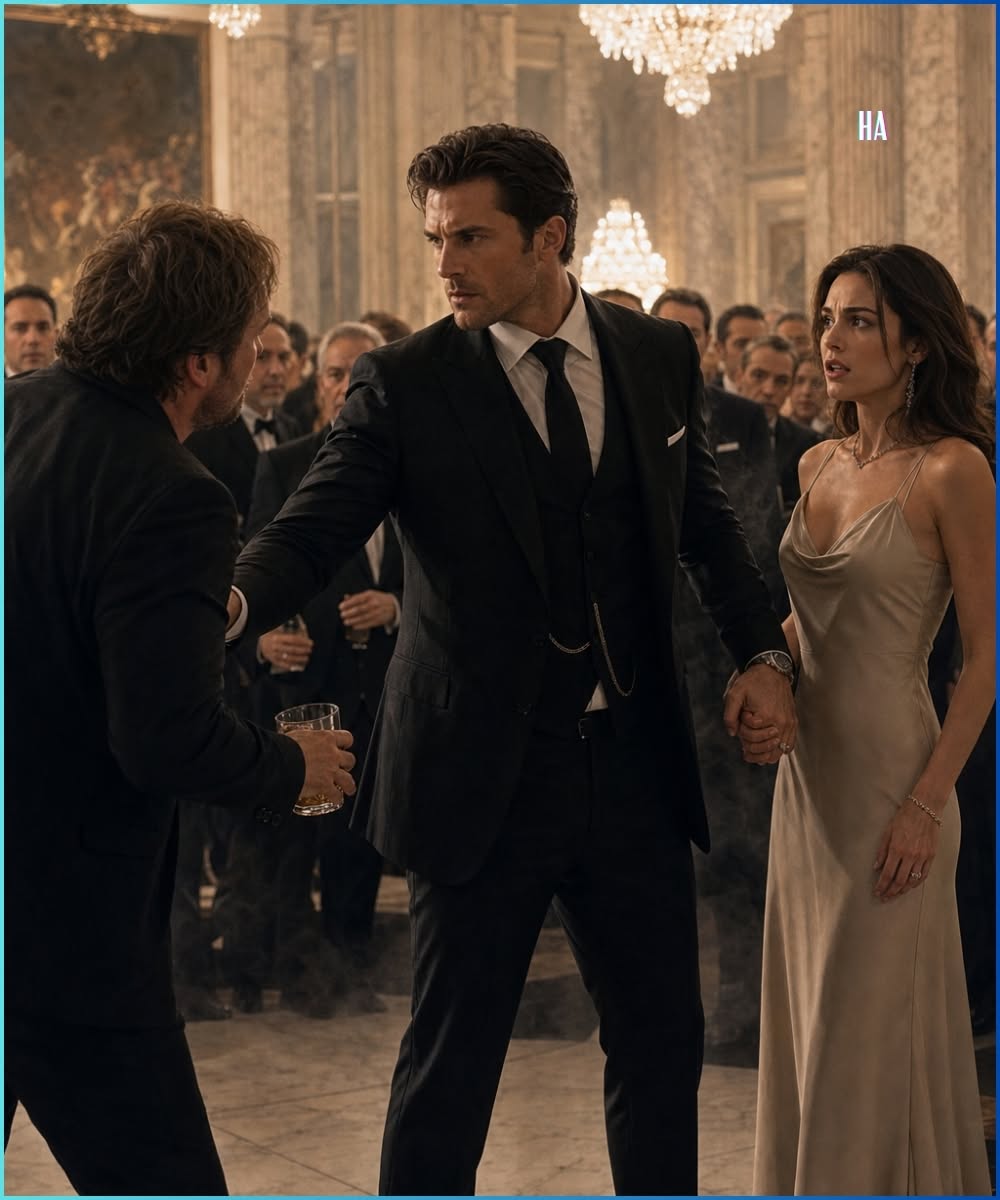
“The catch,” he said, “is that I don’t make offers twice.”
The silence stretched.
My entire life was behind me like a dead end. The apartment. The bills. The threats. The men waiting to break something if I missed one more payment. I thought of my mother’s old engagement ring hidden in my sock drawer. I thought of the second job I had started last week. I thought of what happened to girls who tried to survive alone when powerful men had already decided they were prey.
And I thought of the way Luca had kissed me in front of a room full of monsters, like he’d been daring the world to try him.
My voice came out steady, though my insides were not.
“What exactly would I be doing?”
A flicker of approval moved through his expression. “You’d help me authenticate documents and artifacts. Old letters. Rare books. Anything with history and a lie attached to it.”
“You need a waitress for that?”
“I need someone with taste, patience, and a sharp eye. And I need someone who isn’t stupid enough to flatter me.”
That almost made me laugh.
Almost.
“Do I get a choice?”
His gaze held mine. “You’re making one right now.”
I hated him a little for that too.
At last I said, “If I say yes, I want rules.”
His mouth curved again, slower this time. “Good. I like women who negotiate.”
“I’m serious.”
“So am I.”
He listened while I laid out the only things I could think of in the moment. No touching unless invited. No lying about where I was. No making me sleep in a room with locked windows. No threatening my family, dead or alive. He agreed to all of it with such ease that it made me more suspicious, not less.
Then he said, “You’ll come home with me tonight.”
I stared. “Tonight?”
“Your things can be collected tomorrow.”
“I’m not exactly carrying much.”
“That’s unfortunate. I would have liked to be impressed.”
Against my will, I almost smiled.
Almost.
When I stepped into his car twenty minutes later, I had the strange, unreal feeling that my life had split in two. The city blurred past the windows in streaks of light while my phone buzzed with another message from the collectors.
Unknown Number:
You’re out of time.
I looked at the text, then at the unreadable man beside me.
Luca said nothing, but he held out his hand.
I didn’t take it.
Not yet.
Part 2
Luca’s house was not a house. It was a fortress disguised as elegance.
It sat in the Hudson Valley behind iron gates and a long, tree-lined drive, all stone walls, arched windows, and enough security cameras to make escape feel like a myth. The place was beautiful in the way expensive things were beautiful, which is to say it also felt dangerous.
Mrs. Caruso, the housekeeper, met me inside with the expression of a woman who had already decided I was an inconvenience.
“Miss Reed,” she said, eyeing my uniform. “Your rooms are ready.”
I followed her upstairs through hallways lined with oil paintings and old books until we reached a suite larger than my entire apartment. There was a bedroom, a sitting area, a bathroom bigger than some studio apartments, and a closet stocked with clothes still in their garment bags.
“Mr. Moretti expects breakfast at eight,” she said. “Please dress appropriately.”
“What counts as appropriate?”
“Classically elegant, in his words.”
That sounded exactly like him.
When she left, I stood in the middle of the room and stared at the boxes on the bed. Dresses. Slacks. Blouses. Shoes. Lingerie I did not want to examine too closely. Everything in colors so quiet they seemed expensive by nature.
My phone buzzed again.
Unknown Number:
You think someone can save you? We own your debt, sweetheart.
My hands went cold.
Then another message appeared.
Unknown Number:
Not anymore.
I didn’t know how Luca had done it. I didn’t ask. I should have been relieved, but all I felt was a weird, guilty kind of vertigo. Men like him didn’t give things away for free. They just made the price invisible until you were already paying it.
I barely slept.
At seven-thirty I took a shower, dressed in black trousers and a cream silk blouse, and told myself I was only meeting him for breakfast. Nothing more. Not a surrender. Not an apology.
At eight sharp there was a knock.
A young man in a dark suit led me downstairs to a dining room flooded with morning light. Luca was already at the head of a long table, reading the paper and drinking espresso as if he hadn’t spent the previous night kissing a stranger in a basement full of thieves.
He looked up when I entered.
And somehow he looked even more dangerous in daylight.
“Good morning, Isabella,” he said, gesturing toward the chair at his right. “Sit.”
I did.
The table was covered with fresh bread, fruit, eggs, pastries, cheese, and enough coffee to wake a city.
“You eat like you’re feeding a funeral,” I said before I could stop myself.
His mouth twitched. “You talk like you’re not scared anymore.”
“I’m still scared.”
“Good. Fear is a useful instinct.”
I took a sip of coffee and almost sighed in spite of myself. He had made it exactly the way I liked it, without asking.
“You remember how I take my coffee?”
“I remember most things.”
That should not have sounded intimate. It did anyway.
He folded the newspaper and gave me his full attention. “We should discuss the rules.”
“Of course we should.”
“One, you don’t leave the property without permission.”
I gave him a flat look.
“Two, you don’t contact your old life without telling me.”
“That’s not a rule. That’s a hostage note.”
“Three, what happens in this house stays in this house.”
“And if I don’t like a rule?”
“Then tell me.”
“You’ll change it?”
His eyes settled on mine. “If it’s reasonable.”
That was not as reassuring as he seemed to think.
He set down his cup. “And for the record, Isabella, you are not here as decoration. You’re here because I need what you know.”
I leaned back. “About the antiques?”
“About the truth.”
He took me downstairs after breakfast to an archive room hidden behind a locked panel in the library. Inside were climate-controlled cabinets, manuscripts, maps, ledgers, and objects that made my historian brain light up in spite of myself.
“This collection came from a private estate in Virginia,” he said. “A family member died. The lawyers say there’s a box of wartime correspondence in the estate papers. I think half of it’s fake.”
“Why?”
“Because the signatures are too clean.”
That was enough to pull me in.
I opened the first folder and started reading. Ten minutes in, I had forgotten to be offended by the room, the contract, the house, and the man standing so quietly beside me.
Someone had forged the letters beautifully, but not perfectly. The paper aging was wrong. The slant on the script shifted in places where the writer would never have changed posture. One sentence reused a phrase from a letter published years later.
I looked up. “These are fake.”
Luca watched me with something that might have been satisfaction. “I knew I was paying for something.”
“You’re paying for a headache.”
“Worth every dollar.”
I should have smiled and moved on. Instead I found myself talking more than I had in weeks. About museum paper stock. About historical forgery patterns. About how easy it was to fake age and how hard it was to fake restraint.
He listened.
Actually listened.
It was unnerving.
By the third day, I had learned that Luca’s house was run with military precision but not coldness. Mrs. Caruso always left fresh flowers in the kitchen. The kitchen staff knew my coffee order before I did. The driver waiting outside never talked unless spoken to. Luca himself was always exactly where he said he would be.
He never wasted words.
He never forgot one.
At dinner, he asked about my mother’s favorite books. He remembered that I liked rain more than sunshine because rain made the world quieter. He noticed that I always bit the inside of my cheek when I was thinking. He was infuriatingly observant and strangely gentle in ways that did not fit the stories about him.
Then, one evening, I caught him in the garden.
He was standing by the fountain with his jacket off, sleeves rolled to his forearms, talking quietly to one of the guards. When he saw me, the guard left.
“I didn’t know you still had a garden,” I said.
“I didn’t know I needed one.”
I looked at the roses, at the hedges trimmed too neatly to be natural. “You really do live like a king.”
“I live like a man who expects enemies.”
“That doesn’t sound fun.”
“No, it’s not.”
There was a pause.
Then he said, “You’ve been watching the exits.”
I froze.
He was right.
I hated that he was right.
“I was looking for the library,” I lied.
His gaze sharpened. “Don’t insult me.”
My pulse kicked up. “I don’t trust you.”
“I know.”
“You kidnapped me.”
“I rescued you.”
“Those are not the same thing.”
“No,” he said. “They’re not.”
The honesty in his tone unsettled me more than anger would have. I looked away first.
That night, while searching for a book in the library, I noticed Luca’s tablet left on a side table. The screen was unlocked. My whole body went still.
It was probably stupid. Definitely stupid. But a little spark of hope rose inside me so fast I couldn’t kill it in time. If I could get one message out, maybe someone would help. My old priest. A former professor. Anyone who knew me well enough to care.
I touched the screen.
The room lit up behind me.
“Interesting choice,” Luca said from the doorway.
My blood went cold.
He stood there fully dressed, dark as the night outside the windows, with Marcus at his shoulder looking deeply apologetic.
“Luca,” I said, my heart pounding, “I was just—”
“Lying,” he finished.
I swallowed. “You set this up?”
“The tablet was left here on purpose.”
I stared at him, betrayal and fury rising so fast I could barely breathe. “You tested me?”
“I wanted to know if you had settled in,” he said. “Or if you were still looking for a way out.”
The words hit harder than I wanted them to.
“You can’t keep me here forever.”
“No,” he said, almost softly. “I can’t.”
His expression didn’t change, but the air shifted around him, dark and heavy and too close.
Then he said, “You’re being punished.”
My breath caught. “Punished?”
“Seven days in your room. No visitors. No lessons. No walks. Meals delivered.”
“You can’t be serious.”
“I am.”
I stepped toward him, shaking now with anger. “I’m not one of your men.”
“No,” he said. “You’re the one person I’m least willing to lose.”
“That is not comforting.”
“Good. It’s not meant to be.”
And because I had apparently retained every bad instinct I’d ever inherited from my father, I said, “You’re just proving I was right to try.”
His eyes went dark. “And you’re proving you still don’t understand what kind of world you’re in.”
“I understand enough.”
He moved closer. “Then understand this. If you disappear, I will find you. If anyone else reaches for you, I will break them. If you keep fighting me, Isabella, I will still protect you. I’m just trying to decide how much you’re going to hate me for it.”
The worst part was that I believed him.
He left.
The door locked behind him.
Seven days alone can change the shape of a person.
By day two I was furious. By day three I was talking to myself just to hear a human voice. By day five I was crying for no reason I could explain. By day seven the silence had eaten into my bones so deeply that even my anger had started to feel like company.
When Luca finally opened the door, I was sitting on the edge of the bed with my arms folded around myself and my pride in pieces.
He stood in the doorway and studied me for a long second.
“Did you learn something?” he asked.
I hated how small my voice sounded. “I learned you’re cruel.”
His face didn’t move.
Then I said the truer thing. “And I learned I’m lonelier than I knew.”
Something shifted in his expression, quick as a shadow.
He crossed the room, knelt in front of me, and touched my face with a hand that was almost unbearably gentle.
“You don’t have to be lonely here,” he said.
Tears stung my eyes.
“I hate you,” I whispered.
“I know.”
“And I hate that I missed you.”
His thumb brushed away the first tear before it could fall. “You’re allowed to hate me.”
“I’m not your prisoner.”
“No.” His voice lowered. “You’re the woman I can’t stop thinking about.”
My breath snagged.
He lifted me into his arms then, just for a second, as if he needed to prove to both of us that I was still alive and still there. I should have pushed him away. Instead I rested my forehead against his shoulder and let myself feel the impossible heat of being held.
From that day on, I stopped trying to escape.
Not because I forgave him.
Because I was tired. Because the house had become familiar. Because Luca had become a kind of gravity I did not know how to fight. Because when he looked at me, I felt seen in ways that frightened me more than his violence ever had.
And then I got sick.
It started with nausea in the mornings. Then a missing cycle. Then a doctor in a private room, a blood test, and a long, careful pause before he finally looked up.
“Congratulations,” he said quietly. “You’re about eight weeks pregnant.”
The world went still.
I turned to Luca, expecting shock, maybe anger, maybe the look of a man who had just realized he had made a mistake he could never undo.
Instead his face hardened into something almost feral.
He went very, very calm.
When we were alone, he placed a hand over my still-flat stomach and said, in a voice gone rough at the edges, “Mine.”
I pulled back at once. “Don’t.”
His eyes snapped up. “Don’t what?”
“Don’t do that. Don’t turn this into ownership.”
The silence between us was dangerous.
Then, in a quieter voice, he said, “I meant the child. Not you.”
“That’s still not better.”
His jaw flexed. “I’m not good at this.”
“No kidding.”
But the next day he had herbs ordered from a specialty shop in the city. He had Mrs. Caruso throwing out anything that smelled too strong. He canceled my late-night trips to the archive room. He cut my hours with Professor Ellis, the antiquarian scholar he’d hired for my project, down to half.
“You’re acting ridiculous,” I snapped one night. “I’m pregnant, not fragile glass.”
“You’re carrying my child,” he said. “I’m not taking chances.”
“You mean you’re not letting me breathe.”
His gaze pinned me. “There’s a difference.”
There should have been.
And yet, with every day that passed, I found myself noticing the way his control softened around the edges when it came to the baby. He was still intense. Still demanding. Still terrifying to anyone who crossed him. But when my hand rested on my stomach and the baby kicked, the steel in him melted.
He would go still, then bend his head and speak to the child in a low voice I’d never heard him use with anyone else.
One night I asked, “What are you saying to her?”
His mouth tipped, faintly. “That she’ll be loved.”
“You think it’s a girl?”
“I know it is.”
“You can’t know that.”
“I can feel it.”
His certainty should have annoyed me.
Instead it made my chest ache.
Part 3
The first man to pursue me openly was not dangerous in the way Luca was dangerous.
That almost made him worse.
His name was Daniel Mercer, a museum donor with a clean smile, an expensive watch, and the kind of voice that made women think they were the only person in the room. He met me at a charity preview in Manhattan when Luca was called away to settle a problem downtown. Daniel asked about my research, my studies, and whether I liked old architecture as much as I looked like I did.
He was polished. Charming. Normal.
For one awful second, normal felt like a luxury.
Then he asked if I would have coffee with him sometime, just the two of us.
I told him I’d think about it.
I didn’t realize Luca had heard until he came back into the gallery and stood beside me with that unreadable look he wore when he was trying not to be angry.
Daniel offered him his hand. Luca ignored it.
“I was just asking Miss Reed about her work,” Daniel said lightly.
“I’m sure you were.”
Daniel smiled like he hadn’t noticed the warning underneath those words. “You must be very protective of your people.”
Luca’s gaze cut to me. “Only of what matters.”
It was the sort of answer that made men like Daniel either back away or get brave.
He got brave.
Over the next week, flowers arrived at the estate with Daniel’s name attached. He sent a signed first edition of a poetry collection I had once mentioned in passing. He called the house once and asked to speak with me directly.
Luca didn’t answer the phone, but I saw the vein in his jaw jump when he hung up.
“You’re jealous,” I said before I could stop myself.
“I’m observant.”
“That’s not an answer.”
“It’s the only one you’re getting.”
Daniel wasn’t the danger I thought he was. That part came later.
It happened on a rainy night when I left the gallery early because my back hurt and the baby had been kicking hard enough to make me want tea and my bed and nothing else. I was halfway to the car when two men blocked the sidewalk ahead of me.
Not Daniel.
Loan collectors.
The same kind my father had owed.
My stomach dropped.
“You’re a hard woman to reach,” one of them said.
I stepped back.
“Luca Moretti won’t always be there to hide you.”
My pulse spiked. “I don’t know what you’re talking about.”
One of them smiled without warmth. “Sure you do.”
They moved too fast.
I twisted away, but one grabbed my arm hard enough to make me cry out. The other reached for my bag. I kicked, missed, and stumbled back into the rain.
Then the world exploded into motion.
A car skidded to the curb. Doors opened. Men flooded the street.
Luca appeared through the rain like something summoned from violence itself.
The collectors went pale.
One of them raised a weapon. Luca hit him before he could fire.
I screamed.
Everything after that was chaos and thunder and wet pavement. Luca moved with terrifying precision, his guards closing in, the collectors dropping one by one under the force of men who were clearly used to winning. I stood frozen under the awning, soaked through and shaking, my hand pressed against my stomach as if I could shield the baby from the sound of fear.
Then Luca was there.
He cupped my face, searched my eyes, then looked down at my stomach with a flash of raw panic I had never seen on him before.
“Are you hurt?”
“No.”
“Are you sure?”
“Yes.”
He exhaled once, sharp and shaken.
One of his men was already dragging the surviving collector away. Another held out the bag that had fallen from my shoulder. Luca took it from him, checked me one more time, then turned toward the street as if he might burn the whole block down for what had happened.
I caught his wrist.
He stilled.
“What are you going to do?” I asked.
His voice came out flat. “End this.”
“No,” I said.
That made him look at me.
“No more walls. No more treating me like a thing you can lock away.” My hand shook, but I kept it on his sleeve. “If you keep making decisions for me, you’re not protecting me. You’re trapping me.”
His face went hard, then softer, then exhausted in a way I had never seen.
“You think I don’t know that?”
“Then act like it.”
He stared at me for a long time, rain sliding down his face, and I saw something in him break open. Not weakness. Something more painful.
Fear.
“I lost people because I waited too long,” he said quietly. “I am not waiting again.”
“I’m not them.”
“No,” he said. “You’re worse.”
Despite everything, I almost laughed. “Worse?”
“You make me want things I don’t know how to survive losing.”
The honesty of it knocked the breath out of me.
We stood there in the rain while the city kept moving around us, both of us too exposed to lie anymore.
Finally I said, “Then learn.”
He searched my face, like he was looking for the exact point where I would turn back into someone he could control.
Then he nodded once.
At home, he did something I didn’t expect.
He unlocked the side doors.
He gave me a phone with unrestricted access, a driver I could summon without asking, and a room key that only opened my suite. He removed the most obvious cameras from the hallways outside my rooms. He stopped calling it keeping me safe and started calling it keeping us safe.
It wasn’t perfect. He was still Luca Moretti, and the man had control stitched into his bones.
But it was the first time he had moved toward me instead of over me.
Three weeks later, Daniel came to the estate.
I almost didn’t see him because I was in the glass room looking over the gardens, but Mrs. Caruso told me there was a visitor. He wanted to return a book and speak to me privately.
I met him in the sitting room with Luca standing half a room behind me, silent and unreadable.
Daniel looked nervous now. Less polished. Less certain.
“I should have told you earlier,” he said, glancing between us. “I work with the board that oversees the old auction properties downtown.”
I frowned.
His expression tightened. “I didn’t know that when we met. But I found out quickly enough. Your name came up in a conversation I shouldn’t have heard.”
Luca’s gaze sharpened.
Daniel kept going. “The men who collected your father’s debt were trying to use you as leverage. I thought I was helping when I reached out.”
“Helping who?” I asked coldly.
He swallowed. “You.”
“And Luca?”
He didn’t answer fast enough.
That was answer enough.
The room went still and dangerous.
Luca took one slow step forward. “You used her.”
Daniel raised both hands. “No. I tried to warn her.”
“You tried to get close to her while men were circling this house.”
Daniel looked at me then, and for the first time I saw the truth. He had been sincere. But sincerity and safety were not the same thing.
“I did like you,” he said quietly.
“I know,” I answered.
That seemed to hurt more than anger would have.
“And I liked the version of you I could have had,” I added. “But she didn’t exist.”
He nodded once, almost sadly, then handed me the book and left.
When the door closed, Luca said nothing.
I turned to him. “You knew.”
“I suspected.”
“Why didn’t you tell me?”
“Because you needed to choose without me poisoning it.”
I studied him.
The answer was too honest to dismiss.
That night, for the first time, I told him the truth about what I wanted.
“I don’t want to be rescued forever,” I said. “I want a life. A real one. A job. Freedom. A place where my child doesn’t have to live behind locks.”
His face tightened with feeling I couldn’t fully read. “Then build one.”
“With you?”
His gaze held mine. “If you still want me there.”
I should have said no.
I should have been wiser than that.
Instead I walked to him, placed my hand against the front of his shirt, and said, “Only if you stop confusing love with ownership.”
His hand covered mine.
“I’m trying,” he said.
And for the first time, I believed him.
Months later, when my daughter was born, Luca was in the room and looked more terrified than any man I had ever seen.
The baby came out crying, furious at the world from the first second, with dark hair and Luca’s impossible eyes.
He stared at her like he had been hit in the chest.
“She’s perfect,” he whispered.
I laughed through tears. “You say that like you’re surprised.”
“I am.”
He looked at me then, raw and open and no longer hiding behind control or threat or fear.
“Are you leaving?” he asked.
The question was so honest it nearly broke me.
I looked at the baby in his arms, then at the man who had once claimed me in a room full of criminals and had somehow become the first person in my life who ever learned how to let go.
“No,” I said softly. “But not because you own me.”
His throat moved.
“Because I choose you.”
Something changed in him then. Not victory. Not possession. Relief.
The kind that lasts.
A year later, I stood beside him at the opening of a foundation we had built together, one that restored stolen art and funded scholarships for women in history and conservation. My name was on the donor plaque. My work hung on the walls. My daughter slept in my sister’s arms while Luca greeted museum trustees with the expression of a man who still scared half the room and no longer needed to.
He found me near the end of the night on the terrace overlooking the city.
“You know,” he said, folding his hands in his coat pockets, “the first time I saw you, I thought you were too brave to survive that room.”
I smiled. “And now?”
“Now I think you were the only brave person in it.”
I looked out over New York, over all the lights and steel and noise that had once felt like a cage.
It didn’t feel like that anymore.
It felt like a beginning.
THE END