“English. Just old mountain phrasing. My mom’s family was from Kentucky.”
“What did it mean?”
“That you can sleep because someone who loves you is still awake.”
He absorbed that.
Then he said, “Samir will pay your fee. I added a bonus.”
“No bonus.”
His eyebrows lifted. “Most people do not refuse extra money.”
“Most people aren’t me.”
“It is appreciation.”
“The agreed rate is enough.”
Something shifted in his face then. Not annoyance. Interest.
“What do you want, Savannah Reed?”
The question should have felt arrogant.
Somehow, it didn’t.
She looked him straight in the eye. “A real stage. My own name on the poster. A room full of people who came to listen, not eat over me.”
Zayan nodded once.
“Good night, Savannah Reed.”
“Good night.”
She left by the same side door she had entered.
But by morning, her phone was ringing.
Part 2
The meeting took place on the forty-sixth floor of the Al-Mansour Foundation’s New York office, where the windows faced Central Park and the coffee tasted like someone had negotiated with the beans personally.
Zayan was there, along with a woman named Claire Donovan, the foundation’s director of cultural programs.
Claire was in her forties, silver-blond, brisk, and impossible to impress.
“We host a summer concert series,” Claire said. “Six evenings. Three hundred seats each. We record every performance for our digital archive. Artists choose their own program. Sheikh Al-Mansour recommended you.”
Savannah looked at Zayan.
He gave nothing away.
Claire slid a folder across the table. “Twenty thousand per performance. Rehearsal space included. Promotion included. You keep creative control within reasonable production limits.”
Savannah opened the folder slowly.
A year earlier, she had sung in a hotel bar while a drunk man asked if she knew any Taylor Swift. Now she was staring at a contract worth more money than her father had made in two years working maintenance at a hospital.
“I’ll need a lawyer to review it,” she said.
Claire smiled. “Good.”
Zayan’s eyes warmed, barely.
That was how it began.
Not with romance. Not with a fairy tale. With work.
Savannah quit the Whitmore three weeks later.
Her first concert sold out in nine days.
The night of the performance, she stood backstage in a black dress she had bought on sale and altered herself, pressing her palm to her stomach because her nerves had gathered there like birds.
Claire touched her shoulder. “Ready?”
“No.”
“Good. Means you care.”
Savannah walked into the light.
For ninety minutes, nobody ate over her. Nobody called her background. Nobody asked her to lower the volume.
They listened.
At the end, they stood.
All three hundred of them.
Savannah bowed with tears burning behind her eyes, but she did not let them fall until she was alone in the greenroom with a paper cup of warm tea.
Then Samir knocked.
“Sheikh Al-Mansour would like to congratulate you, if you’re willing.”
“If I’m willing?”
Samir smiled. “His words.”
Zayan entered a moment later.
No entourage. No performance. Just him.
“You were extraordinary,” he said.
Savannah wiped under one eye with her thumb. “That sounded painful for you.”
“I’m learning to say simple things.”
“Dangerous habit.”
“I’ll proceed carefully.”
She laughed, and the sound changed something between them.
Over the next months, the concert series grew from opportunity into momentum. A critic from a music blog wrote about Savannah’s “unvarnished emotional clarity.” A public radio producer requested an interview. A small label asked to meet.
Zayan remained at the edge of it all.
Sometimes present. Sometimes gone for weeks. Always careful.
One night after her fourth concert, he came backstage without knocking and found her barefoot, sitting on the floor, eating peanut butter crackers from a vending machine.
For once, he looked genuinely startled.
“What?” she said. “Do billionaires not eat crackers?”
“Not from machines that look older than me.”
“Then you haven’t lived.”
He sat in the chair across from her.
In his world, men probably did not sit in folding chairs under fluorescent lights while women in evening gowns ate crackers.
But he did.
“Your third song,” he said. “The one about glass.”
Savannah looked down. “What about it?”
“You wrote it about someone.”
“Everyone writes about someone.”
“Was it recent?”
“That is not a professional question.”
“No,” he said. “It isn’t.”
The honesty landed between them.
Savannah folded the wrapper carefully. “Zayan.”
“Yes?”
“I won’t be collected.”
His face stilled.
She continued, “I’ve met men with money. Not your kind of money, but enough to think everyone has a price. They like talent when it’s hungry. They like women when they’re grateful. Then they call it love when really they mean ownership.”
“I know.”
“Do you?”
“Yes.”
She searched his face.
He did not defend himself. That mattered.
“I admire you,” he said quietly. “Professionally. Personally. More than I expected and less conveniently than I would prefer.”
Savannah’s breath caught before she could stop it.
“That’s a dangerous sentence too,” she said.
“I know.”
For several seconds, neither moved.
Then Savannah stood. “I have rehearsal at eight.”
It was not a rejection.
It was not acceptance.
It was a boundary.
Zayan rose. “Then sleep.”
“Bossy.”
“Concerned.”
“Still bossy.”
He almost smiled. “Good night, Savannah.”
“Good night.”
The sixth concert changed everything.
A video of Savannah singing her mother’s lullaby was posted online by the foundation. Within two days, it had half a million views. Within a week, it had crossed three million. Comments came from women who missed their mothers, men who had not cried in years, daughters sitting beside hospital beds, soldiers overseas, nurses on night shift.
Savannah read them alone in her apartment in Queens and cried harder than she had after any review.
Then the invitation came.
The North Atlantic Arts Festival in Vienna wanted her as a late addition to its showcase.
Vienna.
A real international stage.
Claire called screaming. Maya from the Whitmore sent fifteen crying emojis. Savannah’s mother called and said, “Baby, I always knew the world would have to hush up one day.”
Savannah told Zayan in his townhouse library two nights later.
He listened, then said, “I’m proud of you.”
“Your foundation helped.”
“It opened a door. You walked through it.”
She sat with that because it was the exact right thing to say.
And maybe that was why she finally told him, “I’m scared.”
His expression softened.
“Of failing?” he asked.
“No. Of being changed by being wanted.”
Zayan was quiet for a long time. “Then let people want your work. Not your soul.”
She looked at him.
“That sounded like advice from someone who learned the hard way.”
“It was.”
Before Vienna, the foundation hosted one final major event in the Astor Ballroom at the Whitmore. An international investment forum with a cultural program. Savannah was scheduled for thirty minutes between panels.
The room was full of executives, donors, officials, and press.
Zayan was there, seated at the front.
So was Sheikh Rashid Karam, an older family ally known for funding traditional arts institutions. Beside him sat Nabil Morsi, a cultural adviser with a narrow face and the expression of a man who had never been surprised by beauty in his life.
Savannah began with two standards.
The room responded warmly.
Then she sang one of her own songs, a fierce, aching piece called “No One Owns the Sky.”
Halfway through the next song, Morsi stood.
He spoke loudly in Arabic first. Several people turned. Zayan’s jaw tightened.
Then Morsi switched to English.
“This is a representative event,” he said. “I do not understand why an unknown hotel singer with no significant credentials has been placed before guests of this level.”
Savannah lowered the microphone.
Morsi’s voice sharpened.
“People like you don’t belong on this stage.”
The words struck the room like glass breaking.
Zayan rose so fast his chair moved behind him.
But Savannah lifted one hand.
Not to him.
To herself.
She took one breath.
Then she smiled, not sweetly, not politely, but with the calm of a woman who had been underestimated so many times that insult had become a language she no longer needed translated.
“You’re right about one thing,” she said into the microphone. “I don’t have a famous name.”
A pause.
“Yet.”
A murmur moved through the room.
Savannah turned to the pianist. “From the bridge.”
Then she sang.
Not the safe song. Not the polite version. She sang the last song in her set, the one she had written after leaving Ohio, after losing school, after singing to rooms that did not care.
Her voice rose clean and fearless into the chandeliers.
People began clapping before the final note ended.
Then more.
Then the room stood.
Not everyone. But enough.
Savannah bowed once and walked offstage.
Behind the curtain, her hands finally shook.
Zayan found her in the service hallway.
His face was colder than she had ever seen it.
“I heard him,” he said.
“So did everyone else.”
“I will handle it.”
“I already did.”
His eyes moved over her face. “Are you all right?”
“No.”
The honesty surprised both of them.
Savannah leaned back against the wall. “But I will be.”
Zayan’s voice dropped. “He had no right.”
“No. But men like that don’t wait for rights. They take space and call it standards.”
“I’m sorry.”
“You didn’t say it.”
“But it happened under my name.”
She looked at him then. Really looked.
For the first time, she saw not the billionaire, not the sheikh, not the man everyone obeyed. She saw a person standing inside the wreckage of his own privilege, trying to decide whether to decorate it or dismantle something.
“Morsi wants to apologize,” Zayan said after a moment.
“Did he decide that himself?”
“No.”
“At least you’re honest.”
“He will apologize publicly if you want.”
“I don’t need a performance.”
“What do you need?”
Savannah picked up her bag. “To go home.”
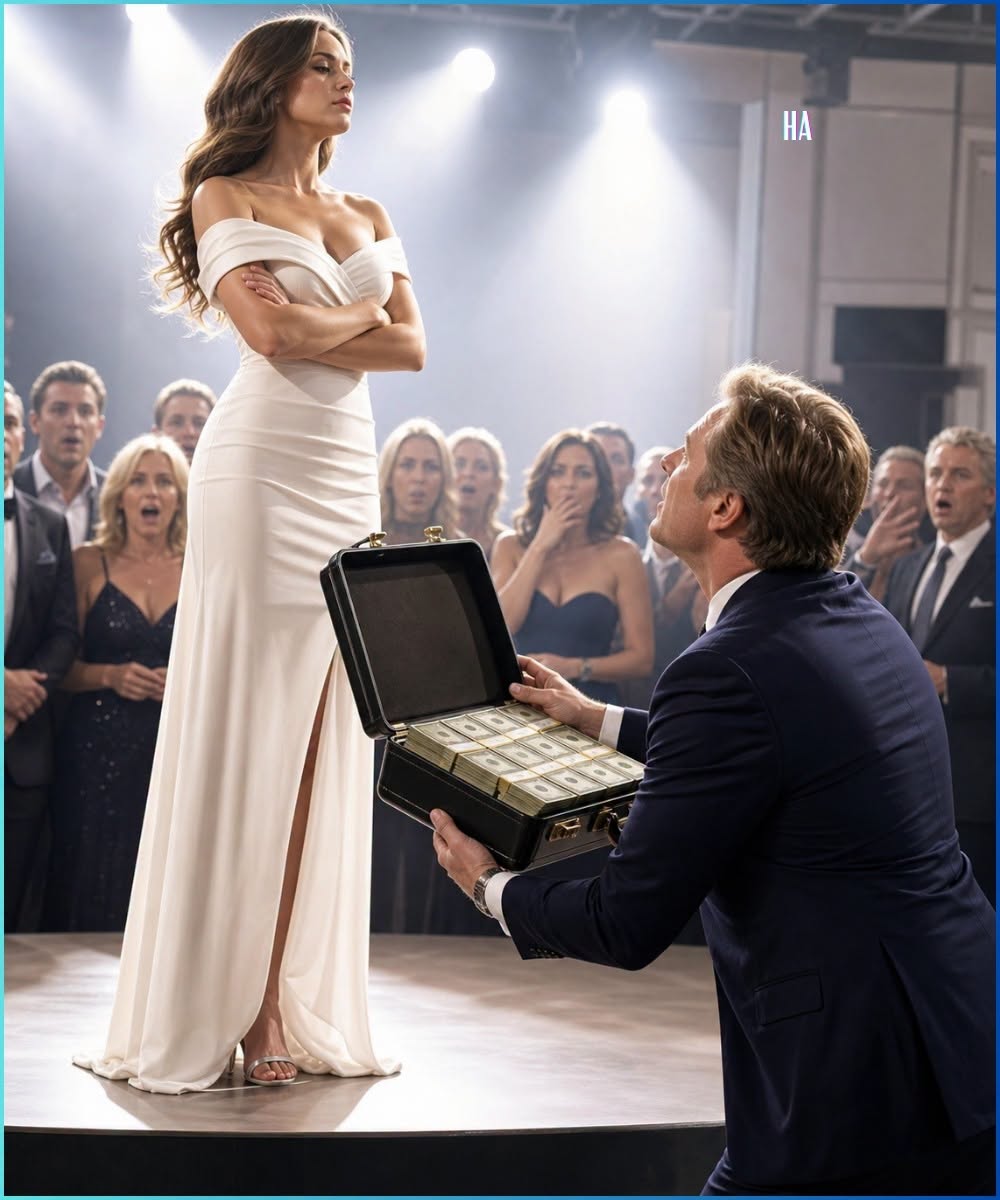
In the lobby, Samir caught up to her with a thick white envelope.
“Sheikh Al-Mansour asked me to give you this.”
Savannah opened it.
A cashier’s check.
One million dollars.
Her name printed cleanly across the line.
For emotional damages, professional disruption, and immediate withdrawal from all remaining public obligations, the memo read.
Savannah stared at it.
Then she closed the envelope and handed it back.
“No.”
Samir looked frightened. “Ms. Reed, please.”
“No.”
“It is meant as respect.”
“No,” she said again, softer now. “It is meant as repair. And money can’t repair what money did not break.”
“May I tell him that?”
“Tell him I accepted the apology I was owed. I will not accept payment for my dignity.”
Then Savannah walked out of the Whitmore into the cold Manhattan night with nothing but her coat, her voice, and the knowledge that every camera in that room had captured what happened.
By midnight, the clip was everywhere.
Part 3
The internet did what the internet does.
It cut the ugliest moment into twelve-second clips. It turned Savannah’s raised chin into a freeze-frame. It captioned Zayan standing behind his chair. It argued. It judged. It chose sides before knowing the story.
But one thing could not be edited away.
Savannah had been insulted in front of the world, and she had kept singing.
By morning, “I don’t have a famous name yet” was everywhere.
The Whitmore issued a careful statement. The foundation issued a stronger one. Nabil Morsi resigned from three advisory boards before lunch.
Savannah turned off her phone.
She spent the day in her apartment, barefoot, making grilled cheese and tomato soup because that was what her mother made when life got too loud.
At 7:12 p.m., someone knocked.
She looked through the peephole.
Zayan stood in the hallway.
No security visible. No Samir. Just him, holding the same white envelope.
Savannah opened the door but did not invite him in.
“You brought it back,” she said.
“I did.”
“Then this will be a short visit.”
“I don’t want you to take the money.”
That stopped her.
He held the envelope out.
She didn’t reach for it.
“I wanted you to see what I almost did,” he said. “I almost turned your pain into a transaction because that is the language I know best. I am sorry.”
Savannah’s throat tightened.
He continued, “This is not for you.”
“Then why bring it?”
“Because I’m redirecting it. One million dollars, in your name, to create a fellowship for working musicians who cannot afford training, recording, legal review, or travel. You control the board. You choose the first recipients. The foundation funds it, but it does not own it.”
Savannah stared at him.
The hallway hummed with old pipes and distant traffic.
“You sat outside my apartment with a million-dollar apology redesigned into a scholarship?”
“Yes.”
“That is the most billionaire thing I have ever heard.”
A small, tired smile touched his mouth. “Is it a bad thing?”
She took the envelope.
“No,” she said. “Not this time.”
Vienna came six weeks later.
Savannah flew economy because she insisted on it, then regretted it somewhere over the Atlantic when a man in the next row snored like a broken engine. She arrived exhausted, nervous, and strangely happy.
The concert hall was smaller than she imagined and more beautiful than she deserved to think about. Gold balconies. Red velvet seats. A stage that seemed to remember every voice that had ever crossed it.
Zayan arrived the night before the performance.
They met in a quiet restaurant with dark wood walls and white tablecloths. Rain tapped the windows.
“My father knows about you,” he said over coffee.
Savannah nearly choked. “That is a terrifying sentence.”
“He knows I care for you.”
She set down her cup.
The room seemed to narrow around them.
“And what does your father think?”
“He thinks my life is complicated.”
“Smart man.”
“He wants to meet you someday.”
“Someday is a useful word.”
“Yes.”
Savannah looked out at the rain. “Zayan, I won’t be hidden.”
“I know.”
“I won’t be polished into someone easier.”
“I don’t want easier.”
“And I won’t give up my work to fit into your world.”
He leaned forward slightly. “Savannah, your work is the reason I saw you at all.”
That quieted her.
The next night, she stood backstage in Vienna and thought about every room that had tried to make her smaller.
The hotel bar in Cincinnati. The wedding where the groom’s uncle asked if she could “sing something fun for once.” The Whitmore ballroom. Morsi’s face. Zayan’s envelope. Her mother’s lullaby.
Then the announcer said her name.
Savannah Reed.
Not background.
Not filler.
Not people like you.
Her name.
She walked into the light.
The first song settled the room. The second took it. By the third, she stopped being afraid. By the lullaby, she could feel people breathing with her.
When she finished, the silence lasted three full seconds.
Then the hall rose.
Savannah bowed, and this time she cried where everyone could see.
Backstage, she barely made it past Claire before Zayan appeared.
He did not touch her immediately. He knew better now.
“Are you all right?” he asked.
Savannah laughed through tears. “No.”
He smiled.
She stepped forward and let him hold her.
For one minute, there was no foundation, no family, no cameras, no future demanding answers.
Only the person who had heard her when she thought no one was listening.
A year later, the Savannah Reed Fellowship funded its first twelve musicians.
A single mother from Atlanta recorded her first EP. A violinist from Detroit paid for surgery on his wrist and returned to performing. A nineteen-year-old songwriter from rural Kentucky flew to New York for the first time and cried when Savannah handed her a studio key.
Savannah’s first album came out that fall.
The title was Not Yet.
It went farther than anyone expected.
Zayan’s father did meet her eventually, in a private room in London after one of her concerts. He was formal, observant, and kinder than she expected.
“You speak very directly,” he told her.
Savannah smiled. “It’s cheaper than lying.”
The old man looked at his son.
Then back at her.
“I see why he listens.”
No blessing came that day. No dramatic announcement. Real life rarely moves that cleanly.
But something opened.
And over time, Zayan and Savannah built what could not be bought. Trust. Patience. A bridge between worlds that did not require either of them to disappear.
Years later, a journalist asked Savannah what changed her life.
She could have said the viral video.
She could have said the million dollars.
She could have said the sheikh.
Instead, she thought of a ballroom in Manhattan, a microphone in her hand, and a man’s cruel words hanging in the air.
“One day,” she said, “someone told me I didn’t belong on a stage.”
The journalist leaned forward. “And what did you do?”
Savannah smiled.
“I kept singing.”
THE END