Part 2
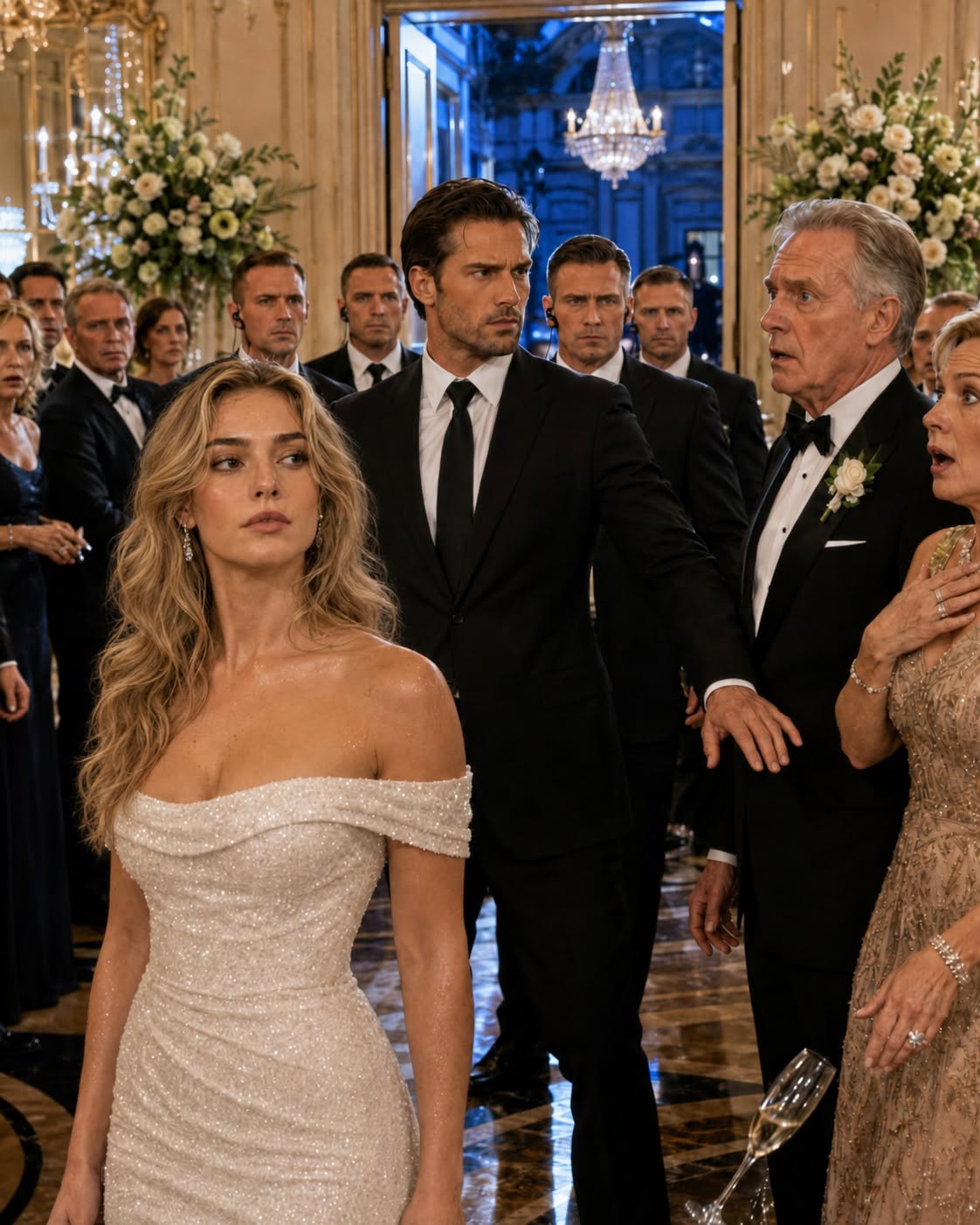
The sound of my mother’s champagne glass breaking seemed louder than the music had been.
For one suspended second, nobody moved.
Not the bride in her silk cathedral veil. Not the groom with his perfect banker smile. Not the guests who had laughed while I climbed out of the fountain with water dripping from my hair.
Only my father moved.
Arthur Campbell straightened his tuxedo jacket as though posture could still save him.
“Excuse me?” he said, looking at Director Elaine Mercer as if she were a poorly trained waitress. “Who are you?”
Elaine did not blink.
She was in her late fifties, silver-haired, sharp-eyed, and built like every room had already confessed to her. She held the sealed folder in one hand, untouched champagne-colored paper against black leather gloves.
“I am the person who asked you a question,” she said. “About the offshore accounts tied to the Campbell Family Foundation.”
A murmur moved through the ballroom.
My father laughed.
It was a small, rehearsed sound. The kind he used at charity dinners when a donor made an uncomfortable remark.
“This is absurd,” he said. “This is my daughter’s wedding.”
Nathan’s arm slid around my waist.
Warm. Steady. Real.
I had changed into the spare black dress from my car, but my hair was still damp at the ends. My skin still smelled faintly of fountain water and humiliation.
Nathan noticed.
His jaw tightened.
“My wife was shoved into a fountain twenty minutes ago,” he said. “Your timing complaints are not persuasive.”
My mother found her voice.
“Wife?” she whispered.
The word traveled across the room faster than scandal should have been able to move.
Allison’s face changed first. The bridal softness vanished. Her eyes cut to Nathan, then to me, then back to Nathan again, as if she were recalculating my value in public.
“You’re married?” she said.
I met her stare.
“Yes.”
“For how long?”
“Three years.”
My mother made a sound between a gasp and an accusation.
“Three years?” she said. “You let us look ridiculous?”
I almost laughed.
Of all the things that had happened that evening, that was the injury she chose.
Nathan looked at her with cold disbelief. “You managed that without assistance.”
My father slammed his palm onto the nearest table.
Silverware jumped. A woman in emerald satin flinched.
“This is a stunt,” he barked. “Meredith has always been dramatic. Always. She disappears for months, hides behind vague government work, and now she brings armed men into her sister’s reception?”
Elaine opened the folder.
The sound of paper shifting was delicate.
Terrifyingly calm.
“Arthur Campbell,” she said, “this investigation began nine months ago, when a foreign relief grant connected to your foundation passed through three shell entities and resurfaced in a private investment account under the name Bellweather Maritime.”
My father’s eyes flickered.
Small.
Fast.
Enough.
Elaine continued, “From there, funds were distributed through vendor invoices, political donations, art purchases, and tonight’s wedding payments.”
The groom, Thomas Whitaker, turned pale.
His father, a heavy man with a florid face and a bank president’s confidence, stood from the front table.
“Now hold on,” he said. “You cannot just walk into a private event and make allegations.”
One of the men in dark suits stepped beside him.
Not touching.
Not threatening.
Just present.
Thomas’s father sat down again.
Elaine’s gaze never left my father.
“We are beyond allegations.”
Allison looked at our father.
“Dad?”
He did not answer her.
That silence told me more than any confession could have.
My mother stepped toward Elaine with the brittle courage of someone who had never been denied a table in her life.
“This family has served Boston for generations,” she said. “The foundation funds hospitals, scholarships, shelters—”
“Some of them,” Elaine said.
My mother stopped.
“Enough of them to look clean,” Elaine added.
The room went deathly still.
I felt Nathan’s thumb move once against my side.
A reminder.
Breathe.
I did.
Slowly.
Carefully.
Because the worst part was not that my family had humiliated me.
The worst part was that I had recognized the name Bellweather Maritime.
Months earlier, a flagged transfer had crossed my desk during a broader counterintelligence review. It was only a fragment then. A shell company attached to a shipping corridor. Nothing obviously tied to Boston. Nothing obviously tied to my family.
Then my father’s foundation appeared in a secondary memo.
I reported the conflict immediately.
I recused myself the same day.
After that, the investigation continued without me.
Or so I had been told.
Now, standing in my sister’s wedding reception with damp hair and a husband my family had not known existed, I understood why Director Mercer had kept the final warrant date from me.
Because tonight had never only been a wedding.
It had been a handoff.
And my father had pushed me into a fountain right before it happened.
The thought entered quietly.
Then locked into place.
I looked at Arthur Campbell again.
For the first time in my life, he looked afraid of me.
Not angry.
Not disappointed.
Afraid.
“Why tonight?” I asked.
His mouth tightened.
Elaine glanced at me. “Meredith.”
“I’m not touching the case,” I said. “I’m asking as the daughter he shoved in front of two hundred witnesses.”
My father’s nostrils flared.
“You always make yourself the victim.”
“No,” I said softly. “You made me the distraction.”
Nathan went very still.
The words changed the air around us.
Elaine’s eyes sharpened.
My father said nothing.
Allison laughed suddenly, too high and too thin.
“This is insane. This is my wedding. You are all insane.” She turned on me, veil trembling. “You couldn’t let me have one day.”
I looked at her dress.
The hand-beaded bodice. The antique lace. The diamond bracelet on her wrist.
Then I looked at the tables.
The flowers imported from Holland. The custom menus. The string quartet standing frozen near the stage.
“One day,” I repeated. “How much did it cost?”
Her mouth opened.
Closed.
My father snapped, “Do not answer that.”
Elaine lifted one hand.
Two agents moved toward the gift table.
That was when Allison changed.
Not cried.
Not panicked.
Changed.
Her eyes darted toward the white-and-gold card box near the floral arch.
It was fast, but I had spent too many years reading microexpressions across interview tables.
Allison knew.
Maybe not everything.
But enough.
“Secure the card box,” Elaine said.
“No!” Allison shouted.
The word cracked through the ballroom.
Everyone turned.
My sister clutched her bouquet against her chest like a shield. White roses. Stephanotis. Silk ribbon. A tasteful cascade of money.
“Allison,” my father warned.
She shook her head. “You said it was handled.”
My mother closed her eyes.
And there it was.
The family portrait tearing down the center.
Elaine nodded to the agents.
One opened the decorative wedding card box. Another pulled out envelopes, cards, velvet pouches, and a narrow ivory package tied with satin.
My father lunged.
Nathan moved before I did.
He stepped between my father and the agents with such smooth precision that Arthur stopped inches from him.
For a moment, they faced each other.
My father, red-faced and sweating.
My husband, calm as winter glass.
“You do not want to touch me,” Nathan said.
Arthur’s lips peeled back.
“You think money makes you powerful?”
Nathan’s expression did not change. “No. But evidence does.”
The agent opened the ivory package.
Inside was not jewelry.
Not cash.
Not a sentimental wedding keepsake.
It was a slim black hardware drive nestled in white silk.
The kind designed to hold encrypted keys.
A little object.
A quiet object.
The ballroom reacted as if someone had drawn a weapon.
Thomas Whitaker backed away from Allison.
“Allie,” he whispered. “What is that?”
She looked at him with sudden hatred.
“Don’t you dare pretend.”
His father rose again. “Thomas.”
Thomas did not look at his father.
He looked at the drive.
Then he ran.
Not far.
Men who expect doors to open for them are never prepared for locked exits.
He made it past the cake table, past a startled bridesmaid, and into the service hallway before two agents brought him back by both arms.
His boutonniere was crushed.
His perfect hair had fallen across his forehead.
And in his hand was a torn envelope stamped with the Campbell Family Foundation seal.
Elaine took it from him.
She read one line.
Then her gaze moved to me.
Not my father.
Not Allison.
Me.
Something cold opened behind my ribs.
“What is it?” I asked.
Elaine did not answer right away.
That was how I knew the answer mattered.
Nathan shifted beside me. “Elaine.”
The director folded the paper once.
“Meredith,” she said carefully, “your name is on this.”
My mother made a small, strangled sound.
Arthur looked at the floor.
There are moments when the mind refuses drama.
It becomes practical instead.
I heard the ice clinking in abandoned glasses.
I smelled lilies and candle wax.
I noticed a smear of fountain water still darkening the hem of my dress.
“My name,” I said.
Elaine handed me the paper.
I took it.
The document was a transfer authorization.
Not completed.
Not signed by me.
But prepared in my name.
Special Agent Meredith Campbell.
A falsified authorization designed to make it look as if I had approved the release of classified seized material from a federal evidence vault.
My pulse slowed.
Dangerously.
All those months of silence from my family.
The strange invitations.
The sudden insistence that I attend Allison’s wedding.
The seat at table nineteen near the terrace.
My father’s speech.
The fountain.
The humiliation.
A public scene.
A ruined dress.
A dramatic exit.
Enough chaos to place me away from the ballroom while someone used my identity inside it.
“They were going to frame me,” I said.
Nobody contradicted me.
Allison’s mascara began to run. “I didn’t know it was that. Dad said it was paperwork.”
I looked at her.
“Paperwork?”
She swallowed. “He said you were already involved. That you owed the family. That it would fix everything.”
“Fix what?”
She looked at our mother.
My mother looked at Arthur.
Arthur said, “Not here.”
The phrase nearly made me smile.
After everything, he still believed he could choose the room.
Elaine closed the folder.
“Arthur Campbell, you are coming with us.”
My father lifted his chin, but his eyes were wet with rage.
“You ungrateful girl,” he said to me. “You have no idea what I protected you from.”
Nathan stepped forward.
I stopped him with one hand.
Arthur saw it.
That I could restrain power now.
That I had never been weak.
Only disciplined.
“What did you protect me from?” I asked.
His face twitched.
For one second, the father from my childhood appeared—not kind, never that—but younger, cornered, and afraid of something larger than himself.
Then the mask came back.
“You’ll find out,” he said.
Elaine’s agents took him by the arms.
My mother followed two steps before stopping, as if proximity to scandal might stain the silk of her dress.
“Arthur,” she whispered.
He did not look at her.
He looked at Allison.
Then he looked at me.
“Ask your husband about Tokyo.”
The words landed softly.
Nathan’s hand tightened around mine.
Only once.
Nobody else noticed.
I did.
My father smiled then.
Not triumphantly.
Not fully.
But enough.
Then they took him out through the ballroom doors beneath the chandeliers he had paid for with stolen money.
The guests parted for him.
All those old Boston names.
All those clapping hands.
Silent now.
When the doors closed, Allison collapsed into a chair.
Her veil spilled across the floor like a surrender flag.
Thomas was escorted out next.
Then his father.
Then two of the groomsmen.
One by one, the wedding party became a witness list.
Elaine gave orders in a low voice. Phones were collected from certain tables. Vendor staff were separated and interviewed. The hotel security feed was preserved.
The ballroom, which had been designed for romance, became a crime scene.
And I stood in the center of it, suddenly exhausted beyond anger.
Nathan turned me gently toward him.
“Meredith.”
I looked up.
His face was composed, but his eyes were not.
“What did he mean?” I asked.
The smallest silence passed between us.
Too small for anyone else.
Large enough for a marriage.
“Not here,” Nathan said.
The same phrase my father had used.
I pulled my hand from his.
His expression changed.
Pain moved through it before control covered it.
“Meredith,” he said again.
“No,” I said. “Not after tonight.”
Elaine approached us before Nathan could answer.
“I need you both upstairs,” she said. “Private suite. Now.”
“Both?” I asked.
Her eyes moved to Nathan.
“Yes.”
Something in her tone told me this was not a request from a friend.
It was an instruction from a director.
We took the service elevator because the lobby was already filling with curious guests, hotel security, and people pretending not to record.
Inside the elevator, Nathan stood beside me without touching me.
The silence was worse than shouting.
At the twenty-third floor, we entered a suite that overlooked Copley Square. Agents had already turned it into a command room. Laptops open. Evidence bags lined across a table. A printer humming in the corner.
Elaine shut the door behind us.
Then she said, “Meredith, your recusal ends here.”
I stared at her. “That is not possible.”
“It became necessary when they attempted to fabricate federal authorization under your identity.”
Nathan looked out the window.
I watched his reflection in the glass.
He would not meet my eyes.
Elaine placed another folder on the table.
This one was blue.
No markings.
No logo.
Just a file I somehow knew I did not want opened.
“Arthur Campbell was not the top of this network,” Elaine said. “He was a financial conduit. A willing one, but not the architect.”
“Who was?”
She hesitated.
Nathan turned from the window.
“Elaine,” he said quietly.
She ignored him.
“The network has been using charitable foundations, private banks, defense contractors, and cultural events to move restricted technology overseas,” she said. “Cyber intrusion tools. Surveillance prototypes. Identity maps of federal personnel.”
My throat tightened.
“My identity map.”
Elaine nodded once.
“We believe tonight’s transfer was meant to plant your credentials in the chain, then burn you publicly before the first warrant return.”
I looked at Nathan.
“And Tokyo?”
His face had lost color now.
Not fear.
Something worse.
Regret.
“There was no Tokyo contract,” he said.
The room seemed to tilt.
I waited for him to continue.
He did not.
I laughed once, quietly, because my body did not know what else to do.
“You texted me from Tokyo.”
“I texted you from Boston.”
The words were gentle.
That made them worse.
“Why?”
Nathan took one step toward me.
I stepped back.
He stopped.
Elaine said, “Nathan’s company flagged the breach attempt on your credentials two weeks ago. We moved him into protective coordination.”
“You moved my husband into protective coordination,” I said, “and nobody told me?”
“You were the target,” Elaine said.
“I am also a federal agent.”
“You are also his wife.”
My eyes snapped to Nathan. “And you agreed?”
His voice was low. “I agreed because someone inside your family was helping them get close to you.”
“My family has been hurting me for thirty-two years. That is not news.”
“No,” Nathan said. “But this was different.”
He reached into his jacket and removed his phone.
Slowly.
Carefully.
He placed it on the table.
On the screen was a paused security video.
I recognized the angle immediately.
The wedding courtyard.
The fountain.
Me standing near the terrace doors.
My father moving toward me with the microphone.
“This was recorded before the push,” Nathan said.
He pressed play.
At first, nothing happened beyond what I remembered.
My father smiling.
Guests laughing.
Me standing still.
Then Nathan zoomed into the left edge of the frame.
A waiter stood near the terrace column holding a silver tray.
Not watching my father.
Watching me.
His right hand slipped beneath the tray.
Metal flashed.
Small.
Black.
A syringe.
My blood went cold.
Nathan paused the video.
“Your father shoved you three seconds before the waiter reached you.”
I could not speak.
Elaine said, “The man disappeared into the service corridor during the chaos. We detained him ten minutes ago attempting to leave through the loading dock.”
My mind replayed the fountain.
The humiliation.
The laughter.
My father’s hands against my shoulders.
Remember this moment.
Had he meant the cruelty?
Or the timing?
Arthur Campbell had spent my life making me feel unwanted.
And tonight, in the cruelest way possible, he may have saved me from being drugged, framed, or killed.
I sat down.
The chair was too soft.
The whole world had become too soft.
“What was in the syringe?”
Elaine’s mouth hardened. “A paralytic sedative. Enough to incapacitate you for several hours.”
Nathan’s voice was almost a whisper. “They needed you missing but alive long enough for the authorization to go through.”
I closed my eyes.
For years, I had trained myself not to look for love in my father’s brutality.
Now the possibility sat before me like a knife with my fingerprints already on it.
“Did Arthur know?” I asked.
“We do not know,” Elaine said. “But his final comment suggests he knew part of it.”
I opened my eyes.
Nathan was watching me now.
Rawly.
“I should have told you,” he said.
“Yes,” I replied.
No anger.
Not yet.
Only fact.
He absorbed it like a blow.
Elaine picked up the blue folder.
“There is more.”
I almost told her no.
For one irrational second, I wanted the fountain back. The simple version. The old wound. The familiar story where my father was cruel, my sister selfish, my mother cold, and my husband the only safe place in the room.
But stories rarely remain kind once truth enters them.
Elaine opened the file.
Inside was a photograph.
Black and white.
Grainy.
Taken from a surveillance camera in a hotel lobby two days earlier.
A woman stood at the front desk, half-turned from the camera.
Pearl earrings.
Perfect posture.
Champagne-blond hair swept into a twist.
My mother.
Beside her stood the waiter from the video.
Elaine slid the image toward me.
“Arthur may have disrupted the injection,” she said. “But your mother appears to have arranged it.”
The room disappeared at the edges.
My mother laughing behind her champagne glass.
My mother calling me difficult.
My mother always making sure I was placed far enough away to disappear.
I touched the edge of the photo.
Not the image.
Just the paper.
Nathan said my name.
I stood.
This time, when he reached for me, I let him.
Not because everything was forgiven.
Because the floor felt suddenly untrustworthy.
Outside the suite windows, Boston glittered as though nothing had happened.
Inside, my life had split open.
Elaine’s phone buzzed.
She looked at the screen.
Her face changed.
“What?” I asked.
She did not answer.
She turned the phone toward me.
A message had arrived from the secure line monitoring my father’s transport.
Detainee Campbell requesting to speak only to Meredith Reed.
Below it, another line appeared.
He says her mother is not the woman who gave birth to her.
Nathan went rigid beside me.
I looked at him.
And in that instant, before he could hide it, I saw recognition in his eyes.