I never told my wife about Margaret. Summer of 1962. We were eighteen. She worked at the ice cream shop on Lake Street, wearing a blue apron and a white paper hat that always sat crooked over her blond curls. I enlisted that fall.
I wrote her fourteen letters from overseas. Every single one came back unopened. I married someone else. Forty-two good years. My wife passed in 2019. Last month, my granddaughter dragged me to bingo at the senior center.
“Pop, you need to get out of the house,” she said.
Five dollars a card.
That was how sixty-three years came walking back into my life.
My name is Robert Hayes, and at eighty-one years old, I thought the biggest surprises of my life were behind me.
I was wrong.
The senior center smelled like coffee, floor wax, and the kind of perfume women wear because they have been loyal to it since 1973.
I did not want to be there.
My granddaughter, Sophie, had practically dragged me out of my recliner.
She was twenty-six, stubborn as a mule, and the only person in my family brave enough to tell me when I was turning into furniture.
“Pop,” she said, parking outside the senior center, “Grandma would haunt you if she saw how many canned soups you’ve eaten this week.”
“She loved chicken noodle.”
“She loved you more. Go inside.”
I grumbled, but I went.
After my wife, Helen, died in 2019, the house became too quiet.
For forty-two years, I had known where she was by sound.
The kettle at six.
The sewing machine after lunch.
Her soft humming when she folded towels.
The television too loud at night because she refused to admit her hearing was going.
After she was gone, silence moved into every room and unpacked.
So Sophie brought me to bingo.
“Just one night,” she said. “If you hate it, we’ll leave.”
I bought one card.
Five dollars.
Sat at a folding table near the back.
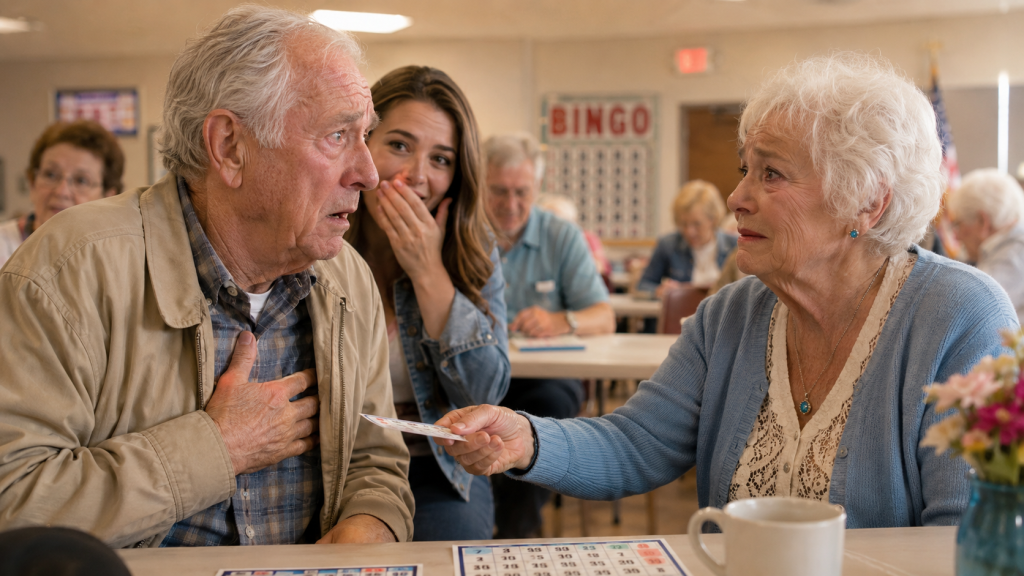
And then the woman across from me looked up.
White hair.
Blue eyes.
A slight scar near her left eyebrow from the bicycle accident she had when we were seventeen.
My heart stopped.
Sixty-three years disappeared.
The senior center faded.
The bingo caller’s voice became distant.
For a moment, I was standing again beside Lake Street with a melting chocolate cone in one hand and all of summer in front of me.
“Hello, Robert,” she said.
I could not speak.
“Margaret?”
Her hand trembled slightly as she slid her bingo card across the table.
On the back was a phone number.
And one sentence.
I never opened your letters because your mother told me you married my sister.
I stared at those words until the bingo hall noise faded into nothing.
“My mother told you I married your sister?” I whispered.
Margaret nodded, her eyes shining.
“She came to the ice cream shop after you shipped out. Said you had chosen Helen. Said my letters would only embarrass me.”
My chest tightened.
Helen had been my wife.
A good woman.
A kind woman.
The mother of my children.
But she had never been Margaret’s sister.
Not even close.
“That was a lie,” I whispered.
Margaret reached into her purse and pulled out a bundle tied with faded blue ribbon.
Fourteen letters.
My letters.
Unopened.
The same envelopes I had written on cramped military stationery with ink that smeared in humid weather.
My hands shook as I touched them.
“I thought they were returned by the post office,” I said.
Margaret shook her head.
“Your mother returned them herself. She told the postman she was family and handled it.”
A bitter, old ache rose in me.
My mother had never approved of Margaret.
Not because Margaret was unkind.
Not because she lacked intelligence.
But because Margaret’s father fixed cars and her mother cleaned rooms at the lake hotel.
My mother believed love should improve a family’s position.
Not threaten it.
She had pushed Helen toward me for years.
Helen came from a family with a hardware business, church standing, and a dining room big enough for formal china.
I liked Helen.
I respected her.
Eventually, I loved her.
But the first girl I ever loved was Margaret.
And apparently, my mother had made sure she disappeared before I came home.
Margaret’s voice broke.
“Robert, there’s something else.”
I looked up.
She slid a photograph across the table.
It was old and faded, the edges curled.
A young woman stood near a clothesline holding a baby boy.
Margaret.
My breath stopped.
She whispered, “I was pregnant when you left.”
The room tilted.
“No.”
She nodded through tears.
“Your mother knew. I went to her after I found out. I was terrified. I thought she would help me reach you.”
My mouth went dry.
“What did she do?”
“She said you were engaged to Helen. She said if I loved you, I would not ruin your life. Then she said you wanted nothing to do with me or the baby.”
I gripped the edge of the table.
“Us?” I whispered.
Margaret nodded.
“His name is Daniel. He’s sixty-two now. And he has your eyes.”
At that moment, Sophie returned with two cups of lemonade and froze.
“Pop,” she whispered, staring at the photo, “why does that man look exactly like Dad?”
I could not answer her.
Because the baby in the photograph had grown into a man I had never known.
A son.
My son.
And I had missed his entire life.
Sophie sat down slowly.
“Pop?”
I pushed the photograph toward her.
My fingers felt numb.
“I think,” I said, though the words barely came out, “I think this is your uncle.”
Margaret covered her mouth.
Sophie looked from me to her, then back to the photo.
The bingo caller shouted B-12.
Someone at another table laughed.
A woman shouted bingo and groaned when someone corrected her.
The world continued like mine had not just split open.
I stood too quickly, and my chair scraped the floor.
Sophie caught my arm.
“Pop, sit down.”
“No,” I said. “I need air.”
Margaret stood too.
Her legs seemed unsteady, and for one terrible second, I thought she might fall.
Instinct moved before age could stop me.
I reached for her elbow.
She looked down at my hand on her arm, and something passed between us.
Not romance.
Not yet.
Something older.
Recognition.
Grief.
The memory of two teenagers who had once believed the world could not outsmart them.
Outside, the evening air was cool.
The sun had nearly set behind the Methodist church across the street.
Sophie stood a few feet away, holding both lemonades, wisely saying nothing.
Margaret wrapped her cardigan tighter around herself.
“I didn’t come to hurt you,” she said.
Her voice was small.
“I wasn’t sure if I should say anything. Then I saw your granddaughter sign you in. I heard her call you Pop. And I thought… if I don’t speak now, I never will.”
“How long have you known I was here?”
“I moved back six months ago.”
“Why?”
She smiled sadly.
“Daniel bought me a condo near his daughter. He thinks I need watching.”
I almost laughed, but the sound died in my throat.
“Daniel has a daughter?”
“Two. And a son. You have grandchildren.”
I pressed my hand against my chest.
Not because of pain exactly.
Because my heart seemed to be trying to hold sixty-three years all at once.
Children.
Grandchildren.
Birthdays.
School plays.
First steps.
All of it gone.
All of it lived without me.
“Did he know about me?” I asked.
Margaret looked away.
“Yes and no.”
“What does that mean?”
“I told him his father had enlisted before I knew I was pregnant. I told him letters were returned. I told him your family made it clear you had moved on.”
I swallowed hard.
“Did you tell him my name?”
“Yes.”
“And he never looked for me?”
“He did once,” she said. “When he was twenty-eight. Your mother was still alive then. He found an old address and went there.”
My stomach turned.
“What happened?”
Margaret’s eyes filled.
“She told him you had died overseas.”
For a moment, I heard nothing.
Not cars.
Not insects.
Not Sophie’s little gasp behind me.
My mother had told my son I was dead.
Dead.
Not married.
Not moved away.
Dead.
I sat down on the curb because my legs simply stopped holding me.
Margaret knelt beside me as best she could.
“I’m sorry,” she whispered.
I shook my head.
“No. You don’t apologize to me.”
“I believed her.”
“You were eighteen.”
“I should have fought harder.”
“So should I.”
That was the truth.
A hard truth.
I had come home from overseas, angry and humiliated that Margaret had never opened my letters.
I let pride do what loneliness could not.
I told myself if she would not read my words, she did not deserve any more of them.
My mother encouraged that.
Helen comforted me.
Life moved forward.
I did not ask enough questions.
That is how lies survive.
Not only because someone tells them.
Because everyone else is too wounded, proud, or afraid to dig.
Sophie sat beside me on the curb, still holding the lemonades.
“Pop,” she said softly, “does Dad know?”
My son, Michael.
The son I raised with Helen.
The father of Sophie.
The thought of telling him made my stomach twist.
Michael had adored his grandmother.
He kept her Bible.
Quoted her recipes.
Spoke of her as if she had been stern but good.
How do you tell a man that his grandmother erased an entire branch of his family?
“I’ll have to tell him,” I said.
Sophie nodded.
“And Daniel?”
I looked at Margaret.
“Does he know you’re here tonight?”
She shook her head.
“He knows I play bingo. He does not know I was hoping you might come.”
I looked at the phone number written on the bingo card still in my hand.
“Will he see me?”
Margaret’s expression tightened.
“I don’t know.”
That night, Sophie drove me home.
I held Margaret’s photograph the whole way.
She had let me take it, along with one of the unopened letters.
“Open one,” she said before we left. “Not all. Just one. You should finally hear yourself.”
At home, I sat at my kitchen table beneath the yellow light Helen had always hated and opened the first letter I had written from overseas.
Dear Maggie,
I still taste strawberry ice cream every time I think of you. The food here is terrible, the heat is worse, and I miss the lake like a man misses breathing. Mostly, I miss you.
I stopped there.
The words blurred.
I had been eighteen.
Young.
Certain.
Hopeful.
I read the rest slowly.
I had told her about the barracks.
About the man from Ohio who snored.
About the sky at dawn.
About saving enough money to marry her when I returned.
I had signed it:
All my love, Robbie.
No one had called me Robbie in sixty years.
The old man at the kitchen table wept for the boy who had written that letter.
The next morning, Sophie came over with Michael.
My son was fifty-six, practical, kind, and built like me in the shoulders.
He walked in already worried.
“Sophie said something happened at bingo.”
I could not help it.
I laughed once.
“Yes. Something happened at bingo.”
We sat in the living room.
I told him everything.
Margaret.
The letters.
The photograph.
Daniel.
My mother.
Michael listened without interrupting.
His face changed slowly from confusion to disbelief to anger.
When I finished, he stood and walked to the window.
“She told him you were dead?”
“Yes.”
“And she told Margaret you married her sister?”
“Yes.”
He turned back.
“Grandma did that?”
I nodded.
“I’m sorry.”
He stared at the floor.
“I don’t understand.”
“Neither do I.”
But I did, in a terrible way.
My mother loved control more than truth.
She had wanted a life for me that looked respectable from the outside.
She got it.
At a cost she never had to pay.
Michael sat down again.
“Does Mom know?”
That question struck like a bell.
Helen.
My wife.
Gone since 2019.
Forty-two good years.
Not perfect.
But good.
She had known I carried an old sadness, but I never gave it a name.
“I never told her about Margaret.”
Michael looked at me carefully.
“Why not?”
“Because it felt unfair. She had done nothing wrong.”
He nodded slowly.
“But this isn’t about Mom doing something wrong.”
“No.”
“It’s about Grandma.”
“Yes.”
He rubbed his face.
“So I have a brother.”
“Half-brother.”
Michael gave me a look.
“Dad. Don’t start with technicalities now.”
I smiled despite myself.
“Yes. You have a brother.”
He picked up the photograph.
Daniel as a baby in Margaret’s arms.
“He does look like me.”
“He has my eyes, she said.”
Michael looked up.
“Call him.”
My throat tightened.
“What if he hates me?”
“He might.”
“That’s your encouragement?”
“That’s the risk of truth.”
Sophie, sitting beside him, nodded.
“Call him, Pop.”
I waited until afternoon.
Then I dialed Margaret’s number.
She answered on the second ring.
“Robert?”
Hearing my name in her voice nearly undid me.
“I’d like to meet Daniel,” I said.
She exhaled shakily.
“I told him.”
My hand tightened around the receiver.
“And?”
“He is angry.”
“I expected that.”
“He said he wants to meet you once. Not at my house. Not at yours. Neutral place.”
“When?”
“Tomorrow.”
We met at a diner off Route 6.
Not the senior center.
Not Lake Street.
Neutral ground.
I arrived thirty minutes early and nearly left twice.
Michael came with me.
Sophie insisted on coming too but agreed to wait in the car unless invited.
Margaret arrived with a tall man who stopped me cold.
Daniel was sixty-two.
Gray at the temples.
Broad shoulders.
My father’s chin.
My eyes.
For a moment, he simply stood there in the doorway, staring at me as if I were a ghost he had not decided to believe in.
I stood too.
“Daniel,” I said.
His jaw tightened.
“Robert.”
Not Dad.
Of course not.
I had not earned that word.
We sat in a booth near the back.
Margaret took Daniel’s side.
Michael sat beside me.
No one opened the menus.
Daniel spoke first.
“My mother says you didn’t know.”
“I didn’t.”
“She says your mother lied.”
“She did.”
He stared at me.
“And I’m supposed to accept that?”
“No.”
That answer seemed to surprise him.
“I am not here to ask you to make this easy for me,” I said. “I missed your entire life. Whether I knew or not, you lived with that absence. You get to be angry.”
His eyes flickered.
“My whole childhood, I thought you left.”
“I know.”
“Then I thought you died.”
My throat closed.
“I know.”
“She mourned you,” he said, looking at Margaret. “Do you understand that? She mourned a man who was alive twenty miles away for half my life.”
Margaret began to cry silently.
Daniel turned back to me.
“I went to your mother’s house when I was twenty-eight. I had saved money for the bus. I had rehearsed what I would say. She looked me in the face and told me you were dead.”
I lowered my head.
“I am so sorry.”
He laughed bitterly.
“That’s not enough.”
“No. It isn’t.”
Michael spoke then.
“I’m Michael.”
Daniel looked at him.
“I know who you are.”
Michael nodded.
“I didn’t know about you either. But I’m glad I do now.”
Daniel stared at him for a long moment.
Then his expression changed, barely.
A crack in the wall.
“You look like him,” Daniel said.
Michael smiled sadly.
“So do you.”
That was the first time Daniel looked away.
The meeting lasted forty-three minutes.
I remember because I watched the clock like a coward.
Daniel asked questions.
Where had I served?
When did I come home?
When did I marry Helen?
How many children did I have?
Did my mother ever mention Margaret?
No.
Never.
Not once.
That answer made Daniel’s mouth twist.
“She erased us completely.”
“Yes,” I said.
He tapped the table once.
“I have three children. Five grandchildren.”
I closed my eyes briefly.
“So Margaret told me.”
“They don’t know about this yet.”
“I understand.”
“No,” he said sharply. “You don’t. You get a surprise family at eighty-one. I get to rewrite my entire life at sixty-two.”
He was right.
I nodded.
“You’re right.”
When he stood to leave, I did not stop him.
But I said, “Daniel.”
He paused.
“I cannot recover the years. I won’t pretend I can. But if there is any way to know you now, even slowly, I would be grateful.”
He looked at me.
For a moment, I saw the boy in the old photograph.
Then he said, “I’ll think about it.”
That was all.
And it was everything.
The next months were not a movie ending.
There were no instant hugs.
No sudden family reunion under twinkling lights.
There were awkward phone calls.
Long silences.
Questions that hurt.
Stories that hurt more.
Daniel sent me photographs.
One at a time.
Him at five with a missing front tooth.
At twelve holding a baseball trophy.
At twenty-two in a mechanic’s uniform.
His wedding.
His children.
His grandchildren.
Each photo was a gift and a punishment.
A life I had not seen.
A life that existed anyway.
I sent him mine.
Michael and his sister, Anne, as children.
Helen in the garden.
Me in uniform.
Me holding newborn Sophie.
For a while, I felt guilty sending photos of the life I had lived while Margaret raised Daniel alone.
Margaret told me once, “Do not make your happiness an insult. I had happiness too.”
She had married briefly in her thirties.
A man named Paul who loved Daniel and died young.
She worked at a school cafeteria for twenty-eight years.
She bought a small house.
She gardened.
She went to church.
She lived.
Not without grief.
But fully.
That humbled me.
I had spent so long imagining her frozen in 1962 that I had forgotten she had been forced to keep moving.
Sophie became the bridge.
Young people are better at crossing broken family lines.
She messaged Daniel’s daughter, Claire, first.
Then met her for coffee.
Then suddenly I had great-grandchildren sending me drawings labeled “New Grandpa Robert,” which made Daniel call me and say, “We need to discuss titles.”
“What do you suggest?” I asked.
He sighed.
“I don’t know.”
“Robert is fine.”
After a pause, he said, “We’ll start there.”
We did.
Then one Saturday, he called and asked if I wanted to come to his granddaughter’s softball game.
I arrived wearing a cap, carrying folding chairs, nervous as a teenager at prom.
Daniel stood near the fence.
He glanced at me.
“You came.”
“You invited me.”
He nodded.
We watched the game side by side.
His granddaughter struck out twice, then got a hit that barely rolled past the pitcher.
Everyone cheered like she had won the World Series.
Daniel laughed.
I looked at him laughing, and grief rose so fast I had to turn away.
He noticed.
“What?”
“I missed your games.”
He was quiet.
Then he said, “Yeah. You did.”
No forgiveness.
No comfort.
Just truth.
I appreciated that.
Truth had been missing too long.
A year after bingo night, Margaret and I returned to Lake Street.
The ice cream shop was gone, replaced by a pharmacy.
But the lake remained.
The water moved in small silver ripples under the afternoon sun.
We sat on a bench.
Both of us old.
Both carrying lives we had not imagined.
She had finally opened the fourteen letters.
Not all at once.
One each week.
She said she wanted to give the eighteen-year-old version of me the patience he had been denied.
I had read copies too.
Every letter was a small funeral for what had been stolen.
But also a resurrection.
Proof that I had loved her.
Proof that she had not imagined it.
Proof that the silence between us had been manufactured by someone else.
“Do you ever hate her?” Margaret asked.
“My mother?”
She nodded.
I watched the lake.
“Some days.”
“And other days?”
“I remember she is dead, and hating
THE END! THANKS FOR READING!