My 7-year-old daughter whispered it like she was afraid the walls could hear her. “Mommy, the bus driver stops at a house sometimes.” I froze beside her bed, one hand still on her blanket. “What house, baby?” She looked toward her window, then back at me. “A gray house.
My 7-year-old daughter whispered it at bedtime. “Mommy, the bus driver stops at a house sometimes.” I had been tucking the blanket under her chin, half listening while thinking about lunches, laundry, and the emails I still had to answer before midnight.
But the moment she said that, my hands stopped moving. “What house, baby?” Emily pulled the blanket up to her mouth. Her little brown eyes moved toward the bedroom door, as if someone might be standing there listening.
“A gray house,” she whispered. “On a road with no houses except that one.”
A cold feeling crawled up my spine.
“What do you mean the bus driver stops there?”
She swallowed hard.
“Mr. Doyle tells us to stay quiet. He says if we tell, he’ll get in trouble and then we’ll have to walk home from school.”
My heart began to pound so loudly I could hear it in my ears.
“How many times has this happened?”
Emily shrugged, but her face crumpled.
“A lot.”
I sat down beside her bed and forced my voice to stay soft.
“Does he let anyone off the bus?”
She shook her head quickly.
“No. He just goes inside. Sometimes for ten minutes. Sometimes more. We’re not supposed to talk.”
I felt sick.
“Are the doors closed?”
“Yes.”
“Is anyone else on the bus?”
“Just kids.”
I wanted to run to the phone right then, but I didn’t want to scare her more than she already was. I kissed her forehead, told her she had done the right thing, and waited until she fell asleep.
Then I went downstairs and called the school.
The woman in the office sounded tired before I had even finished explaining.
“Ma’am, Mr. Doyle has driven Route 12 for eighteen years. There are no unauthorized stops.”
“My daughter is seven,” I said. “She has no reason to invent this.”
“I understand your concern, but our buses are monitored.”
“Then check the monitor.”
There was a pause.
“The GPS occasionally has delays. I’m sure there is an explanation.”
“What explanation is there for a bus driver leaving children alone?”
Her voice tightened.
“Please don’t make accusations without evidence.”
Evidence.
The word stayed with me all night.
The next afternoon, I left work early and parked near the elementary school. When the buses pulled out, I waited two cars back and followed Route 12.
For the first few minutes, everything was normal.
The bus stopped at Maple Street.
Then Oak Lane.
Then County Road.
Children climbed off, backpacks bouncing, parents waving from porches.
I almost convinced myself there had been a misunderstanding.
Then four miles into the route, the bus slowed near a narrow dirt road surrounded by trees.
There was no sign.
No mailbox at the corner.
No school bus stop marker.
The bus turned.
My hands tightened around the steering wheel.
I followed at a distance, my phone already recording from the cup holder.
The dirt road stretched ahead like a secret. Branches scraped the sides of the bus. Dust rose behind the tires.
Then I saw it.
A gray ranch house sitting alone at the end of the road.
The paint was faded. One front window was covered from the inside. A rusted swing set leaned in the yard, though no child seemed to live there.
The bus stopped.
The door opened.
Mr. Doyle stepped down.
He was a heavyset man in his late fifties with gray hair under a navy cap. I had seen him wave to parents a hundred times. I had trusted that wave.
He looked around once, then walked to the front door of the gray house.
And went inside.
The bus remained running.
Six children were still on it.
Alone.
My daughter was one of them.
My vision blurred with anger.
I checked the time.
3:47 p.m.
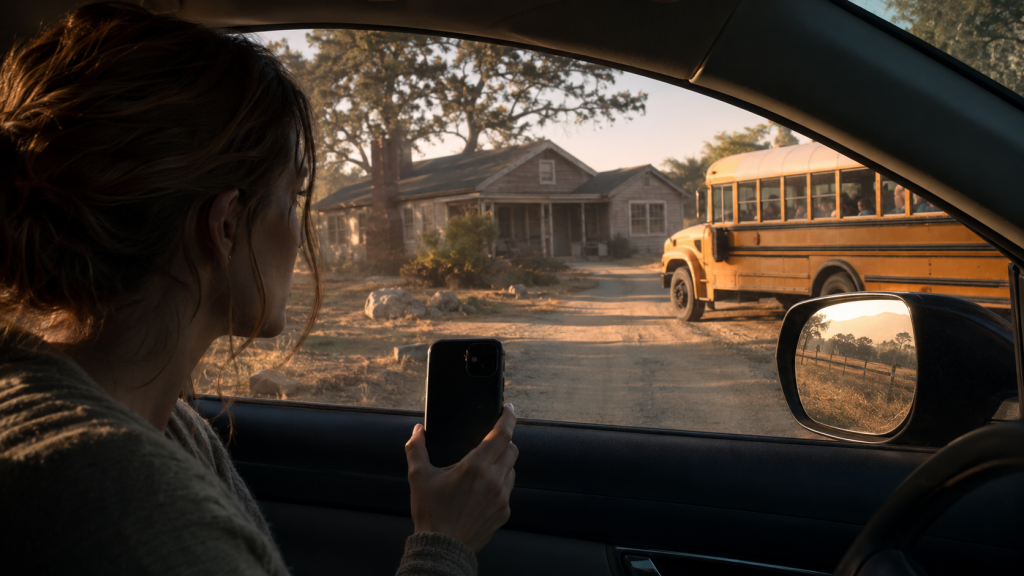
I recorded the bus. The house. The road. The closed door.
At 3:55, I called the police.
My voice shook as I gave the address, the bus number, and everything Emily had told me.
The dispatcher told me to stay where I was.
At 4:00 p.m., the front door opened again.
Mr. Doyle came out holding something in his hand.
It was not a bag.
It was not food.
It looked like a small wooden box.
He tucked it under his jacket and hurried back toward the bus.
Before he reached it, a police cruiser turned onto the dirt road.
Mr. Doyle froze.
The officer stepped out with one hand near his belt.
“Sir, step away from the bus.”
Mr. Doyle’s face changed.
Not fear.
Not guilt.
Relief.
That was the first thing that confused me.
He looked relieved.
The officer told him to put down what he was holding. Mr. Doyle slowly set the wooden box on the ground.
Then a second cruiser arrived.
I got out of my car and ran toward the bus.
“Emily!”
She pressed her face to the window and started crying.
The officer stopped me before I could climb on.
“Ma’am, please stand back.”
“That’s my daughter!”
“We’re getting the children off now.”
One by one, the kids were escorted from the bus. Emily ran into my arms and clung to me so tightly I could barely breathe.
“You told,” she whispered.
“Yes, baby. You were brave.”
Behind us, another officer spoke into his radio.
“The house is registered to a woman named Margaret Bell. She filed a missing persons report two years ago.”
Mr. Doyle closed his eyes when he heard that name.
The officer turned to him.
“You know Margaret Bell?”
Mr. Doyle nodded.
“My sister.”
The whole dirt road went silent.
The missing persons report was for Margaret Bell’s son, Nathan.
He had vanished two years earlier at the age of nine.
According to the report, Nathan had last been seen getting off a school bus.
Route 12.
The same route Mr. Doyle drove.
I looked at him in horror.
“You’ve been stopping here because of a missing boy?”
Mr. Doyle’s face crumpled.
“I never hurt those children.”
“Then why leave them alone?” I snapped. “Why tell them to stay quiet?”
He looked toward the gray house.
“Because nobody believed her.”
The officers searched him, then opened the wooden box.
Inside were photographs.
Dozens of them.
A little boy with sandy hair.
A woman holding him at a birthday party.
A school picture labeled Nathan, age 9.
And beneath the photographs were small envelopes, each marked with dates.
An officer opened one carefully.
Inside was a folded note.
His expression changed as he read it.
“What is this?” he asked.
Mr. Doyle wiped his face with shaking hands.
“Nathan used to leave notes for his mother in that box. After he disappeared, Margaret started leaving letters for him there. Every day at first. Then every week. She believed he would come home and find them.”
“Why were you taking them?”
“I wasn’t taking them,” he said. “I was collecting the ones someone else had been moving.”
The officer looked up.
“Explain.”
Mr. Doyle took a trembling breath.
“Margaret called me three months ago. She said letters were disappearing from the box, then reappearing with marks on them. She thought someone was coming to the house.”
“Why didn’t she call police?”
“She did. They said grief was making her see things.”
I held Emily tighter.
Mr. Doyle looked at me then, and for the first time, I saw the exhaustion in his face.
“I know I shouldn’t have stopped with kids on the bus. I know that. But Margaret stopped answering her phone last week. I came by after work twice, but there was always a truck parked down the road. Today I saw fresh tire tracks. I thought if I waited until after my route, it would be too late.”
The officer’s face hardened.
“What truck?”
Before Mr. Doyle could answer, a sound came from inside the house.
A thump.
Then another.
Everyone turned.
One officer drew his weapon.
“Stay back.”
The front door was still partly open.
The officers moved toward it slowly.
Mr. Doyle started forward, but another officer grabbed his arm.
“That’s my sister’s house,” he said.
“Stay here.”
The next minutes stretched forever.
Emily buried her face against my coat. The other children stood near the cruiser, crying quietly as a second officer called their parents.
Then we heard a shout from inside.
“Police! Show me your hands!”
A crash followed.
Then a man screamed.
Not in pain.
In rage.
Two officers dragged someone out of the house in handcuffs.
He was thin, with a beard and wild eyes. His boots were covered in mud. He wore a brown delivery jacket with no company name.
Mr. Doyle went pale.
“That’s him,” he whispered.
The officer beside him asked, “Who?”
“The man who was near the bus stop the day Nathan disappeared.”
The handcuffed man twisted his head toward Mr. Doyle and smiled.
“You should’ve stayed on your route.”
A chill went through every parent standing there.
Then an officer came out of the house carrying something wrapped in a blanket.
Not a body.
A child.
A boy.
Older than the photo, thinner, pale, blinking against the sunlight like he had not seen it in years.
Margaret Bell came behind them, sobbing so hard she could barely walk.
“Nathan,” she cried. “My baby.”
The world seemed to stop.
Mr. Doyle dropped to his knees in the dirt.
The little boy looked confused, frightened, and weak, but alive.
Alive.
Two years after disappearing.
The officer nearest me whispered, “Dear God.”
Later, the truth came out in pieces.
The man in the delivery jacket had once worked as a substitute driver for the school district. He had learned the bus routes, the stops, and which children got off alone.
Nathan had disappeared after getting off Route 12, but the investigation had focused on family disputes and custody issues. Margaret insisted a strange man had been watching the bus stop for days, but no one found proof.
After months, people stopped listening.
Everyone except her brother.
Mr. Doyle had spent two years blaming himself because he had been driving that route the day Nathan vanished. He had checked mirrors, questioned memories, and replayed every stop until it nearly destroyed him.
Then Margaret began noticing signs at the gray house.
Footprints near the back shed.
Letters moved.
A small handprint in dust on the cellar window.
Mr. Doyle had started stopping there because he believed someone was using the abandoned storm cellar under the property.
He was right.
The man had been keeping Nathan hidden in a locked underground room behind the old house, moving him whenever searches came close. Margaret had unknowingly come within feet of her son many times.
That day, when Mr. Doyle went inside, he had found the cellar door freshly scratched.
He had taken the wooden box because one of Margaret’s letters had come back with a message written on the corner.
Three words.
I am here.
The police found the pencil in Nathan’s hiding place.
The same pencil Margaret had once packed in his school bag.
Mr. Doyle was suspended, of course.
The district had to answer for why the GPS records were ignored.
The school secretary who dismissed my call was placed on leave.
And every parent on Route 12 spent weeks unable to sleep.
But my daughter became the reason everything changed.
If Emily had not whispered at bedtime, the bus would have kept stopping.
If I had accepted the school’s answer, no one would have followed.
If Mr. Doyle had waited one more day, Nathan might have been moved again.
A week later, Margaret Bell came to my house.
She looked older than anyone I had ever seen, not because of age, but because grief had lived in her bones too long.
Nathan stood beside her, holding her hand.
He did not speak much yet.
But he looked at Emily and gave her a small folded paper.
She opened it carefully.
In crooked handwriting, it said:
Thank you for telling.
Emily cried when she read it.
So did I.
That night, when I tucked her into bed, she looked up at me and whispered, “Mommy, was I bad for telling?”
I sat beside her and held her face in my hands.
“No,” I said. “You were brave. Sometimes grown-ups forget to listen. But you made them hear you.”
She nodded, but her eyes stayed serious.
“What if another kid is scared?”
“Then we listen,” I said. “Always.”
Months later, Route 12 had a new driver, new cameras, and a rule that no child would ever be left alone on a bus again.
Mr. Doyle never drove another school route.
Some parents hated him.
Some called him reckless.
But Margaret Bell called him the brother who never stopped searching.
And every year, on the anniversary of the day Nathan came home, she placed a small wooden box on her porch.
Not for missing letters anymore.
For thank-you notes.
The first one was from Nathan.
The second was from Emily.
Hers said:
I was scared, but I told my mommy.
And my mommy believed me.
THE END! THANKS FOR READING!