She Wore My Class Ring to My Law School Gala. By Dessert, She Was Testifying Against My Husband.
Preview
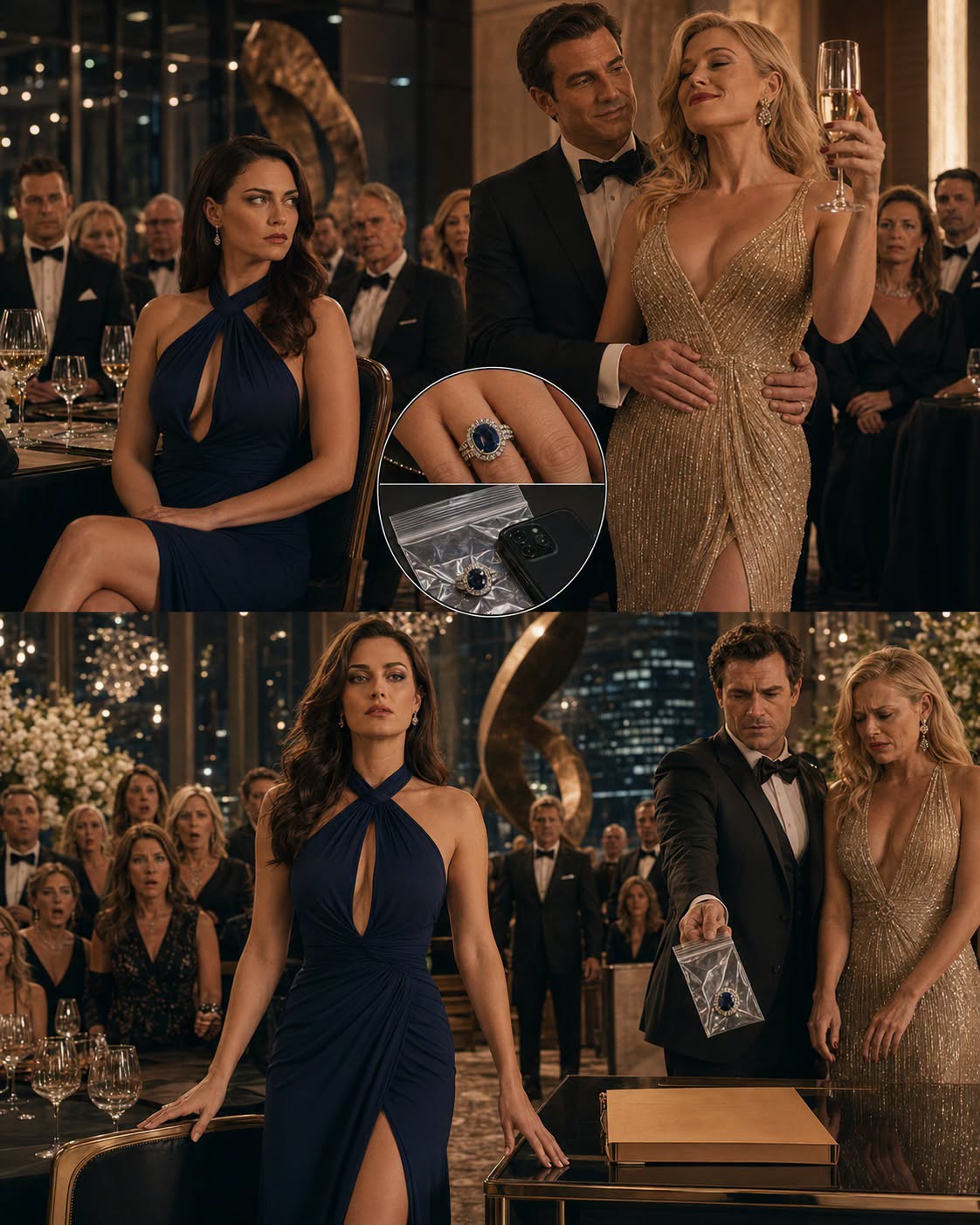
At 8:47 that evening, my husband’s mistress lifted her champagne glass beneath twelve thousand crystals of imported Austrian light.
My law school class ring flashed on her right hand.
“This old thing?” Ava Monroe said, turning it toward a retired federal judge. “Bennett gave it to me after I became his legal advisor.”
The Astor Ballroom went quiet in the discreet, expensive way powerful rooms become quiet.
No gasps.
No dropped forks.
Just the soft collapse of thirty private conversations as former judges, managing partners, prosecutors, professors, and donors redirected their attention toward the woman wearing my name.
The ring was eighteen-karat white gold with a black onyx face.
Inside the band were four engraved words.
CLAIRE WHITMORE — CLASS OF 2022.
I was sitting eight feet away.
My husband, Bennett Reed, did not look at me.
He adjusted the cuff of his tuxedo and continued smiling as though the evening had gone exactly according to plan.
Perhaps it had.
For him, at least.
He had spent six months telling people I was unstable.
Sensitive.
Obsessive.
He had called me brilliant but fragile, which was the kind of insult ambitious men used when they wanted credit for admiring a woman while quietly destroying her credibility.
At twenty-eight, I had a youthful, heart-shaped face that made strangers assume I was softer than I was.
My skin was pale beneath the chandelier light, my dark brown hair fell in a glossy wave over one shoulder, and my gray-green eyes looked almost silver against the black silk of my gown.
I wore no dramatic jewelry.
No red lipstick.
No expression anyone could call emotional.
Bennett had counted on that face.
He believed it would make me look like a wounded girl beside Ava’s polished confidence.
Ava was twenty-six, golden-haired, and dressed in a silver gown with a neckline designed to be photographed.
She had been hired eleven months earlier as Bennett’s executive communications director.
Three months after that, she began appearing in internal emails as “special legal strategy.”
Two months later, she began sleeping in my bed whenever I traveled.
That night, she was attending the Blackwell School of Law Alumni Leadership Dinner as my husband’s guest.
I was attending as an alumna, a donor, and the quiet controlling beneficiary of three entities Bennett had never bothered to understand.
He thought I had come because I was desperate to save our marriage.
He thought wrong.
Retired Judge Miriam Vale leaned toward Ava.
Judge Vale had taught me Evidence II during my final year at Blackwell.
She had also spent twenty-three years recognizing the precise moment a witness realized she had lied in front of the wrong audience.
“That is a Blackwell class ring,” Judge Vale said.
Her voice was gentle.
The gentleness made Bennett’s smile tighten.
Ava glanced at the ring.
“Yes, of course.”
Judge Vale studied her.
“What year did you graduate?”
Ava’s eyes flickered toward Bennett.
“I attended Columbia.”
A pause passed through the table.
Judge Vale looked at the Blackwell crest pressed into the onyx.
“I asked what year you graduated from Blackwell.”
Ava laughed softly.
“It was a joint program.”
Blackwell had never offered a joint program with Columbia.
Half the room knew that.
The other half could tell from Dean Marcus Bell’s face.
Bennett finally turned toward me.
His smile remained perfectly composed.
“Claire,” he said, loud enough for both tables beside us to hear, “please don’t make this into something.”
I folded my hands in my lap.
“I haven’t said a word.”
“That’s what worries me.”
A few people shifted in their chairs.
Bennett exhaled as if he were exhausted by a difficult child.
“My wife has been under extraordinary stress,” he explained to Judge Vale. “She has developed certain suspicions that aren’t grounded in reality.”
Ava lowered her glass and placed her ringed hand on his sleeve.
The gesture was intimate enough to humiliate me and subtle enough for them to deny it later.
Bennett covered her fingers with his own.
“She’s helping me protect the company,” he continued. “Claire has become irrational about business matters.”
My former professors looked at me.
Former judges looked at me.
The dean looked at me.
Bennett believed prestige would protect his lies.
What he had forgotten was that half the room had taught me how to prove one.
Judge Vale pointed toward Ava’s hand.
“May I see the engraving?”
Ava curled her fingers.
Bennett leaned back.
“This is becoming inappropriate.”
“No,” I said calmly. “It became inappropriate when she wore stolen property to a dinner full of lawyers.”
The ballroom became completely silent.
Ava’s face lost a shade of color.
Bennett stared at me, waiting for tears, fury, or some reckless accusation he could use tomorrow.
I gave him nothing.
Then Naomi Grant rose from the table behind mine.
Naomi was my attorney, a Blackwell alumna, and the only person in the room who knew why I had allowed the humiliation to continue for fourteen full minutes.
She placed a slim leather folder beside Ava’s untouched dessert.
Inside were a preservation notice, a subpoena, and a copy of the complaint filed that afternoon.
Dean Bell requested the ring.
Naomi requested Ava’s statement.
And my husband finally understood that I had not come to defend my marriage.
I had come to close the case.
## PART ONE — THE RING ON THE WRONG HAND
Three years earlier, Bennett had slipped that ring from my finger while we stood barefoot in the kitchen of our first apartment.
He had kissed the tiny indentation it left behind.
“One day,” he had said, “everyone will know your name.”
At the time, I thought it was a promise.
Later, I understood it had been an appetite.
Bennett was thirty-four when we met, six years older than me and already skilled at appearing more successful than he was.
He had sharp blue eyes, a camera-ready smile, and the controlled warmth of a man who remembered people’s children only when their parents could help him.
He founded Reed Meridian Group with a borrowed office, two junior analysts, and an extraordinary talent for entering rooms that belonged to other people.
I met him at a charity panel in Manhattan.
I had just graduated from Blackwell and joined a private investment firm that specialized in distressed real estate and corporate restructuring.
Bennett asked three intelligent questions after the panel.
Then he waited near the coat check and asked a fourth.
“Why did you disagree with everyone onstage?”
“Because everyone onstage was wrong.”
He laughed.
Not because I had made a joke, but because he liked that I had not tried to be charming.
For the first year, he seemed fascinated by my mind.
For the second, he began borrowing it.
I reviewed contracts late at night.
I corrected financial models his executives had approved.
I introduced him to bankers, developers, and trustees who had known my family for decades.
When Reed Meridian faced a liquidity crisis, an investment vehicle managed by the Whitmore Living Trust purchased a controlling block of preferred shares.
Bennett called it temporary support.
I called it what the documents called it.
Ownership.
My mother, Elizabeth Whitmore, had taught me the difference.
She had died when I was twenty-three, leaving me a complicated inheritance and one uncomplicated piece of advice.
“Never confuse being loved with being needed.”
For a while, Bennett made the two feel identical.
We married in a candlelit ceremony at my family’s house in Westchester.
He cried when I walked down the aisle.
I believed those tears longer than I should have.
Our marriage did not collapse in one dramatic moment.
It thinned.
Dinner reservations became executive emergencies.
Weekends became investor retreats.
His phone began sleeping facedown.
Then Ava appeared.
She was clever enough not to flirt with Bennett in front of me.
She complimented my legal career, asked where I bought my clothes, and once spent twenty minutes discussing how fortunate Bennett was to have a wife who understood corporate finance.
Three weeks later, I found a hotel receipt folded inside the pocket of his dinner jacket.
The reservation was for a suite at the Halcyon Hotel.
The charge included two breakfasts.
I did not confront him.
Confrontation is useful when someone still respects the truth.
Bennett respected leverage.
So I began collecting it.
I reviewed our joint financial accounts and found regular payments to a consulting company called North Vale Strategies.
North Vale had no employees, no public clients, and a registered address matching Ava’s condominium in Tribeca.
Reed Meridian had paid it $418,000 in eight months.
The invoices described “legal risk analysis.”
Ava had never attended law school.
She had never passed a bar examination.
She was not licensed to practice law in any state.
Bennett knew.
One email from him said, “Keep using legal strategy in the subject line so this stays privileged.”
That sentence would later cost him more than the affair.
The law does not protect fraud simply because someone types the word privileged above it.
Bennett and Ava were not merely hiding their relationship.
They were building a case against me.
Their messages described me as emotionally volatile.
They kept notes after private dinners, recording invented outbursts that had never happened.
They discussed finding a psychiatrist willing to evaluate me through “collateral reports.”
They drafted statements claiming I had become paranoid about company finances.
Most importantly, they planned to use those statements to challenge my authority over the Whitmore Trust.
If they could persuade a court that I lacked capacity, Bennett believed he could secure temporary control of the trust’s voting shares.
He would control Reed Meridian.
He would control two hotels, four development parcels, and the debt facility that kept his company alive.
Then he would divorce me.
The affair was not the betrayal that frightened me most.
The paperwork was.
I discovered the plan on a Wednesday morning while Bennett was in the shower.
His tablet lit up on the breakfast table with a message from Ava.
Once Claire is declared impaired, how quickly can we move the shares?
I photographed the notification.
Then I made coffee.
Bennett entered the kitchen in a towel and kissed my temple.
“Busy day?” he asked.
“Very.”
He smiled.
He thought I meant work.
That afternoon, I called Naomi Grant.
Naomi had been two years ahead of me at Blackwell and had built a reputation dismantling corporate fraud without ever raising her voice.
She listened for forty minutes.
When I finished, she asked only one question.
“Do you want to save the marriage?”
“No.”
“Good,” she said. “That will save time.”
For six weeks, we said nothing.
A forensic team copied company records through lawful board access.
An investigator verified Ava’s credentials.
My trust counsel reviewed every proxy, voting agreement, deed, and marital document Bennett believed he controlled.
A digital specialist traced a forged authorization bearing my electronic signature.
It had been created from an IP address registered to Ava’s apartment.
The document authorized Reed Meridian to pledge trust assets as collateral for a private loan.
Had the bank accepted it, Bennett could have placed nearly eighty million dollars of my separate property at risk.
The bank did not accept it.
The bank’s chair had attended my mother’s funeral.
He called me personally.
By then, I knew about the hotel suites, the hidden payments, the forged consent, and the plan to portray me as mentally incompetent.
I still did not confront Bennett.
Instead, I moved my class ring from the jewelry drawer in our bedroom to a locked walnut box in my study.
Two days later, it disappeared.
Only Bennett knew the combination.
When the invitation to Blackwell’s alumni dinner arrived, Bennett insisted we attend together.
He was being honored for Reed Meridian’s five-million-dollar pledge to the school’s new Center for Legal Ethics.
The pledge had been announced in his name.
The money, however, had been transferred from a Whitmore charitable account without my authorization.
Bennett had stolen my family’s donation and attached his reputation to it.
I accepted the invitation.
Then I asked Naomi to reserve the table behind mine.
On the afternoon of the gala, Bennett stood in our dressing room and watched me fasten a pair of small diamond earrings.
“You look beautiful,” he said.
His tone carried the cautious approval of a man inspecting property before a public showing.
“Thank you.”
“I need tonight to go smoothly.”
“Of course.”
“Ava will be there.”
I met his reflection in the mirror.
“As your employee?”
“As company counsel.”
The lie arrived so easily that it almost impressed me.
“You should be kind to her,” he added. “She’s been dealing with a lot because of your accusations.”
I turned.
“What accusations?”
For one second, panic touched his face.
Then it vanished.
“You know what I mean.”
“I don’t believe I do.”
He stared at me, trying to determine how much I knew.
I let my young face remain open and calm.
He saw innocence because arrogance had made him lazy.
At the ballroom, Ava arrived wearing silver.
She kissed Bennett’s cheek.
Then she lifted a champagne glass with my class ring on her hand.
That was the moment our marriage ended publicly.
It had ended privately long before.
## PART TWO — PRIVILEGE DIES IN DAYLIGHT
Naomi did not serve the documents immediately.
She allowed Ava to keep talking.
That was important.
People often think evidence is something hidden in a locked file.
Sometimes evidence is simply a liar who has not yet realized the room is listening.
Judge Vale examined Ava with the patient attention she had once used on nervous students.
“You said you attended Columbia,” she began.
“I did.”
“And the joint program?”
Ava swallowed.
“It was informal.”
Dean Bell spoke from the next table.
“Blackwell does not issue class rings to visiting students.”
Ava looked at Bennett again.
He removed his hand from hers.
That tiny movement told her more than any confession could have.
She was alone.
“Claire gave it to me,” Ava said.
It was her third version of the story.
A quiet murmur passed across the ballroom.
I took a sip of water.
Bennett’s jaw tightened.
“Claire has given Ava several items over the years,” he said. “They were friends before Claire’s condition worsened.”
There it was.
Condition.
A medical word without a diagnosis.
A smear dressed as concern.
Judge Vale turned to me.
“Did you give Ms. Monroe your class ring?”
“No.”
“Did you authorize your husband to give it to her?”
“No.”
Ava pushed back her chair.
“This is ridiculous.”
Naomi stepped forward.
“It may become ridiculous later, Ms. Monroe. At present, it is conversion of personal property and potential evidence in a broader civil action.”
Bennett rose.
“You cannot ambush my counsel at a private event.”
Naomi’s expression barely changed.
“Your counsel?”
“Yes.”
“Please identify the jurisdiction in which she is licensed.”
Bennett paused.
The answer should have been easy.
New York.
New Jersey.
Connecticut.
Any state would have been better than silence.
“She works under the direction of our general counsel,” he said.
Reed Meridian’s actual general counsel, Thomas Keene, was seated three tables away.
Every face turned toward him.
Thomas looked older than he had that morning.
He set down his wineglass.
“Ms. Monroe has never worked under my direction.”
Bennett’s eyes sharpened.
Thomas continued.
“I sent the board a written notice six weeks ago stating that she was not authorized to provide legal services or represent herself as company counsel.”
Ava turned toward Bennett.
“You told me Thomas approved my title.”
Bennett ignored her.
That was his second mistake of the evening.
His first had been bringing her.
Naomi opened the leather folder.
“Ms. Monroe, Reed Meridian paid your company hundreds of thousands of dollars for legal analysis.”
“I provided strategic consulting.”
“Your invoices say legal analysis.”
“I didn’t write every invoice.”
The ballroom remained silent.
Naomi nodded once.
“Who wrote them?”
Ava looked at Bennett.
He looked toward the exit.
I almost admired the instinct.
Predators recognize open doors.
Unfortunately for Bennett, the ballroom doors were now occupied by two licensed process servers and Reed Meridian’s head of corporate security.
No one blocked him.
They did not need to.
Running from your own awards dinner is a confession even juries understand.
Dean Bell removed his glasses.
“Mr. Reed, the school was informed that Ms. Monroe was your legal advisor.”
“She is.”
“Yet she has no law degree.”
“She provides business advice on legal matters.”
“That is not improving your position.”
A few people lowered their eyes to hide their reactions.
Bennett’s face hardened.
He looked directly at me.
“You planned this.”
“Yes.”
The simplicity of my answer unsettled him.
“Because I wanted a divorce?”
“No.”
His shoulders loosened slightly.
He thought there was still room to negotiate.
I continued.
“I planned this because you forged my signature, diverted trust money, impersonated legal privilege, and attempted to manufacture evidence that I was mentally incompetent.”
The room changed.
An affair could be dismissed as private scandal.
Forgery could not.
Ava sat down slowly.
“I never forged anything.”
“The authorization was transmitted from your home network,” Naomi said.
“I was working remotely.”
“On Claire’s personal tablet?”
Ava’s lips parted.
Bennett stepped in.
“Anything sent from Ava’s residence was done at my direction as chief executive.”
He intended to protect himself by asserting corporate authority.
Instead, he connected himself to the transaction.
Judge Vale’s gaze became almost sympathetic.
Not toward Bennett.
Toward the prosecutors who would eventually receive the file.
Naomi reached inside the folder and removed a printed email.
“On February seventh, you wrote to Ms. Monroe, ‘Use Claire’s saved signature and send the authorization before she notices the board packet.’ Is that your email address?”
Bennett did not answer.
“You obtained private communications illegally.”
“The email was located on Reed Meridian’s corporate server during a board-authorized forensic audit.”
“I control that server.”
“No,” I said. “You manage a company that controls that server.”
He looked at me with genuine confusion.
Bennett had spent so many years being treated like an owner that he had forgotten to read the documents that said otherwise.
Ava touched the ring with her thumb.
Her confidence had disappeared.
“Bennett told me Claire was stepping away from the trust.”
I turned toward her.
“And you believed that entitled you to my signature?”
“He said it was temporary.”
“Fraud often is.”
Her eyes filled with anger.
Not remorse.
Anger.
She had not yet accepted that the night’s humiliation belonged to her too.
Bennett lowered his voice.
“Claire, whatever you think you found, we can discuss it privately.”
He was no longer speaking to an irrational wife.
He was speaking to an adversary.
“You discussed my mental health with former judges,” I said. “You put your mistress in my ring and brought her to my alumni dinner. Privacy stopped being important to you several months ago.”
Ava pulled the ring from her finger.
For one second, she looked as if she might place it on the table.
Naomi stopped her.
“Please do not alter, clean, conceal, or transfer that item.”
“It’s a ring.”
“It is also evidence of access to a locked room and a locked container.”
Ava froze.
She looked at Bennett.
“You said it was in a drawer.”
He did not respond.
I watched the truth reach her.
Bennett had not merely given her jewelry.
He had asked her to wear stolen property in public, in front of lawyers, while he portrayed me as delusional.
If I reacted emotionally, he would use it.
If the ring were discovered, he would blame her.
Ava had believed she was being crowned.
She had been fitted for a noose.
## PART THREE — THE WOMAN WHO OWNED THE ROOM
Dinner service had stopped.
The waiters stood discreetly along the walls while two hundred guests watched Bennett’s future contract in real time.
He buttoned his tuxedo jacket.
The movement restored some of his confidence.
Bennett had always been most dangerous when he believed wealth could outlast facts.
“This is a marital disagreement,” he announced. “It has no place at a university event.”
Dean Bell’s expression cooled.
“The alleged misuse of a donation to this institution makes it our concern.”
“There was no misuse.”
“The five-million-dollar pledge attributed to Reed Meridian came from a Whitmore Foundation account.”
Bennett’s face became still.
Dean Bell continued.
“Mrs. Reed notified us this morning that the transfer was unauthorized.”
Bennett looked at me.
“You froze the pledge?”
“I redirected it.”
“To where?”
“The purpose remains the same.”
That confused him more than cancellation would have.
I had not withdrawn the donation.
I had corrected the donor.
The new Center for Legal Ethics would still be built.
It would simply bear my mother’s name instead of Bennett’s.
Dean Bell reached for the microphone at the podium.
“Ladies and gentlemen, tonight’s planned presentation will be amended.”
The large screen behind him, which had displayed a portrait of Bennett beside the words VISIONARY LEADERSHIP AWARD, went black.
Then a new image appeared.
ELIZABETH WHITMORE CENTER FOR LEGAL ETHICS.
Below it was a photograph of my mother at twenty-nine, standing on the steps of a courthouse with a leather briefcase in her hand.
I had chosen that photograph because she looked young.
Determined.
Alive.
Applause began at the back of the room.
It spread slowly, gathering strength until the ballroom filled with it.
I remained seated.
Bennett stood beside me while two hundred people applauded the woman whose money he had tried to steal.
His face became a careful mask.
“You cannot do this without board approval,” he said beneath the applause.
“I had board approval at four twenty this afternoon.”
“Which board?”
“All three.”
His eyes narrowed.
I could almost see him sorting through the entities.
The Whitmore Foundation.
The Whitmore Living Trust.
Aurelian Hospitality Holdings.
The third name made him glance around the ballroom.
The Aurelian Hotel occupied one of the most valuable corners in Manhattan.
Bennett had spent years boasting that he negotiated its acquisition for Reed Meridian.
He had negotiated the management agreement.
He had never owned the property.
Aurelian Hospitality Holdings did.
My trust owned seventy-one percent of Aurelian.
The chandeliers above us belonged to my company.
The marble beneath Ava’s chair belonged to my company.
The wine Bennett had ordered to impress donors had been selected by an employee who ultimately reported to a board I controlled.
He had brought his mistress into my hotel, placed my ring on her hand, and accused me of instability beneath a roof I owned.
I had not chosen the location.
That was what made it perfect.
“You’re making a scene,” Bennett whispered.
“No,” I said. “I’m allowing yours to finish.”
Dean Bell waited for the applause to fade.
“The Whitmore Foundation has confirmed its commitment to the center,” he said. “It has also requested that tonight’s leadership award be suspended pending review.”
A staff member removed the crystal trophy from the podium.
Bennett watched it disappear.
He had rehearsed a twelve-minute speech.
I had found the draft in his briefcase.
It included a paragraph thanking Ava for her legal brilliance and a sentence describing me as his “beloved wife, whose recent struggles taught him the value of compassionate leadership.”
Even in his fantasy of publicly replacing me, he had planned to use my pain as decoration.
Bennett turned to Thomas Keene.
“Stop this.”
Thomas did not move.
“As general counsel,” Bennett said, “I am directing you to stop this.”
Thomas looked toward me.
That single glance broke something in Bennett.
“You answer to me,” he snapped.
Thomas’s voice remained quiet.
“I answer to the company.”
“I am the company.”
“No,” I said.
Every eye returned to me.
I stood for the first time that evening.
At five feet seven, in black silk and simple diamonds, I did not look powerful in the way Bennett understood power.
I had no microphone.
No security detail.
No desire to dominate the room.
I looked twenty-eight because I was twenty-eight.
My face was smooth, young, and composed, my gray-green eyes steady beneath dark lashes.
Bennett had mistaken youth for ignorance and grace for surrender.
I placed one hand on the back of my chair.
“You own fourteen percent of Reed Meridian’s common shares,” I said. “The Whitmore Trust owns fifty-two percent of the voting interest through preferred shares.”
His mouth tightened.
“I hold your proxy.”
“You held a revocable proxy.”
“Held?”
“I revoked it at nine o’clock this morning.”
His face emptied.
Naomi closed the leather folder.
“After the revocation, the controlling shareholder called a special board meeting.”
Bennett looked toward Thomas again.
Thomas nodded.
“The board voted six to one to terminate you as chief executive for cause.”
A sound moved through the room.
Not shock exactly.
Recognition.
The powerful people seated around us knew what termination for cause meant.
No severance.
No automatic vesting.
No negotiated celebration of a graceful departure.
Just an escort from the building and years of litigation.
Bennett gripped the back of his chair.
“You cannot terminate the founder.”
“The bylaws can,” Thomas said. “And they did.”
“When?”
“Nine fifteen.”
The first course had been served at nine fifteen.
While Bennett told a table of judges that his wife was irrational, his company was removing him.
While Ava displayed my stolen ring, the board was canceling Bennett’s access credentials.
While he prepared to accept an award funded with my money, the banks were freezing his authority over corporate accounts.
He had believed the dinner was his coronation.
It was his exit interview.
His phone vibrated.
Then it vibrated again.
He looked at the screen.
I knew what he was seeing.
ACCESS REVOKED.
CORPORATE CARD SUSPENDED.
MANDATORY DOCUMENT PRESERVATION NOTICE.
A fourth message arrived from the private bank that held his executive credit line.
The line had been secured by Reed Meridian stock.
Stock that was now subject to a misconduct review.
He looked at me.
“What have you done?”
The question was almost tender.
“I read the contracts.”
## PART FOUR — THE CONTRACT BENEATH THE MARRIAGE
Bennett recovered quickly.
That was one of the qualities I had once admired.
He could lose a deal at breakfast and charm a new investor by lunch.
But charm requires an audience willing to forget what it has seen.
That room would not forget.
He glanced at Ava.
“This happened because you were careless.”
Her head snapped toward him.
“I was careless?”
“You wore the ring.”
“You gave it to me.”
“I told you to keep it private.”
“You told me Claire had given it to you.”
Bennett’s voice became colder.
“You misunderstood.”
Ava laughed once.
The sound was sharp and humorless.
“Did I misunderstand the hotels too?”
Bennett’s eyes warned her.
Naomi noticed.
“So there were multiple hotels,” she said.
Ava looked at her.
Bennett stepped between them.
“She is not answering questions.”
Naomi tilted her head.
“Are you representing her now?”
He said nothing.
“Because you are not licensed either.”
A ripple of restrained laughter crossed the nearest tables.
Bennett flushed.
For the first time, his polished image cracked.
He turned toward me.
“You’re enjoying this.”
“No.”
“Don’t lie.”
“I’m not enjoying it.”
That was true.
Revenge is often described as pleasure by people who have never needed it.
There was no pleasure in watching the man I had loved become exactly who the evidence said he was.
There was only relief.
A door closing.
A weight leaving the body.
Bennett lowered his voice.
“You think removing me gives you control?”
“I already had control.”
“You have shares.”
“I have voting control, the debt, and the underlying real estate.”
His face tightened further.
“The debt facility is through North Atlantic Bank.”
“The facility is guaranteed by Whitmore Capital.”
He stared at me.
I continued.
“The guarantee was conditional upon your compliance with company ethics policies and representations regarding related-party transactions.”
“Ava’s company was approved.”
“By you.”
“As chief executive.”
“You failed to disclose that you were sleeping with its owner.”
No one in the room moved.
There are sentences that end marriages.
That sentence ended his remaining deniability.
Ava’s face hardened.
Bennett looked as though he might deny it.
Then he remembered the emails.
The hotel records.
The corporate audit.
The room full of witnesses.
He chose a different lie.
“My marriage was already over.”
I nodded.
“Then you should have filed for divorce before attempting to take control of my trust.”
“I never tried to take your trust.”
Naomi removed another document.
“Would you like to identify your signature on this petition?”
Bennett did not take it.
I had seen the petition for the first time two weeks earlier.
It had not yet been filed.
The heading read: IN THE MATTER OF CLAIRE WHITMORE REED, AN ALLEGED INCAPACITATED PERSON.
Bennett had signed an affidavit stating that I suffered from escalating paranoia, compulsive financial behavior, and delusions regarding marital infidelity.
The final phrase was almost elegant in its cruelty.
Delusions regarding marital infidelity.
He had planned to use the existence of his affair as evidence that I was insane for noticing it.
Bennett’s mother had provided a supporting declaration.
So had Ava.
Ava’s declaration described herself as his legal advisor and claimed she had personally witnessed me threaten employees.
I had never threatened an employee in my life.
The declaration also stated that Ava and Bennett maintained a strictly professional relationship.
Naomi placed it in front of her.
“Is that your signature?”
Ava stared at the page.
“You said this was for insurance.”
Bennett’s expression did not change.
“It was.”
“No, you said Claire had been hospitalized.”
“I said she needed treatment.”
“You told me a doctor had diagnosed her.”
“I told you what was necessary.”
Ava pushed back from the table.
Her chair struck the marble floor.
“You told me she was dangerous.”
Bennett’s voice sharpened.
“Sit down.”
She did not.
For months, Ava had accepted his version of me because it allowed her to see herself as a rescuer rather than a mistress.
She was not taking another woman’s husband.
She was helping a misunderstood man escape an unstable wife.Preview
That lie had given her comfort.
Now it was collapsing beside the dessert plates.
“You said she attacked you,” Ava said.
Bennett glanced around the room.
“This is not the place.”
“You showed me photographs.”
I knew about the photographs.
They showed bruising along Bennett’s ribs.
He had told Ava I caused it during an argument.
The actual medical report came from a bicycle accident in Connecticut.
The accident had occurred six months before the date he claimed I attacked him.
Naomi opened another folder.
“The photographs were taken after Mr. Reed fell during the Grantham Charity Cycling Tour.”
Ava looked at me.
I met her eyes.
For the first time that evening, she looked ashamed.
Not enough to erase what she had done.
Enough to understand it.
Bennett reached for her arm.
“Do not say another word.”
She pulled away.
“Were you ever going to marry me?”
The question did not belong in a corporate investigation.
It belonged to every ordinary betrayal beneath the expensive one.
Bennett’s silence answered it.
Naomi glanced at me.
I nodded.
She removed one final document and placed it in front of Ava.
It was a draft affidavit recovered from Bennett’s private corporate folder.
The document had been created nine days earlier.
It was intended for use if the forged authorization was discovered.
In it, Bennett described Ava as a “rogue contractor who misrepresented her qualifications, initiated an unwanted personal relationship, and acted without executive approval.”
Ava read the first paragraph.
Her face went white.
“You were going to blame me.”
Bennett said nothing.
“You told me we were building a life.”
“This is not relevant.”
“You wrote that I pursued you.”
“You did.”
Her eyes filled.
“You came to my apartment.”
“I was under extraordinary pressure.”
“You gave me her ring.”
“You chose to wear it.”
That was the moment Ava stopped protecting him.
Not when she learned he had lied about me.
Not when she saw the forged documents.
Not when she realized he had used her company to divert funds.
She turned when she discovered his betrayal included her.
People rarely become honest at the moment truth appears.
They become honest when the lie stops benefiting them.
Ava removed her phone from her clutch.
“I have every message,” she said.
Bennett’s expression changed.
“All of them.”
“Ava.”
“Emails, voice notes, photographs, transfers, the draft petition, everything.”
His voice softened.
It was the voice he once used with me.
“Think carefully.”
She looked down at the affidavit in which he had already sacrificed her.
“I am.”
Naomi held out an evidence bag for the ring.
Ava dropped it inside.
Then she handed Naomi the phone.
## PART FIVE — THE LAST EXHIBIT
The process servers approached at 10:06.
One served Bennett with the divorce complaint.
The other served Ava with a subpoena and preservation order.
Bennett accepted the papers without reading them.
“On what grounds?” he asked.
“Fraud, dissipation of marital assets, and adultery,” Naomi said.
He looked at me.
“Our prenuptial agreement limits fault claims.”
“It limits claims against separate property,” I replied. “It does not protect criminal conduct, undisclosed related-party payments, or fraud.”
His eyes moved over my face.
For three years, he had studied every expression I made.
He knew how I looked when I was tired, amused, worried, or hurt.
That night, he could not read me.
Perhaps that frightened him more than the complaint.
“You’ll regret doing this publicly,” he said.
“You did it publicly.”
“I was trying to manage your behavior.”
“No. You were trying to create witnesses.”
Judge Vale folded her hands.
“And unfortunately for you, Mr. Reed, you succeeded.”
Several guests looked away to hide smiles.
Bennett ignored them.
“What do you want, Claire?”
The question came too late.
For months, he had decided what I wanted.
A marriage.
His attention.
A child.
Social approval.
He had believed all women could be controlled by threatening to withhold affection.
“I want what the contracts provide,” I said.
“Money?”
“Accountability.”
“You think those are different?”
“Yes.”
He studied me.
Then he laughed quietly.
It was not a pleasant sound.
“You would have nothing without your family.”
There it was.
The resentment beneath the romance.
He had loved access.
He had tolerated the woman attached to it.
I stepped closer.
“I had my family’s name before you.”
“And I built that company.”
“You built the brand.”
“I built everything.”
“You built a company on capital you did not own, real estate you did not own, guarantees you did not own, and relationships you did not earn.”
His face reddened.
“I made you relevant.”
The cruelty of the sentence surprised even him.
A few people inhaled.
I felt the old instinct to defend myself.
To list my degrees, deals, board votes, and work.
Then I remembered that explanations are gifts.
Bennett no longer deserved one.
“You’re right,” I said.
He blinked.
“I was irrelevant to the version of your life you sold.”
My voice remained steady.
“I was only the money behind it, the signature beneath it, the credibility beside it, and the wife you planned to declare incompetent when she became inconvenient.”
He looked around the ballroom.
The room no longer belonged to him.
Perhaps it never had.
Security waited near the doors, not because I had ordered a spectacle, but because terminated executives were required to surrender company property immediately.
Thomas approached with a document envelope.
“Bennett, I need your phone, laptop, access card, and company keys.”
“You’re humiliating me.”
Thomas’s expression was tired.
“No. I’m following policy.”
Bennett turned back to me.
“Tell him to stop.”
I said nothing.
“You can reverse the vote.”
I could have.
He knew it.
That was the final power he imagined he still possessed—the belief that my love could be used as an appeals process.
“Claire.”
His voice softened again.
For one treacherous second, I heard the man from our first apartment.
The man who had taken my class ring from my finger and kissed the mark it left.
Then I remembered his petition.
His forged signature.
His mistress wearing my name.
“You said you would always protect me,” he whispered.
“No,” I said. “You said that.”
His eyes shone.
Whether from grief, anger, or the terror of losing status, I could not tell.
“I loved you.”
“I believe you loved what loving me gave you.”
“That is not fair.”
“Neither was the affidavit describing my awareness as delusion.”
Ava stood several feet away, watching us.
Her makeup remained perfect, but the fantasy had drained from her face.
She looked very young.
So did I.
Youth, I realized, had never been the problem.
We had both been old enough to make choices.
She had chosen to believe a profitable lie.
I had chosen, for too long, to confuse patience with hope.
Our consequences were not equal.
But they were ours.
Bennett handed Thomas his access card.
Then his company phone.
He hesitated before surrendering the keys to the executive office.
“That office is mine.”
“The furniture is leased,” Thomas said. “The building belongs to Aurelian.”
Bennett’s gaze returned to me.
“The building too?”
“Yes.”
He laughed again, softer this time.
“Of course.”
He finally understood the architecture of his mistake.
He had thought I was a quiet wife seated at his table.
I was the controlling shareholder of his company.
The guarantor of his debt.
The owner of his office building.
The chair of the foundation funding his award.
And through Aurelian Hospitality, the woman who owned the ballroom in which he had tried to erase me.
But the most devastating thing I owned was not the room.
It was the evidence.
Money could be challenged.
Power could change hands.
A clear record survived both.
Bennett slipped his hands into his pockets.
“What happens now?”
“The board refers the forged authorization and related payments to outside counsel.”
“And the marriage?”
“The court handles it.”
“You already decided everything.”
“No.”
I looked toward Ava’s phone, sealed inside an evidence pouch.
“You decided most of it.”
For the first time that night, Bennett lowered his eyes.
Security escorted him toward the ballroom doors.
No one applauded.
That mattered to me.
I had not wanted a mob.
I had wanted the truth to stand without decoration.
At the threshold, Bennett turned.
He looked smaller from across the room.
Not physically.
Structurally.
Like a beautiful building after someone revealed it had no foundation.
“You could have asked me,” he said.
“Asked you what?”
“Whether I was having an affair.”
I held his gaze.
“You would have lied.”
He did not deny it.
The doors closed behind him.
For several seconds, the room remained silent.
Then the string quartet resumed.
The first notes were tentative, almost embarrassed.
Waiters collected untouched desserts.
Guests returned to their seats and pretended not to stare.
Dean Bell approached me with the evidence bag containing my ring.
“The police may need to retain this,” he said.
“I know.”
“I’m sorry, Claire.”
“For the ring?”
“For the evening.”
I looked around the ballroom.
My mother’s photograph still appeared on the screen.
“No,” I said. “The evening did exactly what it needed to do.”
Judge Vale joined us.
“You showed remarkable restraint.”
“I had excellent teachers.”
She smiled.
“You always preferred documents to speeches.”
“Documents are harder to interrupt.”
Naomi returned after securing Ava’s preliminary statement.
“She is cooperating,” she said.
“For now?”
“For as long as cooperation remains in her interest.”
“That sounds right.”
Naomi studied me.
“Are you all right?”
It was the first time anyone had asked without using the question as an accusation.
I considered the answer.
“My marriage ended tonight.”
“It ended earlier.”
“I know.”
“But tonight you stopped carrying it alone.”
That was also true.
Across the room, the crystal trophy intended for Bennett had been removed.
In its place stood a simple framed image of my mother.
I remembered her final advice.
Never confuse being loved with being needed.
Bennett had needed my money, my name, my judgment, my silence, and eventually my legal incapacity.
He had needed so much that I had mistaken dependence for devotion.
Now he needed mercy.
For the first time, I did not confuse that with love either.
The dean requested the ring while my attorney requested Ava’s statement.
By midnight, both were in evidence.
By morning, Bennett’s name had been removed from the company website.
## CONCLUSION — WHAT I KEPT
The divorce took fourteen months.
Bennett fought every provision until fighting became more expensive than accepting what he had signed.
The prenuptial agreement held.
The Whitmore Trust remained untouched.
Reed Meridian recovered most of the diverted funds through insurance, asset seizures, and a settlement with Ava’s consulting company.
The criminal investigation lasted longer.
Bennett eventually pleaded guilty to charges related to the forged authorization and false financial records.
He did not go to prison for breaking my heart.
The law has no statute for that.
He faced consequences for the acts he committed while believing my heart would make me too weak to expose him.
Ava cooperated.
Her testimony helped establish that Bennett directed the false invoices and drafted the incapacity petition.
She surrendered the remaining money in her company accounts and accepted civil liability.
I never forgave her.
I also never needed to hate her.
Hatred would have required keeping her in my life.
The class ring was returned to me six months after the gala.
There was a small scratch along the inside of the band.
A jeweler offered to polish it away.
I asked him not to.
Some marks are damage.
Others are records.
I did not return to the apartment Bennett and I had shared.
Aurelian sold it, and I used my portion of the proceeds to establish a legal assistance fund for women facing financial coercion inside marriages.
The fund provided forensic accountants, emergency counsel, and temporary housing.
We named it the Elizabeth Whitmore Initiative.
The Center for Legal Ethics opened the following spring.
At the dedication ceremony, I stood beneath a pale blue sky on Blackwell’s main steps.
I wore an ivory suit, my dark hair loose around my shoulders, and my class ring on my right hand.
Students filled the courtyard.
Many of them were younger than me.
Some looked frightened by the future.
Some looked certain they could control it.
I recognized both feelings.
After the ceremony, a first-year student approached me.
She had a round, nervous face and a stack of casebooks pressed against her chest.
“Mrs. Reed?”
“Claire is fine.”
She hesitated.
“Is it true you knew what your husband was planning for months and never confronted him?”
“Yes.”
“How did you stay so calm?”
I looked at the ring.
“I wasn’t calm every moment.”
She waited.
“I cried in private,” I said. “I doubted myself. I woke up at three in the morning and reread the same email until the words stopped looking real.”
Her expression softened.
“Then how did you do it?”
“I stopped treating pain like an emergency.”
She frowned slightly.
I continued.
“Pain tells you something matters. It does not get to decide your next move.”
She looked toward the new center.
“So you waited?”
“I prepared.”
That answer seemed to satisfy her.
She thanked me and disappeared into the crowd.
For years, people repeated the gala story as if my victory had happened in one dramatic evening.
They remembered the ring.
The mistress.
The judges.
The revoked proxy and the removed award.
They said I had owned the room.
Technically, I had.
But ownership was never the lesson.
The lesson was that Bennett believed humiliation would make me smaller.
He believed public shame would force me to defend myself before I was ready.
He believed my youth made me naïve, my elegance made me weak, and my love made me controllable.
He was wrong about all three.
I did not win because I had more money.
I won because I stopped asking a dishonest man to confirm the truth I already knew.
I documented it.
I protected myself.
Then I let him speak.
The final lie destroyed him because I no longer interrupted.
That evening, after the dedication ceremony, I returned alone to the Astor Ballroom.
The tables were gone.
Afternoon light poured through the tall windows and turned the marble floor gold.
Without the guests, the room felt smaller.
Kinder.
I stood beneath the chandelier where Ava had raised her glass and displayed my ring.
The memory no longer hurt the way it once had.
It felt distant, like a courtroom after the verdict.
An event manager entered quietly.
“We’re ready to lock up whenever you are.”
I smiled.
“I’m ready.”
Outside, Manhattan moved beneath a warm spring sunset.
Cars filled the avenue.
Students laughed on the courthouse steps.
Somewhere, another woman was being told she was too emotional to trust her own eyes.
Somewhere, another man was confusing her silence with ignorance.
I hoped she would learn what I had learned.
You do not have to scream to end a lie.
You do not have to beg for a seat at a table built with your money.
You do not have to become cruel simply because someone mistook your kindness for permission.
Sometimes the most powerful revenge is not destruction.
It is precision.
It is closing the account, revoking the proxy, preserving the message, reading the contract, and walking through the door with your dignity untouched.
Bennett lost the company, the award, the apartment, the reputation, and the woman who once believed him.
I kept my name.
I kept my future.
And when I stepped out of the ballroom, the door closed gently behind me.
This time, I was not being left.
I was leaving.