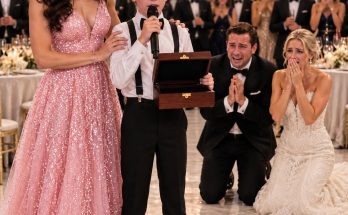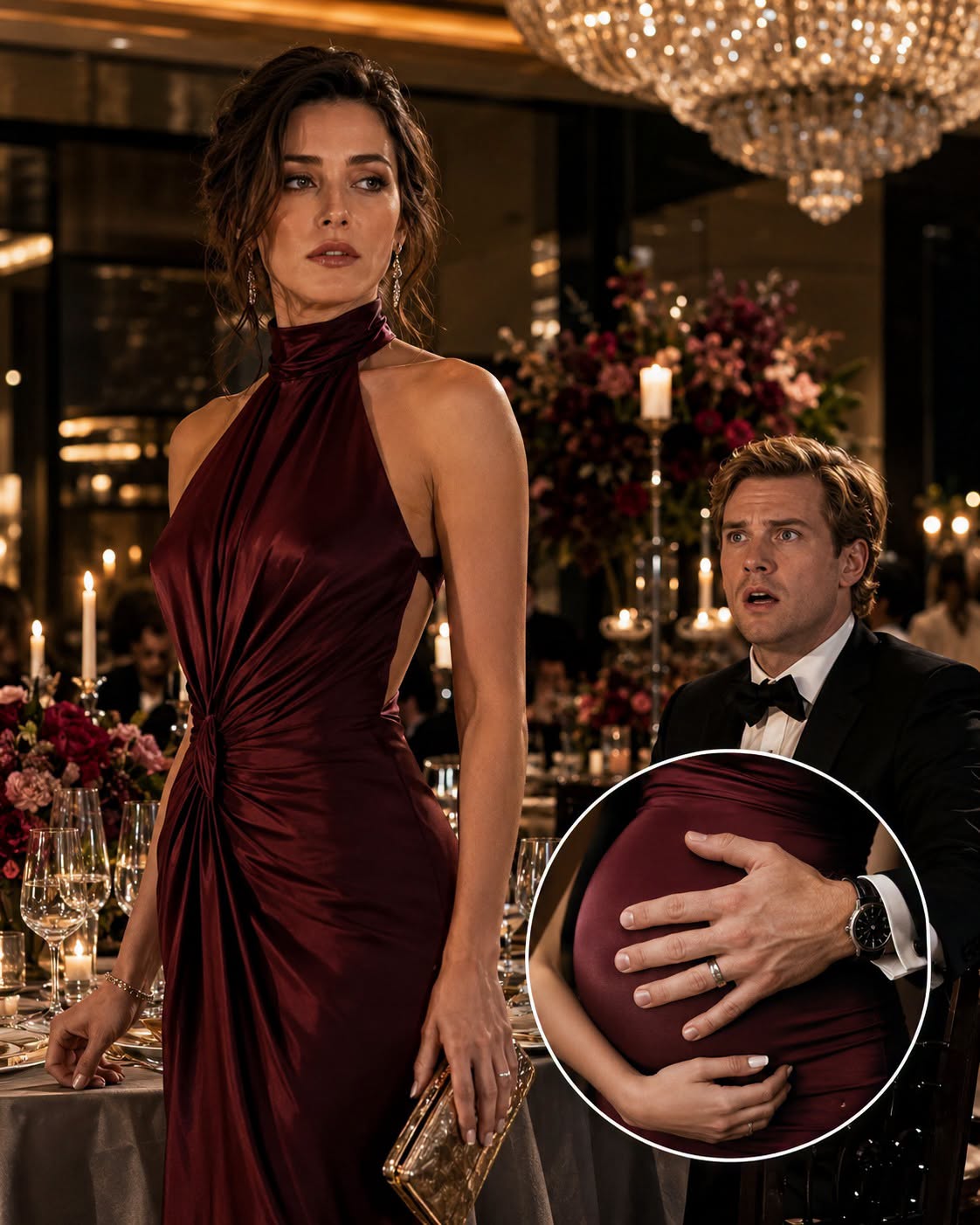
He Wanted a Blessing. The Calendar Gave Judgment
Preview
He told me to bless his mistress’s pregnancy at the family chapel dinner.
Not at the end of a private conversation. Not in the cold privacy of our marble bathroom where the heated floors could warm a woman’s bare feet while her marriage froze under her.
No.
Callum Wexler chose the chapel dining room of his family’s Newport estate, beneath twelve carved angels and a ceiling painted with a sky no sinner deserved. He chose a table dressed in ivory linen, black crystal, winter roses, and enough silver to blind the truth. He chose an audience of thirty-two people—his mother, his sisters, trustees, donors, bankers, cousins who had spent their lives mistaking cruelty for breeding.
And he chose her.
Blythe Monroe sat across from me in a pearl satin dress, her hand folded inside my husband’s hand like she had always belonged there. Candlelight made her skin glow. Pregnancy had given her that luminous softness women wrote poems about and wives learned to fear.
Callum’s mother cried into her lace napkin.
Not because her son had shattered his vows.
Because she was getting a grandchild.
Callum lifted his glass with the same hand that still wore the platinum wedding band I had designed for him in Paris.
“Vivienne,” he said gently, as if gentleness could disinfect humiliation, “a decent woman would give a blessing.”
The room fell silent with a hunger that made my stomach turn. They wanted my collapse. They wanted my rage. They wanted me to become loud enough to look guilty for my own pain.
I lifted my champagne.
The crystal caught the candlelight and threw it back like a blade.
“Of course,” I said.
Blythe smiled.
Callum exhaled, relieved.
Then I looked down the table at the man seated beside the bishop, the man Callum had foolishly invited because old money loves a medical witness when it flatters them.
“Dr. Whitaker,” I said, “before I bless anything, would you please read the timeline?”
The doctor’s face lost all color.
Callum’s hand tightened around Blythe’s.
And for the first time that night, my husband understood that I had not come to dinner as his wife.
I had come as evidence.
Chapter 1 — The Chapel Where Angels Watched Men Lie
The Wexler chapel was built in 1891 by a woman whose husband loved God in public and actresses in private.
That detail was not in the tour pamphlet.
The pamphlet said Cornelia Wexler commissioned the chapel after surviving a winter fever. It said she wanted a place of gratitude. It said the hand-carved pews were imported from Florence, the altar from Belgium, the stained glass from Chartres.
The family whispered the other version only after bourbon.
Cornelia built the chapel because her husband brought his mistress to Newport for the summer and sat her in Cornelia’s box at the opera. Cornelia did not scream. She did not faint. She did not smash the imported china. She smiled until the season ended, waited until her husband fell asleep, and changed the legal structure of the estate before breakfast.
By Christmas, he still had his title, his mistress, and his pride.
Cornelia owned the house.
I used to stand beneath her portrait in the west corridor and think she looked lonely. Later, I understood. She was not lonely.
She was waiting for one of us to learn.
I married Callum Wexler on a September afternoon that smelled of salt, money, and white lilies. The entire East Coast came to watch. Not because I was famous. I was not. I was Vivienne Hart then, daughter of a litigation attorney from Richmond and a mother who taught music until her hands trembled too much to play.
I was pretty in an expensive but forgettable way, with dark hair, gray eyes, and the kind of quiet people mistake for agreement. I had gone to Yale on scholarship, worked in art restitution, and learned early that beautiful things usually came with ugly paperwork.
Callum was not forgettable.
He was American royalty in a navy suit. Golden hair, clean jaw, blue eyes trained from birth to look sincere on camera. His family owned hotels, shipping interests, private hospitals, vineyards, and a philanthropic foundation that fed poor children in countries none of them could pronounce. He had the lazy confidence of a man whose name opened doors before he touched the handle.
When he pursued me, he did it like conquest disguised as romance.
He sent peonies to my office in Manhattan. He remembered that I took espresso without sugar. He flew to Richmond to meet my mother and sat beside her piano for two hours while she played Chopin badly, never once checking his phone.
When he proposed, it was at the Morgan Library after closing, beneath a ceiling painted like heaven. He held out a ring with an emerald the color of old forests.
“My family collects things,” he said. “I want to build something.”
I believed him.
That was my first mistake.
Love did not blind me all at once. It dimmed the lights slowly.
In the beginning, Callum admired my intelligence. Then he tolerated it. Then he found it inconvenient. At parties, he would touch the small of my back and say, “Viv knows all the legal details. Don’t get trapped beside her unless you want a lecture.”
Everyone laughed.
I laughed too, because a wife’s first training is to protect the joke made at her expense.
His mother, Eleanor Wexler, never laughed. She smiled.
Eleanor was a slender woman with silver hair, diamonds like frost, and eyes sharp enough to cut ribbon. She called me “darling” in the same tone other women used for “staff.” She believed marriage was a corporation in which women supplied heirs, beauty, silence, and useful connections.
I supplied only three.
The fourth became the crack they drove a knife into.
For years, I did not get pregnant.
At first, Callum said it did not matter. He said we had time. He said we were modern. He kissed my shoulder at night and whispered that he had married me, not my womb.
Then came the appointments.
Then the careful questions.
Then the vitamins, the specialists, the blood tests, the private clinics where women in cashmere waited beside husbands pretending to read magazines.
There was nothing dramatically wrong with me. That was what made it worse. No villain, no clear enemy, no lightning strike. My hormone levels were “within range.” My scans were “promising.” My body was “receptive.”
Callum’s tests, strangely, kept being delayed.
A scheduling conflict. A lab error. A call from London. A yacht weekend with investors.
The one time I pressed, he smiled and tapped my nose.
“Don’t turn this into a courtroom, Viv.”
So I turned it into hope instead.
Hope is humiliating in retrospect. It wears perfume. It makes appointments. It forgives late arrivals. It buys tiny cashmere socks from a boutique in SoHo and hides them in the back of a drawer, just in case joy needs proof it was expected.
By our fifth anniversary, the drawer held three pairs of socks and my marriage held entire rooms of silence.
That autumn, Callum began talking about renewal.
Not divorce. Not separation. Renewal.
“We should go back to the chapel,” he said one morning in our Manhattan kitchen while I sliced a pear with a knife too beautiful for fruit. “Take new vows. Make it intimate. Start fresh.”
Fresh.
The word sounded clean. It sounded possible.
He had been attentive again for six weeks. Flowers. Dinners. His hand reaching for mine in the dark. His voice low with apology when he said he had been under pressure. There were hotel projects in Miami, regulatory issues in Boston, fights with the board.
“I haven’t been fair to you,” he told me.
It was the closest he had come to admitting cruelty.
I wanted to believe him so badly that I mistook the ache in my chest for forgiveness.
We spent Thanksgiving at Greybourne, the Wexler estate in Newport. Greybourne was not a house. It was a verdict. Forty-two rooms of limestone and sea-facing glass, with lawns rolling down to cliffs where waves broke white against black rock. The chapel sat beyond the winter garden, connected to the main house by a covered stone walkway lined with lanterns.
Callum walked me there the night after Thanksgiving.
The chapel was dark except for votive candles at the altar. His breath clouded in the cold.
“My great-grandmother saved this family in this room,” he said, looking up at the angels carved into the beams. “Eleanor says Wexler men are only faithful to the woman who becomes the institution.”
I should have heard the warning.
Instead, I heard a confession.
Callum turned to me. “Renew with me on New Year’s Eve.”
I looked at his face, the face I had memorized in sleep and anger and photographs, and I felt the fragile animal inside me lift its head.
“Yes,” I said.
He kissed me beneath the painted sky.
Later, I would check the dates so many times they became carved into my mind.
November 29.
The chapel. The candles. The promise.
The same week, two hundred miles away, Blythe Monroe checked into a suite at the Wexler Meridian in Boston under a name paid for by my husband’s private card.
But I did not know that yet.
Back then, I still believed betrayal announced itself with lipstick on collars, midnight calls, perfume that was not yours.
I had not learned the first rule of luxury.
The most expensive lies are odorless.
Chapter 2 — Silk Gloves Hide Steel
Blythe Monroe entered my life wearing winter white.
She arrived at Greybourne three weeks before Christmas as a “consultant” for the Wexler Foundation’s maternal health initiative. Twenty-nine, blond, sweet-voiced, with an Alabama drawl softened by finishing school and ambition. She had the kind of beauty men called natural after it had been carefully financed: small nose, soft mouth, skin polished to candlelight.
At the first board luncheon, she leaned toward me and said, “Mrs. Wexler, I’ve heard so much about your taste.”
Not your work.
Not your leadership.
Your taste.
It was a tiny cut. The kind women learn to ignore until they are bleeding through silk.
I smiled. “Then I hope Callum mentioned my memory too.”
She blinked.
Callum laughed too quickly.
That was the first sound that made me look.
Not the laugh itself, but the fear beneath it.
After that, I began noticing.
Callum did not touch Blythe in public. He was too trained for that. But his attention bent toward her like a candle flame in a draft. He knew when her glass was empty. He listened when she spoke. He looked at her jokes before laughing, as if asking permission to be pleased.
Eleanor noticed too.
Eleanor noticed everything that might threaten the family, then decided whether it was a threat or a tool.
By Christmas Eve, Blythe had been invited to stay in the east guest wing.
“She has no family nearby,” Eleanor said while supervising garland in the main hall. “It would be unkind to leave the girl alone at the holiday.”
“The girl is a consultant,” I said.
Eleanor adjusted a ribbon. “And you are the hostess.”
There are women who insult you by raising their voices.
Eleanor Wexler could do it by lowering hers.
That night, I found Callum in the library with Blythe.
Nothing scandalous. No bodies too close. No hands caught where they should not be. He stood by the fireplace, she sat in the leather chair opposite him, and between them was a chessboard no one had touched.
But when I walked in, Blythe’s face changed.
Not guilt.
Victory.
I knew that expression. I had seen it at auctions when a bidder realized the other person’s limit had been reached.
“Viv,” Callum said. “We were discussing the Atlanta clinic proposal.”
“At midnight?”
Blythe looked into her wine. “I’m so sorry. I didn’t realize the hour.”
I looked at the untouched chessboard. “No one ever does when the game is going well.”
Callum’s jaw hardened. Later, in our bedroom, he told me I had embarrassed him.
“In our bedroom?” I asked.
“You know what I mean.”
“I know exactly what you mean.”
He loosened his tie with a vicious little pull. “Blythe is helping us. Try not to turn every competent woman into a rival because you’re insecure.”
There it was.
The word men use when they want a woman to distrust her instincts.
Insecure.
I stood by the window and watched snow begin to fall over the dark lawn.
“Are you sleeping with her?”
The silence was less than a second.
Long enough.
Callum sighed. “No.”
The answer came smooth, wounded, expensive.
I almost hated him for how badly I wanted it to be true.
The next morning, he placed a blue velvet box beside my coffee. Inside was a diamond bracelet from Graff, so cold and flawless it looked manufactured by angels.
“I don’t want us like this,” he said. “New Year’s Eve. The chapel. Let’s start over.”
I let him fasten the bracelet around my wrist.
The clasp clicked.
I remember thinking it sounded like a lock.
I did not confront Blythe. I did not search Callum’s phone. I did not cry in front of Eleanor or drink too much at dinner or become the brittle, suspicious wife everyone could pity.
Instead, I did what my father taught me when I was twelve and he was preparing for the biggest case of his life.
“Never argue with a liar while he is still enjoying the lie,” he had said, highlighting depositions at our kitchen table. “Wait until the lie signs something.”
So I waited.
And I listened.
The first gift the truth gave me was a calendar.
The Wexlers ran their lives through assistants, invitations, itineraries, seating charts, private aviation logs, donor schedules, estate menus, and board packets. Rich people think privacy means no one can access their lives. In reality, wealth creates records the way a body creates heat.
Every plane has a tail number.
Every suite has a service charge.
Every clinic has an intake time.
Every flower delivery has a recipient.
I had spent eight years managing the public perfection of the Wexler name. I knew where the files slept.
Callum’s assistant, Maeve, adored me. Not because I was kind, though I tried to be. Because I never treated staff as furniture. On December 27, she came to my office at Greybourne with a stack of holiday correspondence and eyes red from crying.
“Mrs. Wexler,” she said, “I think I need to resign.”
I closed my laptop. “Sit down.”
She sat on the edge of the chair, twisting her hands.
Maeve was twenty-four, from Queens, brilliant, underpaid, and terrified of power. Callum had hired her because she made problems disappear. He had not realized people like Maeve survive by keeping copies.
“It’s not my place,” she whispered.
“Then make it your place.”
Her mouth trembled. “Mr. Wexler asked me to backdate a hotel invoice. Boston. The Meridian. November twenty-ninth.”
My pulse did not change.
That was the advantage of heartbreak arriving in installments. By the time the knife enters, the body has practiced holding still.
“Why?”
“He said Mrs. Wexler might misunderstand.”
I looked at the bracelet on my wrist.
The diamonds gave nothing away.
“What name was on the original reservation?”
Maeve swallowed.
“Blythe Monroe.”
There are moments when pain becomes so precise it turns almost clean.
November 29.
The chapel. The candles. Renew with me.
Boston. Suite 1107. Blythe Monroe.
I did not ask Maeve for illegal access. I did not need to. I asked her to write down what Callum had requested of her, date it, sign it, and send it from her personal email to herself.
“Then resign,” I said.
“He’ll ruin me.”
“No,” I said. “He’ll try.”
That afternoon, I called Marisol Chen.
Marisol had been my roommate at Yale. She now ran one of the most feared boutique litigation firms in New York, the kind wealthy men called “aggressive” when they meant “not impressed by them.” She answered on the second ring.
“Tell me,” she said.
That was friendship: no hello, no performance, just a door opening.
I told her enough.
She was silent for a moment.
“Do you want divorce, destruction, or both?”
I looked out the window at the chapel roof under snow.
“I want accuracy.”
Marisol laughed softly. “God, I’ve missed you.”
Within forty-eight hours, accuracy had a structure.
First: preserve records. I sent copies of household calendars, event invitations, clinic schedules, travel confirmations, and foundation emails to a secure server Marisol controlled. All accessed through accounts I was authorized to manage as foundation chair and family-office liaison.
Second: review the prenup.
Callum had loved the prenup when we married because it protected Wexler assets. He had not read closely enough to understand what my father had added.
A fidelity clause.
Not moral outrage. Money.
If either spouse engaged in an affair that caused public reputational damage, concealed financial transfers, or harmed the other spouse’s professional standing, the wronged spouse was entitled to enhanced settlement rights, legal fees, and a claim against any assets used to support the affair.
Callum had laughed when my father insisted on it.
“Mr. Hart,” he had said, “I don’t plan to be stupid.”
My father smiled.
“No one ever does.”
Third: understand Wexler money.
This was where Callum had underestimated me most.
He believed I was decorative because I had learned to be graceful. He believed I was dependent because I did not brag. He believed the Hart family had nothing compared to his.
He was wrong in a way only inherited men can be wrong.
My grandmother, Celeste Hart, had not been rich in public. She wore old sweaters, clipped coupons, and drove a Buick until the doors complained. But in 1984, she invested insurance money from my grandfather’s death into a tiny medical device company founded by a woman no bank would fund.
That company became Asterion Biomedical.
Celeste never sold.
When she died, she left most of her holdings in a private trust to me, with one instruction written in fountain pen.
Never let a man know the full size of your safety.
I had obeyed.
My trust did not make me Wexler rich. Wexler rich was yachts named after virtues they did not practice. Wexler rich was senators taking calls during dinner.
But Asterion had grown quietly, and so had I. Through Hartwell Holdings, I owned stakes in clinics, medical real estate, women-led venture funds, and one particularly interesting block of distressed debt tied to Wexler Meridian Hotels after Callum’s Miami expansion went rotten.
He did not know.
Why would he?
Men like Callum only count money that has announced itself.
By New Year’s Eve, I knew about Boston. I knew about a weekend in Charleston disguised as a donor retreat. I knew about wire transfers to an LLC registered in Delaware under Blythe’s middle name. I knew Callum had approved foundation payments to consulting entities that did little consulting and a great deal of laundering glamour into Blythe’s life.
I also knew something stranger.
Preview
Callum was desperate.
The Wexler empire looked perfect from the outside. Inside, it was a chandelier hanging by frayed silk. Miami construction delays. Hospital liability settlements. A shipping contract under federal review. A private loan coming due in March.
And Callum needed me to renew our vows.
Not for romance.
For paper.
The “renewal” ceremony came with a postnuptial agreement his lawyer sent to me under the charming subject line: Fresh Start Documents.
Fresh Start.
That phrase again.
The agreement looked harmless at first. Sentimental even. It created a “family legacy framework” for future children. It amended certain disclosure requirements. It waived claims arising from “pre-renewal marital strain.” It folded my foundation role into a Wexler-controlled board.
Marisol read it and called me immediately.
“He’s trying to erase the affair before you find it.”
“I found it.”
“Yes,” she said. “But he doesn’t know that. More importantly, this document would weaken your claim to the debt position if his family can argue you acted against Wexler interests while serving as foundation chair.”
“Can they?”
“Not if you don’t sign.”
I looked at the New Year’s Eve dress hanging on my wardrobe door. Black velvet. High neck. Long sleeves. Eleanor had suggested ivory.
I chose mourning.
“What happens if I refuse tonight?”
“He adapts,” Marisol said. “He pressures you. He threatens. He love-bombs. He paints you unstable.”
“And if I pretend I’m considering it?”
“Then he keeps performing.”
So I performed too.
That night, beneath the chapel angels, Callum renewed vows I did not renew back.
He spoke beautifully. Men who lie often do.
He said I was his anchor. His conscience. His truest friend. He promised transparency, tenderness, devotion.
The guests dabbed their eyes.
Eleanor watched me.
When my turn came, I looked at Callum and smiled.
“I will honor the truth of what we are,” I said. “In whatever form it reveals itself.”
People sighed, thinking it poetic.
Marisol, watching over the private livestream from her office in Manhattan, texted me one word.
Perfect.
Callum tried to get me to sign after midnight.
He led me to the library, poured champagne, touched my wrist.
“Just formalities,” he said.
I took the pen.
His eyes warmed.
Then I set it down.
“Tomorrow,” I said. “I don’t sign contracts after champagne.”
His face flashed, just once, with panic.
Then he smiled.
Preview
“Of course.”
At two in the morning, while fireworks broke over Newport Harbor and Callum slept beside me like an innocent man, my phone lit up.
A message from Maeve.
I found something else.
Attached was a screenshot of Callum’s private calendar.
January 12.
Dinner at Greybourne Chapel.
Family announcement.
Blythe + C.
I stared at the screen until the fireworks ended.
Then I got out of bed, walked barefoot to the east corridor, and stood beneath Cornelia Wexler’s portrait.
She looked down at me with that old, cold patience.
“All right,” I whispered.
Chapter 3 — The Woman They Mistook for Furniture
The two weeks before the chapel dinner were the calmest of my life.
That was what frightened people later.
They expected betrayal to make me messy. They wanted eyeliner streaks, broken glass, dramatic phone calls at midnight. They wanted a woman undone because undone women are easier to dismiss.
But rage, when distilled, becomes discipline.
I slept eight hours. I drank water. I attended Pilates at six. I answered emails with warmth. I sat beside Callum at the Winter Pediatric Gala wearing emerald silk and smiled while he lied into microphones about family values.
Blythe stood three tables away, one hand resting lightly over her abdomen though she was not showing yet.
That was the first public clue.
Not the hand.
The entitlement of it.
She wanted to be seen almost as much as Callum wanted to be forgiven.
They underestimated the patience of a woman who had spent her career returning stolen art to families who thought justice had died with their grandparents. I knew how long truth could wait in crates, vaults, tax shelters, private islands, anonymous trusts, and polite drawing rooms.
Truth was rarely lost.
It was usually stored.
Marisol built the case like architecture.
The hotel invoice. The assistant statement. The foundation transfers. The LLC. The postnup draft. Callum’s texts to Maeve asking for “cleanup.” Photographs from the Charleston donor retreat where Blythe wore Callum’s college signet ring on a chain around her neck. Security footage logs from Wexler properties, obtained through authorized foundation oversight because the expenses had been billed to charitable events.
Then came Dr. Simon Whitaker.
He had been the Wexler family physician for thirty years, which meant he knew everyone’s sins in Latin. He was tall, narrow, and exhausted-looking, with silver hair and the haunted manner of a man who had spent decades keeping secrets for people who donated hospital wings.
I met him at a private tea room in Boston. Marisol sat beside me. He arrived ten minutes early and ordered nothing.
“Mrs. Wexler,” he said, “if this concerns medical information, I cannot—”
“It concerns a dinner invitation,” I said.
His mouth closed.
I slid the engraved card across the table.
The Wexler Family requests the honor of your presence at Greybourne Chapel for a private dinner celebrating legacy, family, and new beginnings.
January 12.
Dr. Whitaker looked at it as if it might bite.
“Callum invited you,” I said.
“He asked me to attend as a family friend.”
“Did he ask you to confirm a pregnancy?”
“I cannot discuss—”
“No,” Marisol said pleasantly. “And we are not asking you to. We’re asking whether Mr. Wexler attempted to place you in a position where your presence would lend credibility to a public announcement involving medical facts.”
Dr. Whitaker removed his glasses.
For the first time, I saw not secrecy but disgust.
“He asked me to say I was happy for them,” he said. “He said the family would find it reassuring.”
“Reassuring,” I repeated.
The doctor looked at me. “I told him I would not disclose anything.”
“Did Miss Monroe authorize you to attend?”
“She is not my patient.”
That surprised me.
“Then whose doctor are you in this matter?”
He hesitated.
Marisol leaned forward. “Dr. Whitaker, we already know Mr. Wexler scheduled fertility testing with you last spring and never completed it. We know he later requested that the file reflect a postponement for marital reasons. We know he asked your office to send Mrs. Wexler’s records to a consultant without written authorization.”
The doctor’s face tightened. “I refused.”
“I know,” Marisol said. “That is why you are having tea instead of being subpoenaed.”
A muscle jumped in his jaw.
Callum had not only betrayed me. He had tried to use my body as cover.
That was the moment my grief changed temperature.
Until then, part of me had still mourned the husband I thought I had. The man who listened to my mother play Chopin. The man who kissed me beneath the library ceiling. The man who said he had married me, not my womb.
But trying to make my medical history a prop in his redemption story?
That killed the ghost.
Dr. Whitaker looked at me. “Mrs. Wexler, I cannot provide private records. But I can state, if asked in a legal setting, that I never diagnosed you with infertility, that no medical basis existed for Mr. Wexler’s public insinuations, and that Mr. Wexler did not complete his own recommended testing.”
It was not everything.
It was enough.
“Thank you,” I said.
His eyes softened with something like shame. “I should have done more sooner.”
“No,” I said. “You should have done exactly what you’re going to do now.”
That afternoon, I returned to New York and opened the vault in my apartment for the first time in three years.
Callum hated the vault.
He said it made our home feel like a bank.
Inside were papers that mattered more than jewels: trust documents, stock certificates, letters from my grandmother, acquisition records for Hartwell Holdings, and a sealed envelope my father had given me the week before my wedding.
For when the room gets cold, he had written on the front.
My father had died two years into my marriage. Lung cancer. Fast, brutal, unfair. Callum had been attentive at the funeral. He had held my hand. He had cried when my mother sang.
Grief makes dangerous edits to memory. It lets one good scene stand in for an entire character.
I opened the envelope.
Inside was a copy of the prenup, annotated in my father’s handwriting, and a letter.
Viv,
You love him. I respect that. I also know men with empires often confuse love with acquisition. If he remains worthy, burn this and laugh at your suspicious old father. If he does not, remember: a contract is not romance’s enemy. A contract is what keeps romance from becoming a hostage situation.
Your grandmother left you enough to leave any room. I made sure the paperwork left with you.
Never beg for dignity.
Invoice it.
Dad
I sat on the vault floor and cried for the first time.
Not loudly. Not beautifully.
Just enough to let the daughter in me grieve before the woman stood up.
The next day, I met with Nathaniel Cross.
Nathaniel was not my lawyer. He was my grandmother’s longtime trust adviser, a former federal prosecutor who had gone private and developed the unsettling habit of seeing through people before they finished lying. He was in his early forties, Black, precise, handsome in a way that seemed accidental because he spent no effort advertising it. His suits were impeccable. His eyes were kind only when kindness was useful.
He had never liked Callum.
At my wedding, he shook Callum’s hand and later told my father, “Charming. Dangerous if bored.”
My father had laughed.
Nathaniel had not.
We met at his office overlooking Bryant Park. Snow tapped the windows. He listened without interruption while I explained the affair, the postnup, the pregnancy announcement, the Wexler debt position.
When I finished, he opened a folder.
“We need to discuss Greybourne,” he said.
“What about it?”
“Three years ago, Wexler Holdings used several properties as collateral during a liquidity crunch. Greybourne was not directly pledged because the estate sits in a family trust. However, certain maintenance contracts, art loans, and land-use rights were bundled into a credit facility. That facility was later sold.”
“To whom?”
He looked at me.
“Hartwell Holdings.”
The room became very still.
“I own part of Greybourne’s debt?”
“You own the controlling interest in the facility that controls the estate’s operating rights if Wexler defaults.”
“Does Callum know?”
“No. The acquisition was handled through three layers, all legal, all disclosed where required. His finance team dismissed the buyer as a conservative vehicle.”
I thought of Callum touching my wrist in the library, asking me to sign away “formalities.”
“What happens in March?”
“If Wexler makes payment, nothing. If he defaults, Hartwell can enforce control over certain operating assets, including the chapel event rights, hospitality licensing, and revenue streams tied to the estate.”
I laughed once, softly.
Nathaniel watched me.
“Cornelia would have loved that,” I said.
“Cornelia?”
“Never mind.”
He closed the folder. “There is more. Callum has been moving money out of protected entities in a way that may violate loan covenants. Some transfers appear connected to Miss Monroe’s LLC.”
“Can we prove it?”
“Yes.”
“How long?”
“We already have enough to notify the lenders.”
I looked through the window at the city below, millions of lights pretending they were stars.
“What happens if you notify them before the dinner?”
“Callum panics. The family closes ranks. The mistress becomes sympathetic. You become the jealous wife trying to ruin a pregnant woman.”
“And if we wait?”
Nathaniel’s gaze held mine.
“Then he humiliates himself under chandeliers.”
There are sentences that make you understand why patience is considered a virtue by saints and prosecutors.
I left his office with the documents in a black leather folio and walked forty blocks in the snow.
At Saks, the windows were still dressed for winter fantasy: mannequins in white gowns, diamond collars, fake forests glittering behind glass. People stopped to take photos. They never noticed the wires.
Luxury is mostly wires.
That evening, Callum came home late and found me packing for Newport.
He stood in the doorway of the dressing room, tie loose, face tired in the way powerful men perform when they want comfort without confession.
“You’ve been quiet,” he said.
“I’ve been thinking.”
His eyes sharpened. “About us?”
“About family.”
That pleased him. He crossed the room and touched my hair.
“Sunday will be difficult,” he said. “But necessary.”
I folded a black cashmere sweater into my suitcase. “What is Sunday?”
A pause.
Tiny.
Perfect.
“Mother wants to make an announcement,” he said.
“What kind?”
He looked at me with rehearsed sorrow. “Viv, I don’t want you blindsided.”
I almost admired him then.
The craftsmanship of his cruelty.
“There’s going to be a child,” he said.
I looked at him as if the words had landed slowly.
His face arranged itself into compassion.
“Blythe is pregnant.”
There it was.
No apology first. No acknowledgment of betrayal. Just a child, presented like a weather event we all needed to dress for.
I sat down on the velvet bench.
Callum knelt in front of me. The same posture he had used to propose.
“It wasn’t planned,” he said.
That was another lie. Not because the pregnancy had been planned. Because everything after it had.
“She’s keeping it?” I asked.
“Yes.”
“And you?”
He lowered his eyes. “I have responsibilities.”
“To her?”
“To the child.”
I let silence punish him for six seconds.
Then I asked, “What am I supposed to be in this new family?”
His relief was almost insulting. He had expected screaming. Questions. Accusations. He had not expected strategy disguised as pain.
“You are my wife,” he said. “Nothing changes publicly. Privately, we’ll create an arrangement with dignity. Mother thinks if we present it correctly—”
“Your mother knows?”
His expression flickered.
“She knows this family needs an heir.”
An heir.
Not a baby.
Not a son or daughter.
An heir.
I thought of all the needles in my arms, all the clinics, all the months I had blamed my body while Callum hid from a simple test.
I whispered, “And you want me to bless it.”
Callum took my hands.
“I want you to rise above it.”
There are phrases so vile they deserve museums.
Rise above it.
Meaning: swallow the knife and compliment the handle.
“Will Blythe be there Sunday?”
“Yes.”
“Your mother?”
“Yes.”
“Dr. Whitaker?”
His eyes moved. “As a family friend.”
I nodded slowly. “Then I should wear something appropriate.”
“I knew you were extraordinary.”
No, I thought.
You knew I was useful.
There is a difference.
Chapter 4 — A Decent Woman Would Give a Blessing
On the night of the chapel dinner, Newport froze hard enough to make the ocean sound metallic.
Greybourne glowed against the cliffs like a palace built to survive judgment. Every window burned gold. Black cars moved up the drive one after another, tires whispering over salted gravel. Valets in wool coats opened doors for women in velvet and men in tuxedos who carried their sins under cashmere.
I wore silver.
Not bridal white. Not widow black.
Silver, like a blade polished for ceremony.
The dress was simple from the front—high neck, long sleeves, fluid silk falling to the floor. From the back, it was ruthless: bare to the spine, fastened at the nape with one diamond clasp from my grandmother’s collection. My hair was swept low. My makeup was soft. My face gave nothing away.
When I entered the main hall, conversations changed shape.
People knew.
Of course they knew.
In families like the Wexlers, scandal travels faster than truth because scandal has better shoes.
Eleanor stood beneath a garland of white amaryllis, receiving guests like a queen receiving tribute after a war she had privately funded. She wore burgundy velvet and rubies dark as clotted blood.
“Vivienne,” she said, kissing the air beside my cheek. “You look composed.”
“And you look prepared.”
Her smile did not move. “Tonight is about grace.”
“No,” I said softly. “Tonight is about timing.”
For the first time in eight years, I saw uncertainty pass through Eleanor Wexler’s eyes.
Then Callum appeared.
He looked beautiful. That was the cruelty of him. Betrayal should make people uglier, but some men become more luminous when they are convinced history will forgive them. He wore a black tuxedo, his wedding ring, and the expression of someone about to be admired for managing a tragedy he caused.
“Viv,” he said, low enough for intimacy, public enough for witnesses. “Thank you for doing this.”
I glanced at his ring.
“Don’t thank me yet.”
Blythe arrived at seven.
Winter white again.
This time, silk clung to her body in a way designed to suggest innocence and conquest at once. A diamond bracelet circled her wrist. Not mine, but close enough to be noticed. Her hair fell in soft waves. Her hand rested gently over her abdomen for every camera phone that pretended not to exist.
Callum crossed the room to her.
Not fully.
Just enough.
The room watched him choose the distance.
I watched Blythe choose the smile.
She approached me with her chin lifted.
“Vivienne,” she said. “I know this is complicated.”
“Pregnancy usually is.”
Color touched her cheeks.
“I never wanted to hurt anyone.”
I looked at her bracelet. “Then you’ve discovered a remarkable talent by accident.”
Her mouth tightened.
For a second, I saw the woman beneath the glow. Not soft. Not naive. Hungry. She had not stumbled into my marriage. She had mapped it.
But hunger is not the same as vision.
Dinner was served in the chapel dining room, a long stone chamber built onto the original chapel for family feasts after weddings, baptisms, and funerals. Narrow stained-glass windows lined one wall. The other opened through arches into the chapel itself, where candles burned before the altar.
The table looked obscene.
White roses. Black taper candles. Crystal angels. Gold-rimmed plates. Place cards written by a calligrapher from Boston who charged more per name than some people spent on groceries in a week.
My card sat at Callum’s right.
Blythe’s sat at his left.
That was Eleanor’s signature.
A wife for legitimacy. A mistress for lineage. A man in the middle pretending the arrangement was civilization.
Dr. Whitaker sat six seats down, beside Bishop Alden. He avoided my eyes until I lifted my water glass slightly.
Then he looked at me.
And nodded once.
The first course was oysters on crushed ice.
The second was chestnut soup poured from silver pitchers.
The third was sea bass with fennel and blood orange, because Eleanor appreciated symbolism when it was plated attractively.
Conversation moved with the stiff grace of a funeral trying to become a christening.
A cousin asked about Miami.
A trustee praised Blythe’s work with rural clinics.
Eleanor spoke about legacy.
Callum touched my hand twice. Each time, I let him. A trap feels safer when the animal believes the door is open.
After dessert, servers cleared the plates and replaced them with champagne coupes. The candles had burned low. Outside, wind struck the stained glass with small, desperate sounds.
Preview
Eleanor rose first.
“My dears,” she said, voice trembling beautifully, “there are moments in every family when God asks us to enlarge our hearts.”
I almost smiled.
God, apparently, had become a real estate developer.
Eleanor continued. She spoke of forgiveness without naming offense, of children without naming betrayal, of tradition without naming the women it had eaten. Her eyes shone. Her rubies glowed. By the time she said “new life,” several guests had already begun dabbing their eyes.
Then Callum stood.
He did not look at Blythe first.
He looked at me.
That was his mistake.
He wanted the room to see him as brave enough to face his wife. He wanted my controlled expression to become his absolution. He wanted to borrow my dignity and spend it on his mistress.
“Vivienne and I have walked through a difficult season,” he said.
A difficult season.
Not an affair.
Not deception.
Weather.
“But marriage, at its best, teaches us that love is larger than possession.”
I felt Marisol’s voice in my memory: Let him talk. Men like him confess best when trying to sound noble.
Callum placed his hand over Blythe’s.
She lowered her eyes. A perfect painting of modesty.
“Blythe is expecting a child,” he said. “My child.”
The room inhaled as one animal.
Eleanor began to cry.
Callum’s sister Margot pressed fingers to her mouth. A banker near the end of the table looked down, fascinated by his spoon. Bishop Alden closed his eyes, perhaps in prayer, perhaps in professional exhaustion.
Callum turned to me.
“I know this is not the path any of us expected,” he said. “But I believe families are made not only by perfection, but by grace. Vivienne has always been the most gracious woman I know.”
There it was.
The pedestal before the push.
He lifted his glass.
“Viv, a decent woman would give a blessing.”
The silence afterward was luxurious.
Not empty.
Luxurious.
Layered with silk, diamonds, breath, fear, appetite.
Blythe looked at me with tears shining in her eyes. She was good. I would give her that. If I had been less informed, I might have believed she was ashamed.
Callum’s hand remained over hers.
Eleanor’s tears slid down her face like pearls.
I rose.
No chair scrape. No stumble. The staff had placed felt beneath each chair leg because Eleanor hated ugly sounds.
My champagne coupe felt weightless.
“Of course,” I said.
Callum’s shoulders dropped half an inch.
Blythe’s mouth softened in triumph.
I turned toward her.
“Blythe, I wish health to every innocent child. Always.”
Her smile faltered, just slightly.
Then I looked at Callum.
“But a blessing is not a blindfold.”
The room went still.
I turned down the table.
“Dr. Whitaker,” I said, “before I bless anything, would you please read the timeline?”
The doctor did not move.
Callum did.
“Vivienne.”
His voice was warning wrapped in velvet.
I smiled.
“It’s all right, Callum. We’re among family.”
Eleanor set down her napkin.
Blythe’s hand left her abdomen.
I reached into the slim silver clutch beside my plate and removed a folded sheet of paper. Not medical records. Not private information. Just the announcement card Blythe herself had placed at every seat before dinner, sealed in ivory envelopes embossed with a gold W.
A keepsake, Eleanor had called it.
Inside was a sonogram photograph, a due date, and one line written in looping script.
Baby Wexler arriving September 2.
At the bottom, in smaller print, was the gestational age from the scan Blythe had chosen to share with thirty-two dinner guests and, through them, half of Newport by morning.
I held it up.
“Dr. Whitaker, no private disclosure needed. Based only on the due date and gestational age Miss Monroe publicly provided tonight, what is the approximate conception window?”
Dr. Whitaker’s face looked carved from ash.
Bishop Alden opened his eyes.
Callum whispered, “Don’t.”
I looked at him.
That one word told the table everything his speech had tried to bury.
Dr. Whitaker cleared his throat.
“Due dates are estimates,” he said carefully. “But a September second due date typically places conception around early December, with variation.”
“Early December,” I repeated. “Thank you.”
Blythe’s lips parted.
I lifted another paper.
“Callum asked me to renew our vows on November twenty-ninth in this chapel. He told me he wanted a fresh start. He begged me, quite beautifully, to believe our marriage still had a future.”
Callum’s face hardened. “This is not the time.”
“No,” I said. “This is exactly what time is for.”
I laid the hotel invoice on the table.
“The same night, he paid for Suite 1107 at the Wexler Meridian Boston. Blythe checked in under her own name. The original invoice was later altered at Callum’s request.”
Maeve’s signed statement followed.
Then the private flight record.
Then the Charleston itinerary.
Then the LLC registration.
I placed each document on the linen with the calm of a dealer turning cards.
No shouting.
No accusation unsupported by proof.
The table watched the marriage become evidence.
Callum’s voice dropped. “Vivienne, you are embarrassing yourself.”
I laughed softly.
It was the only unplanned thing I did all night.
“Callum, I’m embarrassing your filing system.”
Someone at the far end of the table choked.
Eleanor stood.
“This is vulgar.”
I turned to her. “No, Eleanor. Vulgar was seating me beside my husband’s pregnant mistress beneath a crucifix and calling it grace.”
Her face went white under the powder.
Blythe began to cry.
“I’m pregnant,” she whispered, as if biology were immunity.
“And I hope the child is healthy,” I said. “But pregnancy is not a permit to help a man defraud his wife, misuse charitable funds, or rewrite a marriage contract after the fact.”
Callum’s head snapped toward me.
There it was.
Fear.
Real fear.
Not of losing me. He had lost me months ago and barely noticed.
Fear of discovery.
I opened the black leather folio resting beside my chair.
“The postnuptial agreement Callum wanted me to sign on New Year’s Eve would have waived claims related to ‘pre-renewal marital strain.’ It would also have shifted foundation authority away from me just in time to conceal payments made to entities connected to Blythe.”
Blythe looked at Callum.
That look was not love.
It was the moment an accomplice realizes she has not been told the whole crime.
“Callum?” she said.
He ignored her.
“Sit down,” he told me.
There are commands that reveal exactly how long a man has mistaken patience for obedience.
I did not sit.
I looked at Dr. Whitaker.
“Would you also confirm what you told my counsel? That you never diagnosed me with infertility, that Callum did not complete his own recommended testing, and that you refused a request to transfer my records without authorization?”
Dr. Whitaker closed his eyes for one second.
Then he opened them.
“Yes.”
The word entered the room like a bell.
Eleanor gripped the back of her chair.
For years, she had allowed whispers to gather around me. Poor Vivienne. So elegant. Such a shame. Callum wants children, of course. A man like that needs a legacy.
Callum’s sister Margot began crying quietly, but not for Blythe now.
For me.
Too late, but not useless.
Callum leaned toward me, his voice low enough that only the nearest guests heard.
“You have no idea what you’re doing.”
I leaned closer.
“That has always been your favorite prayer.”
His eyes narrowed.
I turned back to the room.
“There is more.”
Nathaniel entered through the chapel archway then, as precisely timed as the strike of a clock.
He wore a black overcoat over a dark suit and carried a slim briefcase. Behind him came Marisol Chen, small, elegant, lethal in navy satin. The staff did not stop them. I had added their names to the security list that morning.
Callum stared.
“Who invited them?”
“I did,” I said. “To witness the blessing.”
Marisol gave the table a pleasant smile that made several lawyers present sit up straighter.
Nathaniel placed a folder beside my champagne coupe.
“Mrs. Wexler,” he said, “the notices are ready.”
Callum’s voice cracked. “Notices?”
I opened the folder.
“Wexler Holdings is in breach of multiple covenants tied to the Greybourne operating facility. Hartwell Holdings, as controlling creditor, has the right to enforce oversight.”
Eleanor looked confused.
Callum did not.
He understood before anyone else because guilt is fluent in consequence.
“Hartwell?” he said.
I smiled.
“My grandmother’s company.”
His face went blank.
There are few sights more satisfying than a man discovering his wife had money he could not charm, touch, or count.
Nathaniel continued, calm as winter. “Effective immediately upon notice, Hartwell Holdings may review and restrict estate-related expenditures, hospitality events, chapel revenue functions, and associated accounts. Given the evidence of improper transfers, we are also notifying the relevant lenders and foundation board.”
Eleanor sat down as if her bones had been cut.
“You cannot take Greybourne,” she whispered.
I looked at the chapel, at the angels, at Cornelia’s old stones.
“I don’t want Greybourne,” I said. “I want the rot out of it.”
Callum turned to me, fury replacing panic.
“You vindictive bitch.”
There it was.
The truth, finally undressed.
The room recoiled.
I looked at him with something almost like relief.
“Thank you,” I said. “I was afraid they’d think I exaggerated.”
Blythe pushed back from the table.
“You said she couldn’t touch you,” she hissed at him.
Ah.
There was the final ribbon coming loose.
I turned to Blythe. “He told you many things, I imagine.”
She stood, one hand on the table. “He said you knew. He said your marriage was finished. He said you wouldn’t divorce because you liked the name.”
The old me might have flinched.
The woman standing there simply nodded.
“Did he also tell you the foundation paid your consulting LLC through a maternal health initiative?”
Her face drained.
“I didn’t know that was illegal.”
Marisol spoke for the first time.
“It becomes a problem when services are inflated, funds are mischaracterized, and payments are tied to personal benefit. Intent matters. Documentation matters more.”
Blythe looked at Callum again.
“Callum?”
He was staring at me.
Not at her. Not at his unborn child. Not at his mother.
At me.
As if I had betrayed him by refusing to remain smaller than his plan.
“You’ll destroy the family,” he said.
“No,” I replied. “I’m ending a family tradition.”
Then I lifted my glass one last time.
The champagne had gone warm.
It did not matter.
“To the child,” I said. “May they inherit health, freedom, and better examples than the people who used them as a shield tonight.”
No one drank.
I did.
Then I set down the glass and looked at Callum.
“The pregnancy began while you were still begging me to renew our vows.”
The sentence did not echo.
It landed.
That was worse.
Chapter 5 — The Calendar in Court
The video reached three million views before sunrise.
Not the whole dinner. I had not leaked that. Contrary to what Callum later told reporters, I did not need strangers to see every wound to know I had bled.
But someone near the far end of the table had recorded the moment Callum said, “A decent woman would give a blessing,” and the moment I answered, “A blessing is not a blindfold.”
By morning, the clip was everywhere.
Facebook.
Reels.
TikTok.
X.
Morning shows blurred the faces and sharpened the captions.
BILLIONAIRE ASKS WIFE TO BLESS PREGNANT MISTRESS.
SHE BROUGHT RECEIPTS.
THE CALENDAR SAID NO.
People chose sides with the passion of strangers safely distant from consequence.
Some called me cold.
They were right.
Cold is what water becomes when it survives winter.
Others called me iconic, savage, queen, goals. I disliked those words almost as much as I disliked pity. Viral admiration has the nutritional value of spun sugar. Sweet, brief, and dangerous if mistaken for a meal.
The only message that mattered came from my mother.
She sent one line.
Your father would have stood up.
I sat on the bathroom floor of my Manhattan apartment and held the phone against my chest.
Callum did not come home.
His lawyers called Marisol by nine.
By ten, Wexler Holdings released a statement about “a painful private family matter.” By eleven, the foundation announced an independent review. By noon, three donors paused commitments. By three, the Miami lenders requested documentation. By evening, Blythe’s LLC had deleted its website.
At seven, Callum finally called me.
I let it ring.
At seven-oh-three, he sent a text.
We need to talk like adults.
I sent it to Marisol.
She replied with a laughing skull.
The divorce filing landed two days later in New York Supreme Court.
People think courtrooms are dramatic. Usually they are fluorescent rooms where expensive anger becomes paperwork. My first hearing took place on a gray morning in February. I wore navy. Callum wore resentment. Blythe was not there.
Neither was Eleanor.
That surprised me until it didn’t.
Eleanor had spent her life backing winners. For the first time, she was unsure whether her son still qualified.
Callum’s legal team tried three strategies.
First, I was unstable.
Marisol produced emails showing months of calm correspondence, board leadership, and Callum’s own messages praising my “grace” and “strength.”
Second, the affair had begun after the marriage was effectively over.
Marisol produced the vow renewal texts, the chapel livestream, the hotel invoice, and Callum’s postnup draft.
Third, the money transfers were business-related.
Marisol smiled.
That was when I knew she had been hoping they would say it.
She introduced the consulting invoices, deliverables copied from public reports, wire transfers, luxury purchases, and messages between Callum and Blythe discussing “optics” and “Viv signing after New Year’s.”
The judge, a woman with silver glasses and the exhausted authority of someone who had listened to rich men explain themselves for twenty years, looked at Callum over the file.
“Mr. Wexler,” she said, “your definition of private appears to include accountants, assistants, physicians, trustees, and most of Newport.”
The courtroom did not laugh.
But it wanted to.
Outside, cameras waited. I said nothing. Silence had become my most quoted statement.
Blythe resurfaced in March.
Not publicly.
At my apartment.
The doorman called up at 8:17 p.m. “Mrs. Wexler, a Miss Monroe is here. She says it’s urgent.”
I looked across the living room at Nathaniel, who had stopped by with documents from the trust review. Rain moved over the windows behind him, turning Manhattan into watercolor.
“You don’t have to see her,” he said.
“I know.”
That was why I did.
Blythe entered wearing no makeup, a camel coat, and fear. Pregnancy had changed her face again. The glow was gone. She looked young now. Not innocent, but young.
She stood in my living room, surrounded by books, art, and the quiet my marriage had never allowed me to enjoy.
“Thank you for seeing me,” she said.
I did not offer tea.
Some graces are for guests.
“You have ten minutes.”
Her hand went to her abdomen, then dropped, as if she had learned the gesture no longer worked on me.
“Callum lied,” she said.
“Yes.”
“I mean about everything.”
“Likely.”
She swallowed. “He said you had an arrangement. He said the marriage was dead. He said you refused to have children because you didn’t want to ruin your body.”
My chest tightened, but my face did not change.
Nathaniel, standing near the fireplace, went very still.
Blythe’s eyes filled. “I believed him because I wanted to. That’s not an excuse.”
“No,” I said. “It’s not.”
She flinched.
Preview
Good.
Then she reached into her purse and removed a flash drive.
“I have messages,” she said. “Recordings. He told me to keep copies because his mother might try to cut me out. I think he forgot what kind of woman takes that advice.”
For the first time, I nearly smiled.
“What do you want?”
Her mouth trembled. “Protection for the baby. Not from you. From him.”
There it was.
The shift.
A mistress entering as a weapon and leaving as a witness.
I looked at Nathaniel.
He nodded once.
I turned back to Blythe. “Marisol will arrange counsel for you. Independent counsel. Not mine. Not Callum’s. You will turn over evidence through proper channels. You will tell the truth even when it makes you look ugly.”
Tears slipped down her face.
“I can do that.”
“Can you?”
She looked me straight in the eye then.
“Yes.”
It was the first honest thing I had ever heard her say.
Before she left, she paused by the door.
“I’m sorry,” she whispered.
People think apology is a key.
It is not.
Sometimes it is only a receipt.
“I believe you,” I said. “That doesn’t restore what you helped take.”
She nodded.
“I know.”
After the door closed, I stood very still.
Nathaniel said nothing for a long time.
Then he asked, “Are you all right?”
I laughed, tired and humorless. “Everyone keeps asking that.”
“Because no one knows what else to ask.”
I looked at him.
There had been a quiet thread between us for months, though neither of us had touched it. Not romance exactly. Not yet. More dangerous: recognition. He saw the steel in me and did not ask me to turn it back into jewelry.
“I don’t know what I am,” I admitted.
He crossed the room slowly, giving me every chance to step away.
I did not.
He stopped close enough that I could see rain caught on the shoulder of his coat.
“You don’t have to know tonight,” he said.
The kindness nearly broke me.
Not because it was grand.
Because it asked nothing.
I closed my eyes. For one foolish second, I wanted to lean into him and let another person’s warmth decide the shape of my body.
Instead, I opened my eyes and stepped back.
“I’m still married.”
“I know.”
“You’re my adviser.”
“I know.”
“This is complicated.”
His mouth softened. “Most valuable things are.”
He left ten minutes later without touching me.
That was the night I began to understand the difference between desire and hunger.
Hunger grabs.
Desire waits with its hands visible.
The final twist came in April, in a conference room on the forty-sixth floor of a Midtown tower, during what was supposed to be a settlement negotiation.
Callum arrived with a new haircut, a darker suit, and the dead-eyed calm of a man who had stopped sleeping. His public image had not recovered. The foundation review had turned into a regulatory inquiry. The Miami lenders were circling. Eleanor had removed him from two internal boards “temporarily,” which in Wexler language meant she had placed a knife on the table and was deciding where to point it.
Blythe had moved to Atlanta to live with an aunt. She had given testimony through counsel.
I had not seen Callum in person since February.
He looked at me across the conference table as if I were both enemy and property.
“You’ve made your point,” he said.
“No,” Marisol replied before I could. “We’ve made several.”
His lawyer slid a settlement proposal forward.
Generous, he called it.
It was not.
It offered money Callum could spare, an apology he would never mean, and confidentiality so broad it would have turned my life into a locked room.
I read it once.
Then I looked at Callum.
“You still think this is about payout.”
“What else could it be?” he snapped.
There it was again.
The poverty of his imagination.
I folded my hands.
“I want three things. Full divorce under the fidelity clause. Full repayment to the foundation. And your resignation from Wexler Meridian operations.”
His laugh was sharp. “You don’t get my company.”
“I don’t want your company.”
“You want to ruin it.”
“I want to keep you from using it as a hunting ground.”
His face reddened.
Then Nathaniel placed a document on the table.
“Before Mr. Wexler responds,” he said, “he should review this.”
Callum’s lawyer frowned. “What is that?”
“An amendment to the original Greybourne family trust from 1892.”
Eleanor had entered quietly behind us.
No one noticed until her voice cut through the room.
“It’s real.”
Callum turned.
“Mother?”
She looked older than I had ever seen her. Still elegant. Still armored. But the rubies were gone. She wore pearls and a black suit, as if attending a funeral for the son she had raised incorrectly.
“What are you doing here?” Callum demanded.
Eleanor ignored him and looked at me.
“I found Cornelia’s letters,” she said.
For one strange second, the room became the west corridor at Greybourne, the portrait, the cold eyes, the waiting.
Eleanor continued. “The chapel was never meant to belong to the men.”
Callum stood. “What the hell does that mean?”
Nathaniel opened the document.
Cornelia Wexler, clever dead woman that she was, had created a clause after her husband’s scandal. If any Wexler heir used the chapel or associated family ceremonies to publicly legitimize an extramarital relationship while humiliating a lawful spouse, the spouse could petition for control of the chapel trust and its endowment. The clause had been dismissed for generations as archaic, moralistic, unenforceable.
Except Cornelia had tied it not to morality.
To property misuse.
To reputational harm.
To the chapel’s purpose as a protected family institution.
And Callum had turned his mistress’s pregnancy announcement into a formal family event, funded through estate accounts, witnessed by trustees, clergy, physicians, and donors.
Cornelia had been dead for more than a century.
But her paperwork still had teeth.
Eleanor sat down slowly.
“I thought it was a story,” she said. “My grandmother told me Cornelia left a punishment for arrogant men. I thought it was just… family folklore.”
I looked at her.
“Why tell me now?”
Eleanor’s mouth tightened.
For once, the great matriarch struggled to speak.
“Because I watched my son become the kind of man this family always forgave. And then I watched you refuse to become the kind of woman this family always sacrificed.”
Silence moved through the room.
Callum stared at his mother as if she had struck him.
“You’re choosing her?”
Eleanor looked at him with terrible sadness.
“No, Callum. I’m finally not choosing you over the truth.”
That was the twist none of us had planned.
Not the clause.
Not the chapel.
Eleanor.
The woman who had sharpened the knife had decided, at the last moment, to hand me the handle.
Callum’s settlement posture collapsed within the hour.
He resigned from Wexler Meridian operations by the end of the week. The foundation funds were repaid with penalties. The divorce proceeded under terms so favorable to me that gossip sites called it “a bloodless execution.”
They were wrong.
Nothing about it was bloodless.
They simply had not seen where I kept the wound.
The chapel trust transferred oversight to an independent board chaired by me and two women from Newport preservation and domestic justice organizations. Greybourne remained with the Wexlers, but the chapel became something else: a place no family could use again to sanctify cruelty and call it tradition.
Callum moved to Miami.
Blythe had a daughter in August.
She named her Grace.
I did not comment on that.
But through a separate trust funded by penalties recovered from Callum’s misused accounts, the child received support protected from both parents’ bad decisions. That was Marisol’s idea. I approved it.
“Children shouldn’t pay invoices for adult sins,” she said.
No, I thought.
They should not.
Warm Conclusion — The House I Chose
A year after the chapel dinner, I returned to Greybourne alone.
It was late September, the kind of Rhode Island afternoon that makes even old stone look briefly forgiven. The ocean was blue and violent below the cliffs. Wild grass bent in the wind. The roses had gone heavy and overblown in the garden, dropping petals onto the paths like scraps of silk after a ball.
I walked through the west corridor and stopped beneath Cornelia’s portrait.
She looked exactly as she always had.
Severe.
Patient.
Amused, perhaps, though that may have been my imagination giving kindness to a woman who had earned it the hard way.
“You were right,” I told her.
The house did not answer.
Old houses rarely do.
They wait for you to understand what they have been saying all along.
The chapel doors had been restored. The dining room was empty now. No white roses. No black candles. No champagne coupes trembling in guilty hands. Sunlight moved through the stained glass and scattered color across the stone floor—blue, red, gold, green.
A month later, the chapel would reopen as the Cornelia Hart Wexler Center for Women’s Legal Advocacy.
Eleanor had insisted on including my name in the paperwork.
I told her Hart was enough.
She did not argue.
Our relationship did not become sweet. Life is not that lazy. But it became honest, which is rarer. She wrote letters sometimes. Short ones. Formal. Careful. In one, she said, I mistook endurance for virtue because it was the only virtue women in my time were rewarded for.
I kept that letter.
Not because it absolved her.
Because it proved people can still become more truthful after they have spent a lifetime being powerful.
My mother moved to a small house near me in Brooklyn Heights. Her hands still trembled, but she played again in the mornings, imperfect Chopin drifting through open windows while delivery trucks groaned below. Sometimes I sat with coffee and let the music be unfinished.
Marisol remained impossible, brilliant, and terrifying. She sent me a framed copy of the divorce decree with a brass plaque that read: Never Beg. Invoice.
I hung it in my office where only friends could see.
And Nathaniel?
He waited.
Not dramatically. Not like a man in a movie standing in the rain with a speech. He waited by continuing to be himself. He sent books, not roses. He invited me to gallery openings and accepted no when no was healthier. He made me laugh without trying to own the sound.
Six months after the divorce was final, I asked him to dinner.
He looked at me across the table at a small restaurant in the West Village, candlelight soft on his face, and said, “Are you sure?”
I thought of Callum asking me to rise above humiliation.
I thought of Blythe glowing beneath chapel candles.
I thought of Eleanor crying for legacy instead of loyalty.
I thought of my father’s letter, my grandmother’s safety, Cornelia’s clause, and the version of myself who had once hidden baby socks in a drawer because hope needed somewhere to sleep.
“No,” I said honestly. “But I’m free.”
Nathaniel smiled.
“Free is a good place to start.”
We did not rush. Luxury had taught me the danger of speed disguised as destiny. Real affection moved differently. It did not demand a public blessing. It did not require my silence as proof of grace. It did not ask me to make myself smaller so a man could feel forgiven.
It simply arrived, took off its coat, and waited to be invited in.
People still recognized me sometimes.
At airports. In restaurants. Once in the cereal aisle at Whole Foods, where a woman holding granola whispered, “Are you the calendar wife?”
I laughed so hard I nearly cried.
“Yes,” I said. “I suppose I am.”
She touched my arm gently. “You helped me leave.”
That was when I finally understood the strange mercy of going viral.
The internet had taken the worst night of my life and turned it into spectacle. But somewhere inside the noise, women had found a map. Not a perfect one. Not one that fit every life. But enough to remind them that humiliation was not a home, that proof mattered, that silence could be strategy instead of surrender.
I did not become fearless.
That is another lie people tell about women who survive.
I became afraid of different things.
I stopped fearing loneliness and began fearing self-betrayal. I stopped fearing scandal and began fearing rooms where everyone benefits from your silence. I stopped fearing the end of love and began fearing any love that required me to disappear.
On the first anniversary of the dinner, I posted one photograph.
Not of Callum.
Not of Blythe.
Not of the chapel table.
It was the calendar page from November, framed on my desk beside my father’s letter and a small silver vase of white roses I had bought for myself.
The caption was simple.
He wanted a blessing. The calendar gave judgment.
By midnight, the post had been shared two million times.
But I was not watching anymore.
I was in my kitchen, barefoot on warm floors, making tea while my mother played Chopin badly in the next room and Nathaniel read on the sofa with his tie loosened.
Outside, Brooklyn shone with ordinary rain.
No chapel.
No angels.
No audience.
Just a woman in her own house, holding her own cup, listening to imperfect music and realizing that peace does not always arrive like sunlight.
Sometimes peace arrives like a locked door opening from the inside.
And this time, when I stepped through, I did not look back.