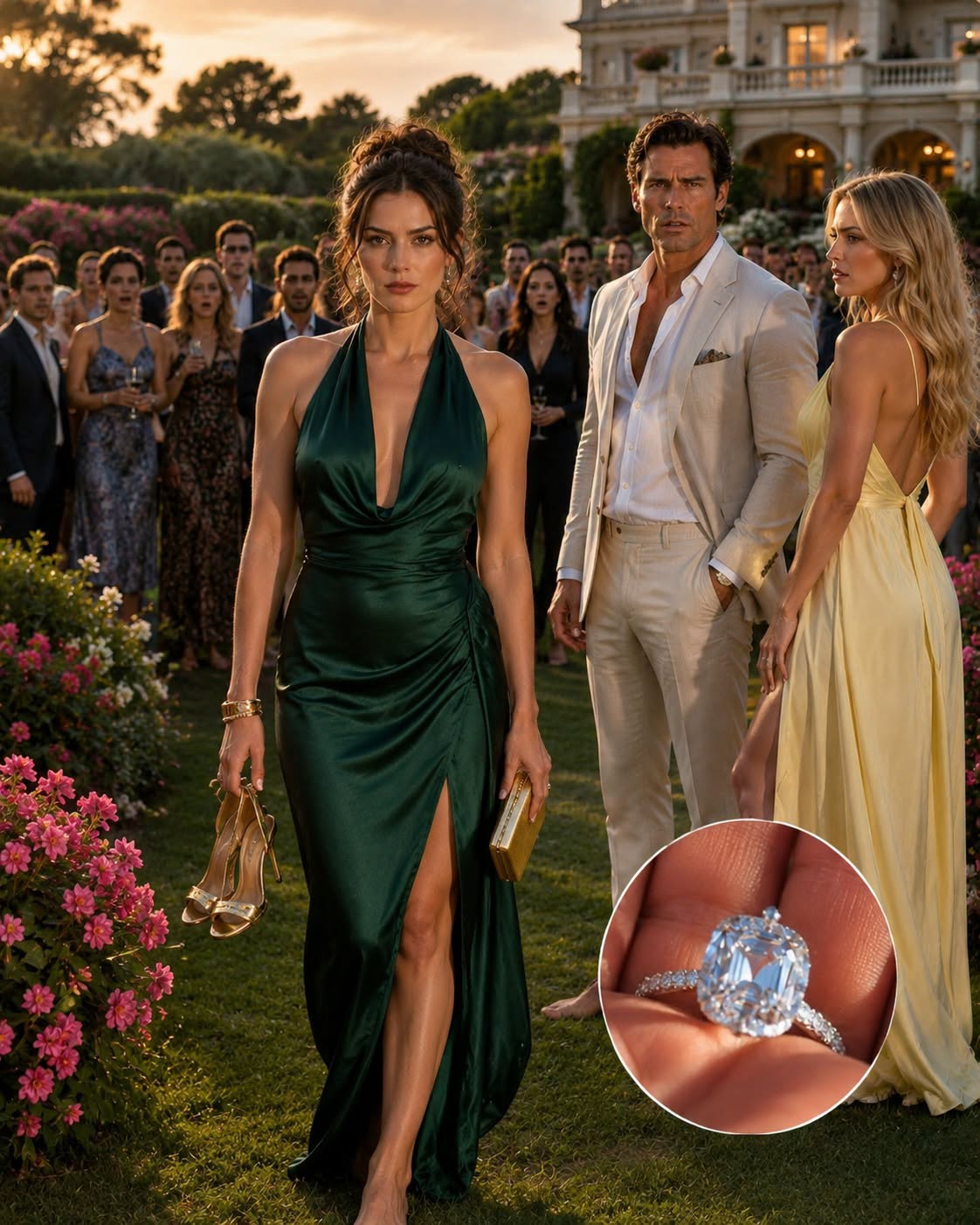
She Named My Shore. I Owned the Tide.
His mistress planted a sign on my private beach that said, “Future Mrs. Hawthorne’s Shore.”
Not on the public strip by the lighthouse.
Not near the resort where tourists left sunscreen fingerprints on rented glasses.
She planted it in the pale, quiet sand below Gray Harbor, the oceanfront estate my grandmother had left in a family trust before Grant Hawthorne had ever learned how to pronounce Sauvignon Blanc without sounding like he was asking for directions.
By the time I arrived, there were seventy-two guests on the beach, six silver champagne buckets, a string quartet playing under a linen canopy, and my husband standing barefoot beside another woman as if betrayal became classier when served at sunset.
He was pouring her champagne.
He was laughing with his head tilted back, the way he used to laugh before he learned that cruelty could be mistaken for confidence.
Someone had placed ivory roses along the dunes.
Someone had tied satin ribbons to the driftwood fence.
Someone had hired a photographer.
And someone, probably Sloane Mercer herself, had decided that my family’s shore needed a new name.
Future Mrs. Hawthorne’s Shore.
The words were painted in gold.
Of course they were.
Sloane never whispered when she could announce.
I stood at the top of the dune path in a black silk dress, holding my heels in one hand and my phone in the other.
Behind me, Everett Pike, the estate manager who had worked for my grandmother for twenty-nine years, looked at the party with the silent horror of a man watching someone pour red wine onto a white antique rug.
“Mrs. Hawthorne,” he said quietly, “security is ready.”
I watched my husband lift his glass to the crowd.
“Nora couldn’t join us tonight,” Grant announced, his voice bright and polished and false.
A few people turned toward him with sympathetic smiles.
“She’s still a little bitter about the transition.”
The transition.
That was what he called adultery now.
A transition.
Sloane placed one manicured hand over her stomach, though she was not far enough along to show anything but intention.
Grant kissed her temple in front of everyone.
A sound moved through the guests, half shock and half delight, because wealthy people love scandal as long as it arrives in good lighting.
I did not cry.
I did not scream.
I did not throw a glass or slap a face or ask him how he could do this to me.Preview
Women like me are raised in rooms where grief is served silently.
We learn to smile at luncheons after funerals.
We learn to thank people for coming while our ribs are still breaking.
We learn that composure is not weakness.
It is a locked door.
And I had been locking doors for months.
“Let’s go down,” I told Everett.
He offered me his arm.
I took it.
Then I walked barefoot down the sand toward the party my husband had thrown for his mistress on land he did not own.
Part 1: The Shore They Thought Was Empty
Gray Harbor had always been quiet at dusk.
The estate sat on the Rhode Island coast like an old secret, all gray shingles, black shutters, and hydrangeas the color of storm clouds.
My grandmother, Beatrice Whitcomb, used to say the house was not built to impress people.
It was built to outlast them.
She had inherited shipping money, turned it into commercial real estate, and then into the kind of private trust that made men lower their voices before saying her name.
She did not believe in fairy tales.
She believed in deeds, signatures, voting rights, and locked cabinets.
When I was eight, she taught me how to read a property line.
When I was twelve, she taught me how to read a balance sheet.
When I was twenty-three, the summer before she died, she took me down to the beach at low tide and pointed her cane toward the water.
“People will stand on what belongs to you and call it theirs,” she said.
“Do not argue with them in the sand, Eleanor.”
“Show them the papers.”
Only my grandmother called me Eleanor.
Everyone else called me Nora.
Grant used to call me love.
Then sweetheart.
Then Nora, with the tired impatience of a man who had already left a marriage but still enjoyed its privileges.
The first sign had been small.
Lipstick on a wineglass at our townhouse in Boston.
A hotel receipt folded into the inner pocket of his tuxedo after a charity gala in Manhattan.
A woman’s laugh in the background of a phone call he claimed came from his driver.
Then came Sloane Mercer.
She was twenty-eight, blonde in a way that looked expensive and hungry in a way that looked dangerous.
She had grown up in Dallas, moved to New York, and built a career teaching women online how to look rich enough to be forgiven.
Her Instagram was all silk scarves, yacht decks, diamond close-ups, and captions about feminine energy.
She called herself a brand consultant.
In truth, she studied lonely rich men until she could mirror the exact shape of their vanity.
Grant was easy.
Men who inherit names but not discipline are always easy.
He was forty-one, handsome in that polished New England way, with silver beginning at his temples and a smile designed for investor dinners.
The Hawthornes had once owned vineyards, hotels, and half of Newport society.
By the time I married Grant, they mostly owned stories about what they used to own.
His mother, Celeste Hawthorne, wore pearls to breakfast and spoke of “legacy” every time someone mentioned debt.
His father had left behind a wine company that bled cash under a label still powerful enough to open doors.
Grant needed liquidity.
I had it.
Or rather, my family trust had it.
He married me in a cathedral full of white orchids and candlelight while the society pages called it a union of two American dynasties.
The Hawthornes got stability.
The Whitcombs got, according to my grandmother’s old friends, “a handsome son-in-law with good bone structure and questionable financial instincts.”
I got love.
At least, I thought I did.
In the beginning, Grant looked at me as if I were a harbor after a storm.
He knew how to be tender when tenderness benefited him.
He wrote notes on thick cream paper.
He flew home early from Los Angeles because I had the flu.
He held my hand at my grandmother’s memorial and told me he would protect everything she built.
I believed him.
That was the part that humiliated me most.
Not the affair.
Not the photographs.
Not the mistress smiling under my sky.
It was remembering the softness I had mistaken for character.
The party invitation had gone out without my knowledge.
Gray Harbor Sunset Launch.
An Intimate Celebration of the Future Hawthorne Shore Club.
Hosted by Grant Hawthorne and Sloane Mercer.
I saw the invitation because Margo, our housekeeper, texted me at 4:17 p.m.
Mrs. Hawthorne, should I prepare the east guest wing for tonight’s party?
I stared at the message from the back seat of my car outside the Whitcomb Foundation office in Providence.
There was no party on my calendar.
There was no approved event at Gray Harbor.
There was no Hawthorne Shore Club.
I called Margo immediately.
Her voice was careful.
That was the first thing that told me it was worse than a misunderstanding.
“Mr. Hawthorne said you approved it,” she said.
“Did he?”
“Yes, ma’am.”
“And the guests?”
“They started arriving an hour ago.”
I closed my eyes.
“How many?”
“More than fifty.”
In the silence, I heard a gull cry through the phone.
Then Margo added, almost whispering, “There is a sign.”
I opened my eyes.
“What does it say?”
She hesitated.
“Margo.”
“It says Future Mrs. Hawthorne’s Shore.”
For three seconds, I felt nothing.
Then my heart made one clean, cold movement inside my chest, like a blade being drawn from silk.
I did not call Grant.
I did not call Sloane.
I called Everett.
“Meet me at the north dune path,” I said.
“Bring the deed binder.”
He did not ask which deed.
Everett knew.
Then I called my attorney.
The ocean was already gold when my car turned through the iron gates of Gray Harbor.
There were valet stands on the gravel drive.
There were rented lanterns along the lawn.
There were strangers laughing near my grandmother’s rose garden, holding champagne flutes that had been taken from my pantry.
A young man in a white jacket stepped toward the car, smiling.
“Welcome to the Hawthorne Shore Club event.”
I looked at him through the open window.
“This is not the Hawthorne Shore Club.”
His smile trembled.
I stepped out before he could answer.
Inside the house, someone had moved my grandmother’s portrait.
Not far.
Only three feet to the left to make room for a floral installation that spelled out H and S in white roses.
That hurt more than I expected.
Not because of the roses.
Because Grant knew.
He knew my grandmother’s portrait stayed above the north hall console because that was where she had stood on the day she signed the documents preserving Gray Harbor from sale, seizure, divorce, greed, and stupidity.
Especially stupidity.
I walked past the flowers without touching them.
Everett waited by the terrace doors with the deed binder under one arm.
He was in a navy suit, silver-haired, straight-backed, and furious in the dignified way of men who have spent decades protecting old houses from new money.
“Mrs. Hawthorne,” he said.
“Has anyone entered the study?”
“No.”
“Has anyone accessed the trust cabinets?”
“No.”
“Security cameras?”
“Recording.”
“Audio?”
“In common areas and exterior grounds, as posted.”
“Good.”
I could hear music from the beach.
A violin was playing something romantic enough to make the insult deliberate.
I looked through the terrace glass and saw Sloane in a white linen dress.
White.
She had dressed like a bride for my humiliation.
Grant stood beside her, one hand at the small of her back, guiding her through the crowd with the proud ownership of a man showing off a new yacht.
He had never guided me that way in public.
He preferred me composed, restrained, useful.
I was the wife who knew which donors hated each other.
The wife who remembered allergies.
The wife who could turn a failing dinner into a successful negotiation with a smile and a change of seating.
Sloane was the woman he could display.
I watched him bend down to murmur in her ear.
She laughed.
Then she looked up toward the house.
For one second, she saw me.
She did not look startled.
She smiled.
It was a small smile.
Not guilty.
Not nervous.
Victorious.
That was when I understood.
She had wanted me to come.
This was not just a party.
It was a coronation.
And I was the old queen she expected to leave through the servants’ entrance.
Everett opened the terrace door.
The wind came in, smelling of salt, roses, and champagne.
“Mrs. Hawthorne,” he said again, softer this time.
For the first time that evening, I looked at him not as my estate manager, but as the man who had known me since I was nine years old and missing both front teeth.
His eyes were kind.
That almost broke me.
Almost.
“Do I look angry?” I asked.
“No.”
“Good.”
“You look like your grandmother.”
I smiled.
“Then let’s not disappoint her.”
We walked down the stone steps together.
Part 2: The Wife He Mistook for Decoration
Grant used to say I made silence feel expensive.
He meant it as a compliment when we were newly married.
Later, he said the same thing like an accusation.
“You just sit there,” he snapped one night in our Boston dining room, six months before the beach party.
“You sit there in your perfect dress with your perfect posture and make me feel like a servant asking permission.”
I had been wearing navy wool.
No jewelry except my wedding ring.
The table between us held untouched sea bass, a candle burning too low, and the kind of silence that forms after love stops defending itself.
“I asked where you were,” I said.
“I told you. Meetings.”
“In Miami?”
“Yes.”
“With Sloane Mercer?”
His fork hit the plate.
That was the first time I said her name.
Not because it was the first time I knew.
Because it was the first time I wanted him to know that I knew.
Grant leaned back in his chair.
He looked almost relieved.
Men like Grant prefer being caught to being questioned.
Being caught lets them perform.
“Nora,” he said, using that exhausted voice.
The voice that made me feel like a schedule conflict.
“Don’t make this ugly.”
I remember looking at the candle.
The flame did not move.
“I didn’t make this.”
He laughed once.
Coldly.
“No. You just made it impossible to survive.”
That was his story.
I had made the marriage elegant and airless.
I had made him feel small by being competent.
I had forced him toward another woman because I expected loyalty from a husband who had been raised to confuse appetite with destiny.
Sloane, apparently, made him feel alive.
I made him feel audited.
He did not say the affair was over.
He did not apologize.
Instead, he stood, poured himself Scotch from my grandfather’s decanter, and told me that divorce could be civilized if I did not embarrass both families.
That was the night I stopped asking questions and started making copies.
The thing people forget about betrayed wives is that we are not always surprised.
Sometimes we are accountants of pain long before the invoice arrives.
I knew about the Miami suite.
I knew about the Cartier bracelet.
I knew about the apartment in Tribeca he had placed under a consulting company.
I knew Sloane had begun calling herself “SMH” in monogrammed stationery.
Sloane Mercer Hawthorne.
She was practicing my life before he had finished destroying it.
I knew because betrayal is loud when a man thinks his wife is too dignified to listen.
Grant left credit card trails.
He used company cars.
He let Sloane post reflections of his face in hotel mirrors, his watch on breakfast trays, his hand around a champagne bottle aboard a yacht off Nantucket.
She never showed him completely.
She did not need to.
She was not posting for strangers.
She was posting for me.
At first, I collected evidence because my lawyer told me to.
Then I collected it because each screenshot reminded me not to soften.
The prenup was simple.
My grandmother had insisted on it.
Grant’s mother had smiled through the negotiation, thinking the document existed to protect Hawthorne assets from Whitcomb ambition.
That was how old families comfort themselves.
They call need pride.
They call dependence tradition.
They never imagine the woman across the table has read the footnotes.
The agreement had an infidelity clause.
If either party engaged in an extramarital relationship and used marital, company, or trust-adjacent assets to support it, the offending party forfeited claims to spousal support, certain shared acquisitions, and any right of occupancy in Whitcomb-controlled residences.
There was also a reputation clause.
A conduct clause.
A confidentiality clause.
And my grandmother’s favorite, Section 14(c), which stated that any attempt to misrepresent ownership, control, or title of Whitcomb Trust property for personal, romantic, commercial, or promotional purposes would trigger immediate revocation of access.
Grant had signed it without reading closely.
He was in love then.
Or he was in a hurry.
Both make men careless.
But the prenup was only one piece.
There was also Hawthorne Cellars.
That was the secret Grant did not know I knew.
Three years before the party, the company had nearly collapsed after a failed expansion into luxury resorts.
Grant had borrowed against inventory, trademarks, future distribution, even the family’s vineyard land in California.
The banks grew nervous.
His mother grew theatrical.
Grant grew desperate.
So my family office, through a quiet holding company called Argent Tide, bought the distressed notes.
Later, when the debt converted, Argent Tide took a controlling position.
Grant believed an anonymous investment group had saved Hawthorne Cellars because they respected the brand.
In reality, my trust had saved him.
I had saved him.
Not because he deserved it, but because at the time I thought a marriage was something you repaired quietly.
My name was not on the paperwork he saw.
That was intentional.
My grandmother had taught me that visible power attracts performance.
Hidden power attracts truth.
Grant gave me plenty of truth.
He told me I was frigid after I lost the pregnancy.
He told me women like Sloane did not make men feel like failures.
He told his mother I had become emotionally unstable.
He told our friends I was taking time away from public life.
He told donors at a hospital gala that I was “recovering beautifully” while I stood five feet away with a glass of mineral water and a body still aching from the miscarriage he had missed.
He had missed it because he was in Palm Beach with Sloane.
The hospital room had been white and cold.
The nurse had asked who she should call.
I said my husband.
Grant did not answer.
For eight hours, I lay beneath a cotton blanket while machines hummed softly and my phone stayed dark.
At 2:13 a.m., he texted.
Sorry. Board dinner ran late. You okay?
I stared at the message until the screen blurred.
Then I turned the phone face down.
That was the last night I needed him.
Not the last night I loved him.
Love dies slower than need.
But need is the chain.
When it breaks, even grief becomes spacious.
By the time Sloane planted that sign, I had already filed certain documents with my attorney.
Not divorce papers.
Not yet.
Grant expected divorce papers.
He was prepared for tears, negotiations, reputation management, perhaps a generous settlement if I behaved.
He had no idea I was not preparing to leave him.
I was preparing to remove him.
There is a difference.
Leaving is emotional.
Removal is structural.
And structure was my inheritance.
The week before the beach party, I received an envelope from a private investigator named Dean Alvarez, a former federal agent who now specialized in rich people behaving badly.
Inside were photographs, invoices, and one transcript from a recorded investor dinner at the Markham Club in Manhattan.
Sloane had been there.
Grant had introduced her as his future wife.
Not partner.
Not companion.
Future wife.
He told the room Hawthorne Cellars would soon announce a lifestyle division using coastal properties, private memberships, wine events, and luxury retreats.
He said Gray Harbor would be “the jewel.”
He said the Whitcomb estate would “finally enter the Hawthorne legacy.”
One investor asked if his current wife approved.
Grant laughed.
“My wife has always preferred paperwork to people,” he said.
The room laughed with him.
Then Sloane lifted her glass and said, “Don’t worry. By summer, the beach will have a new Mrs. Hawthorne.”
That was the line that made my attorney go still.
Not because it hurt me.
Because it created intent.
Fraud usually enters a room wearing confidence.
Grant had already drafted promotional materials.
Sloane had registered a limited liability company called Hawthorne Shore Club.
The business address was Gray Harbor.
My address.
My grandmother’s address.
The company website was not public yet, but the landing page had been staged.
Membership begins where legacy meets desire.
Below the text was a photograph of my beach.
A photograph taken from my terrace.
I printed it and placed it in a folder marked trespass.
Then I placed the folder in my desk drawer.
Then I went to bed.
People think revenge tastes like fire.
It does not.
Real revenge tastes like ice water at midnight.
Clear.
Quiet.
Necessary.
Part 3: Future Mrs. Hawthorne Meets Mrs. Hawthorne
The sand was cool under my feet.
Every step down the dune path carried me deeper into the scene Grant had built to erase me.
Guests turned as I approached.
First one.
Then three.
Then the whole party shifted, the way a flock of birds feels weather before humans do.
The string quartet faltered.
A violin note stretched too long and died in the air.
Sloane saw me coming and straightened her shoulders.
She was beautiful.
I can admit that now without flinching.
Her hair was pinned loosely at the nape of her neck.
Her dress moved like water.
At her throat, she wore a diamond pendant Grant had told me was being repaired for his mother.
On her left hand, she wore a ring.
Not an engagement ring, she wanted people to think.
A declaration.
A square-cut diamond set between two sapphires.
My grandmother’s ring.
For a moment, the beach disappeared.
All I saw was Beatrice Whitcomb’s hand resting on a silver cane, that ring catching the light as she signed documents men prayed she would not understand.
Grant had taken it from the blue velvet case in my dressing room.
Not borrowed.
Not inherited.
Taken.
I felt something inside me go utterly still.
It was not rage.
Rage moves.
This was deeper.
This was the floor dropping out and revealing steel beneath.
Grant finally saw me.
His smile tightened, then returned.
He was good.
I will give him that.
He walked toward me with the relaxed charm he used when a waiter brought the wrong wine in front of important people.
“Nora,” he said warmly.
As if I were late to a dinner, not arriving at my own public execution.
“I’m glad you decided to join us.”
I stopped three feet from him.
Three feet is important.
Close enough to hear.
Far enough not to be touched.
“I wasn’t invited.”
The guests went silent.
Grant’s jaw flexed.
“Don’t start.”
I looked past him at Sloane.
She was smiling again, but her fingers had curled around the stem of her champagne glass.
“Mrs. Hawthorne,” she said.
She said it sweetly.
She said it as if the title already smelled stale.
“Which one?” I asked.
A low ripple passed through the guests.
Grant’s face hardened.
Sloane recovered first.
“I’m sorry this is painful for you.”
“No, you’re not.”
Her smile flickered.
I looked at the sign.
Future Mrs. Hawthorne’s Shore.
The gold paint shimmered under the sinking sun.
“Who put that there?”
Sloane raised her chin.
“I did.”
“Did you?”
Grant stepped between us.
“This is unnecessary.”
“I agree.”
His shoulders loosened slightly.
He thought I meant the confrontation.
I meant the sign.
“This land is part of the Whitcomb Coastal Trust,” I said.
“The beach, the dune path, the terrace, the east lawn, the guest wing, the road you all used to arrive, and the house behind you belong to that trust.”
Someone near the bar whispered, “Oh my God.”
Grant laughed under his breath.
It was an ugly little sound.
“Nora, don’t be dramatic. We’re married.”
“Yes.”
I looked at him.
“We are.”
He lowered his voice.
“You’re embarrassing yourself.”
“No, Grant.”
I glanced toward the photographer, who had stopped taking pictures but had not stopped listening.
“You did that when you threw an engagement party for your mistress on property you have no right to use.”
The word mistress landed hard.
Sloane’s cheeks flushed.
Grant stepped closer.
“I told you this would be easier if you accepted reality.”
“What reality is that?”
“That this marriage is over.”
The pain came then.
Not loudly.
Not visibly.
Just a slow bloom behind my ribs.
Seven years reduced to a sentence on a beach.
I let myself feel it for one breath.
Only one.
Then I folded it away.
“You’re right,” I said.
Grant blinked.
He had expected resistance.
Begging, perhaps.
Or cold negotiation.
Not agreement.
I turned to Everett.
He opened the deed binder.
There was something wonderfully theatrical about paper in that moment.
No shouting could have matched it.
No insult could have cut deeper than Everett placing a certified copy of the trust deed on a cocktail table between two champagne buckets.
“This is the recorded deed for Gray Harbor and its coastal parcel,” I said.
“For clarity, the trust has never transferred, leased, licensed, or granted naming rights to Grant Hawthorne, Sloane Mercer, Hawthorne Cellars, Hawthorne Shore Club LLC, or any person standing on this beach tonight.”
The party had gone so quiet I could hear the water pulling stones beneath the surf.
Sloane looked at Grant.
Grant did not look at her.
That was when she first understood he had sold her a stage he did not own.
“Grant said this was his family property,” she said.
Her voice had lost its honey.
“Grant says many things.”
Grant pointed at Everett.
“Get him out of here.”
Everett did not move.
I almost laughed.
“You cannot order my estate manager off my estate.”
His face flushed dark.
“Your estate?”
“My trust’s estate.”
“It’s marital property.”
“No.”
I let the word hang.
Then I gave him the kindest smile I had left.
“It was never marital property.”
Sloane’s eyes darted to the guests.
She could survive being disliked.
She could not survive being made ridiculous.
“This is still a private event,” she said sharply.
“No,” I said.
“It is now evidence.”
That word did what humiliation could not.
It sobered the rich.
One by one, guests began looking at their phones, their spouses, the path back to the house.
Grant’s voice dropped.
“Nora.”
There it was.
The warning.
The plea disguised as a command.
I looked at him and saw the man from the cathedral.
The man from the hospital room.
The man from the dining table.
The man pouring champagne for another woman under my grandmother’s sky.
And finally, I saw him clearly.
Not as the villain of my life.
As a trespasser.
“Everett,” I said.
“Yes, Mrs. Hawthorne.”
“Remove the sign.”
Two security guards in navy jackets walked down from the dune path.
Sloane stepped in front of the sign.
“Don’t touch it.”
One guard paused.
I looked at her.
“That sign is installed on protected dune-adjacent trust property without permission.”
“It’s just a sign.”
“It is also a false commercial representation and, given the photographs being taken, part of a documented attempt to misappropriate trust property for a private venture.”
She stared at me.
For the first time, she looked her age.
Young.
Scared.
Mean.
Grant moved toward me.
“You vindictive—”
“Careful,” I said.
He stopped.
Not because he respected me.
Because the cameras were still rolling.
I nodded to security.
They pulled the sign from the sand.
It came loose with a soft wooden crack.
Sloane flinched as if they had removed a crown from her head.
I turned to the crowd.
“Ladies and gentlemen, Gray Harbor is closed for the evening.”
No one moved at first.
Wealthy people are not used to being dismissed unless someone is dead or dinner is over.
“The cars will be brought around,” I continued.
“Any photographs taken on trust property tonight may be requested in connection with pending legal action.”
That worked.
The party dissolved like sugar in hot tea.
Guests gathered shoes, wraps, handbags, dignity.
The quartet packed silently.
The bartender looked relieved.
A woman I knew from the Preservation Society touched my arm as she passed.
“Nora,” she whispered.
I looked at her.
She lowered her eyes and kept walking.
That, somehow, hurt too.
Not because she left.
Because she had known.
So many people had known enough to come.
Grant watched the guests climb the dune path.
His face had gone empty.
When the last champagne bucket was lifted away, only three of us remained near the water.
Me.
My husband.
His future wife.
Sloane’s bare feet were sinking slightly into the sand.
She looked at Grant.
“Do something.”
He looked at me.
“Nora, we need to talk privately.”
I smiled faintly.
“Now you want privacy?”
He swallowed.
The wind moved through his shirt.
Sloane lifted her hand, and my grandmother’s ring caught the last orange light of the sun.
I looked at it.
“Take off the ring.”
Her hand closed.
“No.”
Grant said my name sharply.
I took one step toward Sloane.
“That ring is not Grant’s to give.”
“He said it was a family heirloom.”
“It is.”
I held her gaze.
“Mine.”
Silence.
Then Sloane looked at Grant.
His mouth opened.
Nothing came out.
It was the first honest thing he had said all evening.
I extended my hand.
“Take it off.”
Her eyes filled with hatred.
Not shame.
Hatred.
Women like Sloane do not hate men who lie to them.
They hate women who prove it.
Slowly, she pulled the ring from her finger.
She dropped it into my palm.
It was warm from her skin.
I closed my fingers around it.
Then I looked at Grant.
He looked older already.
I said, “Remove the sign. Then the guests. Then him.”
Everett nodded once.
Security stepped forward.
Grant stared at me as if I had slapped him.
“You can’t throw me out of my own marriage.”
“No,” I said.
“But I can revoke access to trust property.”
“This is insane.”
“No, Grant.”
I looked at the empty beach, the trampled roses, the champagne stains darkening the sand.
“This is documented.”
Part 4: The Tide Turns in a Room Without an Ocean View
The next morning, my face was on the internet.
Not crying.
Not screaming.
Not collapsing into the surf.
Walking down the beach in black silk while my husband’s mistress stood beside a sign that made half of America choose a side before breakfast.
Someone had leaked a clip.
Not me.
I would have chosen better lighting.
The video began with Grant saying, “Nora couldn’t join us tonight. She’s still a little bitter about the transition.”
Then the camera panned just in time to catch me descending the dune path with Everett and the deed binder.
By noon, the comments had turned brutal.
Future Mrs. Hawthorne’s Shore became a meme.
People stitched it with videos of women standing in front of houses they owned, cars they paid for, businesses they built.
One woman held up a mortgage statement and said, “Future Mrs. Johnson’s Kitchen? Baby, I am the bank.”
Another stood in a cornfield and said, “He said it was his farm. My granddaddy said otherwise.”
The internet is cruel.
For once, it was not cruel to me.
Grant called thirty-seven times before 10 a.m.
I did not answer.
Sloane posted one statement.
Out of respect for all parties, I ask for privacy during this deeply personal transition.
It stayed up for nineteen minutes before people filled the comments with deed jokes.
Then she deleted her account.
I spent the morning in Providence, in a conference room with no ocean view, wearing a cream suit and my grandmother’s ring.
Across from me sat my attorney, Lydia Crane.
Lydia was sixty, brilliant, and famous for making men regret underestimating quiet women.
Beside her was a litigation partner, a forensic accountant, and Dean Alvarez, the investigator.
At the far end of the table sat Grant, his attorney, his mother Celeste, and the family’s corporate counsel.
Celeste wore pearls the size of small moons and a navy dress that made grief look hereditary.
She did not look at me when I entered.
Grant did.
He looked like he had not slept.
Good.
There are some lessons rest should not soften.
Lydia opened the folder in front of her.
“Thank you all for coming on short notice.”
Grant’s lawyer cleared his throat.
“We are here voluntarily and without waiving any rights.”
“Of course,” Lydia said.
She smiled.
Lawyers smile before surgery.
“We’ll begin with Gray Harbor.”
Celeste finally spoke.
“This family has been through enough public embarrassment.”
I looked at her.
“So has mine.”
Her eyes sharpened.
“Nora, dear, no one wanted this.”
That was Celeste’s gift.
She could turn a knife into weather.
As if betrayal had simply happened, like rain.
I placed my handbag on the table.
“Your son hosted a commercial event with his mistress on my family’s trust property and announced a business venture using assets he does not own.”
Grant leaned forward.
“It wasn’t commercial.”
Lydia slid a document across the table.
“Hawthorne Shore Club LLC, registered in Delaware eight weeks ago.”
Another document.
“Draft membership deck.”
Another.
“Projected revenue from Gray Harbor launch event.”
Another.
“Wire transfer from Hawthorne Cellars marketing account to Mercer Brand Strategy.”
The room changed temperature.
Grant looked at the document.
Then at Sloane’s empty chair.
She had not come.
Smart woman.
Or cowardly.
Sometimes those look the same from a distance.
Grant’s attorney began reading.
Celeste’s lips pressed together.
Lydia continued.
“Mr. Hawthorne, did you authorize company funds for last night’s event?”
Grant said nothing.
His attorney answered.
“We will review.”
“Please do.”
Lydia opened another folder.
“We will also review the use of Mrs. Hawthorne’s image and reputation in investor communications.”
Grant’s eyes snapped to mine.
“What does that mean?”
Dean Alvarez placed a transcript on the table.
The Markham Club dinner.
Grant’s face drained slowly as he read his own words.
My wife has always preferred paperwork to people.
The beach will have a new Mrs. Hawthorne.
The Whitcomb estate will finally enter the Hawthorne legacy.
He looked up.
“You recorded a private dinner?”
Dean spoke calmly.
“The venue records certain rooms for security purposes, with disclosure in the membership agreement. A guest provided the transcript voluntarily after your remarks became relevant to financial solicitation.”
Grant’s lawyer closed his eyes briefly.
Celeste looked at her son with something worse than anger.
Calculation.
She was no longer asking whether he had hurt me.
She was asking how much he had cost them.
That was the Hawthorne way.
Lydia moved on.
“Now to the marital agreement.”
Grant laughed once.
It sounded broken.
“You’re really going to use the prenup?”
“No,” I said.
“You used it.”
He stared at me.
“You made every clause relevant.”
Lydia did not need to raise her voice.
That was why I liked her.
“Section 9: infidelity involving marital or company funds.”
She placed invoices on the table.
“Section 11: reputational harm connected to public misrepresentation.”
She placed screenshots on the table.
“Section 14(c): unauthorized use or attempted use of Whitcomb Trust property for personal, romantic, commercial, or promotional purposes.”
She placed the beach photographs on the table.
The sign gleamed obscenely even on paper.
“Section 17: revocation of residency and access to trust-controlled homes upon breach.”
Grant’s attorney finally spoke.
“Mrs. Hawthorne is escalating emotionally.”
I looked at him.
“No.”
I tapped the folder.
“I’m escalating contractually.”
For the first time that day, Lydia almost smiled.
Then came the ring.
A photograph from my dressing room safe.
A copy of the trust inventory.
A security log showing Grant entering the dressing suite while I was in Providence.
A close-up from Sloane’s own party photographs, the diamond bright on her finger.
Celeste looked at the image and went pale.
She recognized the ring.
Everyone in our circle knew that ring.
It had been on my grandmother’s hand when she faced down a board of men trying to force a sale of the Whitcomb docks in 1987.
It was not jewelry.
It was history.
Grant whispered, “I was going to put it back.”
“You gave it to another woman.”
“I needed something meaningful.”
The sentence sat there, monstrous and small.
Something meaningful.
As if meaning were an object he could steal when he ran out of sincerity.
I leaned forward.
“Do you understand what you did?”
For one second, I saw him almost answer as a husband.
Then pride returned.
“I made a mistake.”
“No.”
I shook my head.
“A mistake is forgetting a birthday.”
I picked up the photograph of Sloane’s hand.
“This is theft wearing romance.”
Celeste’s voice cut in.
“Grant, tell me there is no police report.”
I looked at her.
“Not yet.”
That was the first time Grant looked afraid.
Real fear does not make men loud.
It makes them young.
He turned to me.
“Nora, please.”
There it was.
The first please.
Not at the hospital.
Not at the dining table.
Not on the beach.
Here.
In a conference room.
When money entered the room with a witness.
I felt no triumph.
That surprised me.
I had imagined victory would feel like champagne.
It felt more like closing a window before a storm came in.
Lydia slid the final folder forward.
“Now, Hawthorne Cellars.”
Grant stiffened.
“This meeting isn’t about the company.”
“It is now,” I said.
His attorney frowned.
“Mrs. Hawthorne has no standing in Hawthorne Cellars management.”
Lydia looked at me.
I nodded.
She opened the folder.
“Argent Tide Holdings currently owns sixty-one percent of Hawthorne Cellars voting shares through debt conversion instruments executed over the last thirty-four months.”
The corporate counsel went still.
Grant stared at Lydia.
“What?”
Celeste’s hand tightened around her pen.
Lydia continued.
“Argent Tide is wholly owned by the Whitcomb Coastal Trust.”
I watched Grant understand in pieces.
First the company.
Then the debt.
Then the meetings where he had complained about me while sitting beneath the roof my money had kept from collapsing.
Then the investor dinners.
Then the way he had spoken about my paperwork.
His eyes found mine.
“You?”
“Yes.”
“You bought my company?”
“I saved it.”
He looked as if I had struck him harder than any insult could.
Men like Grant can survive being hated.
They cannot survive owing everything to the woman they called small.
Celeste’s voice was barely audible.
“How long?”
“Long enough,” I said.
The corporate counsel started flipping through pages.
He was looking for a loophole.
There was none.
My grandmother had trained better lawyers than his.
Lydia said, “The board has been notified of misconduct, misuse of corporate funds, and reputational exposure created by Mr. Hawthorne’s personal actions and unauthorized commercial representations.”
Grant stood so abruptly his chair hit the wall.
“You can’t remove me.”
I looked up at him.
His face was red.
His hands were shaking.
There had been a time when that would have made me reach for him.
There had been a time when I would have cared that he was falling apart.
But women are not born cold.
We are cooled.
Slowly.
By empty hospital rooms.
By public smiles.
By men who confuse our patience for permission.
“You are suspended pending board review,” I said.
His mouth opened.
No sound came.
“And Grant?”
He looked at me.
“The company car was collected this morning.”
Celeste closed her eyes.
That was how I knew the blow landed.
Not the beach.
Not Sloane.
The car.
Status has strange gods.
Grant sat down slowly.
His attorney whispered to him.
Celeste turned to me at last.
“Nora, surely we can settle this quietly.”
I studied her.
For seven years, Celeste Hawthorne had corrected my flower arrangements, my seating charts, my charitable priorities, my pronunciation of French villages she had never visited.
For seven years, she had called me dear with the warmth of a locked gate.
For seven years, she had accepted my money while mourning that her son had married beneath the romance he deserved.
“Quietly?” I asked.
“Yes.”
Her voice softened.
“For the sake of the family.”
I smiled.
“There it is.”
She blinked.
“The family.”
I placed both hands flat on the table.
“Your family wanted my silence when Grant missed my miscarriage.”
Grant flinched.
“Your family wanted my money when the company failed.”
Celeste looked away.
“Your family wanted my house for Sloane’s launch.”
The room did not move.
“So no, Celeste.”
My voice stayed calm.
“We will not confuse your comfort with dignity.”
Lydia closed the folder.
“Mrs. Hawthorne’s terms have been delivered.”
Grant looked at me.
“What terms?”
“Divorce under the prenup,” I said.
“Immediate departure from all Whitcomb properties.”
“Resignation from executive duties pending investigation.”
“Return of all trust property.”
“Full reimbursement of company funds used in connection with Ms. Mercer.”
“Public clarification that Gray Harbor, the beach, and all related marks were never Hawthorne assets.”
He stared.
“That will ruin me.”
I did not say what he deserved.
I did not say what he had ruined.
I simply stood.
“No, Grant.”
I picked up my handbag.
“You did that before I entered the room.”
Part 5: The Man Who Arrived Too Late
The rain came three nights later.
Not dramatic rain.
Not movie rain.
Cold coastal rain that tapped against the windows of Gray Harbor and turned the terrace stones black.
I was in my grandmother’s study, sorting through trust correspondence, when Margo knocked softly.
“Mrs. Hawthorne,” she said.
I looked up.
“Mr. Hawthorne is at the gate.”
Of course he was.
Men like Grant never arrive for the breaking.
Only the consequences.
I looked toward the window.
Beyond the glass, the ocean was invisible, but I could hear it.
“Is he alone?”
“Yes.”
“Has he been drinking?”
“Security says no.”
“Let him through to the north porch.”
Margo hesitated.
“Not inside?”
“No.”
Inside was for people who had not tried to give my home to another woman.
I found Grant under the porch light, soaked at the shoulders, his hair dark from rain.
He looked less handsome without the architecture of power around him.
No valet.
No champagne.
No mother.
No mistress.
Just a man standing outside a locked house.
There was a time when the sight would have undone me.
That time had passed, but not without leaving scars.
He saw me through the glass door.
For a second, neither of us moved.
Then I opened it.
The cold air entered first.
“Nora,” he said.
His voice was hoarse.
“Grant.”
He looked behind me, into the warm hall, the old paintings, the polished floor.
His eyes lingered on the place he had treated as his by proximity.
“I need to come in.”
“No.”
“I just want to talk.”
“You can talk from there.”
Rain ran from the porch roof behind him.
He swallowed.
“Sloane left.”
I almost laughed, but the sound would have been too cruel, and cruelty was his language.
I refused to borrow it.
“She sent a statement through her lawyer,” he said.
“She claims I misrepresented my assets.”
I said nothing.
“She said she never would have hosted the event if she’d known.”
That time, I did laugh.
Softly.
Grant winced.
“She knew enough.”
He looked down.
“She’s pregnant.”
I waited.
His face twisted.
“I don’t know if it’s mine.”
There are moments when life offers you a perfect revenge line.
A sentence so sharp it could carve your name into someone else’s regret.
I could have asked if he felt alive now.
I could have asked if the transition was difficult.
I could have asked whether paperwork looked more appealing when paternity became uncertain.
Instead, I said, “That child deserves better than this mess.”
Grant looked up quickly.
Shame moved through his expression.
Real shame.
Too late, but real.
“I destroyed everything.”
“Yes.”
He closed his eyes.
“I loved you.”
The words hit somewhere old.
Not deep.
Just old.
Like touching a bruise you forgot was there.
“No,” I said.
His eyes opened.
“You loved being rescued by me.”
He flinched.
“You loved the rooms I could open, the checks I could sign, the calm I created around your chaos.”
My voice did not rise.
“You loved me best when I was useful and quiet.”
“That’s not fair.”
“It is exact.”
He looked past me again.
The house glowed behind my shoulder.
My grandmother’s portrait watched from the hall, restored to its proper place.
“I thought you’d always be there,” he said.
That was the closest he came to truth.
Not I thought you loved me.
Not I thought we could fix it.
I thought you’d always be there.
The entitlement of it was almost pure.
“I was,” I said.
“For years.”
His mouth trembled.
“I’m sorry.”
Rain softened the edges of his face.
He looked like the man I had married for half a second.
Then lightning flashed far out over the water, and the illusion was gone.
“I know,” I said.
He breathed out as if forgiveness might follow.
It did not.
“I believe you are sorry now,” I continued.
“Because now it hurts you.”
He stared at me.
The sentence landed quietly.
That made it worse.
He stepped closer to the threshold.
“Nora, please. Don’t do this so publicly.”
I looked at him for a long moment.
Then I stepped back and opened the door wider.
Hope flashed across his face.
Poor Grant.
Still mistaking openings for invitations.
I reached to the small table beside the door and picked up a cardboard box.
Inside were his watches, cufflinks, passport, gym bag, and the framed photograph from our wedding that had sat on his desk.
I handed it to him.
He took the box automatically.
“This is what was left in the east dressing room,” I said.
“Anything else will be handled through counsel.”
He looked down at the photograph.
We were smiling in front of the cathedral.
I remembered that day.
The weight of the dress.
The smell of lilies.
Grant’s hand warm around mine.
My grandmother leaning close before I walked down the aisle.
“Love him,” she had whispered.
“But keep your name on what is yours.”
I had laughed then.
I was young enough to think love made such warnings unnecessary.
Grant touched the edge of the frame.
“Do you hate me?”
I considered the question.
Hate is intimate.
Hate keeps a chair at the table.
“No,” I said.
His face crumpled slightly, as if mercy hurt more than anger.
“I don’t hate you.”
I looked beyond him, past the porch, toward the sound of the tide.
“I am finished carrying you.”
He nodded, but I do not think he understood.
Not fully.
Men like Grant understand loss first as inconvenience.
Then as humiliation.
Only much later, if they are lucky, as grief.
I closed the door.
This time, I locked it.
The divorce took nine months.
People called it brutal because I did not decorate my pain for public sympathy.
I did not give interviews.
I did not leak crying photos.
I did not appear in a black veil outside court.
I went to meetings.
I signed documents.
I let Lydia speak.
The footage from the beach did enough talking for all of us.
Grant resigned from Hawthorne Cellars after the board investigation confirmed improper use of corporate funds.
Celeste tried to spin it as a sabbatical.
The board called it a separation.
The shareholders called it overdue.
Argent Tide installed a new CEO, a woman from Napa with steel-gray hair and no patience for men who treated vineyards like family props.
Within six months, Hawthorne Cellars stopped selling fantasy and started selling wine again.
Sloane Mercer reappeared online under her maiden name, then disappeared after one brand partner was asked why it had hired someone involved in an alleged property misrepresentation dispute.
The baby was born in Dallas.
Not Grant’s.
I know because his attorney brought it up during settlement discussions, as if biology could reduce liability.
It did not.
Grant moved to a leased apartment in Back Bay.
No ocean view.
I did not ask who paid the rent.
There are victories too small to examine.
At the final divorce hearing, the courtroom smelled of old wood and raincoats.
Grant sat two tables away in a charcoal suit that no longer fit him as well.
He looked thinner.
His hands were folded.
No watch.
I wore gray.
My grandmother’s ring rested on my finger, restored, cleaned, and properly insured.
The judge reviewed the settlement.
The prenup held.
The trust held.
The occupancy revocation held.
The reimbursement schedule held.
The public clarification had already been issued.
Grant Hawthorne acknowledged that Gray Harbor and its coastal parcel had never been owned, controlled, or commercially available through him, Hawthorne Cellars, or any affiliated entity.
The statement was dry.
Perfectly dry.
The kind of dryness that ruins men who survive on implication.
When the judge finalized the divorce, Grant turned slightly.
For a moment, I thought he would speak.
I think he wanted to.
Maybe he wanted to apologize again.
Maybe he wanted to ask whether any part of us had been real.
Maybe he wanted to say he had been a fool.
But the bailiff opened the door.
People stood.
The moment passed.
Outside the courthouse, reporters waited beneath black umbrellas.
Lydia asked if I wanted to leave through the side entrance.
I looked at the front steps.
For months, everyone had watched me descend a dune path into humiliation.
It felt right that they should also watch me walk out of a courthouse intact.
“No,” I said.
“We’ll use the front.”
Camera shutters clicked.
A reporter called, “Mrs. Whitcomb, how do you feel today?”
Not Mrs. Hawthorne.
Mrs. Whitcomb.
The name settled over me like a coat returned from storage.
I paused at the bottom step.
The old me would have said no comment.
The wounded me would have said something sharp enough to trend by dinner.
The woman I had become did not need either.
“I feel grateful for good lawyers,” I said.
Lydia laughed beside me.
The clip went viral anyway.
That spring, Gray Harbor reopened for the Whitcomb Foundation’s coastal preservation dinner.
Not a gala.
I had lost my appetite for chandeliers pretending to be stars.
We held it outside, above the dunes, with long wooden tables, hurricane lamps, local oysters, and blankets folded over the backs of chairs.
No ivory roses.
No monograms.
No rented fantasy.
Just salt air, honest food, and people who knew better than to arrive without an invitation.
At sunset, Everett walked with me down to the beach.
The sand had recovered from the party.
It always does.
That is what people forget about shorelines.
They look delicate, but they know how to erase footprints.
Near the dune path, a new sign had been installed.
Small.
Cedar.
Unpainted except for dark carved letters.
Whitcomb Shore.
Protected by Trust.
I stood before it for a long time.
Everett cleared his throat.
“Too plain?”
“No.”
I touched the edge of the wood.
“It’s exactly right.”
He nodded.
Then he walked back toward the house, leaving me alone with the tide.
The sky was pink and silver.
The water moved in steady lines.
For the first time in years, I did not feel like I was waiting for someone to come home, explain, apologize, choose, confess, or leave.
The quiet belonged to me.
Not because a court said so.
Not because a deed said so.
Because I had finally stopped offering my peace as a room other people could enter without knocking.
I thought about the woman I had been on that hospital bed, staring at a phone that would not ring.
I thought about the woman at the dining table, listening to her husband call her impossible to survive.
I thought about the woman at the top of the dune path, holding her heels, watching a mistress smile under stolen lights.
I wished I could go back and take her hand.
I wished I could tell her she was not weak for loving him.
She was not foolish for trusting.
She was not cold for surviving.
She was simply becoming the person who would one day walk down the sand and take everything back without raising her voice.
Behind me, laughter drifted from the dinner.
Warm laughter.
Safe laughter.
Margo was probably scolding the caterers.
Lydia was probably terrifying a donor into increasing his pledge.
Everett was probably checking the lanterns.
Life had continued without asking Grant’s permission.
That was the sweetest justice of all.
Not that he lost me.
Not that she lost the shore.
Not that the internet mocked the sign until it became a cautionary tale with background music.
The sweetest justice was this.
I was no longer standing in the wreckage of what he did.
I was standing on what had always been mine.
The tide came in slowly, silver over dark sand.
It reached the place where Sloane’s sign had been planted and covered every mark.
By morning, no one would know it had ever stood there.
I looked at the water and smiled.
She had named the shore.
But I owned the tide.