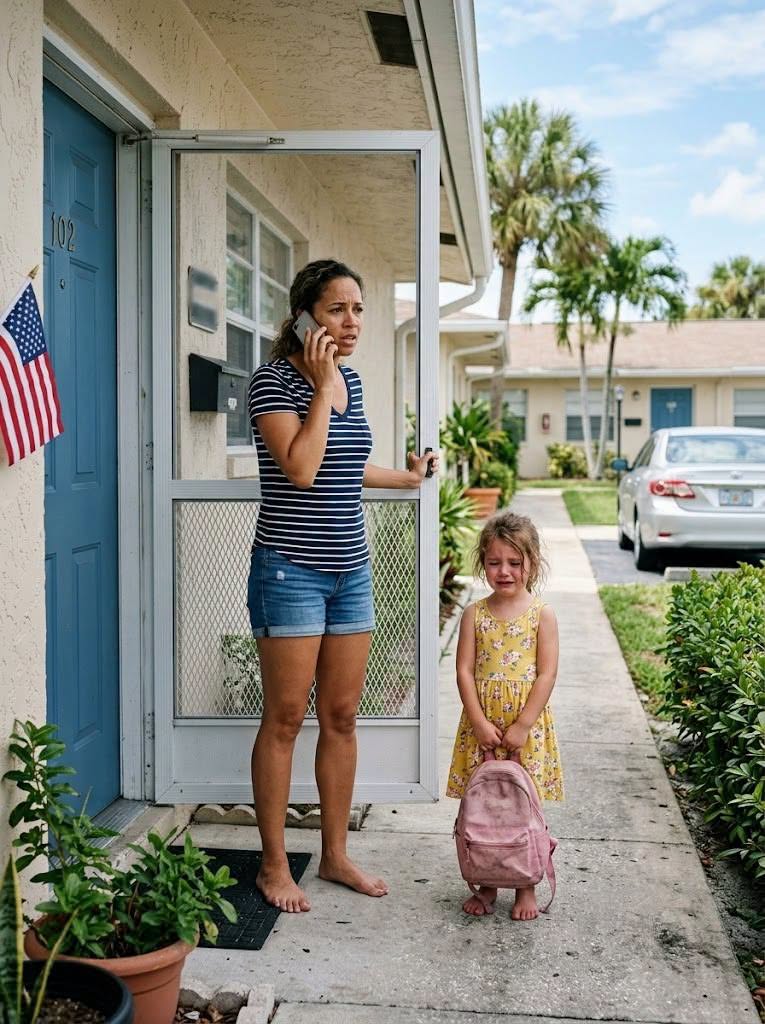
I almost didn’t answer the phone.
Unknown number.
Nine times out of ten, it’s nothing important, but something made me pick up. And I think about that all the time. How different things would have been if I hadn’t. If I’d let it ring out, finished what I was doing, and checked my voicemail later.
Because that one choice, answering, was the moment everything changed.
“Hello?”
A woman’s voice.
“Is this Dana?”
“Yes.”
“There’s a little girl at my apartment. She’s crying. She gave me your number and begged me to call.”
“What’s her name?”
“She said, Ella.”
My stomach dropped.
“Put her on.”
Shuffling.
Then my daughter’s voice, shaky and small.
Advertisements
“Mommy.”
“I’m here,” I said quickly. “I’m right here.”
“They left me,” she sobbed. “They just left me here. They went to the beach with Paige and Lucas. I don’t want to be here.”
I gripped the counter.
“Okay, sweetheart. You’re safe. Stay with the lady who called me. I’ll make sure someone comes for you.”
Back to the woman.
“Can you stay with her while I arrange someone? I’ll call you back once I know.”
“Yes. She’ll be safe with me.”
I kept the phone to my ear, thinking fast.
My first thought was to go myself. Get on a plane, fly to Miami, collect her, but that would take hours.
By then, Ella would have spent an entire day stranded, wondering if I was coming.
I thought about calling my parents and dismissed it immediately.
They were the ones who had left her.
My sister Briana, too.
I couldn’t trust them to undo what they’d done.
So, who?
And then I remembered Paula, my aunt.
She lived in Miami.
We hadn’t been as close in recent years, but when I was growing up, she was the one person in the family who made me feel safe.
It wasn’t guaranteed, but it was the only option I had.
“Please stay with Ella,” I said. “I’m going to call my aunt. I’ll ring you back as soon as I know.”
“Of course,” the woman said.
I hung up and dialed Paula.
She picked up immediately. I told her what happened, gave her the address, and she was already on her way.
That solved one problem, but another one was waiting.
I called my mother’s mobile.
She answered quickly, almost cheerful.
“Dana. Oh, good. You know. Don’t worry. Everything’s fine.”
Fine.
“You left my daughter crying on someone’s doorstep.”
“Not someone,” she corrected smoothly. “Her father.”
“A woman answered the door,” I said. “Not him.”
There was a pause on the other end long enough that I knew they’d heard me, but they weren’t going to admit anything.
My mother’s voice came back firm and dismissive.
“You’ll thank us later. This is what’s best for Ella.”
“Best?”
The word scraped out of me.
“Leaving her crying on a doorstep?”
“You’re blowing it out of proportion.”
Briana cut in. Her tone was sharp, smug, like she’d been waiting for her moment.
“You’ve kept her from him long enough. She needs her real father. We’re helping.”
Helping.
That was the word she chose.
“She was hysterical,” I said. “Do you even care about that?”
“You’re too sensitive, Dana,” my mother said.
I could hear the sigh in her voice like I was a child being scolded.
“You always make everything a drama. One day you’ll see we were right.”
I stared at the wall, the phone hot against my ear, listening to them justify what no sane person could justify.
I ended the call quietly.
No shouting, no tears, just a decision settling into place.
Because this wasn’t about me anymore.
This was about my daughter.
And my family had no idea what they just started.
When I tell people what happened in Miami, some ask, “How could your parents do that? How could they think leaving Ella like that was okay?”
The truth is, it didn’t come out of nowhere.
Miami wasn’t the first time my family decided they knew what was best for me or for my daughter.
It was just the most dangerous, the most unforgivable.
But that pattern, it had been there all along.
Growing up, Briana was the star.
It wasn’t always blatant. It was in little things, subtle things, the kind you can’t quite prove when you’re a child.
But I felt it.
If Briana so much as hummed, Mom and Dad clapped like she was destined for Broadway.
If I got perfect grades, barely a nod.
And when it came to decisions about my life, my parents made them for me.
Always behind my back.
Always with the same phrase.
“You’ll thank us later.”
They signed me up for a science fair I had no interest in.
“You’ll thank us later, Dana. It’ll look good on college applications.”
They invited a girl I didn’t like to a birthday party, convinced I’d become best friends with her.
“You’ll thank us later.”
I didn’t thank them.
What those choices taught me wasn’t resilience or gratitude. It was that my opinion didn’t matter, that someone else always knew better, that if I pushed back, I was being difficult.
And Briana, she never had those forced lessons.
No clubs she didn’t want, no friends she didn’t like.
Everything was tailored to her.
By the time I was grown, the favoritism wasn’t even subtle anymore.
Then came Preston.
When I married him, everyone told me I was lucky.
He was handsome, well-dressed, came from money, the kind of man who picked up the tab for the whole table, who bought champagne for strangers just to make a scene.
And he was generous in a very particular way.
He paid off part of my parents’ mortgage.
He slipped Briana envelopes of cash when she complained about bills.
At holidays, he turned up with expensive gifts, all smiles.
To my family, Preston was a dream.
To me, he was a nightmare I couldn’t wake up from.
Because behind closed doors, Preston was cold, detached. He had lovers, and he didn’t even bother to hide it.
The first time I confronted him, I was shaking. I’d found messages clear as day.
He looked me dead in the eye and said, “So what? What’s the big deal? Look at your life, Dana. The house, the clothes, the money. You should be grateful.”
That was Preston in one line.
He believed money excused everything.
Betrayal, lies, disappearing for nights at a time.
He thought throwing money around made him a good husband.
And my parents, they ate it up.
They didn’t see the arrogance, the coldness.
They saw the mortgage checks clearing and called it love.
Meanwhile, I was breaking.
When Ella was born, I thought maybe he’d change, that being a father might soften him.
But nothing changed. If anything, it got worse.
So, I left.
And here’s where people sometimes ask, “Didn’t you get a huge payout in the divorce?”
No, I didn’t.
There was a prenup. I walked away with almost nothing.
And I didn’t fight for more because here’s the truth.
I didn’t want Preston anywhere near Ella.
If I dragged him into court, demanded alimony or child support, he’d have demanded something back. Visitation, custody, time with her.
And I didn’t want my daughter anywhere near a man who thought cheating was no big deal, who thought money bought him a free pass.
So, I let it go.
I took a promotion at work, stood on my own two feet, and promised myself Ella was better off without him.
But to my parents, I wasn’t brave. I wasn’t protecting my child.
I was selfish.
Because when I left Preston, I didn’t just cut him out of my life.
I cut off their golden goose.
And they never forgave me for that.
After the divorce, I tried to keep the peace out of habit, out of guilt, out of that old voice in my head that said, “A good daughter helps her family.”
So, even though I wasn’t rich, I sent my parents money every month toward their mortgage.
I covered utilities when I could.
Sometimes when Briana complained about school supplies or bills, I helped with Paige and Lucas.
She’d studied art and worked as an art teacher in a school, and she wasn’t making much, so she always seemed to need a little extra.
It wasn’t much, nothing like Preston had given them, but it kept them afloat.
Looking back, maybe that was my mistake.
Maybe I should have cut them off then, but I didn’t because I still wanted Ella to have grandparents.
I still wanted her to grow up with cousins.
And I thought, stupidly, that if I kept giving, maybe one day they’d finally see me as enough.
Then came Steven.
If Preston was fire, all flash, all destruction, Steven was solid ground.
Middle class, steady, thoughtful, no yacht parties, no flashy suits.
But he showed up.
He kept his word.
And he loved Ella like she was his own.
He came into her life when she was two. By the time she was old enough to remember, he was the one tucking her in at night, the one cheering at her school plays.
And my parents, they never warmed to him.
“He’s not her father,” my mother would say, like that settled it.
It didn’t matter that Preston had been a disaster or that Steven had been raising Ella for years.
To them, biology was all that counted.
Which brings me to Miami.
It started like this.
My parents and Briana suddenly became very eager to take Ella on vacation with them.
They talked about the beach, about cousins bonding, about how much fun she’d have with Paige and Lucas.
“It’ll be good for her,” my mother said. “She’ll love it.”
Briana chimed in.
“You need a break, Dana,” my father added.
It sounded so reasonable, almost normal, but there was something strange in how hard they pushed.
They discouraged me from coming, told me it was quality time Ella needed with them, not me.
I hesitated, but they made it sound like a gift for Ella, for me.
And maybe part of me wanted to believe them, so I agreed.
I let her go.
And two days later, the phone rang.
That’s why I can’t say Miami surprised me.
It shocked me.
Yes, it enraged me.
But surprised me? No.
Because my parents had been crossing lines my whole life.
Always deciding what was best for me.
Always telling me I’d thank them later.
This time, it wasn’t my life they interfered in.
It was my daughter’s.
And that was a mistake they would never come back from.
When I think back to that night, what I remember most isn’t the fury.
It’s the silence.
The kind of silence where your heart is thundering in your chest, but the world around you is still.
Where you know if you let yourself feel even half of what’s inside, you’ll crack open.
So I didn’t.
I stayed on the phone with Ella.
Her voice was small, hiccuping, asking me over and over, “Mommy, are you still there?”
“I’m here,” I told her. “I’m not going anywhere. Just keep talking to me, sweetheart.”
We talked about nothing.
Curtains, the neighbor’s dog barking, whether she’d had anything to eat.
Every answer came broken between sobs.
But I kept her going until I heard Paula’s voice in the background.
And then Ella’s sobs changed.
Relief this time.
“Dana, I’ve got her.”
I closed my eyes.
My grip on the phone loosened, but the fury in my chest only got sharper.
Because while Paula was doing what family should do, showing up, my own parents were patting themselves on the back for abandoning my child.
The next step was obvious.
Get to Miami.
But I wasn’t thinking clearly enough to plan.
I was still shaking when I called Steven.
He picked up from work, his voice steady.
“Hey, everything okay?”
I told him.
Everything.
There was a pause.
Then his voice changed. Harder, sharper.
“Book the flight,” he said. “I’ll take time off. I don’t care if it’s unpaid. We’re going together.”
I tried to argue.
“I can handle this. You don’t need to lose money.”
But he cut me off.
“Dana, you’re not doing this alone. Not with them. Not with him. End of discussion.”
And that was Steven.
Quiet most of the time.
But when he decided something, it was decided.
Within an hour, we had tickets for the earliest flight.
By the time we landed in Miami, Paula had already taken Ella home with her.
Her house wasn’t big, a modest little bungalow with peeling paint on the shutters.
But the second I walked through the door, it felt like a fortress.
Ella ran straight into my arms, her face blotchy, her small hands gripping my shirt like she was afraid I’d disappear again.
I held her so tight I felt her heartbeat through her chest.
Steven wrapped his arms around both of us, and Paula stood in the doorway watching, her eyes soft.
She hadn’t changed much, still practical, still brisk.
When I was little, she’d been the one who slipped me candy when Mom wasn’t looking.
The one who told me I wasn’t crazy when I said Briana always got more attention.
We drifted apart.
But standing there in her kitchen, I remembered why I’d trusted her.
“Stay here,” she insisted, pulling out the kettle. “I don’t care if the guest room’s small. It’ll fit the three of you just fine.”
I started to protest.
Miami hotels weren’t exactly hard to find.
But Paula waved me off.
“Nonsense. You need family right now. Real family.”
So, we stayed.
The guest room barely fit the bed, and the mattress springs squeaked every time one of us moved, but it didn’t matter.
It was safe.
Ella curled between me and Steven that night, finally falling asleep after hours of whispering, “You’re here, right? You’re not leaving.”
I promised her I wasn’t.
Over and over until she finally believed me.
The next day, Paula made tea, and we sat around her small kitchen table.
The sunlight came in through lace curtains, and for a moment, it almost felt normal.
Almost.
Ella drew pictures with Paula’s old crayons while we talked.
Paula shook her head.
“I wish I could say I was surprised, but I’m not. Your parents, they’ve always believed they know best.”
“Best,” I said dryly. “Best would have been keeping their mouth shut.”
Steven reached across the table, his hand covering mine.
“She’s safe now. That’s what matters.”
I nodded, but in my chest, I was already making decisions because safe wasn’t enough.
Not anymore.
That afternoon, I opened my laptop.
For years, I’d kept the money flowing.
Monthly transfers to my parents to cover part of their mortgage, payments for utilities, little extras for Briana’s kids when she whined about how hard things were.
It had become routine, automatic.
But now, staring at the numbers on my screen, all I felt was rage.
I clicked through each account and shut them down.
No more mortgage help, no more utility payments, no more cash for Briana.
It took less than 15 minutes.
15 minutes to end years of obligation, guilt, and habit.
Steven leaned against the doorframe, watching me.
He didn’t say anything.
He didn’t need to.
He just nodded once, solid and sure.
It was my choice, my line in the sand.
And it felt good.
That night, as I lay awake with Ella’s small hand curled into mine, I made another decision.
They would never see her again.
Not my parents, not Briana, not anyone who thought it was acceptable to abandon her on a stranger’s doorstep.
I didn’t need a courtroom or a shouting match.
I didn’t even need to announce it.
I just knew they were out of her life.
And I thought that was the end of it.
But what I didn’t know, not yet, was how quickly their lives were about to unravel.
The first call came three days after we got back home.
I was folding laundry, the ordinary kind of chore that feels like it belongs to another life now, when my phone lit up with Briana’s name.
I should have let it go to voicemail, but curiosity won.
I swiped.
“Hello.”
Her voice came through sharp, ragged.
“What did you do?”
I froze.
“Excuse me?”
“I’ve been suspended, Dana.”
“Suspended?”
“You called my school, didn’t you? You told them I abandoned Ella.”
For a second, I couldn’t even find words.
“What are you talking about?”
“Don’t play dumb,” she snapped. “The principal called me in. Said there were complaints. Said parents were talking. That I’m a risk around kids. I know it was you.”
I sat down slowly, pressing the phone to my ear.
Suspended.
And the first thought that flickered across my mind, dry, bitter, was, well, karma works faster than HR departments.
“I didn’t call your school, Briana,” I said evenly. “I didn’t say a word to them.”
“Liar.”
She spat it like poison.
“You’ve always been jealous of me. You’ve been waiting for a chance to ruin me.”
Jealous?
That old tune again.
I almost laughed.
Instead, I said, “If you got yourself suspended, that’s on you. Don’t look at me for someone to blame.”
She cursed under her breath and hung up.
I sat there a long while, staring at the wall.
Suspended for abandoning Ella.
And I hadn’t even lifted a finger.
The truth came out later.
I checked Facebook, the family WhatsApp thread, all the places relatives gossip when they think it’s harmless.
There it was.
Messages, photos, chatter, the stories spreading like wildfire.
Paula had told a few cousins, wanting to make sure everyone knew the truth.
From there, it spread further because people love a story, don’t they?
And nothing gets around faster than family scandal.
By the time it reached the school, it wasn’t rumor anymore.
It was fact, confirmed by too many voices to ignore.
Briana was suspended while they investigated.
I won’t lie, it felt good.
Not because I wanted her unemployed, but because for once the truth had done the work for me.
The second call came two weeks later.
This time it was my parents.
I didn’t pick up right away.
I let it ring out, then watched it light up again and again.
Finally, I sighed and answered.
“Dana,” my father said, like nothing had happened. “We think there’s a problem with the bank. The mortgage payment didn’t come through this month.”
I leaned back in my chair, staring at the ceiling.
“There’s no problem.”
“What do you mean?”
“I mean,” I said, calm and flat, “I stopped paying. Two weeks ago.”
Silence.
Then my mother’s sharp intake of breath.
“What? Why would you?”
“Because you left my daughter crying on a stranger’s doorstep. Because you thought that was acceptable. Because you’ve treated me like a problem my whole life. And because you never once checked on me unless money was involved.”
My father’s voice hardened.
“We’re family, Dana. Families help each other.”
I almost laughed.
My throat was tight, but the words came out steady.
“Family doesn’t abandon children. You didn’t just cross a line. You burned it. I don’t owe you a thing.”
The silence on their end was heavy, stretched thin.
Finally, my mother tried again.
“You’ll regret this one day.”
“No,” I said softly. “The only thing I regret is thinking you’d ever change.”
And I hung up.
That night, Steven asked how it went.
“They noticed,” I said, dry as dust. “Apparently, their mortgage company has higher standards than they do as grandparents.”
He didn’t smile, but I saw it in his eyes.
Pride.
Solid, steady pride.
And here’s the thing.
After that call, I expected to feel wrecked, guilty, torn apart.
But I didn’t.
I felt lighter.
For the first time in years, I wasn’t propping them up.
I wasn’t buying their approval with transfers and top-ups.
I wasn’t feeding the very people who had cut me down my whole life.
I was free.
And for Ella, that meant safety.
You’d think the story ends there, wouldn’t you?
Briana suspended.
My parents cut off.
Me, finally free of their hold.
But it didn’t, because they weren’t done yet, and neither was I.
A few weeks after I cut them off, the knocking started.
It was early evening, the kind of quiet time when the house feels safe.
Steven in the living room with Ella, me finishing dishes, and then came the sharp rattle on the door.
When I opened it, there they were, my parents.
Not the confident, self-assured people who’d told me I’d thank them later.
They looked smaller.
My mother’s eyes darted everywhere but mine.
My father’s jaw clenched tight.
And behind them, Briana, red-eyed, chewing on her lip.
They didn’t say sorry.
Not really.
They said things like, “We were just trying to help. We thought it was best. We didn’t mean for it to go that way.”
And eventually, the real reason for the visit slipped out.
The mortgage.
They were behind.
They needed help.
I listened.
Calm. Silent.
Let them twist in the awkward pauses.
Then I shook my head.
“No. Not anymore.”
My mother’s mouth opened, ready to protest.
My father started with, “But we’re family.”
And that’s when I cut him off.
“Family doesn’t abandon a 7-year-old on a stranger’s doorstep.”
The words came out steady, not loud, and that quiet hit harder than shouting ever could.
They left not long after, muttering about how ungrateful I was, and that was the last time they stood on my porch.
After that, the dominoes fell quickly.
Briana’s suspension at school turned into termination.
She’d lost the trust of the parents, and once that was gone, there was no getting it back.
Word spreads fast in communities.
Too fast.
My parents didn’t recover either.
Without my money covering the gaps, the mortgage slipped further and further behind until it collapsed altogether.
They had to sell the house, downsize, and move into something smaller.
Bitter about it every step of the way.
They’d gambled everything on controlling me.
And when they lost me, they lost it all.
As for Preston, I never spoke to him.
Not once.
But through someone who still moved in his circle, I heard the gossip.
That young woman, the one who opened the door to Ella that night, who had no idea what she was stepping into, left him.
She’d found out Ella was his daughter, and she hadn’t known before.
Smart woman, I thought.
She saw what I’d seen years ago.
A man who thought hiding a child was normal, who thought money made up for character.
She packed her bags and walked.
It wasn’t my victory, but it was satisfying all the same.
And me?
I won’t pretend it was easy.
Cutting off your family never is.
There were nights I lay awake wondering if I’d gone too far.
If maybe I should have forgiven them one more time.
But then I’d remember Ella’s voice on the phone, her sobs, her words.
“They left me.”
And I knew I hadn’t gone too far.
I’d finally gone far enough.
Now it’s quiet.
Steven steady beside me.
Ella safe, laughing again.
Paula back in our lives in small ways.
Phone calls, visits, a reminder that not all family turns poisonous.
So that’s the story.
What do you think?
Did I go too far or not far enough?
Let me know in the comments.
And don’t forget to subscribe for.
If you came here from Facebook because of this story, please go back to the Facebook post, hit like, and comment exactly “Worth reading” to support the storyteller. That small action means more than it may seem, and it helps give the writer real motivation to keep bringing more stories like this to you.