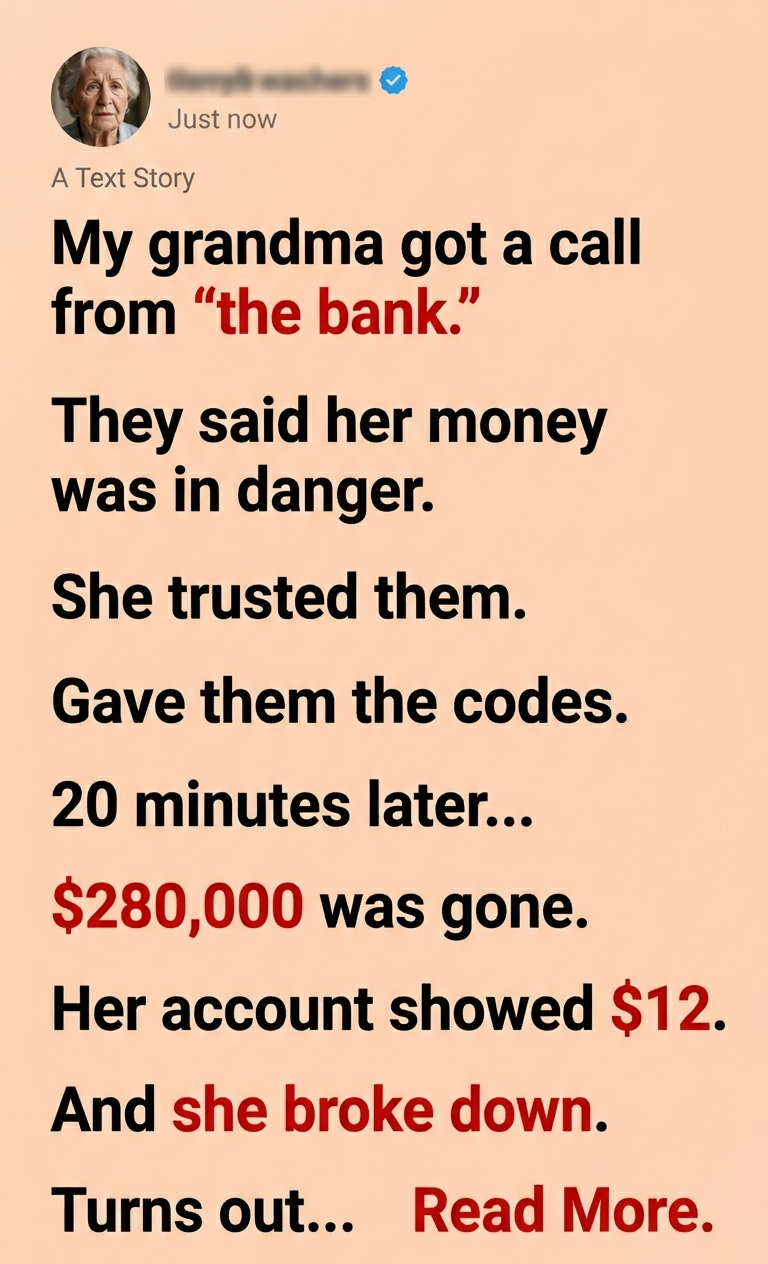
My grandma trusted her bank more than anything.
She didn’t keep cash at home.
Didn’t believe in “risky” investments.
Didn’t click random links.
She did everything right.
So when her phone rang that Tuesday morning, she answered without hesitation.
“Hello?”
“Good morning, ma’am. This is Daniel from your bank’s fraud department.”
The voice was calm. Professional.
Reassuring.
“We’ve detected unusual activity on your account,” he continued.
“A large transfer attempt. We need to secure your funds immediately.”
My grandma’s heart started racing.
“What do I need to do?”
“Don’t worry,” he said gently.
“I’ll walk you through everything.”
That’s how it started.
He already knew her name.
Her bank.
Even the last four digits of her account.
To her, that meant he was real.
“Someone is trying to access your savings,” he told her.
“If we don’t act now, you could lose everything.”
She didn’t question it.
Why would she?
He sounded like help.
He told her to stay on the phone.
Not to hang up.
Not to call anyone else.
“Time is critical,” he said.
Then came the instructions.
“Open your banking app.”
“Confirm your identity.”
“Read me the code you receive.”
One code.
Then another.
Then another.
Each time, he reassured her.
“You’re doing great.”
“We’re protecting your money.”
But what he was really doing…
was taking control.
Within 20 minutes—
$280,000.
Gone.
My grandma didn’t realize it immediately.
The caller ended the conversation with:
“Your account is now secure. You’re safe.”
She exhaled.
Relieved.
Until an hour later.
She checked her balance.
$12.47
She thought it was a glitch.
Logged out.
Logged back in.
Refreshed the screen.
Still there.
That number.
Her entire life savings…
reduced to almost nothing.
She called the bank.
This time, the real one.
“There’s been fraud on my account,” she said, her voice shaking.
The representative paused.
Then asked a question that changed everything:
“Ma’am… did you give anyone your verification codes today?”
Silence.
Her hand started trembling.
“Yes…” she whispered.
That was the moment it hit her.
She hadn’t protected her money.
She had handed it over.
When she called me, she was crying so hard I could barely understand her.
“They said they were helping me,” she kept repeating.
“They sounded so real…”
I drove to her house immediately.
She was sitting at the kitchen table, staring at her phone like it had betrayed her.
“It’s gone,” she said.
“All of it.”
We reported everything.
The bank.
The police.
Fraud departments.
But the truth came quickly.
The money had already been transferred.
Split.
Moved across multiple accounts.
Gone beyond reach.
Recovery?
Unlikely.
I expected anger.
Panic.
But what I saw instead…
was guilt.
“I should have known,” she whispered.
“I was so stupid.”
I sat beside her.
Took her hand.
“No,” I said firmly.
“You were targeted.”
Because that’s the truth.
Scammers don’t look for careless people.
They look for trusting ones.
Days passed.
Then weeks.
The house felt quieter.
But one morning, something changed.
I found her in the garden.
Watering her plants.
Slowly.
Carefully.
Like she was rebuilding something.
“I lost money,” she said when she saw me.
Then she gave a small, tired smile.
“But I didn’t lose everything.”
I squeezed her hand.
“We’ll fix what we can,” I told her.
And this time…
she didn’t feel alone. ❤️