The humid Tennessee air pressed against my skin as I turned my SUV onto the familiar gravel driveway leading to my house on Center Hill Lake.
It was shortly after noon on a Friday. The sun blazed over the wooded limestone slopes surrounding the water, turning the lake into a sheet of white light.
For six months, I had survived on cold coffee and barely four hours of sleep while navigating Nashville’s merciless commercial real estate market.
That morning, I had finally closed the Briarwood acquisition—a multimillion-dollar commercial development deal with a commission large enough to change my life.
But I wasn’t thinking about the money.
All I wanted was three uninterrupted days of silence.
The lake house was my sanctuary.
I had purchased it five years earlier without anyone’s assistance beyond a fifteen-thousand-dollar birthday gift from my parents. I saved for years to cover the rest of the down payment. I refinished the oak floors myself, painted every room in soft coastal colors, and spent countless weekends repairing the porch and restoring old furniture.
The house wasn’t simply an investment.
It was physical proof that I had created a life no one else controlled.
But when I stopped near the front porch, my anticipation vanished.
A massive commercial moving truck sat across my lawn, crushing the hydrangeas I had planted that spring.
Beside it stood a heavy construction dumpster overflowing with wood, drywall, and pieces of cabinetry.
I switched off the engine.
Instead of birds and water, I heard the shrill whine of a power saw coming from inside my home.
A cold knot tightened in my stomach.
I ran up the porch steps.
The front door wasn’t locked.
It had been propped open with a brick.
The moment I crossed the threshold, a cloud of white construction dust filled my throat.
I coughed, my eyes watering as I stared at the devastation.
My living room was gone.
The cream linen sofas, shelves, and framed lake photographs had disappeared. Several walls had been stripped down to bare wooden studs.
My custom kitchen cabinets—the ones I had saved three years to afford—had been torn from the walls, leaving jagged holes behind.
The vintage farmhouse sink I had driven to Memphis to collect was missing.
“Careful with that corner!” a familiar female voice called over the machinery.
I moved deeper into the house.
My heart pounded so violently that it hurt.
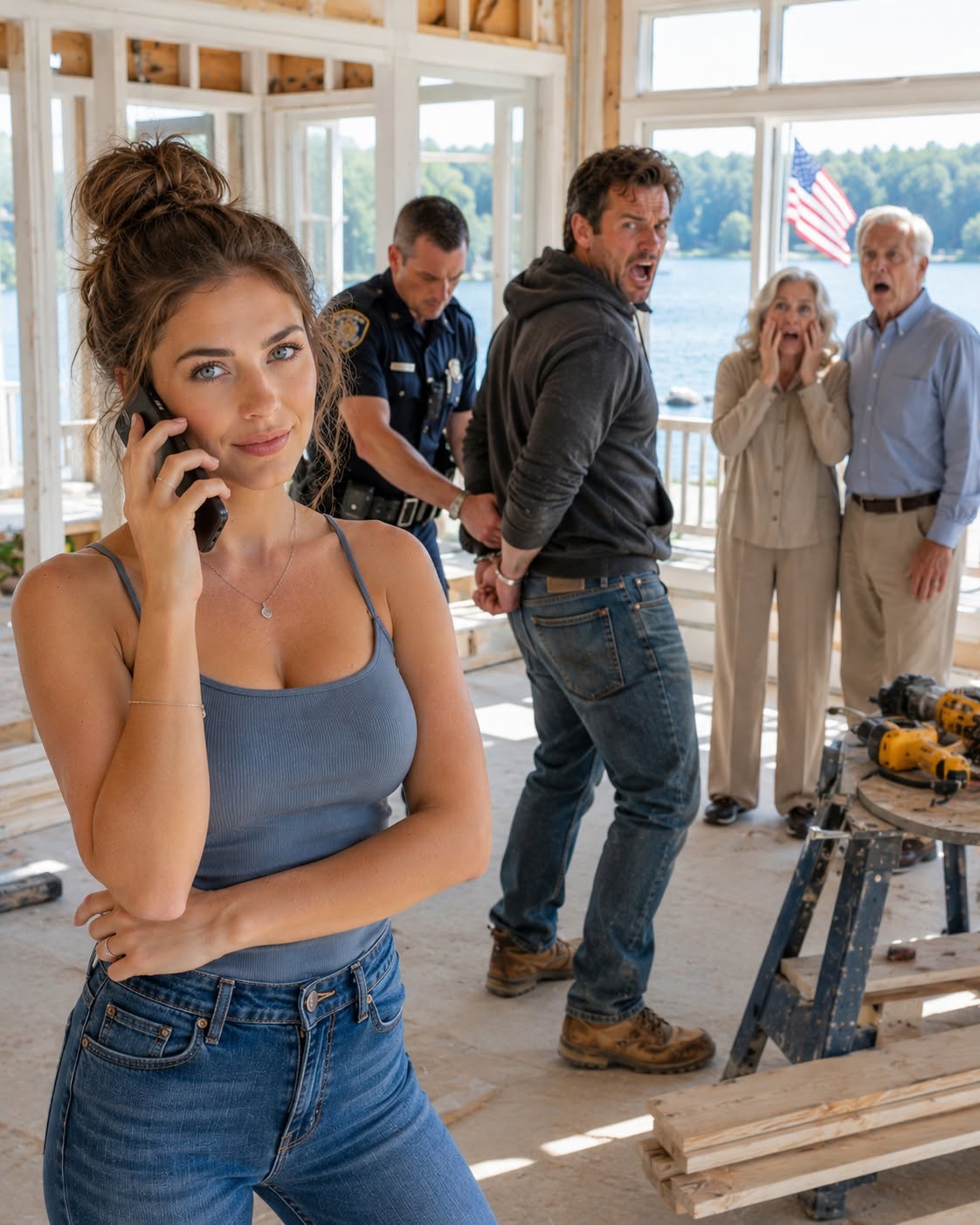
Standing in the middle of what remained of my kitchen was my sister-in-law, Lauren.
She wore a spotless white sundress, an enormous straw hat, and designer sandals completely inappropriate for a construction site.
An iced coffee rested in one hand.
With the other, she was dropping belongings into a black garbage bag.
They weren’t scraps.
They were mine.
My leather journals.
A framed photograph of my late grandfather.
The handmade ceramic mugs I had purchased in Asheville.
“What the hell are you doing?” I screamed.
Two workers holding sledgehammers stopped immediately.
Lauren spun around, one manicured hand flying dramatically to her chest.
“Claire! Oh my God, you frightened me. We didn’t think you were coming this weekend.”
“You didn’t think I would come to my own house?”
My voice dropped into a dangerous whisper.
I stepped toward her.
“Why is there a moving truck on my lawn? Why have my walls been torn apart? And why are my memories inside a garbage bag?”
Before Lauren could respond, the screen door slammed behind me.
“Claire, sweetheart! You’re here earlier than expected.”
My mother, Margaret, walked inside smiling as though she were arriving at a brunch.
She wore cream linen trousers and a coral blouse, her silver hair styled perfectly.
My father, Henry, followed her carrying a box marked RYAN’S OFFICE.
“Mom?” I gestured toward the exposed beams and shattered countertops. “What happened to my house? Who authorized this?”
Margaret waved one hand.
“Don’t be so dramatic about the mess. Denise, the contractor, says the expansion will be finished by the end of the month. We’re opening the first floor and adding more windows. It will be beautiful.”
“Expansion?”
I stared at her.
“This property belongs to me. You cannot walk in and demolish it.”
“Well, someone had to make a practical decision,” she replied in the patronizing tone she had used since my childhood. “Ryan and Lauren need the room. You only come here occasionally. The house sits empty most of the time.”
She glanced affectionately toward Lauren.
“Ryan’s marketing company is growing. He wants to operate a satellite office from the lake, so they’ll be moving here permanently.”
For several seconds, I couldn’t speak.
“Moving here?”
“Yes,” Margaret said, as though the matter had already been settled. “It makes perfect sense.”
“I pay the mortgage,” I said. “I pay the taxes, insurance, and maintenance. My name is on the deed.”
My father cleared his throat without looking at me.
“Claire, there’s no need to keep score. We’re family. Ryan needs support right now, and you’re always working in Nashville. You don’t need an entire lake house sitting unused.”
Lauren stepped forward with a sweet smile.
“We’re actually helping you. We’ll manage the upkeep. Once the new primary suite is finished, you can visit whenever you want and stay in the guest room.”
The guest room.
In my own house.
A cold fury settled inside me.
It was the same family arrangement I had endured my entire life.
Ryan was the golden son.
His failures were emergencies everyone had to solve.
My achievements, savings, and property were treated as resources waiting to be redirected toward him.
“Get out,” I said.
Margaret sighed.
“Claire, don’t behave irrationally.”
“Get out of my house!”
My shout echoed through the exposed rooms.
One contractor dropped her crowbar.
“Leave now, or I’m calling the sheriff and reporting every person here for trespassing and property destr0ction.”
Margaret’s false warmth disappeared.
“You are unbelievably selfish. Everything we’re doing is for this family.”
“I said get out.”
My father guided Margaret and Lauren through the doorway.
Lauren looked furious.
The moving truck started and backed slowly down the driveway.
I stood among the ruins, shaking.
Then I turned toward the contractor in the hard hat.
“Pack up your equipment. You have no permission to be here.”
She raised both hands.
“Ma’am, we were hired under a signed contract. Your parents gave us documentation establishing their authority over the property.”
“They have no authority.”
The contractor frowned and removed papers from her clipboard.
“They showed us a deed and a notarized power of attorney granting them the right to renovate or alter the house.”
The room seemed to lose all sound.
“A power of attorney?”
She handed me a photocopy.
The document granted Henry and Margaret full executive authority over the property.
At the bottom was a signature resembling mine.
Beside it was a blue notary stamp.
My stamp.
My legal name.
My commission number.
I had never signed the document.
I had certainly never notarized it.
Then I remembered Sunday dinner three weeks earlier.
Margaret had spilled red wine over my blouse.
While I washed it out in the bathroom, my work bag—containing my real estate credentials and notary stamp—remained unattended beside the dining table.
They hadn’t simply entered my house.
They had stolen my professional seal and used it to manufacture a legal document.
That wasn’t a family misunderstanding.
It was f3lony forgery.
I couldn’t remain inside the house.
The missing cabinets and exposed walls felt like a physical wound.
I drove into town and rented a room at a quiet bed-and-breakfast.
When the door closed behind me, the adrenaline disappeared.
I sat on the floral bedspread and stared at the forged document.
If the Tennessee Real Estate Commission believed I had improperly notarized property papers, I could lose my license.
My family hadn’t only endangered my home.
They had placed my entire career at risk.
I called my closest friend, Rachel.
“Claire?” she answered brightly. “I thought you were disappearing for the weekend to celebrate Briarwood.”
“They gutted my house,” I whispered.
For twenty minutes, I told her everything.
The moving truck.
Lauren throwing away my possessions.
My parents’ claim that Ryan was moving in.
The forged power of attorney.
Rachel was silent when I finished.
“Claire, listen to me. Your family stole your professional equipment, created a fake document, and attempted to take control of your property. Call Ethan tonight.”
Attorney Ethan Cole had handled zoning disputes and contracts for several of my commercial deals.
I sent him photographs and a scan of the document.
He called back within minutes.
“This is extremely serious,” he said. “We’re looking at trespass, fraudulent misrepresentation, property destr0ction, and forgery. The physical damage may exceed one hundred thousand dollars. The unauthorized use of your notary seal could lead to cr!minal prosecution.”
“What do I do?”
“I’m preparing a cease-and-desist letter tonight. It will go to your parents, Ryan, Lauren, and the construction company. I’m also requesting an emergency restraining order preventing them from approaching the property.”
He paused.
“Do not contact your family directly. People accustomed to getting everything they want often become dangerous when they encounter a legal wall.”
I spent the weekend at the inn.
I hired private security to guard the driveway and contacted restoration specialists.
My phone filled with messages.
Margaret called twenty-two times.
Henry left voicemails that moved from disappointed to pleading to furious.
Ryan sent a stream of insults, calling me jealous and vindictive for ruining his plans over “a few walls.”
I saved everything and forwarded it to Ethan.
By Sunday night, I felt hollow but focused.
The legal machinery had begun moving.
Then Monday morning brought another att:ack.
I returned to Nashville wearing my sharpest navy suit, preparing to present the final Briarwood report.
As I entered the underground garage beneath my brokerage, my managing partner, Rebecca Foster, called.
“Claire, where are you?”
“I just arrived.”
“Do not enter the main lobby. Take the freight elevator directly to the executive floor.”
A chill moved across my skin.
“What happened?”
“Your parents and brother are downstairs yelling at our receptionist. They filed an emergency complaint with the Tennessee Real Estate Commission claiming you embezzled family funds and committed notary fr@ud.”
The garage seemed to tilt.
They were no longer trying only to take my home.
They wanted to annihilate my professional reputation before I could expose them.
I entered Rebecca’s office through a private corridor.
She paced behind her desk holding a thick folder.
“Your mother is downstairs crying to human resources,” she said. “She claims you bought the lake house with money stolen from Ryan’s company. Ryan brought fake emails supposedly proving you have falsified real estate documents for years.”
“It’s all a lie.”
“I know.”
I stared at her.
Rebecca folded her arms.
“You’ve worked here for years. I have personally reviewed your escrow accounts. You are painfully meticulous. Ryan’s evidence is amateurish. But the commission must investigate notary allegations, which means your license may face an automatic administrative review.”
“Are you suspending me?”
Rebecca smiled without warmth.
“That is what they expected. They assumed they could storm into my office, create a spectacle, and manipulate me into firing my highest-producing broker.”
She picked up the telephone.
“Security, remove the three people harassing our staff. If they refuse to leave, contact the Nashville Police Department and have them trespassed.”
She hung up.
“You are not suspended. In fact, the Briarwood closing proved you’re ready for the promotion we discussed. Effective immediately, you are a senior broker with your own junior team.”
Relief nearly weakened my knees.
“But,” Rebecca continued, “you need to end this legally. If the commission finds even one legitimate issue, I won’t be able to protect you.”
“Ethan is filing suit today.”
“Good,” she said. “Bury them.”
Ethan called their complaint a textbook retaliatory strategy.
“They know the forged document exposes them,” he explained. “They want to discredit you first so your accusation appears defensive.”
He submitted my affidavit, the contractor’s testimony, photographs of the house, and the forged document to the commission.
The investigation shifted.
For the next three weeks, I worked mechanically.
I paid eighty-seven thousand dollars from my savings to begin restoring the house.
Extended relatives sent messages accusing me of betraying my parents.
I ignored them.
But one thing didn’t make sense.
My parents were entitled.
They worshiped Ryan.
Yet risking f3lony charges merely to give him a lakeside office seemed too extreme.
Then Ethan called.
“Claire, Ryan’s company isn’t expanding.”