My relationship with my sister-in-law, Lauren Whitmore, had always been a quiet exercise in psychological warfare.
She never needed to shout or make direct threats. Her preferred weapons were carefully disguised insults, false concern, and the kind of condescension that left you questioning whether you had imagined the cruelty.
Lauren was the perfect suburban queen.
Her life looked like a luxury catalog brought to life: imported marble counters, immaculate tennis outfits, designer handbags, and a brilliant orthodontist-crafted smile that never reached her cold, watchful eyes.
To the country club committee, the elite parent association, and every charity board in our wealthy neighborhood, Lauren was flawless.
To me, Rachel Bennett, she was a predator dressed in designer clothing.
She had a disturbing talent for identifying a person’s deepest insecurity and pressing against it with surgical precision.
For years, I tolerated her behavior for the sake of my older brother, Daniel.
Daniel was hardworking, loyal, and deeply committed to his family. Unfortunately, he was also completely blinded by Lauren’s polished performance.
He believed he had married an elegant, generous woman.
He didn’t understand that he was living beside someone who treated compassion as weakness and people as tools.
So when Lauren called me on a sweltering Tuesday morning in July, speaking with a sweetness she rarely used with me, every instinct inside me sounded an alarm.
“I’ve been thinking, Rachel,” she said. Her voice was smooth and sugary. “Sophie has been asking constantly to spend time with Noah. I’m taking her to Willow Creek Country Club for the afternoon, and I’d love to bring him with us.”
I said nothing.
Lauren continued brightly.
“We’ll swim, have lunch at the clubhouse, and let the children enjoy themselves. They serve those fancy chicken strips Noah loves.”
I tightened my grip around the phone.
My six-year-old son, Noah, was my entire world.
He was bright, sensitive, imaginative, and endlessly energetic. The idea of leaving him under Lauren’s supervision made something in my stomach twist.
Then I looked across the living room.
Noah sat on the carpet arranging action figures into an elaborate battle scene. The moment he heard Sophie’s name, his face lit up.
He adored his eight-year-old cousin.
Sophie was gentle, shy, and kind—the complete opposite of her mother.
I didn’t want my distrust of Lauren to steal a happy summer memory from him.
“Fine,” I said reluctantly. “Pick him up at noon. Keep his floaties on near the deep end, and bring him home by five.”
Lauren arrived an hour later in a black Range Rover.
She wore oversized sunglasses and a crisp white sundress, looking every inch the affectionate aunt.
“We’re going to have the best day,” she promised Noah.
I watched the SUV disappear down the street with a growing sense of dread.
I told myself I was being paranoid.
Two hours later, my entire world caught fire.
At exactly 2:14 p.m., my phone rang.
The caller ID showed the emergency number connected to Sophie’s waterproof smartwatch.
I answered, expecting a question about sunscreen.
Instead, I heard the frantic sobbing of a terrified child.
“Aunt Rachel, please come,” Sophie gasped. Her voice was almost drowned out by splashing water and cheerful music playing over the pool speakers. “Something is wrong with Noah.”
The bl00d seemed to drain from my body.
“Sophie, what happened? Where is the lifeguard?”
“He spilled his drink on Mommy’s new purse,” she cried. “Mommy got really angry. She gave him a special gummy to make him quiet, but now he won’t wake up.”
She began sobbing harder.
“His lips are turning blue.”
I dropped the phone.
I ran to my car and drove toward Willow Creek like a woman being chased by fire.
My hands shook so badly that I could barely control the steering wheel. I moved through traffic recklessly, my horn blaring as Sophie’s words repeated in my head.
He won’t wake up.
His lips are turning blue.
I reached the gated entrance, ignored the security guard shouting after me, and drove directly onto the brick courtyard.
I left the engine running and sprinted through the clubhouse.
Guests turned to stare as I pushed past them.
When I burst through the glass doors leading to the pool, chlorine struck my throat.
A crowd had formed near the private cabanas.
Then I heard Sophie screaming.
I forced my way through the gathering.
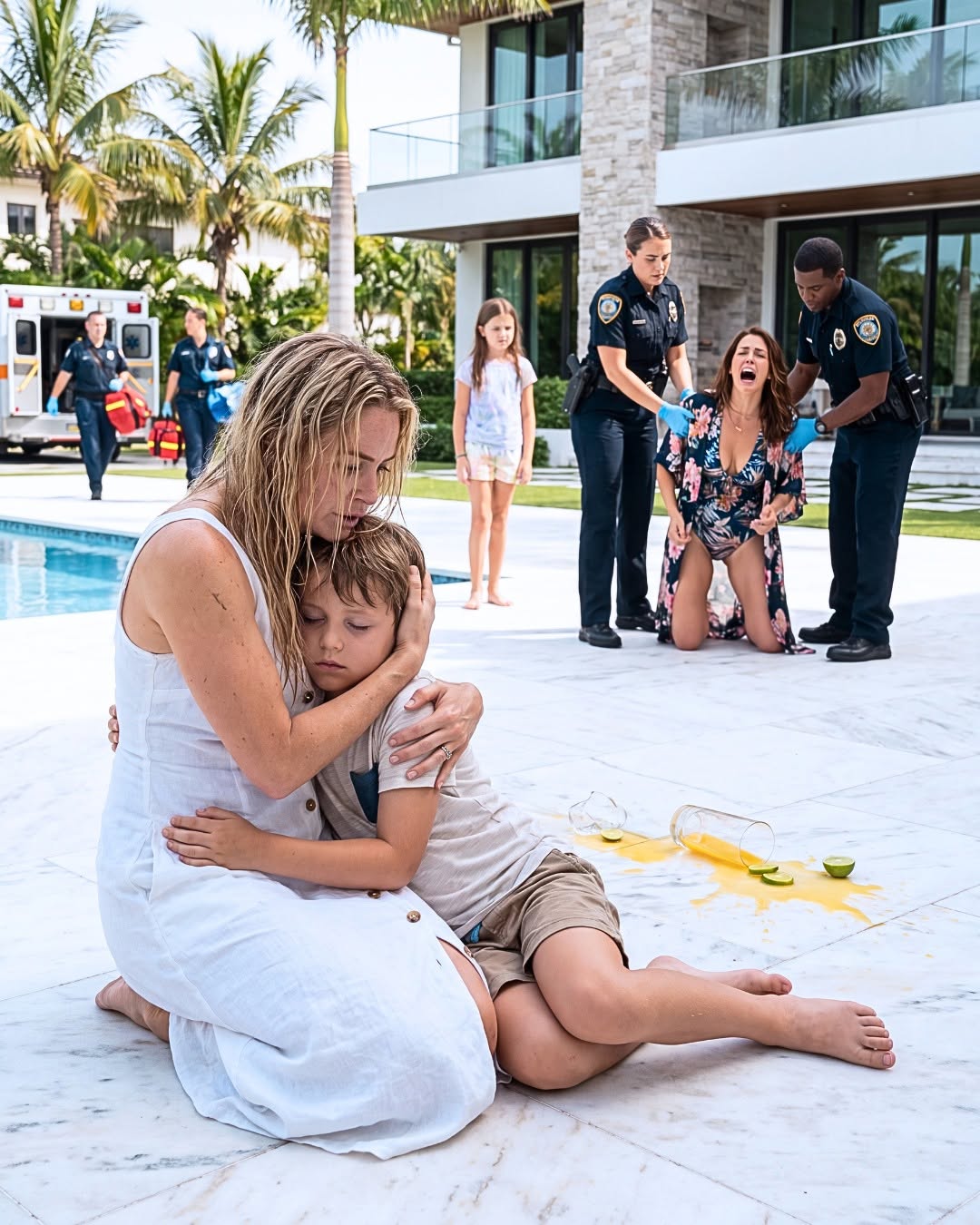
Noah lay motionless on the concrete beside the deep end.
His small body was limp.
His skin had turned a terrifying gray, and his lips were purple.
Sophie knelt beside him, soaked and trembling.
But what ignited something primal inside me was Lauren.
She stood over my unconscious son with a half-empty mimosa in one hand.
A frightened teenage lifeguard attempted to reach Noah with a first-aid kit, but Lauren had one arm extended, physically blocking him.
“I told you to leave him alone,” she snapped. “He’s throwing a tantrum.”
The lifeguard stared at her.
“He isn’t breathing normally.”
“His mother has substance problems and refuses to discipline him,” Lauren replied coldly. “If you touch him and make this worse, I will personally have you fired.”
She was preventing trained help from reaching my child.
Not because she believed Noah was fine.
Because she needed time to hide what she had done.
A sound tore from my throat.
I rushed toward her and sh0ved her away from Noah.
Lauren fell backward into a row of lounge chairs. Her sunglasses flew across the tile, and her mimosa shattered.
I dropped beside my son.
His skin was freezing.
“Noah!”
There was no response.
I looked at the lifeguard.
“Start CPR now!”
The teenager immediately knelt and placed his hands over Noah’s chest.
He began compressions.
One.
Two.
Three.
Four.
Lauren climbed to her feet, her hair disheveled.
“What is wrong with you?” she screamed. “He ruined a twenty-thousand-dollar handbag! He behaved like an animal!”
I bent over Noah and breathed into his lungs.
“What did you give him?”
“It was an organic supplement,” she shouted. “Something to calm him down!”
“You p0isoned him!”
Sirens sounded beyond the iron gates.
Paramedics rushed onto the deck carrying equipment.
They moved me aside and took over.
“No pulse,” one of them called.
They cut open Noah’s swim shirt, attached pads to his chest, and prepared medication.
“Clear!”
His small body jerked.
The monitor remained flat.
“We’re losing him,” the paramedic said. “Load him now.”
The pediatric intensive care waiting room became a private version of hell.
After an hour, a doctor finally emerged.
They had restarted Noah’s heart inside the ambulance.
He was on a ventilator.
Toxicology showed a near-fatal dose of a heavily restricted psychiatric sedative.
If Noah had fallen into the pool, the doctor explained, he would have slipped beneath the water without making a sound.
I sank into a plastic chair.
Before I could fully process the words, the double doors opened again.
A stern woman in a gray suit entered carrying a clipboard.
Detective Harris followed her.
“Ms. Bennett,” the woman said. “I’m Ms. Carter with Child Protective Services. We received an emergency report concerning your son.”
I looked up.
“From whom?”
Detective Harris answered gently.
“Lauren came to the precinct. She claims she found the medication inside Noah’s bag.”
For a moment, I didn’t understand.
“She says you have a substance-abuse problem,” he continued. “According to her statement, you left illegal medication in his belongings, and she accidentally gave him one because she believed it was his allergy medicine.”
The lie struck me like a physical blow.
“That’s insane. Sophie called me. Lauren gave it to him because he spilled juice on her bag.”
Ms. Carter remained expressionless.
“Because of the severity of your son’s condition and the formal accusation made against you, CPS procedure requires temporary intervention.”
“What does that mean?”
“When Noah is medically discharged, he cannot immediately be released into your custody. Unless evidence clears you, the state will place him in emergency foster care.”
I stood so quickly that the chair fell backward.
“You cannot take my child.”
“We have approximately forty-eight hours before a judge signs the placement order,” Ms. Carter said. “If you can provide clear evidence proving Lauren deliberately administered the medication, we can reconsider.”
They left me standing in the center of the waiting room.
Lauren hadn’t only tried to hide her actions.
She had moved first.
She intended to erase me as Noah’s mother before I could expose her.
Then Daniel rushed into the room.
His tie was loose, and his eyes were red.
“Rachel,” he said breathlessly. “I just came from the police station. Lauren is hysterical. Why would you leave medication in Noah’s bag? You know she gets confused about prescriptions.”
I stared at my brother.
He believed her.
“She drugged your nephew because he stained her handbag,” I said. “Now she is trying to have the state take him from me.”
Daniel shook his head.
“She wouldn’t do that. Lauren is Sophie’s mother. She loves children.”
At that moment, I understood I could not depend on him.
I couldn’t wait for a slow investigation while a clock counted down toward losing my son.
I called Attorney Grant Mercer.
Grant was a feared litigator known for dismantling wealthy opponents piece by piece.
“I need you to destroy someone,” I told him. “And I need it done before tomorrow.”
An hour later, I sat across from him inside his dark, wood-paneled office.
“I don’t want a quiet settlement,” I said. “I want every lie she has ever told exposed.”
Grant gave me a cold smile.
“My investigators have already started.”
The next twenty-four hours blurred into ventilator alarms, cold coffee, and unbearable waiting.
Noah remained unconscious while IV fluids removed the toxins from his body.
The CPS deadline moved closer.
Then Grant called.
“Rachel, sit down.”
I stepped into the hospital corridor.
“What did you find?”
“Two years ago, Lauren created an online fundraising campaign claiming Sophie had a rare degenerative bl00d disorder.”
I frowned.
“Sophie is healthy.”
“Exactly. Lauren raised more than two hundred fifty thousand dollars for experimental treatment overseas.”
My stomach tightened.
“We obtained the medical records under emergency subpoena. Sophie never had the disease.”
Grant’s voice became harder.
“Lauren has been giving her low doses of sedatives for years. Enough to make her look pale and exhausted in photographs.”
I covered my mouth.
“She was drugging her own daughter?”
“To make the fundraising lie believable. The money paid for vacations, designer clothing, and handbags.”
The truth was worse than narcissism.
Lauren had used Sophie’s body as a prop.
Grant sent the evidence directly to Detective Harris.
Police moved quickly.
Lauren’s accounts were frozen.
Search warrants were approved.
Daniel, finally shown the medical files and financial records, filed for emergency custody of Sophie.
Lauren’s perfect life collapsed within hours.
But a cornered person with nothing left to lose is dangerous.
Late that night, with less than twelve hours remaining before the CPS hearing, an unknown number sent me a message.
You think you can take everything from me? I have files proving you’re unfit. Come alone to the foreclosed estate on Hawthorne Avenue at midnight, or I send them to CPS. We finish this tonight.
It was obviously a trap.
Lauren wanted me isolated.
She wanted a confrontation she could manipulate.
But I needed a confession before morning.
I forwarded the message to Detective Harris.
Then I drove to the abandoned mansion on Hawthorne Avenue.
The property was enormous and completely dark.
I entered through the front door.
“I’m here, Lauren.”
The door slammed behind me.
The deadbolt clicked.
Lauren stepped from the shadows near the staircase.
Her perfect image was gone.
She wore a stained tracksuit. Her hair was tangled, and her face looked wild.
In her hand was a medical syringe.
The needle caught the moonlight.
“You ruined me,” she screamed. “I was the successful one. You were supposed to remain beneath me.”
“What’s in the syringe?” I asked, forcing my voice to remain steady.
“The rest of the tranquilizer.”
She lifted it.
“Enough to stop a heart.”
My pulse pounded.