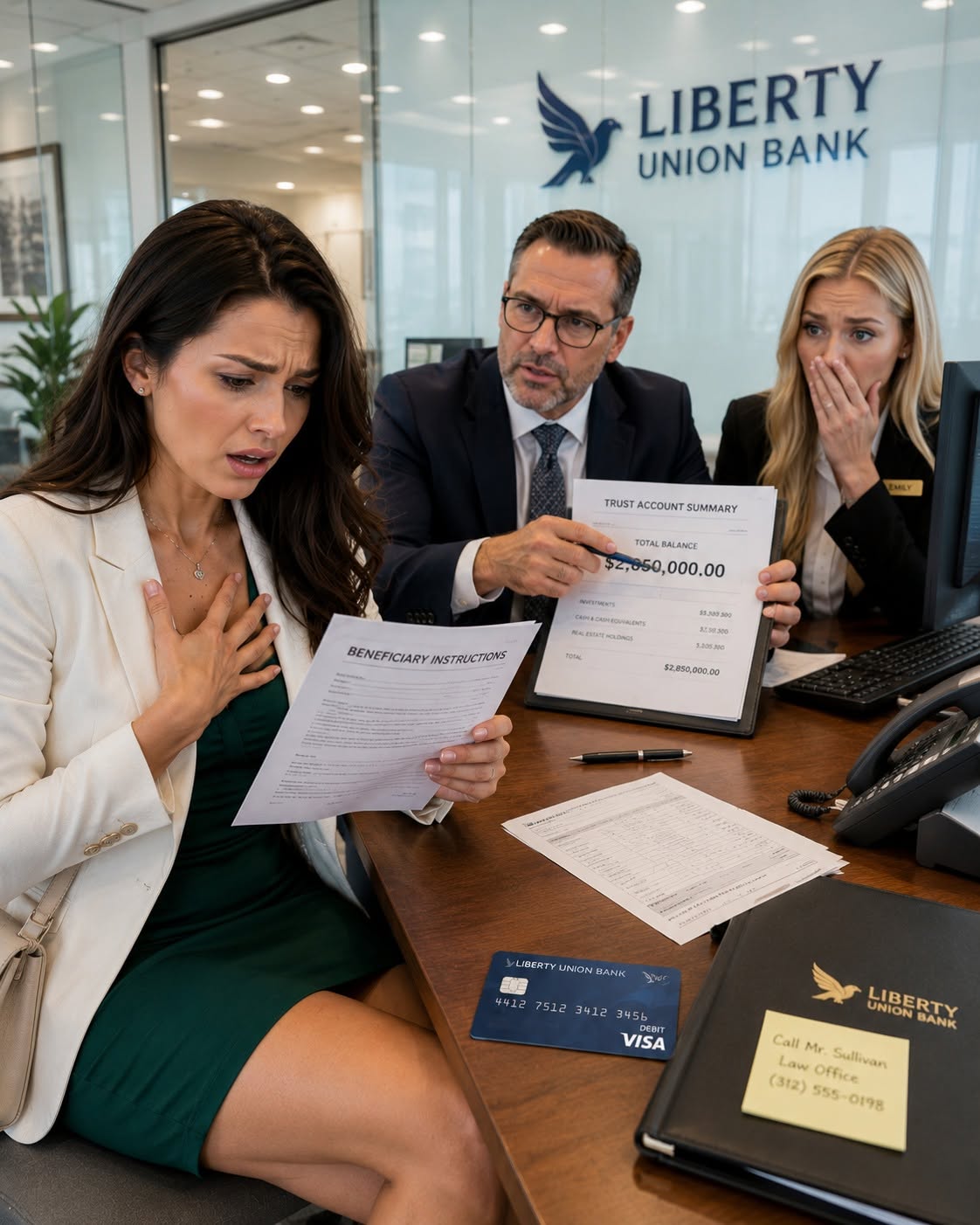
“Your grandfather only gave you this because he pitied you.”
That was what Martin, my adoptive father, told me on the afternoon we buried the only man in that family who had ever called me his daughter without placing conditions on the word.
Five years later, I could still hear the sound of that debit card striking the dining table, landing among dirty dishes, dying flowers, and a silence that still carried the weight of a funeral.
The first time I picked it up, I didn’t feel grateful.
I felt humiliated.
My name was printed across the blue plastic: Hannah Bennett.
Beneath it was the logo for First National Union Bank.
Martin leaned against the doorway, still dressed in his black funeral suit, his tie hanging loose around his neck, as though being tired somehow gave him permission to be cruel.
“There’s twenty thousand dollars in the account,” he said. “Your grandfather wanted you to have something. I have no idea why, but there it is. Don’t turn it into a whole thing.”
I stared at the card.
Then I looked toward the living room, where Grandpa Henry’s photograph still stood beside a white candle.
Henry Bennett wasn’t my grandfather by blood.
But he had been my grandfather in every way that mattered.
When I came into that house at eight years old with a pink backpack, two changes of clothing, and more fear than words, everyone treated me as though I were a temporary child someone had dropped off.
My adoptive mother still called me “the girl” even after the adoption papers were finalized.
My cousins introduced me as “the adopted one.”
Martin corrected me whenever I said “my family,” almost as if those words were too large for someone like me to use.
Grandpa Henry never did.
He taught me how to ride a bicycle on a quiet street in Brookside, even though I fell four times and cried mostly because my pride was hurt.
He came to my elementary school programs whenever no one else could be bothered.
He kept every one of my report cards inside a brown folder and used to say:
“This girl is going somewhere. Just wait.”
When I enlisted in the Army, Martin laughed at me.
“So now you’re trying to prove you’re tough?”
Grandpa Henry took me out for breakfast at a little diner and wrote three sentences on a paper napkin:
Protect your documents.
Protect your character.
Protect your word.
I kept that napkin for years.
A month before he died, he showed me his old wristwatch.
It wasn’t valuable.
The leather strap was worn, and there was a thin scratch across the glass near the number three.
“When I’m gone, this watch belongs to you,” he said.
I told him not to speak like that.
He reached across the table and held my hand.
“Hannah, listen to me. The things people leave behind don’t matter because of what they cost. They matter because they tell you who mattered.”
That was why, on the day of his funeral, when Martin tossed the debit card toward me and told me it was all I was getting, I asked only one question.
“What about Grandpa’s watch?”
His expression immediately hardened.
“The watch stays with the family.”
The words felt like an invisible hand had shoved me in the chest.
“I am family.”
Martin gave a dry, humorless laugh.
“Don’t confuse yourself. My father cared about you, sure. But that doesn’t change what you are.”
“And what exactly am I?”
He stepped close enough that no one else could hear him.
“A responsibility we already finished taking care of.”
I didn’t scream.
I didn’t cry where he could see me.
Maybe because when pain arrives sharp and pure, it doesn’t always make noise at first.
I grabbed my military backpack and packed two shirts, my personal documents, and Grandpa Henry’s napkin.
I kept the debit card only because my fingers closed around it before my pride could throw it away.
That night, I slept on the couch in the apartment of a friend from my unit.
The card sat on the coffee table in front of me.
I bent it slightly without snapping it, leaving a pale white line through the center.
“I don’t want your pity,” I whispered.
Then I put the card inside an envelope.
I didn’t touch it again.
For five years, I believed that was my small victory.
I never spent a single dollar of what I considered an insult.
Then, one cold January morning, while moving between apartments in Chicago, the envelope dropped from an old cardboard box.
The card slid across the hardwood floor until it stopped beside my boots.
It landed faceup.
Almost as though it had been waiting for the exact right moment to find me again.
I could have thrown it in the garbage.
I probably should have.
Instead, I scheduled an appointment with First National Union Bank to close the account.
I didn’t want the money.
I wanted to cut the final thread connecting me to that lie.
I arrived at the Michigan Avenue branch at 9:07 that morning.
Outside, traffic roared through downtown as usual.
Inside, everything looked almost unnaturally clean.
Polished floors.
Glass offices.
The smell of reheated coffee and cold air conditioning.
I took a number.
B17.
When my number appeared, a young bank representative with her hair pulled back and a gentle voice smiled at me.
Her name tag said Megan.
“Good morning. What can I help you with today?”
I placed the debit card on the counter.
“I want to close this account.”
Megan asked for my driver’s license and identification documents.
Then she began typing.
At first, nothing changed in her expression.
It was routine.
Just another bank request.
Then she stopped.
Her fingers remained suspended above the keyboard.
She looked at the computer screen.
Then at my identification.
Then at the bent debit card.
“Ms. Bennett… you’ve never used this card?”
“Never.”
“No withdrawals? No balance checks? No purchases?”
“Nothing.”
Megan swallowed.
“Who told you there was twenty thousand dollars in this account?”
A strange pressure tightened in my chest.
“My adoptive father. He gave it to me after my grandfather’s funeral.”
She became completely still.
Then she picked up the internal phone.
“Mr. Collins, I need you at window four. I have a restricted account.”
The word restricted sent a cold sensation through me.
“I just want to close it,” I said.
Megan lowered her voice.
“I don’t think this is about closing an account anymore.”
And at that moment, without realizing it, I was standing seconds away from discovering that the debit card Martin had thrown at me like charity concealed a betrayal much larger than anything my anger had imagined.
The branch manager stepped out of a glass office with a gray folder tucked under his arm.
“Ms. Hannah Bennett?” he asked. “I’m Andrew Collins, the branch manager. Would you come with me, please?”
Megan didn’t return the card.
That was the first thing that genuinely frightened me.
I followed Andrew into a small office with partially closed blinds and an American flag standing in one corner.
He placed the gray folder on his desk, closed the door without locking it, and offered me a chair.
I didn’t sit back comfortably.
I stayed on the edge of the seat, ready to stand the moment this became another humiliation.
“Before we move forward,” Andrew said, “I need to verify something. Were you aware that this debit card was connected to a trust?”
I blinked.
“A trust?”
Andrew opened a file on his computer and turned the monitor slightly toward me.
I saw my name.
Hannah Bennett.
Then my grandfather’s name.
Henry Bennett.
And below it, a phrase that emptied my lungs.
Direct beneficiary.
“I don’t understand.”
“Your grandfather established an asset trust for your benefit before his death. This card was only a limited access tool. It did not represent the full value of your inheritance.”
The room seemed to shift underneath me.
“My father told me there was twenty thousand dollars.”
Andrew’s jaw tightened.
“According to the information in our system, that amount does not reflect the value of the trust.”
“Then how much is there?”
He didn’t answer right away.
That silence hurt more than any number could have.
Instead, he opened another scanned file.
“I can’t provide the complete financial information until the identity verification process is finished. But there is something I am required to show you.”
A document covered in signatures appeared on the screen.
My grandfather’s signature was near the top.
I knew it immediately.
Strong.
Slightly slanted.
With the oversized H he always wrote.
Below his signature was mine.
Or something pretending to be mine.
I leaned toward the monitor.
The first stroke of the H was too wide.
The final line dropped awkwardly, like someone had practiced my name without understanding how my hand actually moved.
“That isn’t my signature.”
Andrew looked directly at me.
“I need you to be absolutely certain.”
“That is not my signature.”
Megan, who had just walked into the office carrying another folder, raised a hand to her mouth.
Andrew picked up a pen and wrote across a form:
Signature formally denied by beneficiary.
He didn’t write “claims.”
He didn’t write “believes.”
He recorded it as a fact that required investigation.
For five years, my family had demanded my silence with looks alone.
That morning, a stranger was finally putting my truth on paper.
“Who submitted this?” I asked.
Andrew opened another screen.
“The application was presented by Martin Bennett, acting as a family representative.”
His name dropped into the office like a stone.
My adoptive father.
The same man who had told me I wasn’t family had used the word family to move closer to the inheritance my grandfather left me.
“There’s more,” Andrew said.
He showed me a red warning attached to the account.
Power of attorney subject to review due to identity discrepancies.
“Someone attempted to move assets from the trust using a power of attorney,” he explained. “The bank did not fully approve the transactions because several identity verification requirements were incomplete.”
“Not fully?”
Andrew said nothing.
Megan looked toward the floor.
Then the office phone rang.
Andrew looked at the caller information.
His expression changed.
I saw the name before he answered.
Bennett.
“Andrew Collins speaking,” he said formally.
Martin’s voice came through the speaker.
Low.
Sharp.
I knew that voice.
The one he used when he believed everyone around him was an incompetent employee.
“Yes, sir,” Andrew said. “Ms. Hannah Bennett is currently here.”
My spine straightened.
Martin raised his voice.
I couldn’t hear every sentence clearly, but several words reached me.
Mistake.
Confusion.
Old account.
Close it.
Andrew looked at me.
“We cannot close a restricted file at the direction of a third party while the registered beneficiary is physically present.”
Silence followed.
Then Martin changed his voice.
Softer.
Sweeter.
More dishonest.
“Hannah,” he said. “Sweetheart, listen to me.”
The tenderness in his voice tasted like counterfeit money.
“I’m listening.”
“This is all a misunderstanding. Your grandfather left behind some very complicated paperwork. I was only trying to protect the family.”
I stared at the forged signature on the screen.
“Which family, Martin? The one you told me I didn’t belong to?”
He didn’t answer.
That silence confirmed more than any financial record could have.
Martin took a heavy breath.
“We were grieving that day. People say terrible things when they’re in pain.”
“Pain makes people cry,” I replied. “It doesn’t make them forge signatures.”
Megan closed her eyes for a second.
Andrew wrote another note in the file.
The softness vanished from Martin’s voice.
“You don’t know what you’re talking about.”
“Then explain it.”
“I’m not discussing private family business in front of bank employees.”
“That’s interesting,” I said. “Because those bank employees apparently know more about what Grandpa left me than I do.”
Another silence.
Then Martin did what he had always done whenever patience stopped working.
He became arrogant.
“You got what you needed.”
What I needed.
Not what belonged to me.
Not what my grandfather had decided I should receive.
What Martin, sitting on his throne of family pride and contempt, had decided was enough to keep me quiet.
I looked at Andrew.
“I need to know the amount.”
Martin exploded through the speaker.
“Don’t tell her anything!”
Andrew didn’t answer him.
He kept his eyes on me.
“Ms. Bennett, I cannot release any money or provide the full final account documentation today. However, because you are the registered beneficiary, I can show you a preliminary trust summary with sensitive account details redacted.”
He printed a page.
He covered the account numbers and turned the document toward me.
At first, the figure didn’t make sense.
There were too many digits.
I read it once.
Then again.
It wasn’t twenty thousand dollars.
It wasn’t a small symbolic inheritance.
It was enough to purchase a modest home in the city.
Enough to pay for an entire college education.
Enough to clear my debts.
Enough to begin a life without asking anyone’s permission.
But the amount wasn’t what broke me.
It was the certainty.
Grandpa Henry hadn’t left me charity.
He had left me a door.
And Martin had spent five years standing in front of that door, insisting it didn’t belong to me.
Yes, I felt anger.
But underneath the anger was something deeper.
Fresh grief.
It felt as if my grandfather’s funeral were happening again.
Except this time, I was burying the lie my family had handed me in his name.
Martin kept talking.
“Hannah, think carefully about what you’re doing. You’re going to destroy this family.”
I almost laughed.
“What family?”
“Don’t be ungrateful.”
The word struck me with an old, familiar precision.
Ungrateful.
They called me ungrateful when I didn’t smile enough in family photographs.
When I failed to show enough excitement over secondhand clothes.
When I asked questions about my adoption records.
My documents.
My history.
When I wanted more than a roof and food.
But that morning, inside that cold bank office, with my name written into a trust and a forged signature displayed on a screen, the word finally lost its power.
I wasn’t an eight-year-old girl asking permission to belong anymore.
I was a woman staring at proof that someone had chosen her.
“Grandpa never thought I was ungrateful,” I said.
Martin lowered his voice.
“Your grandfather isn’t here to defend you anymore.”
I looked at the document.
“No. But he left records.”