The first thing I noticed was the blood on Chloe’s sock—a bright, violent streak of red against the spotless white tile of the Mercy Heights Hospital emergency department.
The stain was tiny, barely larger than a dime, but beneath the cold fluorescent lights of the trauma room, it looked like someone had torn a hole straight through the universe. My hands, hands that had remained perfectly steady through countless delicate brain surgeries, suddenly felt unbearably heavy.
The second thing I noticed was my husband, Grant Holloway, standing beside the gurney.
He was smiling.
Not warmly.
Not honestly.
It was the polished, carefully measured smile he used whenever he needed to control a room. His shoulders were relaxed. His expensive silk tie sat perfectly centered beneath his collar. He looked like a man who had already buried the truth somewhere shallow and was now courteously inviting everyone to attend the funeral.
Grant was the most sought-after political strategist in the city.
He could turn a public scandal into a victory speech with one press release.
That day, the scandal had followed him home.
“She’s always been clumsy, Evelyn,” Grant told the emergency physician, his voice smooth and controlled. It carried the same easy authority that made people listen even when instinct warned them not to trust him. “She fell down the stairs again. I told her to be careful in those new shoes, but teenagers are teenagers. Arms and legs everywhere. No coordination. She probably inherited that from her biological mother.”
I stood frozen in the doorway of Trauma Bay 4.
I was the Chief Medical Officer of Mercy Heights.
For twenty years, I had survived hospital politics, insurance battles, surgical crises, and the literal difference between life and death.
I was accustomed to being the calmest person in the room.
Usually, I was the one everyone watched when panic started spreading.
But in that instant, every title fell away from me.
I wasn’t the CMO.
I was the woman who packed Chloe’s lunches.
The woman who braided her hair before school photographs.
The woman who had stayed awake until three in the morning two years earlier reading through adoption documents, praying I could give a thirteen-year-old girl the safety she had never found in a childhood filled with “temporary” homes.
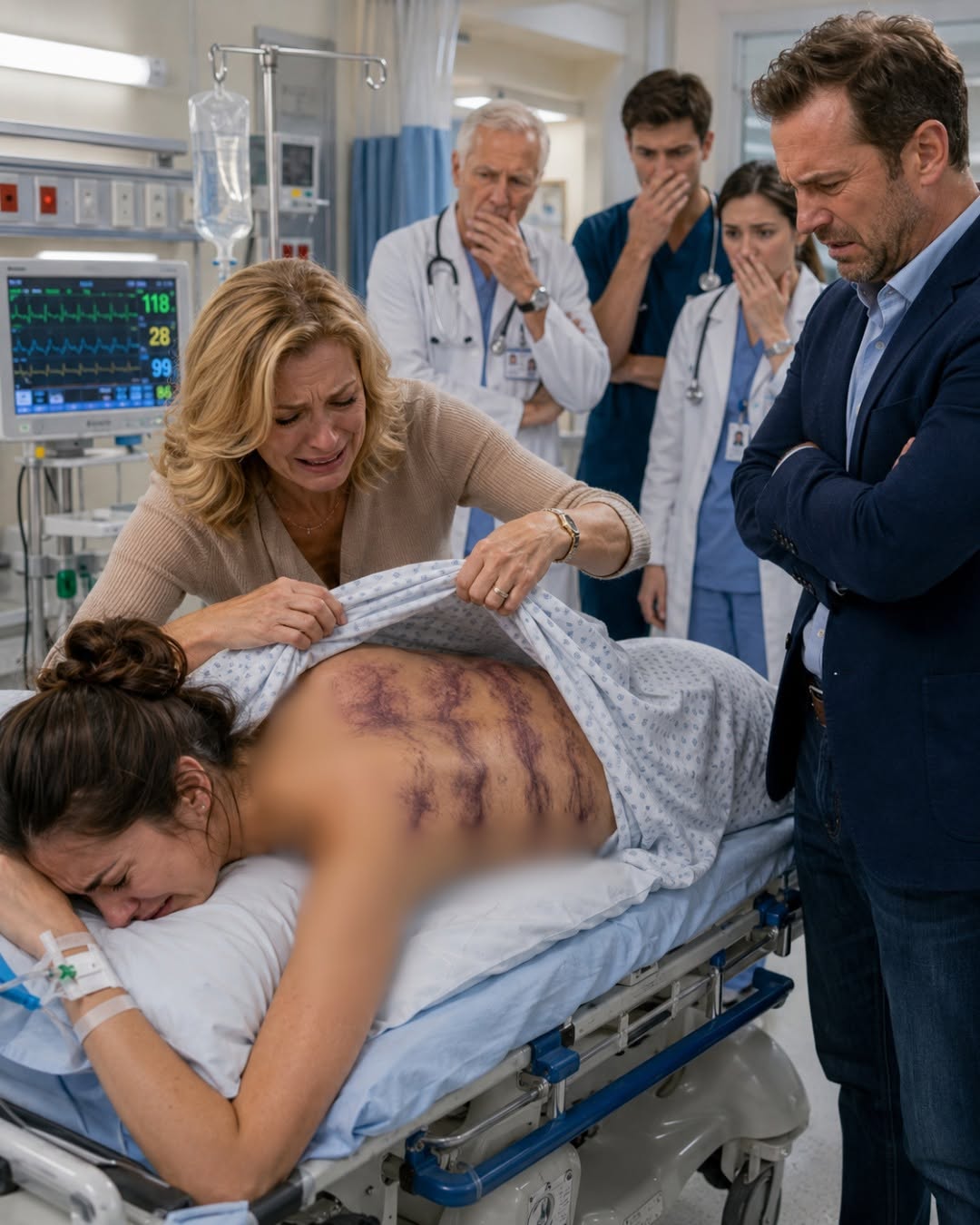
Chloe lay unconscious beneath the brutal trauma lights.
At thirteen, she looked terrifyingly small.
Her skin was nearly colorless.
Her breathing was shallow and mechanical.
The pulse oximeter clipped to her finger continued its steady beeping, a rhythmic protest against the silence surrounding her.
Dr. Ravi Shah, one of my strongest residents, glanced at me.
His expression told me everything.
He was caught between his responsibility to the patient and his awareness that I was his superior.
“Evelyn?” he said carefully. “Her GCS is dropping significantly. We suspect an intracranial hemorrhage. We need to move quickly.”
“Full trauma protocol,” I said.
My voice sounded unfamiliar.
Colder.
Sharper.
Like another version of me had stepped forward, one I usually kept locked away.
“Head CT. FAST exam. Call pediatric protection services immediately.”
Grant’s smile remained in place.
But the corners tightened.
The skin beside his eyes creased in a way I recognized.
It was the expression he gave journalists moments before ruining their careers.
“Ravi, that’s excessive,” he said, deliberately using the doctor’s first name to create a false sense of equality. “She fell. That’s all. There’s no reason to turn a household accident into some dramatic production.”
Then he looked toward me.
“Evelyn is emotional. Understandably. She’s been under enormous pressure at the hospital.”
I didn’t answer.
I couldn’t.
If I spoke directly to him, I was afraid the professional mask holding me together would crack.
I moved beside Chloe’s bed.
My gloved fingers trembled almost invisibly as I lifted the sleeve of her oversized hoodie to inspect the IV line.
Then I saw the bruises.
They covered her arm like a constellation of violence.
Purple.
Yellow.
A deep, ugly green.
Different stages of healing.
A history of pain written across her skin.
My mind raced backward through the previous month.
The dinners Chloe missed.
The way she startled whenever a door slammed.
The way Grant had insisted on taking her to “private tutoring” sessions.
I had been so consumed with saving the hospital that I hadn’t realized my own house was burning.
I gently rotated her arm.
That’s when I saw the mark.
High on her upper arm, close to the shoulder, was a square-shaped metal outline.
One corner had a distinct jagged break.
It looked stamped into her skin.
I knew that shape.
I saw it every morning.
It sat on the mahogany dresser in our bedroom.
The silver buckle on the Holloway family heirloom belt.
Grant wore that belt almost every day because he loved talking about his family’s “old American bloodline.”
My stomach hardened into ice.
For one moment, it felt as though the room had lost all oxygen.
All I could smell was disinfectant.
Metal.
Fear.
Grant leaned closer.
His shadow crossed Chloe’s pale face.
I smelled expensive whiskey beneath the sharp artificial sweetness of mint gum.
“She isn’t even your real daughter, Evelyn,” he whispered.
His voice had become a blade.
“You’re basically a babysitter with paperwork. Stay out of this, or I’ll remind the hospital board exactly whose donations paid for the new cancer center.”
I slowly lifted my eyes.
Not toward Grant.
Toward the dark security camera mounted above the trauma room.
The previous winter, several nurses had been assaulted inside the emergency department.
I had fought for a new policy.
Every camera in the emergency department now recorded high-quality audio.
There were signs posted at every entrance.
Four languages.
Clear lettering.
Grant, trapped inside his own arrogance, had never bothered to notice them.
He believed he was speaking in private.
He didn’t understand that every word was being preserved.
“She became my daughter the day I chose her,” I said.
My voice echoed against the tiled walls.
“And you just confessed in the one room where every word becomes a permanent record.”
For a fraction of a second, fear crossed his face.
It was barely visible.
A shadow over frozen water.
Then the polished consultant returned.
His mask slid back into place.
“You think bruises prove something?” he sneered. “I’m her biological father. Judges in this city believe men like me before they believe bitter, career-obsessed women who use hospitals to settle personal scores.”
He stepped closer.
“I own the judge, Evelyn. I own the mayor. By tomorrow morning, I’ll own your resignation.”
That was his first mistake.
He assumed I was motivated by bitterness instead of a mother’s need for justice.
His second mistake was much worse.
While the nurses prepared Chloe for the CT scanner, something fell from the pocket of her hoodie.
It struck the floor with a sharp crack.
Her phone.
The screen was shattered.
I bent down to pick it up.
Grant’s face changed instantly.
The color drained away.
He lunged forward.
For the first time, his careful composure exploded into panic.
“Give me that!”
I moved faster.
I grabbed the phone.
Even through the cracked glass, I could see a recording application still running.
A red light blinked on the screen.
Chloe hadn’t only survived what happened.
She had documented it.
Grant grabbed my wrist.
His fingers pressed painfully into my skin.
The strength in his grip revealed the man beneath the expensive suit.
“Give me the phone, Evelyn. Right now.”
His voice dropped.
“Don’t make me do something we’ll both regret.”
“Security!” I shouted.
Heavy footsteps immediately began pounding down the corridor.
But before the guards reached the room, Chloe’s heart monitor changed.
The rhythmic beeping vanished.
A single continuous tone ripped through the trauma bay.
Flatline.
The sound erased Grant’s threats.
Everything became chaos.
Blue scrubs.
Shouting.
Movement.
“Code Blue! Pediatric Trauma Bay 4!” the hospital intercom screamed.
Normally, that announcement would turn me into pure instinct.
That day, it struck my chest like a weapon.
“Get him out!” I screamed, pointing at Grant as security rushed him.
They restrained him.
Grant barely fought.
He was staring at the phone in my hand.
He looked like a man watching an empire collapse one brick at a time.
“You’re finished, Evelyn!” he shouted as security dragged him through the double doors. “You and that little brat are finished in this city! I’ll destroy this hospital before I let you destroy me!”
I didn’t watch him leave.
I turned back to Chloe.
Dr. Shah was performing compressions.
His hands moved rhythmically against her chest.
“One, two, three, breathe. One, two, three, breathe.”
“Epinephrine, point one milligrams!” I ordered.
I stepped completely into my medical role because the mother inside me was breaking apart.
I reached for the defibrillator.
“Charge to fifty.”
The machine whined.
“Clear!”
Chloe’s body lifted from the bed.
She looked like a small bird thrown into a storm.
“Again. Seventy joules.”
The machine charged.
“Clear!”
For ten minutes, we fought death.
Ten minutes.
I stared at the girl I had promised to protect and realized that while I was reviewing budgets, negotiating contracts, and attending board meetings, Chloe had been fighting a private war inside the house I shared with a monster.
I remembered every late-night gala.
Every time Grant told me Chloe was “just tired.”
Every time he said she was “going through a phase.”
Every time I had believed him because believing him was easier than imagining the truth.
The guilt became physical.
It felt heavier than the defibrillator paddles in my hands.
Then the monitor moved.
One small spike.
Another.
A broken rhythm.
But a rhythm.
“We have ROSC,” Ravi gasped.
He wiped sweat from his forehead with his sleeve.
“She’s back, Evelyn. But she’s unstable. The pressure in her brain is rising. She needs surgery now.”
They rushed Chloe toward the elevators.
I remained behind in the empty trauma bay.
Plastic wrappers covered the floor.
Used gloves.
Discarded tubing.
And Chloe’s blood-stained sock.
Grant’s threats seemed to remain suspended in the room.
I looked down at Chloe’s phone.
The recording was still running.
I stopped it.
Saved the file.
My thumb was shaking.
I went straight to my office and locked the heavy wooden door behind me.
My hands were trembling so violently that I had to sit on them for several seconds.
Then I breathed.
Once.
Twice.
I connected Chloe’s phone to my computer.
The recordings hadn’t started that day.
There were dozens.