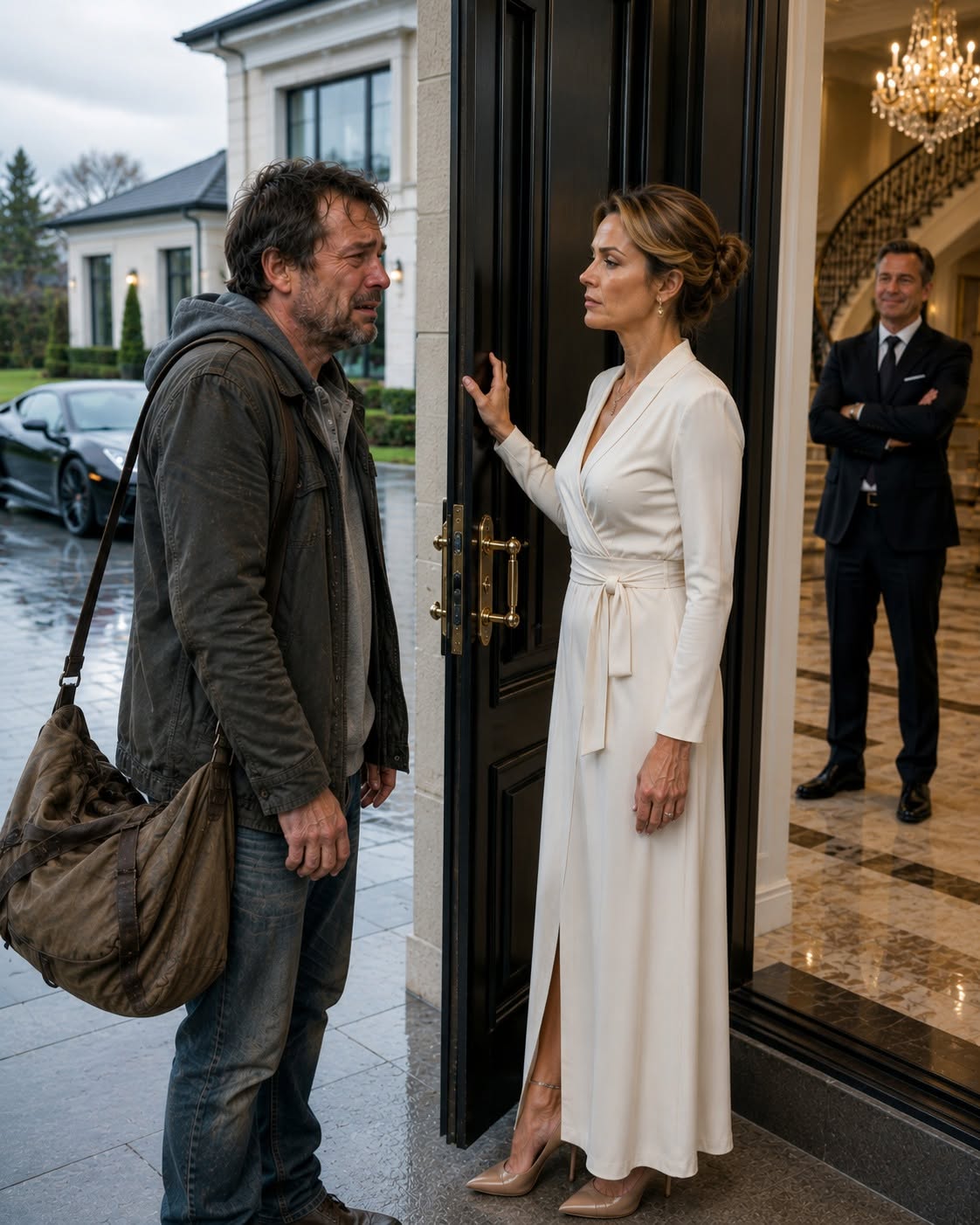
“My father passed away a year ago, Michael, and this house is no longer yours,” Grace said without fully opening the door. “So don’t put on your ex-con act. Leave before I call the police.”
I’d been free for exactly three hours.
I had walked out of state prison that morning carrying an old backpack, a borrowed jacket, and a heart so tight it still felt wrapped in prison bars. For three years, I had replayed the same scene in my mind: me ringing the doorbell at the house in the suburbs, my father opening the door in his plaid shirt, his eyes tired but alive, saying to me:
“I knew you’d come back, son. The truth always finds a crack.”
But it wasn’t him who answered.
It was Grace, my stepmother. She was wearing spotless white pants, a silk blouse, and pearl earrings she never could have afforded before marrying my father. She looked me up and down—from my shaved head to my worn-out sneakers—as if I were a trash bag someone had left on the sidewalk.
“Where’s my father?” I asked, my voice breaking.
She sighed, pretending to be exhausted.
“I just told you. Ernest died. Cancer. Fast. Painful. It’s over.”
I felt the ground shift beneath my feet.
“And no one told me? No one requested permission so I could see him? Not even when he was dying?”
Grace gave the faintest smile.
“Michael, you were in prison for stealing from your own father. Do you really think he wanted you at his funeral?”
I tightened my grip on my backpack straps.
“I never stole anything from him.”
“That’s what you said during the trial. Look where it got you.”
I tried to look past her. The living room was no longer the living room I remembered. The family photos were gone. My mother’s portrait had disappeared. The display cabinet with the old construction company trophies was missing. The walls had been painted an elegant gray. The furniture was new, cold, expensive. Even the house smelled different, like a luxury hotel without a soul.
“Let me in,” I pleaded. “I just want to see his room.”
“His room doesn’t exist anymore. I remodeled everything.”
Then Ian appeared at the top of the staircase.
My stepbrother walked down slowly with a crooked smile. Before I went to prison, the last thing I knew about him was that he owed money on gambling debts, credit cards, and loans no respectable lender would have approved. Now he wore an expensive watch, a designer shirt, and a confidence that made me sick.
“Well, look at that,” he said. “The thief came back for his inheritance.”
“I came for my father,” I replied.
“Your father died believing you were a disgrace.”
The words hit me square in the chest, but I didn’t move.
Grace raised her phone.
“If you set one foot inside this house, I’ll call the police. And with your record, Michael, it won’t take much to send you back to prison.”
She slammed the door in my face.
I didn’t yell.
I didn’t cry there.
I walked to the local cemetery because my father had always said he wanted to be buried beside my mother. I needed to see his name on a gravestone before I could believe he was really gone.
An elderly groundskeeper watched me from a distance.
“Who are you looking for, son?”
“Ernest Sullivan. His wife said he’s buried here.”
The man’s face went pale.
“You’re Michael.”
A chill ran through my body.
“How do you know my name?”
The groundskeeper glanced toward the cemetery entrance and lowered his voice.
“Because your father asked me to give you this if you ever came looking for him.”
He pulled a yellow envelope from his vest pocket along with a small key labeled:
STORAGE UNIT 108.
My hands trembled as I opened the letter.
The very first line read:
Son, if you’re reading this, it means Grace has already started lying to you.
And in that instant, I realized my father’s death wasn’t the end of my nightmare.
It was only the doorway to something much worse.
The handwriting was unmistakably my father’s—large, heavy letters, as though every word had been hammered onto the page.
Son, forgive me for not coming to see you, the letter said. It wasn’t because I believed you were guilty. At first they fooled me. They showed me fake documents, fabricated transfers, false reports. But by the time I discovered the truth, I was already sick, and they were watching my every move.
I sat down on a cemetery bench because my legs had stopped working.
Grace didn’t want me speaking to you. Ian isolated me. They convinced me you’d stolen money from the construction company. But it was all staged. They used your passwords, your computer, and your digital signature. I found duplicate invoices, deposits into shell companies, and transactions made while you were out at job sites.
Rage rose into my throat.
I’d lost three years of my life for something I never did.
I kept reading.
I hid the evidence in Storage Unit 108. Don’t confront Grace until you’ve seen it. Don’t trust anyone in that house. They took your freedom, Michael, but don’t let them take the truth too. I love you. Dad.
The groundskeeper’s name was Don Julian. He gave me some cash so I could take the bus to a storage facility in the city.
“Your father used to come here when he was already very sick,” he told me. “He said a son shouldn’t leave prison empty-handed.”
Storage Unit 108 sat at the end of a dusty hallway lined with rusted metal doors. The key turned effortlessly in the lock.
When I rolled up the metal door, I didn’t find old furniture or boxes of clothes.
I found a room full of evidence.
There were filing cabinets, envelopes, and folders labeled in black marker:
BANKS.
FAKE INVOICES.
IAN.
GRACE.
WILL.
On a table sat a USB drive with a handwritten note.
Watch this first.
I plugged the drive into the cheap phone I’d been given when I was released. The video took a moment to load.
My father appeared on the screen.
He was thin, yellowish, his eyes sunken deep into his face. Behind him I could see his workshop and an old photograph of my mother.
“Michael,” he said, struggling to breathe. “If you’re watching this, you’ve been released. I’m sorry I couldn’t be there waiting for you at the gate.”
I covered my mouth to keep from breaking down.
“You didn’t steal anything. Ian did. He created fake suppliers to siphon money out of the construction company. When the audit began, Grace gave him your passwords. She also gave him the key to your apartment. They planted fake files on your computer.”
My world split apart.
“They also forged my signature to change my will while I was sedated during chemotherapy. There are medical records, emails, receipts, and recordings. Grace claimed she was taking care of me, but she kept me imprisoned in my own house.”
My father closed his eyes for a moment.
“And if she told you I’m buried beside your mother, she lied about that too. Don’t let her decide where my story ends.”
The video ended.
I spent hours going through the folders. There were multimillion-dollar transfers, messages between Ian and a corrupt accountant, photographs of my computer open on dates when I was out of town.
Then I found a red folder.
Its label read:
CONFESSION.
Inside was a signed statement from Ian admitting he’d used my passwords to divert company funds.
But underneath it was the document that took my breath away.
The funeral records.
Grace and Ian hadn’t just sent me to prison.
They had hidden my father’s body.
And the address written there proved that they hadn’t shown him mercy even after death.
I didn’t go back to Grace’s house that night.
Before prison, I would have kicked down the door. I would have screamed. I would have given Ian exactly the kind of scene they needed to paint me as violent all over again.
But three years behind bars had taught me something brutal: anger without evidence only feeds liars.
I slept on the cold concrete floor of the storage unit, hugging my backpack with the USB drive, the letter, and the most important folders inside. I didn’t really sleep. I closed my eyes and kept hearing my father’s voice repeating:
“Don’t let her decide where my story ends.”
The next morning, I went to a legal aid clinic for people who had just been released from prison.
That’s where I met attorney Sarah Miller.
She was a serious woman with her hair pulled back and sharp, observant eyes. She didn’t promise me justice.
That’s exactly why I trusted her.
She reviewed the documents for nearly three hours.
When she finished, she took off her glasses and set them on the table.
“Michael, this isn’t just grounds for an appeal. We’re looking at fraud, forgery, identity theft, will tampering, and possibly concealing human remains. If we handle this correctly, we can clear your name. But they’ll fight dirty.”
“They already stole three years of my life,” I said. “I’m not giving them the rest.”
Sarah closed the folder.
“Then we’ll go through the proper door.”
Eleven days later, the first court orders were issued.
The judge froze Ian’s bank accounts, requested the construction company’s financial records, and ordered an emergency review of my conviction.
That same afternoon, Grace called me.
“Michael, sweetheart,” she said in a sickeningly sweet voice. “I received some very strange legal papers. I don’t know who’s filling your head with these ideas, but we should discuss this as a family.”
“Families don’t fabricate evidence to send an innocent man to prison.”
Silence.
Then her voice changed.
“You’re still an ex-convict. Do you really think a judge is going to believe you over me?”
I looked at the USB drive sitting on the table.
“He doesn’t have to believe me. He only has to listen to my father.”
I hung up.
The legal process lasted eight months.
Ian cracked first.
When prosecutors presented the bank transfers, the messages with the accountant, and his own signed confession, he started sweating as though the courtroom air had turned to fire.
First he blamed Grace.
Then he blamed his debts.
Finally, when he realized how many years he could spend behind bars, he told the whole truth.
He admitted Grace had obtained my passwords. He admitted she’d given him the key to my apartment. He admitted my father had tried several times to call me in prison, but Grace kept telling him I wanted nothing to do with him.
He also confessed that when my father began to suspect the truth, she took away his phone and convinced his private physician that his accusations were hallucinations caused by medication.