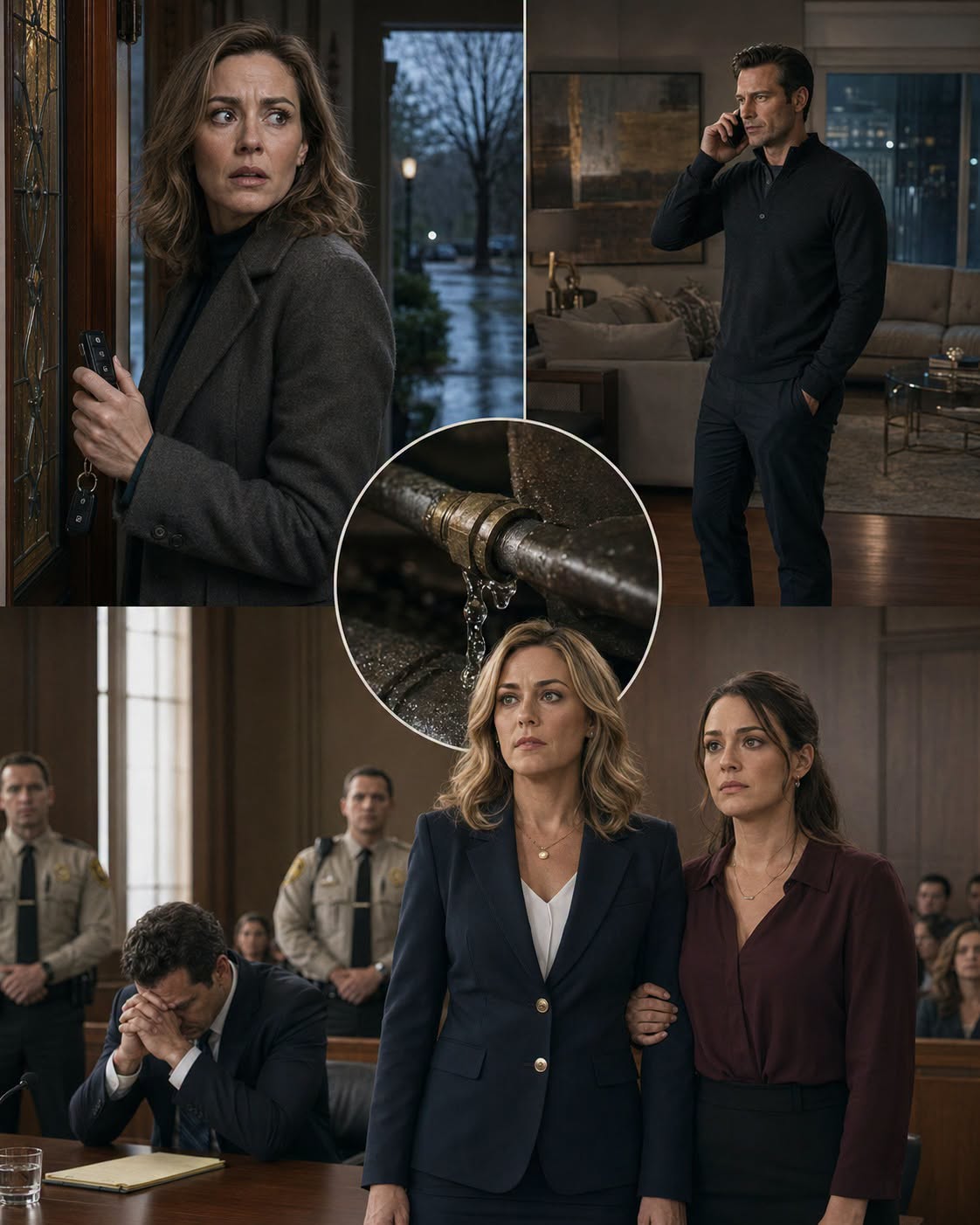
THE FUNERAL HE PAID FOR
PART 1: THE HOUSE WAS TOO STILL
I only went back for the title and insurance papers.
That was all.
A folder from the desk drawer. Ten minutes in and out. No fight, no tears, no last-minute conversation with the man I had spent seven years calling my husband. I had already learned that conversations with Logan never ended where they began. They twisted. They doubled back. They made me apologize for wounds I was still bleeding from.
So I parked two houses down, like a thief outside my own home, and walked up the sidewalk with my keys gripped between my fingers.
The afternoon was cold enough to turn my breath white. Dead leaves scraped across the driveway. The big maple in our front yard—his front yard now, I had been told more than once—shivered in the wind like it was trying to warn me.
I told myself I was being dramatic.
We were separated, not at war.
Logan and I were still “handling things like adults,” as he liked to say in that calm, polished voice he used whenever other people were listening. He told friends we had “grown apart.” He told my mother we were “taking space.” He told me I was unstable, paranoid, and lucky he had not forced the divorce faster.
But I had survived the last six months by listening to the little voice in my body that said something was wrong.
That voice screamed the second I stepped inside.
The house felt wrong.
Not messy. Not broken. Not visibly disturbed.
Just wrong.
Too still.
His boots were by the door.
His black coat hung over the chair in the hallway, one sleeve dangling like a limp arm.
He was home.
My first thought was stupid and automatic: I should leave.
My second thought was colder: He isn’t supposed to be here.
Logan’s truck was not in the driveway. That meant he had parked in the garage, or around back, or somewhere he knew I would not see it. A tiny detail. A tiny choice. But marriage teaches you the language of small choices. It teaches you when a glass placed too hard on a counter means rage. When a smile means punishment later. When silence is not peace but a room holding its breath.
I froze in the entryway.
Then I heard his voice from the living room.
Low. Relaxed. Almost amused.
The way people sound when they think they have already won.
“Yeah,” Logan said, and then he laughed. “I took care of her brakes.”
My whole body went cold.
The keys in my hand bit into my palm. For a second, I couldn’t feel my legs. I just stood there with the smell of lemon cleaner and old coffee in my nose, staring at the hallway runner we had bought on our first anniversary.
Her brakes.
My car.
The car sitting outside under the maple tree.
The car I was supposed to drive that night to my mother’s birthday dinner.
For one insane second, my mind tried to protect me. It tried to make the sentence smaller.
Maybe he said breaks. Maybe he meant a schedule. A delay. A favor.
Then he spoke again.
“See you at your sister’s funeral.”
My knees nearly gave out.
Not your wife.
Your sister.
Sophie.
My baby sister was hosting Mom’s birthday dinner that night. She had insisted on doing it at her townhouse because Mom had been too tired lately, and because Sophie made everything feel warm even when the world was burning down. I was supposed to drive. Sophie was supposed to ride with me afterward to pick up the cake from the bakery across town because she said my car had more trunk space and because she wanted ten minutes alone with me before dinner.
“I need to talk to you about Logan,” she had said the night before.
I had almost asked her what she meant.
But then Mom called, and Sophie got distracted, and I told myself we would talk in the car.
In the car.
With the brakes Logan had “taken care of.”
For one second, rage rose so fast in me that it burned through the fear. I wanted to run into the living room. I wanted to scream. I wanted to throw the framed wedding photo from the mantel at his head and ask him how long he had been planning my sister’s funeral.
But something in me finally understood what fear is supposed to do.
It is not supposed to freeze you forever.
It is supposed to keep you alive.
So I backed away, one careful step at a time.
The hallway floor creaked.
Logan stopped talking.
The whole house went silent.
I stopped breathing.
I could see the living room doorway from where I stood. Half an inch of shadow. The edge of the couch. A slice of Logan’s hand holding his phone. His wedding ring still on his finger, though he had not worn love on that hand for years.
One second passed.
Then another.
My heart beat so hard I thought the sound alone would give me away.
Finally, Logan spoke again, calmer than ever.
“Just make sure she leaves on time tonight.”
I did not wait to hear more.
I moved backward through the entry, turned the lock as slowly as I could, and slipped outside into the sharp afternoon air. I did not run until I reached the sidewalk. Even then, I made myself walk. One foot. Then the other. Past the hedges. Past the neighbor’s empty porch. Past the little stone birdbath where Logan had once kissed my forehead and promised I would always be safe with him.
Two houses down, my hands finally started shaking.
I leaned against a mailbox and tried to unlock my phone. My thumb missed the screen three times.
Call 911, my brain said.
No. Tow the car first.
That thought came from somewhere deeper and older than panic. If I called the police and Logan saw them coming, he could deny everything. He could touch the car again. He could say I was hysterical, that I had misunderstood, that our separation had “affected my judgment.”
He had been practicing that sentence for months.
So I called a tow company first.
My voice sounded strange when I gave the dispatcher the address. Flat. Polite. Almost normal.
“My brakes feel unsafe,” I said. “I need the car taken to Harper’s Auto on Ridge Road. Please send a flatbed. Please tell the driver not to start it.”
The woman on the line paused. “Ma’am, are you somewhere safe?”
The question nearly broke me.
“Yes,” I lied.
Then I called Sophie.
She answered on the third ring, breathless and cheerful. “Tell me you got the papers, because Mom just called and now she wants those little lemon cookies from Bellamy’s too, and I swear—”
“Do not get in any car.”
Silence.
“Claire?”
“Not yours. Not mine. Lock the door and wait for me.”
“What happened?”
“Lock the door, Sophie.”
My voice cracked on her name.
That was when she stopped asking like a sister and started listening like someone who knew me.
“Okay,” she said quietly. “I’m locking it now.”
I heard movement on her end. A door. A deadbolt. Her breathing changed.
“Claire, where are you?”
“Outside the house.”
“Logan’s house?”
I swallowed. “He’s inside.”
“What did he do?”
I looked back down the street.
The house sat there with its white trim and blue shutters, looking ordinary enough to fool God.
“I think he cut my brakes,” I said. “And I think he wants you dead.”
Sophie made a sound I had never heard from her before. Not a scream. Not exactly. More like all the air leaving her body at once.
“Claire—”
“I’m coming to you as soon as the car is gone.”
“Call the police.”
“I will. I need the car secured first.”
“Claire, this isn’t one of his mind games.”
“I know.”
And I did.
That was the worst part.
For months I had doubted myself. I had written down conversations afterward so Logan could not rearrange them in my memory. I had hidden cash in a winter boot. I had kept copies of my documents in Sophie’s kitchen drawer because he had once taken my passport and said I must have misplaced it.
I had known he was cruel.
I had not known he was a man who could laugh about a funeral he had not yet earned.
The tow truck arrived twenty-three minutes later.
I stood behind a neighbor’s lilac bush and watched the driver load my silver Honda onto the flatbed. He was a heavyset man named Ray with kind eyes and grease under his nails. He frowned when I told him again not to drive it, not even onto the ramp.
“We’ll winch it,” he said. “You look like you’ve seen a ghost.”
“Something like that.”
Logan did not come outside.
That scared me more than if he had.
I watched my car rise slowly onto the flatbed, the front tires turning just enough to look alive, like an animal being lifted from a trap. For one second, relief hit me so hard I almost cried.
The car was gone.
Sophie was locked inside.
I had stopped it.
Then my phone lit up.
At first I thought it was Sophie again.
It wasn’t.
It was an email.
Forwarded from Logan’s account.
No message. No explanation. Just a forwarded confirmation, probably sent by mistake because my old address still autofilled under his fingers when he typed too quickly.
The subject line was:
Funeral Home Confirmation — Service Scheduled for S. Bennett.
My sister’s initial.
My last name.
The world narrowed to those words.
S. Bennett.
I opened the email with hands that did not feel like mine.
The funeral home logo sat at the top in soft gray letters, tasteful and quiet, the kind of design meant to make death look manageable. Under it was an order summary.
Private family viewing.
Cremation package.
White lilies.
Clergy honorarium.
Reception room.
Paid in full.
Requested by: Logan Hayes.
Service date: Friday, October 18.
Tomorrow.
My vision blurred.
Tomorrow.
He had not only planned the crash.
He had already paid for the funeral.
And when I scrolled down and saw the note typed into the special instructions box, I understood there was one more thing Logan had arranged before the brakes ever failed.
Family liaison to confirm arrival time: Aaron Bennett.
My brother.
For a moment, I forgot how to stand.
The phone slipped from my hand and hit the sidewalk.
Aaron.
“Just make sure she leaves on time tonight.”
I bent to pick up the phone, but my fingers would not close around it. My brother’s name glowed up at me from the cracked screen like a sentence passed by a judge.
Aaron Bennett.
The man who carved turkey at Thanksgiving.
The man who called Sophie “kiddo.”
The man who had hugged me outside the courthouse after my separation hearing and told me, “Whatever Logan did, we’ll handle it as a family.”
Family.
I laughed once, but it sounded like choking.
Then I picked up the phone and started walking.
Because now I knew something Logan didn’t.
He had planned a funeral.
I was going to make sure someone attended it.
Just not the person he paid for.
PART 2: THE BRAKES WERE NOT A MISTAKE
Sophie opened the door before I knocked.
She had a chef’s knife in one hand and a phone in the other.
Under any other circumstances, I might have laughed. Sophie was five foot three, soft-faced, and wore fuzzy socks with cartoon sheep on them. She looked like a kindergarten teacher who had wandered into a crime scene by accident.
But her eyes were huge.
She pulled me inside and locked three locks behind me.
“What happened?” she whispered.
I showed her the email.
I watched her read it.
At first, her face did not change. Sophie had always been like that in emergencies. When Dad had his stroke, when Mom fell on the ice, when my marriage began collapsing in public, Sophie became quiet. Efficient. Almost peaceful. She could fold panic into a neat square and put it aside until later.
But when she reached Aaron’s name, her mouth trembled.
“No,” she said.
Just one word.
It held twenty-nine years of being a sister.
I wanted to take the phone back. I wanted to delete the email and tell her I was wrong, that there was another Aaron Bennett, another S. Bennett, another man named Logan who liked paying for funerals before people died.
But Sophie’s thumb moved lower.
She found the receipt.
The date.
The lilies.
Her own funeral, itemized in clean black text.
Her face went white.
“He told me you were getting worse,” she said.
The words hit me sideways. “Who did?”
“Aaron.” Her voice was barely there. “He called me this morning. He said you were spiraling. That Logan was worried you might do something reckless tonight. He said if you insisted on driving, I should ride with you so you wouldn’t be alone.”
My stomach turned.
Sophie pressed one hand to her mouth.
“He wanted me in the car.”
“Yes.”
“And Aaron wanted me in the car.”
I nodded because I could not say it yet.
Sophie sat down hard on the edge of the sofa.
The birthday decorations were everywhere. Gold streamers on the wall. Paper plates stacked on the dining table. A banner half hung over the kitchen doorway that read HAPPY BIRTHDAY MOM in Sophie’s careful block letters.
A pot of soup simmered on the stove.
The house smelled like basil, garlic, and lemon cake.
It smelled like love.
And because of that, the horror felt obscene.
I sat beside her.
For a little while, neither of us spoke.
Then Sophie whispered, “Why?”
That was the question I had been avoiding since I left the house.
Why did a husband become a murderer?
Why did a brother help?
Why was my sister’s funeral paid for with lilies?
I looked toward the kitchen counter where Sophie’s laptop sat open beside a stack of papers. I noticed, for the first time, that they were not birthday recipes or grocery lists.
They were bank statements.
Insurance forms.
Copies of checks.
“Sophie,” I said slowly. “What did you need to tell me about Logan?”
She closed her eyes.
That was answer enough.
Two weeks earlier, Sophie had helped Mom switch accountants because Mom kept complaining that her property tax notices were confusing her. Sophie had a sharp mind for numbers. She ran payroll for the physical therapy clinic where she worked, and she had always been the one who could find a missing dollar in a stack of receipts.
When she reviewed Mom’s accounts, she found monthly withdrawals Mom did not remember authorizing.
At first, Sophie thought it was a mistake.
Then she found the signature.
Mine.
On a form authorizing Logan Hayes, as my spouse, to access a joint emergency fund Dad had set up years before for Mom’s medical care. The signature looked like mine if you did not know me well.
Sophie knew me well.
“You never make your C like that,” she said. “And you never spell out your middle name on forms. You hate your middle name.”
I almost smiled. Almost.
“How much?” I asked.
Sophie looked down.
“Soph.”
“Forty-six thousand.”
The room tilted.
I gripped the edge of the couch. “From Mom?”
“From the emergency account. Slowly. Over eight months. He labeled some of them as home repairs. Some as medical reimbursements. A few went straight into an account attached to Aaron’s landscaping business.”
Aaron.
The name struck again.
I remembered Aaron’s new truck. His sudden vacation to Florida. The way he had stopped complaining about money after years of always being one broken lawn mower away from disaster.
“I confronted Aaron yesterday,” Sophie said. “I didn’t tell him everything. Just enough. I said if he and Logan paid the money back before Mom’s birthday dinner, I wouldn’t call the police until after we talked as a family.”
“Oh my God, Sophie.”
“I thought…” She shook her head. Tears slipped down her cheeks. “I thought he’d panic. I thought he’d admit Logan dragged him into something stupid. I didn’t think he would—”
“Plan your funeral?”
She flinched.
I hated myself for saying it, but the words were already between us.
Sophie wiped her face. “There’s more.”
Of course there was.
She opened the laptop and clicked into a folder named MOM TAX DOCS. Inside were scans, screenshots, and PDFs organized by date. My practical sister. My careful sister. The sister Logan thought he could erase with a cut brake line.
She opened an insurance document.
My name appeared first.
Claire Bennett Hayes.
Spouse: Logan Hayes.
Beneficiary: Logan Hayes.
I stared at the number beside coverage amount.
$750,000.
“I knew about that policy,” I said. “Logan insisted on it after Dad died. He said responsible couples planned ahead.”
Sophie nodded. “Look at the rider added six months ago.”
I read it once.
Then again.
Accidental death benefit.
Double indemnity.
My throat closed.
“If you died in a crash,” Sophie said softly, “he could collect one and a half million.”
The room seemed to pulse around me.
I thought of Logan’s hands on my shoulders after we signed the policy paperwork. The way he kissed my temple and said, “Now I can sleep knowing we’re protected.”
Protected.
Sophie opened another file.
“This one is why he needed me gone too.”
It was not a life insurance policy on Sophie. That would have been too obvious. It was worse in a quieter way.
A notarized statement.
Supposedly signed by Sophie.
It said that she had reviewed Mom’s financial records and found no irregularities connected to Logan Hayes or Aaron Bennett. It said she had mistakenly raised concerns during a period of stress. It said no further investigation was necessary.
The signature was hers.
But not hers.
“I found that attached to an email draft in Aaron’s business account,” Sophie said. “He left himself logged in on Mom’s tablet last month. I didn’t snoop then. I should have.”
“They forged you.”
“And if I died tonight, that statement would come out afterward. Poor Sophie was confused. Poor Claire was unstable. Terrible accident. Bad brakes. Wet road. Two grieving men saying they tried their best.”
My hands shook.
Logan had not simply planned murder.
He had planned the story afterward.
I saw it suddenly, the way he would tell it.
My wife was devastated by the separation.
She insisted on driving even though I worried about her.
Her sister rode with her to calm her down.
The brakes failed.
A tragic accident.
And if only Claire had listened.
My own death would be used as proof that Logan had loved me.
Sophie’s death would bury the evidence.
Aaron would cry at the funeral he helped schedule.
I stood too fast.
“I’m calling the police.”
“I already tried,” Sophie said.
I froze. “What?”
“After I saw the funeral email.” She held up her phone. “I called the non-emergency line first because I panicked and didn’t know what to say. They told me an officer could come take a report. Then I called 911 and said there had been a threat. They said to stay put.”
“That’s good.”
She looked toward the window.
The color drained from her face again.
“Soph?”
She pointed.
Across the street, Aaron’s green truck rolled slowly past the townhouse.
Not parked.
Not stopped.
Just passing.
Too slowly.
He turned his head toward Sophie’s windows.
For one terrible second, even through the glass, I saw my brother’s face.
He looked scared.
That made it worse.
A monster with no fear is one thing.
A coward with something to lose is another.
Sophie stepped away from the window.
My phone rang.
Logan.
His name filled the screen, bright and ordinary.
I let it ring once.
Twice.
Sophie shook her head.
I answered.
“Claire,” Logan said, warm with concern. “Where are you?”
My mouth went dry.
I looked at Sophie. At the knife still on the coffee table. At the birthday banner swaying faintly in the heat from the vent.
“I’m at the grocery store,” I lied.
A pause.
Tiny.
Almost nothing.
“What grocery store?”
“Bellamy’s.”
“That’s a bakery.”
My skin prickled.
There he was.
The real Logan, showing through the polite one.
“I meant I’m picking up Mom’s cookies.”
“I thought you went to the house for your car papers.”
“I did.”
Another pause.
“I don’t see your car.”
I closed my eyes.
Of course he had looked.
“It was making a noise,” I said. “I called a tow.”
Silence.
This one was longer.
When Logan spoke again, the warmth was gone.
“You did what?”
“I had it towed.”
“To where?”
“I don’t remember the name. The driver suggested a place.”
“Claire.”
Just my name.
A warning.
For years that tone had worked on me. It had made me explain too much, apologize too fast, hand him the missing pieces of whatever weapon he was building.
This time I said nothing.
He exhaled through his nose.
“You need to listen to me very carefully. You have been under a lot of stress. If you start making wild accusations—”
“I didn’t accuse you of anything.”
Another silence.
Then, softly, “Where is Sophie?”
My heart slammed once.
I looked at her.
She mouthed, Don’t.
“I don’t know,” I said.
Logan laughed under his breath.
Not because anything was funny.
Because he knew I was lying.
“Your mother is expecting everyone at six,” he said. “Don’t ruin another family event.”
He hung up.
Sophie and I stared at the phone.
Then a text came in from Aaron.
Running late. Mom asked if you and Soph can come together. Logan says Claire shouldn’t drive alone.
I could see the whole machine turning.
Logan on one side.
Aaron on the other.
My mother in the middle, unaware that her birthday dinner had become a map for murder.
Outside, Aaron’s truck passed the townhouse again.
This time slower.
Sophie grabbed my hand.
“What do we do?”
I looked at the laptop. The forged statement. The insurance rider. The funeral receipt. The sister I had almost lost before the night had even begun.
For six months, Logan had made me feel like a woman reacting to shadows.
Now I had shadows with names.
“We stop acting like prey,” I said.
And then, finally, we called 911 again.
PART 3: MAKE SURE SHE LEAVES ON TIME
The first officer arrived twenty minutes later.
By then, Sophie and I had moved every document into a folder, emailed copies to ourselves, and placed her laptop inside the oven because it was the only hiding place we could think of that did not make us feel like idiots. Sophie stood in front of the stove afterward and whispered, “If I die because I baked my evidence, I’m haunting you.”
I laughed.
It came out cracked and ugly.
But I laughed.
The officer’s name was Miller. He was young enough to still look uncomfortable with other people’s terror. He listened while I told him about the phone call I overheard, the tow truck, the funeral receipt, and Aaron driving past the house.
He wrote everything down.
He frowned at the email.
He frowned harder at the words paid in full.
But I could see the careful distance in his face.
The one people use when they are deciding whether a frightened woman is a witness or a problem.
“Do you have a recording of your husband saying he tampered with the brakes?” he asked.
“No.”
“Did you see him touch the vehicle?”
“No.”
“Has the mechanic inspected it yet?”
“Not yet. The car was just towed.”
He nodded slowly.
Sophie’s voice sharpened. “He paid for my funeral.”
“I understand how concerning that is.”
“No,” she said. “You don’t. Concern is when your oven makes a weird noise. This is my funeral.”
Officer Miller flushed.
I almost felt sorry for him.
Almost.
He said he would contact Harper’s Auto, request an urgent safety inspection, and file a report. He advised us not to go anywhere alone. He asked if we had somewhere else to stay.
“My mother’s birthday dinner is tonight,” Sophie said.
He blinked. “I would strongly suggest canceling.”
I wanted to agree.
I wanted to call Mom, tell her everything, and drag her into the safest room we could find.
But before I could speak, my phone rang again.
Mom.
I answered on speaker.
“Claire?” she said. Her voice sounded thin and tired but happy. “Honey, are you with Sophie? Aaron said there’s confusion about rides.”
Sophie closed her eyes.
“Hi, Mom,” I said carefully. “We’re together.”
“Oh good. Logan just called. He’s worried about you.”
My stomach turned.
Of course he had.
“He said your car broke down,” Mom continued. “Poor thing. He offered to pick you both up, but Aaron said he could do it instead. Isn’t that sweet? I told him nobody needs to fuss so much. It’s just dinner.”
Officer Miller looked up from his notebook.
Sophie mouthed, No.
“Mom,” I said, “listen to me. Do not get in Aaron’s truck. Do not let Logan into your house.”
A startled pause.
“What on earth is going on?”
“I can’t explain everything on the phone. Lock your door. Stay inside.”
“Claire, you’re scaring me.”
“I know. I’m sorry. Please.”
In the background, I heard a doorbell.
Mom sighed. “That must be Aaron now.”
Every nerve in my body lit up.
“Mom, don’t open it.”
But she had already lowered the phone.
I heard muffled voices.
Aaron’s voice.
Warm. Familiar. False.
“Hey, birthday girl.”
My brother had always known how to sound harmless.
Then the call ended.
Sophie whispered, “He’s with her.”
Officer Miller stood. “Give me the address.”
I gave it to him.
He radioed something in, but I could tell from his face that no cavalry was about to burst through the wall. Not yet. Not until the brake inspection proved something. Not until a detective decided a prepaid funeral counted as more than a disturbing coincidence. Not until danger crossed the invisible line from possible to undeniable.
Logan knew that line.
Men like him lived on it.
They built houses there.
Sophie turned to me. “We have to go.”
“No.”
“Claire, Mom’s with Aaron.”
“And Logan wants us moving. He wants us rushed and scared and in the wrong car at the wrong time.”
“Then we go with the officer.”
Officer Miller hesitated. “I can escort you, but I need to wait for backup if there’s a possible threat at the residence.”
Sophie made a frustrated sound.
My phone buzzed.
A text from Logan.
Your mother is upset. Stop this before you embarrass yourself.
Then another.
Where did you take the car?
Then another.
Claire. Answer me.
I stared at the messages.
Something shifted in me.
Not bravery. Bravery sounds too clean.
This was anger with a spine.
For years, Logan had trained me to fear his questions. Where are you? Who are you with? Why did you say that? Why are you making that face? He turned questions into cages and waited for me to walk inside.
But now his questions told me something.
He did not know where the car was.
He did not know what I had seen in the email.
He did not know how much Sophie knew.
For the first time all day, Logan was the one missing information.
I typed back:
Car is being checked. Sophie and I are going to Mom’s. Don’t come.
I did not send it right away.
Sophie looked at me. “What are you doing?”
“Giving him something to react to.”
Officer Miller frowned. “Ma’am, I don’t recommend engaging.”
“I’m not engaging. I’m pulling a thread.”
I sent the text.
Logan called immediately.
I declined.
He called again.
I declined again.
Then a message came through.
Do not let Sophie talk to anyone.
There it was.
The first crack.
Not Don’t scare your mother.
Not I’m worried.
Do not let Sophie talk to anyone.
I showed the officer.
His expression changed.
Just slightly.
But enough.
He stepped into the hallway to make another call.
Sophie wrapped her arms around herself. “He knows I found something.”
“Yes.”
“So why pay for my funeral under his own name? Why not hide it?”
I had been asking myself that since the email arrived.
Then I remembered something.
Logan did not believe mistakes applied to him.
He believed ordinary systems existed to serve him. Secretaries, bank tellers, funeral directors, wives. He had probably sounded grieving and composed on the phone. He had probably said arrangements needed to be made quickly due to “family circumstances.” He had probably used the name Bennett because it was Mom’s family name, because Sophie had never married, because grief makes people afraid to ask hard questions.
And the forwarded email?
That was not arrogance.
That was habit.
For years, Logan had forwarded bills, forms, reminders, and confirmations to me because I had managed the household while he managed control. He had probably typed C and let autofill do the rest.
The thing he forgot was that even after you leave a house, machines remember you.
Sophie’s phone buzzed.
Aaron.
She stared at it like it was a snake.
“Answer,” I said.
Her eyes widened.
“Put it on speaker.”
Officer Miller stepped back into the room and nodded once.
Sophie answered.
“Aaron?”
“There you are.” My brother sounded breathless. “What the hell is going on? Mom’s crying.”
My sister’s face tightened. “Why are you at Mom’s?”
“It’s her birthday.”
“You were supposed to come at six.”
“Plans changed.”
“Who changed them?”
A pause.
Then Aaron laughed. “What is this? A deposition?”
Sophie looked at me.
I motioned for her to keep going.
“I found the statement,” she said.
Silence.
Total.
Then Aaron said, very softly, “What statement?”
“The one with my forged signature.”
“Sophie—”
“And I found the funeral receipt.”
The sound that came through the phone was not a word.
It was breath.
Panic.
Then Aaron’s voice dropped. “Listen to me. You don’t understand what Logan is doing.”
That sentence landed like a match.
Not I don’t know what you mean.
Not Logan didn’t do anything.
You don’t understand what Logan is doing.
Sophie’s eyes filled with tears.
“Then explain it.”
“I can’t over the phone.”
“Try.”
“I was trying to fix it.”
“You helped him plan my death.”
“No.” His voice broke. “No, Soph, I didn’t know about that part.”
That part.
Officer Miller’s jaw tightened.
My hand found Sophie’s and squeezed.
Aaron kept talking, faster now. “Logan said he was going to scare Claire. That’s all. Make the car fail before she got too far. He said nobody would get hurt. He said you weren’t actually riding with her, that he just needed me to keep the timing straight so she’d leave when he could—”
“When he could what?” I asked.
Aaron went silent.
He had not known I was there.
“Hi, Aaron,” I said.
“Claire.”
My name sounded like guilt in his mouth.
“When he could what?” I repeated.
He swallowed loudly.
Then, behind his voice, I heard Mom ask, “Aaron? Who is that?”
And behind her, farther away but unmistakable, another voice entered the house.
Logan.
“Tell Sophie I’m here,” Logan said pleasantly. “We should all talk.”
Sophie’s hand went ice cold in mine.
Officer Miller grabbed his radio.
I leaned toward the phone.
“Run, Mom,” I said.
Then the line went dead.
PART 4: THE STORY HE PLANNED
We did not wait anymore.
Officer Miller drove first with lights on but no siren. Sophie and I followed in his back seat because he refused to let us take her car and I refused to let her out of my sight. Another cruiser was supposed to meet us at Mom’s house. Harper’s Auto had been told to prioritize the brake inspection. A detective had been notified.
All of that sounded official.
None of it felt fast enough.
I watched houses blur past the window and thought of Mom.
Ruth Bennett was seventy-one years old and stubborn in ways that made her both impossible and precious. She still mailed birthday cards with five-dollar bills inside. She still believed soup could solve half of life’s disasters. She had never liked conflict, not because she was weak, but because Dad’s long illness had taught her peace was something you protected like flame.
Logan knew that too.
He knew she would try to calm everyone down.
He knew Aaron could get inside because he was her son.
He knew I would come if Mom was scared.
He knew all of us well enough to use love as bait.
That realization hurt almost more than the fear.
Murder was not always a stranger in an alley.
Sometimes it was a man who remembered how your mother took her tea.
When we turned onto Mom’s street, Sophie made a small sound.
Aaron’s truck was in the driveway.
Logan’s black SUV was parked behind it.
Mom’s front door was open.
Officer Miller stopped hard at the curb.
“Stay in the car,” he ordered.
I did not argue.
Not because I wanted to obey, but because Sophie was beside me, shaking so badly her teeth chattered.
Miller approached the house with one hand near his holster.
The second cruiser arrived behind us.
For thirty seconds, nothing happened.
Then Mom appeared in the doorway.
Alive.
My whole body sagged.
She looked confused, frightened, and smaller than she had that morning when she called to remind me about cookies. An officer guided her onto the porch. She clutched her cardigan closed at the throat.
Aaron came out next.
His hands were raised.
He was crying.
I had seen Aaron cry only twice before: when Dad died, and when Sophie broke her arm at eleven because he dared her to jump from the garage roof. He looked younger when he cried. Softer. Almost like my brother again.
I hated him for that.
Logan came last.
He was not crying.
Of course he wasn’t.
He walked out with his hands visible, his expression composed, his posture wounded but cooperative. He wore the navy sweater Mom had bought him last Christmas. The good son-in-law costume.
His eyes found mine through the cruiser window.
He smiled.
Not with his mouth.
Just enough in his eyes to tell me he still thought he could win.
An officer spoke to him.
Logan nodded. Calm. Reasonable. Patient.
I could imagine every word.
My wife is unstable.
We are separated.
She misunderstood.
I prepaid funeral arrangements because Sophie had asked for information after a health scare.
Aaron is emotional.
This family has been under strain.
I watched his face and realized something that should have terrified me but instead steadied my hands.
Logan had a story.
That meant he needed people to believe it.
And belief could be broken.
Officer Miller returned to the cruiser. “Your mother is safe. No one is under arrest yet.”
Sophie lunged forward. “What?”
“We’re still sorting out statements. Your brother claims he came because he was worried about you both. Mr. Hayes says he came to help calm the situation.”
“He cut my brakes,” I said.
“We’re waiting on the mechanic.”
I stared past him at Logan.
He was speaking now to the second officer. His hands moved gently, like he was explaining something tragic to a child.
I knew those hands.
I knew how they looked when he lied.
The left thumb rubbed the inside of his wedding ring.
He had done it when I found hotel charges on our credit card two years earlier.
He had done it when I asked why he changed the password to our savings account.
He had done it when he told my mother I had “chosen” to move out.
He was doing it now.
My phone rang.
Unknown number.
I answered before thinking.
“Claire Bennett?” a woman asked. “This is Harper’s Auto. Ray said to call you immediately.”
My breath stopped.
“Yes.”
“We inspected the Honda.”
Sophie grabbed my arm.
The woman’s voice hardened. “Do not drive that car. The rear brake line was cut almost clean through, and the front bleeder valves were loosened. This wasn’t wear and tear. Someone wanted hydraulic failure under pressure.”
I closed my eyes.
There it was.
Proof.
Horror should not feel like relief.
But it did.
“Can you tell the police that?” I asked.
“I already did. Detective Ramirez is on her way here, and an officer is photographing it now.”
“Thank you.”
When I hung up, Officer Miller was watching my face.
“The brakes were cut,” I said.
His expression changed completely this time.
No careful distance.
No polite doubt.
Only focus.
He radioed the update.
Across the lawn, Logan looked up.
He saw the officers change.
He saw Miller turn toward him.
And for the first time since I had known him, Logan’s mask slipped in public.
It lasted less than a second.
But I saw it.
Fear.
Then Aaron shouted.
“I told you he’d kill them!”
Everything moved at once.
Logan turned on him. “Shut your mouth.”
Aaron backed away from the officer, crying harder. “He said it was just the car. He said Claire would panic and pull over. He said Sophie wasn’t supposed to be inside. I didn’t know about the funeral until today.”
Sophie opened the cruiser door before I could stop her.
“Sophie!” I grabbed for her coat, but she was already out.
I followed.
Officer Miller yelled for us to stay back, but Sophie stopped at the edge of the sidewalk, both fists clenched at her sides.
“You didn’t know about my funeral?” she shouted.
Aaron looked at her.
My brother, my broken brother, my coward brother.
“No,” he whispered.
“But you knew about the brakes.”
He squeezed his eyes shut.
Logan said sharply, “Don’t answer that.”
Aaron laughed then.
A wet, terrible laugh.
“You don’t get to tell me what to do anymore.”
Logan’s face went still.
Aaron looked at the officers. “He forged the signatures. Mine too, some of them. But I took money. I knew it was wrong. Sophie found out. Logan said Claire was going to ruin everything in the divorce and Sophie would help. He said nobody had to die. He said a scare would make Claire sign the settlement and make Sophie back off.”
“Stop talking,” Logan said.
Aaron turned on him. “You paid for her funeral.”
Mom made a sound from the porch.
Small.
Wounded.
That sound did what none of the rest had done.
It broke something open.
She looked at Aaron like she did not recognize the man standing in her driveway.
“My son,” she whispered. “What did you do?”
Aaron covered his face.
Logan used that moment.
He took one step backward.
Then another.
Toward his SUV.
I saw it before the officers did because I had spent years watching Logan plan exits.
“He’s running,” I shouted.
Logan moved.
So did the officers.
He made it to the driver’s door and yanked it open, but Miller caught his arm before he could get inside. Logan twisted hard. His polished calm vanished completely.
“You don’t understand,” he snapped. “She is destroying my life.”
I knew he meant me.
Not the brake line.
Not the theft.
Not the funeral.
Me.
I was the crime in his mind.
My survival was the insult.
The officers forced his hands behind his back.
Sophie stood beside me, shaking.
Mom was crying silently on the porch.
Aaron sank down onto the curb as if his bones had dissolved.
And I stood there watching Logan Hayes get handcuffed in my mother’s driveway under a crooked HAPPY BIRTHDAY balloon tied to the porch rail.
It should have been the ending.
It wasn’t.
Because as Officer Miller read Logan his rights, Logan lifted his head and looked straight at me.
“You still don’t know what she was going to tell you,” he said.
The words were quiet.
But they landed.
Sophie stiffened beside me.
Logan smiled again, bloody at the corner of his mouth from where he had bitten his lip during the struggle.
“Ask your sister,” he said. “Ask her what she found before you play hero.”
Then Miller pushed his head down and put him in the cruiser.
I turned to Sophie.
Her face had gone gray.
“Soph,” I said.
She would not look at me.
And just like that, even with Logan in handcuffs, the ground shifted again.
PART 5: WHAT MY SISTER FOUND
Detective Elena Ramirez met us at Harper’s Auto after sunset.
I remember the fluorescent lights first.
Cold and buzzing.
The kind that make everyone look guilty.
My Honda sat in the center bay, raised on a lift. Its silver body looked harmless from the outside, almost embarrassed to be the center of so much horror. Beneath it, the mechanic pointed to the brake line with a gloved hand and explained what had been done.
Cut.
Loosened.
Timed.
Not meant to fail immediately. Meant to fail after enough pressure built in the system. After enough stops. Enough turns. Enough road.
Enough distance from help.
Detective Ramirez listened without interrupting. She was in her forties, with dark hair pulled tight at the back of her head and eyes that did not waste movement. When she finally turned to me, I did not see doubt there.
I saw calculation.
“Your husband is being held,” she said. “Your brother is cooperating. We’ll need full statements from both of you.”
Sophie nodded.
I did not.
Not yet.
Because Logan’s last words were still inside me.
Ask your sister.
I looked at Sophie.
She had not spoken since Mom’s house except to answer direct questions. She stood near the vending machine with her arms wrapped around herself, staring at the floor.
“Sophie,” I said.
She closed her eyes.
Detective Ramirez noticed. “Is there something else?”
My sister pressed her lips together.
“I was going to tell Claire tonight,” she said. “In the car.”
The words scraped through me.
“In the car,” I repeated.
Sophie nodded.
Ramirez waited.
Sophie opened her bag and took out a folded envelope. It was creased, like she had carried it for days.
She handed it to me.
My name was written on the front in Dad’s handwriting.
Claire.
For a second, the garage disappeared.
I was sixteen again, sitting on the back steps while Dad changed the oil in his truck. He used to write labels on everything. Garden tools. Boxes of Christmas lights. Soup containers in the freezer. His handwriting was square and steady and slightly tilted, as if every word was leaning toward you.
My fingers shook as I opened the envelope.
Inside was a letter.
Not long.
Just one page.
My dad had written it eight years earlier, before the stroke took most of his speech but after he had begun to understand that sickness was not a storm passing over him. It was the weather now.
Claire,
If you are reading this, it means Sophie decided the time was right. I asked her to hold it because you always tried to carry everyone, even when you were the one bleeding.
I do not know the man Logan will become. I only know I have seen him look at you like a possession, not a partner.
If I am wrong, forgive an old man for worrying.
If I am right, remember this: love should not make you smaller.
There is money set aside in the emergency account for your mother’s care and, if needed, for you and Sophie to leave any man who makes home unsafe. No one but the three of you should ever control it.
Do not let politeness keep you trapped.
Come home.
Dad
I read it once.
Then again.
By the third time, I could not see the words.
Sophie was crying too.
“I found it in Dad’s firebox last week,” she said. “Mom gave me the key because she wanted me to organize the tax papers. I found the account records. The letter. The withdrawals. Everything. I didn’t tell you right away because I knew you would blame yourself.”
I let out a broken laugh. “You were right.”
“Claire.”
“He used my name.”
“He forged your name.”
“He stole from Mom with my signature.”
“He did that,” Sophie said fiercely. “Not you.”
I looked down at Dad’s letter.
Love should not make you smaller.
For years, I had mistaken shrinking for compromise.
I had called fear patience.
I had called silence peace.
Logan had not started with brake lines. He had started with smaller cuts. Comments about my clothes. Jokes about my memory. Passwords changed “for security.” Friends invited over less often because they “made me tense.” My mother’s calls answered on speaker. My sister’s worries dismissed as jealousy.
He had cut away my world slowly.
The car was only the first cut other people could see.
Detective Ramirez asked gently, “May I see the letter?”
I handed it over.
She read it without changing expression, but when she looked up, her voice was softer.
“This helps establish history and motive around the account. We’ll document it.”
Sophie wiped her face. “Logan knew about the letter.”
My head snapped toward her.
“How?”
“Aaron told him.” Her voice hardened. “I confronted Aaron yesterday with the withdrawals. I showed him the forged statement but not Dad’s letter. I only mentioned there was something Dad left for Claire, something that proved Logan should never have touched the account. Aaron must have told him.”
I thought of the phone call.
Just make sure she leaves on time tonight.
Logan had not only needed Sophie dead because she had evidence.
He needed me dead before I read my father’s last warning.
Because some men can survive being hated.
They cannot survive being seen.
Ramirez’s phone rang.
She stepped away to answer it.
Sophie and I stood beside my ruined car.
“I’m sorry,” she whispered.
I turned to her. “For what?”
“I wanted to protect you.”
“You did.”
“I almost got you killed.”
“No.” I grabbed her shoulders, harder than I meant to. “Listen to me. No. Logan did this. Aaron helped him. You found the truth.”
She stared at me, tears spilling over.
“And you called me,” I said. “You locked your door. You stayed alive. Don’t you dare give him the last piece of you by taking blame that belongs to him.”
Her face crumpled.
I pulled her into my arms.
For a long time, we stood there in the garage while mechanics pretended not to watch and my father’s letter sat under a detective’s careful hand.
Then Ramirez returned.
“We found something in Mr. Hayes’s SUV,” she said.
My stomach tightened. “What?”
“A black duffel bag. Cash. Your passport. Sophie’s work ID. A bottle of brake fluid. Latex gloves. And printed directions to Riverbend Road.”
Sophie whispered, “Riverbend?”
I knew the road.
Everyone in town knew it.
Two miles of sharp curves above the quarry. Poor lighting. A guardrail that had been hit in a storm the month before and never fully repaired.
A perfect place for a car to lose its brakes.
A perfect place for people to say tragedy and shake their heads.
Ramirez continued. “We also found a printed obituary draft.”
I closed my eyes.
Sophie’s hand found mine.
Ramirez did not read it aloud.
She did not have to.
I could imagine Logan’s careful sentences.
Beloved daughter.
Devoted sister.
Taken too soon in a tragic accident.
I wondered if he had included himself among the mourners.
Probably.
Logan loved a good performance.
PART 6: THE FUNERAL THAT NEVER HAPPENED
The next morning, the funeral home called me.
Not Sophie.
Me.
The woman on the phone sounded nervous. She asked for Logan Hayes. When I said he was unavailable, she hesitated, then said they needed clarification about the service scheduled for S. Bennett.
I was sitting at Mom’s kitchen table with Sophie on one side and Detective Ramirez on the other. Mom slept upstairs after a night of crying herself empty. Aaron was in custody. Logan had requested a lawyer and stopped talking the moment he realized charm would not unlock handcuffs.
Ramirez nodded for me to continue.
“There won’t be a service,” I said.
The woman inhaled softly.
“I’m sorry,” she said. “Mr. Hayes told us the death was imminent and arrangements were urgent. He said the family preferred privacy.”
Death was imminent.
The phrase made my skin crawl.
“Did he say who authorized the arrangements?”
“He said he was acting on behalf of the Bennett family. We were told Mr. Aaron Bennett would confirm details after the accident.”
After the accident.
There it was again.
The future Logan had spoken into existence so confidently that other people had started scheduling around it.
Ramirez took the phone after that.
She asked questions in a calm voice. Dates. Times. Payment method. Email records. Staff names. Whether Logan had requested the obituary be held until morning.
He had.
Of course he had.
When the call ended, Sophie walked to the window.
Pale winter light touched her face.
“I keep thinking about the lilies,” she said.
“What?”
“The receipt said white lilies.” She swallowed. “I hate lilies. They make me sneeze.”
A laugh escaped me before I could stop it.
Then Sophie laughed too.
Then we were both laughing and crying at the same time in Mom’s kitchen while a detective pretended very professionally not to notice.
Mom came downstairs near noon.
She looked older than she had the day before.
Not sick. Not weak.
Just older in the way truth ages people when it arrives all at once.
She sat at the table and asked for tea.
Sophie made it.
I watched my sister move around the kitchen, alive and barefoot, and felt grief for the version of this morning Logan had planned. The version where Mom woke to police at the door. The version where Sophie’s house went quiet forever. The version where my name became either a victim’s name or a suspect’s.
Mom wrapped both hands around her mug.
“I should have seen it,” she said.
I shook my head. “No.”
“I let Aaron handle things after your father died. I let Logan help with forms. I was tired.”
“You were grieving.”
“I was still their mother.”
Sophie sat beside her. “And Aaron is still responsible for what he did.”
Mom’s eyes filled.
“He was always afraid,” she whispered. “Even as a boy. Afraid of failing. Afraid of being less than your father. Logan must have seen that.”
“He did,” I said. “But Aaron still chose.”
That was the truth none of us wanted.
Logan had found weakness.
He had fed it.
But Aaron had opened the door.
In the weeks that followed, I learned details in pieces.
Logan had been drowning financially for over a year. Bad investments. Credit cards. A private loan he had hidden from me during our marriage. When I left, he panicked—not because he loved me, but because divorce meant disclosure. Disclosure meant bank records. Bank records meant theft.
Aaron had taken money first as a “temporary loan” to keep his business from failing. Logan helped him hide it, then used that secret as a leash. By the time Sophie found the withdrawals, Aaron was already trapped by shame and fear. Logan convinced him that if I signed a settlement quickly and Sophie backed off, everything could be “fixed.”
Then Sophie found the forged statement.
Then she found Dad’s letter.
Then Logan stopped talking about fixing anything.
He chose Riverbend Road.
He chose my car.
He chose a funeral package.
He chose lilies my sister hated because he did not know her at all.
That detail haunted me.
Not because it was the worst thing.
Because it proved how little murder required him to know us.
He knew our schedules. Our fears. Our pressure points. But he did not know Sophie hated lilies. He did not know Dad’s handwriting would still have the power to bring me to my knees. He did not know Mom would save the birthday candles even after everything because “we don’t throw away light.”
And he did not know I had learned to be quiet without being broken.
Three months later, I sat in a courtroom and told the truth.
My voice shook at first.
Logan watched me from the defense table in a gray suit, his face composed, his hands folded. He looked smaller without the house around him. Without the polished counters and locked drawers and passwords only he controlled. Just a man under fluorescent lights, trying to look misunderstood.
I told the court about the house being too still.
About his boots by the door.
About the laugh in his voice when he said he had taken care of my brakes.
His lawyer objected twice.
The judge allowed enough.
I told them about Sophie’s phone call. The tow truck. The email. The funeral receipt. The forged statement. The mechanic’s findings. The duffel bag. The obituary.
I did not cry until the prosecutor asked about my father’s letter.
Then I looked at Logan.
For years, I had looked away first.
This time I did not.
“My father wrote that love should not make me smaller,” I said. “Logan spent years trying to make me small enough to disappear. When that didn’t work, he tried to finish the job.”
Logan’s jaw tightened.
That was all.
No outburst.
No confession.
Men like Logan rarely give you the satisfaction of becoming obvious.
But the jury believed the brake line.
They believed the funeral receipt.
They believed the obituary drafted before the death.
They believed Aaron, who took a deal and testified with his eyes on the floor, admitting that Logan told him to keep Sophie on schedule, admitting that he knew something was wrong, admitting that cowardice had become cooperation before he was willing to name it.
Sophie testified too.
She wore a navy dress and no makeup.
When the prosecutor asked her how she felt seeing her own funeral confirmation, she took a breath and said, “Like someone had mistaken planning for power.”
Then she looked at Logan.
“I’m still here.”
I think that was the moment I finally breathed.
Logan was convicted on charges that sounded too clean for what he had done. Attempted murder. Conspiracy. Fraud. Forgery. The law uses tidy words because it has to. Life does not.
Aaron went to prison too, for less time than Logan but not no time. Mom visited him once before sentencing. She came home pale and quiet. She never told us what he said, only that she had told him love and forgiveness were not the same thing.
I filed for divorce the day after Logan’s conviction.
This time, I did not sign anything he prepared.
Sophie sat beside me in the lawyer’s office, eating lemon cookies from a paper bag and correcting typos in the draft agreement with a red pen.
“You missed a comma,” she told the lawyer.
He blinked.
I smiled for real.
The Honda was eventually released from evidence.
I sold it for parts.
I could not stand the thought of driving it again, but I also could not stand the thought of it being treated like a grave. It was metal. Wires. Rubber. A machine someone had tried to turn into a weapon.
I kept one thing from it.
The old key.
It sits now in a small bowl by the door of my apartment, beside Dad’s letter and a birthday candle Mom gave me from that ruined dinner. Not as a shrine. Not as a wound I refuse to let heal.
As proof.
Proof that I heard what I heard.
Proof that fear saved me.
Proof that my sister is alive.
On Mom’s next birthday, Sophie hosted dinner again.
Not because it was easy.
Because she refused to let Logan own the date.
She hung the same gold banner, a little wrinkled now, above the kitchen doorway. Mom made soup. I bought the lemon cookies. Sophie made a cake so sweet it made our teeth hurt.
Before we ate, Mom lit one candle in the center of the table.
“For what we survived,” she said.
Sophie reached for my hand under the table.
I held on.
Outside, cars passed in the dark. Brakes hissed softly at the stop sign. Somewhere far away, Logan sat behind a locked door with no phone, no house, no wife, no story left strong enough to save him.
The funeral he paid for never happened.
No lilies.
No obituary.
No tragic accident on Riverbend Road.
Just my sister laughing across the table, alive in the candlelight, and me finally understanding that survival is not the same as escape.
Escape is getting out of the car before it crashes.
Survival is learning you were never the wreck.
You were the witness.
You were the evidence.
You were the one who lived long enough to tell the truth.
And I did.