My husband completely misunderstood the meaning of my silence.
He looked at me and saw a delicate, obedient housewife—a woman he could intimidate, silence, and surround with lies until the end of my life. He mistook quietness for surrender.
What he forgot, or perhaps arrogantly chose to ignore, was that before I became Mrs. Nathan Caldwell, I was Dr. Evelyn Hart.
And for nearly a decade, my profession was making the dead tell the truth.
For seven suffocating years, Nathan carefully constructed an image of me that served his narrative.
At glittering charity galas, he introduced me as his fragile little flower, one hand resting possessively at the small of my back while he flashed his flawless smile for society photographers.
But once the heavy oak doors of our estate closed, the performance ended.
Inside our home, the hand that appeared protective in public became a warning.
The voice that sounded warm and charming to strangers became the bars of my cage.
Every cruel explosion, every sudden escalation, was eventually followed by an extravagant delivery of white lilies—apologies wrapped in cellophane that I was expected to arrange neatly in crystal vases.
“You’re unbelievably lucky I chose you, Evelyn,” Nathan would murmur, his breath carrying the scent of expensive scotch. “Without my name protecting you, you are nothing.”
His mother, Margaret Caldwell, was the architect of his arrogance.
She wore her family pearls like armor and looked at me the way a collector might inspect an imitation painting.
“She had a certain simple charm when you first brought her into the family,” Margaret remarked one Sunday afternoon.
I stood less than three feet away holding a silver tray of espresso cups.
“But women without the right background age so quickly when they have no real purpose.”
I said nothing.
I lowered my eyes and poured the coffee.
That silence was exactly what they mistook for weakness.
When I officially resigned from my position as a forensic pathologist shortly after our honeymoon, our social circle accepted the story Nathan gave them.
He told friends and business partners that the morgue had been too emotionally difficult for me.
That trauma made me faint.
That I had chosen the peaceful life of a devoted wife.
The truth was far darker.
Nathan hated the title before my name.
He hated when judges greeted me with respect at fundraisers.
He hated hearing police captains praise my testimony in murder trials.
He hated the fact that I had an identity that did not depend on him.
So, slowly and methodically, he began separating me from it.
First from my long hospital shifts.
Then from my colleagues.
Then, piece by piece, from myself.
The illusion finally shattered on a freezing Tuesday night.
Nathan stumbled through the front door smelling of gin and expensive perfume.
He had supposedly spent the evening at a strategy meeting with his executive assistant, Madison Reed.
A streak of red lipstick marked his white collar.
For the first time in years, I did not look away.
I asked him where he had been.
The kitchen seemed to change temperature.
Nathan lunged toward me.
His fingers twisted into the wool of my coat, and he slammed me backward.
My spine struck the sharp granite edge of the kitchen island.
The air left my lungs.
He leaned close, his eyes empty.
“Go ahead and cry, Evelyn,” he sneered. “No one in this city will ever believe you.”
By eight the next morning, his attorneys had already filed for divorce.
Reading the petition felt like examining a foreign organism.
In carefully polished legal language, Nathan described me as emotionally unstable, violent, delusional, and financially dependent.
He requested sole possession of the estate.
He demanded that I be blocked from our joint accounts.
And, most audaciously, he asked for an emergency restraining order against me.
Attached was a sworn statement from Margaret claiming she had personally witnessed me harming myself to gain Nathan’s attention.
Below it was another statement from Madison accusing me of threatening her in a parking garage.
It was a masterclass in coercion and character assassination.
They had built what they believed was an airtight fortress of lies.
As I sat on the floor of my temporary apartment reading the documents, a strange calm settled over me.
I reached into the hidden lining of my leather tote and removed a small encrypted hard drive.
The blue light blinked.
For the first time in months, I smiled.
Let them believe they had buried me.
They were about to learn what happened when they tried to bury a woman who knew exactly how to uncover the truth.
The preliminary hearing took place inside the grand courtroom of the downtown courthouse.
Nathan sat at the petitioner’s table in a perfectly tailored navy suit.
He looked relaxed.
Confident.
Victorious.
Three expensive lawyers sat beside him.
When I walked down the aisle, Nathan gave me a small, condescending smile.
My attorney, Daniel Brooks, leaned toward me.
“Ready for the performance?”
I adjusted the high collar of my blouse, making sure the faded marks near my collarbone remained hidden.
“Yes,” I said. “For the first time in years, I am completely ready.”
Nathan’s lead attorney, Charles Whitmore, stood and began his opening statement with theatrical confidence.
“Your Honor, my client is a respected businessman and pillar of this community who has endured extraordinary emotional suffering.”
He paced slowly.
“His wife has a documented history of psychological instability. She abandoned a promising medical career because she could not cope with the pressure. Now, facing the end of her marriage, she has fabricated allegations of abuse for financial gain and revenge.”
At exactly the right moment, Nathan lowered his head and pinched the bridge of his nose.
Behind him, Margaret dabbed at perfectly dry eyes with a silk handkerchief.
Madison sat beside her in a modest pastel dress, though the diamond bracelet on her wrist told a different story.
Then came the evidence.
A photograph of a shattered antique vase.
Deep scratches on the bedroom door.
A bruise on Nathan’s forearm.
Nathan took the stand.
“My wife attacked me during a rage,” he testified. “I only raised my arms to protect myself.”
His voice trembled perfectly.
“I loved her. I never wanted any of this made public.”
The judge watched him carefully.
I watched his hands.
After seven years, I knew every tell he had.
Whenever Nathan lied, his left thumb rubbed against his cufflink.
It was moving now.
Daniel stood for cross-examination.
“Mr. Caldwell, did you strike your wife on the night of April tenth?”
“No.”
“Did you push her into the granite kitchen island?”
“Absolutely not.”
“Did you ever use a belt, walking cane, or heavy metal object to injure her?”
Nathan’s jaw tightened.
“That is a disgusting accusation.”
From behind him, Margaret whispered loudly enough to be heard.
“She always was dramatic.”
I did not move.
Because while they had spent the previous month rehearsing their performance, I had spent three months conducting an investigation.
Long before the night Nathan threw me into the counter, I understood where my marriage was heading.
I knew that leaving without evidence would allow him to destroy my reputation.
So I became an investigator inside my own home.
At night, while Nathan slept off his alcohol, I locked myself in the guest bathroom.
I photographed every bruise.
Every cut.
Every area of swelling.
I placed the day’s newspaper beside the injuries to establish dates.
I traveled to urgent care clinics outside the county and registered under my maiden name.
I saved his threatening voice messages to encrypted cloud accounts.
And most importantly, I compiled clinical notes and mailed sealed copies to my former mentor, Dr. Rebecca Lin, the Chief Medical Examiner for the county.
I treated my own body as evidence.
I documented scar patterns.
Angles of impact.
The evolution of bruises.
The body does not care about wealth.
It does not respect reputation.
It records trauma honestly.
Nathan’s case began to crack when Charles introduced a medical record describing what they called one of my “psychotic episodes.”
“This hospital intake form proves Mrs. Caldwell threw herself down a staircase during a hysterical episode,” he announced.
Daniel stood.
“Objection. The physician’s actual notes state that the injuries were suspicious for blunt force trauma and inconsistent with an ordinary fall.”
Charles waved dismissively.
“One cautious sentence from a tired resident proves nothing.”
“Perhaps,” Daniel said. “Which is why we have an expert witness.”
The courtroom doors opened.
Dr. Rebecca Lin walked inside.
She wore a charcoal suit, her silver-streaked hair pulled tightly back.
Her eyes immediately found Nathan.
His smile disappeared.
Margaret leaned toward Madison.
“Who is that?”
For the first time, I turned toward my mother-in-law.
“That,” I said quietly, “is someone who remembers who I was before your son tried to erase me.”
When the bailiff called my name, I stood.
I walked to the witness box.
I took the oath.
And for the first time in seven years, the frightened wife disappeared.
The doctor returned.
Charles immediately objected.
“Mrs. Caldwell cannot medically interpret her own alleged injuries. She is not serving as an expert witness.”
I looked at the judge.
“Your Honor, I am a board-certified forensic pathologist. I received my medical degree from Johns Hopkins and completed my residency through the State Medical Examiner’s Office. I have testified as an expert in more than forty felony trials.”
The courtroom began to murmur.
“If counsel wishes to challenge my credentials, he may do so. Otherwise, I would like to testify.”
The judge looked at me with new interest.
“Objection overruled. Proceed, Dr. Hart.”
Dr. Hart.
Hearing my title again felt like breathing after years underwater.
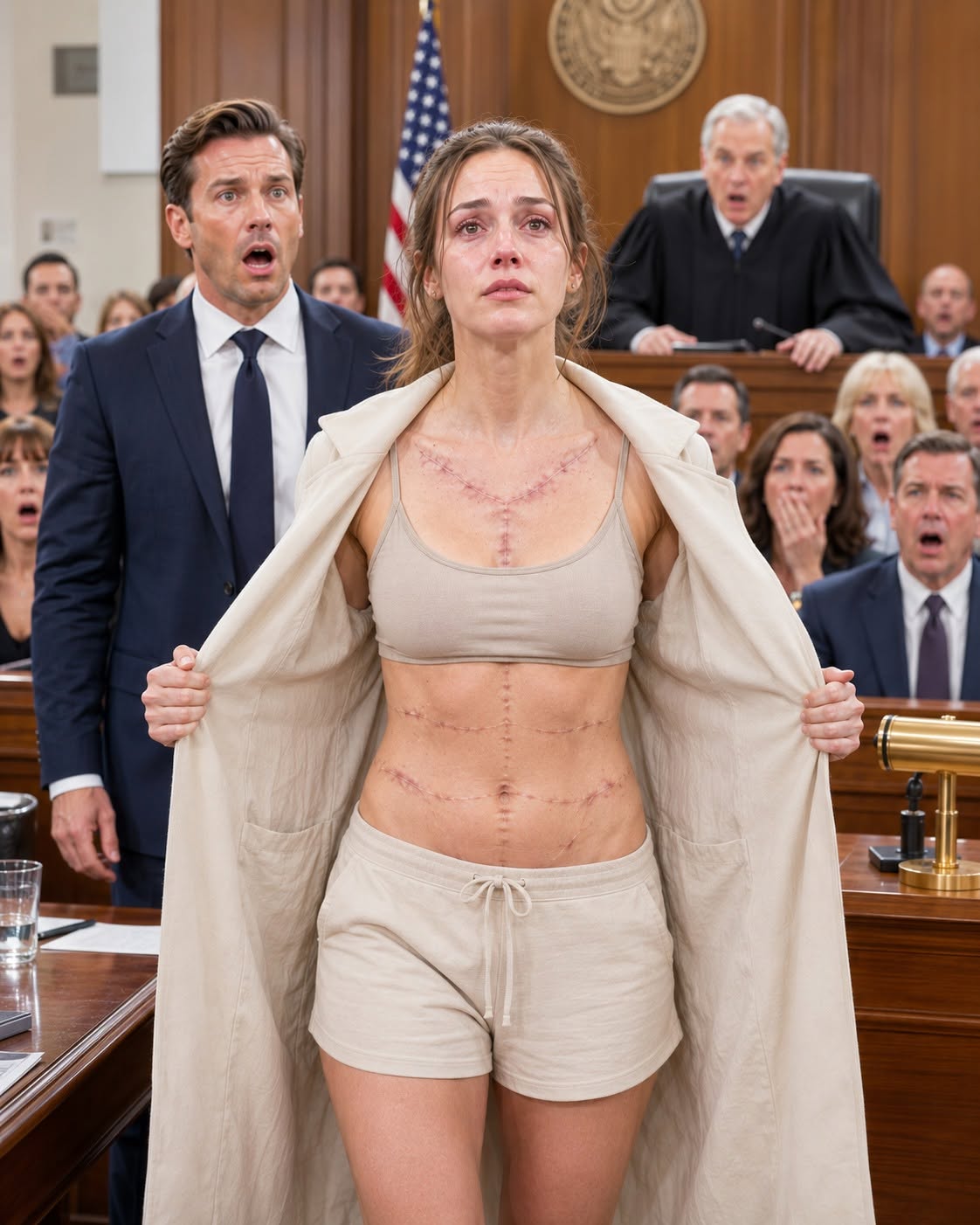
Slowly, I removed my high-neck blouse, leaving the camisole beneath.
The courtroom fell silent.
My scars were visible beneath the fluorescent lights.
Crescent-shaped marks crossed my shoulders.
A jagged scar ran above my collarbone.
Faded contusions remained on my upper arms.
Someone gasped.
It was Margaret.
Madison covered her mouth.
Nathan stared at the floor.
I pointed to one scar.
“This injury was caused by a narrow cylindrical object striking from an elevated angle.”
I turned slightly.
“The direction of force is downward, approximately forty-five degrees. That pattern cannot be created by falling forward down a carpeted staircase.”