Part 2
For a long moment, I could not hear the city.
Chicago was moving beyond the windows, as it always did—traffic sliding along the river, clouds dragging shadows across towers, morning light flashing against glass—but inside my office, everything had gone silent.
The letter trembled in my hand.
If you’re reading this, these twin boys are your sons… and everything you were told four years ago was a lie.
I read the sentence again.
Then again.
Each time, the words became less impossible and more terrifying.
My sons.
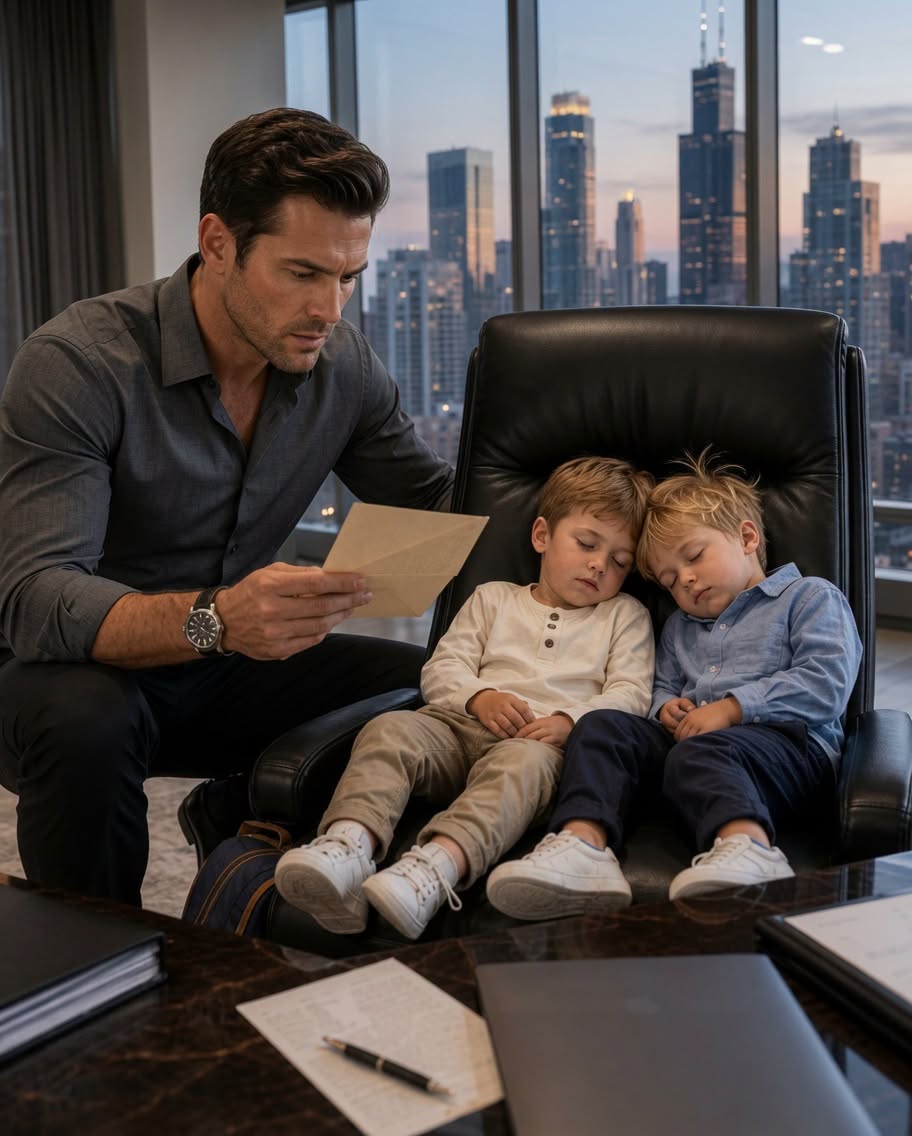
The little boy with the protective arm around his brother watched me carefully, as if my face might tell him whether they were safe. His hair was dark like mine, slightly messy from sleep. The other boy hugged his backpack tighter, his lower lip caught between his teeth.
I forced myself to breathe.
“What are your names?” I asked.
The first boy sat up straighter. “I’m Leo.”
The second whispered, “Noah.”
Leo and Noah.
Names I had never spoken. Names that should have been impossible.
I looked back at the letter. Beneath the first line, the handwriting continued in a voice I knew too well.
Ethan,
I know you may hate me before you finish reading this. I know you may think I chose silence. I didn’t. I tried to reach you more times than you will ever know.
Their names are Leo and Noah. They were born on October 14, four years ago. They are kind, curious, stubborn, and braver than any children should have to be.
They know your name because I never let them believe they were unwanted.
Please do not send them away.
The signature at the bottom made my knees feel unsteady.
Maya.
I sat slowly in the chair across from them because my own chair was still occupied by two boys who might be mine.
Maya Bennett had been the one person who ever came close to undoing me.
Four years earlier, she had walked into my life as a quiet art historian hired to evaluate a private collection attached to one of our investments. She was nothing like the people who usually surrounded me. She did not flatter. She did not perform. She noticed things no one else did—the chipped corner of a marble sculpture, the sadness in a painted child’s eyes, the fact that I drank coffee like I was punishing myself.
For eight months, she made me feel like someone I had buried was still alive.
Then she disappeared.
No explanation.
No goodbye.
Only a message from her number saying she had made a mistake, that she could not live inside my world, that I should not contact her again.
Two weeks later, my assistant at the time, Victoria, placed a legal envelope on my desk. Inside was a signed statement from Maya confirming she wanted no further communication.
I believed it because believing it hurt less than chasing someone who had chosen to leave.
Or so I told myself.
Now her letter lay open in my hands, and two children with my eyes were sitting three feet away from me.
“Where is your mother?” I asked softly.
Noah looked at Leo.
Leo answered for both of them. “She had to go away.”
The room tilted.
“What does that mean?”
“She said we had to find you,” Leo said. “She said if Aunt Claire didn’t come back, we should give the envelope to the lady downstairs. But the lady downstairs asked a lot of questions, so Noah cried.”
“I didn’t cry,” Noah whispered.
“You almost did.”
“I was scared.”
Leo looked guilty. “I was too.”
My chest tightened. I had negotiated billion-dollar deals without blinking, but I had no defense against that small confession.
I reached for the phone, then stopped. Calling security was the logical response. Calling the police might be necessary. Calling my attorneys would be wise.
But every instinct I had built in business felt suddenly too sharp for this room.
“Are you hungry?” I asked.
Both boys nodded.
That simple answer moved me more than the letter had.
I called the private kitchen two floors below and ordered toast, fruit, scrambled eggs, juice, and anything else a four-year-old might reasonably eat. My voice sounded calm. Professional. Almost normal.
When I hung up, Leo was studying the glass award on my desk.
“Are you a king?” he asked.
Despite everything, a laugh escaped me. It was rusty and unfamiliar. “No.”
“You have a big chair.”
“It’s just a chair.”
“Noah said only kings have offices in the clouds.”
Noah hid his face behind the backpack.
I looked at the chair, the desk, the skyline, the life I had spent almost twenty years building into a fortress.
“In that case,” I said, “I suppose I’ve been a very lonely king.”
Leo considered this with solemn interest. “Mom said you were busy saving companies.”
The words struck me gently and painfully.
Maya had told them about me.
Not as a man who left. Not as a man who didn’t care.
She had preserved me for them, even when I had not known they existed.
The elevator chimed outside my office.
Both boys flinched.
That told me more than I wanted to know.
“It’s just breakfast,” I said. “No one is going to hurt you here.”
Noah looked at me with wide eyes. “Promise?”
The question was so fragile that I could not answer quickly.
Promises had weight. I knew what men sounded like when they made them carelessly. I had built an empire by reading the difference between a guarantee and a wish.
So I leaned forward and said the only honest thing I could.
“I promise I will do everything I can to keep you safe.”
Noah seemed to accept that.
My current assistant, Grace Lin, entered with the food cart herself. Grace was sixty-two, impossibly efficient, and one of the few people in the building who could tell me I was wrong without fearing for her job.
She stopped when she saw the boys.
Her eyes moved from them, to me, to the open letter.
“Mr. Carter,” she said carefully, “your nine o’clock meeting begins in forty minutes.”
“Cancel it.”
Grace blinked once. In seven years, I had never canceled an investment meeting on the same day.
“All of it?” she asked.
“All of it.”
Her expression softened almost imperceptibly. “Of course.”
She arranged plates on the low table near the sofa. The boys slid down from my chair, but neither approached until I nodded.
“You can eat,” I said.
They did not need to be told twice.
I watched them take small bites at first, polite and cautious. Then hunger overcame manners. Noah ate strawberries one at a time as if afraid they would be taken away. Leo pushed half his toast onto Noah’s plate without looking at him.
Brothers, I thought.
My sons, the letter had said.
The word still felt too enormous to hold.
Grace came to stand beside me.
“Do you need counsel?” she asked quietly.
“Yes.”
“Family counsel or corporate counsel?”
I looked at the boys.
“For once,” I said, “not corporate.”
Her face changed. She understood more than I had said.
“I’ll call Margaret Vale,” she said. “Discreetly.”
“Thank you.”
As she turned to leave, I added, “Grace.”
She paused.
“No one enters this office without my permission.”
“Already handled.”
The door closed behind her.
I unfolded the second page of Maya’s letter.
There are things I could not safely write until now. I was told you knew about the pregnancy and wanted nothing to do with us. I was shown documents. I was shown a settlement agreement with your signature. I was told your legal team would destroy me if I tried to contact you.
I wanted to believe you would never do that.
But I was pregnant, alone, and frightened. Then my father became ill, and I left Chicago. By the time I realized something was wrong, someone was watching every step I took.
I have kept proof. The boys know where to find the blue box.
If I am not with them, it means I finally tried to bring you the truth and failed.
Do not trust Victoria.
My hand tightened around the page.
Victoria Hale.
My former assistant.
The woman who had worked beside me through the early rise of Carter Capital. The woman who knew my schedule, my correspondence, my signatures, my habits. The woman who had left my company three years ago with a glowing recommendation and a generous severance package after accepting a position with a private foundation.
Victoria had handed me the envelope that ended my relationship with Maya.
Victoria had looked me in the eye and said, “I’m sorry, Ethan. Some people simply can’t handle the pressure of your life.”
At the time, I had believed she was being kind.
Now I wondered what else she had been.
“Do you know Victoria?” I asked the boys.
Noah froze with a piece of toast halfway to his mouth.
Leo looked at the floor.
That was answer enough.
I made my voice gentle. “You’re not in trouble.”
Leo swallowed. “Mom said not to talk to the smiling lady.”
A chill moved through me. “The smiling lady?”
“She came to our house once,” Noah whispered. “She brought presents. Mom made us go upstairs.”
“What did she look like?”
Leo frowned with the effort of memory. “Yellow hair. Red mouth. Shiny shoes.”
Victoria.
The office seemed to darken around the edges.
I stood and walked to the window because I needed one second to gather myself before the anger showed. Outside, the city looked clean and distant, unaware that the past had just opened beneath my feet.
For four years, I had thought Maya left because I was too difficult to love. Too controlled. Too consumed by ambition. I had accepted that as punishment because it matched what I secretly believed about myself.
But what if she had not left?
What if she had been pushed?
Behind me, Noah spoke through a mouthful of eggs.
“Are you mad?”
I turned back.
Both boys were watching me again, measuring danger in my silence. I recognized that look. Not because I had children. Because I had once been a child in rooms where adults changed the weather without warning.
“No,” I said, returning to the sofa. “Not at you.”
Leo nodded, but he didn’t fully relax.
I did not blame him.
Grace returned twenty minutes later with Margaret Vale, a family attorney whose calm made other people calmer by proximity. She wore a navy suit, carried no visible briefcase, and greeted the boys as if meeting children in a CEO’s office was the most natural thing in the world.
“Good morning, Leo. Good morning, Noah. I’m Margaret.”
Noah waved with sticky fingers.
Margaret sat across from me while the boys became absorbed in a small box of colored pencils Grace had produced from somewhere. I had no idea why such a thing existed in my office building. Grace, apparently, had prepared for life more broadly than I had.
I handed Margaret the letter.
She read it twice. Her face remained composed, but her eyes sharpened.
“First,” she said, “the children need immediate care and legal protection. We need to confirm their identities, locate their mother, and contact the appropriate authorities in a way that does not frighten them or create unnecessary exposure.”
“Do it.”
“Second, do not contact Victoria Hale yourself.”
“I wasn’t planning to be polite.”
“That is exactly why you should not contact her.”
I looked away.
Margaret continued. “Third, we need to secure your office footage. Lobby cameras. Elevator logs. Visitor records. Anything showing how the boys arrived.”
I pressed the intercom. “Grace, preserve every security record from midnight onward. Quietly.”
“Already in progress,” Grace replied.
Margaret almost smiled. “Excellent.”
Then her expression softened. “Ethan, I need to ask something difficult. Are you prepared for the possibility that the letter is not true?”
I looked at Leo and Noah.
Noah had drawn a lopsided sun. Leo was drawing a tall building with two tiny figures at the bottom.
“No,” I said honestly.
Margaret nodded. “We’ll arrange a DNA test with proper chain of custody. Until then, you can still make sure they are safe.”
Safe.
The word seemed to hover above the room like something sacred.
My entire life had been built around avoiding dependence. I trusted contracts because contracts did not change their minds. I trusted numbers because numbers did not rewrite history. I trusted silence because silence did not abandon you.
But these boys had walked into my sealed kingdom carrying hunger, fear, and a letter from the only woman I had loved.
And just like that, my empire felt less like an achievement and more like an empty house with locked doors.
A soft knock interrupted us.
Grace opened the door halfway. “Mr. Carter, building security found something. The boys were brought in through the service entrance at 6:12 this morning.”
“By whom?”
Grace hesitated. “A woman wearing a maintenance jacket and cap. Her face is mostly hidden.”
Margaret stood. “Do we have footage?”
“Yes.”
“Show me.”
Grace looked at me. “There’s more. The woman left a second envelope with the front desk. It was addressed to you, but the temporary guard placed it in the general mail bin.”
My pulse slowed in that strange way it did before a crisis.
“Where is it?”
Grace held it out.
This envelope was white, newer than Maya’s, and sealed with clear tape. My name was printed, not handwritten.
I opened it carefully.
Inside was a photograph.
Maya stood on a sidewalk outside what looked like a small medical clinic. Her hair was shorter than I remembered, tucked beneath a gray knit hat. She looked thinner, tired, but unmistakably alive.
The timestamp printed at the bottom was from three days ago.
Behind the photograph was a note.
Stop looking for her, and the boys stay safe.
Margaret took the note from my hand before I could crush it.
“Ethan,” she said sharply, “breathe.”
I had not realized I had stopped.
Leo appeared at my side. “Is that Mommy?”
I looked down at him.
There are moments when the truth has to be handled like glass. Too much force, and it cuts everyone in the room.
“Yes,” I said. “It’s your mom.”
Noah slid off the sofa and came closer. “Can we go get her now?”
The hope in his voice nearly broke me.
I crouched in front of them. “We’re going to try.”
Leo studied my face with an intensity no child should have needed. “Mom said you find things.”
I thought of companies buried under debt, hidden liabilities, false ledgers, stolen patents. I had found all of those.
“I do,” I said.
“Then find her.”
No contract I had ever signed mattered as much as that command.
By noon, my office had become something entirely different. The long conference table was covered not in investment documents, but in printed stills from security footage, copies of letters, timelines, and legal notes. Grace had moved my meetings indefinitely. Margaret had contacted a retired judge she trusted for emergency guidance. A child welfare specialist arrived discreetly, spoke gently with the boys, and agreed that removing them from the one adult they had been sent to find might cause more harm than good, provided temporary safeguards were put in place.
For the first time in my career, I watched experts work around my life instead of my company.
The boys stayed near the sofa, building a tower from wooden blocks Grace had somehow acquired. Noah hummed under his breath. Leo kept glancing toward the door.
“You don’t have to watch it,” I told him.
“Watch what?”
“The door.”
He looked embarrassed. “I’m not.”
I sat beside him on the floor. My suit trousers creased. I did not care.
“When I was little,” I said, surprising myself, “I used to watch doors too.”
Leo’s eyes lifted to mine.
“My father traveled a lot,” I continued. “When he came home, I could tell what kind of evening it would be by how hard he closed the door.”
Leo absorbed this seriously. “Was he scary?”
“No. Just unhappy.”
“Mom gets quiet when she’s scared.”
The simplicity of it cut through me.
“What made her scared?”
Leo looked at Noah, then lowered his voice. “Phone calls.”
“From the smiling lady?”
“Sometimes. Sometimes a man.”
“What man?”
He shrugged. “Mom called him Mr. Gray.”
Margaret, who had been reviewing notes nearby, looked up immediately.
“Mr. Gray?” she asked.
Leo nodded. “He said papers don’t disappear unless people do what they’re told.”
Margaret and I exchanged a look.
This was no longer only about forged letters or family secrets. Someone had been managing Maya through pressure, maybe for years.
Grace entered again, carrying a tablet. Her usually controlled expression was unsettled.
“You need to see this,” she said.
The footage showed the service entrance in grainy black and white. At 6:12, a woman in a maintenance jacket entered, holding Noah’s hand while Leo walked beside her. She kept her head down. The boys looked exhausted but calm. At the elevator, she crouched in front of them.
There was no audio.
She touched both of their faces, kissed their foreheads, then pressed the cream envelope into Leo’s hands.
My throat tightened.
Maya.
Even with the cap, even with the shadows, I knew the way she moved. The slight tilt of her head. The tenderness in her hands.
She had brought them herself.
She had been in my building that morning.
“Where did she go?” I asked.
Grace swiped to the next clip. “She exited through the loading dock six minutes later. A black sedan was waiting across the alley.”
The screen changed.
Maya stepped into the rain. She looked once over her shoulder at the tower. Then the rear door of the sedan opened.
A man emerged holding an umbrella.
His face turned toward the camera for less than a second.
Grace froze the frame.
Margaret whispered a word I had never heard from her before.
I stared at the image.
The man was older now, his hair thinner, his jaw heavier, but I knew him. Everyone in my company knew him.
Charles Whitmore.
My first major investor. My mentor. The man who had helped Carter Capital survive its earliest years. The man scheduled to sit across from me at the meeting I had canceled that morning.
My mind began rearranging the past with brutal speed.
Whitmore had introduced me to Victoria.
Whitmore had advised me not to chase Maya.
Whitmore had once told me that love made ambitious men careless.
And now he was on camera with the woman whose disappearance had shaped the last four years of my life.
The tablet felt cold in my hands.
Margaret spoke carefully. “Ethan, do not jump to conclusions.”
“I’m looking at one.”
“You’re looking at a frame. We need facts.”
Facts. Yes. I had built a career on facts.
But facts had a way of becoming personal when they arrived with the faces of children.
My phone rang.
The caller ID showed Charles Whitmore.
Everyone in the room went still.
I let it ring once. Twice.
Then I answered on speaker.
“Charles.”
His familiar voice filled the office, warm and measured. “Ethan, I hear you canceled our meeting. That isn’t like you.”
“No,” I said. “It isn’t.”
A pause.
“Is everything all right?”
I looked at Leo and Noah. Leo had gone pale. Noah had pressed himself against his brother’s side.
“No,” I said. “Everything is finally becoming clear.”
Another pause, longer this time.
Then Whitmore sighed softly.
“I was afraid she would do something impulsive.”
The room seemed to narrow around his voice.
“Where is Maya?” I asked.
“That depends on how much damage you’re willing to cause.”
Margaret shook her head, warning me to stop.
I didn’t.
“What did you do?”
“I protected you,” Whitmore said, and there was something almost sad in his tone. “From a scandal. From distraction. From a woman who had no idea what your future required.”
My grip tightened around the phone.
“You kept my children from me.”
“I kept your company alive.”
The words settled over the office like dust after a collapse.
I looked at the skyline, at the empire I had believed was built by discipline, vision, sacrifice.
Suddenly I wondered what else had been sacrificed without my consent.
Before I could speak, Whitmore said, “Check your private safe, Ethan. The one behind the west wall. There is something inside you should have found years ago.”
The line went dead.
I stood slowly.
Only three people knew about that safe.
Myself.
Grace.
And Victoria.
Grace looked stricken. “I never told him.”
“I know.”
Behind the west wall, concealed by a panel of dark walnut, was the safe where I kept personal documents too sensitive for office files. I crossed the room, entered the code, and waited for the lock to release.
Inside, beneath old contracts and sealed trusts, sat a small blue box.
Maya’s blue box.
My hands went numb.
I carried it to the desk and opened the lid.
Inside were hospital bracelets. Two newborn photographs. Copies of emails I had never received. A forged settlement agreement bearing a version of my signature good enough to fool someone who wanted to believe it.
And at the very bottom, a folded legal document.
Margaret took one look and went completely still.
“What is it?” I asked.
She lifted her eyes to mine.
“It’s a guardianship petition,” she said. “Filed four years ago, then sealed.”
“By whom?”
She turned the page around.
My name was printed as petitioner.
But I had never filed it.
And beneath my forged signature was a handwritten note from Maya.
Ethan, if this document is real, then why did you never come for us?
Before anyone could speak, Leo reached into the blue box and pulled out one final photograph I had not seen.
It showed Maya standing beside Charles Whitmore outside a courthouse.
Between them stood a woman with yellow hair, red lipstick, and shiny shoes.
Victoria.
On the back, in Maya’s handwriting, were five words:
They all knew about you.
END OF PART 2 – LIKE, SHARE AND COMMENT “THE ENTIRE STORY” IF YOU WANT TO READ THE FULL STORY