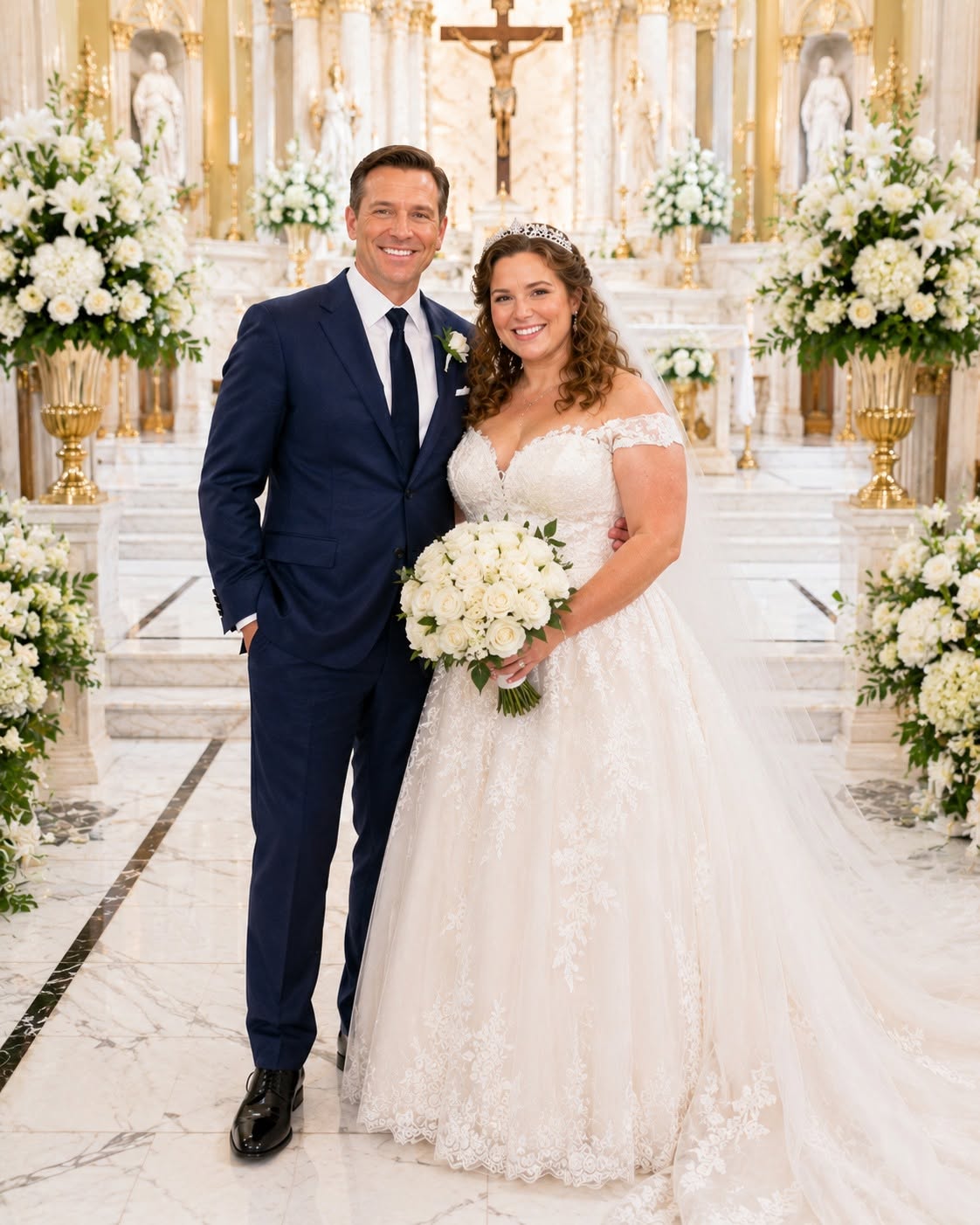
The first moment Natalie Reed understood that the deception had become truly dangerous was not when the wealthy women from Beacon Hill examined her from head to toe, as though her modest dress had somehow lowered the value of the ballroom.
It was when Adrian Caldwell reached for her hand in front of everyone and said, with a cold fury that erased every laugh in the room:
“The next person who insults my wife is free to leave this gala.”
Silence struck the room at once.
Natalie stared at him, unable to make sense of what she had just heard. Adrian was not supposed to defend her that fiercely. He was not supposed to sound genuinely angry. He was not supposed to tighten his fingers around hers as though he feared she might let go.
Because Natalie knew exactly what she had always been to him.
A wager.
Six months earlier, during a bourbon-soaked evening at an exclusive private club in downtown Boston, Adrian had boasted that he could make any woman fall for him. His friend Connor challenged him to marry someone entirely removed from his privileged world—a woman without an influential family name, without designer clothes, and without the slightest interest in his fortune.
The terms were straightforward: a legal civil marriage, six months living together beneath the same roof, and neither person could leave before the agreed deadline.
Natalie had known the truth from the beginning.
Connor revealed the entire arrangement to her at a quiet café in Cambridge. He expected her to throw her drink in his face.
Instead, she asked,
“Does Adrian know that I know about the bet?”
“Yes.”
“Then I have one condition. He does not get to remake me into someone who belongs in his world.”
Adrian agreed with the confident smirk of a man who had never lost anything he could not replace.
They married at Boston City Hall.
There was no kiss.
No bouquet.
No relatives waiting outside.
Only signatures, a wedding ring, and one photograph in which they looked less like newlyweds and more like two strangers waiting for their numbers to be called at a government office.
Natalie continued working at a neighborhood assistance center in Dorchester, helping mothers threatened with eviction, children who had lost financial aid, and elderly residents overwhelmed by official forms they could barely understand.
Adrian could not understand why she left the penthouse every morning.
“You could stop working,” he told her. “I can provide anything you want.”
“I don’t work because I’m waiting for someone to rescue me,” she replied. “I work because there are people who genuinely need help.”
Her answer irritated him.
But gradually, he began to see her differently.
He noticed that she frequently skipped meals.
That she paused halfway up staircases.
That some evenings she stood alone on the penthouse balcony with one hand pressed over her chest.
He also began waiting for her to come home.
He asked about her day.
And eventually, he started listening to the answer instead of merely pretending to.
That was why the drive home after the gala felt unbearably silent.
Natalie could feel pressure gathering beneath her ribs, but she refused to give Adrian another reason to watch her with concern.
They entered the penthouse.
Adrian loosened his tie.
“Sit down. You’re pale.”
“I’m all right.”
Natalie managed three steps.
Then the floor seemed to tilt beneath her.
She reached toward the sofa, but her fingers closed around empty air.
A violent pain tore through her chest, and her legs collapsed beneath her.
Adrian caught her before her body struck the marble.
“Natalie! Look at me. Please, look at me.”
She tried to answer him.
No air would come.
Red ambulance lights flashed across the walls while Adrian repeated her name in a voice that no longer sounded controlled.
Hours later, a cardiologist emerged from the emergency department and asked,
“Mr. Caldwell, did you know your wife has a serious cardiac condition?”
Adrian did not move.
Then the doctor continued,
“What concerns me most is that she knew her condition could deteriorate without warning… and she still agreed to marry you.”
Adrian entered Natalie’s hospital room without his jacket, without his tie, and without the self-assurance he normally carried into every space.
Natalie lay beneath a thin blanket, connected to a heart monitor, an IV line taped to her arm and exhaustion written across her face.
“So now you know,” she murmured.
“I know you have dangerously high blood pressure, early cardiac damage, and that you could have died tonight.”
Natalie turned her face toward the window.
“You had no right to my medical history.”
“No,” he said. “But you were living with me. I saw you exhausted. I saw you holding your chest. And every time you told me you were fine, I chose the explanation that required the least from me.”
She gave a bitter laugh.
“This was a marriage created by a wager, Adrian. It was never a real partnership.”
The sentence hit him with more force than any insult could have.
He sat beside her bed and asked why she had agreed to the arrangement.
Natalie remained silent for a long time.
She had protected that truth for months because she feared that once Adrian knew, every look he gave her would be filled with pity.
“Eight months ago, doctors told me that if I didn’t change the way I was living, I might only have a few years,” she finally said. “Perhaps five. Perhaps less. No one wanted to give me a definite answer.”
Adrian’s jaw tightened.
“And that made you agree to the marriage?”
“I agreed because I was alone.”
Natalie paused, struggling to steady her breathing before continuing.
“Every evening, I returned to an empty apartment. I heated soup from a can and read medical reports I didn’t fully understand. Connor told me about a fake marriage lasting six months. I thought that, for once, I might know what it felt like to have someone ask whether I got home safely. I wanted to wear a ring. I wanted another person sitting across from me at dinner. I wanted to pretend, even briefly, that my life wasn’t ending with no one beside me.”
Adrian lowered his head.
No accusation could have hurt more than such a modest wish.
“I turned your loneliness into entertainment,” he said.
“Yes.”
“And you still treated me with more respect than I ever offered you.”
Before Natalie could respond, Dr. Olivia Bennett entered the room.
She explained that the episode had been caused by critically elevated blood pressure, dehydration, stress, and inconsistent nutrition.
“The damage is significant,” she said, “but it can still be managed. She needs medication, dependable meals, carefully increased physical activity, and far less stress. More than anything, she must stop carrying this alone.”
“She won’t be alone,” Adrian said immediately.
Natalie turned a sharp gaze toward him.
“Don’t make promises because you feel responsible.”
“This is not responsibility speaking.”
“Three months ago, you didn’t even know how I drank my coffee.”
“And now I know you drink it black when you’re upset and add cinnamon when something good happened.”
Dr. Bennett looked between them before quietly leaving the room.
Adrian took a slow breath.
“I don’t know exactly when you stopped being part of a bet. Maybe it was when you said my penthouse looked like ‘a luxury hotel built for ghosts.’ Maybe it was when I watched you help an older woman keep her apartment while you refused to ask for anything for yourself. But when you collapsed tonight, I understood one thing.”
He looked directly at her.
“There is no version of my future that I want if you are not in it.”
Tears gathered in Natalie’s eyes.
“People say extreme things in hospital rooms.”
“Then judge me after we leave. See whether I continue saying them when there are no monitors, no doctors, and no fear forcing the words out.”
Two days later, Adrian brought her back to the penthouse.
He had replaced the food in the pantry and cleared his mornings so he could accompany her on short walks.
Natalie was furious.
“I’m not another acquisition you can manage. You cannot purchase a solution to this.”
Adrian handed her a single sheet of paper.
At the top, he had written:
Decisions That Belong to Natalie
Beneath it were blank sections labeled doctors, schedules, food, visitors, assistance, and boundaries.
“You decide everything,” he said. “I only want to be available when you choose to need me.”
The early weeks were exhausting.
Natalie became tired after walking for ten minutes.
Some days she stood in front of the refrigerator and cried because choosing something to eat felt harder than it should have.
Adrian made mistakes.
But he slowly learned how to listen without turning every difficult day into a crisis he needed to control.
Little by little, they began walking along the Charles River.
They prepared meals together.
They stopped resembling strangers forced to share a contract.
Adrian also began visiting the community center without photographers or announcements. He helped preserve its children’s meal program without placing the Caldwell name on a wall, a plaque, or a press release.
But the real rupture came twelve days before the six-month agreement was due to end.
Adrian’s mother, Eleanor Caldwell, arrived at the penthouse with an attorney.
She had always managed the family name as though it were a corporation whose reputation mattered more than the people carrying it.
“This charade ends today,” she announced. “Natalie will sign a nondisclosure agreement and receive an appropriate settlement.”
Natalie’s face lost its color.
Adrian rose from his chair.
“You will not speak to her as though she works for you.”
Eleanor set a thick file on the table.
Inside were photographs from the night the wager began, messages exchanged between Adrian and Connor, and records documenting a two-million-dollar transfer.
According to the agreement, Connor would receive the money if Adrian remained married for the full six months.
“Your friend has already received half,” Eleanor said. “The remaining amount is released on the one-hundred-eightieth day.”
Natalie looked at Adrian.
“There was money attached to this?”
He did not answer quickly enough.
That pause destroyed much of what they had spent months rebuilding.
“You told me it was an idiotic challenge between two arrogant men,” she whispered. “You never told me two million dollars was involved.”
“I never took the money.”
“But you agreed to put it into the wager.”
“Yes.”
Natalie removed her wedding ring.
She placed it beside the file.
“Then something was still being won.”
She left the penthouse that afternoon and returned to her old apartment.
Adrian did not block the door.
He did not follow her into the hallway.
For the first time, he understood that refusing to let someone leave could be another form of possession.
That night, Adrian confronted Connor.
Connor admitted that he had met Natalie during a community fundraiser and later discovered part of her medical situation.
“I thought you needed to stop treating human beings like trophies,” Connor said. “And I thought she needed to stop believing no one would ever see her. I never intended to keep the money. I placed it in a trust for the community center.”
“You used her illness to manipulate both of us.”
“Yes.”
“And there is no decent explanation that makes what I did acceptable.”
Natalie had known nothing about the money.
Adrian forced Connor to return the full amount, dissolved the unauthorized trust, and ended their friendship.
Then he called a meeting with his company’s investors and executives and publicly admitted the truth.
“I used a woman to prove that I could control the outcome of a relationship,” he said. “The fact that I later fell in love with her does not erase the humiliation built into the beginning.”
The company’s stock price dropped.
Several investors demanded that he resign.
Eleanor accused him of disgracing the Caldwell name.