For thirteen years as a federal investigator, I had looked directly into the worst corners of human behavior.
I had helped dismantle trafficking networks, questioned hardened offenders, and walked through crime scenes that would keep most people awake for the rest of their lives.
None of it prepared me for a phone call at 2:27 in the morning.
My name is Natalie Brooks. I am a federal agent based in Columbus, Ohio.
The harsh vibration of my phone against the nightstand ripped me out of sleep. I reached for it, expecting an emergency dispatcher, a confidential informant, or one of my supervisors.
Instead, I heard my father.
His voice sounded fragile, terrified, and almost too weak to recognize.
He was calling from the holding area of the Franklin County Police Department.
“Natalie, please help me,” he whispered. “Your sister-in-law is lying about me. She told the police I attacked her with a baseball bat.”
I pushed myself upright, the sheets falling into my lap.
“And Eric?” I asked. “Where is your son?”
“He stood there,” Dad said. “He watched everything and didn’t say a word.”
A cold pressure formed in my stomach.
But training took control before panic could.
Fear is useful only if you convert it into action.
“Dad, listen carefully,” I said. “Do not answer another question. Do not sign anything. Do not agree to an evaluation. Do not let them separate you from legal counsel. I am coming.”
I pulled on my tactical jacket, clipped my badge to my belt, and grabbed my keys.
The roads through Columbus were nearly empty, washed in amber streetlight. As I drove, I forced myself to examine the situation the way I would examine any federal case.
Eric’s silence did not sound like confusion.
It sounded coordinated.
If my father had truly attacked someone, my brother would have been panicked, defensive, or furious. Instead, he had stood quietly while his wife built a story around an elderly man.
That meant this was not a family argument.
It was a setup.
And the motive was obvious.
Dad owned his house outright. He had retirement accounts, investments, and a modest but valuable estate. If they could have him declared dangerous, unstable, or mentally incompetent, they could take control of everything.
They had simply forgotten one thing.
His daughter investigated people who believed they were smarter than the law.
The station smelled of stale coffee and disinfectant when I pushed through the glass doors.
My father sat hunched in a plastic chair near the far wall. His skin looked gray beneath the fluorescent lights, and his shoulders seemed smaller than I remembered.
Across the room, my sister-in-law, Vanessa Brooks, stood at the front desk performing for the officers.
I walked directly to the counter.
“I want that man moved into a private interview room,” I told the duty officer. “No further questions until a public defender is present.”
The officer glanced up from his clipboard.
His nameplate read Samuel Porter.
Before he could respond, Vanessa turned toward me.
She pressed a crumpled tissue beneath one eye and released a dramatic sob.
“You don’t understand,” she cried. “He snapped. He came at me with a bat. He is dangerous. He needs to be committed tonight before he hurts someone.”
She pointed to a faint reddish mark on her shoulder.
I did not look at her.
My attention remained on Porter.
My phone began vibrating in my pocket.
The caller was my aunt, Carol.
“Natalie, what is happening?” she asked the second I answered. “Eric says your father has dementia. He says he became violent and attacked Vanessa.”
I could hear Uncle Raymond muttering in the background.
Eric was already contacting relatives.
He was creating a medical explanation before anyone had time to ask legal questions. If enough family members repeated that Dad was confused or unstable, it would become easier to portray every objection he made as evidence of mental decline.
“I have it under control,” I told Carol.
Then I ended the call.
I returned to the desk.
“Officer Porter, dispatch a unit to my father’s house and preserve it as a potential crime scene. Record every additional statement Vanessa makes. Do not allow anyone to remove property from that residence.”
Porter exhaled loudly.
“Ma’am, sit down and wait. This is a domestic matter. Local police can handle it without someone interfering.”
“I am not asking casually.”
I opened my credential case and placed it on the counter.
The federal shield caught the overhead light.
Porter straightened immediately.
“I am directing you to preserve evidence connected to possible elder abuse, financial exploitation, false reporting, and unlawful restraint,” I said. “If you refuse, your name will appear in every report that follows.”
His expression changed.
The irritation vanished.
He grabbed his radio and requested a patrol unit at the address.
I walked toward my father and placed one hand on his back.
“Come on, Dad. We are getting you out of here.”
He tried to stand.
His knees buckled.
I caught his arm before he fell.
The sleeve of his sweater slid toward his elbow.
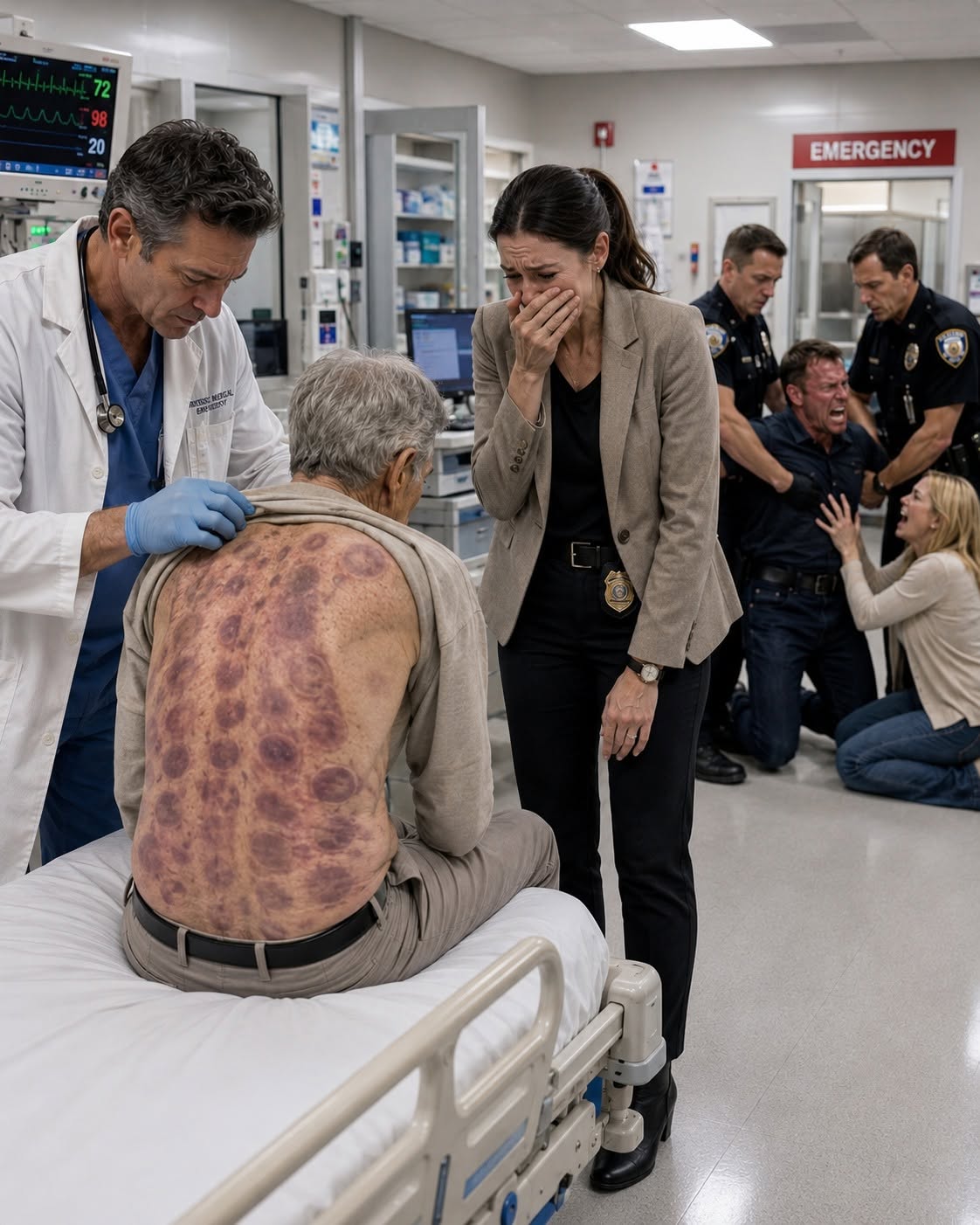
Deep purple marks circled both wrists.
They were complete rings.
Not random bruises.
Not injuries from a short struggle.
Restraint marks.
My father saw me staring and quickly pulled the sleeve down.
That small movement told me everything.
He was ashamed of what had been done to him.
I abandoned the idea of taking him home.
Instead, I guided him into my government-issued SUV and drove directly to Riverside Medical Center.
The triage nurse took one look at him and placed him in a private trauma bay.
A physician named Dr. Hannah Price arrived within minutes.
She examined his heart, blood pressure, hydration levels, and neurological responses while I stood beside the bed trying not to let my hands shake.
The results were alarming.
Dad was severely dehydrated.
His heart rhythm was unstable.
A blood panel showed that he had not received his prescribed cardiovascular medication for several days.
Dr. Price gently lifted his arms and examined the bruising around his wrists. She used a penlight to inspect the damaged skin.
Then she turned to me.
“Agent Brooks, these marks are not new,” she said quietly. “The color and tissue changes suggest they are between four and seven days old. They are consistent with prolonged pressure from narrow plastic restraints, most likely heavy zip ties.”
Anger rose through me so quickly that I felt lightheaded.
I kept my voice controlled.
“Photograph everything. Include measurements and a full medical report.”
I stepped into the hallway and called Officer Porter.
“The hospital has confirmed prolonged restraint injuries,” I said the moment he answered. “My father was likely bound with plastic ties and deprived of medication.”
Porter started to speak.
I cut him off.
“You dismissed visible evidence of elder abuse while he sat in your lobby. If that house is not secured and your report is not corrected immediately, I will contact Internal Affairs and the county prosecutor before sunrise.”
His tone changed.
“A sergeant is already there,” he said. “They are documenting the property now.”
I ended the call and returned to the trauma bay.
The IV fluids had restored a little color to Dad’s face.
He reached for my hand.
“Do not take me back there,” he whispered. “They locked me in the guest room. They shut off the water. They kept bringing me papers. I couldn’t read them because Vanessa took my glasses.”
The words came out slowly, as if each one hurt.
“How long?” I asked.
“I don’t know. Days. Eric said I had to sign everything or they would tell people I was losing my mind.”
I kissed his forehead and told him he was safe.
But my mind had already shifted into investigative mode.
This was not neglect.
It was coercion.
They had isolated him, withheld medication, restrained him, and attempted to force his signature.
There would be a paper trail.
There always was.
I arranged for two trusted officers to remain outside his hospital room.
Then I drove to the house where I had grown up.
When I unlocked the front door, the hallway was dark.
A figure stepped out from the shadows.
“What are you doing here?”
Eric stood near the living room entrance.
He wore the same clothes from the station. His face showed irritation, but underneath it I saw panic.
“This is Dad’s property,” I said. “I have his key and his permission.”
“You have no right to come in and start searching,” he snapped. “Vanessa and I are managing his affairs. His mind is gone.”
“I am preserving evidence.”
I stepped past him.
“Interfere with me, and I will have you removed for obstruction.”
The house smelled stale.
Fast-food wrappers covered the kitchen counter. Empty medicine bottles sat beside the sink, but none belonged to my father’s current prescriptions.
I opened the trash bin and pulled out the full liner.
Eric watched from the doorway.
“You are digging through garbage now?”
I ignored him.
Near the bottom, beneath coffee grounds and food containers, I found strips of shredded paper.
I spread them across the kitchen island and began fitting them together.
Twenty minutes later, the fragments formed part of my father’s original will.
The pages had been torn through the signature lines and the sections naming beneficiaries.
My name had been cut apart.
Beneath the shredded will, I found another document.
A General Power of Attorney.
The signature looked wrong immediately.
My father’s handwriting had always been smooth and precise.
This signature was jagged and unsteady.
I checked the notary information through a secure state database.
The commission had expired three years earlier.
I placed the papers into an evidence envelope.
Eric’s face had gone pale.
“What is that?” he asked.
“You already know.”
By seven that morning, I was inside the federal digital forensics unit with our lead analyst, Maya Reynolds.
She scanned the Power of Attorney and verified the notary record.
“The seal is fraudulent,” she said. “The commission was invalid when this document was created.”
“I need the bank activity,” I told her. “Savings, retirement, investment transfers. Everything.”
We prepared an emergency subpoena request.
Within the hour, the bank’s fraud division released the records through a secure channel.
Maya and I studied the transactions.
Three days earlier, $250,000 had been removed from Dad’s retirement savings.
The money traveled through a shell company, broke into smaller transfers, and then reached several online gambling sites.
Maya highlighted the flow on her screen.
“The intermediary account is connected to Eric’s Social Security number,” she said. “They split the funds to avoid reporting thresholds.”
They had not merely stolen money.
They had attempted to disguise the theft.
“Run Vanessa nationally,” I said. “Aliases, marriages, civil cases, property disputes.”
The results appeared quickly.
Vanessa had used three surnames in three states during the previous decade.
In each location, she had become involved with a man connected to elderly property owners.
There were lawsuits over deeds, inheritance documents, and bank access.
“She has a pattern,” Maya said. “She moves into a family, isolates the vulnerable person, gains control of the assets, and creates conflict when anyone challenges her.”
“Check the property listing database.”
Maya entered Dad’s address.
The house was listed for sale.
The posting had gone live less than forty-eight hours earlier.
The authorization document carried the same forged signature.
They were attempting to sell his home while he was confined inside it.
I gathered the records and drove to the office of County Prosecutor Elaine Harper.
I placed the evidence file on her desk.
Forged documents.
Illegal transfers.
Prior civil cases.
The property listing.
Medical records.
Elaine reviewed everything in silence.
“This is enough for elder exploitation, forgery, unlawful confinement, and financial conspiracy,” she said. “I am taking it directly to a judge.”
Two hours later, we had a signed no-knock warrant.
A state financial crimes team assembled with federal digital specialists.
Our convoy moved toward Eric’s office in downtown Columbus.
Officers secured the exits while I entered the glass-fronted building.
Eric sat at his desk with real estate transfer forms open across two monitors.