“My Dear, Someone Screams Inside Your House Every Day, Claire. And if You Refuse to Call the Police, I’m Going to Call Them Myself.”
Mrs. Parker said those words to me on a Thursday afternoon while standing outside my front gate, her apron still streaked with tomato sauce and a broom clenched between her hands as though she intended to use it as a weapon.
I had just arrived home from work, carrying my handbag, my keys, and the kind of exhaustion that sinks all the way into your bones after working from eight in the morning until six in the evening, only to return to a house with no one waiting inside.
“Mrs. Parker, I’m not even here during the day,” I said, forcing a small smile. “I live by myself.”
Her face remained completely serious.
“Well, someone is inside that house. And what I’m hearing isn’t the plumbing. It’s a woman screaming.”
My stomach twisted into a knot.
Ever since Ethan died two years earlier, my home in a quiet gated neighborhood in Westchester County had become unbearably still.
Not peacefully still.
Cruelly still.
I had learned to eat dinner with the television playing in the background, to leave the hallway light on throughout the night, and to keep my eyes from lingering too long on my husband’s photograph in the living room.
Ethan had died in a crash on Interstate 87.
At least, that was what everyone told me.
His SUV had caught fire.
His brother Ryan identified the body because, according to him, the family wanted to spare me from “that kind of trauma.”
I accepted every explanation I was given because when someone places an urn in your hands, there is rarely enough breath left inside your body to ask questions.
But Mrs. Parker refused to dismiss what she had heard.
“It begins like someone crying,” she said, lowering her voice. “Then a woman starts begging for help. Sometimes she says, ‘Don’t leave me here.’”
My entire body went cold.
Those were my words.
I had said them to Ethan years earlier after an argument that began when he disappeared for three days and returned home smelling like expensive perfume, insisting the entire thing had been caused by stress at work.
I had sobbed into a voice message.
I had begged him not to leave me.
And afterward, I hated myself for begging.
I barely slept that night.
I checked every door, every window, and every closet.
There was nothing.
The following morning, I did something I had never imagined myself doing.
I dressed for work, drove out through the neighborhood entrance, waved to the security guard, and continued down the road for three blocks.
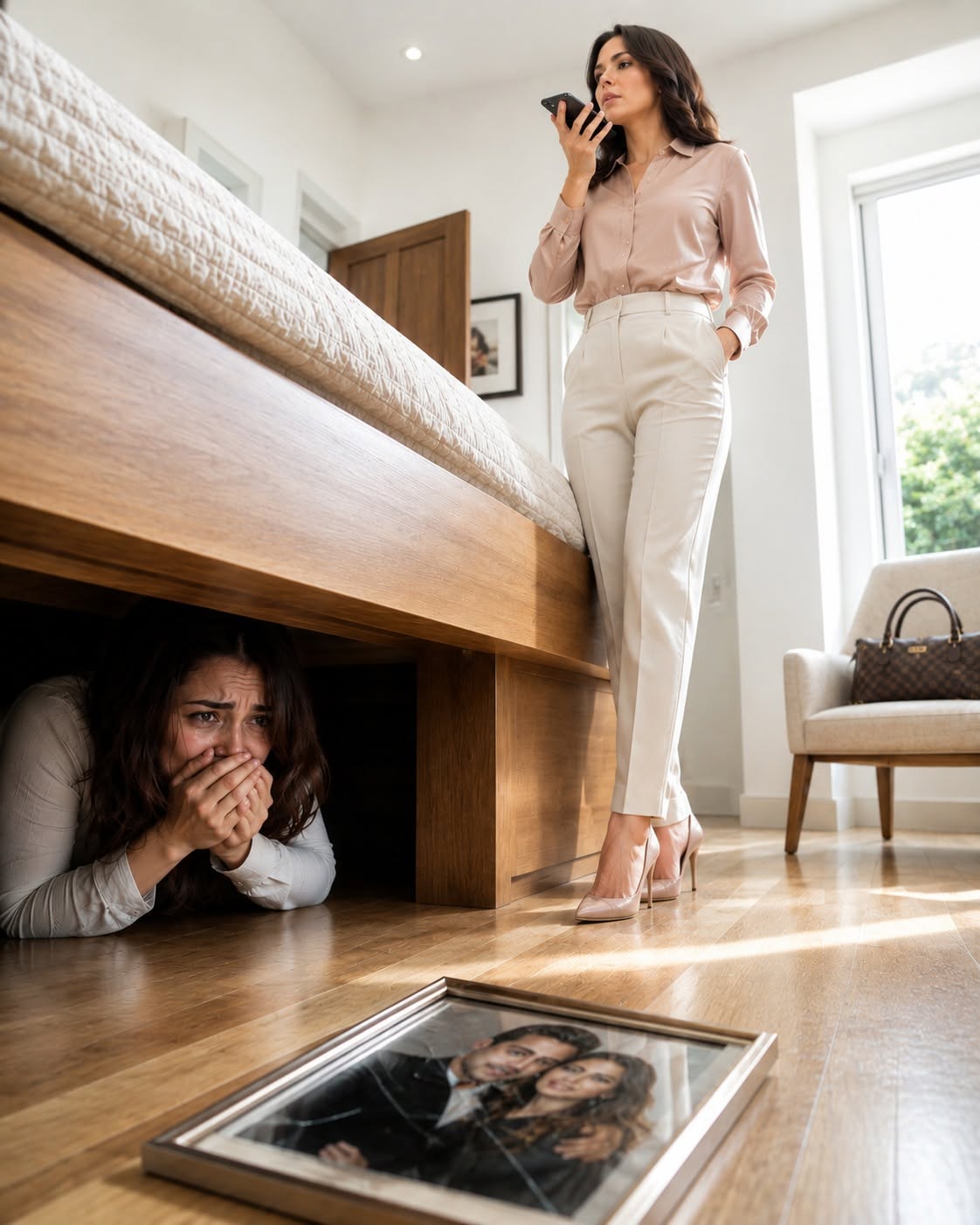
Then I parked the car, walked back through a rear access street, entered through the service door, and crawled underneath my bed.
Two hours went by.
Dust tickled the inside of my nose.
My arms began to ache.
I was seconds away from convincing myself that Mrs. Parker had misunderstood what she had heard when the sound reached me.
A key slipping into the lock.
No one kicked in the door.
No window shattered.
Someone simply unlocked my house as though entering a place that belonged to them.
Footsteps moved across the living room.
They stopped for a moment in front of Ethan’s photograph.
Then they continued down the hallway.
My bedroom door swung open.
From beneath the bed, I saw a pair of black heels.
A woman entered the room with a phone on speaker.
“I’m inside,” she said.
The male voice that answered turned my blood to ice.
“Check behind the mirror. The insurance documents should be there.”
I pressed both hands over my mouth.
It was Ethan.
My dead husband.
The woman pulled open drawers, shifted perfume bottles, and tossed papers aside.
Then she approached my nightstand and lifted Ethan’s framed photograph.
“Poor Claire,” she whispered. “She’s spent two years grieving for you while you’ve been sitting somewhere listening to her the entire time.”
A quiet laugh came through the phone.
Ethan’s laugh.
Something inside me broke apart without making a sound.
The woman continued searching.
Ethan kept directing her from the phone.
They discussed property deeds, insurance policies, and documents that, according to them, I should never have held on to.
Then Ethan said,
“Look underneath the mattress.”
The woman placed her hand on the bed.
My phone was already in my palm.
Before crawling underneath the bed, I had entered 911.
I pressed the Call button, lowered the volume completely, and set the phone facedown on the floor while leaving the microphone open.
The woman raised one corner of the mattress.
At that precise moment, someone began hammering against the front gate.
“Claire!” Mrs. Parker shouted from the street. “I know someone is inside that house!”
The woman immediately dropped the mattress.
“Your neighbor is outside,” she whispered.
Ethan swore.
“Don’t open the door. Get out through the backyard.”
“What if Claire is here?”
Silence followed.
Two long seconds.
Then Ethan answered,
“Then find her.”
The woman lowered herself into a crouch.
Her face appeared directly in front of mine.
Pale eyes.
Red lipstick.
A thin scar beside one eyebrow.
I recognized her from an old photograph Ethan had saved in his cloud account.
When I confronted him about it, he swore she was “just an insurance client.”
Vanessa.
She smiled at me.
“Hello, widow.”
I screamed.
It wasn’t a powerful scream.
It came out fractured, like every piece of grief I had carried for the last two years had suddenly forced its way out of my body at once.
Vanessa reached beneath the bed and tried to seize me, but I kicked her with all the strength I had and rolled out from the opposite side.
Ethan’s framed picture fell from the nightstand.
The glass exploded across the floor.
“Don’t let her escape!” Ethan yelled through the speakerphone.
And there, half trapped beneath my own bed, I understood the most horrifying truth of my life.
The man whose grave I had visited with flowers was not merely alive.
He had transformed my grief into a weapon.
And the worst part had not even begun.
I ran barefoot through the hallway as Vanessa grabbed a fistful of my hair.
Pain ripped across my scalp, but rage gave me strength I never knew existed.
I slammed my elbow into her stomach, threw open the front door, and stumbled outside in my pajamas, trembling so violently that I could barely stand.
Mrs. Parker was waiting beyond the gate with her broom raised over her shoulder.
“Help!” she shouted.
“Someone broke into Claire’s house!”
Neighbors began emerging from their homes.
Most people don’t want to become involved in someone else’s trouble, but nearly everyone looks when that trouble begins screaming in the middle of the sidewalk.
Mr. Collins from House Number 12 called 911.
A young woman across the street lifted her phone and began recording.
The neighborhood security guard sprinted toward us from the guard booth.
Vanessa tried to escape through the backyard.
She never reached the fence.
Mrs. Parker’s son, who repaired motorcycles in his garage, stopped her beside the outdoor utility sink.
Vanessa screamed that she was my cousin.
She claimed I was mentally unstable.
She insisted Ethan was dead and that she had only entered my home because she was trying to help me.
No one believed her.
My phone was still lying beneath the bed with the emergency call connected.
And Vanessa’s phone was still on speaker.
Ethan’s voice came clearly through it.
“Vanessa, answer me. Did you find the documents?”
Silence dropped over the street like a bucket of freezing water.
Vanessa said nothing.
I said nothing.
None of the neighbors spoke.
Every person standing there had just heard a dead man giving instructions.
The police arrived eight minutes later.
An ambulance followed.
I couldn’t form a complete explanation.
All I could do was repeat the same words.
“My husband is alive. My husband is alive.”
The officers entered the house with me.
They recovered my phone beneath the bed.
The 911 operator had captured more than enough evidence—the unlawful entry, the search for private documents, the threats, and Ethan’s unmistakable voice.
The officers also found a duplicate key to my house inside Vanessa’s red handbag.
But that discovery was only the beginning.
Behind a loose baseboard inside my closet, investigators discovered a small electronic device wired to a portable speaker.
It held multiple recordings.
A woman screaming.
My voice, pieced together from old audio messages.
Sentences I had sent Ethan during arguments years earlier:
“Please, don’t do this.”
“You’re frightening me.”
“Let me out.”
Someone had cut the messages apart and rearranged them so that it sounded as though a woman was being tortured inside my house every day.
Mrs. Parker made the sign of the cross.
“I knew I wasn’t hearing ghosts.”
Inside the bathroom ventilation system, investigators found a hidden camera.
In the study, they discovered a modem configured for remote access.
And in the kitchen, sitting beside the sink, was Ethan’s blue coffee mug.
There were fresh fingerprints on it.
He had not simply returned that morning.
He had been entering my home for months.
Possibly for years.
That same afternoon, the District Attorney’s Office contacted Ryan, my brother-in-law.
The man who had held me while I cried at Ethan’s funeral.
The man who took control of the paperwork because he wanted to “spare me the stress.”
The man who persuaded me not to open the casket, claiming Ethan would never have wanted me to remember him in such a terrible condition.
Investigators located Ryan at an insurance firm in Midtown Manhattan.
He was wearing a gray suit and speaking in the same calm, gentle voice that had always made him appear trustworthy.
He denied knowing anything.
Then they played the recording of Ethan’s voice.
According to the officers, every trace of color vanished from Ryan’s face.
I wasn’t there to witness it.
But I could imagine it perfectly.
Later, I was taken to the prosecutor’s office.
Cold coffee.
A rigid chair.
The same questions asked again and again.
“Did you personally view the entire body?”
“No,” I answered.
“Who made the official identification?”
“Ryan.”
The accident itself had been real.
The SUV had burned.
But the body inside it had not belonged to Ethan.
It belonged to a temporary worker who occasionally assisted with the inspection of wrecked vehicles.
A man with no close relatives.
Someone had placed Ethan’s identification among the dead man’s personal belongings.
Ryan performed the visual identification.
The investigation was closed far too quickly.
And I, completely destroyed by grief, signed every document placed in front of me.
The way widows sign things when they have not yet learned the language of tragedy.
Then one of the investigators placed a yellow folder on the table.
“Mrs. Bennett, there is something else you need to know. Your husband was deeply in debt.”
Ethan had used his position in the insurance industry to alter case files, reroute payments, collect fraudulent commissions, and involve himself with people who did not resolve disputes through lawsuits.
They resolved them with threats.
Faking his own death gave Ethan freedom.
But he still had one serious obstacle.
My house.
The house legally belonged to me.
My mother had left it to me before she died, with a clear title and one sentence I had never forgotten:
“A woman who owns the roof over her head cries differently.”
Ethan needed me to sell it.
First, Ryan began telling me that Westchester held too many painful memories.
He said I should sell the property, move to Vermont, and begin a new life.
Then the strange sounds started.
Objects shifted from one place to another.
The screaming began during the hours when I was at work.
They were constructing a narrative.
The grieving widow was hearing voices.
Imagining intruders.
Slowly losing her mind.
Once people believed that story, they could pressure me.
They might even try to have me declared mentally incompetent.
They might force me to sell the house “for my own safety.”
But they had failed to account for Mrs. Parker.
They had failed to consider her habit of sweeping the sidewalk at exactly the same hour every afternoon.
And they had failed to realize that a 72-year-old woman could tell the difference between a ghost and a dishonest man rinsing out his coffee mug in another person’s kitchen.
I did not sleep inside my house that night.
I stayed on Mrs. Parker’s couch, wrapped in a heavy blanket while she brewed chamomile tea and placed a Saint Jude candle on the coffee table.
At three in the morning, my phone rang.
The caller ID showed an unknown number.
I answered without saying a word.
On the other end, Ethan breathed into the phone.
“Claire,” he said. “You have no idea what you’ve involved yourself in.”
Before I could answer, he added the sentence that made me feel as though I were waiting for one final blow.
“If you give them that folder, you’re going to learn who died because of you.”
For several seconds, I couldn’t move.
Mrs. Parker sat beside me with her reading glasses balanced on the end of her nose.
She took the phone from my hand and activated the speaker.
“Say that again, you miserable bastard,” she said.
Ethan disconnected the call.
His threat remained in the living room like black smoke.
At sunrise, we returned to the prosecutor’s office.
The lead investigator, Rachel Morgan, listened to the recording.
She did not react with exaggerated horror like an actress in a television drama.
She did something far more frightening.
She became completely serious.
“Your husband is desperate,” she said.
“And that means we’re getting close.”
They captured Ethan three days later.
He wasn’t hiding on a beach in Miami.
He wasn’t living inside a mansion.
He wasn’t overseas, as I had imagined during my worst panic attacks.
They found him in a rented room near the Port Authority Bus Terminal in Manhattan.
He had grown a thick beard.
He possessed several false identification cards, four credit cards, a laptop, and a suitcase filled with cash.
When officers arrived, Ethan attempted to flee across the rooftops.
A neighbor spotted him climbing over a fence and yelled,
“Thief!”
Sometimes that one word gets an entire neighborhood moving faster than a court order ever could.
When investigators informed me that Ethan was in custody, I felt no relief.
I only felt tired.
It was an ancient, crushing exhaustion, as though my body had aged twenty years since the morning I hid beneath my bed.
They asked me to identify him.
I saw him through a wall of glass.
He was thinner.
Dark circles hollowed the skin beneath his eyes.
But he was alive.
Horribly, undeniably alive.
Ethan raised his eyes and gave me the faintest smile.
The expression made my stomach turn because it was the same smile he used whenever he came home carrying flowers after humiliating me.
“Claire,” he said through the intercom. “I can explain all of this.”
I moved closer to the glass.
“No.”
His smile vanished.
“I did it to protect you.”
I nearly laughed.
“Protect me from what? A peaceful life?”
“I owed dangerous people money. If they knew I was still connected to you, they would have hurt you.”
“So you sent Vanessa into my bedroom, used recordings of my voice to create fake screams, placed cameras in my bathroom, and tried to convince everyone around me that I was mentally unstable.”
He looked down.
“Things got out of control.”
“No, Ethan.”
I stared directly at him.
“For the first time, things stopped being under your control.”
He didn’t answer.
I still don’t understand why I asked the next question.
Perhaps the most foolish part of the human heart always asks for one final crumb before it allows the door to close forever.
“Did you ever love me?”
Ethan waited far too long before answering.
The silence told me everything.
“I loved you in the only way I knew how,” he finally said.