The crack of the child’s head against the pavement sounded like a dry branch snapping under a combat boot.
For Marcus Hayes, that sound was a trigger that ripped him out of the sunny, manicured reality of Centennial Park and dragged him backward through time. For a microsecond, he wasn’t a thirty-two-year-old civilian in an Ohio suburb; he was twenty-four again, a combat medic kneeling in the dust of the Arghandab Valley, listening to the agonizing sounds of things breaking that could never be put back together.
But there was no dust here. There was only the harsh, glaring afternoon sun, the smell of freshly cut bluegrass, and the horrifying, blood-curdling scream of a mother.
“Get him off! Oh my God, somebody shoot it! Get him off my baby!”
The woman’s voice tore through the park, shattering the lazy Saturday afternoon. It was the kind of scream that paralyzed the spine.
Marcus blinked hard, his hand instinctively dropping to his right side where his service dog, Brutus, usually stood. His fingers met empty air. Panic, cold and metallic, tasted like pennies in the back of his throat. He looked up.
Fifty yards away, near the edge of the busy six-lane boulevard that bordered the park’s south side, his 140-pound Cane Corso mix was pinning a tiny, thrashing six-year-old boy to the blistering concrete.
“Brutus!” Marcus roared, his voice cracking with a mixture of disbelief and sheer terror.
The world erupted into chaos.
Let’s rewind to two hours earlier.
The morning had started with the heavy, suffocating silence that Marcus knew all too well. He lived in a small, sparsely furnished duplex on the edge of town, a place devoid of photographs or personal touches, save for the massive orthopedic dog bed in the center of the living room. Marcus was a man who lived his life in a state of carefully managed retreat. The shrapnel wound in his leg ached when it rained, but the invisible wounds in his mind flared up unpredictably—triggered by a slammed door, a flashing light, or a crowd of people moving too fast.
His only tether to sanity was Brutus.
Brutus was not a pet. He was a piece of highly calibrated, living medical equipment. Covered in dense, obsidian fur, with a head the size of a cinderblock and eyes the color of old amber, Brutus was intimidating to look at. People often crossed the street when they saw them coming. But beneath that terrifying exterior was a soul of pure, unwavering devotion. Brutus could smell the cortisol spiking in Marcus’s sweat before a panic attack hit. He was trained to apply deep pressure therapy, to wake Marcus from night terrors, and, above all, to never, ever break a command.
“Good boy,” Marcus had whispered that morning, burying his face in the dog’s thick neck. Brutus had let out a low, rumbling sigh, leaning his massive weight against Marcus’s good leg.
They had gone to Centennial Park simply because the walls of the duplex had started to feel like a closing fist. Marcus needed air. He needed the horizon. He put the thick leather harness on Brutus—the one clearly marked with bright red patches that read ‘SERVICE ANIMAL – DO NOT PET’—and made the mile walk to the green space.
But Centennial Park wasn’t empty. It was crawling with the very essence of American suburban life that Marcus found so alienating.
Sitting on a park bench near the playground, utterly consumed by a bone-deep exhaustion, was Sarah Jenkins. She was twenty-eight but her eyes held the hollow, haunted look of someone ten years older. Sarah was a single mother. Her uniform consisted of faded yoga pants, a stained t-shirt, and a paper-thin hospital admission bracelet from three days ago that she hadn’t found the energy to cut off.
She was running on four hours of sleep and the fumes of a cold, generic-brand coffee. She worked the night shift stocking shelves at a grocery store, and during the day, she fought a relentless, uphill battle for her son, Leo.
Leo was six. He had a mop of chaotic blonde curls, big, expressive blue eyes, and he hadn’t spoken a single word in his entire life. He was profoundly autistic, prone to sensory overloads, and, most terrifyingly to Sarah, he was an “eloper.” When the world became too loud, too bright, or too unpredictable, Leo didn’t cry. He ran. Fast, silently, and without any sense of danger.
“Just stay by the swings, baby. Please,” Sarah whispered, her voice cracking as she rubbed her throbbing temples. “Mommy just needs to sit down for two minutes.”
Leo didn’t acknowledge her. He was obsessively spinning the wheel of a toy truck in the dirt, entirely absorbed in the repetitive motion.
Watching Sarah from a distance, with a sneer of palpable disgust on his face, was David Vance.
David was the kind of man who measured his self-worth by the crispness of his lawn edges and the strict adherence to the neighborhood Homeowners Association rules—of which he was, naturally, the president. He was fifty-four, wore a pristine salmon-colored polo shirt, and carried an expensive, custom-fitted golf club that he used as a walking stick, a habit he developed after a minor knee surgery he never stopped talking about.
David’s life was a hollow shell of accumulating wealth and losing human connection. His wife rarely spoke to him, his adult children didn’t call, and so he channeled all his bitter, controlling energy into policing Centennial Park.
He had noticed Marcus and Brutus the moment they arrived.
David hated dogs. He especially hated large, muscular dogs that looked like they belonged in a junkyard rather than his pristine neighborhood. He watched Marcus, noting the military-style boots, the faded jacket, and the heavy limp. Trash, David thought to himself, his grip tightening on his golf club. Bringing a dangerous beast like that around children. It’s a lawsuit waiting to happen.
He had already pulled his phone out, ready to call animal control, just waiting for the dog to bark, lunge, or do anything that would justify his intervention.
Not far from David stood Chloe, a nineteen-year-old girl with a bright pink, fluffy phone case, chewing loudly on a piece of bubblegum. Chloe was a barista at a local coffee shop, but in her mind, she was an undiscovered influencer. She lived her life through the lens of her camera, constantly searching for the next viral moment. Her phone was currently out, recording a TikTok dance, oblivious to the simmering tension in the park around her.
The catalyst was small. It always is.
A teenager on a skateboard came tearing down the concrete path, attempting to grind on a metal bench near the playground. The board slipped. It slammed against the metal grating with a horrific, screeching CLANG.
To Marcus, it sounded like a mortar shell. He flinched, his heart rate instantly spiking to 160 beats per minute. Beside him, Brutus stiffened, his ears pinning back, immediately sensing his handler’s distress. Brutus pressed his heavy flank against Marcus’s thigh, grounding him.
But to Leo, the sound wasn’t a memory; it was physical pain.
The boy dropped his toy truck. His hands flew to his ears. His eyes widened in absolute terror. And before Sarah could even push herself off the bench, Leo bolted.
He didn’t run toward his mother. He ran away from the noise. He ran straight toward the edge of the park.
Toward the roaring traffic of Oakgrove Boulevard.
“Leo!” Sarah screamed, the coffee cup slipping from her hand, splashing brown liquid across her worn sneakers. She scrambled to her feet, her exhausted muscles screaming in protest. “LEO, NO! STOP!”
But Leo was incredibly fast. He was a small blur of a blue t-shirt and light-up sneakers, heading directly for the fatal drop-off between the grass and the asphalt.
Marcus, still shaking from his own adrenaline spike, turned his head at the sound of the mother’s scream. He saw the boy running. He saw the six lanes of cars flying by at fifty miles an hour. He saw the distance between the mother and the child.
Sarah was never going to reach him in time.
Marcus’s brain, trained for split-second triage, did the math. Distance. Speed. Imminent casualty. He opened his mouth to shout, to do something, but his legs were frozen, rooted in the invisible mud of his own trauma.
Suddenly, the leash was ripped from his hand.
The thick leather burned across Marcus’s palm, tearing the skin.
Brutus had broken his hold.
In the five years they had been together, Brutus had never, not once, broken a command. He was trained to ignore food, other animals, and extreme chaos. His place was at Marcus’s side. But in that fraction of a second, the dog’s ancestral instincts overrode his training. He didn’t see a boy; he saw a pack member running off a cliff.
Brutus didn’t just run. He exploded.
One hundred and forty pounds of pure, dark muscle launched across the grass. The sheer power of the animal was terrifying to behold. Clumps of sod flew up behind his massive paws. He was a heat-seeking missile made of teeth and sinew, locked onto the tiny blue shirt.
“Hey! Look at that dog!” Chloe shrieked, instantly spinning her phone away from her face and zooming in on the massive animal. The red record button pulsed. “Oh my god, he’s attacking a kid!”
David Vance saw it too. His eyes lit up with a sick, vindicated fury. I knew it, he thought. I knew that thing was a monster. He tightened his grip on the heavy iron head of his golf club and began to jog toward the street, his bad knee throbbing.
Leo was three feet from the curb.
A massive, multi-ton utility truck, oblivious to the drama unfolding in the park, was barreling down the right lane, a few feet over the speed limit. The driver was looking down at his radio.
Leo’s foot hit the concrete lip of the sidewalk. He didn’t look left. He didn’t look right. He just kept running.
Sarah’s lungs burned. “SOMEBODY STOP HIM!” she shrieked, her voice tearing her vocal cords. She tripped over a tree root, skinning her hands and knees on the ground, but she crawled forward, tears blinding her vision.
Brutus closed the gap.
Just as Leo’s foot left the safety of the sidewalk, suspended over the asphalt where the truck’s massive grill was hurtling forward, the dog hit him.
It was a violent, brutal collision.
Brutus didn’t grab the boy’s clothes. He didn’t try to gently pull him back. There was no time for gentleness. The massive dog lunged sideways, using his own broad, heavy shoulder as a battering ram.
The impact sent the sixty-pound boy flying backward onto the hard concrete of the sidewalk.
CRACK.
The sound echoed over the roar of the traffic.
Leo hit the ground hard, rolling violently, his small head bouncing against the pavement. He let out a breathless, stunned gasp before erupting into a deafening, hysterical wail.
Brutus scrambled on the concrete, his claws scraping wildly to stop his own momentum from carrying him into the street. He slid, his hind legs dropping off the curb just as the utility truck blasted past.
The rush of wind from the truck tore the hat off a nearby pedestrian. The side mirror of the giant vehicle clipped Brutus’s hindquarter with a sickening thud, spinning the massive dog around.
But nobody saw the truck.
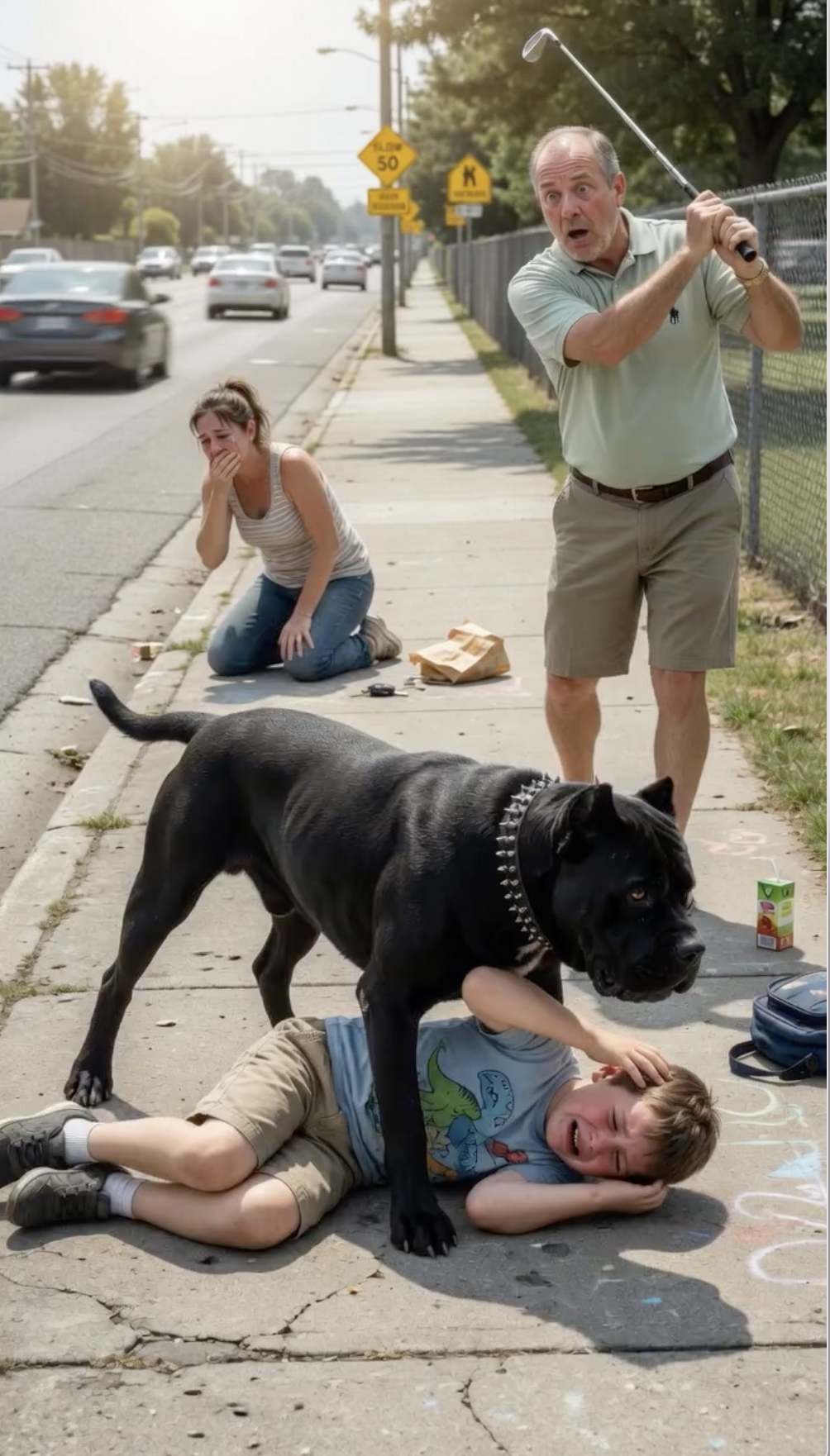
All the crowd saw was a giant, terrifying black dog violently tackling a screaming, bleeding child to the ground.
“Get him off! Oh my God, somebody shoot it! Get him off my baby!” Sarah screamed, finally reaching the edge of the scene. She threw herself onto her knees, trying to pry the dog away.
But Brutus wouldn’t move.
The heavy dog was standing directly over Leo’s sobbing body. His massive paws were planted on either side of the boy’s chest. Brutus was panting heavily, blood dripping from a gash on his hind leg where the truck had clipped him, staining the concrete red.
“Get away from him, you son of a bitch!” David Vance roared, pushing through the gathering crowd of horrified onlookers. He raised the heavy metal golf club high above his head, aiming directly for the space between the dog’s amber eyes. “I’m going to bash your skull in!”
Chloe stood five feet away, her phone recording every second, her hand shaking. “Oh my god, the dog killed him, I think the dog killed him,” she muttered into her microphone, already imagining the millions of views.
Marcus, his heart hammering against his ribs, his lungs fighting for air, finally broke free from his paralysis. He forced his bad leg to move, sprinting with a heavy, agonizing limp toward the mob.
“Don’t touch him!” Marcus screamed, his voice raw, reaching out blindly. “Don’t you dare touch my dog!”
David brought the heavy golf club swinging down with all his might.
Sarah closed her eyes and screamed.
Leo wailed.
And Brutus, the giant, terrifying beast, simply lowered his massive head, closed his eyes, and draped his heavy neck entirely over the little boy’s fragile skull, turning his own back to the incoming blow.
He was bracing for the strike.
chapter 2
Time in the human brain is a funny, elastic thing. When the sympathetic nervous system dumps a lethal cocktail of adrenaline and cortisol into the bloodstream, seconds don’t just slow down; they fracture. They break apart into microscopic shards of crystal-clear reality.
For Marcus Hayes, the descent of the heavy iron golf club was happening in agonizing, stuttering frames.
He could see the sunlight glinting off the polished chrome of the shaft. He could see the bulging veins in David Vance’s forearms, the man’s face contorted into a mask of ugly, self-righteous fury. David wasn’t trying to save a child. Marcus saw that instantly. The man in the pristine salmon polo shirt was acting out a power fantasy, eager to destroy something he didn’t understand, eager to be the violent hero in a pristine suburban park.
And beneath the arc of that heavy metal weapon, Brutus was doing the exact opposite.
The 140-pound Cane Corso, an animal bred for centuries to guard and intimidate, a creature with enough bite force to snap a femur like a dry twig, had made a conscious choice. Brutus hadn’t growled. He hadn’t bared his teeth at the man threatening his life. Instead, he had tucked his massive, blocky head downward, curling his thick neck over the screaming six-year-old boy, effectively turning his own body into a living, breathing Kevlar vest.
Brutus whimpered—a high, unnatural sound of canine distress—but he did not move an inch. He was holding the line. Just like he was trained to do.
No, Marcus thought. The word wasn’t a sound; it was an absolute refusal of reality vibrating in his marrow. Not him. You don’t get to take him. Marcus’s right leg—the one held together by titanium pins, screws, and the stubborn ghosts of a roadside bomb outside Kandahar—screamed in white-hot agony as he pushed off the grass. He didn’t run. He launched himself. He threw his thirty-two-year-old, battle-scarred body across the blistering concrete with the reckless abandon of a man who had already died once and wasn’t afraid to do it again.
He didn’t aim for David. There was no time to stop the swing.
He aimed for the space between the club and his dog.
David Vance put the entire weight of his body into the swing. He was aiming to crush the dog’s skull. He wanted the visceral satisfaction of the impact. He wanted the crowd to cheer for him.
But the target vanished, replaced by a blur of faded military surplus fabric.
CRACK.
It didn’t sound like a golf club hitting a golf ball. It sounded like a baseball bat striking a side of frozen beef.
The heavy iron head of the club slammed into the juncture of Marcus’s left shoulder and collarbone. The kinetic energy transferred instantly, shattering bone and tearing muscle fibers. Marcus’s vision flashed a blinding, brilliant white. The air was forcefully expelled from his lungs in a ragged, wet gasp.
His momentum carried him downward, collapsing hard onto the concrete right next to Brutus and the screaming boy.
For a single, suspended moment, the entire park went dead silent.
Even the roaring traffic on Oakgrove Boulevard seemed to fade into a dull, distant hum. The world held its breath.
Then, the true chaos began.
The heavy golf club clattered to the pavement. David Vance stumbled backward, his eyes wide, his chest heaving. The sheer shock of hitting a human being—of feeling the sickening give of bone beneath his weapon—temporarily short-circuited his rage. He looked at his hands, trembling violently, then down at the crumpled form of the man on the ground.
“He… he jumped in the way!” David stammered, his voice an octave higher than normal, desperate to reclaim the narrative. He looked frantically at the circle of bystanders. “You all saw that! The dog was attacking the boy, and this lunatic jumped in the way! I was trying to save the kid!”
But nobody was looking at David.
Sarah Jenkins had finally scrambled the last few feet. Her knees were scraped raw and bleeding through her yoga pants, her hands covered in park dirt. She threw herself onto the concrete, her maternal instincts drowning out all logic and fear. She shoved her hands toward the terrifying, massive black dog, fully expecting to be bitten, fully expecting to find her son torn to pieces.
“Leo! Leo, baby, look at mommy!” she sobbed hysterically.
Brutus let out a deep, huffing breath. Slowly, the massive dog lifted his head. He didn’t snap at Sarah. Instead, he gently stepped backward, deliberately unpinning the boy. As he moved, his injured hind leg gave out slightly, and he stumbled, leaving a thick smear of dark blood on the gray concrete.
Sarah grabbed Leo by the shoulders, pulling him violently into her chest. She ran her hands frantically over his face, his arms, his torso, looking for the fatal wounds, looking for the torn flesh.
“Where does it hurt? Where did he bite you?!” she screamed, her eyes wild, scanning her son’s small body.
Leo was crying, a harsh, overstimulated wail that meant his sensory processing was completely overwhelmed. But as Sarah patted him down, a profound, freezing realization washed over her.
There was no blood on Leo.
There were no bite marks.
The only injury on her son was an angry red scrape on his elbow from where he had hit the pavement. His clothes weren’t torn. His skin wasn’t punctured.
Sarah stopped breathing. She looked down at the concrete where Leo had been pinned. Then she looked up, past the dog, past the bleeding man on the ground, and stared at the edge of the sidewalk.
She saw the tire tracks.
The thick, black, smudged rubber marks of a utility truck’s tires were stamped literally inches from where Leo’s head had been. The violent rush of wind she had felt, the screech she had half-heard—it suddenly pieced itself together in her exhausted brain.
Leo had been stepping off the curb.
The dog hadn’t tackled Leo to attack him.
The dog had tackled Leo to knock him out of the path of a four-ton vehicle going fifty miles an hour.
“Oh my god,” Sarah whispered, the words slipping out of her mouth like a prayer. Her entire body began to shake, a tremor that started in her core and radiated out to her fingertips. She looked at Brutus.
The massive Cane Corso was limping heavily. The side mirror of the truck had sliced a deep, jagged gash into his left hindquarter. Blood was pooling on the pavement beneath his paw. But the dog wasn’t paying attention to his own wound.
Brutus was frantically nudging the motionless shoulder of Marcus, letting out sharp, pathetic whines, licking the side of the man’s face.
Marcus was currently trapped in the dark.
The pain in his collarbone was a roaring, white-hot fire, but the psychological pain was worse. For ten seconds, he wasn’t in Centennial Park. He was back in the Humvee. He could smell the burning diesel, the copper tang of blood, and the fine, chalky dust of the Afghan desert. He could hear the panicked shouting over the radio. He was waiting for the secondary explosion.
Stay with me, stay with me, he muttered in his mind, trying to find a lifeline to the present.
Then, he felt a rough, wet tongue drag across his cheek. The smell of burning diesel vanished, replaced by the distinct, earthy scent of his dog’s breath.
Marcus’s eyes snapped open. The bright Ohio sun blinded him for a second. He gritted his teeth, suppressing a groan as he forced his right arm to push himself up. His left arm hung uselessly at his side, the shoulder visibly deformed under his jacket.
“I’m okay, buddy. I’m here,” Marcus rasped, his voice a gravelly whisper. He reached up with his good hand, burying his fingers in the thick fur of Brutus’s neck. The dog immediately stopped whining, pressing his massive head hard against Marcus’s chest, applying deep pressure therapy even while bleeding from his own leg.
Chloe, the nineteen-year-old influencer, had been standing paralyzed, her phone still aimed squarely at the chaotic scene. Her mouth was hanging open. The narrative in her head—vicious dog attacks child in park—was rapidly crumbling.
She lowered her phone, her thumb hovering over the screen. She had recorded the whole thing in 4K resolution at sixty frames per second. She tapped the screen, dragging the playback slider backward.
She watched the tiny boy run. She watched the dog explode across the grass. But this time, she wasn’t looking at the dog. She was looking at the background.
There it was.
Entering the top right corner of her screen was the massive grill of the utility truck, barreling down the right lane, ignoring the yellow light. She watched in slow motion as the dog hit the boy, violently shoving him backward just a fraction of a second before the truck blasted through the exact physical space where the boy’s body had been. She watched the truck’s mirror clip the dog, spinning it around.
She saw the dog stand over the boy, not biting, but shielding.
And then she saw the man in the pink shirt—the man who lived in the big house on the corner—run up and swing a golf club at the animal that had just saved a child’s life.
Chloe felt a wave of absolute nausea hit her stomach. The bubblegum lost its flavor.
“He didn’t do it,” Chloe said aloud. Her voice was thin, but in the sudden quiet of the park, it carried.
People turned to look at her.
“He didn’t attack him,” Chloe repeated, her voice growing stronger, a rising tide of righteous indignation flushing her cheeks. She pointed a trembling finger with a hot-pink acrylic nail directly at David Vance. “The dog pushed the kid out of the street. A truck almost hit him. I have it on video. The dog saved his life, and you just hit that man with a golf club!”
The atmosphere in the park shifted. It was an invisible, palpable change in barometric pressure. The crowd of thirty people, who just moments ago were ready to form a lynch mob against the dog, suddenly turned their collective gaze onto David.
David felt the heat of their stares. His face, already flushed with anger, went completely pale. The golf club on the ground suddenly looked like a murder weapon.
“That’s… that’s ridiculous!” David sputtered, taking another step back, pointing an accusatory finger at Marcus. “Look at that thing! It’s a monster! It was pinning the boy down! I saw it with my own eyes! The owner is a menace, he shouldn’t be allowed to have an aggressive breed in a public park!”
“You shut your mouth.”
The voice wasn’t loud, but it was laced with such absolute, chilling authority that David snapped his jaw shut.
It was Marcus.
The veteran was struggling to his feet. It was an agonizing process. He had to use his good right arm to push off the ground, leaning heavily on his bad leg. Every movement caused the broken collarbone to grind, sending fresh waves of nausea through him. But he stood up.
He towered over David, even with a pronounced hunch. Marcus’s eyes, usually deadened and detached, were currently burning with a cold, controlled fury.
Brutus stood right by his side, his ears still pinned back, blood still dripping from his hindquarter, but his amber eyes locked onto David with unwavering intensity. The dog didn’t growl. He didn’t have to. The quiet menace of the 140-pound animal, perfectly synchronized with his master’s anger, was terrifying.
“This is a federally protected service animal,” Marcus said, his voice terrifyingly calm, biting off each word. He used his good hand to point to the bright red patches on Brutus’s harness. “He is trained for medical alerts and mobility assistance. He has never shown an ounce of aggression in his life. He just broke a command to save that boy’s life. And you…”
Marcus took a painful step forward. David actually cowered, raising his hands defensively.
“…you just assaulted a disabled veteran and struck a medical service dog,” Marcus finished.
A collective gasp rippled through the crowd. The words disabled veteran and service dog hit the American suburban consciousness like a sledgehammer. The mob mentality completely flipped.
“Oh my god, you psycho!” a woman in yoga clothes yelled at David.
“Somebody call the cops on this guy!” a man holding a tennis racket shouted.
David was hyperventilating. His pristine image, his authority, his control over his neighborhood—it was all evaporating in the hot afternoon sun. “It was a mistake! It was a chaotic situation! I am the HOA president, I was acting in the interest of public safety!” he stammered, frantically looking for a friendly face and finding none.
While the crowd turned on David, Sarah finally managed to calm Leo down. The boy was exhausted from the sensory overload, his crying reducing to dry, shuddering hiccups. He buried his face in the crook of Sarah’s neck, his small hands clutching the back of her stained t-shirt.
Sarah stood up. Her legs felt like jelly. She walked slowly over to where Marcus and Brutus were standing.
Marcus turned his head to look at her. He saw the sheer exhaustion in her eyes, the poverty in her clothes, and the terrifying, unconditional love of a mother who almost lost her entire world. He recognized a fellow survivor when he saw one.
Sarah looked down at Brutus. The giant dog looked back at her, panting softly. He slowly wagged his tail once, a heavy thump against Marcus’s leg.
Tears welled up in Sarah’s eyes, spilling over her lashes and cutting clean tracks through the dust on her cheeks. She didn’t care about the crowd. She didn’t care about David.
She fell to her knees right in front of the massive, bleeding dog.
“Ma’am, please be careful,” Marcus said softly, his own pain making his voice tight. “He’s injured, he might be jumpy—”
But Brutus wasn’t jumpy.
As Sarah knelt, the giant Cane Corso stepped forward, ignoring his bleeding leg. He lowered his massive cinderblock head and gently, almost impossibly delicately, rested his chin on Sarah’s shoulder, right next to where Leo was buried in her neck.
Brutus let out a long, rumbling sigh. He was applying deep pressure therapy to the terrified mother.
Sarah broke.
A sob tore out of her throat, deep and primal. She wrapped her free arm around the dog’s thick, muscular neck, burying her face in his coarse black fur. The dog smelled of grass, dust, and copper blood.
“Thank you,” she wept into the animal’s coat. “Oh my god, thank you. Thank you. You saved my baby. You saved my baby.”
She looked up at Marcus, her eyes shining with absolute, unfiltered gratitude. “He’s… he’s bleeding. Your dog is bleeding because of us. And your arm…” She noticed the unnatural slump of his left shoulder.
“We’ll be okay,” Marcus lied through his teeth, a cold sweat breaking out on his forehead. The adrenaline was wearing off, and the reality of the pain was setting in. He felt lightheaded. “He’s a tough old man. And I’ve had worse.”
In the distance, the wail of sirens began to cut through the suburban air. The high-pitched shriek of police cruisers rapidly approaching.
David Vance heard the sirens too. A sudden, desperate calculation flashed behind his eyes. He realized the incredible danger he was in. Assault with a deadly weapon. Assault on a veteran. In front of thirty witnesses. His career, his reputation, his comfortable life—it was all teetering on the edge of destruction.
He needed to act first. He needed to control the narrative before the police got out of their cars.
David bent down, snatched his golf club off the concrete, and pulled his cell phone from his pocket. He didn’t call 911. He dialed a private number.
“Yes, Phil, it’s David,” he spoke rapidly into the phone, turning his back on the crowd and walking toward the street where the cruisers were pulling up. “I need you down at Centennial Park right now. Yes, Phil, your law firm. Bring a civil litigator. I was just attacked by an unhinged vagrant and his pit-bull mix. The animal is completely rabid. It mauled a child and then the owner attacked me when I tried to intervene.”
Chloe, standing a few feet away, heard every word. Her jaw dropped. “Are you out of your mind?!” she yelled. “I have the whole thing on video! You’re lying!”
David turned around, his eyes cold and dead. “You delete that video right now, little girl,” he snarled, dropping the polite suburban facade entirely, “or I will sue you and your parents into absolute oblivion for unauthorized recording and defamation. Do you understand who I am?”
The flashing red and blue lights of three police cruisers washed over the park, casting long, erratic shadows across the grass. Four officers jumped out of their vehicles, hands resting on their duty belts, scanning the chaotic scene.
They saw a bleeding, intimidating man in military boots. They saw a sobbing woman. They saw a 140-pound, bloodied, terrifying-looking dog.
And they saw David Vance, the wealthy, well-dressed HOA president, running toward them, pointing frantically at Marcus.
“Officers! Thank God you’re here!” David yelled, playing the victim with terrifying perfection. “That man is unstable! His dog just mauled a child, and when I tried to stop it, he assaulted me! He’s a threat to everyone here! You need to shoot that animal before it kills someone!”
Marcus stood frozen. He saw the officers’ eyes instantly lock onto Brutus. He saw their hands unclip the holsters of their service weapons.
The nightmare wasn’t over. It was just beginning.
chapter 3
The metallic click of a police officer unholstering a 9mm Glock is a sound that cuts through ambient noise like a razor blade. It is a sound designed to command absolute compliance. But to a brain rewired by combat trauma, it doesn’t mean compliance. It means incoming fire.
As the four police officers fanned out across the grass of Centennial Park, their hands resting on their weapons, Marcus Hayes felt the fragile walls of his reality begin to crumble. He wasn’t in Ohio anymore. The manicured bluegrass faded into the dusty, sun-baked earth of the Helmand Province. The flashing red and blue lights reflecting off the police cruisers were the strobe lights of a medevac chopper landing in a hot zone.
“Sir! Step away from the animal! Step away right now!”
The voice belonged to Officer Miller, a twenty-six-year-old rookie whose adrenaline was completely overriding his training. He saw exactly what David Vance’s frantic 911 call had primed him to see: a chaotic, bloody scene, a massive, muscular black dog standing over a crying child, and a large, intimidating man who looked like he’d been in a street brawl.
And standing to the side, pointing an accusatory finger with all the righteous indignation of a wealthy taxpayer, was David Vance.
“I told you!” David yelled, his voice cracking with feigned panic, safely positioning himself behind the bumper of the nearest squad car. “The dog is out of control! It mauled the kid, and that guy attacked me when I tried to stop it! You have to put that beast down before it kills someone!”
Officer Miller drew his weapon. He didn’t point it at Marcus. He leveled the sights directly at the broad, heavy chest of Brutus.
“Step away from the dog! Hands in the air!” Miller barked, his voice tight.
Sarah Jenkins, still kneeling on the concrete with her arms wrapped protectively around her terrified son, let out a blood-curdling scream. “No! Don’t shoot! You don’t understand!”
But her voice was drowned out by the overlapping commands of the other officers, who were now pulling their tasers and batons, forming a semi-circle of escalating violence around the bleeding veteran and his service dog.
Marcus couldn’t raise his hands. His left collarbone was shattered into a jagged, agonizing puzzle beneath his skin. The pain was a living, breathing entity gnawing at his shoulder, sending waves of nausea crashing over him. But worse than the pain was the blinding, primal terror of seeing a gun pointed at his only lifeline.
Brutus whined—a low, tragic sound. He felt Marcus’s heart rate skyrocketing. He smelled the sudden, overwhelming spike of cortisol and adrenaline. The dog, despite his own bleeding leg, leaned heavier against Marcus’s good side, attempting to ground him, attempting to pull his handler out of the flashback. Brutus didn’t look at the officer with the gun. He looked up at Marcus, his amber eyes filled with unwavering devotion.
I am here, the dog’s gaze said. I am holding the line.
“I said step away!” Officer Miller yelled again, his finger hovering over the trigger guard. The dog was massive. The dog was bloody. In Miller’s inexperienced mind, this was a lethal threat.
Marcus didn’t step away.
Instead, with a choked, agonizing gasp, he threw his body weight forward. He collapsed to his knees right in front of Brutus, placing his own chest directly in the line of fire. He wrapped his good right arm around the dog’s thick neck, burying his face in the coarse black fur.
“Shoot me,” Marcus growled. The words were barely a whisper, torn from a throat raw with screaming, but the absolute, chilling certainty in his voice carried across the sudden silence of the park. “If you want to put a bullet in my medical equipment, you have to put one through me first. Shoot me.”
Officer Miller froze. His hands began to shake. The narrative he had been fed by David Vance was violently clashing with the reality in front of him. Vicious, rabid dogs don’t calmly lean against their owners. And victims of dog attacks don’t shield the animal with their own bodies.
“Officer! Stop! What the hell are you doing?!”
Chloe pushed her way to the front of the crowd. The nineteen-year-old barista was shaking like a leaf, her knuckles white as she gripped her phone, but her eyes were blazing with the fierce, uncompromising justice of a generation that grew up recording every injustice they witnessed.
She ignored the drawn weapons. She marched straight up to a senior officer, a sergeant with graying hair who had just arrived in the fourth cruiser.
“That man,” Chloe pointed a trembling, hot-pink nail at David Vance, “is a liar. A disgusting, narcissistic liar. He hit that man with a golf club for no reason!”
“Miss, please step back behind the perimeter,” the sergeant said sternly, holding up a hand. “We are trying to secure a dangerous scene.”
“The only dangerous thing here is him!” Chloe screamed, refusing to yield an inch. She shoved her phone directly into the sergeant’s face. The screen was paused on the high-definition video of the incident. “Look at it! Look at the screen right now! The dog didn’t bite anyone. A truck almost ran over the little boy. The dog tackled him out of the way. It saved his life. And then that psychopath in the pink shirt ran up and tried to beat the dog to death with a golf club while it was protecting the kid!”
David Vance’s face went the color of wet ash. “She’s lying! That video is probably doctored! You can’t trust these kids today!”
The sergeant frowned. He looked from David’s panicked, sweating face to the furious, tear-streaked face of the teenager. Then, he looked down at the phone.
“Play it,” he ordered.
Chloe hit play.
The audio of the screeching skateboard and Sarah’s initial scream blared from the small speaker. The sergeant watched, his eyes narrowing, as the events unfolded. He watched the massive dog break away. He saw the horrifying speed of the utility truck tearing through the yellow light. He watched the brutal, calculated tackle that knocked the child to safety just a microsecond before the truck blasted through the exact space the boy had occupied.
He watched the dog stand guard. He watched David Vance swing the heavy iron golf club. And he watched Marcus Hayes sacrifice his own body to save his animal.
The video ended. The sergeant let out a slow, heavy breath. The atmosphere in the park shifted from a tense standoff to a profound, sickening realization of truth.
“Miller,” the sergeant barked, his voice suddenly sharp and authoritative. “Holster your weapon. Now.”
Officer Miller blinked, confusion washing over his face, but he quickly slid the Glock back into its holster, the metallic click echoing loudly.
The sergeant turned his gaze slowly toward David Vance. The wealthy HOA president was visibly shaking, his eyes darting around for an escape route that didn’t exist. He had played his hand, betting entirely on his social status and the visual bias against a scary-looking dog. And he had lost completely.
“Sir, you told dispatch that a dog was mauling a child and the owner attacked you,” the sergeant said, his voice dropping an octave, laced with pure contempt. “Is that what you still claim?”
“It was… it was a confusing situation!” David stammered, taking a step backward, his hands held up defensively. “I acted in good faith! I was trying to protect the community! That animal is a menace!”
“The only menace I see here,” the sergeant said, stepping forward, “is a man who filed a false police report, assaulted a disabled veteran, and attempted to slaughter a service animal. Turn around, Mr. Vance.”
“What? You can’t be serious!” David squawked, his voice cracking into a high, hysterical pitch. “Do you know who I am? I know the mayor! I play golf with the chief of police! You can’t arrest me!”
“Turn around, put your hands behind your back, or I will put you on the ground,” the sergeant ordered, reaching for his handcuffs.
David Vance, a man who had never faced a physical consequence in his entire privileged life, tried to pull away. It was a mistake. In one fluid motion, the sergeant grabbed David’s wrist, twisted it sharply behind his back, and slammed the man face-first onto the hood of the nearest police cruiser. The hot metal burned against David’s cheek.
The metallic click of the handcuffs ratcheting tight around David’s wrists sounded like music to the crowd. A spontaneous smattering of applause broke out from the bystanders.
“David Vance, you are under arrest for assault with a deadly weapon, filing a false police report, and cruelty to a protected service animal,” the sergeant recited, his tone flat and professional as he patted the man down. “You have the right to remain silent. I highly suggest you start using it.”
As David was shoved into the back of the cruiser, his perfectly manicured life crumbling to dust, the real emergency was unfolding on the concrete.
The adrenaline that had kept Marcus conscious was rapidly burning away. The blinding pain in his shoulder was spreading, radiating down his chest and up into his neck. He was shivering violently, a classic sign of clinical shock.
“Paramedics are two minutes out,” Officer Miller said softly, having rushed over to Marcus’s side. The young officer looked deeply ashamed, his eyes avoiding the dog he had almost shot. “Sir, you need to lie down.”
“Don’t… don’t touch him,” Marcus ground out between clenched teeth, his right arm still wrapped tightly around Brutus. The dog was panting heavily, his massive tongue lolling, but his amber eyes never left Marcus’s face. The pool of blood beneath Brutus’s injured leg was growing larger. The truck’s mirror had sliced deep into the muscle, and the physical exertion of the tackle and the standoff had exacerbated the bleeding.
Sarah Jenkins crawled over to them. She had finally managed to calm Leo down enough to sit him on the grass a few feet away, but she couldn’t leave the man and the dog who had sacrificed everything for her.
She looked at Marcus’s pale, sweaty face, and then at the massive, bleeding animal. She took off her faded flannel overshirt, wadded it up, and gently pressed it against the gash on Brutus’s hindquarter to staunch the bleeding. Brutus flinched slightly but didn’t pull away. He simply licked Sarah’s hand once.
“I’ve got him,” Sarah whispered to Marcus, tears streaming freely down her face. “I’ve got him. I’m holding the pressure. You just breathe. Please, just breathe.”
The wail of the ambulance sirens finally peaked, and the heavy, box-like vehicle aggressively jumped the curb, coming to a halt directly on the grass. Two paramedics jumped out, carrying trauma bags and a backboard.
They rushed to Marcus, immediately recognizing the signs of severe shock and a complex fracture.
“Sir, we need to get you on the board, your collarbone is displaced,” a female paramedic said, snapping on purple nitrile gloves and reaching for a pair of trauma shears to cut away his shirt.
“Wait,” Marcus gasped, swatting her hand away with surprising strength. He looked wildly around. “My dog. Brutus. Where is he?”
“I’m right here. He’s right here,” Sarah assured him, keeping her hands firmly pressed against the dog’s wound.
“He needs a vet,” Marcus panted, his eyes rolling back slightly. “He’s losing blood. I’m not… I’m not leaving until he’s safe. He goes first.”
The paramedic looked sympathetic but firm. “Sir, we are an ambulance for humans. We legally cannot transport an animal. Animal control is on the way to take him to an emergency clinic, but you have to go to the trauma center right now. You are going into shock.”
“No!” Marcus yelled, the panic returning, thick and suffocating. He tried to sit up, but the pain dropped him immediately back to the pavement. “Animal control will throw him in a cage! They don’t understand him! He’s a service dog! He can’t be alone in a cage!”
For Marcus, the idea of Brutus being hauled away by strangers, thrown into a cold metal kennel while bleeding and terrified, was a fate worse than death. Brutus was his anchor. Without the dog, Marcus was completely untethered from reality, drifting back toward the nightmare of the war.
“I will take him.”
The voice was quiet, but it commanded absolute attention. It was the police sergeant.
He walked over, his radio crackling on his shoulder. He looked down at the massive, bleeding Cane Corso, and then at the broken veteran. The sergeant had served twenty years ago. He knew the look in Marcus’s eyes. He knew exactly what that dog meant to him.
“I have a K-9 transport unit pulling up right now,” the sergeant said, kneeling down so he was eye-level with Marcus. “We use a specialized emergency trauma vet across town for our police dogs. They are the best in the state. They don’t use cages for heroes. My officers will transport Brutus there directly with lights and sirens. I swear to you on my badge, he will be treated like one of our own.”
Marcus stared into the sergeant’s eyes, searching for a lie. He found only grim, absolute sincerity.
Marcus let out a long, shuddering breath. The fight drained out of him. He reached up, his trembling fingers tangling in Brutus’s thick fur one last time. He pulled the massive head down to his chest.
“Stand down, Brutus,” Marcus whispered, tears finally breaking free, mixing with the sweat and dirt on his face. “Stand down. Good boy. I’ll find you. I promise.”
Brutus whined, a heart-wrenching sound of confusion and distress. He didn’t want to leave. His training told him his place was right here, applying pressure, keeping his handler safe. But the command had been given.
Slowly, agonizingly, the massive dog stood up. He limped heavily, favoring his injured leg. Two K-9 officers arrived with a heavy-duty stretcher specifically designed for large dogs. They didn’t try to leash him. They simply guided him, speaking in low, soothing tones reserved for fellow officers.
As they lifted Brutus onto the stretcher, Sarah stood up. Her hands were covered in the dog’s blood. She looked at Marcus, who was now being strapped to a backboard by the paramedics, his face a mask of agony and profound loss as he watched his dog being loaded into the back of a police SUV.
Sarah made a decision.
“Excuse me,” she said, grabbing the arm of the female paramedic. “Where are you taking him?”
“Mercy General Trauma Center,” the paramedic replied, already moving fast to load the stretcher into the ambulance.
Sarah turned to her son. Leo was sitting quietly on the grass, intensely focused on a small, shiny metal buckle that had broken off Brutus’s harness during the tackle. He was spinning it in his fingers, entirely lost in his own world, miraculously unharmed.
Sarah scooped Leo up into her arms. She ignored her bleeding knees, her ruined clothes, and her exhaustion.
“I’m coming with you,” Sarah said, stepping toward the back doors of the ambulance.
The paramedic frowned. “Are you his wife? A family member?”
“Yes,” Sarah lied without a second thought, her eyes flashing with a fierce, unbreakable resolve. “I’m his family. And I’m not leaving him alone.”
The paramedic didn’t have time to argue. She nodded, and Sarah climbed into the cramped, brightly lit back of the ambulance, pulling Leo onto her lap.
As the ambulance doors slammed shut and the sirens wailed, drowning out the world, Sarah looked down at Marcus. The veteran was staring blankly at the ceiling of the rig, his chest heaving, trapped in a silent, agonizing void without his dog. Sarah reached out, her small, blood-stained hand gently covering his uninjured right hand. She didn’t say a word. She just held on.
Fifty miles away, in the pristine, mahogany-paneled office of a high-rise law firm, a phone rang.
Phil Harrington, a lawyer who specialized in making wealthy people’s problems disappear, picked it up. He listened to the frantic, high-pitched voice of David Vance calling from the back of a police cruiser.
As Phil listened, a cold, predatory smile spread across his face.
“Assault? Animal cruelty? Relax, David. You’re panicking,” Phil said smoothly, leaning back in his leather chair. “It’s a he-said, she-said with a teenage girl’s video. We can bury that. The real issue is the dog. If that animal survives, it’s a walking piece of evidence and a sympathetic prop for the jury. But… if we can argue that the dog is inherently dangerous, a public menace that caused the accident in the first place…”
Phil paused, his mind calculating the angles, finding the legal loopholes.
“Listen to me carefully, David. Do not say another word to the police. I am filing an emergency injunction right now. I am calling the city’s vicious animal control board. We are going to demand that the dog be seized by the state immediately as a threat to public safety. If the state euthanizes the dog before this goes to trial, their entire narrative falls apart. We make you the victim. We make the dog the monster.”
Phil hung up the phone and began typing furiously. The legal machine was moving, cold, unfeeling, and entirely focused on destroying a 140-pound hero to protect a wealthy coward.
At the emergency veterinary clinic, the doors burst open. The K-9 officers wheeled Brutus inside on the stretcher. The massive dog was unresponsive, his breathing shallow and rapid. The blood loss from the truck mirror strike was more severe than anyone had realized; the impact had severed a major artery in his hindquarter.
“We need a trauma bay! We have a K-9 down! Massive hemorrhage!” the lead officer shouted.
A team of veterinary surgeons rushed out, taking the stretcher and sprinting down the hallway. The fluorescent lights flickered overhead as they pushed the massive, bleeding animal into surgery. The doors swung shut, locking the police officers out.
Two hours later.
Marcus Hayes woke up to the sterile, unforgiving smell of hospital bleach. The blinding white lights of the ER ceiling swam into focus. He felt a heavy, dull throbbing in his left shoulder, which was now heavily immobilized in a complex sling and brace. The sharp edge of the pain had been dulled by a heavy dose of intravenous painkillers, leaving his mind foggy and slow.
He turned his head.
Sitting in an uncomfortable plastic chair next to his bed was Sarah Jenkins. She looked completely shattered. Her face was pale, her clothes ruined, but she was awake, staring intently at the floor. Leo was asleep on two pushed-together chairs in the corner, holding tightly to the broken metal buckle from Brutus’s harness.
Marcus tried to speak, his throat dry as sandpaper. “Sarah…”
She snapped her head up. The moment she saw he was awake, a fresh wave of tears hit her eyes. She stood up and rushed to the side of the bed.
“Hey. Hey, don’t try to move,” she whispered, her voice shaking. “You’re okay. The doctor said you have a compound fracture of the clavicle and a torn rotator cuff. They set the bone. You’re going to be okay.”
Marcus blinked, his foggy brain struggling to process the information. He looked down at his right side. It was empty. The crushing weight of panic immediately returned, fighting through the haze of the painkillers.
“Brutus,” Marcus gasped, his heart monitor suddenly spiking, emitting a rapid, panicked beep-beep-beep. “Where is Brutus? Did the cops take him? Where is he?”
Sarah’s face crumbled. She looked away, biting her lip so hard it almost bled. She reached out and grabbed his good hand, squeezing it tightly.
“Sarah. Look at me,” Marcus demanded, the veteran’s authority returning to his voice despite his broken body. “What happened to my dog?”
Sarah looked back at him, her eyes filled with absolute devastation.
“Marcus… I called the vet clinic like the police sergeant told me to,” she sobbed, the words tumbling out of her mouth. “They got him into surgery. He lost a lot of blood, but they stopped the bleeding. They said he was going to pull through.”
Marcus felt a massive, staggering wave of relief wash over him. “Okay. Okay. Then why are you crying? I need to go get him.”
“You don’t understand,” Sarah choked out, her grip on his hand becoming painful. “While he was in recovery… men in suits showed up at the clinic. They had court papers. A judge signed an emergency order.”
The heart monitor beside Marcus’s bed began to scream.
“What are you saying?” Marcus whispered, a cold terror gripping his spine.
“David Vance’s lawyer filed an injunction,” Sarah wept, her head dropping to the bed rails. “They claimed Brutus is a vicious animal involved in an active criminal investigation. The judge signed it. Marcus… Animal Control seized him from the clinic an hour ago. They took him to the city pound.”
Marcus froze. The painkillers could no longer hold back the nightmare.
“And they put a hold on him,” Sarah finished, her voice a devastated whisper. “A mandatory vicious dog hold. The lawyer is demanding he be put down tomorrow morning.”
chapter 4
The silence in the trauma room was heavier than the concrete that had broken Marcus’s bones.
The digital clock on the wall blinked a glowing, merciless red: 11:42 PM. In eight hours, the city’s vicious animal control board would open its doors. By 8:15 AM, they would walk down a sterile concrete corridor, open a metal cage, and inject a lethal dose of pentobarbital into the veins of the only living creature that kept Marcus Hayes tethered to this earth.
Marcus lay perfectly still against the crisp hospital sheets. The heavy doses of Dilaudid pumping through his IV had dulled the sharp, white-hot agony in his shattered collarbone, replacing it with a thick, suffocating mental fog. But the medication couldn’t touch the terror in his chest. It was a cold, expanding void.
Without Brutus, the walls of the hospital room seemed to vibrate. The rhythmic hiss-click of the oxygen regulator sounded dangerously like the pressurized hydraulics of a medevac chopper. The shadows in the corner of the room began to lengthen, twisting into the shapes of the men he couldn’t save in the Arghandab Valley. He was slipping. The psychological dam was breaking, and the floodwaters of his PTSD were rushing in.
“Marcus. Look at me.”
Sarah’s voice was a sudden, sharp anchor. She leaned over the bed rail, forcing her face into his line of sight. Her eyes were bloodshot, rimmed with deep, purple exhaustion, but the maternal fire burning behind them was absolute.
“They’re going to kill him, Sarah,” Marcus whispered, his voice cracking, the stoic armor of the combat veteran finally fracturing completely. A single tear escaped his eye, tracking through the dirt and dried blood still on his cheek. “He broke protocol. He left my side. He knew the rules, and he broke them to save the kid. And now he’s going to die in a cage, wondering why I abandoned him.”
“You didn’t abandon him,” Sarah said fiercely, her voice trembling with barely suppressed rage. “And he is not going to die tomorrow.”
“You don’t understand the system,” Marcus choked out, closing his eyes. “David Vance has money. He has a lawyer who knows the judges. The city won’t risk a liability lawsuit over a ‘pit-bull mix’ that a rich man claims is dangerous. They rubber-stamp these euthanasia orders to make the problem go away. I’m a disabled vet with no money and a broken shoulder. We lost.”
Sarah stood up. She looked at Marcus, then over to the corner of the room where little Leo was fast asleep, his small hand still tightly clutching the broken metal buckle from Brutus’s harness.
Sarah Jenkins had spent her entire life being crushed by the system. She knew what it felt like to be dismissed by doctors, ignored by social workers, and ground down by a society that viewed her and her autistic son as collateral damage. She knew the crushing weight of poverty and the terrifying power of men in expensive suits.
But today, a 140-pound monster had thrown itself in front of a four-ton truck for her child. Today, a broken man had thrown his body over that dog to take the swing of a heavy iron club.
The universe had finally shown Sarah grace. And she was not about to let a man in a salmon-colored polo shirt take it away.
“No,” Sarah said, her voice dropping to a terrifyingly calm register. “We didn’t lose. Because David Vance made one fatal mistake.”
Marcus opened his eyes, struggling to focus on her. “What?”
“He assumed he was the only one writing the story,” Sarah said. She reached into her pocket and pulled out her cracked, outdated smartphone. “He forgot about the girl with the pink phone.”
Sarah didn’t know Chloe’s last name. She didn’t know her handle. But she knew where she worked. Chloe had been wearing an apron from The Roasted Bean, an independent coffee shop three blocks from Centennial Park.
It was midnight. The shop was closed. But Sarah started searching Instagram, tracking location tags, scanning photos of lattes and pastries, desperately looking for the barista with the bright pink phone case and the fierce sense of justice.
It took her forty-five minutes. She found a profile: @Chloe_Creates. The latest story update was a text post against a black background, posted two hours ago. It read: I just watched a hero get arrested because a rich psychopath lied to the cops. I have the video. I don’t know what to do with it.
Sarah typed a direct message with shaking hands.
Chloe. I am the mother of the little boy from the park today. The man in the hospital is named Marcus. The dog is named Brutus. David Vance’s lawyer just got a judge to seize the dog. They are going to euthanize him at 8:00 AM tomorrow. Please. Send me the video.
Three minutes passed. The three longest minutes of Sarah’s life. Then, three dots appeared on the screen. Chloe was typing.
I’m not sending it to you, the reply read.
Sarah’s heart plummeted into her stomach.
A second message popped up.
I’m posting it everywhere. Give me ten minutes.
Time in the digital age moves differently than time in the physical world. In a courtroom, justice takes months, buried under mountains of paperwork and procedural delays. On the internet, justice—or destruction—can happen at the speed of light.
At 1:15 AM, Chloe uploaded the raw, unedited, 4K video simultaneously to TikTok, Twitter, and Facebook. She didn’t use a catchy dance song. She didn’t use filters. She simply titled it: Wealthy HOA President Lies to Police, Demands Hero Service Dog Be Euthanized After Dog Saves Autistic Child.
In the caption, she tagged the local police department, the mayor’s office, the city’s animal control board, and three major national news outlets. She laid out the timeline: The truck. The tackle. The golf club. The arrest. And the devastating update about the 8:00 AM euthanasia order.
For the first thirty minutes, the video sat quietly in the algorithmic void, accumulating a few hundred views from Chloe’s local followers.
Then, the algorithm recognized the engagement metrics. The watch time was 100%. The share rate was unprecedented. The comment section was exploding with raw, visceral emotion.
By 2:00 AM, the video crossed 100,000 views.
The internet is often a cesspool of division, but if there are two things that instantly unite the American public, it is the protection of innocent children and the undeniable heroism of a dog.
By 3:30 AM, the video hit 2 million views. It breached the walls of local Ohio algorithms and went national.
Veterans groups began sharing it, furious at the sight of Marcus shielding his service dog with his own broken body. Autism advocacy networks amplified the footage, moved to tears by the massive dog’s split-second decision to save a non-verbal child. Animal rights activists mobilized with terrifying efficiency, tracking down the exact phone numbers and email addresses of the city’s vicious animal control board.
By 5:00 AM, the hashtag #SaveBrutus was the number one trending topic in the United States.
The city’s dispatch centers began to melt down. The phone lines at the mayor’s office and the local precinct were instantly jammed. Thousands of calls poured in from New York, Texas, California, and London, all demanding to know why a hero dog was on death row.
While the world caught fire, David Vance was sleeping deeply in his holding cell, utterly oblivious to his impending doom. His lawyer, Phil Harrington, had assured him he would be bailed out first thing in the morning and the dog problem would be permanently “handled.”
But in the hospital room, Marcus was burning from the inside out.
It was 6:30 AM.
Marcus ripped the IV line out of the back of his hand.
The heart monitor shrieked in protest. Blood immediately began to pool on his skin, dripping onto the pristine white sheets.
“Marcus! What are you doing?!” Sarah yelled, jumping out of her chair, her heart leaping into her throat.
“I’m leaving,” Marcus grunted, his face pale and sweating profusely as he swung his legs over the side of the bed. The movement sent a horrific, grinding spike of pain through his shattered collarbone. He almost blacked out, gripping the edge of the mattress with his good hand until his knuckles turned white.
“You can’t leave! You have a compound fracture, you just had surgery, you’re high on painkillers!” Sarah pleaded, trying to gently push him back down.
Marcus looked up at her. His eyes were no longer foggy. The primal, protective instinct of the handler had completely overridden the narcotics.
“It’s 6:30, Sarah,” Marcus said, his voice a low, gravelly rasp. “The pound opens at 8:00. I am not letting my dog die in a room full of strangers. I will walk there if I have to. I will tear the doors off the hinges with one arm. Get my clothes.”
Sarah looked into the face of a man who had survived a war, a man who had just shielded a 140-pound dog from a deadly weapon. She realized that trying to stop him was impossible.
She nodded. “I’ll get the car.”
The drive to the city’s animal control facility was a silent, agonizing journey. Sarah’s beat-up sedan rattled over the potholes of the early morning streets. In the passenger seat, Marcus sat rigid, his left arm heavily strapped to his torso, his breathing shallow and rapid. Every bump in the road was a fresh wave of torture, but he didn’t make a sound.
Leo sat in the back, wide awake, staring out the window. He was quiet, but he still gripped the broken metal harness buckle, rubbing his thumb over the cold steel.
They pulled into the dreary, concrete parking lot of the county animal control building at 7:45 AM. The sky was overcast, casting a gray, hopeless pallor over the facility.
Marcus unbuckled his seatbelt with his right hand. He kicked the door open.
As he stepped out into the cold morning air, he froze.
The parking lot wasn’t empty.
There were three local news vans parked haphazardly on the grass, their satellite dishes extended. And gathered in front of the locked glass doors of the pound was a crowd.
There were at least a hundred people. Some were holding hastily scribbled cardboard signs that read FREE BRUTUS and ARREST DAVID VANCE. Others were simply standing in silent, furious vigil. At the front of the crowd stood Chloe, wearing her barista apron over her jacket, her phone held high, live-streaming to an audience of over three hundred thousand people.
When the crowd saw Marcus—pale, sweating, his shoulder heavily bandaged, wearing his oversized, blood-stained military jacket draped over his right side—a profound hush fell over the parking lot.
They parted like the Red Sea.
Marcus didn’t acknowledge them. He didn’t have the energy. He walked straight through the corridor of people, his boots heavy on the pavement. Sarah walked closely behind him, holding Leo’s hand.
Inside the lobby, behind the bulletproof glass of the reception desk, the situation was chaotic. The phones were ringing incessantly, a continuous, deafening wall of sound.
Standing in the center of the lobby, looking incredibly out of place in his tailored, two-thousand-dollar Italian suit, was Phil Harrington.
David Vance’s lawyer had arrived early to ensure the euthanasia order was executed smoothly before the press caught wind of the situation. He had spent the last twenty minutes screaming at the terrified clerk behind the glass to expedite the paperwork. He hadn’t checked his phone all morning. He had no idea the internet had just nuked his client from orbit.
Phil turned around as the electronic doors slid open. He saw Marcus. He noted the heavy limp, the bandaged shoulder, and the sheer, terrifying intensity in the veteran’s eyes.
“You,” Phil said smoothly, stepping forward, assuming his natural posture of legal intimidation. “Mr. Hayes, I presume. I am Philip Harrington, legal counsel for David Vance. I strongly advise you to leave the premises. Your animal has been legally classified as a public menace under section 4B of the municipal code. The destruction order has been signed by Judge Carter. There is nothing you can do, and your presence here is bordering on harassment.”
Marcus didn’t stop walking. He didn’t even blink. He walked until he was inches from the lawyer’s face.
Phil Harrington was six feet tall, but suddenly, he felt very, very small.
“Where is my dog?” Marcus asked. His voice wasn’t a yell. It was a terrifying, hollow whisper that carried the weight of a loaded gun.
“The procedure is scheduled for eight o’clock,” Phil replied, taking a half-step back, suddenly aware of the massive crowd pressing against the glass doors outside, filming them. “It’s 7:55. It’s over, Mr. Hayes. Your dog attacked my client. Actions have consequences.”
“He didn’t attack anyone!” Sarah yelled, stepping out from behind Marcus. “He saved my son’s life! You’re murdering a hero because your rich client is a coward!”
Phil scoffed, adjusting his silk tie. “A touching narrative, ma’am, but the law deals in facts, not emotions. A 140-pound apex predator pinned a child and mauled an innocent bystander. The judge reviewed the police report and agreed. The dog dies.”
“The police report is obsolete.”
The heavy, authoritative voice boomed from the entrance.
Everyone turned.
Pushing through the glass doors, flanked by two uniformed officers, was the police sergeant from the park the day before. He looked exhausted, having clearly been awake all night, but there was a grim, satisfied smile playing on his lips.
He held up a thick manila folder.
“Sergeant,” Phil Harrington said, instantly recognizing the officer, his legal radar suddenly pinging with danger. “What is the meaning of this? We have a signed court order.”
“You had a court order, Mr. Harrington,” the Sergeant corrected, slapping the folder down onto the reception counter. “Obtained under false pretenses by a client who committed perjury. At 6:00 AM this morning, after my precinct received roughly four thousand phone calls and a personal visit from the Mayor, I woke up Judge Carter.”
Phil’s face dropped. The arrogant veneer cracked. “You woke up a superior court judge?”
“I did,” the Sergeant said. “And I showed him a video that has currently been viewed by twelve million people. A video that clearly shows your client, David Vance, filing a false police report, assaulting a disabled veteran, and attempting to kill a federally protected service animal that was in the act of saving a child’s life from oncoming traffic.”
The Sergeant turned to look directly at Phil, his eyes burning with contempt.
“Judge Carter was not pleased to learn he had been lied to, counselor. He immediately stayed the euthanasia order. Furthermore, the district attorney has upgraded the charges against your client. Mr. Vance is now facing felony assault with a deadly weapon, felony animal cruelty, and perjury. His bail has been revoked. He will not be going home today. Or anytime soon.”
Phil Harrington stared at the folder. The color drained completely from his face. He was a shark, and he suddenly realized he was bleeding in the water. Without a word, he turned on his expensive leather heel, pushed his way through the crowd, and practically ran to his Mercedes in the parking lot.
The lobby fell silent. The phones finally stopped ringing.
The Sergeant turned to Marcus. The tough, graying cop’s face softened completely. He looked at the broken veteran, noting the blood seeping through the hospital bandages.
“Mr. Hayes,” the Sergeant said softly. “Your dog is in block C.”
Marcus didn’t say thank you. He couldn’t. His throat was completely closed.
He walked past the reception desk, pushing through the heavy metal double doors that led into the holding areas. Sarah and the Sergeant followed closely behind.
The smell hit him first. The sharp, metallic scent of bleach mixed with the undeniable odor of fear. The noise was deafening—dozens of dogs barking, whining, and throwing themselves against the chain-link fences of their concrete runs. It was a prison for the innocent.
Marcus walked slowly down the corridor, his boots echoing. He ignored the noise. He was searching for a specific frequency.
At the very end of Block C, in the last cage reserved for the “vicious” holds, the concrete run was completely silent.
Marcus stopped in front of the heavy steel grate.
Inside the cold, sterile cage, lying on the bare concrete floor, was Brutus.
The massive dog looked terrible. The gash on his hind leg had been stitched, but the heavy loss of blood had weakened him. His thick black coat was dull, his massive head resting heavily on his paws. He looked defeated. He looked like an animal that had accepted his fate.
“Brutus.”
The word was a cracked, broken sob.
The dog’s ears twitched.
Slowly, painfully, the massive blocky head lifted from the concrete. The amber eyes, cloudy with exhaustion and painkillers, locked onto the figure standing on the other side of the bars.
It took a second for the dog’s brain to process the visual. But then, his nose caught the scent. The smell of the hospital, the smell of blood, the familiar, comforting scent of his handler.
Brutus didn’t bark. He let out a sound Marcus had never heard before—a deep, resonant, vocalized cry that sounded almost human.
The 140-pound dog scrambled to his feet, ignoring the agony in his stitched leg. He threw his massive body against the heavy steel gate, his tail wagging so hard his entire back half shook. He pushed his wet nose through the chain-link, whining frantically, desperately trying to get to Marcus.
An animal control officer rushed forward with a ring of keys. His hands were shaking as he unlocked the heavy padlock and pulled the gate open.
Brutus lunged forward.
Marcus dropped to his knees right there on the dirty concrete floor, ignoring the white-hot explosion of pain in his shattered shoulder. He wrapped his good arm around the dog’s thick, muscular neck, burying his face deep into the black fur.
Brutus whined, aggressively licking the tears off Marcus’s face, nudging his heavy head under Marcus’s chin, immediately attempting to apply deep pressure therapy even while trembling himself.
“I’ve got you,” Marcus wept, his voice muffled by the fur. “I’ve got you. I’m sorry. I’m so sorry. You’re a good boy. You’re the best boy. We’re going home.”
Standing a few feet away, Sarah watched the broken soldier and his massive, scarred dog hold each other on the concrete floor. She felt a small hand tug at her jeans.
Leo was standing beside her. He wasn’t looking at his spinning toy. He was looking directly at the giant black dog.
Slowly, the six-year-old boy took a step forward.
Marcus saw the boy approaching. He tensed slightly, ready to hold Brutus back, knowing the dog was injured and stressed.
But Brutus didn’t growl. The giant dog pulled his head back from Marcus’s chest. He looked at the tiny boy in the blue t-shirt. The dog remembered the smell. He remembered the boy he had pulled from the edge.
Leo stopped two feet away. He reached out his small hand, opening his palm.
Resting in the center of the boy’s hand was the broken metal buckle from Brutus’s harness.
Brutus slowly extended his massive head. He gently, incredibly delicately, sniffed the boy’s hand. Then, the giant dog leaned forward and pressed his wet nose directly against Leo’s cheek, a soft, huffing breath of acknowledgment.
Leo didn’t flinch. He didn’t run. For the first time in his life, the overstimulating world was quiet. He reached out and buried his small fingers into the thick fur on top of the dog’s head.
The absolute, devastating beauty of the moment shattered the final walls of Marcus’s isolation. He looked up at Sarah, the mother who had fought the world to save his dog.
Sarah smiled, tears streaming down her face, and nodded.
They weren’t just survivors anymore.
Six months later.
The leaves in Centennial Park had turned a brilliant, fiery orange. The air was crisp, and the afternoon sun cast long, golden shadows across the manicured grass.
A lot had changed.
David Vance was gone. The internet’s wrath had been absolute. The viral video had destroyed his reputation, his business, and his standing in the community. Stripped of his HOA presidency and facing serious felony charges, he had sold his house at a loss and fled the state, destined to spend the next few years fighting a losing battle in criminal court.
The world had moved on to the next viral outrage, but in this quiet corner of Ohio, the healing had begun.
Sitting on the same metal bench near the playground was Sarah. She was wearing a new jacket. The dark, exhausted hollows under her eyes were gone, replaced by a quiet, steady peace. A GoFundMe started by Chloe had raised over two hundred thousand dollars in three days. It paid for Marcus’s medical bills, the finest veterinary care for Brutus, and allowed Sarah to quit her soul-crushing night shift and enroll Leo in a specialized behavioral therapy program.
Marcus sat next to her. His left arm was out of the sling, though he still moved it with a deliberate, cautious stiffness. The haunted, empty look in his eyes had faded, replaced by the warmth of a man who finally realized he didn’t have to carry the weight of the world alone.
He reached out, his hand finding Sarah’s on the cold metal of the bench. She intertwined her fingers with his, leaning her head against his good shoulder.
A few yards away, near the edge of the grass, Leo was playing. He wasn’t spinning a toy wheel. He was throwing a heavy, slobber-covered tennis ball.
“Fetch!” the boy yelled. It was still one of the only words he spoke, but he said it with absolute joy.
Fifty feet away, a massive, 140-pound Cane Corso exploded across the grass. Brutus was fully healed, save for a thin, silver scar on his hindquarter. His black coat gleamed in the autumn sun. He snatched the ball out of the air with terrifying speed, his powerful muscles bunching as he skidded to a halt.
He didn’t bring the ball directly back. He trotted over to the curb. The same curb where the world had almost ended six months ago.
Brutus stood on the edge of the concrete. He looked at the rushing traffic on Oakgrove Boulevard. He stood tall, his amber eyes scanning the rushing cars, a silent sentinel guarding the boundary between life and death. Satisfied that the threat was contained, he turned around, tail wagging, and trotted back to drop the ball at the little boy’s feet.
Marcus watched the dog, his heart full, the ghosts of the past finally quiet.
Because the deepest wounds of this world are rarely healed by time; they are healed by the violent, uncompromising grace of those who refuse to let us bleed alone.
Author’s Note & Philosophy:
Sometimes, the universe disguises our salvation as a disaster. We spend so much of our lives building walls to keep the pain out—walls of isolation, walls of wealth, walls of anger—forgetting that those same walls keep the light out, too. Marcus hid behind his trauma; David hid behind his status. But true character is never revealed in the quiet moments of control. It is forged in the split-second collisions of fate.
Never underestimate the power of unconditional loyalty, whether it comes from the fierce heart of a mother fighting the system, or the silent, heavy devotion of a dog willing to trade its life for a stranger’s. Society will often try to judge the book by its cover—criminalizing the scarred, fearing the intimidating, and rewarding the wealthy. But the truth, when forced into the light, has an undeniable gravity. Stand your ground, shield the innocent, and remember that sometimes, the monster you fear is the only thing standing between you and the edge.