“I’m moving to Singapore with Vanessa,” Richard Bennett announced in the middle of Terminal 4 at John F. Kennedy International Airport. “You can stay behind in that house alone, growing old among prescription bottles, prayer candles, and memories.”
Six months after her mother-in-law passed away, Laura Bennett accompanied her husband to the airport, certain that this would be the final time she ever carried one of his suitcases.
Standing beside him, Vanessa Cole, the deputy director at the company where Richard worked, smiled while straightening the lapel of his jacket. She was thirty-eight years old, fourteen years younger than Richard, and had been his mistress for three years.
Laura, fifty-two, did not cry.
After twenty-five years of marriage, she had no tears left for a man who had spent decades mistaking her patience for submission.
“Have a good flight,” she said.
Richard frowned. He had expected a scene. Tears. Pleading. Perhaps Laura dropping to her knees in front of everyone and begging him not to leave. For years, he had taken pleasure in watching her ask his permission for things as small as buying herself a new pair of shoes.
“That’s all you have to say?” he asked. “You’re not going to beg me to stay?”
“No.”
Vanessa gave a quiet laugh.
“Richard needs a woman who can keep up with him. Not someone who smells like reheated dinners and adult diapers.”
The insult was deliberate.
For five years, Laura had cared for Richard’s mother, Eleanor, entirely on her own after dementia left the older woman unable to manage even the smallest part of her daily life. Richard always claimed his executive meetings were far too important for him to help.
While Laura slept in twenty-minute stretches, changed bedding, bathed Eleanor, and endured one frightening nighttime episode after another, Richard ate at expensive Manhattan restaurants with Vanessa and charged luxury hotel rooms to his corporate account.
Eleanor had died six months earlier.
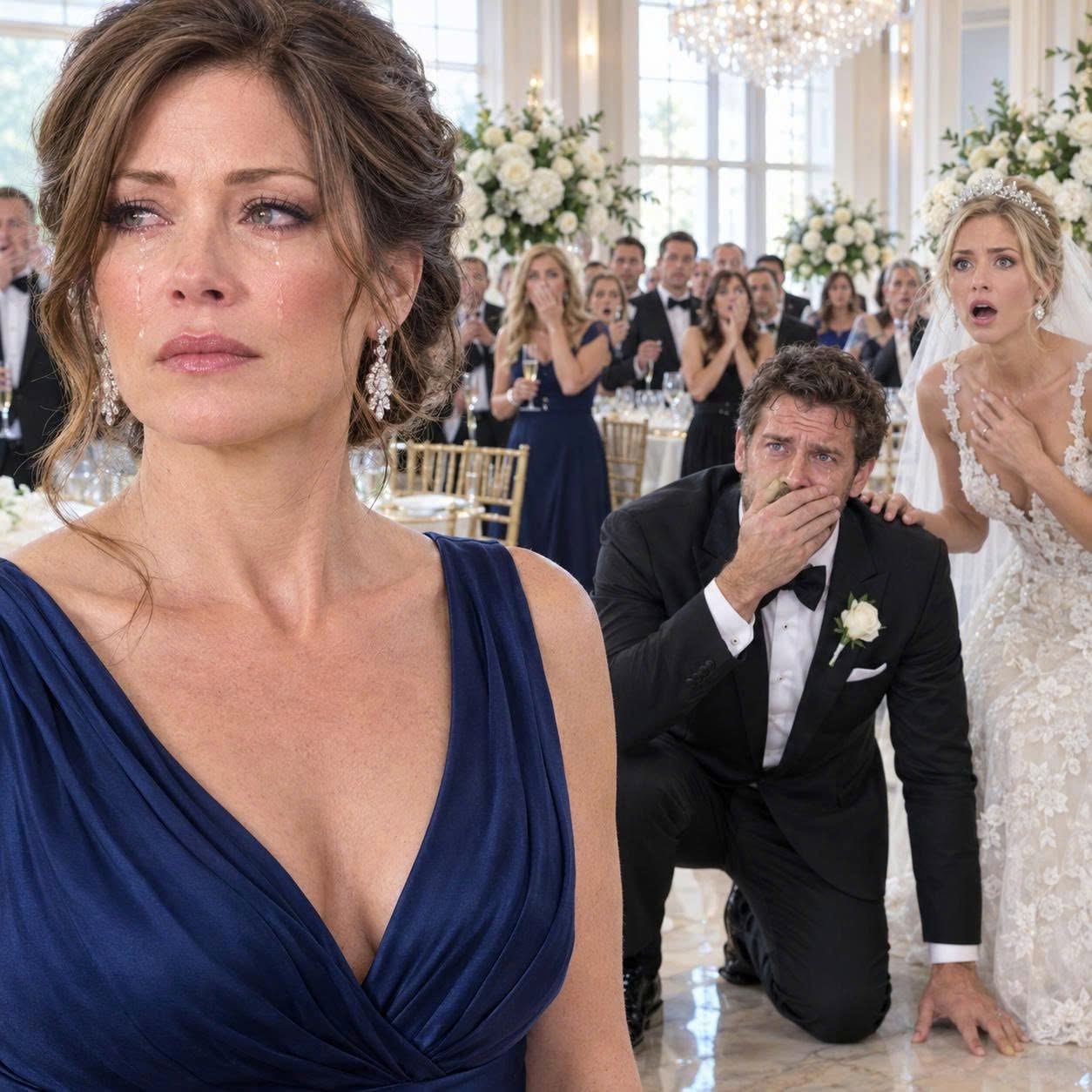
At the funeral, Richard wept in front of the entire family and told everyone that he had held his mother’s hand until she took her final breath.
No one mentioned that he had barely entered her bedroom during the last years of her life.
That was the day Laura stopped loving him.
Richard glanced at the Swiss watch Laura had given him on their tenth wedding anniversary.
“I sold the house too,” he said. “You’ll need to be out within a few days. I’m sure one of your brothers can come collect you.”
Vanessa smiled as though she had already selected the furniture for the life she intended to build with him.
What neither of them knew was that the house could not legally be sold, that their accounts were already being monitored, and that the nearly two million dollars Richard believed he had transferred to a shell corporation had never actually left the United States.
Laura tightened her grip on her handbag. Inside it were a letter from her attorney, copies of wire-transfer records, forged contracts, and a USB drive.
“Goodbye, Richard.”
She watched them walk toward the security checkpoint pulling two enormous suitcases.
Richard moved with complete confidence, convinced he was carrying his mother’s inheritance, Laura’s life savings, and a fortune stolen from Harrington Global Group.
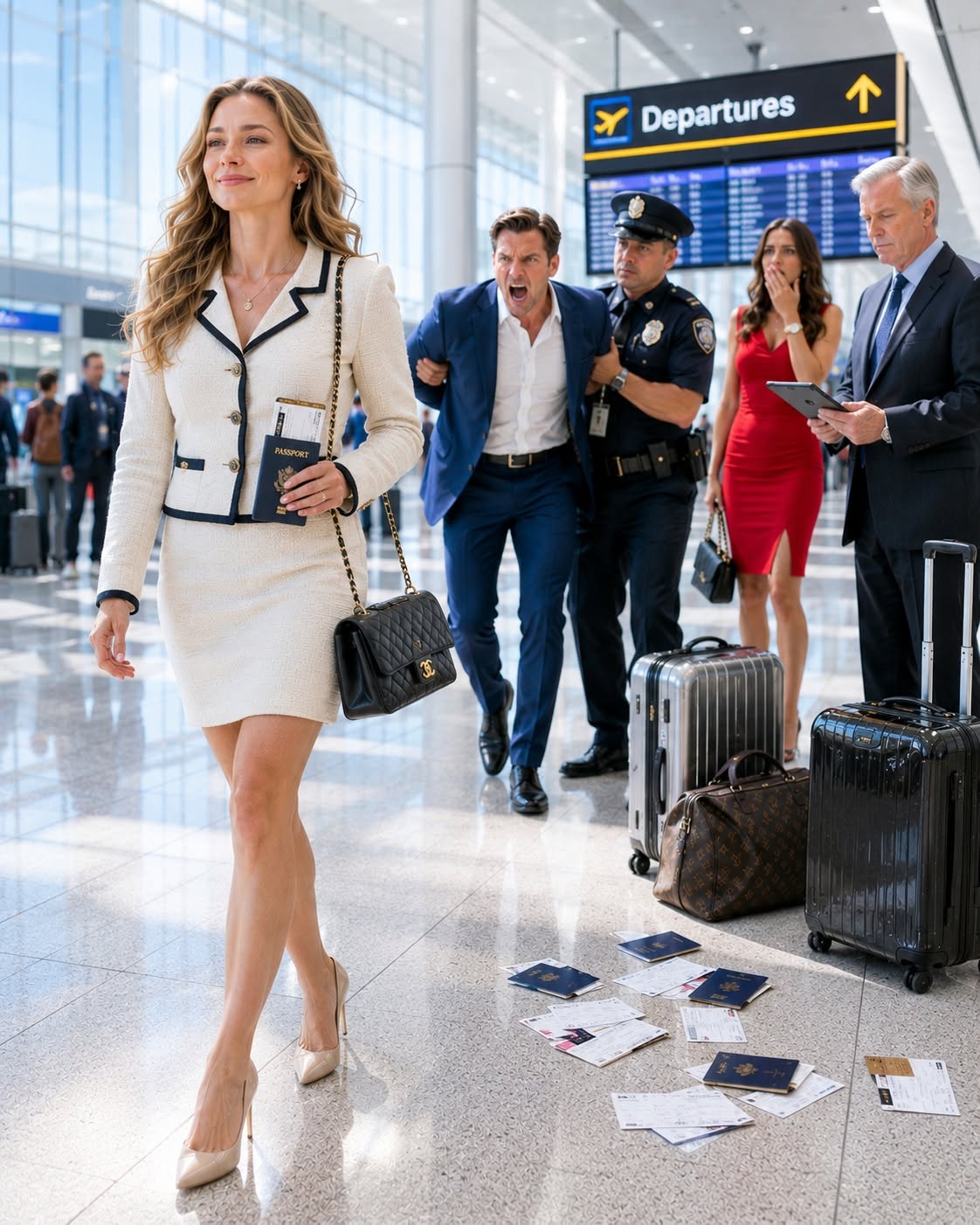
The moment he placed his passport on the scanner, an alarm sounded.
Two federal security officers approached.
Behind them appeared three plainclothes investigators.
“Richard Bennett, you are under arrest under the authority of the United States Attorney’s Office.”
Vanessa immediately released his arm.
Richard turned toward Laura, his face pale and confused, searching her expression for an explanation.
Laura only lifted her chin.
He still had no idea who had arranged his downfall.
And he had no idea what secret was hidden inside a letter written by his own mother.
He could not imagine what was about to destroy everything he thought he had won.
Three days earlier, Laura had still been pretending to be the obedient wife who made coffee, ironed shirts, and politely asked what time she should serve dinner.
Everything changed when she searched for the passbook connected to an account she had funded for twenty years.
She had saved eighty-five thousand dollars there, one careful deposit at a time, giving up vacations, new clothes, and even treatments for the chronic pain in her back.
The account balance was zero.
Beneath the statement, she found a transfer receipt showing that every dollar had been sent to Vanessa Cole.
That evening, Richard’s phone vibrated inside the pocket of his jacket.
A message appeared on the screen.
“Thank you for the money, darling. Between your mother’s inheritance and the Harrington deal, Singapore will belong to us.”
Laura waited until Richard fell asleep.
His password was still her birthday.
The messages confirmed the affair.
They also revealed something much worse.
During Eleanor’s funeral, while Laura stood near the entrance greeting grieving relatives, Richard and Vanessa had taken a photograph together in a private room at the funeral home.
“Excellent performance, devoted son,” Vanessa had written. “Now the inheritance finally belongs to us.”
Laura felt sick.
She searched Richard’s home office and discovered a safe hidden behind a painting.
Inside were passports, applications for residency in Singapore, divorce documents bearing Laura’s forged signature, and bank statements showing that Eleanor had accumulated more than four hundred thousand dollars in savings.
Richard had always insisted that they could not afford to hire a professional caregiver.
Instead, he left Laura alone to lift his mother, wash soiled clothing at three in the morning, and damage her own health through exhaustion while he protected every dollar so he could eventually spend it with his mistress.
Laura photographed everything and called Attorney Michael Grant, the lawyer who had represented her father many years earlier.
“Do not confront him,” Michael warned her. “Let him continue believing he has already won. First, we protect the house. Then we trace every dollar.”
When Laura returned after filing an emergency notice with the family court, she found Vanessa sitting comfortably in her living room, drinking coffee from Eleanor’s favorite cup.
Richard had given her a key.
“Sign the settlement,” Vanessa ordered, pushing a stack of documents across the table. “The house has already been promised to a buyer.”
Certain that Laura knew nothing, Vanessa casually admitted that she and Richard planned to use Laura’s savings, Eleanor’s inheritance, and “one major corporate transaction” to begin their new life together.
Laura asked for three days.
Vanessa assumed she was frightened.
That same night, Laura opened Richard’s office with an emergency key.
Inside a corporate envelope, she found falsified contracts, invoices from suppliers that did not exist, and handwritten transfer instructions prepared by Richard.
Nearly two million dollars were scheduled to be sent into a company controlled by Vanessa.
Attorney Grant delivered the evidence to Charles Harrington, founder of Harrington Global Group and a longtime friend of Laura’s late father.
“Let Richard believe the transfer was completed,” Charles instructed. “I want him arriving at the airport convinced that no one can touch him.”
Twenty-five years earlier, Richard had been an unknown accountant with no influence and no professional connections.
Laura had asked her father to recommend him for a position.
That single phone call had opened the door to Harrington Global Group, where Richard eventually rose to oversee international operations.
Over the years, he rewrote the story.
He claimed that talent alone had carried him to the top.
He told people Laura had never contributed anything to his success.
The internal investigation revealed that Richard had established three fraudulent suppliers directly connected to Vanessa.
For more than a year, he processed smaller illegal payments to test the company’s security controls.
Once he understood which systems could be manipulated, he prepared one final, massive theft.
The finance division received the transfer order, but Charles Harrington stopped the money before it left the company.
Inside the accounting system, the transaction was marked as “processed.”
In reality, the entire amount remained frozen.
Investigators also uncovered hotel bills, jewelry purchases, expensive dinners, and luxury vacations that Richard and Vanessa had charged to corporate accounts.
For the next three days, Laura played the most difficult role of her life.
She packed Richard’s linen suits, folded his ties, and placed his favorite cologne—the one he reserved for important business meetings—inside his suitcase.
“At least you’re still useful for something,” he remarked.
That evening, he placed a divorce agreement on the dining-room table.
“Sign this. I’ll give you six thousand dollars so you can rent a small apartment somewhere. Don’t become greedy.”
Laura pretended to sign a set of almost identical pages that Attorney Grant had prepared.
They carried no legal authority.
Richard barely examined the final page.
He was so certain Laura lacked the intelligence or courage to deceive him that he never noticed the difference.
On Monday morning, he asked her to drive him to the airport.
He wanted Vanessa to witness Laura’s humiliation.
He wanted to enjoy every moment of what he believed was her defeat.
Instead, the immigration alert was triggered.
Everything collapsed.
“There has to be a mistake!” Richard shouted. “I’m an executive at Harrington Global Group! Call Charles Harrington!”
“I’m already here,” a voice said from behind the officers.
Charles Harrington stepped forward beside Attorney Grant and two representatives from the company’s legal department.
“And I was the one who turned over the evidence.”
Vanessa tried to move away with her luggage, but a federal agent stepped into her path.
She immediately claimed she knew nothing and insisted Richard had arranged the transfers alone.
“You created the companies!” Richard shouted. “You received Laura’s money!”
“You told me all of it was legal!”
Within less than a minute, they began accusing each other.
The love they had claimed was worth more than twenty-five years of marriage dissolved in front of an airport boarding gate.
Richard stared at Laura.
“Tell them you approved the transfer.”
Laura stepped closer without raising her voice.
“I approved nothing. I never signed the divorce agreement. And the house was never legally for sale.”
The color vanished from Richard’s face.
“What did you do?”
“I stopped obeying you.”
The agents led him away.
Vanessa was also arrested after investigators discovered original contracts, jewelry purchased with corporate money, and banking access devices inside her suitcase.
Laura left the airport without feeling happy.