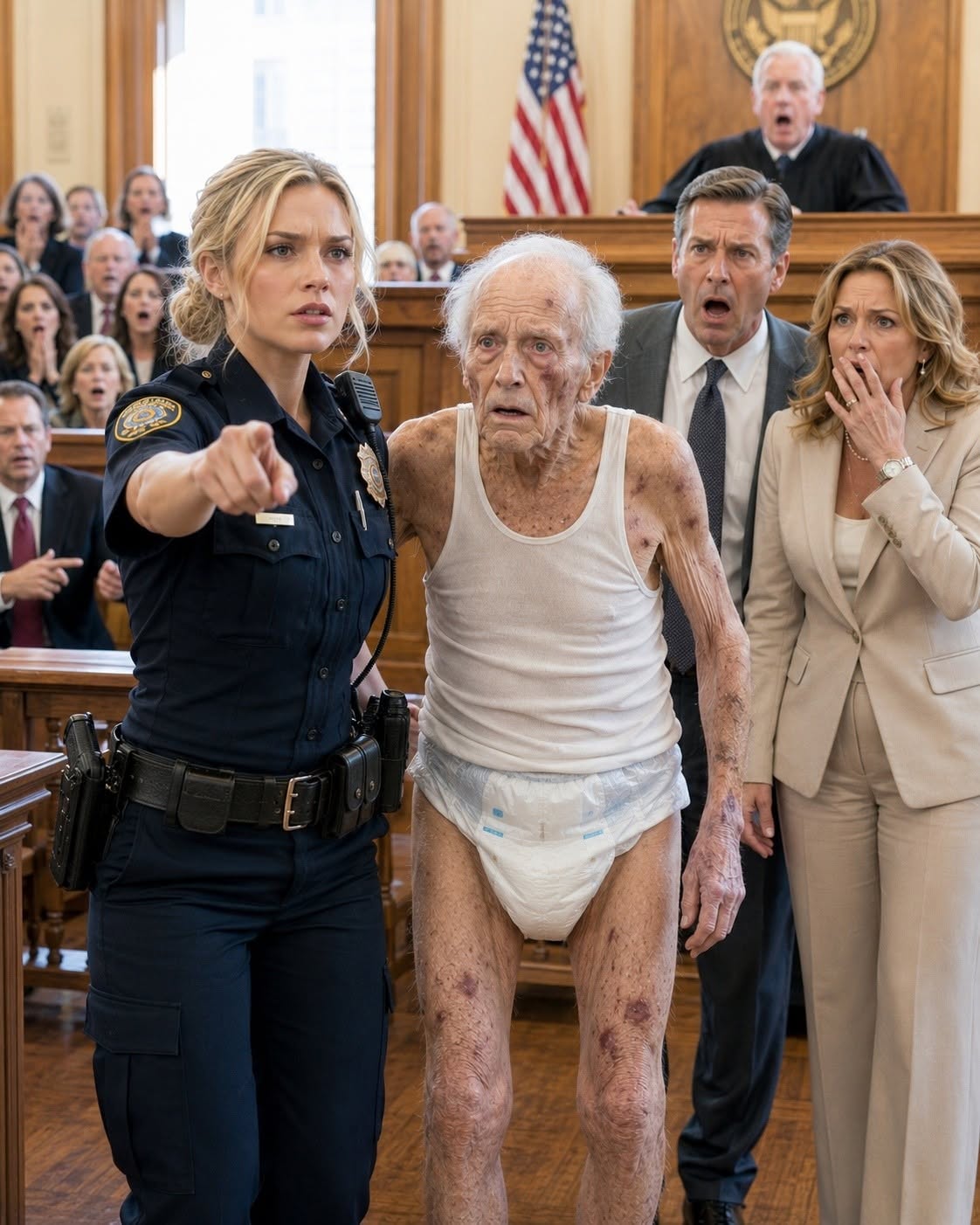
The smell reached the back of my throat before my mind could understand what I was seeing—a suffocating mixture of mold, old urine, wet wood, and something metallic that made my stomach twist.
Only ten minutes earlier, my mother had been drinking vintage champagne from crystal, laughing as she called me the greatest disappointment in the Whitmore family.
I had returned to the gated community of Westbridge after three years away.
I hadn’t come because I missed home.
I came because my grandfather, Arthur Whitmore, had suddenly stopped answering my calls.
At first, my parents said he was traveling through Europe.
A month later, they claimed he was confused and no longer knew how to use a phone.
The previous week, they changed the story again.
They said he was perfectly lucid.
He simply wanted nothing to do with me.
I knew they were lying.
I just didn’t know how badly.
Dinner inside the vast, wood-paneled dining room of the Whitmore estate felt like a carefully staged punishment. Rain struck the tall windows while my family picked at expensive food beneath a chandelier large enough to light a hotel lobby.
My father, Michael, cut into his steak without looking at me.
“Still working at that little government job, Claire?” he asked.
“I’m still employed,” I replied.
My younger brother, Brandon, laughed while adjusting an expensive platinum watch.
“She probably processes parking complaints,” he said. “Maybe she answers calls about potholes.”
My mother, Diane, lifted her champagne glass.
Her diamonds glittered.
Her eyes did not.
“You’ve always been useless, Claire,” she said. “Just like that pathetic old man rotting in the shed.”
Every sound in the room stopped.
I stared at her.
“What did you say?”
For half a second, her confidence slipped.
Then she smiled again.
“It was a joke. Don’t be dramatic.”
I shoved my chair back so violently that it crashed onto the hardwood floor.
My father stood immediately and blocked the glass doors leading to the patio.
“Sit down,” he ordered. “You’re embarrassing yourself.”
I looked around the room.
My training took over.
Michael’s fingers were locked around the brass door handle.
Fresh yellow mud covered Brandon’s designer boots, though the driveway was paved.
The kitchen security camera had been twisted away from the house and pointed toward the far end of the backyard.
They had not moved Grandpa into a care facility.
They had moved him outside.
“You put him in the shed,” I whispered.
Diane rolled her eyes.
“He wanders. He becomes aggressive. The main house wasn’t safe.”
I didn’t wait for the rest of the lie.
I drove my shoulder into my father’s chest, forced my way past him, and ran into the freezing rain.
The lawn had become mud beneath the storm.
My blouse clung to my skin as I crossed the yard toward the abandoned groundskeeper’s shed at the edge of the property.
A new steel padlock secured the door.
I slammed both hands against the wood.
“Grandpa?”
Something scraped weakly from inside.
Then came a dry, painful cough.
I opened my handbag and pulled out a compact entry tool.
Within seconds, the lock snapped open and fell into the mud.
The door groaned on rusted hinges.
The darkness inside smelled like death.
Arthur Whitmore—the man who had built an industrial empire from nothing, the man who taught me to ride a bike and bandaged my scraped knees—was curled on a stained mattress beneath a leaking roof.
Rainwater dripped onto his shoulders.
His face had collapsed inward from hunger.
Purple bruises circled both wrists.
A cracked dog bowl filled with gray water sat beside his head.
When light from the yard struck his face, he raised one shaking hand to protect his eyes.
“Claire?” he rasped. “They said you left me. They said you stole the money and disappeared.”
I dropped to my knees and wrapped my coat around him.
My rage became so complete that I stopped shaking.
Footsteps moved through the mud behind me.
“This looks terrible,” Michael said over the rain. “But you don’t understand the medical situation.”
I pulled out my encrypted phone and pressed the emergency switch three times.
It connected directly to my unit.
“Captain Whitmore,” dispatch answered.
Behind me, my family went silent.
“Send Major Crimes and a full medical response to my location,” I said. “Possible unlawful imprisonment, aggravated elder abuse, financial fraud, and attempted homicide. Three suspects on scene.”
I turned toward my father.
“Treat them as dangerous.”
Brandon laughed nervously.
“Captain? What kind of joke is this?”
I rose from the mud and faced them.
For years, they had mistaken my silence for weakness.
They believed that because I had left the family business and refused to participate in their corporate fights, I had failed.
“You should have asked what kind of government work I do,” I said.
Diane walked toward us beneath a large umbrella.
“She’s bluffing,” she snapped. “Claire has always invented stories to make herself feel important.”
I opened my credentials.
The gold badge reflected the patio lights.
State Criminal Investigations Bureau.
Major Crimes Division.
Captain Claire Whitmore.
My father’s face turned gray.
Brandon spun toward the house.
I stepped into his path before he could reach the door.
“Move,” he demanded.
“No.”
“You can’t hold me without a warrant.”
“I can detain you during an active life-threatening crime to prevent the destruction of evidence,” I said. “And the warrant is already being signed.”
What they did not know was that my task force had spent six months investigating a statewide network that stole property from elderly victims.
The group used forged competency orders, fraudulent trusts, bribed physicians, and shell corporations.
Three companies in our investigation—Blackstone Capital, Evergreen Trust Services, and Summit Holdings—had been traced to Brandon’s internet addresses.
One account had recently received two and a half million dollars.
The money came from my grandfather’s estate.
I had returned home hoping the connection was somehow a mistake.
The shed proved it wasn’t.
Sirens grew louder.
Police vehicles and an ambulance entered through the gates as red and blue lights flashed across the wet property.
Paramedics rushed toward Arthur.
As they lifted him onto a stretcher, he caught my wrist.
“The blue ledger,” he whispered. “Under the chapel floor.”
I looked toward my family.
Diane’s eyes immediately moved to Brandon.
That glance told me the ledger was real.
“Take him to St. Catherine’s Medical Center,” I ordered. “Secure the room. Only approved medical staff go near him.”
Four unmarked vehicles arrived moments later.
My detectives spread across the property and separated the suspects.
My family’s unity disappeared almost immediately.
“It was Brandon’s idea!” Diane screamed. “He said the estate taxes would destroy us!”
Brandon pointed at our father.
“Michael forged the medical documents! I only created the accounts!”
My father looked at me as if I had betrayed him.
“We’re your family, Claire.”
“No,” I said. “You’re my suspects.”
The search of the house revealed how carefully they had prepared the crime.
In the master bedroom, investigators found crushed sedatives on a marble mortar and pestle.
In Michael’s study, there were blank legal documents carrying Arthur’s shaking signature.
In Diane’s vanity, we found a prepaid phone containing encrypted conversations with a private physician, Dr. Gregory Hale.
He had been paid one hundred fifty thousand dollars to declare Arthur mentally incompetent without examining him.
The last exchange was worse.
Diane had instructed him to increase Arthur’s sedatives until his heart failed.
She wanted the death to appear natural.
They had not merely stolen from him.
They had planned to kill him.
Diane sat handcuffed in her spotless kitchen while I sealed the phone in an evidence bag.
“Claire, please,” she cried. “You don’t understand the pressure we were under. Maintaining this family’s legacy costs money.”
“You decided one human life was an acceptable expense.”
“We can fix this,” she whispered. “We can finally include you. A third of the estate. Just lose the phone.”
I activated my body camera.
A red light appeared.
“I’m sorry,” I said. “Would you repeat your offer to bribe a state officer?”
Her tears stopped immediately.
By midnight, search warrants covered the estate, Whitmore Industrial Group, and Brandon’s downtown penthouse.
My team tore through the floor of the private chapel.
We found fresh wood, dust, and nothing else.
The blue ledger was gone.
At the precinct, Brandon sat comfortably in an interrogation room drinking coffee.
When I entered, he smiled.
“You destroyed a chapel for nothing,” he said. “Grandpa is confused. Your case depends on the word of a dying man.”
My phone vibrated.
It was a message from the hospital.
I looked at Brandon.
“You underestimated him.”
Arthur survived.
After fluids, respiratory treatment, and emergency care, his condition stabilized.
At 4:12 in the morning, with a stenographer and my lead detective present, he gave a complete video statement.
He identified Michael, Diane, and Brandon as the people who imprisoned him.
He described the starvation, beatings, threats, and forced signatures.
Then he explained the truth about the blue ledger.
It wasn’t a physical book.
It was a password.
Years earlier, Arthur and I had created an encrypted cloud archive for his patents, financial files, and legal documents.
He had chosen “Blue Ledger” as the passphrase because it reminded him of the old accounting books he used when he first started the company.
I entered the phrase on a secure terminal.
Access granted.
Hundreds of files appeared.
Arthur had been quietly gathering evidence long before they locked him away.
There were scanned contracts showing Michael’s handwriting.
Recordings from Arthur’s smartwatch captured Diane threatening him.
Banking records connected Brandon’s shell companies to stolen money.
The most damaging folder was titled “The End.”
Inside were emails between Brandon and Dr. Hale discussing the amount of potassium chloride needed to imitate a fatal heart attack.