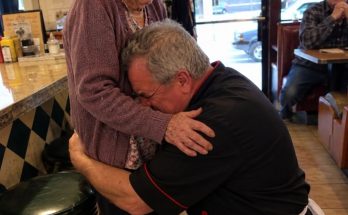
[PART 1]: “You stole from your own father’s children.” The entire room went silent. My uncle Raymond’s face lost its smug color as Grandma Eleanor gripped the arms of her wheelchair and forced herself upright. For months, she had communicated only through nods and weak smiles, but now her voice cut across the Christmas dining room with startling clarity.
“That money was never yours.” Raymond laughed nervously. “Mom, sit down. You’re confused.” Grandma shook her head. “No. I remember everything.” Thirty-five relatives stood frozen between the decorated tree and the long dinner table. My son, Daniel, held the empty trust statement in his trembling hands. He had turned eighteen three weeks earlier, believing the family tradition would help pay his first year of college. Instead, he had discovered that his inheritance—and everyone else’s—had been stolen. Raymond crossed his arms.
“I managed the trust for decades. I deserved compensation.” “Compensation?” I said, spreading the court-ordered records across the table. “You withdrew nearly $6,000 every month, bought the Florida house, paid its taxes, renovated the pool, and charged every Thanksgiving dinner there to the trust.” My cousins began shouting. Some had taken student loans because Raymond claimed their distributions were delayed. Others had worked two jobs, postponed college, or abandoned plans entirely. Raymond had watched them struggle while serving turkey beside a swimming pool purchased with their money. “Grandfather trusted you,” my cousin Melissa whispered. Raymond slammed his glass down.
“Your grandfather was controlling. He left me with all the responsibility and none of the reward.” Grandma reached into the blanket covering her legs and pulled out a worn envelope. “Your father knew you resented him,” she said. “That is why he gave me this.” Raymond’s expression changed. “What is that?” “A letter written one week before he died.” She handed it to me. The paper was yellowed, but Grandfather’s handwriting was unmistakable. I read aloud: “Eleanor, if Raymond ever claims the trust belongs to him, open the blue ledger in my study. It contains the true account numbers and the name of the person authorized to remove him.” Every head turned toward Raymond.
He stepped backward. “That study was cleared out years ago.” Grandma looked at him steadily. “Not the study in our old house.” Then she pointed toward the fireplace. “The study beneath this house.” No one moved. We had celebrated Christmas there for decades, never knowing Grandfather had built a hidden room below the library. Grandma reached beneath her collar and removed a small brass key. Raymond suddenly lunged forward, but Daniel stepped between them. “You’ve taken enough,” my son said. My uncle stopped, staring at the key as though it could destroy him. Grandma placed it in my palm and whispered, “Open the room. Your grandfather left proof of something far worse than theft.”.
I unlocked the library door while thirty-five relatives followed behind me. Grandma directed Daniel toward the oldest bookcase, where he found a brass plate hidden beneath a row of dusty encyclopedias. The key fit perfectly. With a heavy click, the entire shelf shifted forward, revealing a narrow staircase descending into darkness. Raymond tried to leave, THE END! THANK YOU FOR READING!