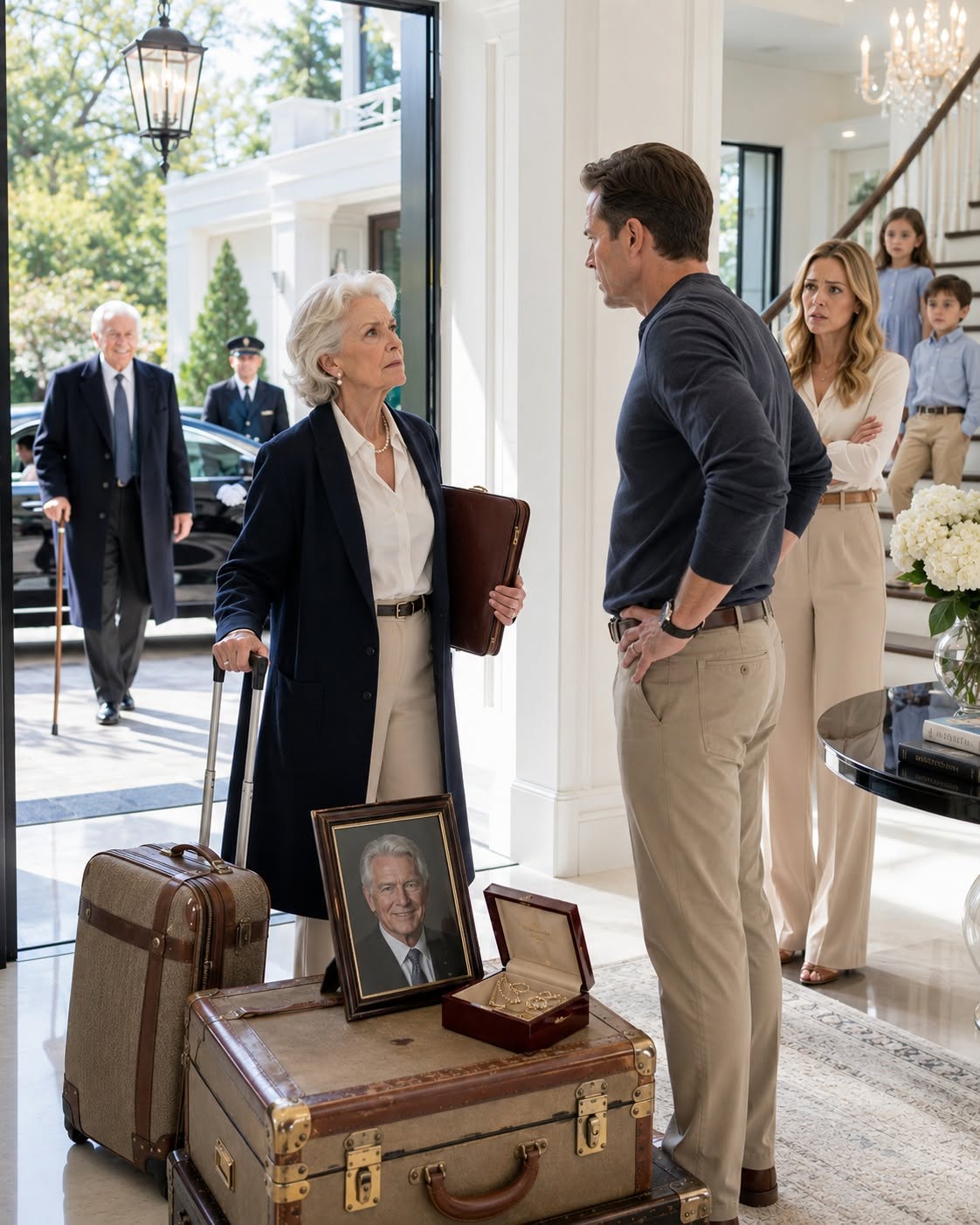
“If you refuse to move into an assisted living community, then pack your belongings and leave my house today.”
My son, Ethan, said it without raising his voice. He stood across the kitchen island holding a blue folder, looking at me as though I were no longer his mother but an inconvenience that needed to be dealt with. Beside him, my daughter-in-law, Lauren, folded her arms over her flawless white blouse, as if she were waiting for me to sign a dry-cleaning ticket instead of accepting abandonment dressed up as concern.
A brochure for an upscale retirement residence outside Austin lay on the counter. Manicured lawns, cheerful residents, kind-looking nurses, sunlit rooms. Everything appeared beautiful, spotless, and extremely expensive. A gold pen rested neatly on top of the application.
I looked first at the pot of broth simmering on the stove.
I had started the chicken and vegetables early because Noah, my youngest grandson, had woken up coughing. The carrots were still firm. The parsley had not yet been chopped. The burner was turned too high.
It hurt less to think about those things than to look at my only son telling me I no longer belonged in a home purchased with my money.
“Did you hear me, Mom?” Ethan asked.
“Yes.”
Lauren released a long sigh, as though I were a difficult child refusing to cooperate.
“Mrs. Margaret, we’ve been more than patient. You forget things, you interfere with the children’s routines, and you’re constantly underfoot—in the kitchen, in the laundry room, everywhere.”
I glanced at the neatly folded clothes beside the dining room, the school backpacks packed and waiting by the door, and the field-trip permission form I had signed that morning because they had forgotten about it.
“Everywhere doing what?”
Lauren pressed her lips into a thin line.
“That’s exactly what I mean. You turn every discussion into an argument.”
Ethan rubbed his forehead.
“Mom, please. Don’t make this more difficult than it already is.”
That sentence had followed me for three years.
Don’t make this more difficult when Lauren removed my wedding photographs from the living room.
Don’t make this more difficult when they gave the bedroom they had promised me to Lauren’s mother “just for the holidays” and moved me into the room beside the laundry area.
Don’t make this more difficult when I stopped taking clients because Lauren complained about the fabric, the needles, and the women coming to the house for dress fittings.
Don’t make this more difficult when I asked to see the bank statements connected to the four hundred thousand dollars I invested in the family company after selling my home in Savannah.
That morning, I finally understood what they had meant all along.
Don’t make this more difficult meant: disappear quietly so we never have to admit that we erased you.
My name is Margaret Hayes. For more than thirty-five years, I designed and sewed wedding gowns. Not the cold, mass-produced dresses hanging beneath department-store lights, but handmade gowns stitched from real lace and family memories, with tears hidden inside their hems. I could recognize silk by the sound it made between my fingers. I knew whether a fabric would fall beautifully before I ever placed scissors against it.
My husband, Thomas, used to say my hands could persuade pain to remain still.
He died six years before Ethan ordered me out.
Before his death, Thomas asked his closest friend and longtime business partner, Charles Whitmore, to look after me. I assumed they were discussing life insurance, bank accounts, and legal documents. Ethan handled everything after the funeral. He placed papers covered in yellow sticky notes in front of me and said:
“I’ll take care of you, Mom.”
I trusted him.
Two years later, I sold my house. Ethan and Lauren urged me to move in with them in Highland Park. They promised me a private suite on the ground floor, access to the garden, independence, and more time with my grandchildren. They also asked me to invest part of the sale proceeds in Hayes Whitmore Textiles, the company Thomas had built with Charles.
“It’s about protecting Dad’s legacy,” Ethan told me.
That sentence broke down every defense I had.
The private suite was never completed. At first, the contractor was blamed. Then visiting relatives needed the room. Eventually, Lauren turned it into a home office and fitness studio. I was moved into a narrow bedroom beside the laundry room, without a proper closet, my dresses hanging from a portable metal rack.
In the beginning, I helped because I loved them.
Later, my love became an expectation.
I watched the children, cooked meals, washed clothing, bought groceries, and entertained guests. Lauren introduced me as “Ethan’s mother, who helps out around the house.” One evening, I overheard her tell a friend that having me there was like having a live-in housekeeper, except more old-fashioned.
Ethan said nothing to correct her.
That morning, when they slid the retirement-home brochure toward me, I did not cry.
I had already spent three years crying myself empty.
I reached over and turned off the stove. The click of the burner sounded louder than any scream.
“I’ll go pack.”
Ethan released a breath of relief.
That relief wounded me more deeply than his ultimatum.
I went upstairs to the small room beside the laundry area and packed my clothes, a photograph of Thomas, my sewing scissors, several old documents, and my mother’s wooden jewelry box into two suitcases.
When I opened the box, my hands became cold.
My grandmother’s sapphire brooch was gone.
So was the gold bracelet Thomas had given me for our twenty-fifth wedding anniversary.
Lauren appeared in the doorway.
“Are you nearly finished?”
“Where is my jewelry?”
She did not even blink.
“What jewelry?”
“The pieces that were kept in this box.”
“You’ve been misplacing quite a lot lately.”
Her answer came too quickly.
That was when I understood they did not merely want me out of the house. They wanted me to leave appearing confused, diminished, and simple to erase.
I picked up my phone and typed a message.
Charles, you once told me that if I ever needed an open door, I should call you. Is that offer still good?
His reply arrived in less than a minute.
Always. Where are you?
An hour later, a black SUV driven by a chauffeur stopped in front of the house.
Ethan opened the door, apparently expecting a taxi.
But when he saw Charles Whitmore step out—the most powerful man in the company Ethan constantly boasted about managing—the confidence disappeared from his face.
And when Charles took my suitcase and said, “I’ve come for Margaret. Since she is no longer welcome here,” Ethan realized the real catastrophe had only just arrived at his door.
Charles did not raise his voice.
He had no reason to.
At seventy-three, he walked carefully because of an old knee injury, relying on a dark walnut cane. Yet he carried the kind of authority that entered a room before he did and never asked anyone’s permission to remain.
Lauren’s posture stiffened.
Ethan attempted a smile.
“Charles, this is a private family matter.”
“Then it’s unfortunate that you forced your mother to seek help from someone outside the family,” Charles replied.
Lauren stepped forward.
“We are only trying to do what is best for Margaret. She is no longer capable of living independently.”
I turned toward her.
“That’s interesting. Three hours ago, I was capable of cooking, washing sheets, looking after a sick Noah, and collecting Lily from dance class.”
Silence split the foyer.
My grandchildren stood on the staircase.
Lily, who was nine, was crying without making a sound. Noah clutched a plastic dinosaur against his chest.
I walked toward them.
“I’m not saying goodbye to either of you.”
“Are you leaving because of me, Grandma?” Lily asked.
Something inside me cracked.
“No, sweetheart. I’m leaving because grown-ups sometimes mistake a large house for a generous heart.”
Ethan lowered his eyes.
I climbed into Charles’s SUV without another argument. As we drove away, I watched the front of the house disappear behind the darkened windows.
For years, I believed that leaving would mean I had lost.
But that afternoon, for the first time, breathing did not feel like something I needed permission to do.
Charles brought me to his apartment in Chicago, overlooking Lincoln Park. It was spacious and peaceful, with tall windows and the smell of freshly brewed coffee. His housekeeper, Evelyn, greeted me as though they had been waiting for me all day.
“You may stay as long as you need,” Charles told me.
“I don’t want to become dependent on anyone.”
“Giving you a safe place does not give me ownership over your life, Margaret.”
No one had spoken to me that way in years.
That evening, we ate chicken noodle soup and grilled cheese sandwiches. Simple food that made no attempt to impress anyone but still offered warmth.
We spoke about Thomas, the company’s earliest years, the cotton shipments that came from North Carolina, and the nights I worked at my sewing machine while Thomas and Charles reviewed hotel supply orders at the dining room table.
Then Charles became quiet.
“Margaret, has Ethan been giving you financial reports regarding your ownership shares?”
I looked up.
“My shares?”
Charles’s expression shifted.
He went into his study and returned carrying a leather portfolio. He opened it on the table.
Inside was Thomas’s original succession plan.
Forty percent of Hayes Whitmore Textiles had been placed into a trust for my benefit.
Voting rights.
Quarterly dividend payments.
Independent access to the company’s financial records.
I read the page three times.
“Ethan told me everything had been transferred into a family partnership.”
“Only if you knowingly approved a legally valid transfer.”
“I signed documents after Thomas’s funeral. Ethan told me they were related to taxes.”
“Did you have an attorney representing only you?”
“No.”
“Did anyone explain that you might be surrendering control of your ownership?”
“Never.”
I went to retrieve the folder I had packed in my suitcase. Charles spread the documents across the table.
Several signatures were genuinely mine.
Others looked close, but they were not.
The loop in the M was wrong. The final stroke in Hayes was missing—the same stroke I had used since I first learned cursive.
“I never signed this,” I said.
The following morning, Charles’s attorney, Rebecca Sloan, arrived.
She reviewed each page without changing expression. Her questions were exact, unsentimental, and necessary. She requested bank statements, company ledgers, trust records, wire-transfer histories, and notarized documents.
“Do not confront your son yet,” she warned me. “We’re going to sew this story together using evidence, not emotion.”
Two weeks later, the truth began to unfold.
My shares had generated more than three million six hundred thousand dollars in dividends since Thomas died.
I had received only a modest monthly payment.
The remaining funds had been redirected into a management corporation controlled by Ethan.
Some of the money financed an expansion of the manufacturing plant.
Some purchased the Highland Park house.
Some paid personal expenses.
The four hundred thousand dollars I invested after selling my home had not been recorded as preferred equity. Instead, it had been listed as a “voluntary family contribution with no repayment requirement.”
Nausea rose into my throat.
But Rebecca had not finished.
“We also investigated the missing jewelry.”
She placed two additional documents before me.
My grandmother’s sapphire brooch had been sold eleven months earlier through an upscale jewelry broker in Manhattan.
The identification used in the transaction belonged to Lauren.
Thomas’s anniversary bracelet had been sold as well.
Both payments had been deposited into Lauren’s private bank account.
And that same account was being used to pay rent on an apartment in SoHo leased under the name of a marketing consultant named Ryan Cole.
Charles closed his eyes.
I said nothing.
Because in that instant, I realized Lauren had not wanted my bedroom so she could create a study area for Lily.
She needed me gone before I discovered that my family had used my savings, my name, my jewelry, and my silence to construct an enormous lie.
And the worst truth was not contained in those documents.
It was waiting inside the company’s boardroom.
The meeting was held at ten o’clock on a Thursday morning in the main conference room of Hayes Whitmore Textiles.
It was the same company where Thomas had begun by carrying bolts of fabric through a warehouse and eventually signed supply contracts with luxury hotels throughout the country.
The room smelled of polished walnut, expensive coffee, and newly awakened fear.
Three black folders rested on the table beside an open laptop and a small box filled with certified copies.
I sat beside Rebecca.
Charles was seated on my left.
Also present were the company’s outside counsel, an independent forensic accountant, and two directors from the board.
Ethan arrived first.
Dark circles shadowed his eyes. His navy suit, usually tailored to perfection, seemed to hang loosely from his shoulders.
Lauren entered behind him wearing a beige dress and dark sunglasses pushed up into her hair. She carried the flawless expression of a woman who believed humiliation was something that only happened to other people.
When she noticed the folders, she stopped walking.
“What is this?” Ethan asked.
“A formal review of your mother’s ownership and property rights,” Rebecca answered.
“I want to speak with her privately.”
“No,” I said.
My voice sounded calm.
Ethan looked at me as though he could not understand that particular word coming from my mouth.
“Mom…”
“When you ordered me out of your home, you did it in front of your wife with a retirement-home application sitting on the kitchen counter. Today, we will speak in front of every person who needs to hear the truth.”
Lauren gave a brief, dismissive laugh.
“This is ridiculous. Margaret is confused.”
Rebecca opened the first folder.
“Then clearing up the misunderstanding should be simple.”
She began with the trust.
She explained the forty-percent ownership Thomas had left to me, my voting rights, my entitlement to quarterly dividends, the requests for financial information that had been ignored, and the transfer documents bearing suspicious signatures.
Ethan’s face lost its color.
“Dad wanted the company protected.”
“Your father created a trust to protect your mother,” Charles said. “He did not authorize you to deceive her.”
“I planned to correct everything,” Ethan muttered.
My chest tightened.
“When? After convincing everyone I was a burden? After placing me in assisted living so I would stop asking questions?”
“That wasn’t what happened.”
“Then explain what happened.”
Ethan opened his mouth.
Nothing came out.
The accountant projected a spreadsheet onto the wall.
Dividends generated.
Payments actually received by me.
Funds diverted into Ethan’s management company.
Mortgage payments.
Credit-card bills.
Vacations.
Private-school tuition.
Renovations.
Personal purchases.
Three million six hundred thousand dollars.
The number felt too large to belong inside a single room.
Lauren leaned toward the table.
“The company needed cash. Ethan was forced to make difficult decisions.”
The accountant changed the screen.
“The company also paid invoices submitted by Cole Brand Consulting despite receiving inadequate documentation of services. Total payments amounted to five hundred twenty thousand dollars over three years.”
Ethan frowned.
“Ryan did legitimate work for the business.”
“Did you personally review the campaign reports?” the outside attorney asked.
“Lauren said she supervised him.”
Every face turned toward Lauren.
Her jaw tightened.
“I handled branding, events, and media relations. I should not have to justify every meal or meeting.”
Rebecca placed another folder on the table.
“We are not discussing meals.”
The folder contained the lease for the SoHo apartment.
Rental receipts.
Electronic transfers from the account holding the proceeds from my jewelry.
Photographs of the building’s entrance.
Hotel bills.
Printed text messages that required no explanation.
Ethan picked up one of the pages.
“What is this?”
Lauren reached for it, but Rebecca pulled the document away.
“Evidence of payments made using funds connected to the company and Mrs. Hayes’s personal property.”
Ethan read Ryan Cole’s name several times.
Then he looked at his wife.
“You rented an apartment?”
“It was used for business meetings.”
“With Ryan?”
“Don’t create a scene.”
It was strange to hear those words come from her.
The same command in a different outfit.
Don’t make this more difficult.
Don’t create a scene.
Don’t ask.
Don’t look.
Don’t remember what belongs to you.
I opened my handbag and removed an old photograph.
It showed my grandmother wearing the sapphire brooch at Ethan’s christening.
I placed it in front of Lauren.
“That brooch was inside my jewelry box.”
She lifted her chin.
“You never wore it.”
“It did not belong to you.”
“I intended to replace it.”
“What can replace a grandmother?”
No one answered.
Ethan lowered his gaze to the jeweler’s sales documents.
His hands began to tremble.
“Lauren…”
She stood abruptly.
“I will not remain here while everyone attacks me for trying to protect my family.”
Charles spoke for the first time in several minutes.
“Protecting a family does not involve selling a widow’s possessions.”
Lauren snatched up her purse.
“Ethan, we’re leaving.”
He remained seated.
“How long?” he asked.
“What are you talking about?”
“You and Ryan.”
Lauren glanced toward the door.