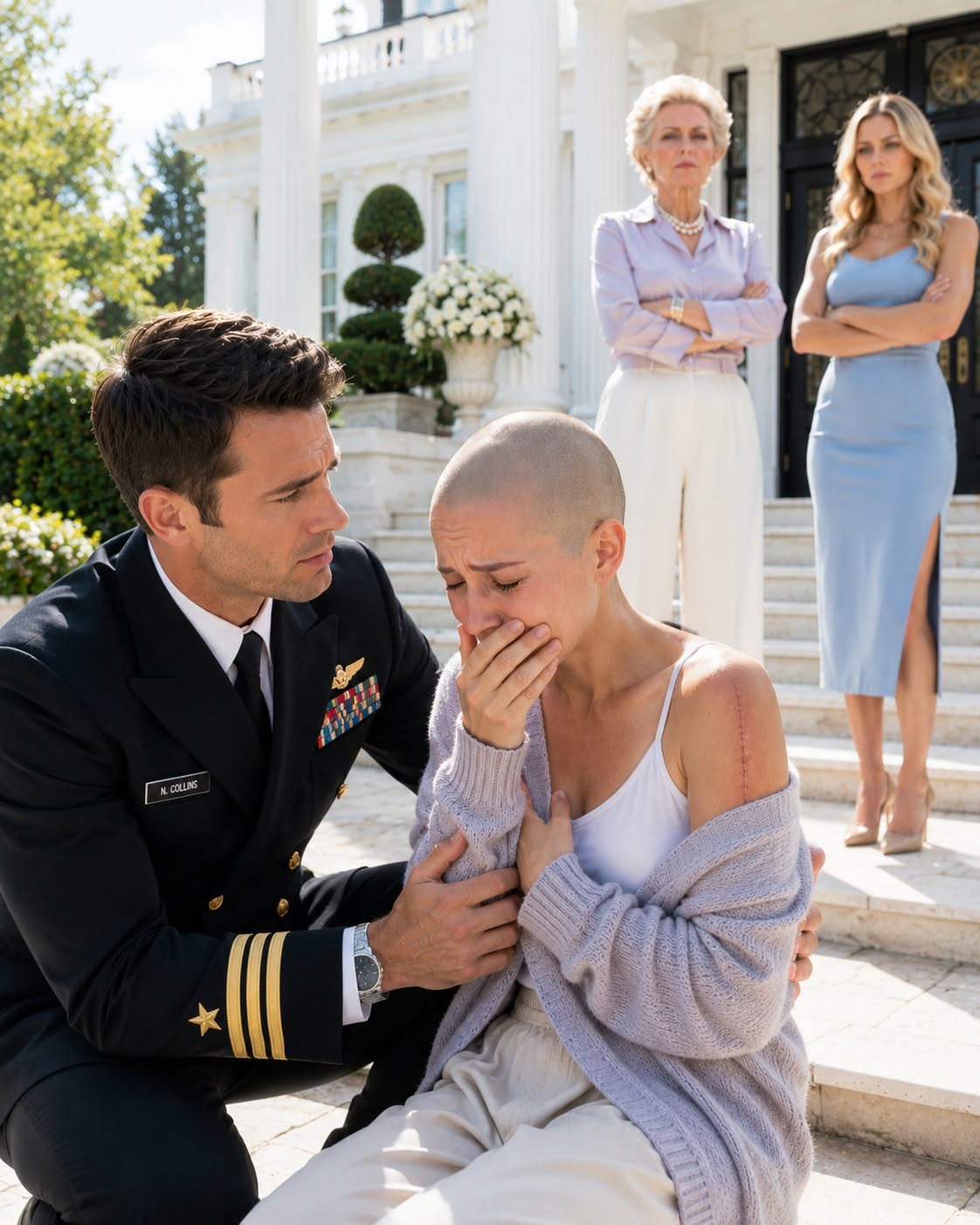
Diane’s laughter made the room feel colder than any winter I had survived during deployment.
“You honestly believe the money is the reason Laura stayed?” she asked. “You still don’t understand your own wife.”
Laura tightened her grip on the nurse’s arm.
“Diane, enough.”
“No,” I said. “Let her finish.”
My phone vibrated again.
COME TO MERCY GENERAL HOSPITAL. ALONE. ASK FOR ROBERT HALE.
The name awakened something I had buried years ago.
Robert Hale had been my father.
At least, that was the name written beneath an old photograph Diane had hidden in a drawer when I was a boy. She had told Melissa and me that he abandoned us when I was eight years old, emptied the family savings, and ran away with another woman.
For twenty-six years, I had believed he was either dead or too ashamed to return.
“You recognize that name,” Laura whispered.
I stared at her.
“So do you.”
Tears filled her eyes.
“I wanted to tell you.”
Diane smiled as if she had just won.
“There it is. Your perfect wife has been lying to you.”
I turned toward Karen.
“Keep Diane and Melissa here.”
Then I faced Laura.
“You’re coming with me.”
The nurse objected, insisting that Laura needed to be examined immediately, so we traveled together in the second SUV. During the drive, she sat beside me with her hands clasped tightly in her lap.
“Robert paid for my biopsy,” she finally said.
My jaw hardened.
“How did he find you?”
“He came to the house six months ago.”
“And you kept that from me?”
“Your mother threatened to destroy every medical record I had and report me for stealing from her.”
“That wouldn’t have frightened you before.”
“No,” Laura said. “But what Robert showed me did.”
She reached into her purse and removed an old envelope.
Inside was a photograph of a younger Diane standing beside a man dressed in an Army officer’s uniform. Faded handwriting on the back read:
For Nathan—when it is finally safe for him to know the truth.
My hands started trembling.
“Safe from what?”
Laura looked toward the hospital entrance.
“From your mother.”
Robert Hale was waiting inside a private consultation room.
He was thinner than the man in the photograph, and nearly all his hair had turned silver, but I recognized my own eyes in his face.
He rose when I walked in.
“Nathan.”
I had imagined that meeting for most of my life. In some versions, I punched him. In others, I refused to speak and walked away.
Instead, I asked only one question.
“Why?”
His shoulders sagged.
“Because your mother threatened to send me to prison for something I never did.”
He placed a dented metal case on the table.
Inside were military service records, bank statements, letters addressed to me, and photographs collected over twenty-six years.
Every birthday.
Every graduation.
My enlistment ceremony.
My wedding.
He had watched my life from a distance.
Robert had served as a logistics officer in the Army. Before he disappeared, he discovered that Diane and her foster brother were stealing money from a housing fund intended for veterans. When he confronted them, Diane fabricated documents that made it appear as though Robert had taken the money.
“She gave me a choice,” he said. “Disappear, or she would testify that I abused her and stole from wounded veterans. She promised to make sure you and Melissa grew up believing I was a criminal.”
“So you abandoned us anyway.”
“Yes.”
The answer came immediately, heavy with shame.
“I was a coward.”
Laura touched my arm.
Robert continued.
“I sent money every month. Diane kept every payment but returned all my letters. When you enlisted, I tried contacting you again. She threatened to revive the accusations and destroy your security clearance.”
I opened one of the envelopes.
It had never been unsealed.
Inside was a birthday card written for my twelfth birthday.
I am proud of you, even when I am not allowed to stand beside you.
My vision went blurry.
Then Robert placed one final document in front of me.
It described a trust account created in my name when I was a child.
The balance exceeded $1.8 million.
Diane had been withdrawing from it for decades.
“The money you sent home from overseas was not her greatest theft,” Robert said. “She stole the life I tried to provide for you.”
Before I could respond, the consultation-room door swung open.
Karen stood in the doorway, pale and breathing hard.
“Nathan, something has happened.”
“What?”
“Diane is gone.”
Beside me, Robert closed the metal case.
Karen’s face tightened.
“And she took Laura’s original medical records.”
The hallway seemed to spin around me.
“How did she get out?”
“Through the hospital kitchen,” Karen replied. “Melissa distracted one of the officers by pretending to collapse.”
“Where is Melissa?”
“Still at the house. She is demanding a lawyer.”
Laura pressed a hand against her chest.
“My pathology report was inside that file.”
The nurse helped her into a wheelchair.
“We can perform the tests again.”
Laura’s face filled with fear.
“You don’t understand. Diane told me she changed something in the report.”
Robert moved closer.
“What did she alter?”
“I don’t know.”
A physician arrived and insisted that Laura be admitted immediately. I wanted to remain with her, but she seized my hand.
“Find the file.”
“I’m not leaving you.”
“You already found me,” she whispered. “Now finish what you started.”
I kissed her forehead and followed Karen outside.
Mark had tracked Diane’s vehicle toward the old state highway. Her credit cards and accounts had been frozen, but she still possessed jewelry, cash, and documents valuable enough to trade for help.
We divided into separate teams.
Robert rode with me.
For several miles, neither of us spoke.
Eventually, he said, “You do not owe me forgiveness.”
“I’m aware of that.”
“But I owe you the truth.”
“You owe me twenty-six years.”
His expression tightened.
“Yes.”
I glanced toward him.
“Why did you help Laura?”
“Because she was the first person willing to believe me.”
He explained that Laura discovered his name while searching through Diane’s documents. She contacted him secretly, hoping he could explain where the money I sent from deployment had gone.
Instead, Robert revealed the trust account and the original fraud.
When Laura became ill, he paid for her biopsy through an independent medical clinic.
“She stayed in that house to gather evidence,” Robert said. “She could have escaped, but she believed Diane would destroy the financial records and disappear.”
My anger shifted direction.
Laura had not stayed because she lacked the courage to leave.
She stayed because she was protecting a future she feared she would not survive long enough to see.
Mark called.
Diane’s SUV had been located beside an abandoned roadside motel.
We arrived only minutes later.
The motel-room door was standing open.
Every drawer had been emptied. Papers had been burned in the sink. Laura’s medical file was scattered across the bed.
Diane was gone.
Karen studied the documents.
“Several pages are missing.”
Robert lifted a partially burned sheet from the sink.
“This appears to be a pathology summary.”
The lower section had been destroyed, but one sentence remained readable:
Specimen identification does not correspond with patient record.
I stared at it.
“What does that mean?”
“It suggests the tissue sample may not have belonged to Laura,” Karen said.
My heart seemed to stop.
“Are you telling me she may not have cancer?”
“I’m saying someone may have substituted another sample.”
Mark noticed a security camera positioned above the motel office. The manager resisted at first but eventually allowed us to review the footage.
Diane had entered the room alone.
Twenty minutes later, another vehicle pulled into the lot.
A man stepped out wearing a hospital maintenance uniform.
I recognized him immediately.
He was the same man shown in the photograph sent to my phone.
But Robert stiffened beside me.
“That man is not a maintenance employee.”
“Who is he?”
Robert leaned closer to the monitor.
“Dr. Victor Shaw. Diane’s foster brother.”
The uncle I had been told died before I was born.
The same man who had helped Diane steal from the veterans’ housing program.
The video showed Victor handing Diane a passport and a thick envelope.
Then he turned his face toward the camera and smiled.
My phone rang.
Unknown number.
I answered.
A man said, “Your wife never had the illness everyone believes she has.”
“Where is Diane?”
“You should ask a more intelligent question.”
My fingers tightened around the phone.
“What did you do to Laura?”
He laughed quietly.
“We needed her frightened, weakened, and silent. The diagnosis accomplished the first two. Your mother took care of the last one.”
The call ended.
Karen stared at me.
“What did he say?”
I struggled to speak.
“The diagnosis was part of their plan.”
Robert stepped away from the monitor, looking physically ill.
Then Mark’s phone rang.
He listened for several moments before turning toward me.
“The hospital completed Laura’s emergency scan.”
“What did they find?”
“There is a mass.”
Every trace of hope left the room.
Mark swallowed.
“But the specialist believes it might not be cancerous.”
I returned to Mercy General shortly before midnight.
Laura lay beneath a white blanket, surrounded by machines blinking gently in the darkened room. Against the hospital bed, she looked impossibly fragile.
A specialist named Dr. Rachel Morgan stood beside the window.
“We repeated the imaging and examined the pathology records,” she explained. “Your wife does have a tumor, but the original biopsy slides are incompatible with her blood type.”
Laura stared at her.
“Then whose tissue was tested?”
“We do not know.”
“Do I have cancer?”
Dr. Morgan chose her words carefully.
“We believe the growth may be a benign phyllodes tumor. These tumors can enlarge rapidly and become dangerous, but they are treatable. Surgery is necessary before we can be certain.”
Laura covered her mouth.
I sat beside her and took her hand.
For months, she had lived beneath a death sentence deliberately manufactured by strangers.
Dr. Morgan continued.
“Her extreme weight loss appears to be caused partly by malnutrition, chronic stress, and severe untreated anemia.”
My relief turned instantly into fury.
“They starved her.”
Laura closed her eyes.
“Diane controlled the food. She said there was no reason to waste expensive groceries on someone who was already sick.”
I lowered my head because I no longer trusted what my face might reveal.
Dr. Morgan scheduled surgery for the following morning.
Before she left, she added, “There is another issue. The fraudulent biopsy report came from a private laboratory owned by Victor Shaw.”
The same name had surfaced again.
Karen arrived with Mark and Robert shortly after sunrise.
They had uncovered evidence of a much larger operation.
For decades, Diane and Victor had stolen from military families through false real-estate investments, manipulated medical claims, and forged compensation paperwork. My trust fund had been their first major theft, but it was far from their last.
When I announced the fake military compensation package, Diane believed she could exploit my identity to access another fortune.
Laura’s false diagnosis had served an even darker objective.
“She found the trust documents,” Karen explained. “Victor fabricated a malignant biopsy result to terrify her. Diane isolated her, hoping she would either leave or become too weak to testify.”
Laura stared at the ceiling.
“They wanted me gone.”
“Yes.”
“Why didn’t they simply kill me?”
No one answered.
Because every person in that room understood.
Their plan had been designed to look natural.
A sick woman.
A grieving husband.
Missing records.
The perfect silence.
Then Melissa requested permission to see us.
She entered the room under supervision, wearing no jewelry, no makeup, and none of the arrogance she had once worn like armor.
Her eyes were swollen.
“I know where Mom is headed,” she said.
I stood.
“Why should I believe anything you say?”
“Because Victor will kill her after she gives him the trust documents.”
Robert’s expression hardened.
“Where are they going?”
Melissa looked at Laura.
“I’m sorry.”
Laura said nothing.
Melissa began to cry.
She admitted that Diane had controlled her for years through money, fear, and dependency. It did not excuse her cruelty, but it explained why she had monitored Laura’s calls and movements.
“She told me Nathan would abandon us if Laura turned him against us,” Melissa whispered. “She said everything we had would disappear.”
“You watched my wife starve,” I said.
“I know.”
“You ridiculed her illness.”
“I know.”
“You helped keep her imprisoned.”
Melissa lowered her head.
“I know.”
Laura finally spoke.
“Where is Diane?”
“At an abandoned military supply depot outside Fort Redstone. Victor stores records there.”
Mark and Karen exchanged a glance.
Fort Redstone had been closed for twelve years.
Melissa handed us an old key and a handwritten access code.
“Mom ordered me to meet them tonight,” she said. “She believes I still have the transfer certificate connected to the trust.”
“Do you?”
Melissa reached into her coat and removed a sealed envelope.
“I took it from her bedroom before the investigators arrived.”
For the first time, I saw something in my sister other than selfishness.
Fear.
And perhaps the earliest beginning of shame.
The plan was straightforward.
Melissa would enter the depot wearing a concealed transmitter. Mark and federal officers would surround the property. Robert insisted on joining them because Victor had framed him decades earlier.
I wanted to go as well.
Laura refused to allow it.
“You need to be here when I wake up.”
I looked from my wife toward the door.
The soldier inside me wanted the mission.
The husband inside me understood where I belonged.
I kissed her hand.
“I’m staying here.”
At 2:14 that afternoon, the surgical team took Laura away.
At 2:37, Melissa entered the abandoned depot.
Mark’s voice came through Karen’s phone from the command vehicle.
“We have visual confirmation. Diane and Victor are inside.”
Then Melissa’s voice came through the transmitter.
“I brought the certificate.”
Victor answered, “Good girl.”
A metal door slammed.
Static burst from the speaker.
Then Diane screamed.
The connection died.
For twenty-three minutes, we heard nothing.
I paced outside the surgical wing while Karen repeatedly tried to reach Mark. Robert had accompanied the tactical unit, leaving me trapped between two battles I had no power to control.
Finally, Mark called.
“Melissa is alive.”
“And Diane?”
“Injured, but conscious.”
“Victor?”
There was a pause.
“He escaped.”
The operation had collapsed almost immediately.
Victor discovered Melissa’s transmitter and attacked Diane when she attempted to trade information for protection. He escaped through an underground maintenance tunnel before officers entered the building.
But Diane had been captured.
And so had the records.
Hundreds of boxes.
Thousands of forged medical claims, stolen military identities, and fraudulent property transfers.
The criminal network was not worth two million dollars. It exceeded forty million.
The recovered evidence finally cleared Robert of the crimes Diane and Victor had pinned on him.
But Victor remained free.
At 5:06 p.m., Dr. Morgan came out of the operating room.
“The tumor has been removed successfully.”
My legs almost collapsed.
“Was it cancer?”
“The preliminary analysis found no malignancy.”
I covered my face.
For the first time since returning home, I cried without trying to hide it.
Laura had been terrorized, starved, and humiliated because of a fabricated diagnosis.
But she was alive.
She still had a future.
When she woke that evening, the first thing she asked was, “Did you stay?”
I pressed my mouth against her fingers.
“I never left.”
Three days later, Diane asked to speak with us from her hospital room.
Laura refused to go.
I chose to.
Diane lay handcuffed to the bed with one shoulder wrapped in bandages. Without her jewelry, makeup, and carefully arranged hair, she looked older than I had ever seen her.
She studied me for a long time.
“You look like him now.”
“Robert?”
She nodded.
“I always hated that.”
“Why?”
“Because he was decent.”
The response surprised me.
She looked toward the window.
“Decent people make cruel people feel exposed.”
I waited.
Diane admitted that she had resented Robert’s integrity after marrying him. He refused to exploit his military position to make them wealthy. When Victor began stealing from the veterans’ housing fund, Diane joined him because she wanted the life she believed she deserved.
Robert eventually uncovered the scheme.
So she destroyed his reputation before he could expose theirs.
“Did you ever love us?” I asked.
She looked back at me.
“In the only way I knew how.”
“That is not an answer.”
“It is the only answer I have.”
Then she disclosed the last secret.
Melissa was not Robert’s biological daughter.
Victor was her father.
The room seemed to tilt.
“Your brother?”
Diane closed her eyes.
“Victor was not related to me by blood. We grew up in the same foster home.”
The distinction did very little to make the truth less disturbing.
Victor stayed close because Melissa gave him leverage over Diane. He manipulated both of them while expanding the fraud operation.
“Why reveal this now?”
“Because he will come after Melissa.”
Diane recited a phone number she had memorized decades earlier.
“He uses another identity. Dr. Nolan Shaw. He runs a private clinic near the Canadian border.”
Fairbanks.
The city where I had served during one of my cold-weather training assignments.
The place where some of my military-transfer records had been processed.
Victor had not recently discovered my family.
He had been tracking me for years.
Karen traced the clinic.
It existed.
So did a private flight scheduled to depart the next morning.
Federal authorities acted immediately.
Victor was arrested at the airfield carrying three passports, large amounts of cash, and a list of military personnel whose families he intended to target next.
The nightmare was finished.
Or so we believed.
Two weeks later, Laura left the hospital.
She did not return to Diane’s house.
Instead, we moved into a small furnished apartment provided through a military-family assistance program.
Robert stood in the doorway holding flowers.
Laura smiled at him.
I did not.
Forgiveness was not something I could grant in a single moment.
But I stepped aside and allowed him to come inside.
That was the beginning.
Melissa remained in custody while prosecutors determined whether her cooperation justified a reduced sentence.
Diane and Victor faced the possibility of spending the rest of their lives in prison.
The stolen properties were frozen.
My trust account was restored.
The fake compensation package I invented no longer mattered.
Then Karen arrived carrying a sealed federal envelope.
“You should sit down before opening this,” she said.
I broke the seal.
Inside was an official notice regarding the recovered forty-million-dollar fraud network.
Because my report exposed the operation and protected hundreds of military households, I qualified for a federal whistleblower award.
The amount listed at the bottom was $6.4 million.
Laura stared at the number.
I started laughing.
Somehow, after everything, the imaginary fortune had become real.
But Karen did not smile.
“There is a condition,” she said.
My laughter stopped.
“What condition?”
“The payment cannot be processed until one unresolved ownership dispute is settled.”
“Who filed the dispute?”
Karen placed a birth certificate on the table.
The claimant was Melissa Carter.
Melissa was not making a claim against the federal award.
She was claiming a share of the original trust.
According to the documents recovered from Fort Redstone, Robert had created the account for both children he believed belonged to him.
Even after discovering that Melissa was not biologically his, he had never removed her as a beneficiary.
I found Robert sitting alone in the apartment courtyard.
“You knew?”
He nodded.
“Not until Melissa was six.”
“And you kept her in the trust?”
“She was still my daughter in every way that mattered to me.”
“She helped Diane destroy Laura.”
“Yes.”
“And you still want her to inherit?”
Robert looked directly at me.
“I want a court to decide what she legally deserves. But I will not erase all the years I loved her simply because she later became someone I barely recognized.”
His answer made me angry because it held more mercy than I was capable of feeling.

