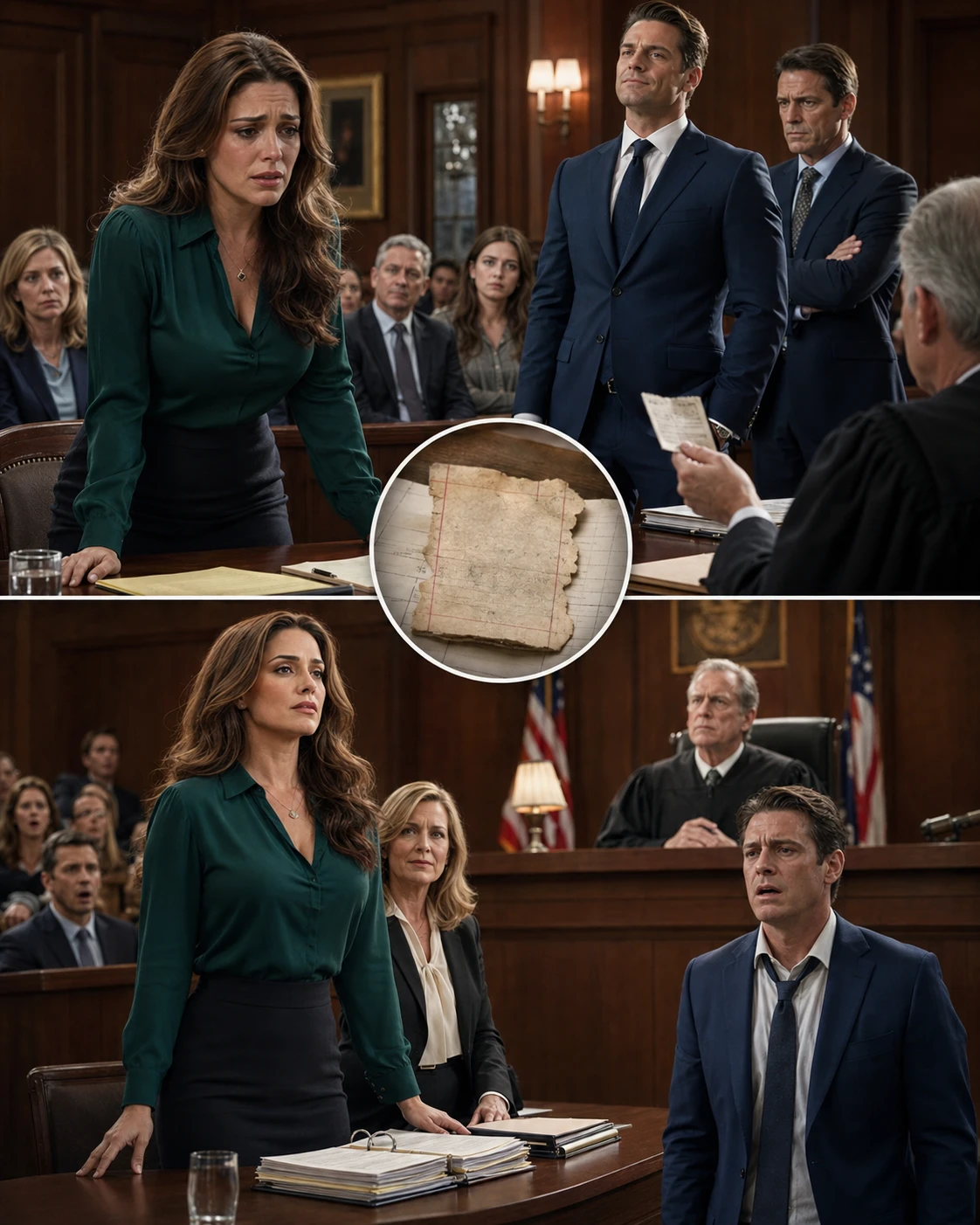
My brother visited Grandma four times in the three years I cared for her.
At her funeral, he called me a gold digger.
And two weeks later, he stood in court asking a judge to take away the farm I had sacrificed everything to keep alive.
Ryan sat across from me in a tailored navy suit, looking calm and confident. He had already told our entire family that I isolated Grandma, controlled her medication, and pressured her into changing her will.
According to him, I hadn’t given up my career to care for her.
I had simply made an investment and waited for her to die.
He had said those exact words beside her casket.
“You didn’t stay because you loved her,” he told me loudly enough for everyone to hear. “You stayed for the payout.”
My aunt looked away. Two cousins stopped speaking to me.
The cruelest part was that I didn’t even know Grandma had changed her will.
For three years, I cooked her meals, changed her bandages, managed her doctor appointments, and slept with my bedroom door open in case she called for me during the night.
Ryan always had an excuse for not visiting.
Work was busy.
Flights were expensive.
His children had activities.
But after Grandma died, he arrived before the flowers did.
Her new will left me the farmhouse, the orchard, and all eighty-four acres of Bennett Farm. Ryan received ten thousand dollars and one strange sentence:
“Any benefits Ryan has already received from my property must be fully accounted for.”
Ryan claimed I had planted those words in her mind.
Then his lawyer played three videos.
In the first, Grandma called me by my mother’s name.
In the second, she couldn’t remember whether it was Tuesday or Wednesday.
In the third, she asked when Grandpa would be home, even though he had been dead for eleven years.
The clips were only a few seconds long, but the silence afterward felt endless.
Ryan leaned back and smiled.
His lawyer asked the judge to freeze the estate, remove me from the farm, and appoint an outside administrator until the will could be declared invalid.
If the judge agreed, I could lose my home before the case even reached trial.
Then Ryan’s lawyer submitted a statement from Melissa, the part-time caregiver who had helped twice a week.
She claimed I kept Grandma’s phone, screened her visitors, sorted her mail, and refused to let Ryan speak to her alone.
Each accusation contained just enough truth to sound believable.
I did keep the phone when Grandma slept.
I did turn visitors away when she had an infection.
I did sort out advertisements before giving her the important mail.
Ryan had taken ordinary acts of care and turned them into evidence of control.
Then my attorney placed a small plastic evidence bag on the table.
Inside was a faded library receipt found in the pocket of Grandma’s blue coat.
Twenty printed pages.
Fifteen cents each.
Three dollars total.
The receipt was dated three days before Grandma first met with the attorney who prepared her new will.
Ryan laughed.
“A printing receipt doesn’t prove she understood anything.”
The judge studied it for several seconds.
Then she looked directly at him.
“Mr. Bennett, your petition says your grandmother could not complete simple tasks without your sister’s assistance.”
“That’s correct,” Ryan said.
The judge raised the receipt.
“Then explain why she spent ninety-seven minutes alone at a public computer researching the eastern twelve acres of her farm.”
Ryan stopped smiling.
The judge turned another page.
“The same twelve acres you transferred while acting under her power of attorney.”
Ryan leaned toward his lawyer.
His voice was barely a whisper, but I heard every word.
“They can’t have the pages.”
The courtroom went silent.
Ryan’s lawyer immediately stood. “A library receipt doesn’t prove what she printed—or that she understood any of it.”
Then Maya Patel, the librarian, was called to testify.
She remembered Grandma clearly.
Grandma had arrived alone on the senior shuttle with a property number written on a folded piece of paper. She asked how to access county land records, then spent nearly two hours reading every page before printing anything.
Claire wasn’t there.
No one was coaching her.
And before Grandma left, she asked Maya one question:
“If someone uses your name to sell your land to a company he controls, is that still a real sale?”
Ryan’s face tightened.
But he recovered quickly.
He claimed Grandma had approved the sale and later forgotten about it. According to him, I had taken advantage of her confusion and convinced her he had stolen the land.
The judge ordered both sides to locate the twenty printed pages.
We searched Grandma’s desk, her bedroom, the farmhouse safe, and every box in the attic.
They were gone.
Only the three-dollar receipt remained.
Ryan smiled again.
“Because there was nothing on those pages,” he said.
But on the back of the receipt, Grandma had written four characters:
E.B. 214
Maya recognized the code.
It belonged to a sealed envelope Grandma had placed in the library’s historical archive months before she died.
The release instructions said:
Give this to my attorney only if Ryan accuses Claire of making me change my will.
When the envelope was opened, the first page showed Ryan’s signature on the land transfer.
On the next page, Grandma had circled a bank account and written:
Follow where the money went.
PART 3 — THE ENVELOPE
The words in Grandma’s handwriting made my hands go cold.
**Follow where the money went.**
Margaret Ellis, Grandma’s attorney, would not let anyone touch the documents until the court clerk photographed and numbered every page. Inside the envelope were the deed for the eastern twelve acres, a county parcel map, records for North Ridge Holdings, and several pages of Grandma’s handwritten notes.
One sentence stood out immediately: **Claire does not know. Keep her out until I understand.**
Ryan’s lawyer objected before Margaret could read more. He argued that Grandma’s notes proved nothing except that she had become suspicious and confused. Then Ryan produced a document of his own.
It was a short note signed by Grandma eighteen months earlier: **Ryan may handle the east field transaction.**
For a moment, my stomach dropped. The signature looked real, and Margaret confirmed that it appeared to be Grandma’s.
Ryan leaned back in his chair. “She asked me to sell the land. Later, she forgot. Claire filled in the blanks.”
His story had changed, but not enough for the judge to dismiss it. Ryan was no longer denying the transaction. He was claiming Grandma had approved it and then lost the ability to remember.
Margaret pointed out that the note only allowed Ryan to handle a possible sale. It did not authorize him to transfer the property to a company connected to himself, conceal the buyer’s identity, or personally profit from the deal.
“You haven’t shown that my client owned North Ridge,” Ryan’s attorney replied.
That was true. The public records listed Ryan’s longtime friend, Peter Sloan, as the company’s manager. Ryan’s name appeared nowhere in the ownership documents.
Judge Halbrook ordered emergency discovery into North Ridge, the land transfer, and the original video files Ryan had presented. Until the investigation was complete, the farm would remain frozen under temporary supervision.
As we left the courtroom, Ryan stepped close enough that only I could hear him.
“You should have taken the house and left the rest alone.”
I looked directly at him. “Grandma was the one who didn’t leave it alone.”
His expression changed for half a second.
That was when I understood the envelope had not shown us everything.
It had only shown us where to start.
—
## PART 4 — THE BATTLE OVER GRANDMA’S MIND
Ryan’s next attack was not about the land. It was about Grandma’s ability to understand what she had done.
His lawyer brought in a medical consultant who had never examined her. Using Melissa’s statement and the short videos, he claimed Grandma showed signs of cognitive decline and could have been easily influenced.
He did not say she definitely lacked legal capacity. He only needed to make the judge uncertain.
Margaret responded with testimony from the people who had actually seen Grandma during the months before she signed the will. Her doctor explained that Grandma sometimes became disoriented after taking strong pain medication, but her records contained no diagnosis of dementia.
On ordinary mornings, she knew where she was, understood conversations, and made her own choices.
Then Margaret described their first meeting.
Grandma had called the law office herself and arrived on the town’s senior shuttle. She carried a list of her assets, the names of both grandchildren, and the parcel number for the missing twelve acres.
“I asked why Claire wasn’t with her,” Margaret told the judge.
“What did she say?” my lawyer asked.
“She said, ‘Because if I leave Claire the farm, Ryan will blame her. I want this decision to belong to me.’”
Ryan’s jaw tightened.
Margaret had met with Grandma three times, always privately. During the final meeting, Grandma accurately described the farm, the orchard, her accounts, and what each grandchild would receive.
She also predicted that Ryan would challenge the will. That was why Margaret had documented every meeting and used two independent witnesses.
Ryan’s lawyer changed direction. Even if Grandma had legal capacity, he argued, I still controlled her daily life. I managed her medication, transportation, meals, and visitors, and I was the person receiving almost everything.
The facts sounded ugly when stripped of love.
Yes, Grandma depended on me. Yes, I lived on her property. Yes, I benefited from the will.
But dependence was not proof of control.
My lawyer presented messages showing every time I invited Ryan to visit, every weekend he canceled, and every time I begged him to stay with Grandma so I could rest.
His replies were almost identical: **Too busy. Maybe next month. The farm has staff.**
Then the court clerk announced that Melissa’s original phone had been recovered.
The judge had seen three short clips.
The phone contained more than two hours of video.
—
## PART 5 — WHAT THE VIDEOS REALLY SHOWED
The first full video began exactly where Ryan’s edited version began. Grandma looked at me and called me by my mother’s name.
In court, Ryan had ended the clip there.
But the original continued. Grandma blinked, touched my cheek, and said, “No, Claire. You have your mother’s eyes when you’re angry.”
Then she reminded me that her cardiology appointment had been moved to Thursday at ten.
The second clip had shown her unable to remember the day of the week. The full version revealed that Melissa had given her pain medication twenty minutes earlier.
After a brief pause, Grandma asked, “Did Ryan call the county again about my east field?”
That part had been removed.
The third video was the one that had hurt me most. Grandma asked when Grandpa would be home, even though he had been dead for eleven years.
The complete recording did not show a woman trapped in a delusion. It showed a widow staring at her husband’s photograph.
“Some mornings I forget for one second,” she said softly. “Then I remember all over again.”
No one in the courtroom moved.
Ryan had taken Grandma’s weakest moments and removed every second that showed she understood them.
My lawyer turned to Melissa. “Who asked you to send these videos?”
“Ryan said the family needed to know how bad she was getting,” Melissa answered.
“Did he tell you which clips he wanted?”
She hesitated. “Sometimes.”
Then my lawyer asked whether Ryan or any business connected to him had paid her. Melissa said no.
A subpoenaed bank statement was placed in front of her.
North Ridge Holdings had paid her twice—$2,500 after she sent the videos and $2,000 three days before she signed the affidavit accusing me of isolating Grandma. Both payments were labeled **care consultation**.
Melissa was not a consultant.
Her face lost all color. Ryan’s attorney requested a recess, but Judge Halbrook refused.
Melissa finally admitted that Ryan had offered to help with her credit card debt. He also knew she had inflated several timesheets and promised I would never find out if she told the court “what Grandma was really like.”
“I didn’t lie about everything,” Melissa said through tears. “Claire did keep the phone sometimes.”
“Yes,” I said. “When Grandma was sleeping.”
The betrayal was not that Melissa had invented a completely different household.
She had sold pieces of the real one and allowed Ryan to rearrange them.
When she stepped down, Judge Halbrook ordered North Ridge to produce its complete banking records.
Ryan whispered angrily to his attorney.
For the first time, his attorney did not answer him.
—
## PART 6 — THE MAN BEHIND NORTH RIDGE
The public records still said Peter Sloan owned North Ridge. The bank records told a different story.
Peter had deposited only $1,000 when the company was formed. The filing fees, legal bills, property survey, and appraisal had all been paid from accounts connected to Ryan.
Emails showed Ryan choosing the twelve acres, negotiating the price, and instructing Peter when to sign.
Peter was called to testify under subpoena. At first, he described Ryan as nothing more than a consultant.
Then my lawyer displayed an email in which Ryan had written: **Keep my name off the public filing until the family title is clean.**
Peter stared at the screen.
“What did he mean by ‘family title’?” Judge Halbrook asked.
“He said his grandmother owned the land, but he had authority to move it,” Peter answered.
“Move it where?”
“To North Ridge.”
“And who controlled North Ridge?”
Peter glanced at Ryan. “Ryan did.”
Whispers spread through the courtroom.
Peter admitted that he had agreed to appear as the company’s public manager because Ryan said appearing on both sides of the transaction would “look messy.” In exchange, Peter would receive ten percent of any future development profit.
Ryan’s lawyer argued that poor disclosure did not automatically prove theft. Grandma had authorized an east-field transaction, North Ridge had paid for the land, and the farm received $74,000.
The money had reached Grandma’s account. Most of it was later spent on farm debts, taxes, and medical bills.
Ryan claimed this proved the sale benefited her.
Margaret asked the questions he could not answer. Why had he selected a price far below the property’s development potential? Why had he hidden his control of the buyer? Why had he received anything beyond legitimate expenses?
When Ryan took the stand, he said the land had poor road access and uncertain zoning. North Ridge had assumed the risk, and Grandma had trusted his judgment until I turned her against him.
Then he looked at me.
“Claire wanted the whole farm. She turned one complicated sale into a crime.”
My attorney asked whether he had personally received money from North Ridge or the developer.
“No,” Ryan answered.
“Any consulting fee?”
“No.”
“Any acquisition fee?”
“No.”
He did not blink.
Then the courtroom doors opened, and a courier entered carrying financial records from Red Cedar Development.
Margaret studied the first page and slowly sat down.
Whatever she had found was not recorded in North Ridge’s books.
—
## PART 7 — GRANDMA’S FINAL STATEMENT
Before the new financial records were read, Margaret asked to present one final statement from Grandma.
Ryan’s lawyer objected, but Judge Halbrook allowed it. Margaret had prepared the memorandum during their last meeting, and Grandma had read, corrected, and signed it before two independent witnesses.
It was not a dramatic confession. It was Grandma explaining her decision in the plain, direct language I remembered.
She stated that I had never asked for the farm. I had not selected her attorney, and I did not know she was investigating Ryan.
She had deliberately kept me uninvolved because she knew Ryan would accuse me of turning her against him.
Grandma also explained why she wanted me to inherit the property.
**Claire knows the orchard. She knows the workers, the seasons, and the promises I made to neighboring families. Ryan knows its sale value.**
My throat tightened, but I kept my eyes on the table.
Then Margaret read the sentence that silenced the courtroom.
“Claire gave up three years to keep me in my home. Ryan used three months of authority to take part of that home from me.”
Ryan shook his head. “She misunderstood the deal.”
Judge Halbrook looked at him. “You will have an opportunity to explain the deal after the records are admitted.”
The Red Cedar documents showed that North Ridge had signed an option agreement for future commercial development. That agreement alone made the property far more valuable than Ryan had admitted.
But the largest hidden payment had not gone to North Ridge.
It went directly to Bennett Strategic Consulting, a company owned solely by Ryan.
The amount was **$86,000**.
The payment description read: **Acquisition and family-title facilitation fee.**
Ryan’s attorney closed his eyes.
My lawyer asked whether Ryan still denied receiving personal compensation.
Ryan called it a legitimate finder’s fee. He claimed the developer paid him for bringing the opportunity together, not for selling Grandma’s property to a company he secretly controlled.
Then Margaret presented an email Ryan had sent Red Cedar before the deed was signed.
**The current owner is elderly. I hold authority and can deliver the parcel without a family dispute if we move quickly.**
He had not accidentally fallen into a conflict of interest.
He had planned around Grandma’s age.
Judge Halbrook asked him one simple question.
“Why did you tell this court you received no personal payment?”
Ryan opened his mouth.
Nothing came out.
That was when I finally understood why he had fought so hard to prove Grandma could not trust her own mind.
If the court believed she was confused, everything she discovered could be dismissed as another forgotten day, another wrong name, another edited moment.
The will contest had never been only about inheriting the farm.
It was designed to bury the one witness who had already discovered what he had done.
—
## PART 8 — THE JUDGE’S DECISION
Ryan’s attorney asked for time to negotiate. Judge Halbrook gave both sides one day, but no agreement was reached.
Ryan still wanted the will invalidated. He argued that the land transaction and the inheritance dispute were separate matters and that my daily involvement in Grandma’s life created undue influence.
My lawyer answered with the timeline.
Grandma went to the library without me. She found Margaret without me, traveled to every legal meeting without me, and placed the evidence in the archive before I knew there was anything to hide.
The judge also reviewed my messages to Ryan.
In one, I had written, **Grandma keeps asking when you’re coming. I need one weekend to sleep.**
Ryan replied, **The farm has staff. She’ll be fine.**
In another message, I told him Grandma wanted to discuss the eastern field. He answered, **Don’t upset her with business details she no longer understands.**
He had used her age whenever it benefited him. When he needed her signature, she understood. When she questioned him, she was confused.
Judge Halbrook issued her ruling two weeks later.
She found that Grandma understood her property, knew the people who would normally inherit, and clearly expressed how she wanted her estate distributed. There was no credible evidence that I had pressured, threatened, or manipulated her.
The videos had been presented without fair context. Melissa’s testimony had been compromised by undisclosed payments, and Ryan’s financial interest gave him a powerful motive to attack Grandma’s capacity.
Then the judge looked directly at my brother.
“Your sister did not isolate your grandmother from you. Your grandmother withdrew her trust after discovering what you had done with it.”
The new will was upheld.
Ryan’s request to remove me from the farm was denied. He was ordered to pay most of his own legal expenses, and Grandma’s estate would not finance the challenge he had brought in bad faith.
But the judge did not order him arrested.
Instead, she froze any further transfer of the twelve acres, ordered a complete accounting of everything Ryan had done under the power of attorney, and referred the financial records to the appropriate civil and investigative authorities.
Ryan left without looking at me.
The relatives who had avoided me at the funeral waited in the hallway. My aunt stepped forward first.
“Claire, we didn’t know.”
I looked at her. “You didn’t have to know everything. You only had to ask before deciding I was guilty.”
No one had an answer.
—
## PART 9 — WHAT JUSTICE REALLY LOOKED LIKE
The legal fight over the land lasted several more months.
That part moved more slowly than the courtroom. There were depositions, accounting reports, title reviews, and negotiations that ended without dramatic speeches.
But the result mattered.
Because North Ridge still held the land and the final development sale had not closed, the transfer could be challenged before the property passed to an innocent buyer.
Peter cooperated after his own attorney explained the risk he faced. He provided the remaining emails and admitted that Ryan had controlled every important decision.
North Ridge eventually agreed to cancel the deed and return the twelve acres to Grandma’s estate.
Ryan repaid the $86,000 fee, along with part of the estate’s legal and accounting costs. Red Cedar withdrew its development option after the title dispute became public.
Melissa signed a corrected statement and returned the money she had accepted. I did not ask for criminal charges against her, but I never allowed her back into my life.
The authorities continued reviewing whether Ryan’s actions justified additional charges. After a while, I stopped asking for updates.
I had already spent months allowing his choices to control every hour of my day. I did not want the rest of my life measured by whether he was punished enough.
The farm needed me.
Spring rain had damaged two rows of young trees. The irrigation pump had failed, and several workers did not know whether they would still have jobs after the estate was settled.
For the first time since Grandma died, I returned to problems I understood how to solve.
Some relatives sent apology letters. A few admitted Ryan had shown them only the shortened videos, while others said they had assumed I must have requested the farm because I received it.
I answered only those who accepted responsibility without excuses.
To one cousin, I wrote, “I’m not asking you to pretend nothing happened. I’m asking you to remember what happened the next time someone offers you an easy villain.”
Ryan sent me one email.
He said he had made mistakes, but Grandma had been unfair to him. He said I had won, so there was no reason to continue “destroying the family.”
I read it once and deleted it.
This had never been about winning.
It was about whether Grandma’s decisions still belonged to her after she died.
The court had answered yes.
Now I had to learn how to live inside that answer.
—
## PART 10 — THE THREE-DOLLAR LEGACY
The first apple harvest after the case was smaller than usual.
Still, the orchard looked beautiful in the early morning. Sunlight rested on the wet leaves, and the old red barn cast a long shadow across the grass.
I kept Grandma’s blue coat on the hook beside the kitchen door.
For months, I could not look at it without seeing the plastic evidence bag in court. Eventually, it became a coat again, carrying the faint scent of cedar and the hand cream she always used.
I decided not to sell the farm.
I renewed the workers’ contracts, repaired the irrigation lines, and set aside the eastern twelve acres for a new orchard instead of commercial development.
With part of the money Ryan repaid, I funded new computers and a public-records assistance program at the town library.
The space was named **The Evelyn Bennett Research Room**.
Maya asked what I wanted displayed beside the printer. I gave her a framed copy of the three-dollar receipt.
I did not include Ryan’s name or a summary of the lawsuit.
Below the receipt, we placed one sentence Grandma had spoken during her visit:
**I need to understand it myself.**
At the dedication, my aunt stood quietly in the back. She did not ask me to forgive her.
She only said, “I should have known the woman who raised us would never surrender her mind so easily.”
“That was the problem,” I told her. “Everyone saw one confused moment and decided it erased all the clear ones.”
Later that evening, I returned to the farmhouse alone.
I hung Grandma’s coat on its hook and opened the kitchen window. Outside, workers stacked empty harvest crates while children from the library tour ran between the first rows of trees.
For three years, I had cared for Grandma because I loved her.
For months after her death, I was forced to defend that love as though it were a financial scheme.
But the farm no longer felt like evidence.
It felt like what Grandma intended it to be—a home, a responsibility, and a choice she had made with her own clear mind.
Ryan had called me a gold digger.
In the end, the smallest receipt in Grandma’s pocket led everyone to the person who had actually followed the money.
I’ve shared the full story here, and I truly hope it touched your heart. If it did, please leave a ❤️ so this story can reach more readers who may feel the same. Thank you so much.