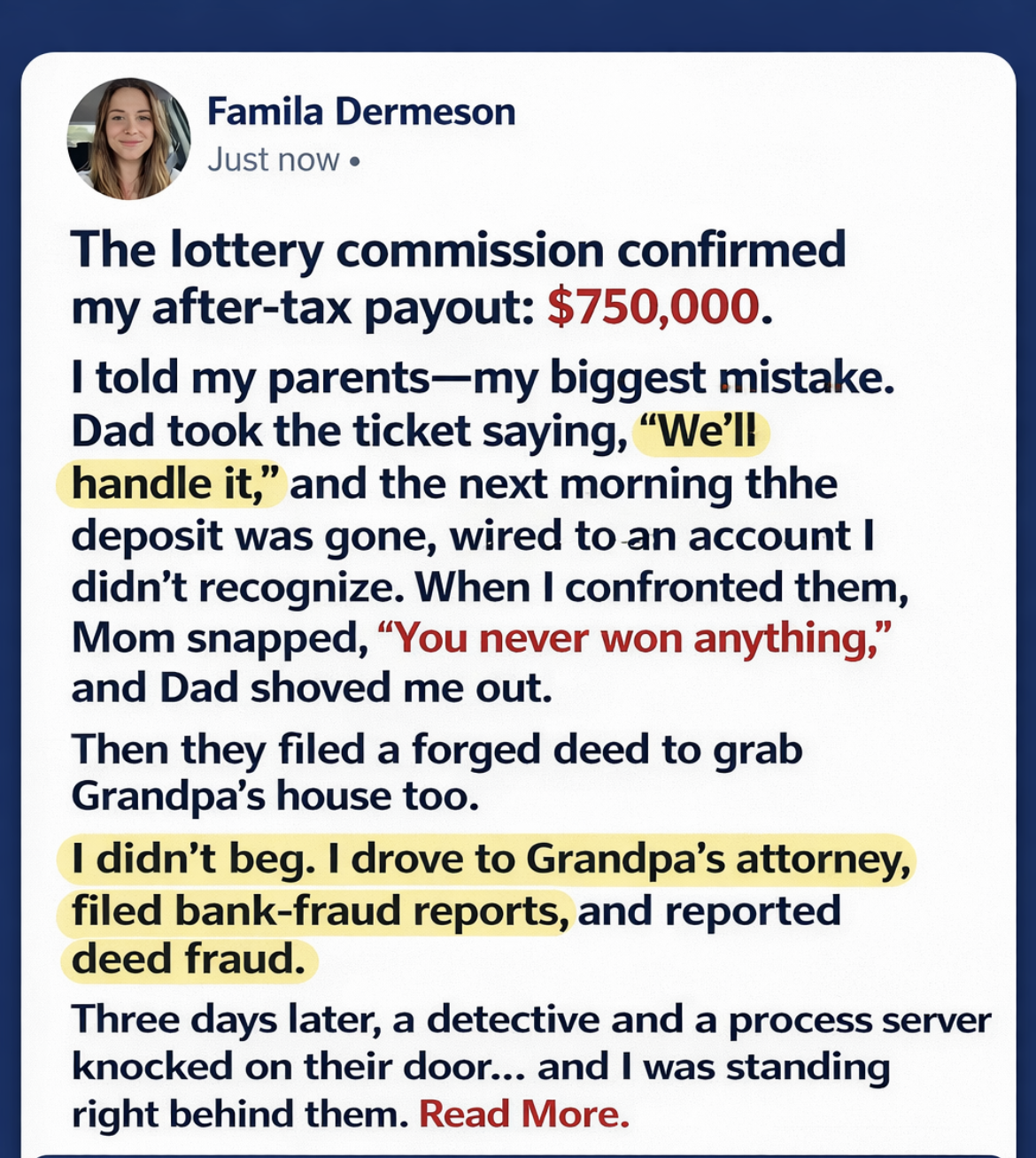
The day the lottery commission confirmed my after-tax winnings—$750,000—my hands wouldn’t stop shaking. Not because I was picturing yachts or designer bags. I was picturing relief. I could finally wipe out my student loans, replace my dying Honda, and fix the roof on Grandpa Walter’s old house—the small, stubborn place that still smelled like sawdust and coffee, the one he’d legally left to me because he said, “You’ll actually take care of it.”
I made the same mistake people always warn you about. I told my parents.
I told them because I thought family meant safety. Because I still had a child’s reflex to bring big news to the people who raised me, even after years of learning they didn’t celebrate my wins unless they could take credit for them. I stood in our kitchen holding the paperwork and the claim instructions like they were fragile. My mom’s smile looked tight, like she was holding it in place with effort. My dad didn’t say congratulations at all. He took the ticket from my fingers like I was handing him a bill to pay.
“We’ll handle the paperwork,” he said. “You get too emotional.”
It sounded almost caring—until you heard the part underneath: You’re not in charge of your own life.
That night, I couldn’t sleep, so I padded down the hallway for water and heard their voices in the kitchen. Low. Confident. The sound of people making plans without you.
Dad scoffed, “She thinks she’s clever. She didn’t win anything. We’ll deposit it and tell her it was a scam.”
Mom laughed quietly. “And Walter’s house? She doesn’t deserve that either. She’s spoiled.”
I stood there with my cup in my hand, feeling the floor tilt beneath me. Spoiled. That was their favorite label for me—spoiled—while I worked double shifts, paid my own bills, and carried the emotional weight of being the “responsible” one. Grandpa had been the only person who looked at my effort and called it what it was: survival.
The next morning I checked my banking app with that sick, bracing feeling you get before bad news. And there it was: a large withdrawal I hadn’t approved, followed by a wire transfer to an account I didn’t recognize. The amount made my stomach drop so hard I had to sit down. It wasn’t “missing.” It was moved—cleanly, quickly, like someone who knew what they were doing.
I walked into the living room where my parents were watching TV like nothing had happened and held up my phone.
“What is this?” I asked. “Why is my deposit gone?”
My mom’s face changed instantly—warmth snapping off like a light. “You didn’t win the lottery,” she said flatly. “Stop making up stories.”
My dad stood up, slow and looming, like he wanted height to do what facts couldn’t. “Pack your things. If you’re going to accuse us, you can leave.”
Accuse. Like I was inventing the proof glowing on my screen.
I gestured toward Grandpa’s framed photo in the hallway—him in his old flannel shirt, smiling like he knew something the rest of them didn’t. “The house is mine,” I said, voice shaking. “It’s legally in my name. He left it to me.”
Dad’s eyes hardened. “Not anymore.”
He shoved papers at me—printed forms I’d never seen, my name copied badly on a signature line, dates that didn’t match anything, a “transfer” that looked like it had been slapped together in an hour. My mom folded her arms and watched my face like she was waiting for me to crack.
“You don’t get to threaten us,” she said coldly. “You don’t get to hold money over family. You’ll learn respect.”
Then my dad opened the front door, pointed outward, and barked, “Get out. Come back when you’re done with this nonsense.”
I left with a backpack, my phone, and my keys. That was it. From the sidewalk, I watched them drag my belongings into the garage like trash. I heard the deadbolt click. In seconds, I lost the place I’d grown up in—because I’d made the mistake of believing I’d earned a place there.
I didn’t cry. Not then.
Shock has a way of turning off tears and turning on focus. I sat in my car, hands steady now, and made a list on my phone. Bank. Police report. Grandpa’s attorney. County recorder. Credit freeze. Every step I’d once thought was “too dramatic” suddenly felt like oxygen.
I drove straight to Grandpa’s attorney—Mr. Hargrove, the one whose card Grandpa kept in a kitchen drawer with rubber bands and spare keys. The receptionist took one look at my face and quietly led me into a conference room.
When I told Mr. Hargrove what happened, he didn’t gasp. He didn’t say, “Are you sure?” He only asked, “Do you have screenshots of the transfers?” and “Do you have those forged papers?”
I slid my phone across the table. “Yes.”
He nodded once. “Good. Here’s the reality: if they accessed your lottery funds without authorization, that’s theft and likely identity fraud. And if they tried to record a fraudulent deed or transfer on your grandfather’s property, that’s a separate, very serious issue.”
Then he did something my parents never did for me. He believed me immediately—and moved.
First, he helped me file a formal fraud report with my bank, including the wire details and the suspicious receiving account. We requested an emergency hold and recall, knowing full well that wire recalls don’t always work, but also knowing banks move faster when there’s a police report attached.
So we got one.
At the station, the officer listened as I explained the timeline: lottery confirmation, parents taking the ticket, overheard conversation, unauthorized transfer, forged documents, being forced out. I kept it factual. I showed screenshots. I showed the forged papers. The officer’s face tightened in that way that says, Okay, this is real.
“This will go to a detective,” he said. “And you need to contact the county recorder immediately about the property. If they file anything, we need it flagged.”
Mr. Hargrove took me to the county office the same afternoon. We searched the property records for Grandpa’s house, and my heart thudded when we saw it: a recent recording attempt had been submitted—imperfect, but enough to create confusion. A fake quitclaim transfer. My name scribbled, notarization that didn’t match.
The clerk’s expression went hard. “We’ve been seeing more deed fraud lately,” she said. “We can flag this and route it to the deed fraud unit.”
Mr. Hargrove filed the paperwork to contest the recording immediately. He also filed a notice that a legal dispute existed over the property—so no one could quietly sell it out from under me without raising alarms.
Then he looked at me and said, “Now we let the system do what it’s supposed to do—because your parents are counting on you to stay quiet.”
That night I stayed with a friend, wearing borrowed pajamas, staring at the ceiling while my phone filled with messages from my mother.
Stop this.
You’re being dramatic.
You’ll ruin our family.
Come home and apologize.
Not a single message asked if I was okay. Not one asked where I was sleeping. The only thing they cared about was control.
Two days later, my bank called. The fraud team had traced the receiving account enough to take action: they froze what remained before it could be moved again. Not everything—some of the money was already gone—but enough to matter. The investigator also confirmed the access pattern: the withdrawal originated from a device tied to my parents’ home internet. My dad hadn’t just taken the ticket. He’d used familiarity—my info, my trust—to move money like it belonged to him.
On the third day, Mr. Hargrove said, “We’re ready to serve them.”
Real life doesn’t look like ten lawyers marching through a doorway. It looks like paperwork—thick, precise, undeniable. It looks like a process server with a calm face. It looks like one detective and two officers performing a civil standby to keep things from exploding. It looks like consequences arriving without drama, because drama is what guilty people use to distract from facts.
That evening, as my parents sat down to dinner, there was a knock at their door.
My father opened it expecting a neighbor.
Instead, he saw a process server, a detective, and two uniformed officers. Behind them stood Mr. Hargrove with a folder in his hands.
And behind him—standing very still, heart pounding but face calm—stood me.
My mother’s fork clattered onto the plate. Her eyes went wide like she’d finally reached the part of the story where her lies stopped working.
“What is this?” she stammered.
I didn’t smile big. I didn’t perform. I simply spoke clearly, like you do when you’ve learned that calm is power.
“You’re right, Mom,” I said. “I didn’t win the lottery.”
My dad’s jaw tightened. “Then why are they here?”
I lifted my own folder—copies of reports, screenshots, the deed challenge filing, the fraud case number, and Grandpa’s will. “Because you stole it anyway,” I said.
The detective stepped forward and asked my parents to sit down. The process server handed them the papers: notice of investigation, civil complaint for conversion and fraud, and documentation that the deed filing was being contested and flagged as suspicious. Mr. Hargrove spoke in the careful tone lawyers use when they’re already past persuasion.
“You will not sell, transfer, or encumber the property,” he said. “Any attempt will be met with immediate legal action. As for the funds—your bank has already been notified, and law enforcement has been provided a report.”
My mother started crying—not soft remorseful crying, but angry crying, like the world had violated her by refusing to let her win.
My father’s face went red. “This is insane,” he snapped. “She’s ungrateful. We raised her—”
The detective raised a hand. “Sir, this isn’t about gratitude. It’s about unauthorized transfers and potential forgery.”
In that moment, my parents looked smaller. Not because I wanted them to suffer—but because their power had always been built on me staying quiet. And quiet had finally ended.
The officers didn’t “drag them away.” Real life doesn’t always get that tidy. They took statements. They documented reactions. They warned them about contacting me. They advised them that further property tampering could carry criminal consequences.
Then they turned to me and asked if I needed an escort to retrieve essential belongings. That part was almost harder than the money—walking through the house and seeing my childhood like a museum I wasn’t allowed to touch. But I took my documents, my clothes, my laptop, and the one photo of Grandpa I cared about. The one where he’s laughing, mid-sentence, like he’s still telling me I’ll be okay.
Outside, Mr. Hargrove asked, “Are you alright?”
I swallowed. “No,” I admitted. “But I’m not powerless.”
In the weeks that followed, the case moved through the systems that exist for exactly this reason. The deed fraud unit invalidated the attempted filing. The court issued orders preventing my parents from interfering with Grandpa’s property. The bank recovered part of the funds, and the rest became evidence—paper trails don’t vanish just because people want them to.
My parents tried to call me. Tried to message. Tried to bargain.
We can talk.
Let’s not ruin each other.
You got some back, isn’t that enough?
But something had shifted in me permanently. I wasn’t negotiating my right to exist. I wasn’t begging for respect. And I wasn’t letting people who stole from me rewrite themselves as victims.
Because the truth is, I didn’t “get lucky” with the lottery.
I got lucky realizing, in time, that family isn’t the people who take your win and call it theirs.
Family is the people who wouldn’t even consider stealing from you—especially when you’re finally trying to build a life Grandpa would be proud of.