PART 1: THE SECOND BURNER
I watched my wife send my blind mother crashing to the floor—and then reach for the stove.
Two streets away from our Atlanta home, my hands locked around the steering wheel so hard my knuckles turned white. My phone trembled in its mount, but the picture on the screen was clear.
Too clear.
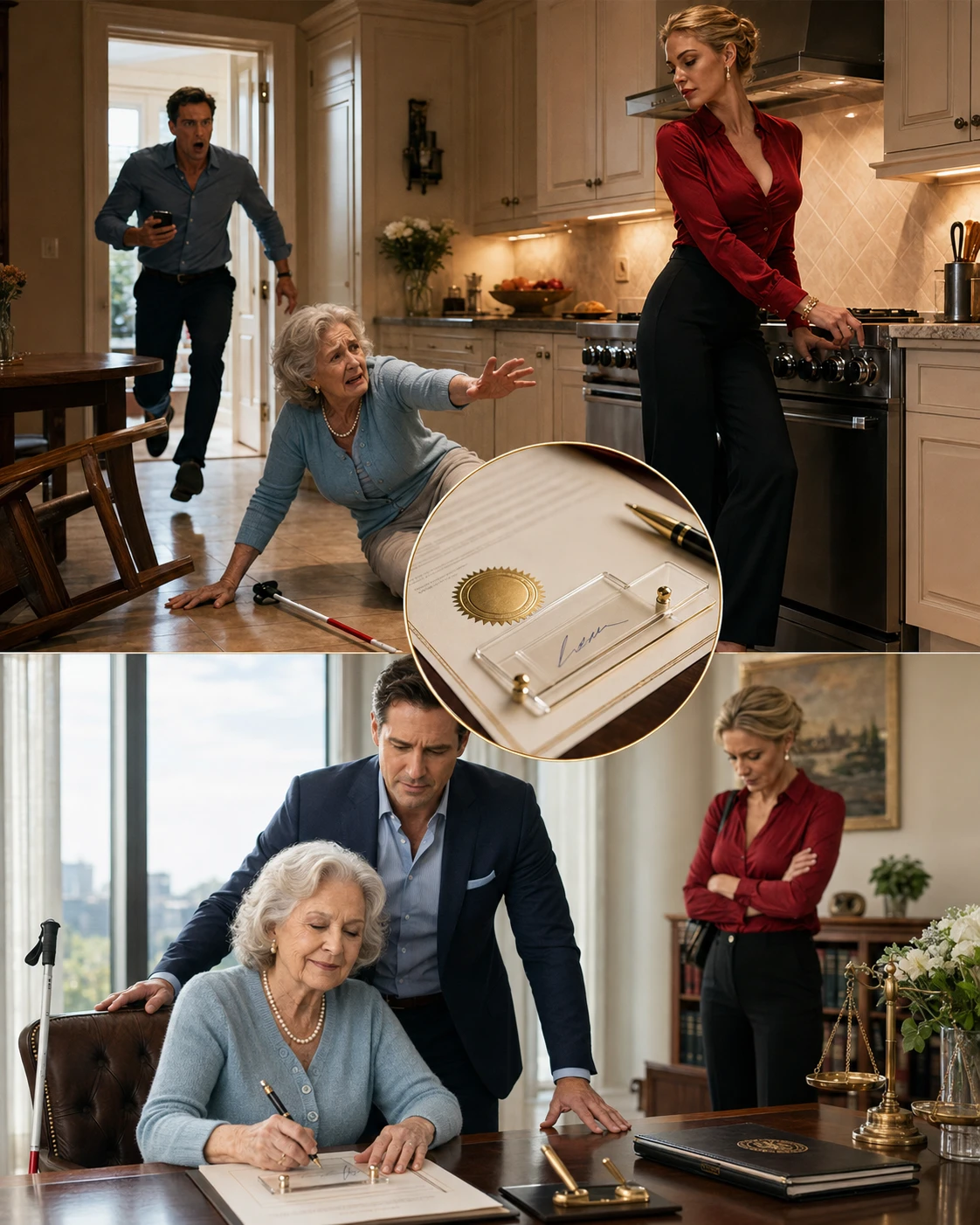
My mother, Evelyn, was on her knees beside the kitchen table.
One palm pressed against the tile.
The other reached blindly for a chair that wasn’t there anymore.
Lauren had kicked it away.
For one stunned second, I couldn’t breathe.
My mother made a small sound.
Not a scream.
That would have been easier to hear.
It was the kind of sound a person made when they had learned that showing pain only invited more pain.
Lauren stood over her in a red blouse and black slacks, her blond hair pinned neatly at the back of her neck. She looked exactly as she did when we went to church on Sundays.
Composed.
Elegant.
Kind.
The same Lauren everyone called an angel.
At church, she guided my mother down the aisle with both hands around her arm.
In front of our neighbors, she spoke to Evelyn in a patient, gentle voice.
Whenever I entered a room, Lauren’s face softened immediately.
“Do you need some tea, Mom?”
“Would you like your blanket?”
“Let me find your cane for you.”
People saw those moments and smiled at me as if I had won some kind of lottery.
“You married a good woman, Daniel.”
I had heard it so many times that, for months, I had used those words to silence the suspicion growing inside me.
Now I watched that good woman turn toward the stove.
Lauren lifted one burner knob.
I saw the motion before I understood it.
Click.
She didn’t light the flame.
She looked down at my mother.
Then she reached for the second knob.
My hand was already on the door handle.
I grabbed my phone and ran.
The summer heat hit me like a wall when I stumbled out of the car, but I barely felt it. I cut through an alley behind two houses, jumped a low fence, nearly fell, kept running.
The camera feed bounced in my hand.
On-screen, my mother was trying to pull herself upright.
“Lauren,” she whispered.
Lauren turned another knob.
Click.
“Please.”
“You should have signed it when I told you.”
I stopped running for half a heartbeat.
Signed what?
Then Lauren spoke again.
“None of this had to be difficult.”
I started moving faster.
The house came into view through the trees.
My house.
My father’s house.
The home where I had grown up.
The place my mother had returned to after losing most of her sight.
The place I had promised would always be safe for her.
Inside the kitchen, Lauren crouched down.
“You’re going to stay exactly where you are.”
My mother’s face lifted toward the sound of her voice.
“You told Daniel you were taking care of me.”
Lauren laughed softly.
Even through the tiny speaker on my phone, that laugh made something cold slide down my spine.
“I am taking care of things.”
I reached the side door.
Locked.
Of course it was.
Lauren had started keeping it locked during the day because she said my mother had become “confused.”
I nearly broke the key trying to get it into the lock.
Inside, the house was strangely quiet.
Then I smelled it.
Gas.
Not much yet.
But enough.
I heard my mother cough.
I rounded the corner into the kitchen.
Lauren spun toward me.
Her face changed so quickly it would have been impressive if I hadn’t hated her in that moment.
Fear.
Shock.
Then innocence.
“Daniel?”
I didn’t answer.
I crossed the room and turned off the burners.
One.
Two.
The clicking stopped.
I opened the nearest window.
“What are you doing?” Lauren asked.
Still that voice.
Still pretending.
I looked at her.
For seven years, I had known every version of that face.
The smiling face from our wedding photographs.
The tearful face beside my father’s hospital bed.
The exhausted face after long workdays.
The affectionate face she rested against my shoulder while we watched television.
But I had never seen the face in front of me now.
Not really.
Because beneath the surprise, there was calculation.
She was already deciding what story to tell me.
“Daniel, thank God,” she said quickly. “Your mother fell. I was trying to—”
“Don’t.”
One word.
She stopped.
My mother was still on the floor.
I dropped beside her.
“Mom.”
Her whole body jerked when I touched her.
That nearly destroyed me.
My own mother flinched from my hands.
“It’s me,” I whispered. “It’s Daniel.”
Her shoulders collapsed.
“Danny?”
She hadn’t called me Danny since I was twenty.
“I’ve got you.”
Her fingers found my sleeve and clenched around it.
“I didn’t fall.”
“I know.”
Lauren went silent.
My mother turned her face toward me.
I saw tears spilling from eyes that no longer gave her much more than light and shadow.
“I didn’t fall.”
“I know, Mom.”
“You believe me?”
Those three words hurt worse than anything else.
Because she hadn’t asked whether I saw it.
She asked whether I believed her.
Which meant some part of her had spent months believing I didn’t.
I looked across the kitchen at Lauren.
“Yes,” I said.
And I made sure Lauren heard every syllable.
“I believe you.”
The room changed after that.
Lauren straightened.
“What exactly is that supposed to mean?”
I helped Mom into the chair.
Her right knee was already swelling.
There was a bruise beneath the sleeve of her sweater.
Not a fresh one.
An older bruise.
Yellow around the edges.
My stomach turned.
I had seen marks like that before.
And every time, Mom had given me an explanation.
I bumped into the dresser.
I lost my balance.
I’m getting clumsy.
I had wanted to believe her.
No.
That wasn’t true.
I had wanted to believe Lauren.
There was a difference.
I stood.
Lauren folded her arms.
“You’re acting crazy.”
I held up my phone.
Her eyes dropped to the screen.
I watched the understanding reach her.
Then the fear.
“You installed a camera?”
I said nothing.
“You recorded me?”
“Above the pantry.”
Her eyes moved automatically toward it.
The tiny black lens sat where I had installed it three nights earlier.
Lauren stared at it.
Then she looked back at me.
“You were spying on me.”
I almost laughed.
“You shoved my blind mother to the floor.”
“She lost her balance.”
“I watched you kick the chair away.”
“She was about to fall. I moved it.”
“And the stove?”
Her mouth opened.
Nothing came out.
My mother sat very still behind me.
Lauren glanced at her, and for one terrible second I saw pure hatred.
Not irritation.
Not frustration.
Hatred.
I moved between them.
“Look at me,” I said.
Lauren’s gaze returned to mine.
“You’re done.”
Her face went pale.
“Daniel.”
“Stay away from my mother.”
“You don’t understand what’s been happening.”
“I understand exactly what I just watched.”
“No, you don’t.”
“Then explain the gas.”
She swallowed.
“I was cooking.”
“There was nothing on the stove.”
“I had just started.”
“You turned on two burners without lighting either one.”
Her eyes narrowed.
“You’re upset.”
That sentence almost broke whatever restraint I had left.
I stepped closer.
“You don’t get to tell me what I am.”
My mother whispered my name.
I stopped.
That was what Lauren had been counting on all along.
My anger.
My confusion.
My instinct to keep the peace.
My willingness to doubt myself before I doubted the woman I loved.
So I backed away.
I called 911.
Lauren stared at me as the dispatcher answered.
Her expression hardened.
“Daniel, don’t do this.”
I looked directly at her.
“You already did.”
She took one step toward me.
Then my mother’s hand moved across the table.
Searching.
I reached out.
She found mine.
And held on.
For the first time in months, she didn’t let go when Lauren entered the room.
It was only later, while the paramedics examined my mother’s knee, that I realized how long the truth had been sitting in front of me.
Mom had been disappearing by inches.
Her clothes hung more loosely from her shoulders.
She spoke less.
She stopped asking me to bring home cinnamon rolls from the bakery she liked.
She stopped listening to the old jazz records my father used to play on Saturday mornings.
When I asked if she was hungry, she always said she’d eaten.
Lauren always confirmed it.
“She had breakfast.”
“She wasn’t hungry at lunch.”
“You know how little she eats these days.”
But the meals I actually saw became smaller.
Toast.
Half a cup of soup.
A few crackers.
And the cane.
God, the cane.
I had found it across rooms from her so many times.
“Mom, why’d you leave this over here?”
She would go quiet.
Lauren would answer for her.
“She forgets where she puts things.”
Once, I found a cast-iron pan balanced near the edge of the kitchen counter, exactly where Mom’s searching hand could have landed.
Lauren laughed when I asked about it.
“Your mother moved it, Daniel. She forgets things.”
That answer had sounded reasonable.
Until the deed papers surfaced.
The house had belonged to my father.
After he died, there were complications with the estate, signatures that still needed to be completed, documents that would finally place the property in my mother’s name as he had intended.
Lauren found the papers in the study before I finished organizing them.
She had stood in the doorway holding the folder.
“I thought this house was yours.”
“No. Dad wanted Mom protected.”
Lauren smiled.
“Of course.”
But something in her voice had changed.
After that, concern became her favorite weapon.
She told our neighbors my mother was getting confused.
She told people at church that Mom had started wandering near the stove.
She suggested locks.
Alarms.
Maybe even a care facility someday.
Every lie sounded loving.
Every warning pointed toward the same conclusion.
If something happened inside that house, everyone would already know whom to blame.
Evelyn.
Blind.
Elderly.
Forgetful.
Dangerous without realizing it.
Lauren had been writing the story of my mother’s death before she tried to create it.
And I had nearly helped her by believing every word.
As the paramedics lifted my mother onto a stretcher, one of them asked whether she had fallen before.
Mom’s lips parted.
Then she hesitated.
Lauren was standing in the hallway.
I saw my mother’s face change.
I stepped beside her.
“You can tell him.”
Her hand tightened around mine.
“Yes,” she whispered.
The paramedic leaned closer.
Mom turned her face toward his voice.
“Yes,” she said again. “I have fallen before.”
Lauren’s expression didn’t move.
But I saw her fingers curl into fists.
“And were those falls accidents?” the paramedic asked.
My mother began to shake.
For a moment, I thought she would retreat into silence again.
Then she said the word I should have heard months ago.
“No.”
Behind me, Lauren sucked in a breath.
The paramedic looked at me.
I didn’t turn around.
Because if I had looked at my wife then, I didn’t know what I might have done.
Instead, I kept holding my mother’s hand.
And for the first time, I wondered how many times she had been waiting for me to do exactly that.
PART 2: WHAT MY MOTHER NEVER TOLD ME
At the hospital, they found no fracture in Mom’s knee.
A deep contusion.
Swelling.
Several older bruises.
Mild dehydration.
And something that made the doctor look at me longer than necessary before speaking.
“She appears undernourished.”
I stared at him.
“What?”
“Not severely, but enough to concern me, especially given her age and mobility limitations.”
The word undernourished made the room tilt.
I thought of all those small meals.
All the untouched plates.
All the times Lauren told me, She already ate.
I sat beside my mother’s hospital bed after the doctor left.
For a while, neither of us spoke.
The machines around us made soft electronic sounds.
Mom’s hands rested in her lap.
They looked older than I remembered.
Thin.
Veined.
Fragile.
My father used to say those hands could fix anything.
A torn shirt.
A scraped knee.
A bad day.
When I was nine, she sat beside me until sunrise because I was afraid of a thunderstorm.
When I failed algebra in tenth grade, she didn’t yell. She stayed up helping me work through equations she hadn’t seen in twenty-five years.
When Dad died, I thought grief had hollowed her out.
Now I understood something else had been hollowing her out too.
And it had happened under my roof.
“Why didn’t you tell me?”
I hated myself as soon as the question left my mouth.
Mom lowered her head.
“I tried.”
The answer was quiet.
I closed my eyes.
“When?”
“Not directly.”
“Mom—”
“I didn’t know how.”
“You could have told me.”
“I know.”
“Why didn’t you?”
Her mouth trembled.
“Because you loved her.”
I looked away.
Outside the window, Atlanta moved on as if nothing had happened.
Cars crawled through the afternoon traffic.
A helicopter crossed the blue sky.
Somewhere, people were going to lunch, arguing over parking spaces, buying groceries.
My entire life had split open.
And the city didn’t care.
Mom continued.
“At first I thought I was misunderstanding her.”
I turned back.
“She would move things. My cup. My cane. The phone. I would ask where they were and she would say they were exactly where I’d left them.”
My throat tightened.
“She started saying I was forgetting things.”
“Yes.”
“Why?”
Mom’s fingers folded together.
“I think she wanted me to stop trusting myself.”
The words landed hard.
“She’d put something in my path,” Mom said. “A small stool. A basket. Once one of the dining chairs. Then when I tripped, she’d say I needed to be more careful.”
I couldn’t speak.
“She only did those things when you were gone?”
“At first.”
“At first?”
Mom swallowed.
“Then she started doing them while you were upstairs or outside. She knew how long it took me to reach you.”
I thought of all the times I had been home.
Working in the study.
Taking a shower.
Mowing the lawn.
Ten yards away.
Twenty feet away.
While my mother lived in fear.
“I should have known.”
“You were supposed to trust your wife.”
“No.”
“Yes, Daniel.”
“No, Mom. Not when you were afraid in your own home.”
Her face turned toward me.
“You noticed eventually.”
Eventually.
The word was meant to comfort me.
It didn’t.
“How long?”
She didn’t answer.
“How long has she been hurting you?”
Her breathing changed.
“Mom.”
“A few months.”
“How many?”
“I don’t know.”
“You know.”
She went still.
“Since the papers?”
That got a reaction.
A tiny movement.
But enough.
“The deed papers,” I said.
Mom’s head lowered.
“I think so.”
I stood and walked to the window.
For seven years, Lauren and I had built a life together.
Not a perfect one.
But what I believed was a real one.
We had fought about money before.
We had fought about the house.
After Dad died, Lauren wanted to renovate.
New kitchen.
New floors.
Maybe take out a home equity loan once everything was settled.
I told her no.
The house wasn’t mine.
She acted like she understood.
Then she began saying that Mom would be happier somewhere designed for visually impaired seniors.
I called it practical.
She called it compassionate.
Mom called it unnecessary.
I remembered one argument especially.
Lauren had stood in our bedroom with her arms crossed.
“Your mother can’t live here forever.”
“It’s her house.”
“Not yet.”
“What does that mean?”
“It means the paperwork isn’t done.”
I stared at her.
Lauren immediately softened.
“I didn’t mean it like that.”
“How did you mean it?”
She kissed my cheek.
“I mean we need to think about everyone’s future.”
At the time, I let it go.
Now those words returned differently.
Everyone’s future.
“What did she want you to sign?” I asked.
Mom’s face changed.
I came back to the bed.
“This morning. On the camera. Lauren said, ‘You should have signed it when I told you.’ What was she talking about?”
Mom pressed her lips together.
“Tell me.”
“A paper.”
“What paper?”
“I didn’t see it.”
Of course she hadn’t.
My mother was legally blind.
“What did she say it was?”
“She said it would make things easier.”
“For what?”
“The house.”
The room went cold.
“She said you were overwhelmed. That managing everything after your father’s death was too much for you.”
I felt sick.
“And?”
“She said I should let you handle the property.”
“Did she say transfer it to me?”
“Yes.”
My pulse started hammering.
“Did you sign anything?”
“No.”
“Why didn’t you tell me?”
“I asked her if you knew.”
“And?”
“She said it was your idea.”
I stared at her.
Mom continued quietly.
“I knew that wasn’t true.”
“How?”
“Because if you wanted something from me, you would have asked.”
I sat down again.
“So you refused.”
“Yes.”
“And after that?”
“She got worse.”
There it was.
Not a random accident.
Not caregiver stress.
Not frustration.
Pressure.
Lauren wanted control over the house.
Mom refused.
And the woman I had slept beside every night began tightening a noose around her life.
“What exactly did she say when you refused?”
Mom was silent for a long time.
Finally she whispered, “She said people already thought I was losing my mind.”
I felt every muscle in my body tighten.
“What else?”
“She said if I kept being difficult, perhaps you would have no choice but to put me somewhere that could keep me safe.”
I had to stand again.
I couldn’t sit with that much anger inside me.
“And then?”
Mom’s voice grew smaller.
“She said no one would believe an old blind woman over her.”
I turned around.
My mother’s face was wet with tears.
The worst part wasn’t that Lauren had said it.
The worst part was that, until today, she had been right.
The police spoke to both of us separately.
Lauren told them my mother fell.
She claimed she turned on the burners because she was making tea and became distracted when Evelyn went down.
She said I had misunderstood what I saw because I was already suspicious.
Then she made her most predictable move.
She questioned my mother’s memory.
I knew because one of the officers returned to ask whether Mom had ever been diagnosed with dementia.
“No,” I said.
“Memory loss?”
“No.”
“Confusion?”
“No.”
“Your wife says there have been episodes.”
“My wife has been telling people that for months.”
The officer studied me.
“Why?”
“So they’d believe exactly what she’s telling you now.”
I showed him the footage.
Not just the last few minutes.
Everything the camera had captured since I installed it.
The first day, there wasn’t much.
Lauren ignored Mom for most of the afternoon.
Then, before I came home, she placed Mom’s cane in the hallway closet.
When I walked through the door twenty minutes later, Lauren pretended to help search for it.
The second day, she put a plate of food in front of Mom.
Waited until Mom touched the sandwich.
Then removed half of it.
When Mom asked where the rest was, Lauren said, “You ate it.”
The officer’s face changed.
On Thursday, Lauren stood behind my mother while she searched a drawer.
Mom asked for her medication organizer.
Lauren held it in her hand.
“Where did you put it?” she asked.
“I thought it was here.”
“You really don’t remember?”
“No.”
Lauren smiled.
Not kindly.
“You’re getting worse.”
The officer watched the clip twice.
Then came Friday.
The chair.
The fall.
The gas.
“You have copies?” he asked.
“Three.”
That was true.
The moment I arrived at the hospital, I uploaded the footage to cloud storage and emailed a copy to myself.
I wasn’t going to lose the truth now that I finally had it.
Lauren called me seventeen times that afternoon.
I didn’t answer.
Then the messages started.
Daniel, we need to talk.
Your mother is manipulating you.
You don’t know what I’ve dealt with while you’re at work.
She hates me.
She’s been trying to break us apart for years.
Then:
You can’t destroy our marriage over one moment taken out of context.
One moment.
I watched the video again.
Mom falling.
Lauren watching her.
The stove.
Click.
Click.
I turned my phone facedown.
A minute later, another message arrived.
I love you.
I stared at those three words for a long time.
For seven years, they had been enough to pull me back from almost any argument.
Now all I could hear was my mother asking from the floor:
You believe me?
I deleted nothing.
The officer had told me to preserve every message.
Then a final one appeared.
If you come home angry and make accusations, I won’t stay and be abused.
I laughed once.
A hard, empty sound.
She was already rewriting the story.
Even now.
Especially now.
But for the first time, she wasn’t writing it alone.
I had the footage.
Mom had her voice back.
And I was finally paying attention.
That evening, as the nurses prepared to discharge her, Mom asked quietly, “Are we going home?”
I looked at her.
Home.
The word hurt.
Lauren was still there.
At least according to the neighbor who called to say she had seen Lauren’s car in the driveway.
“No,” I said.
My mother stiffened.
“Where will we go?”
“A hotel tonight.”
“You don’t have to do that.”
“Yes, I do.”
“Daniel—”
“Mom.”
She stopped.
I took her hand.
“We’re not going back until I know she can’t get near you.”
Mom’s fingers trembled inside mine.
Then she nodded.
As we left the hospital, my phone rang again.
This time it wasn’t Lauren.
It was our next-door neighbor, Mrs. Parker.
Her voice sounded uncertain.
“Daniel?”
“Yes?”
“I don’t know if this matters.”
“What?”
There was a pause.
“Lauren is carrying boxes out of the study.”
I stopped walking.
“What kind of boxes?”
“Files, I think.”
My stomach dropped.
The deed papers.
“Is she still there?”
“Yes.”
I handed Mom’s wheelchair handles to the nurse beside us.
Then I lifted the phone back to my ear.
“Mrs. Parker, don’t confront her.”
“Daniel—”
“Please.”
I was already moving.
Because suddenly I understood something.
Lauren hadn’t called seventeen times because she wanted to save our marriage.
She wanted to know how long she had before I came home.
PART 3: EVERY LIE SOUNDED LIKE LOVE
By the time I reached the house, a patrol car was already parked outside.
I had called the officer from the hospital and explained what Mrs. Parker saw.
He told me not to enter alone.
For once, I listened.
Lauren stood on the front porch beside two cardboard boxes.
When she saw me step out of my car with the officer behind me, her expression froze.
Then she looked at the boxes.
Then back at me.
I almost admired how quickly she recovered.
“These are my things.”
“They came from the study.”
“My things were in the study.”
The officer stepped forward.
“Ma’am, we’re not here to argue about property. Mr. Mercer needs to retrieve personal and estate documents.”
Lauren’s eyes stayed on mine.
“You brought the police to our house?”
“Our house?”
The words slipped out before I could stop them.
Her mouth tightened.
“Daniel, not here.”
“Why? You’ve never had a problem talking about this house before.”
The officer gave me a warning look.
I stepped back.
He was right.
Anger wouldn’t help.
Evidence would.
I went inside with him while Lauren remained on the porch.
The study looked almost normal.
That was what scared me.
The filing cabinet was open.
Two drawers had been pulled out.
Folders sat in uneven stacks across my father’s old desk.
I went immediately to the drawer where I kept the estate documents.
Empty.
My heart began pounding.
“They’re gone.”
The officer looked around.
“What documents?”
“The deed transfer. Estate records. My father’s papers.”
“Could they be in the boxes?”
We went back outside.
Lauren folded her arms.
“You are not searching my belongings.”
The officer stayed calm.
“I’m asking whether you removed documents belonging to the estate.”
“No.”
I looked at the nearest box.
A folder corner was visible beneath one of Lauren’s sweaters.
Blue.
The estate folder was blue.
I didn’t touch it.
I pointed.
“That.”
Lauren followed my finger.
Her face changed.
Only slightly.
But I saw it.
The officer saw it too.
He asked her to move the sweater.
She refused.
The conversation lasted several minutes after that, and I won’t pretend I remember every word.
I remember Lauren accusing me of humiliating her.
I remember her saying she was afraid of me.
I remember the officer telling both of us to stay calm.
Eventually, the folder came out.
My father’s estate papers were inside.
So was a second document.
The one Lauren had asked my mother to sign.
I knew immediately because Mom’s name appeared near the bottom in large printed letters with a signature line beneath it.
The document wasn’t completed.
But the language was clear enough.
It would have authorized me to handle decisions concerning the property.
My name.
Not Lauren’s.
That was the genius of it.
She hadn’t tried to transfer anything directly to herself.
She didn’t need to.
She was my wife.
She had spent years making decisions with me.
Influencing me.
Convincing me.
She only needed Mom out of the way.
Then she could work on me.
I stared at the document.
“I never asked for this.”
Lauren looked at the officer.
“His mother wanted him to manage the house.”
“No, she didn’t.”
“She told me she did.”
“I just came from the hospital.”
Lauren’s eyes sharpened.
“She doesn’t remember things correctly.”
There it was again.
The same blade.
Used so often she didn’t even think before reaching for it.
“She remembered refusing to sign.”
Lauren’s face went still.
“She remembered you telling her it was my idea.”
Nothing.
“She remembered you threatening to put her in a facility if she wouldn’t cooperate.”
“That’s ridiculous.”
“And she remembered you saying no one would believe her.”
Lauren laughed.
Not because anything was funny.
Because she needed me to look unreasonable.
“You hear yourself, Daniel?”
“Yes.”
“You’re taking the word of a confused seventy-six-year-old woman over your wife.”
I stared at her.
And suddenly I understood why this had worked for so long.
Lauren rarely told a lie that stood alone.
She wrapped every lie in a truth.
My mother was seventy-six.
She was blind.
She did sometimes forget where she had set down a cup.
She did need help in unfamiliar spaces.
Lauren took ordinary human vulnerability and turned it into a weapon.
And I had let her.
“She isn’t confused,” I said.
“You don’t know what happens when you’re gone.”
“Yes,” I said. “Now I do.”
Lauren’s eyes flicked toward the pantry window.
Toward the camera.
Her face hardened.
The officer asked about the document.
Lauren said she printed it because she thought it would “simplify family matters.”
He asked why it was mixed with estate records in a box she was removing from the house.
She didn’t have a good answer.
For once, Lauren’s story had too many holes to fill.
That night, Mom and I stayed in a hotel near the hospital.
I booked two adjoining rooms.
She insisted one would have been enough.
I insisted harder.
After she fell asleep, I sat at the little desk by the window and watched every hour of camera footage again.
I didn’t want to.
I needed to.
I had spent months seeing pieces.
Now I forced myself to see the pattern.
Lauren never screamed at Mom when the camera was recording.
She didn’t have to.
Cruelty could be quiet.
At 10:13 Tuesday morning, Mom walked into the kitchen and asked whether there was coffee.
Lauren was reading at the table.
“There was.”
“Is there any left?”
“No.”
“Could you help me make some?”
“You know where the machine is.”
Mom’s hand moved along the counter.
Lauren watched.
The coffee machine had been pushed three feet to the left.
Mom searched the empty space where it usually sat.
“I can’t find it.”
Lauren turned a page.
“You need to try harder.”
Two minutes passed.
Mom found the machine.
The water reservoir was empty.
She asked for help.
Lauren sighed loudly, stood, filled it halfway, then returned to her seat.
When I came home that evening, Lauren hugged me at the door.
“Your mom had such a good day.”
I closed my laptop and pushed it away.
Another clip.
Wednesday afternoon.
Mom sat in the living room.
Lauren came through carrying laundry.
“You told Mrs. Gardner I don’t feed you.”
Mom’s face lifted.
“I didn’t.”
“She asked why you’ve lost weight.”
“And what did you say?”
“That I’ve had less appetite.”
Lauren put the basket down.
“You’re making me look bad.”
“I didn’t say anything about you.”
“You don’t have to. You sit there looking pathetic and people make assumptions.”
Mom’s mouth tightened.
“I am not trying to make anyone think badly of you.”
“Then eat when I give you food.”
“I do.”
Lauren laughed.
“You don’t even remember.”
That sentence again.
You don’t remember.
You forgot.
You’re confused.
You’re getting worse.
By midnight, I wanted to throw the computer through the window.
Instead, I kept watching.
Because I had missed this once.
I wasn’t going to look away again.
Then I reached Thursday evening.
A clip from shortly before I came home.
Lauren was in the study.
Mom appeared in the doorway.
“Lauren?”
“What?”
“May I ask you something?”
“Apparently.”
Mom hesitated.
“Is Daniel unhappy with me?”
My chest tightened.
Lauren didn’t answer immediately.
“Why would you ask that?”
“He seems worried.”
“He is worried.”
“About me?”
Lauren turned in the desk chair.
“Yes.”
Mom absorbed that.
“Has he said something?”
“He doesn’t know what to do with you.”
I whispered, “No.”
On-screen, Mom stood completely still.
Lauren continued.
“He loves you, obviously. But this is becoming too much.”
“No.”
My mother had said the same word.
Quietly.
“He told me I could stay.”
“He says that because he feels guilty.”
“No.”
Lauren stood.
“You think he enjoys coming home every night wondering if you’ve fallen? Wondering whether you left the stove on? Wondering whether you’re going to burn down the house?”
“I don’t use the stove alone.”
Lauren stepped closer.
“You did last week.”
“No.”
“You don’t remember.”
I paused the video.
My hands were shaking.
There it was.
The stove story.
Planted before Friday.
She wasn’t improvising.
She had built it patiently.
Then Lauren said something that made my blood run cold.
“If something happens, Evelyn, you need to understand that Daniel can’t keep sacrificing his life for you.”
Mom whispered, “I would never ask him to.”
“I know.”
Lauren touched her shoulder.
A gentle touch.
The kind I had seen a hundred times.
“That is why signing those papers would be the loving thing to do.”
I sat back.
Every lie sounded loving.
Every threat sounded reasonable.
Every cruelty came wrapped in concern.
And suddenly I understood why Mom had become so quiet.
Lauren hadn’t only hurt her body.
She had convinced her that speaking might cost me my marriage.
That asking for help might burden me.
That defending herself would prove she was confused.
It wasn’t one fall.
One bruise.
One cruel morning.
It was a system.
And I had lived beside it without seeing the full shape.
I closed the laptop.
A soft sound came from the connecting door.
“Daniel?”
Mom.
I opened it.
She stood just inside her room, one hand against the doorframe.
“Are you awake?”
“Yes.”
“I couldn’t sleep.”
I guided her to the chair.
For a moment we sat without talking.
Then Mom said, “You’re blaming yourself.”
I looked at her.
“How do you know?”
“You breathe like your father when you blame yourself.”
Despite everything, I almost smiled.
“What does that even mean?”
“Loudly.”
A weak laugh escaped me.
Then my eyes burned.
“I saw the videos.”
She understood.
“All of them?”
“Yes.”
“I wish you hadn’t.”
“I wish I’d installed that camera six months ago.”
“Daniel.”
“I was there.”
“You weren’t.”
“I mean I lived there.”
She reached across the space between us until her fingers found my hand.
“She was good at making things look ordinary.”
“That doesn’t excuse me.”
“No.”
The answer surprised me.
Mom tightened her grip.
“It doesn’t excuse you.”
I stared at her.
“You should have asked more questions.”
The words hurt.
They were supposed to.
“You should have listened when I got quiet. You should have wondered why I stopped doing things I loved.”
“I know.”
“But.”
She waited.
“But you are listening now.”
My eyes filled.
She squeezed my hand.
“So don’t waste the part that matters trying to rewrite the part you can’t change.”
For the first time all day, I bowed my head.
And I cried.
Not loudly.
Not dramatically.
Just sitting beside my mother in a hotel room while traffic hissed along the wet street outside.
She held my hand the entire time.
The woman I had failed was comforting me.
That shame stayed with me.
I decided it should.
Not as punishment.
As memory.
A promise.
Never again.
The next morning, Lauren’s version of the story reached church before I did.
Mrs. Gardner called Mom.
Then two neighbors.
Then a friend of my father’s.
Lauren had told people there had been “a frightening misunderstanding.”
She said Mom had fallen near the stove.
She said I panicked.
She said stress after my father’s death had made the family situation difficult.
She did not mention the chair.
She did not mention the gas.
She did not mention the document.
And she definitely did not mention the camera.
Mom looked miserable after the third call.
“I knew this would happen.”
“What?”
“She’ll make everyone choose.”
“No.”
“Daniel—”
“No one gets to choose between a lie and the truth if they haven’t seen the truth yet.”
Mom’s face turned toward me.
“What are you going to do?”
I thought about the footage.
About the officer.
About the neighbors who had been unknowingly prepared to blame Mom.
About church friends who had watched Lauren guide her down the aisle like a saint.
Then I remembered something Lauren had said months earlier.
People believe what they see, Daniel.
She had been talking about a television commercial.
But the sentence came back now.
People believe what they see.
I opened my laptop.
“I’m going to stop arguing with her story.”
Mom frowned.
“What does that mean?”
“It means I’m going to show the truth.”
PART 4: THE WOMAN BEHIND THE SMILE
I didn’t post the footage online.
I didn’t send it to everyone we knew.
Part of me wanted to.
I wanted the whole city to see Lauren kick that chair away.
I wanted every person who had called her an angel to watch her face while my mother lay on the floor.
But this wasn’t about humiliating Lauren.
It was about protecting Mom.
So I listened to the officer.
I preserved the recordings.
I gave copies where they needed to go.
I documented the messages.
I photographed the bruises the hospital had recorded.
And I called the people whose testimony mattered.
Mrs. Parker remembered seeing Lauren move Mom’s cane into the garage one afternoon.
At the time, she assumed Lauren was cleaning.
Mrs. Gardner remembered Mom asking quietly at church if there were programs for visually impaired seniors who “didn’t want to be a burden.”
Our pastor remembered Lauren telling him that Evelyn had become forgetful around the stove.
That detail mattered.
Because Mom had never cooked alone after losing most of her sight.
Not once.
Lauren knew that.
So did I.
The story she had planted depended on nobody asking the right question.
When did Evelyn supposedly start doing something she had deliberately stopped doing years earlier?
Three days after the kitchen incident, I returned to the house with Mom.
Lauren wasn’t there.
She had been instructed to stay away from my mother while the matter was investigated, and she was staying with her sister.
The house felt different without her.
Not peaceful.
Not yet.
More like a theater after the audience leaves.
The scenery remains, but you can suddenly see the ropes.
Mom stood in the kitchen doorway.
Her hand tightened around my arm.
“Do you want to go somewhere else?” I asked.
“No.”
“You don’t have to come in.”
“I know.”
She stepped forward.
I watched her move slowly to the table.
Her fingers found the chair.
The same chair Lauren had kicked away.
Mom touched its back for a long time.
Then she sat.
I opened every window.
Not because there was gas.
Because I needed air.
Afterward, we went to the study.
The estate papers were spread across Dad’s desk.
I sat beside Mom and read every line aloud.
Not a summary.
Not the parts I thought mattered.
Every line.
When I finished, I said, “Dad wanted the house in your name.”
“I know.”
“No one gets to change that.”
She was quiet.
Then she asked, “Do you want it?”
The question caught me off guard.
“What?”
“The house.”
“Someday? I don’t know.”
“No. Now.”
“Mom, it’s yours.”
“That isn’t what I asked.”
I leaned back.
She waited.
“No,” I said finally. “Not like that.”
“Good.”
I smiled faintly.
“You were testing me?”
“I raised you. I’m allowed.”
Then her expression grew serious.
“Lauren wanted you to have control because she thought she had control of you.”
I didn’t answer.
Because she was right.
Not absolute control.
But enough.
Enough to know what argument would make me hesitate.
Enough to know when I would avoid confrontation.
Enough to know how to sound calm when I was emotional.
Enough to predict that if the papers placed decision-making in my hands, she could spend months wearing me down.
Sell the house.
Renovate.
Borrow against it.
Move Mom somewhere else.
Maybe that was all she originally wanted.
Maybe the violence came when Mom refused.
I would never know the exact moment resentment became cruelty.
But I knew the moment Lauren decided my mother’s fear was useful.
And that was enough.
Lauren asked to meet me.
Her attorney suggested a public place.
I agreed.
We chose a quiet coffee shop in Midtown.
She arrived before me.
No red blouse this time.
Gray sweater.
No makeup.
Hair loose around her face.
She looked tired.
Vulnerable.
For seven years, seeing her like that would have pulled me toward her.
Now it only made me realize how many faces she knew how to wear.
I sat across from her.
For several seconds, neither of us spoke.
Then Lauren said, “You look terrible.”
I almost smiled.
“So do you.”
She flinched.
Maybe genuinely.
“I didn’t think you’d come.”
“I almost didn’t.”
“Why did you?”
“Because I want to hear you say it.”
“Say what?”
“The truth.”
Lauren looked down at her coffee.
“You already decided what the truth is.”
“No. The camera decided part of it.”
Her jaw tightened.
“Thirty seconds.”
“Hours.”
She looked at me.
I watched that land.
“How much did you record?”
“Enough.”
Her eyes filled.
“Daniel, I was exhausted.”
I waited.
“Your mother is difficult.”
Still I waited.
“She doesn’t like me.”
“That’s your explanation?”
“No. I’m trying to make you understand the pressure.”
“What pressure makes you kick a chair away from a blind woman?”
Her eyes closed.
“Don’t say it like that.”
“How should I say it?”
“She wasn’t supposed to fall that hard.”
The air left my lungs.
Lauren realized what she had admitted.
We stared at each other.
“So you did mean for her to fall.”
“I didn’t say that.”
“You just did.”
“No, Daniel, I meant—”
“And the gas?”
Her face changed.
“I panicked.”
“You panicked and turned on two burners?”
“I wasn’t thinking.”
“You looked directly at her before you turned the second one.”
Lauren covered her face.
People at the next table glanced toward us.
I lowered my voice.
“Why?”
She shook her head.
“Why, Lauren?”
“You want some monster answer.”
“I want the real one.”
She dropped her hands.
Her eyes were red now.
“You always chose her.”
I stared at her.
“What?”
“The house. Your father. Your mother. Everything.”
“This is about the house?”
“It is not just about the house.”
“Then what?”
“We’ve been married seven years, Daniel. Seven. And I still felt like a guest in that place.”
“It belonged to my parents.”
“We lived there.”
“After Dad died, because Mom needed help.”
“There. Exactly.”
Her voice rose.
“She needed help. She needed you. She needed space. She needed time. She needed money. She needed rides. She needed appointments. Every decision came back to Evelyn.”
I looked at the woman across from me and felt something inside me finally go quiet.
Not anger.
Grief.
The marriage was ending in that moment.
Maybe it had ended earlier.
Maybe the kitchen had killed it.
But sitting there, listening to Lauren make my mother’s vulnerability sound like an offense, I stopped searching for the woman I thought I married.
“She went blind,” I said.
“I know.”
“She didn’t choose that.”
“I know.”
“She lost Dad.”
“So did you.”
“Yes.”
“And I lost my husband to that house.”
“No, Lauren.”
“Yes.”
“You lost me when you started hurting my mother.”
She looked away.
“You don’t know what it’s like being invisible in your own marriage.”
“And Mom knew exactly what it was like being terrified in her own home.”
Lauren’s mouth trembled.
“I didn’t plan to hurt her.”
“What did you plan?”
Silence.
“The papers?”
“I wanted you to have control.”
“Why?”
“Because then we could make decisions.”
“You mean you could.”
“We could sell the house.”
There it was.
Plain.
“We could move somewhere that was ours,” she said. “We could put your mother somewhere safe.”
“She was safe.”
Lauren looked at me.
We both knew the lie.
“She was supposed to be safe.”
My voice cracked.
Lauren stared down at the table.
“She wouldn’t sign.”
“So you started punishing her?”
“No.”
“You hid her cane.”
“She used it against me.”
I couldn’t believe what I was hearing.
“A cane?”
“She would sit there waiting for me to help her with everything.”
“She is blind.”
“She isn’t helpless.”
“No. She isn’t. But you made sure she felt helpless.”
Lauren’s face hardened.
“I was angry.”
“Yes.”
“I wanted her to stop controlling our lives.”
“So you moved things.”
She said nothing.
“You lied about what she ate.”
Nothing.
“You told her I wanted to send her away.”
Lauren looked at me then.
“I thought maybe if she believed it, she’d agree.”
The words were so calm they scared me more than shouting would have.
“You made my mother believe I didn’t want her.”
“I was desperate.”
“You made her afraid to tell me.”
“I needed space.”
“You starved her.”
“I did not starve her.”
“The doctor said she was undernourished.”
“She refused food.”
“The camera shows you taking it away.”
Lauren went pale.
I leaned toward her.
“And on Friday, what? You thought if she had an accident, the problem would finally solve itself?”
Her breathing stopped.
For one second, the coffee shop seemed completely silent.
Then she whispered, “I didn’t know what I was doing.”
“Yes, you did.”
“No.”
“You turned the first burner.”
Tears slipped down her face.
“Stop.”
“You looked at Mom.”
“Stop.”
“You turned the second.”
“I said stop.”
“That wasn’t panic.”
She stood so quickly her chair scraped backward.
People turned.
Lauren grabbed her purse.
I stayed seated.
She looked down at me, crying.
“I loved you.”
I believed that she believed it.
Maybe she had loved me.
Maybe some people were capable of love and cruelty inside the same heart.
That didn’t make the cruelty less real.
“I loved you too,” I said.
Her face broke.
For one dangerous second, the history between us rushed back.
Our wedding.
Road trips.
Christmas mornings.
Her sleeping with her head on my chest.
The way she held my hand at Dad’s funeral.
The life I thought we had.
Then I saw my mother on the kitchen floor.
Lauren whispered, “Then don’t do this.”
I looked at her.
“Do what?”
“Destroy me.”
I thought of Mom asking whether I believed her.
I thought of the bruises.
The hidden cane.
The missing food.
The stove.
“I didn’t.”
Lauren flinched.
“You did.”
She left without finishing her coffee.
I watched her walk out the door.
And I knew I would never follow her again.
PART 5: THE TRUTH WAS THERE ALL ALONG
There was no dramatic courtroom confession.
No crowd applauding while Lauren was dragged away.
Real consequences moved more slowly than that.
There were interviews.
Statements.
Attorneys.
Medical records.
Copies of footage.
Questions asked more than once in slightly different ways.
There was the recording from the camera.
There were Lauren’s messages.
There were the papers from the study.
There was Mom’s testimony.
There was my testimony.
And there were months of small details that suddenly made sense when placed beside one another.
The cane.
The food.
The bruises.
The stove story planted at church.
The warnings about confusion.
The document.
The threat.
The chair.
The burners.
None of it stood alone anymore.
That was what Lauren had never counted on.
She had built her protection out of isolated moments.
A bruise could be an accident.
A misplaced cane could be forgetfulness.
Weight loss could be age.
A strange comment could be misunderstanding.
An unlit burner could be distraction.
But put them together and they became what they had always been.
A pattern.
The truth had been there from the beginning.
We had only been looking at it one piece at a time.
Mom decided not to move.
That surprised me.
The first week back at the house, she barely entered the kitchen.
I offered to sell.
She refused.
“This is where your father taught you to ride a bicycle.”
“That was the driveway.”
“You crashed into the hydrangeas.”
“I remember.”
“This is where you broke the upstairs window.”
“That was an accident.”
“You threw a baseball indoors.”
“I was twelve.”
“You knew better.”
I smiled despite myself.
Mom’s expression softened.
“This house belongs to more than what happened in that kitchen.”
I looked around.
Sunlight came through the windows.
Dad’s old clock ticked above the doorway.
Mom had lived there for forty-one years.
Lauren had frightened her for months.
Mom refused to let those months own the other four decades.
So we stayed.
But everything changed.
I changed the locks.
Installed proper safety rails.
Reorganized the kitchen so Mom could navigate it without guessing.
We hired a part-time aide whom Mom chose herself.
Not me.
Not anyone speaking for her.
Her.
I placed raised markers on appliances.
Added voice controls.
Moved every sharp or dangerous object to predictable locations.
And whenever something changed, I told her.
It sounds small.
It wasn’t.
For months, objects had been moved to make her doubt herself.
Predictability became a kind of healing.
So did choice.
“What do you want for breakfast?”
“Do you want help?”
“Would you rather I leave it here?”
“Do you want me to come with you?”
At first, Mom answered almost every question with, “Whatever is easiest.”
I learned to ask again.
“What do you want?”
Slowly, her answers returned.
Eggs.
Coffee.
Jazz.
The blue sweater.
The window open.
No help today.
Yes, help me with the stairs.
Small things.
Ordinary things.
They felt like victories.
Three months later, Mom asked for cinnamon rolls.
I almost cried in the bakery.
People learned the truth gradually.
Some apologized.
Mrs. Gardner came to the house carrying peach cobbler and cried in our living room.
“I should have known.”
Mom shook her head.
“She made sure you wouldn’t.”
Pastor Wallace apologized too.
“I repeated things Lauren told me,” he said. “I believed I was being compassionate.”
Mom gave him the same answer she had given me.
“Then be more careful who gets to define another person’s weakness.”
He carried that sentence with him.
So did I.
Mrs. Parker was angrier than all of us.
“I never liked that woman.”
Mom smiled.
“You invited her to your Christmas party.”
“I was being Christian.”
For the first time in months, I heard my mother laugh.
A full laugh.
Not the careful little sound she made when she was worried about taking up too much space.
I stood in the kitchen doorway and listened.
That sound became one of my favorite memories.
The deed was finalized in Mom’s name.
When the attorney placed the documents in front of her, he read through them slowly.
Mom signed with a signature guide beneath her hand.
No pressure.
No hidden purpose.
No one telling her what would be “easier.”
When she finished, she slid the pen toward me.
“There.”
I looked at the papers.
“Dad would be happy.”
“Yes.”
Then she added, “Your wife would be furious.”
I stared at her.
Mom smiled.
“What? I am blind, not humorless.”
I laughed so hard the attorney joined in without knowing why.
It was strange how laughter returned.
Slowly.
Then all at once.
Lauren and I divorced.
There was no reconciliation.
No final kiss.
No promise that perhaps someday we could be friends.
Some things don’t need to be softened.
I loved the woman I believed Lauren was.
I grieved her.
That grief was real even after I understood that parts of her had been hidden from me.
For months I woke up reaching toward the empty side of the bed.
Sometimes I remembered a good moment and felt guilty for missing it.
Therapy taught me something I should have known.
A memory doesn’t become fake because the person inside it later harms you.
The happiness I felt then was real.
So was the betrayal.
I didn’t have to choose one truth.
But I did have to choose what I did with them.
I chose not to let love become an excuse for blindness.
I chose not to let guilt become a substitute for action.
Most of all, I chose to believe my mother while she was still here to hear me say it.
Nearly a year after that Friday morning, Mom and I sat on the back porch while rain moved through Atlanta.
She had gained weight.
Not much.
Enough that the pale blue sweater no longer hung from her shoulders.
Her cane rested beside her chair.
Beside her.
Not across the room.
Not hidden in a closet.
Exactly where she had placed it.
I handed her a cup of tea.
She smiled.
“Too much honey?”
“You always complain.”
“Because you always put too much.”
“You always drink it.”
“That isn’t the point.”
I sat beside her.
For a while, we listened to the rain.
Then she said, “You still watch me.”
I turned toward her.
“What?”
“When I walk into the kitchen.”
I knew exactly what she meant.
“I don’t mean to.”
“Yes, you do.”
I looked down at my cup.
“I worry.”
“I know.”
“I almost didn’t get there in time.”
“But you did.”
“That’s not comforting.”
“No.”
The rain tapped softly against the porch roof.
Mom reached over and found my hand.
“Daniel.”
“Yeah?”
“You cannot spend the rest of your life standing two streets away from that kitchen.”
I closed my eyes.
Sometimes I still dreamed about it.
The camera feed.
The chair sliding.
Mom falling.
Lauren’s hand on the stove.
Click.
Click.
In the dream, I could never get the car door open.
In the dream, my key never fit the lock.
In the dream, I always arrived too late.
Mom squeezed my hand.
“She doesn’t live here anymore.”
“I know.”
“Say it.”
I smiled faintly.
“She doesn’t live here anymore.”
“This is my house.”
“Yes.”
“And I am safe.”
My throat tightened.
“Yes.”
“And you’re annoying.”
I laughed.
“There she is.”
Mom leaned back in her chair.
The rain began falling harder.
After a moment, she said, “I knew you would believe me.”
I looked at her.
That wasn’t what she’d asked on the kitchen floor.
She’d asked with fear in her voice.
You believe me?
I think she knew I remembered because her smile faded.
“Eventually,” she corrected.
The guilt returned.
Not as violently as before.
But enough.
“I’m sorry it took me so long.”
“I know.”
“I’ll always be sorry.”
“I know that too.”
I waited.
Mom turned her face toward the rain.
“Then make the apology useful.”
I thought about everything that had happened.
How easy it had been to mistake performance for kindness.
How Lauren smiled while tightening control around someone who could not see her face.
How quickly concern became accusation.
How every bruise had been explained.
Every silence dismissed.
Every warning made to sound reasonable.
The camera hadn’t created the truth.
It had only forced me to see what my mother had already been living.
That was the lesson I carried.
Not that cameras save people.
Not that monsters always reveal themselves.
They don’t.
Sometimes they help at church.
Sometimes they bring casseroles to grieving families.
Sometimes they kiss you goodbye in the morning.
Sometimes they speak gently while making another person doubt their own memory.
Cruelty does not always shout.
Sometimes it says, I’m only trying to help.
Sometimes it says, You’re confused.
Sometimes it says, No one will believe you.
Lauren had counted on that final sentence more than anything.
And for a while, she had been right.
Then one Friday morning, two streets away, I watched the woman everyone called an angel kick a chair away from my blind mother.
I watched my mother fall.
I watched Lauren reach for the stove.
And I finally stopped asking myself which version of my wife I wanted to believe.
I looked at what she had done.
That choice came late.
I will carry that shame.
But I will also carry what happened next.
I ran home.
I turned off the gas.
I took my mother’s hand.
And when she asked me the question Lauren had spent months teaching her to fear—
You believe me?
—I finally gave her the answer that changed everything.
“Yes, Mom.”
I still remember how tightly she held on.
“I believe you.”