### Part 1
The thing about expensive restaurants is that they can make you feel underdressed, underpaid, and mildly suspicious of your own credit score before you even sit down.
The place Uncle Raymond picked had white tablecloths so crisp they looked ironed directly onto the tables, low amber lights, and a glass wine cabinet stretching almost to the ceiling. Every steak on the menu seemed to come with a description longer than my apartment lease.
I’m Ethan Parker, thirty-six, senior accountant at a midsize firm in Philadelphia, divorced father, and full-time referee to six-year-old twins Noah and Sophie.
That night, Noah wore the navy button-down shirt he called his “business shirt.” Sophie had insisted on a yellow dress because, in her words, “Fancy people probably like sunshine.”
They both pressed close to my legs while the hostess led us through the dining room.
My uncle slapped me between the shoulders.
“Big night out, huh, Ethan?”
“Apparently.”
“Relax.” Raymond grinned. “Family takes care of family.”
I should have heard thunder after that sentence.
There were nine of us: me, Noah, Sophie, my parents Linda and Frank, Uncle Raymond, Aunt Denise, my cousin Travis, and Travis’s teenagers, Mason and Chloe.
Mason and Chloe wore designer hoodies and looked personally offended by the existence of chairs that didn’t recline.
The hostess set ordinary menus in front of everyone else and children’s menus in front of my twins.
Noah’s eyes widened.
“We get our own?”
“You sure do.”
He immediately began reading aloud.
“Chicken fingers. Grilled cheese. Sophie, they have mac and cheese.”
“Can I get extra cheese?”
“We’ll ask.”
For one perfect minute, they were excited.
Then the server came.
“Can I start everyone with drinks?”
“Bottle of Cabernet,” Raymond said before anyone else spoke. “Something good. None of that banquet-room stuff.”
Travis laughed.
Mason ordered Coke. Chloe asked for sparkling water.
My father ordered iced tea after quietly examining the prices.
My twins whispered their choices.
“Apple juice,” Sophie said.
“Me too,” Noah added.
“Two apple juices,” I told the server.
When the bread arrived, Noah reached toward the basket.
Aunt Denise placed her fingertips on it first.
“Wait until everyone has been served, sweetheart.”
His hand stopped.
“Oh.”
He folded both hands in his lap.
I noticed because fathers notice tiny withdrawals.
Especially divorced fathers.
You learn to recognize the moment your child decides making himself smaller might make the adults happier.
The server returned for our orders.
Raymond requested the ribeye, baked potato, asparagus, and a lobster tail.
Travis ordered a filet with two lobster tails.
Mason asked for surf and turf.
Chloe ordered lobster.
“No starch,” she said without looking up from her phone. “I’m going to a party later.”
My mother chose salmon.
My father found the least expensive entrée he could without making it obvious.
I ordered roast chicken.
Then the server smiled at the twins.
“And what can I get for you two?”
Noah sat up.
“Chicken fingers, please.”
“And mac and cheese,” Sophie said. “With extra—”
“Actually,” Raymond interrupted.
The server looked at him.
Raymond rested his arm across the back of his chair.
“The kids will eat afterward.”
I thought I’d misheard him.
“After what?”
“After the adults finish.”
The table went strangely quiet.
The server blinked.
Raymond gave his familiar little chuckle.
“Kids eat after the adults finish. Teaches patience. Gratitude. They don’t need to be stuffing themselves while the adults are trying to have a nice dinner.”
He reached across the table.
Then he slid both children’s menus away from Noah and Sophie.
Just like that.
Noah’s smile disappeared.
Sophie’s hand froze over her red crayon.
I felt a hot pulse move through the back of my neck.
“They’re six,” I said.
Raymond’s smile tightened.
“Don’t start, Ethan.”
“I’m not starting anything. They ordered dinner.”
“We all grew up this way.”
“No. We didn’t.”
Aunt Denise sighed.
“Oh, honestly. It’s one meal.”
My mother glanced down at her napkin.
My father stared into his iced tea.
And that bothered me almost as much as Raymond.
The server looked from him to me.
“Should I put the children’s meals in?”
Raymond leaned back.
He was waiting.
Not for an answer.
For obedience.
Then Sophie touched my wrist.
“It’s okay, Daddy.”
Her voice was almost a whisper.
“I’m not that hungry.”
She had asked me four times since leaving our apartment when dinner would be.
Noah pushed his crayons into a perfectly straight row.
“I can wait too.”
Something inside me became very calm.
Not less angry.
Calmer.
I looked at the server.
“It’s fine,” I said. “Just put in the adult orders for now.”
Raymond lifted his wineglass.
“There you go. See? Everything runs smoothly when people respect the system.”
I smiled.
And because I’m an accountant, while everyone else started talking again, I began doing math.
I counted lobster tails.
Steaks.
Wine.
Desserts they hadn’t ordered yet.
And I realized there was one lesson about gratitude Uncle Raymond had never expected anyone to teach him.
### Part 2
Dinner arrived in waves.
First came my mother’s salmon and my father’s chicken.
Then Raymond’s ribeye landed in front of him with butter sliding across the top.
Travis’s plate looked like something from a magazine advertisement: steak, two lobster tails, truffle fries.
Mason received nearly the same thing.
Chloe’s lobster arrived split neatly down the center, steam rising from the shell.
Noah and Sophie got nothing.
The empty spaces in front of them looked enormous.
Sophie folded her napkin into a triangle.
Then a rectangle.
Then a triangle again.
Noah watched the plates without turning his head directly toward them.
“Can I have one fry?” he whispered to Mason.
Mason looked down at his mountain of fries.
Then pulled the plate closer to himself.
“Get your own food, dude.”
Noah immediately lowered his eyes.
My mother leaned toward him.
“Don’t beg.”
That nearly did it.
I wanted to stand up right then.
I wanted to take my children home, stop at the first diner we found, and let them order pancakes, fries, spaghetti, and ice cream if they wanted.
But something had clicked into place in my head.
Raymond was enjoying this.
Not dinner.
Control.
And if I exploded, he’d turn himself into the reasonable one.
He had done it my entire life.
So I cut my chicken.
I moved potatoes onto the little bread plates in front of Noah and Sophie when nobody was paying attention.
A few carrots followed.
Noah caught my eye.
I winked.
He ate them quietly.
Raymond saw Sophie chewing and frowned.
“Ethan.”
“What?”
“I said they eat later.”
“It was a carrot, Ray.”
“It’s the principle.”
“Then invoice me for the carrot.”
My father coughed into his napkin.
Travis smirked.
Raymond stared at me for a moment, then stabbed his steak.
“This is what happens when kids don’t have structure.”
My fork stopped.
“What does?”
“They become entitled.”
Noah was staring at his lap.
Sophie’s shoulders had pulled inward.
I felt that familiar pressure in my chest.
Raymond loved taking ordinary parenting moments and turning them into public evaluations of my entire life.
Since my divorce, he had become especially fond of it.
“You’re too soft.”
“You’re exhausted because you don’t know how to organize.”
“Those kids need a stronger family structure.”
Translation: they needed him.
At least, that was what he wanted everybody to believe.
“This is nice,” Raymond announced halfway through dinner. “Family time. People complain families aren’t close anymore, but look at us.”
He spread his hands as though he had personally invented Thanksgiving.
Denise smiled.
“Exactly.”
“Once the little ones learn their place, everything gets peaceful.”
I watched Sophie flinch.
And suddenly I wasn’t looking at a restaurant anymore.
I was remembering her fifth birthday.
Raymond had offered to host it.
“Pool, barbecue, everything,” he’d promised. “My treat.”
His backyard in South Jersey was enormous compared with my two-bedroom apartment over a nail salon.
The twins had been ecstatic.
Then we arrived.
Raymond had invited coworkers, neighbors, drinking buddies, and several people I didn’t recognize.
Travis’s teenagers and their friends took over the pool.
Noah and Sophie were told to stay on the shallow steps.
“When can we swim?” Noah kept asking.
“Later,” Raymond said.
After an hour, I told Raymond we might leave.
He looked genuinely offended.
“You’re welcome, by the way.”
“For what?”
“Food. Pool. Music. This costs money, Ethan. You couldn’t give them this.”
That sentence had followed me home.
So had another one.
After the cake, when the teenagers had received enormous slices with ice cream and Sophie had been handed half a piece, she’d asked me in the car:
“Daddy, do little kids always get leftovers?”
“No,” I’d told her.
It had been a lie.
At least around Raymond.
Now, at the restaurant, dessert menus appeared.
Noah looked at the pictures like a starving tourist outside a bakery.
“Chocolate lava cake,” Chloe said.
“Tiramisu,” Travis ordered.
“Crème brûlée,” Denise said.
Raymond ordered cheesecake.
The server turned toward me.
“And for you?”
I folded my napkin.
Set it on my chair.
Then stood.
Raymond’s forehead wrinkled.
“What are you doing?”
“We’re good.”
Sophie looked up at me.
“Are we leaving?”
“Soon.”
I turned to the server.
“Could we get the checks, please?”
Raymond waved his hand.
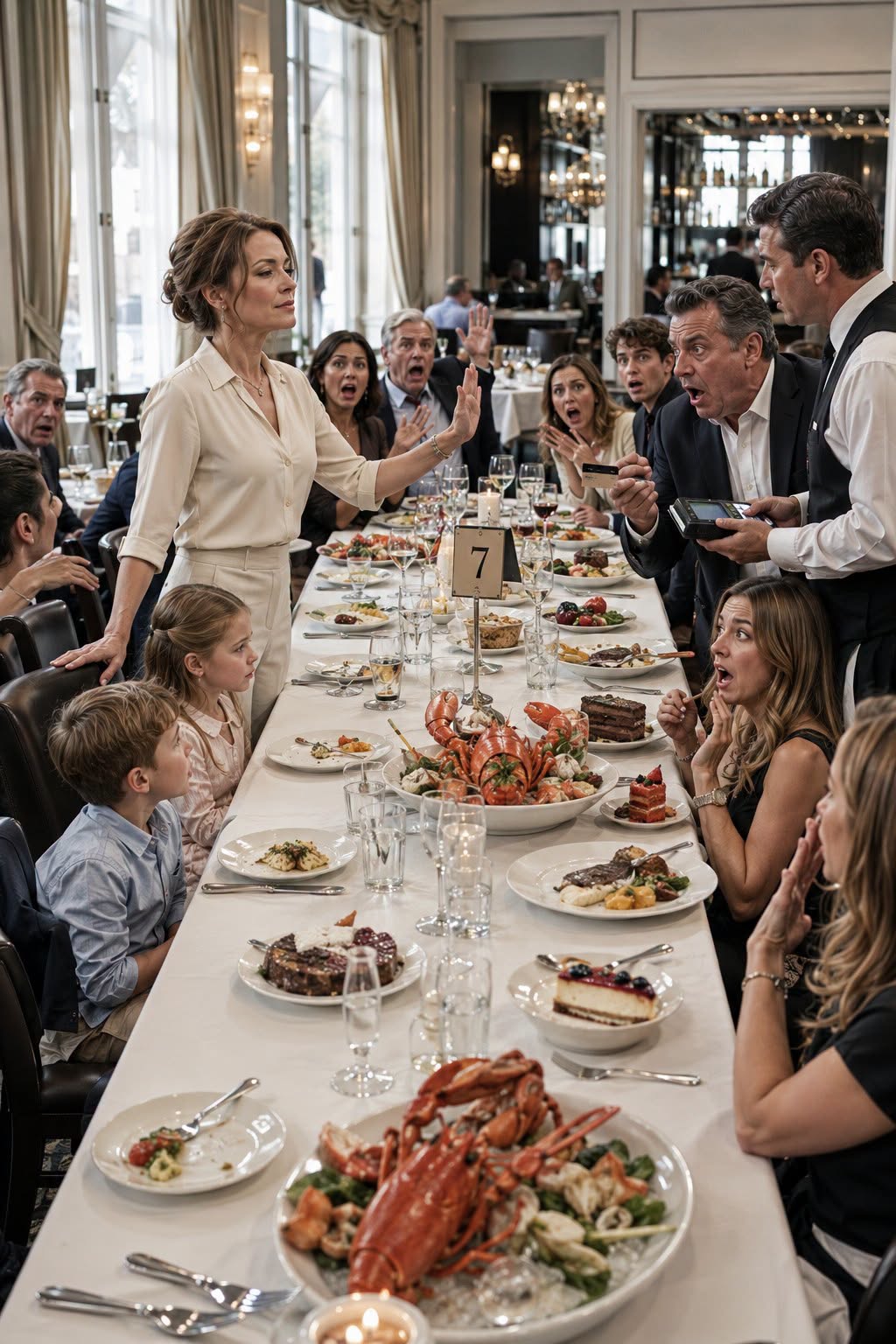
“One check. We’ll split it.”
I looked at the server.
“No.”
Raymond’s hand stopped.
“For table seven only,” I continued. “My food, my kids’ drinks, and my parents’ meals. Everything else is separate.”
The silence was beautiful.
Travis laughed uncertainly.
“Come on, Ethan.”
“I’m serious.”
Raymond leaned toward me.
“We always split.”
“You ordered lobster for four people.”
“So?”
“My children ate carrots off my plate.”
His face reddened.
“You’re embarrassing yourself.”
“No, Ray.”
I pulled Sophie’s coat from the back of her chair.
“I’m making sure everyone pays for what they consumed.”
A few minutes later the server returned with the checks.
Raymond barely looked at his before sliding a card into the folder.
“You don’t treat family like strangers,” he muttered.
The server disappeared toward the payment terminal.
I watched.
One attempt.
Then another.
The server looked down.
Tried again.
His posture changed.
When he returned, he spoke quietly.
“Sir, I’m sorry.”
Raymond looked up.
“Your card was declined.”
Nobody moved.
The server swallowed.
“This portion is eight hundred forty-seven dollars. Do you have another form of payment?”
And for the first time that evening, Uncle Raymond had absolutely nothing to say.
### Part 3
Raymond’s face didn’t turn red this time.
It went pale.
Not slightly pale.
Paper pale.
Travis suddenly became fascinated with his phone.
Denise stared at the bill as if an extra digit might disappear if she waited long enough.
My father cleared his throat.
Raymond grabbed the folder.
“Run it again.”
“I did, sir.”
“Well, do it again.”
The server kept his voice professional.
“I’m happy to, but it declined multiple times.”
“It’s your machine.”
“Ray.”
I said his name quietly.
He looked at me.
I put Sophie’s coat around her shoulders.
“Noah, buddy, get your jacket.”
That snapped him out of it.
“You’re leaving?”
“Yes.”
“You created this mess!”
“No. You ordered eight hundred dollars worth of dinner.”
“We were supposed to split it!”
I almost laughed.
Instead, I took out my wallet.
“My portion is already paid.”
Raymond shoved his chair back.
“You couldn’t just do what we always do?”
“No.”
“Why?”
I looked at Noah.
Then Sophie.
“Because my six-year-olds sat hungry while you ordered a second lobster tail for adults who were already eating steak.”
Denise’s lips tightened.
“Oh, stop making them victims.”
Sophie heard that.
I saw her face change.
And suddenly I understood that leaving wasn’t just about getting them fed.
It was about deciding which adult voice would stay in their heads afterward.
Raymond stood.
“You think I don’t know you’re struggling?”
There it was.
His favorite weapon.
Money.
“Raymond,” my mother whispered.
“No, Linda. He wants to act proud? Fine.”
He pointed at me.
“I bring him here so his kids can experience something better than pizza and cheap diners, and this is how he thanks me.”
I stepped closer.
“You brought them somewhere they weren’t allowed to eat.”
“Because children need discipline.”
“No. Because you need an audience.”
His jaw tightened.
Travis muttered, “Jesus, man.”
Raymond pointed toward the dining room.
“Look around. People are staring.”
“They’re staring because your card declined after you ordered nearly nine hundred dollars worth of food.”
For once, numbers were more effective than shouting.
We walked out.
The August night outside felt damp and warm after the freezing restaurant.
Noah took my left hand.
Sophie took my right.
Behind us, Raymond’s voice followed through the doors.
“Ungrateful!”
I didn’t turn around.
Ten minutes later, the twins were in the back seat with milkshakes.
I bought them chicken sandwiches and fries too.
No waiting for adults.
No hierarchy.
No lessons about gratitude.
Just food.
Sophie took three bites before she spoke.
“Daddy?”
“Yeah?”
“Was Uncle Ray mad because we were hungry?”
I looked at her in the rearview mirror.
“No.”
“Why was he mad?”
Because he couldn’t control me.
Because his generosity always came with invisible strings.
Because I had spent years confusing help with ownership.
I gave her the six-year-old version.
“Sometimes grown-ups get upset when people don’t follow their rules.”
Noah sucked chocolate shake through his straw.
“Even if the rules are dumb?”
I smiled despite myself.
“Especially then.”
The next morning, my phone was full.
Aunt Denise:
You humiliated Raymond.
Travis:
Bro, it was one dinner.
My mother:
Please apologize so we can move forward.
Raymond sent the longest message.
You don’t bite the hand that feeds you. Remember who has been helping you since Rachel left. Maybe think about what your life would look like without family support.
I read that line three times.
The hand that feeds you.
The irony almost impressed me.
I typed:
I can feed my own children.
Then I put the phone down.
At work Monday morning, I buried myself in reconciliations.
Numbers calm me.
They either balance or they don’t.
People can rename selfishness generosity.
They can call control tradition.
But $847 is still $847.
Just before lunch, an email appeared from the investment company holding Noah and Sophie’s college accounts.
Quarterly statement available.
I clicked it without much thought.
Then my stomach dropped.
Noah’s account balance was dramatically lower than it should have been.
So was Sophie’s.
I scrolled.
There were transfers.
Several of them.
All marked with language I didn’t recognize.
Managed allocation.
Business growth portfolio.
Authorization on file.
My pulse began beating in my ears.
I opened the oldest transfer.
Then another.
Then another.
Over six months, tens of thousands of dollars had moved out.
Money my ex-wife and I had originally saved.
Money from my grandmother.
Birthday gifts.
My monthly contributions.
College money.
I stared at the authorization line.
Manager: Raymond Parker.
And suddenly the restaurant bill stopped being the biggest number Uncle Raymond owed my children.
### Part 4
I didn’t call Raymond immediately.
That was the first smart thing I did.
The old version of me would have.
I would have demanded answers, listened to him explain why I misunderstood my own finances, and somehow ended the conversation apologizing for my tone.
Instead, I downloaded everything.
Statements.
Transfer records.
Account histories.
Authorization documents.
Then I called the investment company.
“This is Ethan Parker,” I told the representative. “I’m the owner of two education accounts. I need to know who authorized these withdrawals.”
Keyboard clicks.
A pause.
“It appears an authorized manager submitted the instructions.”
“Who?”
“Raymond Parker.”
“He’s my uncle.”
Another pause.
“Okay.”
“I never authorized him to withdraw anything.”
“Well, sir, we do have signed documentation.”
“Send me copies.”
The documents arrived fifteen minutes later.
I printed them.
My hands went cold.
The signature looked enough like mine to fool someone who had never watched me sign my name.
But it wasn’t mine.
The E leaned too far.
The P had a loop I never used.
And I knew exactly where Raymond had gotten the information needed to access those accounts.
Two years earlier, I’d let him “help.”
That word again.
After Rachel moved out of state, money became tight.
Rent.
Daycare.
Student loans.
Food.
School supplies.
The twins’ medical expenses.
I tracked every dollar because I had to.
Raymond had cornered me one Sunday in my parents’ kitchen.
“You’re doing those kids a disservice.”
“By buying groceries?”
“By thinking small.”
He wanted access to their college accounts.
Said he knew better investments.
Said he could help them “build real wealth.”
I resisted.
He pushed.
“Do you trust me or not?”
Eventually, I had sent him account information so he could make a contribution.
That was all.
A week later he sent me a picture of paperwork.
Got things streamlined. Don’t freak out.
I had freaked out.
He assured me it was routine.
I was exhausted.
Overwhelmed.
And stupid enough to believe family had limits.
Now I called him.
He picked up immediately.
“If this is about dinner—”
“It’s about Noah and Sophie’s money.”
Silence.
Then he laughed.
“Oh, that.”
My skin crawled.
“Where is it?”
“Invested.”
“Where?”
“In my company.”
I closed my eyes.
Raymond owned Parker Climate Solutions, a small HVAC operation in South Jersey.
He loved telling strangers he operated “multiple companies.”
As far as I could tell, the multiple companies were one HVAC business, a holding LLC, and a pickup truck with two different logos.
“You transferred my children’s college funds into your business?”
“Our family business.”
“No. Your business.”
“You don’t understand what I’m doing.”
“I’m an accountant.”
“You’re a conservative accountant. That’s your problem.”
I stared at the statements.
“More than thirty-six thousand dollars is missing.”
“It’s not missing.”
“Then send it back.”
“Ethan.”
“Send it back.”
“You’re being emotional.”
That word.
Men like Raymond use emotional the way other people use a fire extinguisher.
Whenever consequences start burning, they spray it everywhere.
“You forged my signature.”
“I streamlined paperwork.”
“You forged it.”
“You gave me access.”
“To contribute. Not withdraw.”
He sighed loudly.
“You know what? This is why nobody helps you. Every good thing someone does becomes a courtroom investigation.”
Something in that sentence stuck.
Courtroom.
Investigation.
Maybe he meant it sarcastically.
Maybe not.
I opened a new folder on my computer.
TWINS — FINANCIAL / LEGAL.
I saved every document.
Then I searched years of text messages.
I found Raymond saying:
Send me the account numbers. I’ll put something in for the kids.
Another:
Don’t worry if you miss a contribution. I got you.
Nothing about withdrawals.
Nothing about management authority.
Nothing about using their money for business cash flow.
I took screenshots.
Backed them up.
Printed copies.
Then I called a lawyer.
Claire Donovan specialized in family matters involving financial exploitation.
She listened while I talked for nearly forty minutes.
I apologized twice for rambling.
The second time, she put her pen down.
“Ethan.”
“Yeah?”
“You’re not rambling.”
She tapped the forged authorization.
“You’re describing somebody taking control of money belonging to your children without permission.”
She pointed to my neatly organized binder.
“And you may have just handed me the cleanest paper trail I’ve seen all month.”
I thought that was the surprise.
It wasn’t.
Claire turned another statement toward me.
“Do you see this company name?”
I did.
It wasn’t Raymond’s HVAC company.
“What is that?”
“That,” she said, “is what I think we need to look at next.”
### Part 5
The company was called Grayline Asset Partners.
I had never heard of it.
Neither had Raymond ever mentioned it.
Claire circled several transfers.
“Your kids’ money didn’t move directly from the education accounts into the HVAC company.”
I leaned closer.
“It moved here first.”
“Yes.”
“And then?”
“That’s what we need the compliance department to tell us.”
For the next week, I lived two lives.
During the day, I reviewed client statements, answered emails, and pretended I wasn’t imagining my children’s college money disappearing into a maze of accounts.
At night, after Noah and Sophie fell asleep, I sat at our kitchen table under the humming fluorescent light and organized evidence.
The apartment smelled faintly of nail polish remover from the salon downstairs.
The twins’ artwork covered the refrigerator.
Sophie had drawn all three of us standing beneath an enormous yellow sun.
Noah had drawn what appeared to be a dinosaur driving a city bus.
Those pictures kept me focused.
This wasn’t revenge.
It wasn’t about Raymond’s restaurant humiliation.
It was about two children who trusted adults to leave their future alone.
The investment company froze any remaining third-party authority while it investigated.
Claire reported the questionable documents to its compliance division.
Then she helped me file complaints with the appropriate state office.
Raymond called six times.
I answered once.
“You reported me?”
“Yes.”
“You actually reported your own uncle?”
“Yes.”
“You’re trying to destroy my company.”
“I’m trying to recover my children’s money.”
“Same thing.”
That answer told me more than any confession could have.
A few days later, Claire called.
“Grayline isn’t some high-return investment vehicle.”
“What is it?”
“From what we can tell, it’s a management entity Raymond controls.”
I sat down.
“So he moved the money from the twins’ accounts to a company he owns, then from there into his HVAC business?”
“That appears to be what happened.”
“Why?”
“Cash flow.”
The phrase felt dirty.
Payroll.
Supplier bills.
Debt.
Whatever Raymond needed money for, apparently Noah and Sophie had become his emergency line of credit.
And because they were children, he had expected nobody to make noise.
My parents reacted exactly as I feared.
My mother called first.
“Ethan, your uncle says you’ve involved lawyers.”
“I have.”
“Can’t you two talk?”
“We did.”
“Then talk again.”
“He took the twins’ money.”
“He says he invested it.”
“He used it in his business.”
“Well, if he pays it back—”
“Mom.”
Her voice softened.
“He loves those kids.”
I looked through the living-room doorway.
Noah was making a pillow fort.
Sophie was ordering him around like a tiny general.
“Love doesn’t forge signatures.”
Silence.
Then the sentence I had heard a thousand versions of growing up.
“Families make sacrifices.”
I almost laughed.
“Whose sacrifice?”
“What?”
“Raymond needed money, so Noah and Sophie sacrificed theirs. At dinner, he wanted control, so Noah and Sophie sacrificed their meal. At their birthday, his teenagers wanted the pool, so Noah and Sophie sacrificed their turn.”
“That isn’t fair.”
“No. It isn’t.”
She meant my description.
I meant the reality.
The conversation ended badly.
That Sunday, my mother called again.
“Please come to dinner.”
“No.”
“Your father misses the twins.”
“He can visit.”
“Raymond will be here.”
“Then definitely no.”
She exhaled.
“Ethan, somebody has to be the bigger person.”
That phrase made my teeth hurt.
“Why is the bigger person always the one who got hurt?”
She had no answer.
Then she started crying.
I hated that.
My mother’s tears had been one of Raymond’s shields since I was a teenager.
Anything that upset family peace became worse than whatever had caused the upset.
Finally, she said, “Just come once. Bring your paperwork. Everybody can sit down calmly.”
I agreed for one reason.
Claire wanted witnesses.
“If he’s the kind of man you describe,” she had told me, “don’t push him into admitting anything.”
“What do I do?”
“Give him room.”
“For what?”
“To explain how smart he thinks he is.”
So I arrived at my parents’ house that Sunday carrying a black binder.
Raymond arrived twenty minutes late.
He strode through the front door laughing.
Kissed my mother’s cheek.
Clapped my father on the shoulder.
Then saw me sitting at the dining table.
“Well, look who finally came down from his cross.”
I said nothing.
His smile widened.
“Still pouting about your little accounts?”
I opened the binder.
“No.”
I pushed the first statement across the table.
“I came to hear you explain them.”
### Part 6
Raymond sat down slowly.
Aunt Denise took the chair beside him.
My father stood near the counter.
My mother twisted a dish towel in both hands.
Noah and Sophie were in the living room watching cartoons.
I had made sure the television was loud enough that they couldn’t hear normal conversation.
I also knew Raymond didn’t do normal conversation for long.
I opened the binder.
“This was Noah’s education account.”
I placed another page beside it.
“This was Sophie’s.”
Then the transaction history.
“You moved more than thirty-six thousand dollars.”
Raymond glanced over the pages.
“Correct.”
My father’s head snapped toward him.
“You did?”
Raymond waved him off.
“It’s invested.”
“In what?” I asked.
“My business.”
“Why?”
He gave me a look like I was slow.
“Because businesses grow money.”
“You needed working capital.”
“So?”
“You used children’s college savings as working capital.”
Denise jumped in.
“Stop saying it like that.”
“How should I say it?”
“You’re making him sound like a criminal.”
I looked at Raymond.
“Did I authorize those transfers?”
He shifted.
“You authorized me to handle things.”
“No. I gave you the account information to contribute money.”
“Semantics.”
My mother whispered, “Ray…”
I slid the authorization form forward.
“Is this my signature?”
He barely looked at it.
“It’s paperwork.”
“Is it mine?”
“You said I could help.”
“Is that my signature?”
His jaw tightened.
Finally he snapped, “I signed what needed signing because you never handle anything until the last minute.”
My father stared at him.
“You signed Ethan’s name?”
Raymond threw up his hands.
“Oh, for God’s sake. Don’t act like I robbed a bank.”
There it was.
Claire had been right.
Give an arrogant man enough room and eventually he’ll build his own gallows.
I kept my voice even.
“What happened to the money?”
“I already told you.”
“Be specific.”
“My company had a rough quarter.”
Denise closed her eyes.
Raymond kept going.
“Supplier costs went up. Two major commercial jobs paid late. Payroll doesn’t care whether customers pay on time.”
“So you used Noah and Sophie’s money.”
“Temporarily.”
“You didn’t ask.”
“Because you would have said no.”
My mother sat down.
That answer hit even her.
I leaned back.
“Exactly.”
Raymond realized it too late.
He pointed at me.
“Don’t twist my words.”
“I’m not.”
“You’ve been looking for an excuse to disrespect me since that restaurant.”
“This started six months before the restaurant.”
“You think you’re so independent?”
His voice rose.
“You live above a nail salon, Ethan. You drive a ten-year-old Honda. You pack leftovers for lunch. Those kids would have nothing if people like me didn’t step in.”
I felt anger.
Then, surprisingly, pity.
This man genuinely believed price tags proved worth.
My children’s apartment embarrassed him.
Their diner dinners embarrassed him.
My sensible car embarrassed him.
Because if a person could be happy without looking rich, then Raymond’s entire life was built around impressing people for no reason.
“They have me,” I said.
He laughed.
“Exactly my point.”
“No. You missed it.”
I closed the binder.
“They have a father who pays the rent before buying lobster.”
My dad looked down.
My mother started crying.
Raymond slapped the table.
“Everything I’ve done has been for this family!”
The sound made Noah and Sophie appear in the hallway.
Sophie hugged her stuffed rabbit to her chest.
“Daddy?”
I immediately stood.
“We’re okay.”
Raymond pointed toward them.
“See? Now you’re frightening the kids.”
I almost admired the speed of that reversal.
I walked over and knelt.
“Go get your shoes, guys.”
“Are we leaving?”
“Yes.”
They disappeared down the hall.
When I returned, I removed one final document from the binder.
Raymond scoffed.
“What now?”
I placed it on the table.
“My attorney sent you formal notice today.”
He stared at the page.
“Notice of what?”
“You have thirty days to restore every dollar taken from the accounts, including the calculated loss.”
His eyes lifted.
“And if I don’t?”
“The compliance case continues. So do the state complaints.”
Denise gasped.
“You would do that to family?”
I looked at her.
“He already did it to family.”
Then I placed down another document.
“And this restricts Raymond’s unsupervised access to Noah and Sophie while the financial matter is being investigated.”
Raymond shot to his feet.
“You can’t keep them from me.”
“I can protect my children.”
“I’m their uncle!”
“Great-uncle.”
“That changes nothing.”
“It changes plenty.”
He leaned over the table.
“You are going to regret humiliating me.”
For the first time, I smiled.
“No, Ray.”
I picked up my binder.
“You keep confusing embarrassment with consequences.”
Then my phone buzzed.
A message from Claire.
Three words.
Call me immediately.
And the attachment underneath it showed that Raymond’s problem was about to become much larger than thirty-six thousand dollars.
### Part 7
I called Claire from my car.
The twins were buckled into the back seat.
Noah was explaining something complicated about dinosaurs to Sophie.
I put Claire on Bluetooth but lowered the volume.
“What happened?”
“The compliance department found additional activity.”
My stomach tightened.
“In the twins’ accounts?”
“No. That’s the interesting part.”
She paused.
“Raymond appears to have used the same management authorization process with at least two other relatives.”
I went silent.
“Who?”
“They can’t disclose identities to us. But the pattern triggered an expanded review.”
I stared through the windshield at my parents’ porch.
Raymond was visible through the window, pacing.
My father sat at the table.
My mother had both hands over her face.
“So this wasn’t just us.”
“It doesn’t look like it.”
A strange feeling washed over me.
Not satisfaction.
Something colder.
I had spent years wondering whether I was too sensitive.
Whether Raymond treated me differently because I was divorced.
Because I had less money.
Because I didn’t respect him enough.
Now another possibility existed.
Maybe Raymond treated generosity like a business model.
Give first.
Gain access.
Create obligation.
Then take.
Over the following weeks, the family split exactly where old fractures had always existed.
Denise called me vindictive.
Travis sent a message saying I was “destroying a man over paperwork.”
My mother begged me not to discuss it outside the family.
My father surprised me.
He showed up at my apartment alone one Wednesday evening carrying a pizza.
No lecture.
No message from Raymond.
Just pizza.
After the twins went to bed, he sat across from me at the little kitchen table.
“I’m sorry.”
I looked up.
“For what?”
“For not saying anything at the restaurant.”
He rubbed his thumb along the edge of his paper plate.
“I saw those kids sitting there.”
I didn’t rescue him.
He needed to finish.
“I knew it was wrong.”
“Why didn’t you say something?”
“Because your uncle makes every disagreement exhausting.”
“That’s not a reason.”
“No.”
His eyes lowered.
“It’s an excuse.”
That was the first useful apology anybody in my family gave me.
Dad didn’t ask me to forgive Raymond.
He didn’t tell me to be the bigger person.
He just said, “I should have protected my grandchildren from being humiliated in front of me.”
I nodded.
“Yeah.”
“I’ll do better.”
“That’s all I’m asking.”
Raymond waited twenty-seven days.
Then Claire called.
“The funds arrived.”
“All of them?”
“Full principal, plus the amount we demanded for estimated losses.”
I sat back in my office chair.
“Where did he get it?”
“Not our problem.”
That afternoon, I moved every dollar into new accounts.
New institution.
New passwords.
No family intermediaries.
No “help.”
No shortcuts.
Only me.
The state review didn’t disappear simply because Raymond repaid the money.
Neither did the compliance investigation.
That part belonged to the professionals now.
Raymond sent one final message.
I hope you’re happy. I had to liquidate assets because you couldn’t give me a little time. After everything I did for you, I hope someday your kids understand what you cost this family.
I read it once.
Then blocked his number.
Not muted.
Blocked.
Denise too.
Travis followed after he called me selfish for refusing to drop everything.
My mother hated it.
For several months she kept testing the boundary.
“Raymond sent Christmas gifts.”
“No.”
“He wrote birthday cards.”
“Return them.”
“He wants to apologize.”
“He knows my lawyer’s address.”
“Ethan.”
“Mom.”
One afternoon, she placed an envelope on my kitchen counter.
“Just take it. It’s money for the twins.”
I didn’t touch it.
“From Raymond?”
“Yes.”
“No.”
“It’s five hundred dollars.”
“I don’t care.”
“He’s trying.”
“No. He’s purchasing access.”
“That isn’t fair.”
I looked at her.
“You keep using that phrase when what you mean is that I’m no longer making this easy for everyone.”
She stared at me.
I pushed the envelope back.
“My children are not taking money from a man who once decided they weren’t important enough to eat dinner with the adults.”
Her eyes filled.
“Are you really going to hold one dinner against him forever?”
“No.”
I shook my head.
“I’m going to remember the pattern forever.”
That distinction mattered.
Because the restaurant hadn’t destroyed our family.
It had simply turned on the lights.
And once you see the strings attached to someone’s generosity, you can’t pretend they’re ribbons anymore.
### Part 8
A year later, our Friday nights looked nothing like Uncle Raymond’s idea of success.
We had our own traditions.
Payday Friday meant dinner somewhere the twins chose.
Sometimes pizza.
Sometimes the diner on Washington Avenue where the menus were sticky and the waitress called everybody “hon.”
Sometimes grilled cheese at home while we watched a movie nobody paid attention to.
Noah always tried to convince me that ordering fries “for the table” meant he personally owned eighty percent of them.
Sophie had developed strong opinions about milkshake flavors.
Our apartment was still small.
My Honda was still old.
I still brought leftovers to work.
But something had changed.
I stopped measuring my life against Raymond’s.
That was freedom I hadn’t known I was missing.
The freelance tax work I started during the legal mess became regular side income.
I paid off one of my student loans early.
I rebuilt my emergency fund.
And every month, money went quietly into Noah and Sophie’s college accounts.
Nothing flashy.
Just consistent.
My dad began visiting every other Saturday.
He never arrived empty-handed, but he stopped bringing expensive things.
He brought puzzles.
Used books.
Once, inexplicably, a huge box of sidewalk chalk.
The twins loved it.
My mother took longer.
She still spoke to Raymond.
I never demanded otherwise.
Boundaries aren’t about controlling everybody else.
That was Raymond’s mistake.
They’re about deciding what you will participate in.
Eventually Mom stopped carrying messages.
She stopped asking me to “just hear him out.”
The first Thanksgiving after everything happened, she called.
“Raymond won’t be there.”
“Okay.”
“I told him I couldn’t have him around the twins unless you were comfortable.”
I was quiet.
“That probably wasn’t easy.”
“No.”
“What did he say?”
“That you’d poisoned everyone against him.”
I laughed softly.
“Of course.”
Then Mom surprised me.
“I told him he managed that himself.”
That Thanksgiving, Noah and Sophie helped my father set the table.
When dinner was ready, Sophie climbed into her chair.
She looked around suspiciously.
“Are kids eating now?”
Every adult at the table went quiet.
My chest tightened.
“Yes,” I said.
“At the same time?”
“At the same time.”
She smiled.
“Good.”
My mother turned away for a moment, pretending to adjust something on the counter.
I knew she was crying.
I didn’t punish her for it.
But I didn’t pretend the past had vanished either.
After dinner, my father brought out pie.
Noah immediately asked for the biggest piece.
“Absolutely not,” I said.
“Why?”
“Because I want the biggest piece.”
He gasped.
“That’s selfish!”
“It’s called being an adult.”
Sophie pointed her fork at me.
“Kids eat after adults?”
I laughed so hard I nearly spilled my coffee.
“No. Everybody gets pie.”
That was the lesson I wanted them to remember.
Not that children always come first.
Not that adults always come first.
That people who love you don’t need to make you smaller to prove they matter.
Months later, I ran into Raymond unexpectedly.
I was leaving a hardware store with Noah and Sophie when I saw him near the entrance.
He looked older.
Not ruined.
Not homeless.
Not some dramatic movie villain destroyed by justice.
Just older.
That felt more real somehow.
His business was apparently still operating, although smaller.
Whatever happened with the broader investigation stayed mostly outside my life.
Claire handled what involved us.
The rest wasn’t my story.
Raymond saw the twins.
His expression changed immediately.
“Ethan.”
I stopped.
The kids stayed beside me.
He looked at Noah.
Then Sophie.
“Wow. You two got big.”
Neither answered.
Raymond looked back at me.
“Can we talk?”
“You’re talking.”
He swallowed.
“I made mistakes.”
I waited.
“I was under pressure.”
Still waiting.
“I thought I could replace the money before anybody noticed.”
There it was.
Not before anybody needed it.
Before anybody noticed.
“I know.”
“I never meant to hurt the kids.”
“You were willing to risk their money without asking.”
“I paid it back.”
“After lawyers.”
His jaw moved.
“I miss them.”
I believed him.
That didn’t change anything.
“Raymond, you don’t miss a relationship you respected. You miss access you assumed you’d always have.”
He looked wounded.
Maybe he was.
People can hurt you and still feel pain when you leave.
One doesn’t erase the other.
“Is there really nothing I can do?”
I looked at him for a long moment.
A year earlier, part of me might have wanted that question.
I might have imagined some perfect apology where Raymond finally understood everything and I got the uncle I wished I had.
But late understanding doesn’t restore old trust.
Sometimes the lesson arrives after the relationship has already expired.
“You can become a better person,” I said.
His eyes lifted.
“But you’ll have to do it without using my children as proof.”
I took Noah’s hand.
Sophie grabbed the other.
Then we walked away.
That night was Friday.
The twins chose the diner.
We squeezed into our usual booth under a flickering sign while plates clattered behind the counter and somebody’s toddler laughed three tables away.
The waitress came over.
“What’ll it be?”
Noah ordered a cheeseburger.
Sophie ordered mac and cheese.
“Extra cheese,” she added confidently.
The waitress turned to me.
“And Dad?”
“Turkey club.”
She gathered the menus.
“All together?”
I looked at my kids.
“Absolutely.”
Their plates came out before mine.
Noah looked at them, then at me.
“Dad, should we wait?”
I smiled.
“No, buddy.”
“Really?”
“Really.”
Sophie already had her fork in the macaroni.
“Good,” she said. “Because I’m starving.”
I watched them eat.
No speeches.
No hierarchy.
No one earning the right to be fed.
Just two happy kids in a cheap diner with full plates in front of them.
Raymond had spent years telling me that family takes care of family.
He was right about one thing.
Family does.
He had simply never understood what taking care of someone actually meant.
THE END!