PART 1: THE WORDS HE THOUGHT WOULD ERASE ME
“She’s not my biological daughter.”
My father delivered those words in open court as if he were stating the weather.
For a few seconds, nobody moved.
The probate courtroom in Chicago became so quiet I could hear the fluorescent lights humming above us. Somewhere behind me, someone shifted in a wooden chair. Paper whispered against paper at the attorneys’ tables.
My father, Edgar Donovan, remained on the witness stand.
He didn’t look at me.
That hurt more than the words.
Not because I believed him.
Because I knew he had practiced saying them without looking at me.
Across the aisle, my stepmother, Diane, lowered her eyes with the solemn expression she wore at funerals, charity dinners, and any public event where she wanted people to admire her restraint.
Beside her sat her son, Nicholas.
My half-brother.
At least, that was what I had called him for most of my life.
Nicholas stared straight ahead, jaw tight, hands clasped on the table.
Their attorney rose.
“Your Honor, in light of the recently obtained genetic testing and supporting records, Mr. Donovan’s position is that Ms. Donovan does not qualify as his biological descendant for purposes of the disputed estate and associated family holdings.”
Associated family holdings.
That was a beautiful phrase for several billion dollars in voting shares of Donovan Global Dynamics.
Twenty-six years of my life.
My mother’s sacrifices.
My father’s ambition.
And my work.
Reduced to associated family holdings.
The attorney continued talking.
DNA.
Inheritance definitions.
Beneficiary eligibility.
Biological descent.
Intent of the settlor.
Corporate succession.
He said the words smoothly, because expensive lawyers were trained to make violence sound administrative.
I sat beside my attorney, Rebecca Hart, with my hands folded in my lap.
She leaned toward me.
“You all right?”
“No.”
She glanced at me.
I added quietly, “But I expected it.”
That was the difference.
An ordinary daughter might have collapsed in that courtroom.
She might have stared at the man who raised her and tried to understand how forty-two years could be erased by one laboratory report.
She might have wondered whether every birthday, every Christmas, every scraped knee, every graduation, every family photograph had suddenly become a lie.
I didn’t have the luxury of being surprised.
I had spent five years watching them build toward this moment.
I just hadn’t known exactly which weapon they intended to use until nine months earlier.
My father finally looked at me.
Only for a second.
His eyes met mine.
Then moved away.
I almost smiled.
Because I knew fear when I saw it.
And Edgar Donovan was afraid.
That mattered.
My father had built an international industrial technology company from a rented warehouse in suburban Chicago. He had negotiated with unions, governments, defense contractors, banks, hostile investors, regulators, and men whose private jets cost more than most companies.
Edgar did not frighten easily.
But that morning, there was fear in his eyes.
Not guilt.
Not yet.
Fear.
The judge turned toward the attorneys.
“Counsel, I understand the significance you attach to the genetic evidence. I am less clear about why this issue is being raised at this stage.”
Their attorney, Malcolm Pierce, stepped forward.
“Your Honor, the disputed trust provisions repeatedly reference Mr. Donovan’s descendants. In addition, certain stock transfer restrictions incorporated into the estate plan apply to direct lineal family members. The evidence establishes that Ms. Donovan does not fall within that category.”
Rebecca rose.
“That is a highly selective characterization of the documents.”
Pierce barely looked at her.
“We’ll address interpretation in due course.”
“You’re asking the court to decide interpretation while concealing the history behind the document.”
“Objection.”
The judge lifted a hand.
“Ms. Hart. You’ll have your opportunity.”
Rebecca sat.
I could feel Diane watching me now.
I did not turn toward her.
I didn’t need to.
I had spent enough years learning the way Diane operated.
She never attacked first.
She moved furniture.
Changed dinner reservations.
Rescheduled meetings.
Suggested that certain decisions would be “easier” if someone else handled them.
She rearranged a life until one day you realized you no longer had a place inside it.
The first time I met her, I was thirty.
My mother had been dead fourteen months.
Diane arrived at a foundation dinner wearing a silver dress and carrying no visible grief whatsoever.
She was beautiful in the deliberate way some people are beautiful—a carefully managed combination of hair, posture, tone, and attention.
My father introduced her as a friend.
Six months later, she was living with him.
A year after that, they married.
I did not hate her for replacing my mother.
Nobody could replace my mother.
That wasn’t the problem.
The problem was that Diane understood something very quickly.
Donovan Global Dynamics was not merely a company.
It was our family’s history made tangible.
Control the company, and you controlled the story of who mattered.
And Diane wanted Nicholas inside that story.
At first, it seemed reasonable.
Nicholas was twenty-six when my father and Diane married. He had an MBA, three years at a consulting firm, excellent manners, and the natural confidence of a man who had never entered a room wondering whether anyone wanted him there.
My father offered him a corporate strategy position.
I supported it.
I actually recommended that Nicholas spend his first year rotating through operations.
“You think I need factory training?” he asked me.
“If you’re going to advise people who run factories, yes.”
He laughed.
“You really are Edgar’s daughter.”
At the time, I thought it was a compliment.
Years later, I would remember the sentence differently.
Because Nicholas learned.
He learned the business.
He learned the board.
He learned my father.
And Diane learned everything else.
Which executives resented me.
Which directors believed a woman could run the company but preferred not to test the theory.
Which family trusts controlled voting shares.
Which documents had been signed when.
Which provisions became vulnerable if certain relationships were redefined.
Five years before that courtroom hearing, meetings began appearing on my father’s calendar without me.
Three years before it, Nicholas became executive vice president.
Two years before it, a revised will appeared.
Eighteen months before it, my father began transferring responsibilities I had held for years.
And nine months before it, someone went looking for records from St. Matthew’s Hospital dated October 1981.
My records.
That was when I stopped pretending this was ordinary succession planning.
I hired Rebecca.
Quietly.
Then I started looking too.
Now we were here.
My father on a witness stand.
Diane wearing black.
Nicholas pretending not to know me.
And Malcolm Pierce arguing that biology should decide who belonged to a family.
The judge turned toward my father.
“Mr. Donovan, when did you first learn that Ms. Donovan was not your biological child?”
There it was.
The question I had been waiting for.
My father’s fingers tightened against the edge of the witness stand.
Pierce immediately stood.
“Your Honor, we would prefer to address the chronology through the documentary record.”
“I asked the witness.”
My father looked toward his lawyer.
The judge noticed.
“So I’ll ask again. Mr. Donovan, when did you first learn?”
A pause.
“Recently.”
One word.
Rebecca wrote something on her legal pad.
I kept watching my father.
The judge frowned.
“How recently?”
“Within the last year.”
That was the first lie.
Not the first lie my father had ever told me.
But the first one I heard him tell under oath.
And strangely, hearing it made me calmer.
Because now I knew exactly what he had chosen.
He wasn’t confused.
He wasn’t being manipulated.
He wasn’t an elderly man pushed into something he didn’t understand.
He had chosen Diane.
He had chosen Nicholas.
He had chosen control.
And to preserve all three, he had decided to rewrite my birth.
Pierce guided him through the rest.
A private investigator had located historical medical information.
Modern testing had been conducted.
The probability that Edgar Donovan was my biological father was effectively zero.
My father described himself as “shocked.”
Diane touched his arm when he returned to the table.
Nicholas finally looked at me.
There was something almost apologetic in his expression.
Almost.
I remembered another day.
Twenty-four years earlier.
My first week at Donovan Global Dynamics.
I had graduated from Northwestern and expected my father to put me somewhere near corporate headquarters.
He sent me to Plant Three.
Second shift.
Quality control.
I had been furious.
“You’re punishing me because I’m your daughter,” I told him.
“No,” he said. “I’m making sure nobody can ever say you got to the top because you’re my daughter.”
“Big difference.”
“It will be one day.”
For three years, I did jobs nobody photographed.
Inventory counts at two in the morning.
Vendor disputes.
Broken production lines.
Safety audits.
A winter when our Wisconsin plant almost lost its largest customer.
I moved upward slowly.
When I finally became chief operating officer at thirty-seven, the announcement called me a twenty-year company veteran.
Not the founder’s daughter.
That had been my father’s rule.
Earn it.
And I had.
Which was why the irony nearly choked me now.
He had spent my entire career insisting I prove I was more than his daughter.
Now he was trying to take everything I had earned by insisting I was never his daughter at all.
When Pierce finished, the judge looked toward our table.
“Ms. Hart?”
Rebecca stood.
“Your Honor, before I question Mr. Donovan, my client wishes to address one foundational issue.”
The judge looked at me.
“Ms. Donovan?”
I rose.
My knees were steady.
I had wondered for weeks whether they would be.
“My response, Your Honor, is that this matter did not begin where they claim it began.”
Pierce frowned.
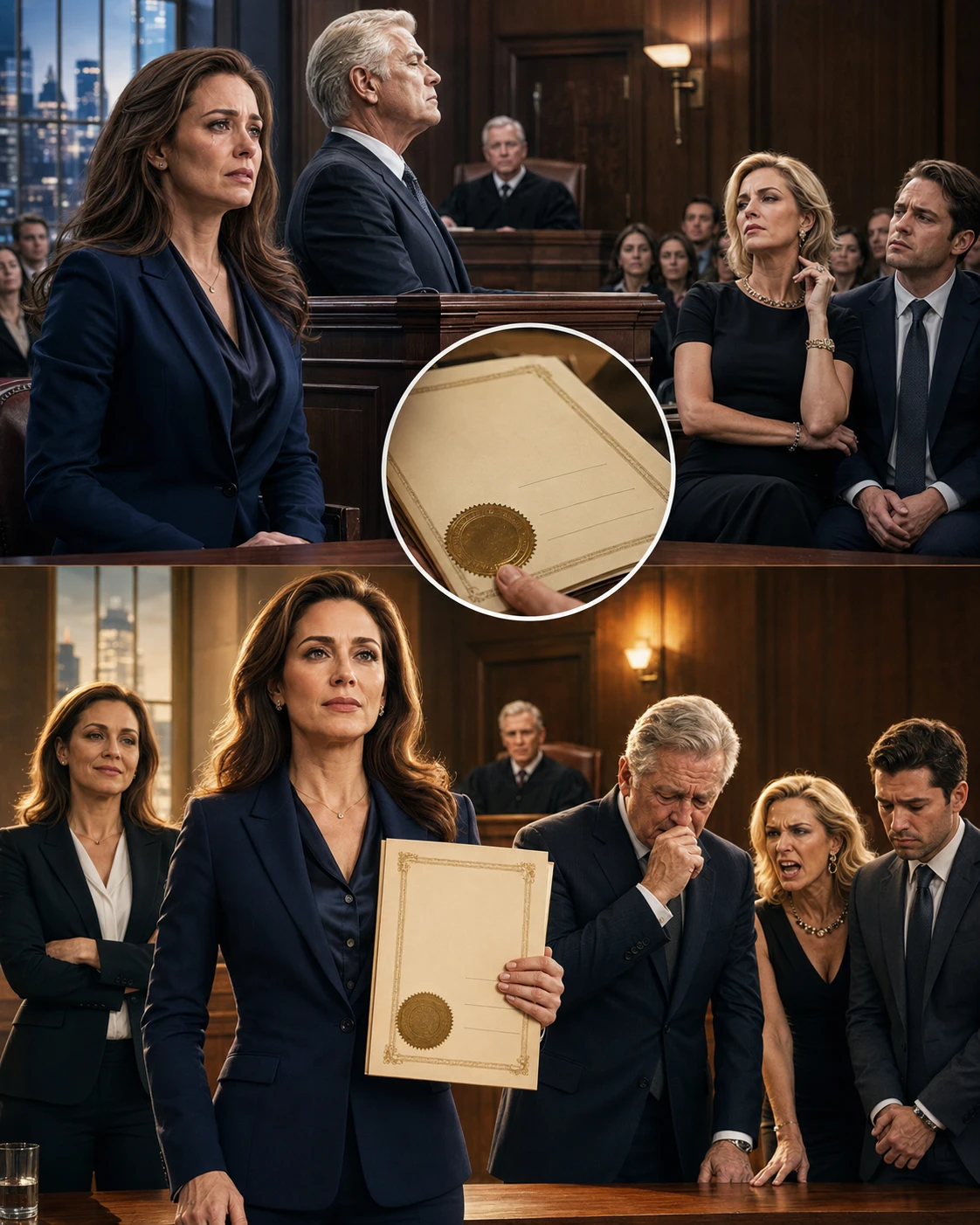
Rebecca said, “We would like to submit a certified court record.”
That changed something.
Diane’s eyes snapped toward the briefcase at my feet.
Nicholas shifted in his chair.
My father looked at me.
And there it was again.
Fear.
I bent down.
Opened the case.
Removed a cream-colored folder.
The paper inside weighed almost nothing.
It had survived forty-four years.
A death.
Two house moves.
One flood in my mother’s basement.
A corporate merger.
And several people who apparently would have preferred it never be found.
I carried it toward the bench.
Pierce held out his hand.
The clerk gave him a copy.
His expression changed before he reached the bottom.
Not dramatically.
Malcolm Pierce was too experienced for that.
But the color drained from his face.
He looked at my father.
Then at Diane.
Then back at the document.
The judge read silently.
The courtroom remained still.
Finally, she raised her eyes.
“Mr. Pierce.”
“Yes, Your Honor.”
“Did your client tell you about this?”
Pierce did not answer immediately.
My father did.
“No.”
The judge looked directly at him.
“What you have just said creates a problem, Mr. Donovan.”
My father swallowed.
Diane stopped pretending to look calm.
And for the first time in five years, I realized they had made a mistake they could not quietly correct with another meeting.
The judge placed the paper on the bench.
It was a certified copy of an adoption decree entered in Cook County on June 18, 1982.
Petitioner:
Edgar James Donovan.
Child:
Me.
He had not discovered that I wasn’t his biological daughter last year.
He had known before I could walk.
And forty-four years earlier, he had gone before another judge and asked the law to make me his daughter forever.
PART 2: WHAT MY MOTHER LEFT BEHIND
My mother used to say that people remembered emotion and paper remembered facts.
When I was younger, I thought that was simply another one of Sarah Donovan’s strange bookkeeping philosophies.
She saved everything.
Receipts.
Tax records.
Warranties for appliances we no longer owned.
Mortgage documents after the mortgages were paid.
My report cards.
Letters.
Cancelled checks.
Corporate ledgers from the earliest days of Donovan Global Dynamics.
She stored records in labeled archival boxes and wrote dates in blue ink with the same fountain pen for almost thirty years.
My father teased her constantly.
“One day,” he would say, “we’re going to need another house just for your paperwork.”
My mother would answer, “One day you’ll be grateful I can prove what happened.”
After she died, I could not bear to go through her things.
So I rented a climate-controlled storage unit and moved most of the boxes there.
For fourteen years, they sat untouched.
Then someone started searching for the truth about my birth.
The first warning came from a retired hospital administrator.
Her name was Ellen Marsh.
She called me at work.
“Ms. Donovan?”
“Yes?”
“This is going to sound unusual.”
Most dangerous conversations in my life had started with some version of that sentence.
Ellen explained that she had once worked in records administration at St. Matthew’s, the hospital where I was born.
A private investigator had contacted her.
“He was asking about archived maternity files,” she said.
“My files?”
“He mentioned your mother’s name.”
My fingers went still on my desk.
“What did you tell him?”
“Nothing confidential. I haven’t had access in years. But he was unusually persistent.”
“Did he say who hired him?”
“No.”
He didn’t need to.
Three days earlier, Nicholas had chaired a succession committee meeting I was supposed to chair.
My father claimed it had been a scheduling mistake.
There were becoming too many scheduling mistakes.
I called Rebecca that afternoon.
We had known each other since college.
She was a probate and fiduciary-litigation attorney and had spent twenty years dealing with families who loved one another until enough money entered the room.
When I finished explaining, she was silent.
Then she asked, “How much is at stake?”
“Personally?”
“Financially.”
“Depending on valuation? The family-controlled shares tied to the estate plan could be worth between three and four billion.”
“Sarah.”
“I know.”
“No. I don’t think you do. Nobody hires an investigator to dig through forty-year-old maternity records because they’re curious about genealogy.”
I knew that too.
I just wasn’t ready to say it aloud.
That night, I drove to the storage facility where my mother’s boxes had been sitting since her death.
I stayed until after midnight.
Dust caught in the light from the overhead fixtures.
I opened box after box.
Household finances.
Old company documents.
Medical bills.
Correspondence.
My hands started shaking when I found the box labeled:
ANNA — BIRTH / MEDICAL / SCHOOL
Anna.
Me.
Inside were photographs of my mother holding me in the hospital.
A tiny plastic bracelet.
My first pediatric records.
An envelope containing my birth certificate.
I had seen copies before.
Father: Edgar James Donovan.
Mother: Sarah Anne Donovan.
Nothing unusual.
Except the certificate had been issued ten months after my birth.
I stared at the date.
Then I saw my mother’s handwriting on the envelope.
Amended copy. Keep with decree.
Decree.
I searched the box.
Nothing.
For the first time in my life, I hated my mother’s filing system.
I went through everything again.
Then a third time.
No decree.
But there was another envelope.
Inside was a carbon copy of a letter dated February 1982 from an attorney named Harold Beck.
I read it standing under the buzzing storage light.
Sarah, I have received the remaining consent. Edgar’s petition can now proceed. Assuming no objection, the adoption should be finalized before summer.
My throat closed.
Adoption.
I sat on the concrete floor.
I read the letter again.
Then again.
It is difficult to explain what happens inside you when a fact arrives forty years late.
Nothing about my childhood changed.
And everything changed.
I remembered my father teaching me to ride a bicycle.
My father asleep in a hospital chair when I had appendicitis at fourteen.
My father refusing to speak to me for two days after I crashed his Mercedes at seventeen.
My father crying at my wedding.
My father holding my son for the first time.
None of it disappeared.
But a door opened behind every memory.
And suddenly I was looking through it, searching for something I had never known was missing.
I called Rebecca.
She answered on the third ring.
“It’s midnight.”
“I was adopted.”
Silence.
Then, “Where are you?”
We spent the next six months finding out what that sentence meant.
The county records were old.
Some were sealed.
Some had been transferred.
Some existed only as indexes.
St. Matthew’s had closed its original maternity wing decades earlier.
The attorney who handled the proceeding was dead.
The family doctor was dead.
My mother was dead.
For a while, it felt as though time itself had agreed to keep the secret.
But paper remembers facts.
The amended birth certificate led us to the court index.
The court index led to the case number.
The case number led Rebecca through a maze of petitions and eventually to an order unsealing a limited portion of the historical record because my legal status was directly at issue in pending litigation.
And there it was.
A one-page final decree.
I was seven months old when Edgar Donovan adopted me.
Not because he was deceived.
Not because my mother tricked him.
Not because he discovered the truth years later.
The petition stated that he entered the proceeding with full knowledge that he was not my biological father and requested that I be legally recognized as his child “for all purposes and with all rights attendant thereto.”
All purposes.
All rights.
His signature appeared at the bottom.
The shock should have been enough.
It wasn’t.
Because once I knew there had been an adoption, several things stopped making sense.
Why had my father hidden it?
Why had my mother hidden it?
Why had the investigator gone to the hospital rather than simply searching court records?
And why was my father suddenly willing to publicly disown a daughter he had voluntarily adopted?
That was when Rebecca told me not to confront him.
“We know a fact,” she said. “We don’t know the plan.”
So I waited.
That may have been the hardest thing I ever did.
I sat in meetings with my father while knowing he had kept the central fact of my birth from me for forty years.
I listened to Diane ask questions about family trusts.
I watched Nicholas receive more authority.
And I said nothing.
Instead, I followed my mother’s records.
The hospital files confirmed the birth certificate had originally listed no father.
A retired clerk remembered amended certificates being issued after adoptions.
Then we located a nurse.
Margaret Bell was eighty-three and lived in Rockford.
She remembered my mother.
Not immediately.
But when I showed her a photograph, she smiled.
“Oh, yes. Sarah.”
My chest tightened.
“You remember her?”
“She was terrified.”
That surprised me.
My mother had never seemed terrified of anything.
Margaret took my hand.
“She was alone when she came in. Your grandmother arrived later. A man came the next morning.”
“My father?”
“Edgar?”
I nodded.
Margaret’s expression softened.
“He brought flowers so large we had nowhere to put them.”
I nearly laughed.
That sounded like him.
“He knew I wasn’t his?”
Margaret looked confused.
“Of course he knew.”
Three words.
Of course he knew.
Margaret remembered because my mother had been afraid Edgar would change his mind.
He hadn’t.
According to Margaret, my father had stood beside my mother’s bed and told her he did not care whose blood I carried.
“He said, ‘That baby is ours if you still want me.’”
I had to look away.
That sentence nearly destroyed me.
Not because it was cruel.
Because it wasn’t.
The man who said those words had once loved me before the law required him to.
The man sitting across from me in court forty-four years later was claiming biology erased everything.
I asked Margaret one final question.
“Did my mother ever say who my biological father was?”
Margaret hesitated.
“No name I remember.”
I nodded.
Then she added, “But I remember she was very clear about one thing. He had surrendered any claim. Edgar was going to adopt you.”
That was enough.
At least then.
Rebecca wanted to disclose the decree as soon as their petition raised paternity.
I refused.
“Not yet.”
“Anna, this defeats their central argument.”
“It defeats the argument they’re showing us.”
She studied me.
“What do you think they’re hiding?”
“I don’t know.”
That was the truth.
But I knew my father.
And Edgar Donovan never built a strategy around a single door.
If the adoption decree closed one route, he would have another.
I needed to know what it was.
So we waited.
And they kept moving.
Two months later, I was removed from the corporate succession committee.
A month after that, my father proposed amendments that would shift future voting control toward a trust benefiting Nicholas.
Then a new valuation of the company appeared.
Then the revised will.
Then a petition challenging my beneficiary status under older family arrangements.
Each step was carefully separated.
Nothing looked outrageous by itself.
Together, they formed a corridor.
And every door in it led toward the same destination.
Me outside.
Nicholas inside.
The most painful confrontation came before the court case.
I found my father alone in his office one evening.
The Chicago skyline glowed beyond the glass.
He looked smaller than I remembered.
Not weak.
Just older.
“Are you trying to remove me from the company?”
He didn’t look up from his papers.
“This isn’t the place.”
“It’s your office.”
“Exactly.”
I shut the door.
“Then answer me as chairman.”
He leaned back.
“You’ve become combative.”
“I’ve become excluded.”
“You have substantial wealth.”
“This isn’t about salary.”
“You have shares.”
“For now?”
His eyes met mine.
That was when I knew.
“You already decided,” I said.
“Business succession isn’t emotional.”
“It became emotional the moment you started pretending I hadn’t spent twenty-six years here.”
“Nicholas has strengths you don’t.”
“I know.”
That startled him.
I stepped closer.
“He understands alliances better than I do. He makes people feel comfortable. He doesn’t challenge you publicly. He lets Diane tell you his ideas were yours.”
“Enough.”
“But he did not build this company with you.”
“Neither did you.”
That sentence landed harder than anything he would later say in court.
Because it was false.
We both knew it.
Maybe I had not started Donovan Global Dynamics.
But when our automation division nearly collapsed, I rebuilt it.
When the European acquisition went bad, I spent eleven months overseas stabilizing it.
When my father had bypass surgery, I ran the company.
When a product recall threatened to bankrupt one of our subsidiaries, I negotiated the settlement that kept it alive.
I had not inherited my position.
I had paid for it in years.
My father looked away.
“I’m doing what protects the company.”
“From me?”
“From uncertainty.”
I stared at him.
“What uncertainty?”
He didn’t answer.
I almost told him then.
I almost said, I found the decree.
Instead, I asked, “Dad, if there was something important you never told me, would you tell me now?”
Something moved across his face.
Pain, perhaps.
Or shame.
For one second, I saw the man from Margaret Bell’s memory.
The man carrying ridiculous flowers into a maternity ward.
Then the moment vanished.
“There’s nothing you need to know.”
That was his second choice.
The first had been choosing Nicholas.
The second was choosing the lie when I gave him a chance to tell me the truth.
I left.
Three weeks later, his lawyers challenged my status.
And now, in court, the adoption decree sat between us.
The judge looked at my father.
“Mr. Donovan, did you petition to adopt Anna Donovan in 1982?”
My father’s mouth tightened.
“Yes.”
“Did you know at that time that you were not her biological father?”
“Yes.”
“Then your testimony that you discovered this fact within the last year was false.”
Pierce stood.
“Your Honor, my client understood the question to concern scientific confirmation—”
“I did not ask when he received a DNA test.”
The judge’s voice sharpened.
“I asked when he learned she was not his biological child.”
Pierce sat.
Nobody spoke.
The judge looked at me.
For the first time that morning, I allowed myself to breathe.
But only once.
Because I knew what came next.
Malcolm Pierce had been surprised by the decree.
My father had been afraid of it.
Diane had been furious.
Nicholas had looked sick.
But none of them looked defeated.
And that meant Rebecca had been right about one thing.
This hearing was not the end.
Pierce rose slowly.
“Your Honor, the decree certainly changes one aspect of our argument. It does not resolve the controlling issue.”
Rebecca glanced at me.
There it was.
The second door.
Pierce continued.
“The relevant instruments do not merely use the term ‘child.’ Some specify biological issue.”
My stomach tightened.
Diane finally looked directly at me.
And this time, she smiled.
PART 3: THE FAMILY THEY TRIED TO REDEFINE
For five years, I had thought Diane wanted Nicholas to replace me.
That was true.
It just wasn’t complete.
Diane wanted history to replace me.
A new history.
One in which my mother became a sentimental footnote.
One in which I became an adopted child who had been generously allowed into a family fortune but never truly belonged to it.
One in which Nicholas represented continuity.
Blood.
Legacy.
The future.
It was brilliant in the ugliest possible way.
Because my father had spent decades building Donovan Global Dynamics around the mythology of family.
Our annual reports included photographs from the original warehouse.
Our corporate museum displayed my parents’ first accounting ledger.
My mother’s handwriting appeared in glass cases.
Employees had heard the story a thousand times.
Edgar built the machines.
Sarah kept the business alive.
Then their daughter grew up and joined them.
It was part of the company’s identity.
Diane could not simply remove me without raising questions.
So she needed a reason that sounded larger than ambition.
Blood gave her one.
Pierce began laying out documents.
The earliest was an old family stock agreement from the 1990s.
Another was a trust amendment from years later.
He emphasized words like issue, descendants, and lineal bloodline.
He spoke with renewed confidence.
The adoption decree had embarrassed them.
But it had not frightened them enough.
Rebecca whispered, “They knew.”
“I know.”
“They expected the decree might surface.”
I nodded.
That explained the investigator.
He had not been looking merely to establish that I wasn’t my father’s biological child.
He had been looking to understand exactly how that fact had been handled.
Pierce displayed an old trust amendment.
“The distinction matters because Mr. Donovan has the right to direct certain voting shares among qualified descendants. The newly confirmed biological facts establish that Ms. Donovan does not satisfy the specific definition.”
Rebecca rose.
“That assumes this document controls.”
“It does.”
“It also assumes the provision was intended to exclude legally adopted children.”
“The language is plain.”
The judge frowned.
“Not entirely.”
Pierce continued anyway.
Their strategy became clear.
They could concede that I was legally Edgar Donovan’s daughter and still argue that particular assets were reserved for biological descendants.
It was colder than simply saying I wasn’t his child.
Because it allowed my father to claim he still loved me.
He simply had to explain that love and ownership were different things.
During a recess, I went into the hallway.
Rebecca followed.
“We need the drafting history.”
“We have some.”
“Not enough.”
I leaned against the marble wall.
Around us, lawyers walked past carrying files, arguing quietly into phones, living lives in which my existence was not currently being dissected.
Rebecca lowered her voice.
“Did your mother have anything connected to those trust amendments?”
“I searched every box.”
“Search again.”
“I did.”
“Then think differently. Sarah was meticulous. If she knew you were adopted and she knew the family instruments used bloodline language, she would have noticed.”
My mother.
Again.
Everything returned to her.
I closed my eyes.
I remembered sitting at our kitchen table when I was maybe twelve.
My mother sorting mail.
My father complaining about legal bills.
“You lawyers charge me four hundred dollars an hour to tell me what I already know,” he said.
My mother didn’t look up.
“That’s because you don’t read what you sign.”
“I employ people to read.”
“One day that’s going to cost you.”
“I married someone who reads.”
“Yes,” she replied. “And I keep copies.”
I opened my eyes.
“Rebecca.”
“What?”
“The company records.”
“You checked them.”
“Current records.”
She understood immediately.
“The legacy archive.”
Donovan Global maintained an off-site archive containing early corporate documents that predated digital recordkeeping.
Most executives had never visited it.
I had.
My mother had organized part of it herself.
We left court that afternoon knowing we had forty-eight hours before the next hearing.
I drove directly to the archive.
The facility manager, Carlos Mendez, had worked for Donovan Global for thirty-one years.
When he saw me, he hesitated.
“Ms. Donovan.”
“Carlos.”
“I was told access to founder records requires general counsel approval now.”
Of course it did.
“Who told you?”
He looked uncomfortable.
“Mr. Nicholas Donovan’s office.”
I almost admired the efficiency.
Almost.
“Are these records subject to a litigation hold?”
“Yes.”
“Then nobody should be restricting authorized parties from identifying responsive documents.”
“I’m not trying to get in the middle.”
“You already are.”
His face tightened.
I regretted the sentence immediately.
Carlos had spent decades protecting company records.
This wasn’t his war.
I softened my voice.
“I’m sorry. I need you to call legal. Tell them my attorney will seek a court order tonight if necessary.”
He studied me.
Then glanced toward the security camera.
“Your mother used to come here.”
I froze.
“What?”
“Before she got sick.”
“How often?”
“A few times. She transferred boxes from her office.”
My pulse increased.
“Do you know which ones?”
He hesitated.
Then gave me a sad smile.
“Mrs. Donovan labeled everything.”
Forty minutes later, after three calls between attorneys, I was allowed limited supervised access.
Carlos led me past rows of shelving to the founder collection.
There were eighteen boxes associated with my mother.
I had already reviewed scanned indexes.
But scanning was not the same as touching what she touched.
Box six held early payroll.
Box seven contained vendor contracts.
Box eight, tax correspondence.
Box nine was marked:
FAMILY SHARE STRUCTURE / PERSONAL COPIES
My hands began trembling.
Inside was a folder containing drafts of the exact trust agreement Pierce had displayed in court.
Drafts.
Redlines.
Letters between attorneys.
Handwritten notes.
My mother’s notes.
I sat on the floor.
For two hours, I reconstructed a conversation that had happened when I was sixteen.
My grandfather—Edgar’s father—had wanted to create a family stock trust.
His attorney originally used boilerplate language referring to “natural-born issue.”
My mother had objected.
There, in blue ink beside the phrase, she had written:
Anna? Absolutely not. Fix this.
I covered my mouth.
Below it, my father had initialed the revision.
The final agreement defined descendants to include legally adopted children.
Pierce had not shown that agreement.
He had shown a later amendment.
I kept reading.
The later amendment used the phrase lineal descendants by blood or legal parentage in one section but shortened it to lineal issue elsewhere.
A drafting letter specifically stated that the shorter phrasing was not intended to change beneficiary eligibility.
Again, my father had signed.
Again, my mother had kept a copy.
Rebecca arrived just after nine.
I handed her the folder.
She read silently.
Then she looked at me.
“This destroys their interpretation.”
“Maybe.”
“Not maybe.”
I pulled out another document.
“What about this?”
It was a memorandum dated four months before my mother died.
She had written it herself.
Not a legal document.
A record.
Three pages describing her concern that Edgar had begun discussing separating “blood ownership” from “management succession” after Nicholas first entered our family socially through Diane.
Nicholas had not yet joined the company.
Diane and my father were supposedly not yet romantically involved.
My mother had written:
Edgar is worried about preserving the Donovan name. I reminded him that Anna carries it because he gave it to her. He agreed. I asked that any future estate changes continue to treat her exactly as our child.
I stared at the sentence.
Rebecca asked quietly, “Did your mother know Diane?”
“Yes. Socially.”
“How well?”
“I don’t know.”
The room suddenly felt cold.
But I stopped myself.
This was exactly where fear could turn into fantasy.
We had no evidence of an affair before my mother’s death.
No evidence Diane had done anything then.
And I would not invent a villainy simply because I hated what she was doing now.
My mother’s memorandum proved only that my father had worried about bloodline succession before her death.
And that Sarah had confronted him.
That mattered enough.
“Use the trust drafts,” I said. “Not the memorandum unless we need it.”
Rebecca nodded.
That was one of the reasons I trusted her.
She never needed drama when facts were stronger.
The next morning, Pierce’s confidence lasted eleven minutes.
Rebecca began with the original agreement.
Then the drafting letter.
Then my mother’s handwritten objection.
Then Edgar’s initials.
My father sat absolutely still.
Diane whispered something to Nicholas.
Rebecca turned toward the witness stand.
“Mr. Donovan, is that your handwriting?”
“Yes.”
“And your initials?”
“Yes.”
“You approved the definition expressly including adopted children?”
“At the time.”
“At the time?”
“Circumstances change.”
“Was the definition ever removed?”
Pierce objected.
Overruled.
My father looked toward him.
“No.”
“Did you sign the subsequent amendment?”
“Yes.”
“Did your counsel send a letter stating that ‘lineal issue’ was shorthand and not a change to beneficiary eligibility?”
“I don’t remember.”
Rebecca handed him the letter.
“Does reviewing it refresh your memory?”
He read.
“Yes.”
“And you received a copy?”
“It appears so.”
“Did you object?”
“No.”
“Did you sign the amendment afterward?”
“Yes.”
Rebecca paused.
“Then what changed?”
Pierce stood.
“Argumentative.”
“Sustained.”
Rebecca nodded.
Then asked more softly, “Mr. Donovan, between the date you signed these documents and the date you sought to exclude Anna, did her legal relationship to you change?”
“No.”
“Did her role in the company change?”
A pause.
“She became more senior.”
“Did she leave the family?”
“No.”
“Did she contest her adoption?”
“No.”
“Did you?”
“No.”
“So the only relevant circumstance that changed was that Nicholas became part of your family and eventually part of Donovan Global Dynamics. Correct?”
“Objection.”
The judge looked at my father.
“Overruled. He may answer.”
My father’s eyes met mine.
For the first time, I wanted him to lie.
Because if he lied again, perhaps I could stop hoping there was still some part of him worth saving.
Instead, he said, “Nicholas became a factor in succession planning.”
There it was.
Not Diane.
Not a laboratory.
Not newly discovered genetics.
Succession.
I looked at Nicholas.
His face had gone pale.
Rebecca returned to our table.
The judge called another recess.
I thought we had them.
I should have known better.
Because Diane found me before we returned to court.
She was standing alone near the windows at the far end of the hallway.
“Anna.”
I kept walking.
“You think you’ve won.”
I stopped.
Not because I wanted to speak to her.
Because I heard something in her voice.
Desperation.
I turned.
“What do you want?”
She approached.
“You have plenty.”
I almost laughed.
“So that’s your argument?”
“You have your own shares. Your salary. Your investments. Your home. Your children will never need anything.”
“And Nicholas?”
“He has devoted himself to this family too.”
“No. He devoted himself to an opportunity.”
Her eyes hardened.
“You’ve never respected him.”
“I gave him his first real operating role.”
“You made him spend a year proving himself to people who already worshipped you.”
“I made him do what I did.”
“You were Edgar Donovan’s daughter.”
The words came out before she could stop them.
I stared at her.
Then smiled faintly.
“That’s interesting.”
She realized it too late.
“You spent all morning arguing I wasn’t.”
“I meant that everyone believed—”
“No. You meant exactly what you said.”
I stepped closer.
“You know what your mistake was, Diane?”
Her face changed.
“You thought I was fighting for an inheritance.”
“Aren’t you?”
“No.”
I looked through the glass toward the city.
“I’m fighting because you tried to take forty years of my life and redefine them as charity.”
For once, Diane had nothing to say.
I walked back toward the courtroom.
Behind me, she called my name.
I didn’t stop.
Then she said the one thing that did stop me.
“Your father was the one who suggested the DNA test.”
I turned.
Diane’s eyes shone.
Not with triumph.
With anger.
“You want me to be the reason he did this,” she said. “I’m not.”
I stared at her.
“He came to me.”
“When?”
“Five years ago.”
My skin went cold.
“He said the company needed a biological Donovan to remain under family control after he was gone.”
“Nicholas isn’t a Donovan biologically.”
“He intended to adopt him.”
That hit me harder than I expected.
Of course.
The symmetry was almost obscene.
Adopted daughter out.
Adopted son in.
Not blood.
Never blood.
Choice.
My father’s choice.
Again.
Diane stepped closer.
“I encouraged him because Nicholas deserved a future. But do not tell yourself I invented this.”
I believed her.
Not because I trusted her.
Because suddenly everything made sense.
My father had not been manipulated into betraying me.
Diane had simply given his fear somewhere to go.
And the thing I had been fighting for five years was not my place in the company.
It was my father’s unwillingness to accept a future he could not control.
I returned to the courtroom carrying a different kind of anger.
Cleaner.
More painful.
But finally mine.
PART 4: THE QUESTION MY FATHER COULDN’T ANSWER
The turning point did not come from another secret document.
It came from a question.
By then, the legal issue was narrowing.
The original trust language favored me.
The adoption decree destroyed the claim that my legal relationship was newly questionable.
The drafting history undermined their bloodline interpretation.
But my father still had significant authority over portions of the estate plan and company shares he personally controlled.
He could choose Nicholas for some of them.
That had always been true.
What he could not do was retroactively erase rights already created under instruments he and my mother had established.
And he could not pretend his decision arose from facts he had only recently discovered.
That distinction mattered.
By the third day of testimony, even Nicholas seemed to understand it.
During lunch, he found me outside the courtroom.
“Can we talk?”
“No.”
“Anna.”
I stopped.
He looked exhausted.
“I didn’t know about the adoption.”
“Mine or your proposed one?”
His eyes widened.
So Diane had not told him I knew.
“Both,” he said eventually.
I believed him about mine.
The other part was less convincing.
“Dad discussed adopting you.”
“He mentioned it.”
“When?”
“Last year.”
“And you never wondered why a seventy-six-year-old man suddenly needed to legally adopt his forty-year-old stepson?”
His jaw tightened.
“It was part of estate planning.”
“Exactly.”
“That doesn’t mean I wanted this.”
I looked through the courthouse window.
“Then why are you sitting on their side?”
He did not answer.
I turned back toward him.
“That’s the problem, Nick. You keep telling yourself you didn’t design the machine, so you aren’t responsible for what it does.”
“What was I supposed to do? Refuse everything?”
“Yes.”
He flinched.
It was harsh.
But some truths are simple.
“You knew they were removing me,” I continued. “You knew you were receiving authority that had been mine. You knew meetings were being hidden. Maybe you didn’t know the birth story. Fine. But you knew enough.”
He looked down.
“I thought Edgar had reasons.”
“He did.”
“What?”
“He was afraid.”
Nicholas gave a bitter laugh.
“Edgar isn’t afraid of anything.”
“You don’t know him as well as you think.”
“What was he afraid of?”
I looked at him.
“Dying.”
Nicholas went silent.
That was the truth beneath everything.
My father had spent his life controlling outcomes.
Machines obeyed tolerances.
Contracts obeyed language.
Companies obeyed voting structures.
But age obeyed nothing.
Neither did death.
My mother’s death had broken something in him.
For years, I thought grief had simply made him colder.
Now I understood.
It had made him obsessed with continuity.
He wanted the Donovan name to continue.
He wanted the company to remain controlled by someone he could define as his successor.
And at some point, biology became symbolic.
Not because I was less his daughter.
Because I reminded him that family had never been as controllable as business.
He had chosen me once.
Now, approaching the end of his life, he wanted to choose again.
Nicholas rubbed his face.
“I never asked him to hurt you.”
“No. You just accepted the reward.”
He had no answer.
“Are you going to testify?” I asked.
His eyes lifted.
“I don’t know.”
“Yes, you do.”
I walked away.
That afternoon, Rebecca called my father back to the stand.
She placed no dramatic documents in front of him.
She simply stood a few feet away.
“Mr. Donovan, when Anna was seven months old, did you ask a court to make her your daughter?”
“Yes.”
“Why?”
Pierce rose.
“Relevance.”
Rebecca looked toward the judge.
“Intent, Your Honor. Mr. Donovan has placed his definition of family and descendants directly at issue.”
The judge nodded.
“Overruled.”
Rebecca turned back.
“Why did you adopt her?”
My father stared at his hands.
“Because I was married to her mother.”
“That was the only reason?”
“No.”
“Why else?”
He looked at me.
I felt my throat tighten.
“Because I loved her.”
Nobody moved.
Rebecca let the silence remain.
Then she asked, “Did you consider her your daughter when she was five?”
“Yes.”
“Ten?”
“Yes.”
“When she joined Donovan Global Dynamics?”
“Yes.”
“When you promoted her to vice president?”
“Yes.”
“When she became chief operating officer?”
“Yes.”
“When you executed the original family trust expressly including adopted children?”
“Yes.”
“When did she stop being your daughter?”
Pierce stood immediately.
“Objection.”
The judge hesitated.
Then said, “Overruled.”
My father’s face changed.
He looked suddenly old.
Not the industrial titan from magazine covers.
Not the founder whose name appeared on buildings.
Just an old man in a dark suit who had finally been asked to explain an impossible contradiction.
“When did she stop being your daughter?” Rebecca repeated.
My father looked at me.
His eyes were wet.
I hated that.
I wanted his tears to mean something.
I wanted them to fix something.
They didn’t.
“She didn’t.”
Rebecca’s voice softened.
“Then why are we here?”
Pierce objected again.
This time the judge allowed it.
But the answer had already entered the room.
Everyone understood.
We were not there because DNA changed a family.
We were there because power changed a man.
Rebecca returned to the table.
My father remained on the stand.
The judge asked Pierce whether he had further questions.
He did.
He tried to repair the damage.
“Mr. Donovan, can you love Anna and still believe the company should pass through a biological line?”
“Yes.”
“Is that your position?”
“Yes.”
“Is your decision motivated by hatred?”
“No.”
“By Diane?”
“No.”
“By Nicholas?”
My father hesitated.
“By the future.”
Pierce nodded.
“What do you mean?”
My father looked directly at me.
For once, he did not look away.
“I built something meant to outlive me.”
The courtroom listened.
“I watched my wife die. I watched friends die. I watched companies disappear because founders left behind children who sold everything. I wanted certainty.”
His voice trembled.
“I wanted the name to continue with the company.”
I could not remain silent.
Rebecca touched my arm.
I whispered, “Let me.”
She hesitated.
Then nodded when the judge allowed me limited testimony in response.
I took the witness stand.
Rebecca approached.
“Anna, do you understand your father’s concern?”
“Yes.”
“Do you agree with his solution?”
“No.”
“Why?”
I looked at my father.
“Because a name is not DNA.”
His expression tightened.
“You taught me that.”
I was speaking to him now more than the court.
“You told me I had to earn everything because being your daughter wasn’t enough. So I did. Then after I earned it, you decided being your daughter was the only thing that mattered—and suddenly I wasn’t enough for that either.”
His eyes closed.
I kept going.
“You say you want continuity. I gave you twenty-six years of continuity.”
My voice broke.
I hated it.
I continued anyway.
“When you had surgery, I ran the company. When Milwaukee nearly shut down, I lived there for six months. When we lost Kessler Automotive, I rebuilt the division. When we acquired Helix Systems, I spent a year away from my children fixing the integration because you told me the company needed me.”
I wiped one tear before it reached my chin.
“And every time I did what you asked, I thought we were building the same future.”
My father looked down.
“We were.”
“No. We weren’t.”
That was the hardest truth.
“You were building a monument to yourself.”
The courtroom went completely silent.
Pierce objected.
The judge allowed me to finish.
I turned toward my father.
“My mother understood something you forgot. Donovan Global was never valuable because it carried your name. Your name became valuable because thousands of people built something beneath it.”
I could see Diane staring at me.
Nicholas too.
“You wanted a biological legacy so badly that you were willing to destroy the daughter you chose.”
My father’s mouth opened.
Nothing came out.
I looked at the judge.
“I am not asking this court to force my father to love me. And I am not asking the court to give me property he has the legal right to give someone else.”
Rebecca had insisted we make that clear.
“I am asking that he not be permitted to rewrite existing agreements, my mother’s rights, or forty-four years of legal parentage simply because the truth became inconvenient.”
That was our case.
Not greed.
Not entitlement.
Memory.
Law.
Choice.
When I stepped down, Nicholas was crying.
Diane noticed.
Something changed in her face.
For the first time, she looked uncertain about what victory would cost.
That evening, Nicholas called Rebecca.
He was willing to testify.
PART 5: WHAT SURVIVES AFTER THE TRUTH
Nicholas did not save me.
I want that understood.
No man walked into the courtroom at the last moment carrying the solution to my life.
My mother had preserved the facts.
Rebecca had built the legal case.
I had chosen to fight.
Nicholas simply stopped helping them lie.
Sometimes that is enough to change the direction of a room.
He testified the next morning.
Diane looked as though she wanted to drag him out by his collar.
My father looked worse.
Nicholas admitted that succession discussions had begun years before the DNA testing.
He admitted that my removal from certain committees was part of a deliberate plan to increase his authority.
He admitted that my father had raised biological succession before hiring the investigator.
And he admitted the investigator had been instructed not merely to determine paternity, but to find a legal basis for distinguishing me from future heirs.
Pierce tried to soften the language.
Nicholas would not let him.
“My stepfather wanted to know whether Anna could be excluded.”
My father stared at the table.
Diane whispered, “Nicholas.”
The judge looked sharply toward her.
Nicholas continued.
“I benefited from it.”
That mattered.
He did not pretend innocence.
“I told myself Edgar was making a business decision. I knew Anna was being marginalized. I didn’t know she was adopted, but I knew the process was designed to move control toward me.”
Rebecca asked, “Why are you telling the court this now?”
Nicholas looked at me.
“Because I kept waiting to reach the point where it would become wrong.”
His laugh was bitter.
“And then I realized I’d passed it years ago.”
That was the most truthful thing he ever said to me.
The ruling came several weeks later.
By then, the public knew enough that Donovan Global’s board had formed an independent committee.
Our family dispute had become impossible to keep private.
I hated that.
I hated photographs outside the courthouse.
I hated headlines speculating about my biological father.
I hated reporters calling my children.
I hated seeing my mother’s name pulled into arguments by strangers who had never heard her laugh.
But there are moments when privacy becomes the price powerful people expect you to pay for their protection.
I was done paying it.
The court rejected my father’s attempt to treat my adoption as grounds for excluding me from the existing family trust.
The judge found that the original documents, subsequent drafting history, and decades of conduct demonstrated that adopted children were included.
The “biological issue” argument failed.
More importantly, the court found my father’s testimony about recently discovering my status not credible.
That finding triggered consequences beyond the immediate petition.
The disputed amendments were subjected to additional scrutiny.
Certain attempted transfers were suspended.
A neutral fiduciary was appointed to oversee contested trust assets while the remaining issues were resolved.
And the billions in voting shares they had expected to move away from me did not move.
Not that day.
Not quietly.
Not through a rewritten definition of who I was.
The court did not hand me my father’s entire fortune.
I never asked it to.
It did something more important.
It refused to let him erase promises already made.
After the ruling, the courtroom slowly emptied.
Rebecca hugged me.
“You did it.”
“We did.”
She smiled.
“Your mother did a lot of it.”
I laughed through tears.
“Yes.”
“She would have been terrifying in litigation.”
“You have no idea.”
Across the room, Diane was speaking sharply to Pierce.
Nicholas stood alone near the door.
Then my father approached me.
Everyone noticed.
Rebecca asked quietly, “Want me to stay?”
“Yes.”
My father stopped a few feet away.
For a moment, neither of us spoke.
He looked older than he had at the beginning of the case.
I wondered whether I did too.
“Anna.”
I waited.
“I never wanted this to become public.”
I almost smiled.
Of all the things he could have said.
“That’s what you’re sorry about?”
“No.”
He rubbed his forehead.
“I handled this badly.”
“Badly?”
He flinched.
I had spent my entire childhood afraid of disappointing him.
It was strange how little power his disappointment held now.
“You stood in court and said I wasn’t your daughter.”
“I said you weren’t my biological daughter.”
“You knew what you were doing.”
“I was trying to distinguish—”
“Dad.”
One word.
He stopped.
“You knew exactly what the headline would be.”
His eyes dropped.
Yes.
He knew.
“I was scared,” he said.
That surprised me.
Not because I didn’t know.
Because he finally admitted it.
“Of what?”
“Leaving the company without control.”
“You won’t have control after you’re dead.”
His mouth tightened.
“That is the problem.”
For the first time, I almost felt sorry for him.
Almost.
“You can’t manage your own death.”
“I know.”
“No. I don’t think you did.”
We stood in the courtroom where he had tried to legally reduce forty-four years of fatherhood to a genetic distinction.
I thought about Margaret Bell.
The flowers.
The young man who had stood beside my mother’s hospital bed.
That baby is ours if you still want me.
“Did you love me?” I asked.
His eyes filled immediately.
“Yes.”
“Do you?”
“Yes.”
I believed him.
That made everything worse.
People like simple betrayals.
A father who never loved you is easy to hate.
A father who loves you and hurts you anyway leaves nowhere clean to put the pain.
“Then why?”
He took a long breath.
“After your mother died, the company was all I had that felt permanent.”
“You had me.”
“I know.”
“You had my children.”
“I know.”
“You had people.”
“I know.”
His voice cracked.
“But people die.”
There it was.
The wound underneath the empire.
I did not forgive him.
Not then.
Maybe forgiveness was not even the right goal.
I said, “Companies die too.”
He looked at me.
“And names.”
I picked up my briefcase.
“The only things that last are the choices people remember.”
My father glanced at the folder inside it.
The adoption decree.
“That paper.”
“Yes.”
“I’d forgotten Sarah kept a copy.”
I shook my head.
“That wasn’t your mistake.”
“What was?”
“You forgot you signed it.”
He looked as if I had struck him.
Not literally.
Something worse.
Because I did not mean the signature.
I meant the choice.
Forty-four years earlier, Edgar Donovan had been given a child who did not carry his blood.
He chose me anyway.
That was the most important inheritance he ever gave me.
And decades later, when he became frightened enough to treat that choice as reversible, my mother’s records forced him to face the man he used to be.
I walked out.
Nicholas was waiting in the hallway.
“Anna.”
I sighed.
“What?”
“I’m resigning.”
“From the company?”
“From the succession process. The executive role too, if the board thinks it’s appropriate.”
I studied him.
“You don’t have to resign because of me.”
“I’m not.”
That was better.
“I need to figure out what I actually earned.”
For the first time, he sounded like someone I might someday respect.
“That’s going to hurt.”
He gave me a tired smile.
“I learned from watching you.”
I almost told him not to push it.
Instead, I nodded.
It took another eight months to resolve the corporate consequences.
The board’s independent committee reviewed the succession process.
Several governance changes were adopted.
My father stepped down as chairman earlier than planned.
Nicholas remained with the company, though at a lower level and without special succession privileges.
Diane blamed me.
Then blamed Nicholas.
Then blamed the lawyers.
Eventually, perhaps, she blamed my father.
I stopped caring.
The trust litigation settled with the disputed rights intact.
The shares my mother and father had placed into family structures decades earlier remained governed by the definitions they had originally agreed upon.
I remained a beneficiary.
More importantly for the company, I retained the voting position that their plan had been designed to strip away.
Months later, the board elected me chair.
Not chief executive.
I had learned enough from my father to know those roles did not need to belong to the same person.
My first major act was to change our succession framework.
No bloodline preferences.
No family entitlement.
No automatic inheritance of operational control.
Ownership could be inherited.
Leadership had to be earned.
When the resolution passed, I went to the corporate archive alone.
Carlos found me standing beside my mother’s boxes.
“You won?” he asked.
I smiled.
“Nobody wins these things.”
He nodded as though he understood.
Maybe he did.
I opened Box Nine.
Pulled out my mother’s handwritten draft.
Anna? Absolutely not. Fix this.
Four words in blue ink.
My mother had been dead fifteen years.
Still fighting for me.
I sat there for a long time.
Eventually, I cried.
Not because of the money.
Not the board seat.
Not the ruling.
I cried because my mother had known.
She had known that one day language might become a weapon.
So she had corrected it.
She had known my father loved me.
She had also known love did not make people immune to fear.
So she kept copies.
And she had apparently known something I did not learn until forty-two.
Being chosen did not make me less of a daughter.
It meant someone had once looked directly at the truth and chosen me anyway.
My father visited the archive six months later.
I did not know he was coming.
I was reviewing materials for the corporate history exhibition when Carlos appeared.
“Your father is here.”
I almost told him I was busy.
Then I changed my mind.
Edgar walked slowly now.
He carried a cane he hated.
We stood beside the original accounting ledger my mother had kept at our kitchen table.
“She’d be furious with me,” he said.
“Yes.”
He laughed quietly.
That was the first time we had laughed together since the trial.
“I suppose there’s no need to soften it.”
“Not anymore.”
He looked at a photograph of the three of us.
I was six.
My father had one hand on my shoulder.
My mother stood beside him.
“She made me promise something,” he said.
“What?”
“When we adopted you.”
I waited.
“She said I wasn’t allowed to use it against her later.”
My chest tightened.
“What did that mean?”
“That if we ever fought, I could never say you weren’t mine.”
I closed my eyes.
Of course my mother had thought of that.
“Did you promise?”
“Yes.”
“And then you did worse.”
“Yes.”
There was no defense in his voice.
No excuse.
Just agreement.
That mattered more than apology.
He looked at me.
“I’m sorry.”
I had imagined hearing those words so many times.
In my imagination, they healed something.
Reality was quieter.
“I know.”
“Can you forgive me?”
I looked at the photograph.
“I don’t know.”
He nodded.
For once, he did not push for an outcome.
“I’d like to try to be your father again.”
My throat tightened.
“You never stopped being my father.”
His face changed.
“That was the whole point.”
I turned toward him.
“You were my father when you adopted me. You were my father when you raised me. You were my father when you taught me the company. And you were still my father when you stood in court and betrayed me.”
Tears filled his eyes.
“You don’t get to become a stranger just because being a stranger would make what you did easier to forgive.”
He looked down.
“I understand.”
“I don’t think you do yet.”
“Maybe not.”
We stood there.
No miraculous reconciliation.
No dramatic embrace.
Just two people looking at the evidence of a family that had been real even when one of us tried to rewrite it.
Before he left, my father touched the glass above my mother’s ledger.
“She always kept records.”
“Yes.”
“She never trusted memory.”
I smiled.
“No. She trusted memory.”
He looked at me.
“She just knew people sometimes lied about it.”
He laughed once.
Then walked away.
A year after the court case, I returned to St. Matthew’s old maternity building before it was scheduled for redevelopment.
Most of it had been empty for years.
Margaret Bell came with me.
She moved slowly beside her daughter, but she remembered the corridor.
“Your mother’s room was around there,” she said.
The walls had been repainted so many times nothing looked original.
It didn’t matter.
I could imagine her.
Twenty-four years old.
Terrified.
Holding a baby whose future was uncertain.
Then my father entering with flowers too large for the room.
Margaret smiled.
“He was nervous too.”
“My father?”
“Oh, terribly.”
I laughed.
“I wish I’d seen that.”
“He kept asking whether he was holding you correctly.”
“That sounds less like him.”
“He became Edgar Donovan later.”
I looked at her.
She nodded toward the empty room.
“That day, he was just a young man afraid he’d drop his baby.”
His baby.
I stood there until my eyes burned.
For months after the court case, reporters kept asking whether I planned to locate my biological father.
I never answered publicly.
The truth was complicated.
Maybe one day I would.
Maybe I wouldn’t.
Biology had become important to everyone around me only when they discovered it could be used as leverage.
I refused to let that become the reason I searched.
If I ever opened that door, I wanted it to be because I was ready to know what was behind it.
Not because Diane wanted blood to define me.
Not because Nicholas needed legitimacy.
Not because my father became frightened of death.
And certainly not because billions of dollars were involved.
For now, I knew enough.
I knew who my mother was.
Sarah Donovan.
The woman who balanced company books at our kitchen table.
The woman who kept every document.
The woman who saw legal language that could someday hurt her daughter and wrote four furious words in blue ink.
I knew who my father was too.
Edgar Donovan.
The man who chose me.
Raised me.
Taught me.
Betrayed me.
And eventually had to live with the fact that the paper he signed when I was a baby had told the truth better than he did forty-four years later.
And I knew who I was.
Anna Donovan.
Not because DNA said so.
Not because a judge said so.
Not because billions in shares said so.
Because my entire life had been built beneath that name.
They thought a laboratory result could erase me.
They thought if they proved I wasn’t biologically Edgar Donovan’s daughter, the rest of the story would collapse behind it.
They were wrong.
The DNA result was true.
That was what made their strategy so dangerous.
But truth is not the same thing as the whole truth.
The whole truth was that my father had known from the beginning.
The whole truth was that he had chosen to adopt me.
The whole truth was that he and my mother had built legal agreements around that choice.
The whole truth was that I had spent twenty-six years helping build the company they later tried to remove me from.
And the whole truth was sitting in an old court archive on one thin sheet of paper carrying my father’s signature.
Sometimes families are destroyed by secrets.
Ours was nearly destroyed by something different.
A truth deliberately stripped of its history.
My father stood up in court and told everyone I was not his biological daughter.
He expected that sentence to make me smaller.
Instead, it forced the entire room to ask the question he had spent five years trying to avoid.
If blood had never made me his daughter in the first place—
what had?
His choice.
His promise.
My mother’s memory.
And the life we had already lived.
Those things could be betrayed.
They could be denied.
They could be dragged into court and argued over by people charging a thousand dollars an hour.
But they could not be made never to have happened.
And that was the one thing Edgar Donovan, for all his power, could not control.
The past had already been written.
Fortunately for me, my mother had kept a copy.