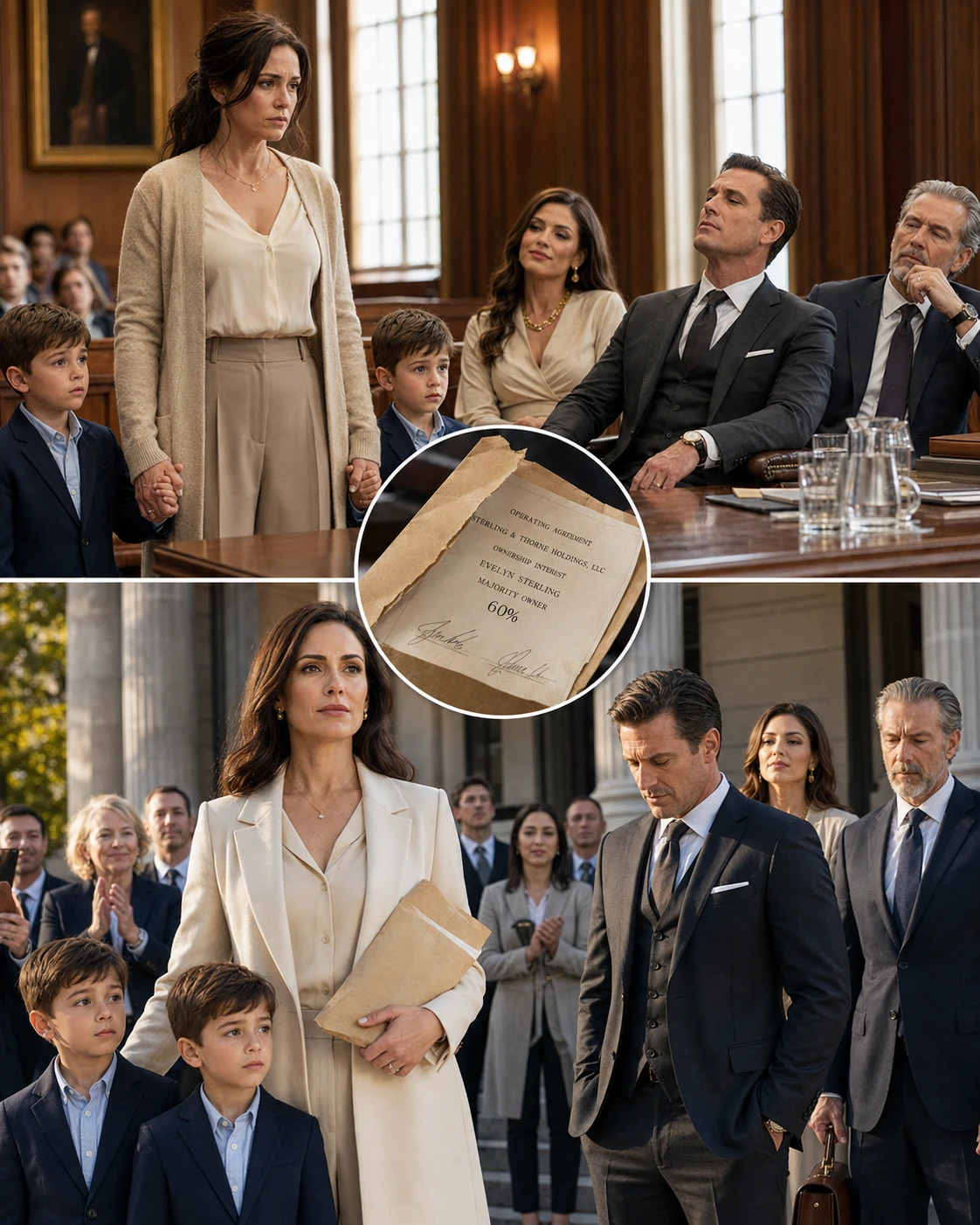
PART 1: THE WOMAN WHO WAS SUPPOSED TO LOSE
“You’ll walk away with nothing, and the kids will stay with me.”
My husband said it confidently in court.
Not to me.
About me.
Like I was already gone.
Like nine years of marriage, two children, and everything I had sacrificed could be erased by a signature on a prenuptial agreement.
Dominic Thorne leaned back in his chair beside his attorney, perfectly relaxed in a charcoal suit that probably cost more than three months of my current rent.
Beside him sat Gianna Rossi.
The woman he had spent the last year insisting was “just a friend.”
She wore cream silk, a gold watch, and the faint smile of someone attending a victory dinner rather than the destruction of a family.
I saw that smile the moment I entered the courtroom.
And I knew exactly what she thought.
They had won.
I was late.
I was unemployed.
I was represented by an attorney Dominic had already mocked as “a bargain-bin family lawyer.”
And I had walked into court holding the hands of our seven-year-old twin sons.
Noah on my left.
Eli on my right.
Identical dark hair.
Identical blue eyes.
Completely different ways of being afraid.
Noah squeezed my fingers so tightly my knuckles hurt.
Eli stared straight ahead and pretended he wasn’t scared at all.
The courtroom went strangely quiet when we entered.
Then came the whispers.
“Did she really bring the children?”
“Seriously?”
“That can’t look good.”
I heard all of it.
I kept walking.
Dominic didn’t stand.
He barely looked at the boys.
His gaze settled on me instead, and that familiar little smirk touched one side of his mouth.
“Still trying to put on a show,” he muttered.
Loud enough for me to hear.
Loud enough for everyone near him to hear.
I didn’t answer.
That was the first thing Dominic had never understood about silence.
He thought silence meant surrender.
For years, whenever I stopped arguing, he assumed he had won.
He never considered that sometimes a person goes quiet because she has finally stopped trying to convince you.
Sometimes she goes quiet because she is watching.
Remembering.
Collecting.
Waiting.
I brought the boys to the front and stopped.
The judge looked over his glasses at me.
“Ms. Sterling, you’re late.”
“I know, Your Honor.”
My voice didn’t shake.
That surprised even me.
“I’m here now. And they needed to be here too.”
Gianna gave a soft laugh.
“This is absurd. Who brings children into something like this?”
The judge’s expression changed immediately.
“One more interruption from the gallery, and you will be removed.”
Gianna’s smile disappeared.
Dominic glanced at her.
Just once.
A tiny warning.
Behave.
That look told me more about their relationship than all the messages I had discovered months earlier.
The judge directed the clerk to arrange for the boys to sit with the court’s family-services officer after the initial statements.
Before Noah released my hand, he looked up at me.
“Mom?”
“I’m right here.”
“You’re not leaving without us, right?”
The entire front row went still.
Dominic looked away.
I bent down and kissed Noah’s forehead.
“No.”
It was the only promise I made that morning.
And the only one that mattered.
When the boys were taken to the side room, I sat beside my attorney, Rachel Kent.
Rachel wasn’t famous.
She didn’t have Dominic’s lawyer’s polished website, television appearances, or corner office.
But she had spent twenty-two years handling divorces involving people who believed money could turn lies into facts.
She had told me something during our first meeting.
“Powerful people don’t always hide the truth well, Evelyn. Sometimes they simply become convinced no one will dare look.”
Dominic’s attorney rose.
Martin Caldwell.
Silver hair.
Perfect posture.
A voice designed to make simple statements sound final.
“Your Honor, this is not a complicated matter.”
Of course it wasn’t.
It was never complicated when Dominic told the story.
According to him, everything belonged to him.
The house.
The investments.
The cars.
The vacation property in Aspen.
The brokerage accounts.
The company.
Especially the company.
And because I had spent the last seven years primarily raising our sons instead of earning a corporate salary, apparently I no longer qualified to raise the children I had been raising every day.
“There is a valid prenuptial agreement,” Caldwell continued. “Ms. Sterling signed voluntarily before the marriage. The agreement clearly protects Mr. Thorne’s assets.”
He glanced briefly toward me.
“We are also seeking primary physical custody.”
Rachel’s pen stopped moving.
Caldwell continued.
“Mr. Thorne has significant financial resources, a stable residence, established household support, and the ability to provide every educational and developmental opportunity the children require.”
I felt something cold move through my stomach.
Not because I hadn’t expected it.
Because I had.
Dominic had been repeating the same argument for months.
Money meant stability.
Money meant power.
Money meant he was the better parent.
“And Ms. Sterling?” the judge asked.
Caldwell gave the smallest pause.
A professional pause.
Almost sympathetic.
“Ms. Sterling currently has no significant independent income.”
There it was.
My humiliation reduced to a sentence.
I stared at Dominic.
He finally looked at me.
For nine years, I had watched that man walk into rooms and convince people he was the smartest person there.
Sometimes he was.
That was part of what made him dangerous.
Dominic wasn’t careless in the ordinary sense.
He remembered names.
Numbers.
Contracts.
Weaknesses.
He noticed who had power and who wanted it.
He knew which waiter to charm, which banker to flatter, which employee to frighten.
And when we were younger, I had loved watching his mind work.
Before I understood that one day he would use it on me.
Caldwell placed the prenuptial agreement before the court.
“My client is not attempting to punish Ms. Sterling. He is simply asking that the agreement both parties signed be enforced.”
Not attempting to punish me.
I almost laughed.
Three months earlier, Dominic had canceled the card I used for groceries.
Two months earlier, he had removed me from the family health plan before Rachel forced his attorney to correct it.
Six weeks earlier, he had told me over the phone that if I fought him for custody, he would “make sure every parent at the boys’ school knew exactly what kind of mother I was.”
And four days ago, outside mediation, he had leaned close enough that I could smell his expensive cologne.
“You should have taken what I offered.”
“What did you offer, Dominic?”
“Enough to disappear quietly.”
I hadn’t.
That was why we were here.
Caldwell finished.
The judge turned toward Rachel.
“Ms. Kent?”
Rachel stood.
“My client agrees she signed the prenuptial agreement.”
Dominic’s eyebrows lifted.
Caldwell looked almost disappointed.
He had expected us to fight the prenup.
That was what they had prepared for.
Coercion.
Duress.
Technical defects.
Emotional claims.
They had spent weeks building a fortress around the wrong door.
Rachel looked at me.
I nodded.
She sat down.
The judge looked directly at me.
“Ms. Sterling, do you wish to say anything?”
For a moment, I could hear nothing except the blood rushing in my ears.
Then I reached into my bag.
The envelope was exactly where I had placed it.
Cream-colored.
Old.
Worn along the edges.
I had carried it through three apartments, one house, two pregnancies, and nine years of marriage.
I had almost thrown it away twice.
Dominic had told me it didn’t matter anymore.
That sentence had saved me.
Because something about the way he said it made me keep it.
I placed the envelope on the table.
“I signed the agreement,” I said, “because I trusted him.”
Dominic let out a quiet breath through his nose.
“Here it comes.”
I ignored him.
“I understood what I was signing. I understood that property Dominic owned before our marriage would remain his. I understood that I would not be entitled to certain assets listed in the agreement.”
Caldwell stood.
“Then I’m not sure what—”
“There’s just one thing he overlooked.”
The attorney stopped.
Dominic’s face didn’t change.
Not yet.
Caldwell frowned.
“Everything is clearly documented. There is nothing missing.”
I looked directly at Dominic.
For the first time that morning, I smiled.
It wasn’t warm.
It wasn’t forgiving.
“Not everything.”
And that was when Dominic stopped leaning back in his chair.
PART 2: BEFORE HIS NAME WAS ON THE BUILDING
Eight years earlier, Dominic didn’t have a glass office forty-two floors above Manhattan.
He didn’t have a driver.
He didn’t have magazine profiles calling him a visionary.
He didn’t have Gianna.
He had debt.
A laptop with a cracked corner.
Three good suits.
A business plan nobody wanted to finance.
And me.
I was twenty-nine when we married.
Dominic was thirty-two.
We had met at a fundraising dinner where neither of us belonged.
I was working in operations for a commercial design firm. Dominic was trying to persuade anyone who would listen that corporate real estate could be managed differently.
He was intense.
Funny when he forgot to impress people.
Restless.
Impossible to embarrass.
I fell in love with the version of him that dreamed out loud.
He used to sketch business ideas on napkins.
He would wake me at two in the morning and say, “Evelyn, what if landlords could predict tenant turnover before renewal?”
I’d groan.
He’d keep talking.
Eventually, I would sit up and listen.
That was us.
For a while.
The prenuptial agreement had been his father’s idea.
The Thorne family had money then, but most of it was tied up in property and old investments.
Dominic’s father distrusted marriage.
Possibly because he had been married three times.
I remember sitting at a polished conference table while a lawyer explained what I was giving up.
Dominic held my hand underneath the table.
“You know this changes nothing between us,” he whispered.
I believed him.
That was the strange thing about betrayal.
People assume you must have ignored warning signs.
Sometimes you didn’t.
Sometimes the person really was good to you.
Until he wasn’t.
I signed.
Six months after our wedding, Dominic lost his position at a development firm after a restructuring.
That was when he decided to start his own company.
Thorne Strategic Properties.
The name sounded much bigger than the reality.
In reality, the company began at our dining room table.
I was still working full-time.
Dominic was making calls from home.
At night, I built spreadsheets.
I organized prospective client lists.
I reviewed vendor contracts.
I rewrote proposals because Dominic wrote the way he spoke—fast, confident, and sometimes without noticing important details.
We needed startup money.
Dominic had less access to cash than people later assumed.
His protected family assets were not liquid enough to fund the launch without consequences he didn’t want.
I had savings.
Not millions.
Not even close.
But I had bought a small apartment before we met, sold it shortly after our wedding, and kept the proceeds in an account in my name.
Eighty-three thousand dollars.
It represented almost everything I had built for myself before Dominic.
One night, he sat across from me at our kitchen table.
“We can make this work.”
I stared at the financial projections.
“Or we can lose eighty-three thousand dollars.”
“We won’t.”
“You don’t know that.”
“No.”
He reached across the table.
“But I know what I can build.”
Then he squeezed my hand.
“And I know what we can build.”
We.
That word cost me eighty-three thousand dollars.
And for years, I didn’t regret a cent.
When the company was formally created, our attorney prepared the operating agreement.
Dominic was going to be president and chief executive.
I would hold a controlling membership interest.
Fifty-one percent.
He held forty-nine.
It wasn’t romantic.
It wasn’t symbolic.
It reflected our actual contributions at the time.
My cash.
My operational work.
His concept.
His industry relationships.
His full-time labor.
I remember teasing him about it.
“So technically I’m your boss?”
He kissed me against the refrigerator.
“Enjoy it while it lasts, Sterling.”
He always called me Sterling when he was flirting.
I kept my maiden name after marriage, something Dominic claimed not to care about.
At first, I remained actively involved.
I worked my regular job during the day and spent evenings helping build Thorne Strategic.
The first year, we barely survived.
The second, we made money.
The third changed everything.
Dominic secured a major commercial client.
Then another.
Then investors came.
Then employees.
Then offices.
By the time I became pregnant with the twins, the company had grown far beyond our dining room.
And my life changed with it.
Pregnancy was hard.
The boys came early.
Noah spent twelve days in neonatal care.
Eli spent seventeen.
I stopped working.
Originally, I planned to return after six months.
Six months became a year.
Then Dominic asked if I could stay home longer.
“We don’t need the second salary anymore,” he said.
I remember standing in the nursery while Eli slept against my shoulder.
“This isn’t about salary.”
“I know.”
“I have a career.”
“And you can go back.”
“When?”
“When things settle.”
Things never settled.
Dominic traveled more.
The company expanded.
His calendar became a wall I couldn’t climb.
And our sons needed somebody who knew which one refused liquid antibiotics and which one had nightmares after thunderstorms.
Somebody had to attend occupational therapy when Noah struggled with fine motor skills.
Somebody had to answer preschool calls.
Somebody had to rearrange life when one child had a fever and the other refused to leave his side.
That somebody became me.
I didn’t resent my children for that.
Not once.
But slowly, Dominic began describing our choices differently.
I wasn’t managing our home.
I “didn’t work.”
I wasn’t raising our children while he expanded the company.
I was “lucky I didn’t have to do anything.”
And Thorne Strategic Properties stopped being something we had built.
It became his company.
At dinners, he introduced me as “my wife, Evelyn.”
Not co-founder.
Not majority member.
Not the person who had emptied her savings account so he could make payroll during the first four months.
Just his wife.
I noticed.
I let it go.
That was my mistake.
Not because I lost my ownership.
I didn’t.
Because each time I accepted his revised version of our history, Dominic became more comfortable rewriting the next part.
When the twins were five, I asked to return to work.
He resisted immediately.
“Why?”
I actually laughed.
“Because I want to.”
“The boys need you.”
“They’re in school.”
“For six hours.”
“We can hire help.”
His expression changed.
Not angry.
Worse.
Patient.
Like I had become unreasonable.
“You have everything you need, Evelyn.”
That sentence stayed with me.
Everything I needed.
A house he controlled.
Accounts he controlled.
A life structured around his schedule.
I had access to money.
I did not have independence.
There was a difference.
I started consulting part-time anyway.
That was when the marriage began breaking openly.
Gianna appeared soon after.
According to Dominic, she was a friend of a client.
Then a consultant.
Then someone working on branding projects around the company.
Then someone whose name appeared on his phone too often at midnight.
The first time I asked about her, he laughed.
“Are you jealous?”
“No.”
“Then why are we having this conversation?”
Because I had seen the way he turned his phone face down.
Because he had started showering immediately after coming home from certain dinners.
Because he said Gianna’s name too casually, the way people sometimes do when they are working very hard to make a person sound unimportant.
I did not accuse him.
I watched.
And Dominic mistook that for weakness.
Again.
The day I knew our marriage was over, there was no lipstick on a collar.
No dramatic hotel receipt.
No stranger sending me photographs.
It was a Tuesday.
I had brought lunch to Dominic’s office because he said he was trapped in meetings.
His assistant wasn’t at her desk.
The conference-room door was partly open.
I heard Gianna laughing.
Then Dominic said, “Once this is finished, she won’t have a reason to interfere anymore.”
Gianna asked something I couldn’t hear.
Dominic answered clearly.
“She signed the prenup. Evelyn gets nothing.”
I stood outside that door holding a paper bag with his favorite sandwich inside.
For several seconds, I couldn’t move.
Then Gianna said, “What about the boys?”
Dominic’s answer came easily.
“I’ll handle the boys.”
Not our boys.
The boys.
Like they were another problem in a transaction.
I left without letting them see me.
That night, Dominic ate dinner at home and kissed Noah on the head.
He asked Eli about a science project.
Then he smiled at me and said, “Long day.”
I looked at the man I had once loved more than anyone in the world.
And I understood something.
The marriage was already over.
I was simply the last person he expected to realize it.
Three weeks later, Dominic filed for divorce.
Two days after that, his attorney sent me a letter reminding me of the prenup.
A week later came the custody petition.
That was when I opened the old fireproof box in the back of my closet.
I found our marriage certificate.
The boys’ birth certificates.
My old apartment closing papers.
And beneath them, a cream envelope.
The original operating agreement for Thorne Strategic Properties.
I sat on the bedroom floor and read every page.
Then I read it again.
Fifty-one percent.
Evelyn Sterling.
Forty-nine percent.
Dominic Thorne.
I called Rachel the next morning.
She listened without interrupting.
Then she asked one question.
“Did you ever sign anything transferring your ownership?”
“No.”
“Are you sure?”
“Yes.”
“Dominic may say otherwise.”
“He can say whatever he wants.”
Rachel was silent.
Then she said, “Good. Now we find out what his company filings say.”
That was the moment I stopped preparing to survive my divorce.
And started preparing to understand it.
What we found terrified me more than the prenup ever had.
Because Dominic had not simply forgotten that I owned part of his company.
He had built his entire case on pretending I didn’t.
PART 3: THE VERSION OF ME HE NEEDED EVERYONE TO BELIEVE
For the next two months, I learned how efficiently a marriage could be dismantled.
One email at a time.
One bank statement.
One accusation.
One carefully phrased legal filing.
Dominic never called me a bad mother outright.
He was smarter than that.
He said I was “emotionally overwhelmed.”
He said I had “limited current employment.”
He said he worried about my ability to “maintain the children’s established standard of living.”
He said the boys were accustomed to the home, school, travel, activities, and resources he could provide.
All true.
And completely dishonest.
Because the part he left out was that I had been the one providing the actual life inside those resources.
I knew Noah couldn’t sleep if his closet door was open.
I knew Eli lied about stomachaches when he was anxious.
I knew which boy needed five minutes alone after an argument and which one needed to talk immediately.
Dominic knew their shoe sizes because his assistant ordered shoes.
He knew their school because his name was on the tuition.
He loved them.
I have never claimed otherwise.
That would have been my own kind of lie.
But somewhere along the way, Dominic had started confusing the ability to pay for a child’s life with the act of living it beside him.
Money did that to him.
It made him think access was the same as presence.
During temporary custody mediation, he arrived eighteen minutes late.
Then spent forty minutes describing himself as the more stable parent.
When Rachel asked which twin had a severe allergy to amoxicillin, Dominic hesitated.
Just for a second.
Then he guessed.
Wrong.
I watched his jaw tighten.
Afterward, he cornered me near the elevator.
“You enjoyed that.”
“No.”
“You set me up.”
“The medical forms have had Noah’s allergy listed for six years.”
His face hardened.
“Don’t play games with me.”
I stared at him.
That was the moment I finally understood how threatened he was.
Not by me taking money.
By me refusing to accept his version of reality.
He stepped closer.
“The prenup stands.”
“I know.”
“You will not get the house.”
“I know.”
“You will not touch my premarital assets.”
“I know.”
His eyes narrowed.
“Then what exactly do you think you’re fighting for?”
“My children.”
“That’s not all.”
No.
It wasn’t.
But he didn’t know that yet.
“See you in court, Dominic.”
He caught my elbow when I turned.
Not hard enough to bruise.
Hard enough to remind me who he thought had control.
“You should think very carefully about how ugly you want this to become.”
I looked down at his hand.
Then back at him.
“You filed for full custody.”
His fingers loosened.
“You made it ugly.”
I walked away.
That afternoon, Rachel received the company documents we had requested.
Not everything.
Dominic’s side objected to almost every financial request.
They called them burdensome.
Irrelevant.
Overbroad.
Rachel narrowed them.
Requested again.
Eventually, enough arrived.
Company tax records.
Ownership schedules.
Capital accounts.
Historical filings.
I sat in Rachel’s conference room as she spread copies across the table.
“Your name is still here,” she said.
I stared at the document.
Member: Evelyn Sterling.
Ownership interest: 51%.
My throat tightened.
“Then why is he saying the company is his?”
Rachel looked at me.
“Because in public, operationally, it is. He runs it. He’s CEO. You haven’t been involved in daily management for years.”
“But legally?”
“That is a different question.”
She slid another paper toward me.
A tax document.
My name again.
Income allocated to me.
I stared at it.
“I never saw this.”
“You filed joint returns.”
“Dominic handled the taxes.”
“Exactly.”
The income existed on paper.
But distributions had largely been retained by the company or moved through accounts Dominic managed.
Because I had been married to him, living in the same household, trusting the same accountant, I had never challenged it.
The money was growing the business.
Our business.
Or so I had believed.
Rachel leaned back.
“He knew.”
“Of course he knew.”
“Not only when the company formed. The tax records show your ownership continued year after year.”
I felt cold.
Something about that hurt more than discovering Gianna.
An affair was personal betrayal.
This was erasure.
Dominic had spent years telling me I contributed nothing while signing tax returns that only existed because the law still recognized exactly what I had contributed.
“What does this do to the prenup?” I asked.
“It doesn’t have to destroy the prenup.”
Rachel tapped the agreement.
“Your prenup protects his premarital assets. It also contains broad waivers. But an agreement saying you do not acquire rights to his assets does not magically turn an asset you already legally own into his property.”
I stared at her.
“So he can keep what’s his.”
“Yes.”
“And I keep what’s mine.”
“That is the argument.”
For the first time in months, I laughed.
Not because anything was funny.
Because Dominic’s favorite sentence had just turned around and faced him.
What’s mine is mine.
He had said it so many times.
He just never imagined I might be allowed to say it too.
But Rachel wasn’t smiling.
“There’s another problem for him.”
She showed me his sworn financial disclosure.
Under business ownership, Dominic had identified himself as controlling owner and valued his interest using the entire company.
No mention of my fifty-one percent.
I looked up.
“He told the court he owns all of it?”
“He certainly appears to have represented the company as though your membership interest doesn’t exist.”
“Can he say it was a mistake?”
“He can say whatever his attorney allows him to say.”
I heard Dominic’s voice in my head.
Evelyn gets nothing.
“He thought I wouldn’t look.”
Rachel nodded.
“Or he thought you didn’t remember.”
I did remember.
Not every detail.
But I remembered the kitchen table.
I remembered signing the papers.
I remembered Dominic raising a glass of cheap champagne.
“To fifty-one percent.”
I remembered laughing.
“To forty-nine.”
He had pulled me into his lap.
“One day this company is going to make us rich.”
Us.
The truth really had been there from the beginning.
Over the next few weeks, Dominic became more aggressive.
He asked the court to restrict my access to funds.
He pressed harder for temporary custody.
He described my move into a rented townhouse as evidence that the boys’ lifestyle would decline with me.
Then came the moment that almost broke me.
Noah heard us arguing.
Dominic had come to pick up the boys.
He looked around my small living room and said, “This is what you chose for them?”
I told him to stop.
He kept going.
“There’s barely room here.”
“There are three bedrooms.”
“At my house, they have a playroom, a pool, a yard—”
“At your house, they ask when you’re coming home.”
His face changed.
Noah was standing on the stairs.
Dominic saw him too late.
Noah looked from his father to me.
“Are we poor now?”
I wanted to disappear.
Instead, I crouched in front of him.
“No.”
“Dad says you don’t have money.”
Dominic said quickly, “That’s not what I meant.”
Noah ignored him.
“Do we have to stop school?”
“No.”
“Do we have to give Oliver away?”
Oliver was our dog.
“No.”
His eyes filled.
“Are you and Dad fighting because we cost too much?”
Something inside me cracked.
I pulled him against me.
“No, baby. Never.”
Eli appeared behind him.
“Are we going to live with Dad and not you?”
I looked over Noah’s shoulder at Dominic.
He had gone pale.
“Who told you that?” I asked.
Eli looked at the floor.
“I heard Dad talking.”
Dominic stepped forward.
“Eli—”
“No.”
My voice stopped him.
It was the first time I had ever spoken to Dominic in front of our children with that tone.
Not loud.
Final.
“You do not discuss custody where they can hear you.”
“I didn’t know they were there.”
“That is not good enough.”
He stared at me.
Then he looked at our sons.
For a second, I saw shame.
Real shame.
And because I knew the man he used to be, it almost hurt worse.
He left without another argument.
That night, after the boys were asleep, I sat on the kitchen floor with the cream envelope beside me.
I was tired of proving I deserved to keep my children.
Tired of pretending Dominic’s money made him more real than me.
Tired of being measured by the salary I had given up at his request.
I called Rachel.
“I don’t want a settlement that requires me to keep this quiet.”
She understood immediately.
“Evelyn—”
“He built his custody argument around me being financially incapable.”
“Yes.”
“He filed documents saying the business is his.”
“Yes.”
“And he knows that isn’t true.”
“Yes.”
“Then I want it addressed in court.”
Rachel was silent for a moment.
“There may be consequences for the business.”
“I know.”
“For Dominic.”
“I know.”
“He may blame you.”
I looked around my rented kitchen.
At the school calendar taped to the refrigerator.
At two lunch boxes drying beside the sink.
At the life Dominic had decided was inadequate because it wasn’t expensive enough.
“He already does.”
Rachel exhaled.
“Then bring the originals.”
So I did.
The night before the hearing, I barely slept.
The next morning, Noah woke with a stomachache.
Eli refused to go without him.
The family-services officer was scheduled to meet the children at court after Dominic’s request for immediate primary custody.
So I dressed them.
Packed crackers.
Water.
Noah’s inhaler.
Eli’s dinosaur book.
And the cream envelope.
Traffic was terrible.
We arrived late.
Dominic saw lateness.
Gianna saw desperation.
His attorney saw weakness.
They had no idea that while Dominic had spent months trying to prove I owned nothing, I was carrying the document that said I owned more of his company than he did.
PART 4: NOT EVERYTHING
The courtroom seemed smaller after I placed the envelope on the table.
Nobody whispered now.
Caldwell stood beside Dominic, looking irritated rather than worried.
“What exactly is Ms. Sterling attempting to introduce?”
Rachel rose.
“An original executed operating agreement for Thorne Strategic Properties.”
Silence.
Not dramatic silence.
Confused silence.
The kind that happens when everyone hears words that do not fit the story they were expecting.
Caldwell blinked.
Dominic didn’t.
That frightened me more.
He knew exactly what the envelope contained.
The judge looked at him.
Then at me.
“Thorne Strategic Properties is Mr. Thorne’s company?”
“It is the company at issue in his financial disclosures,” Rachel said.
Caldwell recovered quickly.
“Your Honor, the existence of old formation paperwork has no relevance to custody, and the prenuptial agreement—”
Rachel opened the envelope.
“The prenuptial agreement is exactly why this matters.”
She handed a copy to Caldwell.
Then one to the clerk.
The judge began reading.
Dominic stared at me.
I watched the confidence leave his face by degrees.
Not all at once.
First his shoulders stiffened.
Then his jaw.
Then his eyes moved toward Caldwell.
The attorney was reading faster now.
Gianna leaned toward Dominic.
“What is it?”
He didn’t answer.
The judge looked up.
“Mr. Caldwell.”
“Yes, Your Honor?”
“This agreement identifies Ms. Sterling as a fifty-one-percent member.”
Caldwell turned another page.
“The company has undergone substantial restructuring since formation.”
“Do you have a transfer document showing Ms. Sterling disposed of her ownership?”
Caldwell hesitated.
I will remember that hesitation for the rest of my life.
Because it was the first time since Dominic filed for divorce that someone on his side did not have an answer ready.
“My understanding is that Mr. Thorne is the controlling principal.”
“That was not my question.”
Caldwell looked toward Dominic.
The judge repeated himself.
“Do you have documentation showing Ms. Sterling transferred this interest?”
Dominic leaned toward his attorney and whispered something.
Caldwell’s mouth tightened.
“Not with me, Your Honor.”
Rachel spoke.
“We specifically requested any such document during discovery.”
Caldwell turned toward her.
“And?”
“None was produced.”
Dominic finally spoke.
“This is ridiculous.”
The judge looked at him.
“Mr. Thorne, speak through counsel.”
“That agreement is from years ago.”
I stared at him.
He sounded angry.
Not confused.
That mattered.
The judge noticed too.
“Are you disputing your signature?”
Dominic went silent.
“Mr. Thorne?”
“No.”
“Are you disputing Ms. Sterling’s signature?”
“No.”
“Do you contend a later agreement replaced this one?”
Dominic looked at Caldwell.
Caldwell stood.
“My client’s position is that Ms. Sterling ceased all involvement in the company years ago and that Mr. Thorne has operated and grown the company exclusively since then.”
Rachel answered.
“Operational involvement is not the same as ownership.”
Caldwell’s face hardened.
“This is a family proceeding, not a corporate dispute.”
“No,” Rachel said. “But Mr. Thorne made his supposed ownership of this company central to two issues before this court—his financial disclosure and his argument that Ms. Sterling lacks resources to care for the children.”
The judge looked at the documents again.
Rachel continued.
“And the original operating agreement is not the only record.”
Dominic’s head snapped toward her.
That was the moment.
The moment he realized I hadn’t simply found an old envelope.
I had looked.
Really looked.
Rachel produced the tax documents.
“Company records produced during discovery continue to identify Ms. Sterling’s membership interest.”
Caldwell took them.
He stopped turning pages.
The judge examined copies.
“These are recent?”
“Yes, Your Honor.”
“How recent?”
“The latest provided is from the previous tax year.”
I looked at Dominic.
He stared at the table.
Gianna whispered, “Dominic.”
Nothing.
Rachel continued.
“These tax records allocate income consistent with Ms. Sterling’s ownership interest.”
The judge looked directly at Dominic.
“Mr. Thorne, did you sign joint tax returns with your wife?”
Caldwell started to stand.
Dominic answered first.
“Yes.”
“So you were aware that these records continued to reflect her ownership?”
Dominic’s expression hardened.
“She didn’t run the company.”
The judge’s voice became colder.
“Again, that is not the question.”
I had lived with Dominic long enough to know when he felt cornered.
His right thumb rubbed against the side of his index finger.
He had done it during investor negotiations.
During hospital conversations when the twins were premature.
During the night his father died.
He was doing it now.
“I was aware of the tax treatment.”
There it was.
A tiny sentence.
Quiet.
Almost harmless.
But the room changed.
Caldwell closed his eyes for half a second.
The judge leaned back.
“And yet your sworn financial disclosure represents the company as an asset controlled and owned by you without identifying Ms. Sterling’s fifty-one-percent interest.”
“My attorneys prepared those documents.”
Caldwell turned sharply.
Rachel said nothing.
She didn’t need to.
The judge’s face said enough.
“Your attorney prepares a document based on information you provide, Mr. Thorne.”
Dominic looked toward Caldwell.
For the first time, I saw something I had never seen between Dominic and one of his expensive lawyers.
Distrust.
Instant.
Mutual.
Gianna stood halfway.
“Dominic, you told me—”
The judge struck the gavel.
“Sit down.”
Gianna sat.
Her face had lost all color.
I wondered what Dominic had told her.
Probably the same thing he had told everyone.
The company is mine.
The house is mine.
The money is mine.
The children will be mine.
Evelyn gets nothing.
The judge turned to Rachel.
“Counsel, are you alleging intentional concealment?”
Rachel chose her words carefully.
“We are asking the court to determine why a material ownership interest was omitted from Mr. Thorne’s disclosures, despite records indicating he knew it existed.”
Caldwell immediately responded.
“We strongly reject any implication of deliberate concealment.”
Rachel nodded.
“Then a forensic review should resolve it.”
That sentence hit Dominic harder than anything else.
“No.”
He said it before his attorney could stop him.
The judge stared at him.
Dominic realized his mistake.
Caldwell rose.
“My client means that a forensic review would be unnecessarily disruptive to a functioning company.”
Rachel looked at me.
Then back at the judge.
“If the disclosures are accurate, review should confirm that.”
Dominic’s thumb kept moving.
The judge removed his glasses.
“Mr. Thorne, your petition argues that Ms. Sterling is unable to provide financially for the children.”
“Yes.”
“Your counsel repeatedly characterized her as having no significant independent resources.”
“Yes.”
“And now documentation before the court indicates she may hold a fifty-one-percent interest in the company you presented as evidence of your own financial superiority.”
Dominic swallowed.
“Her shares don’t mean she has access to the company’s money.”
Finally, I spoke.
“Because you control every distribution.”
Every eye turned toward me.
Dominic’s stare burned into mine.
The judge nodded.
“Explain.”
I forced myself to breathe.
“When the company started, I handled operations. After the twins were born, I stepped away from daily work. Dominic became the person controlling company accounts and distributions.”
Caldwell objected.
The judge allowed me to continue within limits.
“My ownership remained on the books. The tax documents confirm that. But Dominic handled the money. I trusted him.”
I looked at the old papers lying on the table.
“My mistake was believing that because I wasn’t running the company anymore, I didn’t need to pay attention.”
Dominic laughed bitterly.
“So now you want half of something you didn’t build.”
The words struck me so hard I almost lost my composure.
Almost.
I looked directly at him.
“I funded it.”
He stopped.
“I worked nights for it.”
Silence.
“I wrote proposals for it. I handled vendors for it. I covered our bills while you spent a year earning almost nothing. I gave you my savings because you told me we were building something together.”
His eyes flickered.
“And then I gave up my career because you asked me to stay home with our sons.”
“Evelyn—”
“No.”
My voice cracked.
I hated that it cracked.
But I kept going.
“You do not get to erase my work because yours happened in an office.”
Nobody moved.
“You do not get to erase my ownership because your name is on the building.”
Dominic’s face reddened.
“And you do not get to tell this court I am financially incapable of raising our children because you made sure I had to ask you for access to money that was partly mine.”
The judge raised a hand before Dominic could respond.
“That will be enough.”
I sat.
My hands were shaking under the table.
Rachel quietly placed her hand over one of them.
The judge reviewed the documents for several minutes.
It felt like an hour.
Finally, he spoke.
“Given the discrepancy in Mr. Thorne’s financial disclosures and the ownership documentation presented today, the court is not prepared to make a final financial determination.”
Dominic leaned toward Caldwell.
The judge continued.
“I am ordering supplemental disclosure concerning Thorne Strategic Properties and directing that an independent forensic accountant review the relevant ownership, distributions, and financial representations.”
Caldwell stood.
“Your Honor—”
“I have not finished.”
He sat.
“Until that review is completed, neither party will transfer, dispose of, encumber, or materially alter any ownership interest implicated in these proceedings.”
Dominic’s face went rigid.
The judge then looked at me.
“Ms. Sterling.”
“Yes, Your Honor.”
“Do you understand that the existence of a business interest does not automatically decide custody?”
“Yes.”
“I’m glad.”
He looked at Dominic.
“Mr. Thorne, do you understand that wealth does not automatically decide custody either?”
Dominic said nothing for a second.
Then, quietly, “Yes.”
The judge reviewed the custody materials.
He asked questions about school.
Schedules.
Medical care.
Daily routines.
Then the family-services officer returned with notes from speaking to the boys.
I wasn’t allowed to hear everything.
I didn’t want to.
They were children.
They deserved one part of this battle that did not belong to us.
But I heard enough.
The boys loved their father.
They loved me.
They were afraid one of us would disappear.
And they believed I was going to lose them because they had heard adults talk about money.
The judge’s expression darkened.
“I want both parents to hear this clearly. These children are not assets in your divorce.”
I felt tears burn behind my eyes.
“No child should be made to believe a parent can be taken away because one household has more money than another.”
Dominic stared at the floor.
The judge continued the existing schedule temporarily, with the boys’ primary residence remaining with me while custody evaluation continued.
Dominic did not get the immediate custody order he had requested.
He did not get the declaration that I was financially incapable.
He did not get to walk out holding everything.
But the moment that truly stopped the courtroom came just before recess.
Caldwell approached the clerk with the company documents.
The judge looked again at the ownership page.
Then at Dominic’s sworn financial disclosure.
He frowned.
“Mr. Caldwell.”
“Yes?”
“Your client valued his interest using one hundred percent of this company.”
Caldwell said nothing.
The judge looked at the operating agreement.
“But according to this document, Mr. Thorne personally owns forty-nine.”
Nobody breathed.
Gianna stared at Dominic.
And then she said the one sentence he could not control.
“You told me you owned all of it.”
Her voice wasn’t mocking anymore.
It was frightened.
Dominic turned toward her.
“Not now.”
She pulled her bag closer.
“You said she had nothing.”
The judge slammed the gavel.
“Ms. Rossi.”
Gianna went silent.
But it was too late.
The whole room had heard.
I looked at Dominic.
His face had changed completely.
For months, I had been the one on trial in every room we entered.
My parenting.
My finances.
My choices.
My worth.
Now, for the first time, the question hanging over the courtroom was not whether I was telling the truth.
It was how long Dominic had been lying.
And to whom.
PART 5: WHAT WAS ACTUALLY MINE
Justice did not arrive in one dramatic ruling.
I wish it had.
Real life was slower.
More expensive.
Less cinematic.
There were accountants.
Depositions.
Revised financial disclosures.
Company counsel.
Family evaluations.
More hearings.
More nights when I lay awake wondering whether telling the truth would destroy the business I had helped build.
Dominic blamed me for all of it.
At first.
Three days after the hearing, he called.
I almost didn’t answer.
Then I remembered we had children.
“What?”
His voice was low.
“Do you understand what you’ve done?”
“Yes.”
“You put the company at risk.”
“No.”
“You dragged internal financial records into open court.”
“You put the company into the divorce when you used it to argue that you were fit to raise our children and I wasn’t.”
“You could have handled this privately.”
“I tried.”
“That’s not true.”
“You offered me enough money to disappear.”
He went silent.
I continued.
“You demanded full custody.”
“I was protecting them.”
“From what?”
Silence again.
“From a three-bedroom townhouse?”
“From instability.”
“I am the person who packed their lunches for seven years.”
“That doesn’t mean—”
“No, Dominic. You don’t get to do that anymore.”
“Do what?”
“Change the definition every time I meet it.”
He breathed heavily.
“You said I didn’t have money. Then we proved I own fifty-one percent of the company, and suddenly money doesn’t matter.”
“That isn’t—”
“You said I didn’t work. Then we showed I helped build the company, and suddenly the early years don’t count.”
“Evelyn—”
“You said the boys needed stability, but you were willing to take them from the parent who has been their daily routine since birth.”
He didn’t speak.
I closed my eyes.
“I am done proving myself according to rules you rewrite whenever you start losing.”
He hung up.
Two weeks later, Gianna stopped appearing beside him.
I did not ask why.
I did not care.
She had never been the center of my marriage.
Dominic was.
That took me a long time to understand.
It was easier to hate the other woman than to admit your husband was the one who had made promises to you.
Gianna had smiled in court.
She had mocked me.
She had believed his story because that story benefited her.
I would never like her.
But she had not signed my marriage certificate.
Dominic had.
The forensic review confirmed what the documents already showed.
My ownership had never been transferred.
No valid sale.
No amendment eliminating my interest.
No document bearing my signature surrendering it.
For years, the company’s own tax records had continued reflecting me as majority member.
Dominic’s attorneys argued that the real economic arrangement was more complicated.
They were right.
Businesses always were.
Dominic had been the driving executive force for years.
He had transformed a small operation into a company worth far more than either of us had imagined.
I never denied that.
I didn’t want credit for work I hadn’t done.
I wanted the truth about work I had done.
There was a difference.
The financial negotiations lasted months.
In the end, Dominic could not simply take the company.
Neither could I.
Destroying it would have harmed employees, clients, investors, and eventually our sons.
So we negotiated a buyout.
A real one.
Based on independent valuation.
Not the insulting amount Dominic had offered when he believed I had no leverage.
Not everything I could theoretically demand.
Enough.
More important, it was mine.
My ownership.
My history.
My choice.
The court also required corrected disclosures.
Dominic’s credibility had been damaged by the omission.
I wish I could say he broke down and confessed to everything.
He didn’t.
People like Dominic rarely transform because someone proves them wrong.
They explain.
Justify.
Reframe.
He said he had genuinely believed I no longer had a meaningful interest.
He said lawyers and accountants had handled details.
He said he had built almost all the company’s later value.
He said his custody position had been based on concern, not punishment.
Some of that may even have been true in his mind.
That was the hardest lesson.
A person does not have to wake up every morning thinking, I am the villain.
Dominic probably didn’t.
He simply made every decision according to what benefited him, then found a reason afterward that allowed him to believe he was still a good man.
Custody was resolved separately.
As it should have been.
The evaluator spoke to teachers.
Doctors.
Neighbors.
Both of us.
The boys.
The final arrangement gave us shared legal custody.
The boys continued living primarily with me during the school week, with substantial time with Dominic.
He did not lose his sons.
I never wanted him to.
I wanted him to stop trying to make them evidence that he had won.
The final custody hearing was quieter than the first.
No Gianna.
No spectators whispering about the poor unemployed wife.
No dramatic entrance.
Just Dominic.
Me.
Our lawyers.
And the judge.
The judge looked at both of us.
“You are going to be connected through these children for many years. If either of you treats parenting like a contest, the children will pay the price.”
I glanced at Dominic.
He was already looking at me.
For once, neither of us looked away.
After court, we stood outside beneath a gray sky.
Rachel had gone ahead.
Caldwell was speaking on the phone several yards away.
Dominic put his hands into his coat pockets.
“You got what you wanted.”
I studied him.
“No.”
His mouth tightened.
“You got the money.”
“This was never just about the money.”
“That’s easy to say now.”
I almost argued.
Then I stopped.
The old Evelyn would have spent twenty minutes trying to make him understand.
I didn’t need that anymore.
“Do you know what Noah asked me the night after the first hearing?”
Dominic’s expression changed.
“What?”
“He asked if I had brought that envelope so we could stay together.”
Dominic looked away.
My throat tightened.
“He thought if I proved I had money, you might want us again.”
“Evelyn…”
“That is what this did to them.”
His jaw clenched.
“I never told him that.”
“Children don’t need you to say everything directly.”
He stared at the courthouse steps.
For a long moment, neither of us spoke.
Then he said, “I was angry.”
“I know.”
“I thought you were going to take them from me.”
“I never asked to.”
“I know that now.”
I looked at him.
There were a thousand apologies missing from that conversation.
Maybe I would never receive them.
But that was the first honest thing Dominic had said to me in a long time.
I nodded.
“The boys need you.”
His eyes met mine.
“They need me too.”
“I know.”
That was enough.
Not forgiveness.
Not reconciliation.
Enough.
A year later, my life looked nothing like the one I had been terrified of losing.
I did not return to our old house.
Dominic kept it as part of the financial settlement.
I didn’t want it.
Too many rooms in that place felt like museums of a marriage that had stopped existing long before either of us admitted it.
I bought a smaller home ten minutes from the boys’ school.
Four bedrooms.
A backyard just large enough for Oliver to destroy.
No pool.
No marble foyer.
No wine cellar.
The twins didn’t care.
Eli taped glow-in-the-dark stars to his ceiling.
Noah painted one wall blue and immediately regretted choosing the shade.
I let him live with it for three weeks before we repainted.
I returned to consulting.
Then, slowly, to operations work.
I discovered that seven years away from a formal job had not erased my brain.
That sounds ridiculous now.
At the time, I had genuinely started wondering.
Dominic had repeated his version of me so often that I had absorbed pieces of it.
Unemployed.
Dependent.
Out of touch.
Lucky.
When you hear the same description for long enough, even from someone who hurts you, sometimes you start checking yourself in the mirror to see if it has become true.
It hadn’t.
I was rusty.
That was different.
The first time I signed a consulting agreement for a client entirely under my own name, I sat in my parked car afterward and cried.
Not because of the amount.
It wasn’t enormous.
Because nobody had given it to me.
Nobody had approved it.
Nobody could cancel it because I had made him angry.
Mine.
Such a small word.
Such a dangerous one when you have spent years being told you own nothing.
Dominic remained CEO of Thorne Strategic Properties after buying out my interest.
The company survived.
So did he.
The boys spent every other weekend and part of each week with him.
He became more involved.
Not immediately.
Not perfectly.
But enough that Eli stopped asking whether Dad would be home when he visited.
Enough that Dominic learned which twin had the allergy without hesitation.
Enough that one afternoon Noah came home and announced, “Dad made pancakes.”
I looked at the burnt edge of the pancake Noah had wrapped in a napkin as proof.
“That looks dangerous.”
“It was.”
“Did you eat it?”
“Two.”
Progress.
The cream envelope stayed with me.
I didn’t throw it away after the case ended.
For a while, it remained in my desk drawer.
Then one evening, I took it out.
Noah and Eli were doing homework at the kitchen table.
I ran my thumb along the worn edge.
That envelope had held proof of company ownership.
But when I looked at it then, I thought about everything else I had once believed needed documentation.
My contribution.
My sacrifice.
My motherhood.
My intelligence.
My right to stand in a room without apologizing for taking up space.
I had spent years hoping someone else would confirm those things.
Dominic.
A lawyer.
A judge.
A bank statement.
A legal agreement.
Some proof that I had mattered.
The court documents had been necessary.
But the rest?
The rest I should never have handed over for someone else to measure.
“Mom?”
I looked up.
Eli was watching me.
“What?”
“What’s in that?”
I smiled.
“Old papers.”
“Important?”
“They were.”
Noah glanced over from his math worksheet.
“Dad’s company papers?”
I hesitated.
The boys knew a simplified version now.
Enough to understand that adults had argued about business and money.
Not enough to make either parent a monster.
“Yes.”
Noah frowned.
“Are you going to keep them forever?”
I looked at the envelope one last time.
“No.”
That surprised me.
I stood.
Walked to the cabinet where we kept old school papers.
And placed it inside a storage box.
Not hidden.
Not worshiped.
Just kept.
History.
That was all.
A week later, Dominic came to pick up the boys.
He stood outside while Noah searched for his sneakers.
Eli was already in the car.
Dominic looked through the open doorway.
At my small house.
At the family photographs.
At the dog hair on the couch.
At the pile of backpacks by the stairs.
“You seem happy here,” he said.
“I am.”
He nodded.
Another pause.
Then he gave a strange little smile.
“Do you remember the night we signed the operating agreement?”
I did.
Cheap champagne.
Takeout containers.
A refrigerator that rattled whenever the compressor started.
“Yeah.”
“You kept saying you were my boss.”
“You hated it.”
“I pretended to hate it.”
I almost smiled.
Then Noah came running down the stairs.
“Found them!”
He was holding two shoes from completely different pairs.
Dominic looked at me.
I looked at him.
And despite everything, we both laughed.
Noah stared at us.
“What?”
“Nothing,” I said.
Dominic ruffled his hair.
“Go find two shoes that belong together.”
Noah groaned and ran back upstairs.
For one brief second, the past did not feel like a wound.
It simply felt finished.
Dominic turned toward me.
“I was wrong about something.”
There were too many possibilities.
I waited.
He looked at the stairs where Noah had disappeared.
“You were never going to leave with nothing.”
My chest tightened.
I thought about the courtroom.
Gianna’s smile.
Caldwell’s confident voice.
The judge looking down at those papers.
Dominic telling everyone I had no resources, no leverage, no power.
I thought about walking through those doors with Noah and Eli holding my hands.
I shook my head.
“No.”
I looked toward his car, where Eli was making faces through the window.
“Even if that envelope had been empty, I wasn’t leaving with nothing.”
Dominic followed my gaze.
He understood.
At least I think he did.
The boys were never property.
Never leverage.
Never a prize.
And neither was I.
For years, Dominic had believed power belonged to whoever owned the biggest house, controlled the bank accounts, hired the most expensive lawyer, or had his name written in steel above a lobby.
He had forgotten something much simpler.
A name on a building does not tell you who built the foundation.
A person can be quiet and still remember.
A person can be financially dependent and still have rights.
A mother can be frightened and still fight.
And a woman you have spent years convincing she owns nothing may eventually open an old envelope and discover the one thing you were counting on her never finding.
The truth.
It had been there all along.
In black ink.
On the first operating agreement.
Fifty-one percent.
My name.
My signature.
His signature beneath it.
Dominic had been right about one thing from the beginning.
The prenup said he could keep what belonged to him.
So he did.
And in the end, so did I.