PART 1: THE DAUGHTER THEY BURIED
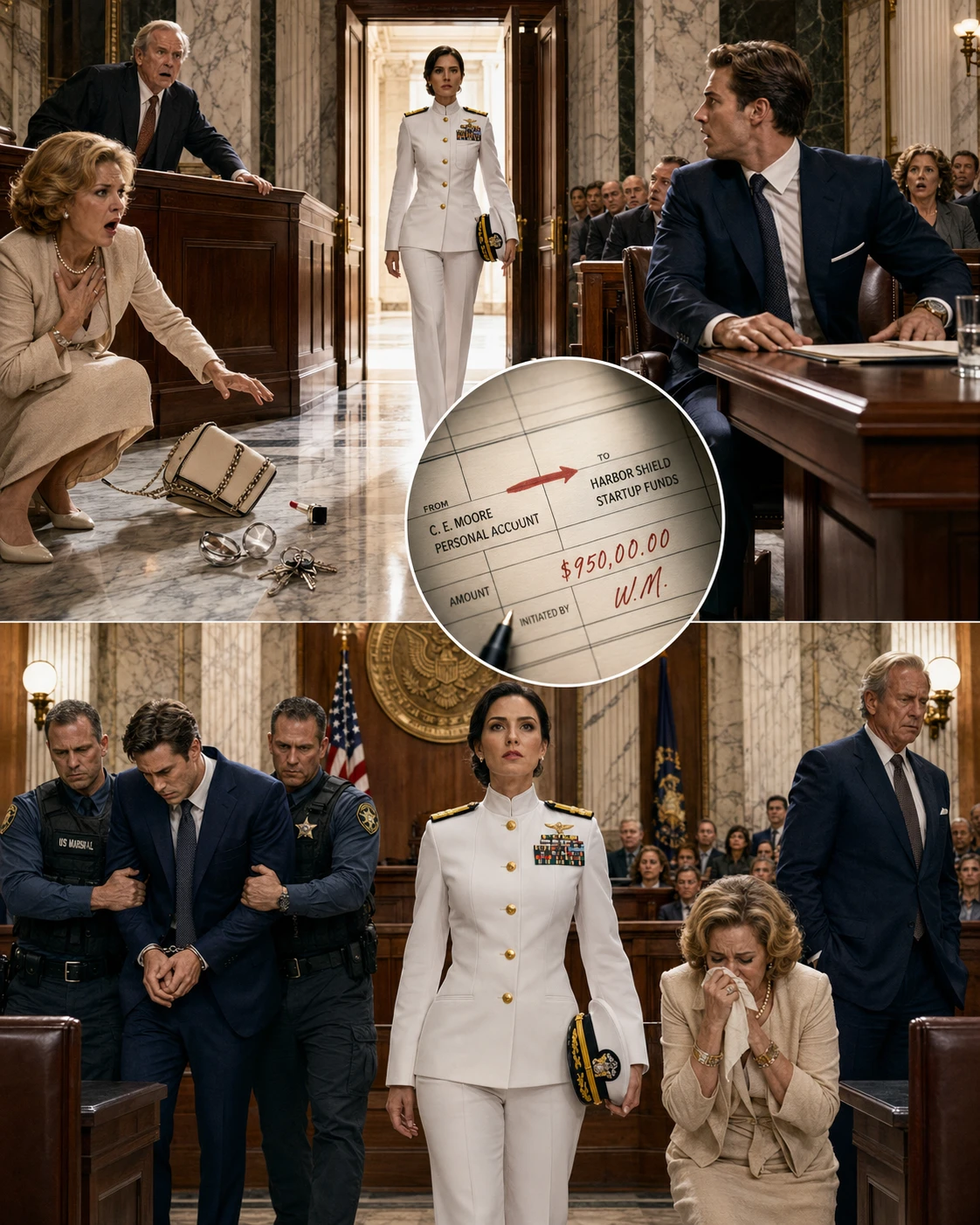
My mother dropped her purse when she saw me walk into federal court.
Not because she thought I was dead.
What frightened her was worse.
She realized I had survived long enough to become credible.
The purse struck the marble floor with a hard crack, spilling a lipstick, a silver compact, and a ring of keys beneath the bench. Half the courtroom turned toward the sound.
I kept walking.
My shoes struck the polished floor in measured steps.
White ceremonial uniform.
Gold shoulder boards.
Ribbons and medals aligned over my heart.
Hair secured at the nape of my neck exactly the way I had worn it through inspections, briefings, ceremonies, and the kind of rooms where a mistake could follow you for the rest of your career.
Grant turned last.
That was the moment I had imagined more times than I wanted to admit.
Not his arrest.
Not his conviction.
Not even an apology.
Just the moment my brother looked directly at the truth he had spent more than a decade erasing.
He had been sitting at the defense table with both hands folded in front of him, composed in a navy suit that probably cost more than our mother’s first car. His attorney had been whispering something into his ear.
Then Grant heard my footsteps.
He glanced over his shoulder.
His face changed.
It did not collapse dramatically. Grant was too practiced for that.
His mouth simply stopped moving.
His shoulders stiffened.
And his eyes traveled from my shoes to the ribbons on my chest, then to the insignia on my shoulders.
For one second, he looked exactly like the seventeen-year-old boy who used to stand in our father’s garage pretending he had not scratched the car.
Caught.
Calculating.
Already searching for someone else to blame.
Behind him, my father rose halfway from his seat.
“Caroline?”
He did not say it loudly.
He did not have to.
I heard him.
After twelve years of being spoken about as though I were a diagnosis instead of a daughter, hearing my own name in my father’s voice should have meant something.
It didn’t.
I looked ahead.
At the government table, Assistant United States Attorney Rebecca Sloan stood.
She had warned me that the first thirty seconds would be the hardest.
She was wrong.
The hardest part had happened years earlier, when I still loved my family enough to believe I could make them understand.
This?
This was procedure.
“Your Honor,” Sloan said, “the government calls Lieutenant Commander Caroline Moore.”
The silence became heavier.
My mother stopped reaching for the things that had fallen from her purse.
My father remained half-standing.
Grant’s attorney turned toward him sharply.
I walked past all three of them.
For ten years, they had lived inside the version of me Grant created.
I was the daughter who broke under pressure.
The one who failed out of the Navy.
The one who became jealous of her successful brother.
The one whose judgment could not be trusted.
The one whose memory was unreliable.
The one who disappeared because she was ashamed.
Grant told the story so many times that eventually my parents stopped treating it like a lie.
They treated it like an alibi.
I stepped into the witness box.
The clerk administered the oath.
I raised my right hand.
The words felt almost absurdly familiar.
Oaths had shaped my entire adult life.
I had taken one when I entered service.
I had taken others when granted access to information I was required to protect.
And now I was taking one in front of the three people who had taught me that some people could say family with the same mouth they used to destroy you.
I sat.
Sloan approached the podium carrying a folder.
“Please state your full name for the record.”
“Caroline Elizabeth Moore.”
Grant lowered his eyes.
“And your occupation?”
“I am an officer in the United States Navy.”
A murmur moved through the gallery.
The judge looked over his glasses.
Sloan continued.
“Your current rank?”
“Lieutenant Commander.”
My mother made a sound.
Tiny.
Almost nothing.
But I knew her well enough to recognize it.
A breath pulled too sharply into the lungs.
Shock.
Grant’s attorney stood.
“Your Honor, I’m not sure the witness’s military rank is relevant to the charges before—”
“It is relevant,” Sloan said, “because the defense has raised the witness’s alleged military discharge, alleged mental deterioration following that discharge, and alleged history of fabricating professional accomplishments as grounds to challenge her credibility.”
The judge looked toward the defense table.
Grant’s attorney sat down.
My father finally lowered himself onto the bench.
Sloan opened the folder.
“Lieutenant Commander Moore, were you discharged from the United States Navy ten years ago for psychological instability?”
“No.”
“Did you fail out of training?”
“No.”
“Were you ever administratively separated for misconduct?”
“No.”
“Were you ever discharged under the document previously submitted to the Moore family and later referenced in financial proceedings concerning your assets?”
“No.”
Sloan lifted a page.
“Government Exhibit 47.”
Grant did not look up.
I did.
That page had haunted my life without my seeing it until six weeks earlier.
A forged discharge form.
My name.
My old service number.
A copied seal.
Language that sounded official enough to anyone who did not know what an actual record looked like.
Grant had counted on that.
He did not need to fool the Navy.
He only needed to fool our parents.
Our banker.
The executor handling part of my grandmother’s estate.
A few family friends.
Anyone who might someday ask why Grant Moore had become the successful, trustworthy heir while his younger sister seemed to vanish from the family completely.
Sloan displayed a second document.
“And Government Exhibit 48?”
“My authenticated service record.”
“Does it show a discharge?”
“No.”
“What does it show?”
I looked at Grant.
For the first time since I entered the courtroom, I let myself meet his eyes.
“It shows continuous service.”
His jaw tightened.
Sloan let the answer hang.
Continuous service.
Two words.
Ten years of lies.
My father rubbed one hand over his mouth.
My mother stared at me as though the uniform had become something monstrous.
Maybe to her, it had.
Because my uniform did not merely prove that Grant lied.
It proved that she had chosen him over evidence.
Again.
And again.
And again.
Sloan stepped closer.
“Lieutenant Commander Moore, do you know who created the false discharge document?”
“Yes.”
“How?”
“Because the metadata from the source file traces back to a computer Grant owned at the time. Because portions of the document were copied from a publicly available sample form he downloaded. Because an email attaching the document was sent from an account created to resemble an old address of mine. And because the recovery information for that account used Grant’s phone number.”
Grant’s attorney stood.
“Objection. Foundation.”
Sloan did not even look at him.
“We’ll establish the forensic foundation through the government’s digital examiner.”
“Sustained as to the technical conclusion. The witness may testify to what she personally observed or received.”
I nodded.
Sloan looked back at me.
“When did you first learn the document existed?”
“Not when Grant created it.”
“When?”
“Years later.”
“How many?”
“Almost ten.”
My mother looked down.
That hurt more than I expected.
Not because I wanted her sympathy.
Because for one stupid fraction of a second, some buried part of me still wanted her to look ashamed.
I had been nineteen when I told my parents I wanted to enlist.
My father had set his fork down beside his plate.
He stared at me across the dining room table.
“Don’t begin something you can’t finish.”
Grant laughed.
Not loudly.
Just enough.
He was twenty-two then and had already started talking about building a business. He had ideas about storm recovery, property restoration, emergency contracting. Our father loved those conversations.
Grant spoke his language.
Growth.
Contracts.
Reputation.
Legacy.
I spoke about service.
Training.
Intelligence work.
Learning languages.
Seeing whether I could become something I had not inherited.
My father had never known what to do with that.
The cruelest truth was that I did finish.
I kept finishing.
Training.
Qualifications.
Deployments.
Schools.
Long nights without sleep.
Assignments I could not explain to my family even if they had still been asking.
I became good at finding patterns in places where people deliberately tried to hide them.
Accounts.
Transfers.
Aliases.
Layered records.
The discrepancy between what a document claimed and what its structure revealed.
I learned that most complicated deceptions depended on something simple.
The liar expected nobody patient enough to compare everything.
Grant had made the same mistake.
He had spent years convincing people I was unstable.
Then he built a company around financial structures he assumed I would never see.
Sloan closed the folder containing the forged discharge papers.
Then she picked up another one.
“Lieutenant Commander Moore, I want to turn to Harbor Shield Recovery.”
Grant finally looked at his attorney.
My father looked at Grant.
And I understood something.
They still thought this was about the fake discharge.
They still believed Grant’s worst crime against me was stealing my reputation.
They had no idea what I had found the night before.
I reached instinctively toward my right uniform pocket.
Inside was a folded piece of paper I had carried since dawn.
Not evidence.
Not technically.
Sloan already had the authenticated copy.
Mine was personal.
A photocopy of a ledger page.
A ten-year-old transfer.
My savings account.
A Harbor Shield startup account.
And beside the authorization code were two initials.
Not Grant’s.
W.M.
Warren Moore.
My father.
Sloan faced me.
“When did you first suspect that Harbor Shield Recovery had been built with money taken from you?”
I looked at my father.
He was no longer staring at the judge.
He was staring at my pocket.
“I suspected it six weeks ago,” I said.
“When did you know?”
“Last night.”
And for the first time that morning, my father looked afraid.
PART 2: THE LIE THAT BECAME FAMILY HISTORY
The first thing Grant stole from me was not money.
It was context.
Money can be traced.
Context disappears much more easily.
One sentence removed from a conversation.
One email sent under someone else’s name.
One worried expression interpreted for the right audience.
One absence explained before the absent person has a chance to explain it herself.
Grant understood that instinctively.
When I left home at nineteen, there had been no dramatic rupture.
No screaming.
No slammed doors.
No declaration that I would never return.
I hugged my mother at the airport.
My father shook my hand before pulling me awkwardly against his chest.
Grant punched my shoulder and told me not to embarrass the family.
I remember smiling.
“Try not to bankrupt it while I’m gone.”
He grinned.
“Jealous already?”
That was Grant.
Every joke had a blade hidden inside it.
At first, I called home whenever I could.
My mother wanted details I could not always give her.
Was I safe?
Was I eating?
Were there good people around me?
My father wanted results.
Had I passed?
What score?
What came next?
Grant barely spoke to me unless someone handed him the phone.
Then he began telling me about Harbor Shield.
At first, it was only an idea.
A company that would coordinate emergency repairs after storms, flooding, fires, and other disasters.
Grant was good at selling the idea because he understood something real: people become desperate when their homes are damaged.
They need someone to tell them what happens next.
They need a voice that sounds certain.
Grant had always sounded certain.
“You should invest,” he told me once.
I laughed.
“I make military pay.”
“You’ve got savings.”
“I have enough to keep being able to say I have savings.”
“It’s family, Caroline.”
“That sentence usually comes right before someone asks for money.”
His voice changed.
Not much.
But I heard it.
“You always think you’re smarter than everybody.”
“No. I think I don’t want to invest in a business I don’t understand.”
“You understand plenty when you want to.”
“I’m hanging up, Grant.”
“Run away. You’re good at that.”
I nearly called him back.
That was his gift.
He could make disengaging feel like surrender.
Instead, I went back to work.
Months passed.
Then my mother began sounding strange on the phone.
Careful.
“Are you sleeping?”
“Yes.”
“Enough?”
“As much as anyone here.”
“You sound tired.”
“I am tired.”
“Caroline, there’s nothing wrong with admitting when something is too much.”
I remember sitting on the edge of my bunk with the phone against my ear.
“What are you talking about?”
Silence.
Then: “Nothing.”
That answer stayed with me.
A few weeks later, my father asked whether I had made “a final decision.”
“About what?”
Another pause.
“Your future.”
“I know what my next assignment is, if that’s what you mean.”
“You don’t have to pretend with us.”
“Pretend what?”
“Your mother worries.”
“Dad, what happened?”
“Nothing happened.”
But something had.
I just could not see it.
By the following year, Grant’s version of me had begun spreading through places I could not reach.
He told our parents I was struggling.
Then that I had failed a major training requirement.
Then that the Navy had placed me on leave.
Then that I had been separated.
Whenever I contradicted him, he produced explanations for the contradiction.
Of course Caroline says she is still serving.
She is ashamed.
Of course Caroline will not send you her records.
They are classified.
Of course she sounds angry.
She is under pressure.
Of course she says I am lying.
She has always resented me.
He took pieces of the truth and rearranged them until the lie seemed more reasonable than reality.
I couldn’t send my parents every document they wanted.
Some of my work was sensitive.
I was tired.
I was away for long periods.
I did become angry when they questioned me.
Grant used every normal reaction as proof of abnormality.
Years later, when I finally saw the emails he had forged from my old address, I had to sit down.
They sounded almost like me.
That was what made them vicious.
He had copied phrases from old messages.
He knew how I signed my name.
He knew I used “Mom” rather than “Mother.”
He knew I sometimes wrote short sentences when exhausted.
He had studied me carefully enough to manufacture a damaged version of me.
One forged email said:
I don’t want anyone contacting the Navy. I can handle this myself.
Another:
Please stop asking about the discharge. I don’t want Dad knowing everything.
And another:
Grant can take care of the money until I’m stable again.
That final sentence cost me years.
My grandmother had died not long before I enlisted.
She left money to both Grant and me.
Not a fortune.
Enough to matter.
Enough that, combined with the savings I kept putting away, I should have had a secure foundation by my mid-twenties.
Instead, Grant used the forged emails and false discharge papers to convince my parents that allowing me direct control of certain family funds would be irresponsible.
My parents had authority over part of the estate while paperwork was being completed.
They did not steal my inheritance in one dramatic act.
They erased me through signatures.
Temporary management.
Protective decisions.
Family accommodations.
Words that sounded loving if you did not examine where the money went.
By the time I understood what had happened, my portion had been shifted, absorbed, invested, or “advanced” into projects connected to Grant.
Harbor Shield grew rapidly.
Grant became the Moore child people admired.
He sponsored charity auctions.
He shook hands with county officials.
He paid for new scoreboards at local schools after storms damaged the old ones.
He gave interviews about helping families rebuild.
My mother saved the newspaper clippings.
My father framed one.
I know because I saw it the last time I went home before disappearing from their lives.
I was twenty-four.
I had leave.
I had spent nearly three years trying to correct the story from a distance.
I decided that if I stood in front of them, they would have no choice but to see me.
That was still how naïve I was.
I arrived in uniform.
Not ceremonial whites.
Just my regular service uniform.
My mother opened the door.
She froze.
“Caroline.”
“Hi, Mom.”
Her eyes moved over me.
“You shouldn’t have come like this.”
I thought she meant unannounced.
“Sorry. I wanted to surprise you.”
“That isn’t what I mean.”
My father came from the living room.
Grant was behind him.
The framed Harbor Shield article hung over the fireplace.
My brother on the front page.
LOCAL ENTREPRENEUR HELPS FAMILIES REBUILD AFTER DEVASTATING FLOODS.
I looked at it.
Then at him.
Grant smiled.
“Nice costume.”
For a second, nobody spoke.
I actually laughed.
I thought he was making a joke.
Then I saw my mother’s face.
“Costume?”
“Caroline,” she whispered, “please.”
I looked down at myself.
Then back at them.
“You think this is fake?”
My father’s jaw hardened.
“Your brother showed us the discharge paperwork.”
“Then your brother forged discharge paperwork.”
Grant shook his head with sad, patient disappointment.
That expression.
I still hate that expression.
“Here we go.”
I stepped toward him.
“Show me.”
“Show you what?”
“The paperwork.”
“You know what paperwork.”
“No. I don’t.”
My father moved between us.
“That’s enough.”
“Dad, he is lying to you.”
“Grant has been here.”
The words hit harder than if he had shouted.
I stared at him.
“What does that mean?”
“It means he has been here helping this family while you disappear for months and expect us to accept whatever explanation you give.”
“I’m in the Navy.”
“We know what you say.”
I felt the room tilt.
Not because I was unstable.
Because I finally understood the scale of what had happened.
There are lies you can correct with facts.
And there are lies that become emotional architecture.
My parents did not merely believe Grant had evidence.
They needed him to be right.
If Grant was lying, then they had spent years doubting their daughter.
They had redirected money that belonged to me.
They had repeated humiliating things about me to relatives and friends.
They had congratulated themselves for being compassionate while shutting me out.
Accepting the truth would require admitting what they had done.
Believing Grant was easier.
I looked at my mother.
“Do you believe I’m sick?”
She began crying.
That answered me.
“Caroline,” she said, “we want to help you.”
“I’m standing here telling you the truth.”
Grant sighed behind my father.
“You always do this.”
I turned.
“Do what?”
“Make everything about you.”
“You forged military documents.”
“Listen to yourself.”
I moved before I realized I was moving.
Not at him.
Toward the hallway.
Toward the small office where my father kept family files.
My father caught my arm.
“Where are you going?”
“To find whatever he showed you.”
“No.”
“Why?”
“Because this ends now.”
I stared at his hand on my arm.
Then at his face.
“No,” I said quietly. “It ended a long time ago. I’m just the last person finding out.”
I pulled free.
My mother begged me to stay.
Not to explain.
Not to investigate.
To calm down.
To rest.
To stop upsetting everyone.
Grant stood beside the framed article and watched me leave.
As I reached the door, he said the sentence that kept me awake for years.
“Maybe someday you’ll stop blaming everyone else for what happened to you.”
I turned.
“What happened to me?”
His smile disappeared.
For one moment, he looked almost annoyed that I had asked.
Then my father said, “Go.”
So I did.
That was the last time I entered my parents’ house for nearly eight years.
I stopped trying to convince them.
I changed my emergency contacts.
I stopped sending personal updates.
I built a life outside the Moore family.
Not because I was ashamed.
Because every attempt to defend myself became another piece of evidence Grant used against me.
My career moved forward.
My family’s story moved in the opposite direction.
Eventually, I heard from a cousin that people believed I had left the Navy completely.
Another relative thought I had been hospitalized.
Someone else believed I lived overseas “because Caroline couldn’t handle being around the family.”
I stopped correcting them.
Silence was not surrender.
It was triage.
Then, twelve years after I first enlisted, a federal investigator called me at work.
“Lieutenant Commander Moore?”
“Yes.”
“My name is Special Agent Daniel Mercer. I’m calling regarding an investigation into Harbor Shield Recovery.”
Everything inside me became still.
I closed my office door.
“What about it?”
There was a pause.
Then he asked:
“Did you ever authorize Grant Moore to use your identity in connection with company financing?”
I sat down.
“No.”
“Did you ever invest in Harbor Shield Recovery?”
“No.”
“Did you ever transfer approximately eighty-four thousand dollars into an account used for the company’s initial operating capital?”
My hand tightened around the phone.
“No.”
Another pause.
This one longer.
“Lieutenant Commander Moore, we need to speak with you.”
I looked through the glass wall of my office at people moving down the corridor.
For years I had believed Grant stole my family from me because he was jealous.
That phone call was the first time I understood jealousy had only been the beginning.
PART 3: HARBOR SHIELD
Federal investigators do not react dramatically when you tell them your brother forged your identity.
They take notes.
That was strangely comforting.
Special Agent Mercer met me two days later with Assistant U.S. Attorney Rebecca Sloan in a secure conference room.
No one asked whether I was emotional.
No one told me to calm down.
No one asked what I had done to provoke Grant.
Sloan placed copies of financial records on the table.
“Before we go further,” she said, “we need you to understand that some of what we show you may be difficult.”
“I’ve had family holidays,” I said. “I’ll manage.”
Mercer almost smiled.
Sloan did not.
I liked her immediately.
Harbor Shield had grown from a regional restoration contractor into a web of affiliated companies involved in emergency housing, repair coordination, insurance settlements, equipment leasing, and subcontracting.
On paper, the company had spent a decade helping people after disasters.
The federal case showed another pattern.
Homeowners had been charged for work that was delayed, incomplete, inflated, or sometimes never performed.
Desperate families had signed documents they did not fully understand.
Payments passed through related vendors.
Funds intended for rebuilding moved between accounts before portions vanished into expenses with vague descriptions.
The government alleged money laundering and fraud tied to those transfers.
I read silently.
Every few pages, my brother’s name appeared.
Grant Moore.
Founder.
Chief executive.
Authorized officer.
Public face.
There were photographs of him standing beside flood victims.
Quotes from interviews.
Copies of charitable donations.
Then came the accounts.
Numbers changed everything.
Public relations depends on emotion.
Ledgers do not care who looks trustworthy.
I followed the transfers.
One company paid another.
That company issued a consulting fee.
The consulting fee moved to another account.
A vendor returned part as a reimbursement.
Emergency funds mixed with operating funds.
Money spread sideways until the original source became difficult to see.
Not impossible.
Just difficult.
“You recognize something?” Mercer asked.
I realized I had stopped turning pages.
“This pattern.”
“What about it?”
“Whoever designed this understood that most people would track forward.”
Sloan leaned slightly closer.
“Explain.”
“If you start with a victim payment and ask where it went, you get lost because there are too many branches. Start with the destination accounts and trace backward. The repetition becomes obvious.”
Mercer studied me.
“You do this professionally?”
“Not this exact thing.”
“But related analysis.”
“Yes.”
I could not tell them everything about my work.
I did not need to.
They had their own experts.
I was there because one of the starting accounts belonged to me.
Or had.
Sloan turned to a document near the bottom.
The bank name was familiar.
So were the final four digits.
My savings account.
My first serious account.
The one where I deposited money from every paycheck because my grandmother used to tell me that independence began with being able to leave any room you needed to leave.
I stared at the transfer.
Eighty-four thousand dollars.
Years of savings plus money from my inheritance.
Gone.
The transaction had occurred while I was away.
The authorization file included an email.
My name.
My old address.
My supposed approval.
My vision sharpened.
“This isn’t mine.”
“We know,” Mercer said.
“How?”
“The account sending the email was spoofed. The actual originating account is one of several we traced to Mr. Moore.”
“Grant?”
Mercer nodded.
My stomach turned.
I had spent years telling myself I no longer cared about the money.
That was partly true.
What hurt was seeing the theft reduced to a row of numbers.
Grant had not lost control during a fight.
He had not borrowed money and failed to repay it.
He had planned.
He had copied my voice.
He had created a false crisis around my mental health.
Then he used that crisis as permission to take what belonged to me.
“How much of Harbor Shield started with this?” I asked.
Sloan answered.
“We cannot say this was the only source of capital.”
“That isn’t what I asked.”
She held my gaze.
“A significant amount of the earliest traceable operating money appears to include funds taken from accounts associated with you.”
I sat back.
For a few seconds, I could hear nothing except the air-conditioning.
Grant used to tell people he built Harbor Shield from nothing.
That was another lie.
He built it partly from me.
My money.
My reputation.
My absence.
Even my supposed breakdown had economic value.
The more unstable I seemed, the easier it became for him to explain why he had access to funds connected to me.
Mercer slid another folder forward.
“This is where things become relevant to your family.”
I almost laughed.
“They became relevant to my family ten years ago.”
He nodded once.
“Fair point.”
Inside were statements my parents had given.
My mother described me as “emotionally volatile.”
My father said I had “a longstanding pattern of professional exaggeration.”
Professional exaggeration.
I read that phrase twice.
Then a third time.
My father, who had once warned me not to start something I could not finish, had told federal investigators that my military career itself might be fabricated.
Sloan watched me.
“Do you need a minute?”
“No.”
I turned the page.
My mother had said Grant managed family financial issues because I was “not consistently capable of making rational decisions.”
There was no medical diagnosis attached.
No physician.
No hospitalization.
Nothing.
Just family opinion repeated until it had become documentary history.
“Are they witnesses for Grant?”
“They are expected to testify for the defense.”
That surprised me less than it should have.
“What will they say?”
Sloan answered carefully.
“That you have resented your brother for years, that you made contradictory statements about your career, that your accusations regarding your money arose after your relationship with the family deteriorated, and that you have a history of instability.”
I looked at her.
“Based on documents Grant forged.”
“Yes.”
“And they know the government verified my military service?”
“They have been informed that aspects of the alleged discharge are disputed.”
“Disputed.”
I hated the word.
Sloan understood.
“The forensic evidence will be introduced at trial.”
I closed the folder.
“Then put me on the stand.”
Mercer glanced at Sloan.
She did not answer immediately.
“You understand what the defense will do.”
“Yes.”
“They will use your estrangement.”
“Yes.”
“They will use anger toward your brother.”
“I am angry at my brother.”
“They will use that.”
“Then let them.”
Sloan folded her hands.
“You could be an important witness, but I need you to understand something. This case is not a family adjudication. The court is not going to decide whether your parents failed you.”
“I know.”
“It is not going to return ten years to you.”
“I know.”
“It cannot make them believe you.”
That one landed.
I looked away.
Through the window of the conference room, evening light had begun fading across the building opposite us.
“I stopped needing them to believe me a long time ago.”
Sloan waited.
I corrected myself.
“I stopped expecting it.”
That was more accurate.
The investigation expanded.
I met with prosecutors several times.
I authenticated old communications.
I provided records from my service history.
Investigators obtained account data, archived emails, devices, corporate records, and documents from Harbor Shield.
Each new piece did something strange to me.
It made the past less personal.
For years, Grant’s lie had lived in the humiliating language of family.
Jealous.
Unstable.
Dramatic.
Difficult.
Now the same years existed in timestamps.
Bank transfers.
IP logs.
Corporate filings.
Digital metadata.
Authorization records.
Numbers did what my family never had.
They remembered me accurately.
Three weeks before trial, Mercer called.
“We found another connection to your account.”
I went back to the conference room.
He showed me a series of early Harbor Shield ledgers.
My money entered one account.
From there, portions were distributed.
One authorization column contained initials.
Most were G.M.
Grant Moore.
But several early transfers used a different code.
W.M.
I stared at them.
“Who entered these?”
“We’re still establishing that.”
“W.M.”
Mercer said nothing.
“My father is Warren Moore.”
“We know.”
I felt cold.
“No.”
Sloan was there that day.
She leaned against the table.
“We don’t want you jumping to conclusions.”
“My father’s initials are on transfers from money taken from me.”
“They are on internal approval fields. We are not yet saying what that proves.”
“He said he didn’t know.”
“People say many things during investigations.”
I looked at her.
“He believed Grant.”
She did not answer.
I repeated it because I needed someone to make the sentence reasonable.
“My father believed Grant.”
Mercer placed another page in front of me.
It was an email.
Grant to Warren.
Ten years earlier.
Short.
Businesslike.
Need the family approval on C account before Friday. If she calls, keep her away from the bank until we clear the transfer.
C account.
Caroline.
My father’s response was only six words.
Handle it. I’ll manage your mother.
I read those six words until they blurred.
Not What are you talking about?
Not Why would Caroline call?
Not Do you have authorization?
Handle it.
I’ll manage your mother.
I stood.
The room suddenly felt too small.
Sloan said my name.
I walked to the far wall.
For years, I had divided my family into simple roles.
Grant lied.
My parents believed him.
Grant manipulated.
My parents protected him.
That was painful enough.
I had built my recovery around it.
There is a particular kind of grief in discovering that the explanation you used to survive was still too generous.
I turned.
“How much did my father know?”
“We’re still working on that.”
“Rebecca.”
It was the first time I used her first name.
She did not flinch.
“We have evidence Warren Moore had involvement in early Harbor Shield financial decisions beyond what he previously disclosed.”
“Was he an owner?”
“Not officially.”
“Did he control Grant?”
“We don’t know how to characterize the relationship yet.”
“Then what do you know?”
Mercer answered.
“We know Grant was the public executive. We know your father approved or discussed certain early transfers. We know several decisions attributed publicly to Grant were preceded by communications with Warren. And we know the defense has represented Warren as a parent with no operational role in Harbor Shield.”
My hands went numb.
The entire family structure rearranged itself in my mind.
Grant had always been the golden child.
I thought that meant my father admired him.
What if it meant something else?
What if Grant had been more than the favorite?
What if he had been the face of the future my father wanted?
The son with the company.
The Moore name on trucks.
The family legacy rebuilt larger than anything my father had managed himself.
I remembered every dinner when my father asked about Harbor Shield.
Every investment conversation.
Every article framed on the wall.
Every time he told me Grant had “built something real.”
I had assumed pride made him blind.
Maybe pride had made him a participant.
The night before I testified, Sloan gave me access to the portions of the unredacted discovery material I was legally permitted to review in preparation for cross-examination.
I stayed until almost midnight.
I read every page connected to my name.
Then every page connected to the earliest Harbor Shield accounts.
I traced forward.
Then backward.
Exactly as I had told Mercer.
The pattern emerged gradually.
Grant authorized most routine movement.
But when money moved through the oldest accounts—when early capital was redirected, when disputed victim funds crossed certain thresholds, when internal reserves were shifted—another approval appeared repeatedly.
W.M.
Sometimes not initials.
Sometimes a short email.
Don’t move until I review.
Use the recovery account, not general.
Keep this out of the monthly packet.
Grant, call me before you sign anything.
My father.
The man who had told federal investigators he barely understood his son’s business.
The man who planned to sit in court and describe me as unreliable.
Then I found the ledger page.
The first large movement of money taken from me into Harbor Shield’s early operations.
Grant’s authorization appeared on the receiving side.
But the internal approval field contained W.M.
My father had not been tricked into believing I was unstable after Grant stole from me.
At minimum, the records showed he had been involved in the financial decision at the same time my supposed instability was being used to justify it.
That changed everything.
Near midnight, I called Sloan.
“You need to see page 7,442.”
“I’ve seen it.”
“No. Look at the sequence.”
Silence.
I heard keys.
“What sequence?”
“Compare the authorization time to the email my father received about keeping me away from the bank.”
More keys.
Then nothing.
“Sloan?”
“I’m here.”
“He approved it before the transfer.”
“Yes.”
“And the forged email claiming I wanted Grant to manage the money came after.”
The silence answered before she did.
The story I had believed for years had always been:
Caroline became unstable.
The family became concerned.
Grant took control of Caroline’s money.
Except the timeline showed something else.
They moved the money.
Then the email appeared.
Then the discharge document.
Then the narrative about my instability hardened.
The lie had not caused the theft.
The theft had needed the lie.
I sat alone beneath fluorescent lights, staring at the page.
That was the terrifying truth.
Grant had invented the story about me.
But my father had needed it.
Not merely because he preferred his son.
Because Harbor Shield’s beginning was tied to money they had no right to use.
I printed the ledger page with permission.
Folded the copy.
Put it into my pocket the next morning.
And walked into court.
PART 4: UNDER OATH
Sloan did not begin with my father.
Good prosecutors understand timing.
Truth has weight.
If you drop all of it at once, people protect themselves from the impact.
So she built the sequence piece by piece.
My service.
The forged discharge.
The false emails.
The stolen savings.
Harbor Shield.
She asked me to describe the account that funded the transfer.
“It was mine.”
“Did Grant Moore have your permission to use that money?”
“No.”
“Did Warren Moore?”
My father shifted behind the defense table.
“No.”
“Did Judith Moore?”
My mother pressed her lips together.
“No.”
“Did you tell anyone that Grant should control your finances because you were mentally unstable?”
“No.”
“Were you mentally incompetent to control your finances?”
“No.”
“Had you been discharged?”
“No.”
“Had you failed out of the Navy?”
“No.”
Each answer became a nail driven into a coffin they had built for me.
Then came the cross-examination.
Grant’s attorney was named Jonathan Pike.
Expensive suit.
Soft voice.
The kind of lawyer who understood that cruelty is often more effective when delivered politely.
He approached me with a legal pad.
“Lieutenant Commander Moore, you dislike your brother.”
“I dislike what he did.”
“That wasn’t my question.”
“I don’t know the man he is well enough anymore to give you a simpler answer.”
A few people in the gallery shifted.
Pike smiled slightly.
“You’ve been estranged from your family for years.”
“Yes.”
“You stopped speaking regularly to your parents.”
“Yes.”
“You stopped attending family holidays.”
“Yes.”
“You changed your emergency contacts.”
“Yes.”
“So it would be fair to say there was significant hostility.”
“On my side?”
“Between you.”
“There was significant harm.”
Pike looked toward the judge.
“Please answer the question asked.”
“I did.”
He waited.
I knew what he wanted.
Angry woman.
Difficult woman.
Resentful sister.
He needed me to fight him emotionally because Grant’s defense depended on turning my emotional response into proof that the original abuse had never happened.
I had lived inside that trap for a decade.
I was done stepping into it.
Pike picked up a page.
“Did you once accuse your brother of forging documents in your parents’ home?”
“Yes.”
“And when your father asked you to leave, you did.”
“Yes.”
“You did not contact local police.”
“No.”
“You did not sue your brother at that time.”
“No.”
“You did not immediately contact the bank.”
“I didn’t know money had been taken yet.”
“But you believed he had forged military records.”
“I believed he had lied about my service.”
“And you simply left.”
“I was twenty-four. My parents were telling me my real uniform was a costume. I understood that remaining in the house would not improve the conversation.”
A few jurors looked at my mother.
Pike changed direction.
“Your work involves intelligence?”
“Yes.”
“Secret information?”
“At times.”
“Things you cannot discuss.”
“Yes.”
“So throughout these years, when your parents asked for proof of your career, there were things you refused to tell them.”
“There were things I was not allowed to tell them.”
“But from their perspective, you expected them to accept claims they could not independently verify.”
I looked directly at him.
“My military service was independently verifiable.”
“Not every detail.”
“They did not need every detail to verify whether I was still serving.”
Pike’s smile disappeared for half a second.
“Did you provide your mother with your full personnel file?”
“No.”
“Your classified assignments?”
“No.”
“Your operational records?”
“No.”
“Then there were gaps.”
“In classified work?”
“In the information you provided your family.”
“Yes.”
“And your brother offered explanations for those gaps.”
“He invented explanations for them.”
“That is your interpretation.”
“No. The forged discharge document is not an interpretation.”
Sloan hid a smile behind her hand.
Pike moved on.
“You testified that money was taken from you.”
“Yes.”
“But some of those funds originated from a family estate.”
“Funds distributed to me from a family estate.”
“Managed in part by your parents.”
“Yes.”
“So there was confusion regarding control.”
“No.”
“Isn’t it possible your parents believed they had authority—”
“Belief does not change the forged email claiming I approved the transfer.”
Pike stopped.
The judge said, “Counsel, move along.”
He did.
Then he made the mistake Grant’s lawyers had spent weeks trying to avoid.
He asked about my father.
“Your father is not an executive of Harbor Shield Recovery, correct?”
“Not officially.”
Pike looked up.
“Not officially?”
“That is correct.”
“Do you have personal knowledge that Warren Moore served as an officer of Harbor Shield?”
“No.”
“Director?”
“No.”
“Employee?”
“Not in any formal record I saw.”
“Then when you suggest your father had some role in these transactions, you are speculating.”
Sloan rose.
“Objection. Mischaracterizes prior testimony.”
“Overruled. She may answer.”
Pike faced me.
“Are you speculating, Lieutenant Commander?”
I could feel my father watching me.
I thought of the folded page in my pocket.
I thought of the email.
Handle it. I’ll manage your mother.
I answered carefully.
“I am saying I saw records showing his involvement.”
“Records you reviewed only recently.”
“Yes.”
“Records prepared by other people.”
“Some.”
“Internal records that use initials.”
“Some.”
“Initials which you have decided refer to your father.”
“Some are accompanied by emails sent to and from his verified address.”
Pike paused.
That was the first crack.
He had expected me to overclaim.
I did not.
Good analysis is not about saying more than the evidence proves.
It is about refusing to say less.
Pike glanced toward Grant.
Then at his notes.
“Your Honor, I’d like to move to a different subject.”
He did.
But the question had already been asked.
And now Sloan could return to it.
When cross-examination ended, she stood for redirect.
“Lieutenant Commander Moore, defense counsel asked whether your conclusions regarding your father were speculation.”
“Yes.”
“Did you come to court today intending to accuse your father of being an officer of Harbor Shield Recovery?”
“No.”
“Why not?”
“Because I don’t have evidence that he held a formal title.”
“Do you have evidence that he participated in financial decisions?”
“Yes.”
Pike stood.
“Objection.”
Sloan already had the document.
“Government Exhibit 112 has been admitted, Your Honor.”
The judge nodded.
“Proceed.”
Sloan projected the email.
Grant to Warren.
Need the family approval on C account before Friday. If she calls, keep her away from the bank until we clear the transfer.
My father’s reply:
Handle it. I’ll manage your mother.
My mother turned to him.
It happened slowly.
Her face changed before her body did.
“Warren?”
The judge looked sharply toward the gallery.
“Ma’am.”
My mother lowered her voice.
But I heard her.
“What is that?”
My father did not answer.
Grant looked straight ahead.
Sloan turned to me.
“Who is the person identified by the initial C in the account discussed here?”
“Based on the account number and later transfer record, me.”
“When was this email sent?”
I gave the date.
“And when was the money transferred?”
“The next morning.”
“Had the email in which you supposedly authorized Grant Moore to manage your finances been sent by then?”
“No.”
Pike rose.
“Objection. The authenticity and authorship of that separate email—”
“Already established through prior forensic testimony,” Sloan said.
The judge nodded.
“Overruled.”
Sloan looked at me.
“When did the purported authorization from you appear?”
“Later that afternoon.”
Silence.
It was not dramatic in the way television courtrooms are dramatic.
Nobody shouted.
Nobody confessed.
The silence was worse.
Everyone could see the timeline.
My money moved first.
My consent appeared later.
Then came the story explaining why nobody should trust me when I objected.
Sloan displayed the false discharge record.
“When was this created?”
“Three days later.”
My mother covered her mouth.
I stopped looking at her.
Sloan asked, “What does that sequence mean to you?”
Pike objected again.
This time the judge sustained it.
Sloan rephrased.
“Did the false discharge document exist before the transfer?”
“No.”
“Did the forged authorization email exist before the transfer?”
“No.”
“Was your father warned that you might contact the bank?”
“Yes.”
“Did he respond that he would manage your mother?”
“Yes.”
“Did he tell Grant to stop?”
“Not in that communication.”
“Did he ask whether you had authorized the transfer?”
“No.”
“Did he contact you?”
“No.”
Sloan lifted another page.
“And this ledger?”
My heartbeat changed.
Exhibit 119.
The page I had carried folded in my pocket.
“Do you recognize it?”
“Yes.”
“What is it?”
“An early Harbor Shield internal transaction ledger.”
“Your name appears?”
“My account identifier does.”
“Grant Moore’s authorization?”
“Yes.”
“And another approval field?”
“Yes.”
“What does it say?”
“W.M.”
My father stood.
This time fully.
“That’s enough.”
The courtroom erupted in murmurs.
The judge struck the bench.
“Mr. Moore, sit down.”
My father remained standing.
His face had gone dark red.
“That is not what happened.”
“Mr. Moore.”
Grant turned around.
“Dad.”
It was the first word I had heard my brother say since I walked in.
My father looked at him.
Something passed between them.
Not affection.
Not exactly fear.
Recognition.
That was when I knew the ledger was not the worst thing in the room.
Their reaction was.
For twelve years, Grant had been the confident one.
My father had been the immovable one.
Now Grant looked at Warren Moore the way an employee looks at the person who actually has authority.
“Sit down,” Grant whispered.
My father sat.
My mother stared between them.
Sloan waited until the courtroom quieted.
Then she asked me one final question.
“Lieutenant Commander Moore, when you began reviewing these records, what were you trying to prove?”
“My brother stole from me.”
“And what did you discover?”
I swallowed.
“That the lie about me was bigger than I understood.”
Pike stood.
“Objection.”
The judge looked at Sloan.
“Ask a narrower question.”
She nodded.
“Did you discover records showing Warren Moore participated in decisions involving your funds before the documents alleging your instability were created?”
“Yes.”
My father closed his eyes.
“And did those records change your understanding of why the false story about you existed?”
Pike objected again.
The judge sustained it.
But the jury had already heard enough.
So had my mother.
When I stepped down from the witness stand, she stood as I passed.
“Caroline.”
I stopped.
Not because she deserved it.
Because I wanted to know what she would say now that the story keeping her alive had begun to collapse.
Her eyes were wet.
“Why didn’t you tell us?”
For a moment, I could not speak.
Of every possible sentence, that was the one she chose.
I looked at her.
“I did.”
Her lips parted.
“I told you for ten years.”
Then I walked past her.
Behind me, my father said nothing.
Grant said nothing.
And for the first time in my life, their silence belonged to them.
PART 5: THE NAME THEY COULD NOT SAVE
My testimony did not end the trial.
Real cases rarely arrange themselves around a single dramatic witness.
There were forensic analysts.
Bank officers.
Former Harbor Shield employees.
Victims.
Accountants.
Investigators.
People whose homes had flooded and who had trusted Grant when he promised repairs.
People who had watched insurance money disappear into delays, fees, substitutions, and excuses.
My story was only one thread.
But it was the oldest thread.
And once the government pulled it, Harbor Shield began coming apart from the beginning.
The financial examiner showed the jury how early capital moved through company accounts.
The digital examiner demonstrated that the false emails attributed to me came from accounts linked to Grant.
Another expert explained the forged discharge document.
Then the government introduced more communications between Grant and my father.
None said, We are committing fraud.
People imagine criminals write things like that.
They usually do not.
Instead, they write:
Move it before month-end.
Don’t put this in the packet.
Use the other account.
Call me first.
She doesn’t need to know.
I’ll handle the family.
Context does the rest.
Warren Moore had never held a formal Harbor Shield title.
That fact was true.
It was also misleading.
He advised Grant.
He reviewed major transfers.
He pushed for aggressive growth.
He treated company money and family money as pieces on the same board.
Grant remained responsible for the company he built and ran.
My father had not secretly replaced him.
The truth was uglier because it was more ordinary.
Grant had been the public architect.
My father had been the hidden hand that encouraged, approved, and protected decisions when Harbor Shield was young enough to fail.
The son wanted to prove he was extraordinary.
The father wanted the Moore name attached to something powerful.
And when they needed money they did not have, they took mine.
When they needed an explanation, Grant created one.
When I contradicted it, my father defended the lie because admitting the truth would expose his own role.
My instability had never been the beginning.
It was camouflage.
My mother learned that in court with everyone else.
Her role was different.
She had not approved transfers.
She had not designed Harbor Shield’s accounts.
But she had done something more intimate.
She had protected the story.
Every time someone questioned why I disappeared, she explained me.
Every time I tried to contradict Grant, she interpreted my anger as illness.
Every time evidence challenged what she wanted to believe, she chose the version that preserved her marriage, her son, and the image of our family.
During her testimony, Sloan asked her a simple question.
“Mrs. Moore, did you ever independently verify that your daughter had been discharged from the Navy?”
My mother sat in the same witness box where I had sat.
“No.”
“Did you call the Navy?”
“No.”
“Did you speak with an attorney about verifying the document?”
“No.”
“Did you request an authenticated personnel record?”
“No.”
“Why not?”
My mother looked toward me.
I was sitting behind the government table that day.
Her eyes found mine.
“Because my son told me what happened.”
Sloan waited.
“Which son?”
My mother’s face tightened.
“My son Grant.”
“And when Caroline told you Grant was lying?”
“I thought she was upset.”
“When she appeared at your home in a military uniform?”
“I thought…”
She stopped.
“What did you think?”
My mother began crying.
“I thought she needed help.”
“Did you verify the uniform?”
“No.”
“Did you verify her rank?”
“No.”
“Did you verify whether she was still receiving military pay?”
“No.”
“Did you verify anything she told you?”
My mother whispered, “No.”
That was the closest thing to an apology I received in court.
It was also enough.
Not emotionally.
Factually.
Sometimes facts are the only form of closure available.
My father never took the stand.
Neither did Grant.
Closing arguments began on a Thursday.
Sloan never called me a victim.
I appreciated that.
She called me what the evidence showed I was.
A source of stolen funds.
A target of fabricated records.
A witness whose credibility had been attacked before she ever knew a federal case existed.
She showed the timeline again.
Money.
False authorization.
False discharge.
Family statements.
Harbor Shield growth.
Then the later pattern of moving money through increasingly complicated structures.
“The government is not asking you to decide whether this was a good family,” she told the jury. “We are asking you to examine what the defendants and their associates did when facts threatened money. Again and again, they manufactured explanations rather than produce legitimate authority.”
Pike’s closing argument focused on complexity.
Harbor Shield was large.
Disaster recovery was chaotic.
Accounts moved quickly during emergencies.
Families sometimes managed money informally.
Estranged siblings carried grudges.
Employees made mistakes.
Initials could be misunderstood.
Bad business decisions were not automatically federal crimes.
Some of that was true.
Which was why the government had brought records instead of adjectives.
The jury deliberated through Friday.
Then Monday.
I did not spend the weekend imagining Grant in prison.
I slept.
For the first time in years, deeply.
On Monday afternoon, Sloan called.
“Verdict.”
I returned to court in a dark civilian suit.
No white uniform.
I did not need it anymore.
My service had already been established.
My name had already been returned to the record.
My parents were there.
My mother looked smaller than she had a week earlier.
My father looked older.
Grant looked almost exactly the same.
That fascinated me.
Some people can stand at the edge of losing everything and still arrange their face for the room.
The clerk read the counts.
Guilty.
Then another.
Guilty.
And another.
Not every allegation.
Enough.
Grant closed his eyes after the second guilty verdict.
My mother began sobbing.
My father stared straight ahead.
I felt no rush of victory.
No warmth.
No sudden healing.
I had imagined justice as something loud.
It was quiet.
A sequence of words read into a record.
A man learning that confidence could no longer edit reality.
Afterward, people moved quickly.
Attorneys gathered documents.
Marshals repositioned themselves.
Reporters waited outside.
My mother came toward me.
Sloan glanced at me, silently asking whether I wanted an exit.
I shook my head.
My mother stopped a few feet away.
“Caroline.”
I waited.
She looked at my face as if trying to find the nineteen-year-old daughter she had once hugged at an airport.
“I’m sorry.”
There it was.
The sentence I had wanted when I was twenty-four.
And twenty-five.
And twenty-six.
I had imagined it would break something open inside me.
Instead, I felt tired.
“For what?”
Her face crumpled.
I did not ask to punish her.
I needed to know whether she understood.
“For believing him.”
“That’s part of it.”
“For saying those things about you.”
I said nothing.
“For not checking.”
“Yes.”
She wiped her face.
“I thought I was protecting this family.”
“You were.”
She looked confused.
I continued.
“You protected the version of the family you wanted. That isn’t the same as protecting the people in it.”
She looked toward my father.
He remained near the defense table.
Alone now.
For most of my life, he had been the center of gravity in our family.
His approval mattered.
His disappointment mattered.
His idea of strength shaped Grant.
His idea of failure shaped me.
Now he looked like a man standing in the ruins of something he had once called legacy.
My mother lowered her voice.
“I didn’t know about the money.”
“I believe you.”
She began crying harder.
That surprised her.
Maybe she expected me to accuse her of everything.
I had no interest in making the truth larger than it was.
Grant taught me what happens when people do that.
“I believe you didn’t know about the transfer when it happened,” I said. “But you knew I told you he was lying. You chose not to find out.”
She nodded.
That distinction mattered.
Then my father approached.
My mother stepped aside.
He looked at me for a long moment.
No apology.
That was predictable.
“You embarrassed this family.”
I almost smiled.
Even after everything.
Even here.
He still believed shame traveled outward rather than inward.
“No,” I said. “The evidence did.”
His nostrils flared.
“You could have handled this privately.”
“It was handled privately for ten years.”
“You know what I mean.”
“I do.”
Behind him, Grant was speaking urgently to his attorney.
My father lowered his voice.
“Harbor Shield helped thousands of people.”
“And harmed others.”
“Your brother built jobs. He built something that mattered.”
“With money he stole.”
“You got your career.”
The sentence stopped me.
Not because it hurt.
Because I finally heard the logic beneath everything.
“You got your career.”
As though success in one part of my life canceled theft in another.
As though because I survived, nothing had been done to me.
As though Grant needed my money more because his dream mattered more.
I studied my father.
“Is that how you justified it?”
His face changed.
Barely.
But I saw it.
“You had the Navy,” I said. “Grant had Harbor Shield. So my money was available.”
“I never said that.”
“You didn’t have to.”
“Be careful, Caroline.”
I almost laughed.
There it was.
The old command.
The warning that had controlled every room in our house.
Be careful.
Calm down.
Think about the family.
Don’t make this worse.
I stepped closer.
“No, Dad. You be careful.”
His eyes narrowed.
“For twelve years, you told people I could not be trusted. You let Grant create documents in my name. You participated in moving money you knew was connected to me, and when I showed up telling the truth, you called me unstable because the lie protected you.”
“You don’t know what I knew.”
“You’re right.”
That surprised him.
I nodded toward the courtroom.
“That’s why I testified only about what the records proved.”
He stared at me.
“You always thought you were smarter than us.”
“No.”
The answer came easily.
“I just learned to check.”
My father looked away first.
That was the only victory I needed from him.
Grant asked to speak with me before the marshals took him from the courtroom.
I almost refused.
Then I remembered the last thing he had said to me in our parents’ house.
Maybe someday you’ll stop blaming everyone else for what happened to you.
So I agreed.
We stood several yards apart.
No privacy.
No dramatic final embrace.
No brother begging forgiveness.
Grant stared at me.
“You enjoyed that.”
I knew exactly what he meant.
The uniform.
The testimony.
The verdict.
“No.”
“Don’t lie.”
“I’m not.”
“You waited years for this.”
“I didn’t know there would be a this.”
“You hated me.”
“I hated what you did.”
He laughed bitterly.
“Same difference.”
“No. It isn’t.”
Grant looked exhausted for the first time.
“You always got everything.”
I stared at him.
“What?”
“Dad respected you.”
The absurdity of it nearly took my breath away.
“Dad told everyone I was unstable.”
“Before that.”
Grant’s voice hardened.
“You left. You did exactly what you wanted. You passed everything. Every time Mom talked about you, it was Caroline this, Caroline that. You didn’t even have to be home. I was here doing the work.”
“Grant—”
“You came back in uniforms. Awards. Promotions. Everybody was supposed to be impressed.”
I finally understood.
Not his crimes.
Those required choices jealousy could never excuse.
But I understood the wound he had fed until it became permission.
He had watched my father measure us.
He had believed life was a scale.
If I grew, he shrank.
If I was respected, he was overlooked.
If I had something, he deserved to take it back.
“You could have built your life without destroying mine,” I said.
“You don’t understand.”
“I understand exactly enough.”
“You think Dad controlled everything?”
“No.”
That answer surprised him.
I continued.
“You made your own choices.”
His expression went cold.
“He pushed Harbor Shield.”
“I know.”
“He wanted growth.”
“I know.”
“He told me the family money was ours to use.”
There it was.
Not an excuse.
A final piece.
I looked at him.
“And the forged emails?”
He said nothing.
“The discharge papers?”
Nothing.
“Telling Mom I was mentally unstable?”
His jaw tightened.
“You were never around.”
“That did not make me crazy.”
“You acted like you were better than us.”
“No. I acted like I was allowed to have a life you couldn’t control.”
A marshal stepped closer.
Grant looked at my uniform-free shoulders, as if the insignia were still there.
“Did you come in white just to humiliate me?”
I thought about that.
Then answered truthfully.
“No.”
“Then why?”
“Because your defense planned to tell a federal jury I had lied about my service.”
He looked away.
“I wore the truth where everyone could see it.”
The marshal touched his arm.
Grant turned to leave.
“Grant.”
He looked back.
I had no speech prepared.
No final cruelty.
No forgiveness.
Just the one thing he had denied me for twelve years.
“My life happened.”
He frowned.
“All those years you told people I failed. I didn’t. All those years you told people I disappeared because I was ashamed. I wasn’t. All those years you used my name while telling everyone I had lost my mind.”
I held his eyes.
“You didn’t erase those years. You only stopped my family from seeing them.”
For the first time, he had no answer.
They took him away.
Months later, sentencing and related proceedings continued.
Investigations into Harbor Shield’s financial network did not end with one verdict.
My father faced consequences of his own involvement.
My mother stopped giving interviews to anyone, including the relatives who suddenly wanted to know “what really happened.”
People contacted me.
Cousins.
Old family friends.
Neighbors.
Some apologized.
Some wanted details.
Some said they had “always wondered.”
I did not answer most of them.
One message came from a woman who remembered me from a charity dinner years earlier.
She wrote that Grant had told everyone I had suffered a breakdown after failing out of the military.
She said she was sorry she believed him.
I stared at the message for a while.
Then deleted it.
Not angrily.
I simply did not need to collect every piece of my reputation and carry it home.
There was no home to return it to.
The Navy had records.
The court had records.
I had my life.
That was enough.
Several months after the trial, I drove past my parents’ street for the first time since I was twenty-four.
I did not plan to.
Traffic had been diverted.
When the old house appeared at the end of the block, my hands tightened on the steering wheel.
For years, I had dreamed of walking through that front door after everyone learned the truth.
In some versions, my mother ran toward me.
In others, my father apologized.
Sometimes Grant stood beneath that framed newspaper article while I tore it from the wall.
I did none of those things.
I slowed at the intersection.
From the road, I could see the living room window.
I wondered whether the article still hung above the fireplace.
Then I realized I did not care.
The light changed.
I drove on.
That evening, I attended a formal Navy event.
I put on the same white uniform I had worn in federal court.
I adjusted the ribbons.
Checked the line of the jacket.
Smoothed one sleeve.
Then I caught my reflection.
For a second, I saw the twenty-four-year-old version of myself standing in my parents’ doorway while Grant called my uniform a costume.
I remembered how badly I wanted someone in that room to defend me.
My mother.
My father.
Anyone.
I wish I could tell that younger version of me that one day everyone would apologize.
They didn’t.
I wish I could tell her the truth would repair everything.
It didn’t.
Truth is not magic.
It does not return stolen years.
It does not make parents become the people you needed.
It does not transform a brother who chose resentment over love.
It does not erase humiliation just because the record has finally been corrected.
What truth does is smaller.
And stronger.
It gives the lie an ending.
I reached into the inside pocket where, months earlier, I had carried the folded Harbor Shield ledger.
The pocket was empty now.
I had stopped carrying the page after the verdict.
I no longer needed proof against my own body.
I knew what happened.
The government knew.
A jury knew.
And somewhere inside the federal courthouse archives, the record now contained my name followed not by unstable, discharged, jealous, or unreliable.
It contained the words I had spoken when Rebecca Sloan asked me to identify myself.
Caroline Elizabeth Moore.
Lieutenant Commander.
United States Navy.
Continuous service.
That was the part Grant never understood.
He thought if he controlled the story long enough, he could control what my life had been.
My parents helped him.
My father financed the lie with silence and necessity.
My mother protected it because accepting the truth would have destroyed the family she imagined she had.
For twelve years, they confused their version of me with me.
But a lie can occupy someone’s place without becoming that person.
I had gone on living beyond their sight.
I had trained.
Worked.
Failed at things they never knew about.
Succeeded at others.
Made friends who never met Grant.
Earned trust from people who judged me by what I did instead of what my brother said.
I had built a life in the space where my family insisted there was only disgrace.
And when Harbor Shield finally began collapsing beneath the weight of its own records, I did not return as the broken daughter they remembered.
I returned as a witness.
Not for revenge.
Not even for vindication, though I would be lying if I said vindication did not matter.
I testified because I had spent too many years learning what happens when decent people allow a convenient lie to remain unchallenged.
Lies grow.
They acquire signatures.
They enter bank files.
They become family history.
They become business justifications.
They become sworn statements.
They become someone else’s permission to hurt the next person.
Until somebody makes them stop.
That Tuesday morning, my parents had entered federal court believing they were there to protect their son from me.
They thought I was still the family problem.
They thought Grant was still the family success.
They thought my anger was evidence.
They thought my absence was guilt.
They thought the daughter they had buried would arrive begging to be believed.
Instead, the rear doors opened.
The light caught the white edge of my uniform.
My mother dropped her purse.
My father stood.
My brother turned around.
And before I said one word, all three of them understood the same thing.
I had not come back to ask my family for my name.
I had come to put it into the record.
Under oath.