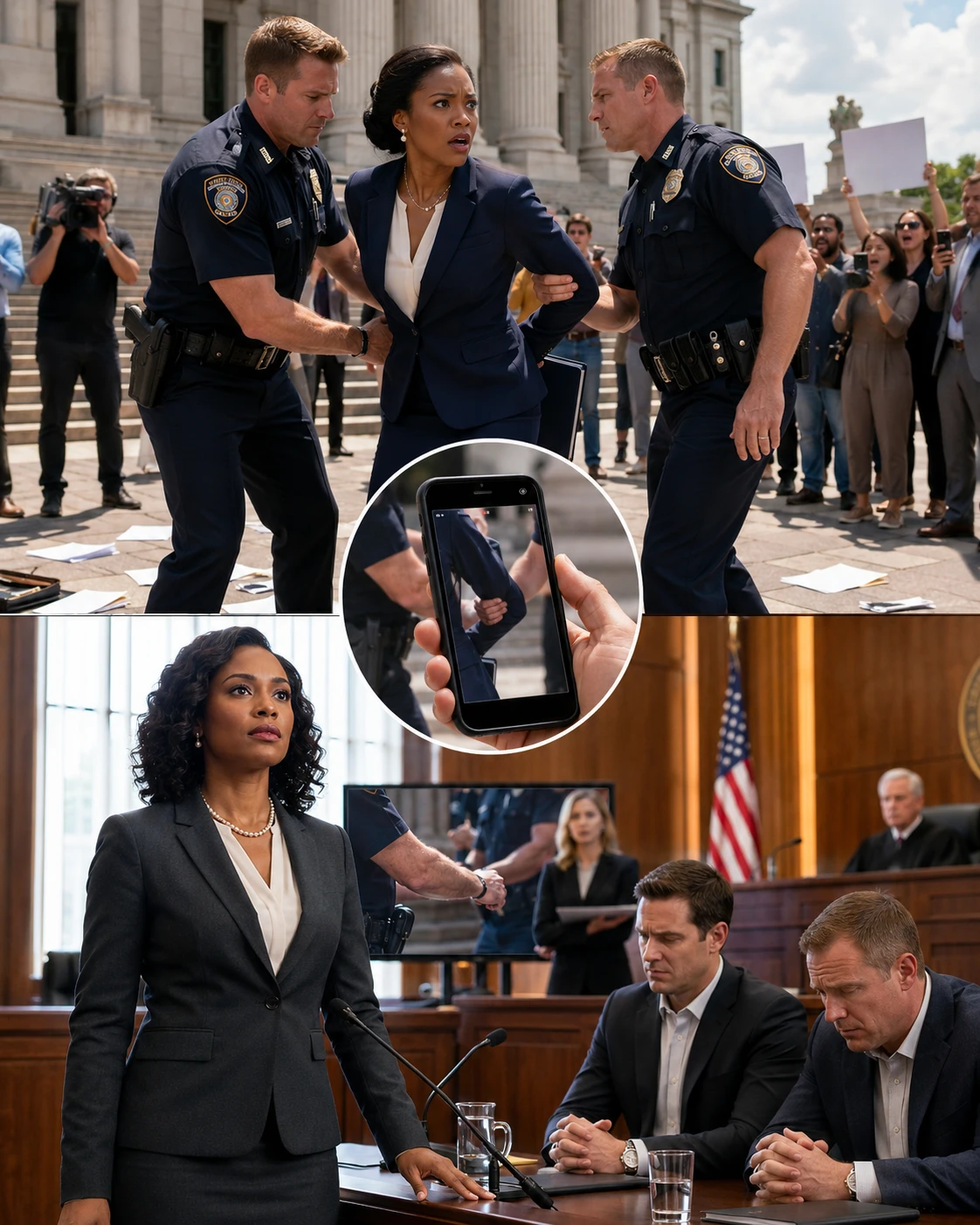
PART 1: THE ORDER I REFUSED TO OBEY
The first thing Officer Grant Heller said to me was, “Put the phone down.”
Not hello.
Not ma’am.
Not step back.
Not even a question.
An order.
I remember that because judges learn to pay attention to language. Words matter in my courtroom. Tone matters. Timing matters. The difference between a request and a command can become the difference between consent and coercion, between lawful conduct and abuse.
And Heller had not spoken to me like a citizen standing peacefully on a public sidewalk.
He had spoken to me like someone whose obedience he had already decided he was entitled to.
I lowered my folder against my hip but kept my phone raised.
“I’m not interfering,” I said. “I’m documenting from a public space.”
The courthouse plaza behind him was loud enough that I almost had to raise my voice.
Almost.
I didn’t.
I had spent fourteen years practicing law and six years on the bench. I had learned long ago that volume rarely made a weak position stronger.
The demonstration had been going on since late morning. Maybe two hundred people filled the broad stone plaza outside the Mapleford County Courthouse, carrying cardboard signs and chanting beneath the August sun. Reporters stood near the steps. Camera crews crowded the edge of the lawn. Police officers had formed a line between the protesters and the courthouse entrance.
So far, it had been tense but peaceful.
That was why I had stopped.
I had left my chambers during lunch with a folder of case notes tucked under one arm, intending to cross the plaza, grab coffee, and return before my afternoon docket.
I wasn’t wearing my robe.
I wasn’t wearing anything that identified me as a judge.
Just a navy suit, low heels, pearl earrings my mother had given me when I passed the bar, and my courthouse security badge clipped inside my purse.
No escort.
No special treatment.
No reason anyone looking at me should have known who I was.
And I preferred it that way.
A judge should understand what the law feels like when no one knows your title.
That afternoon, I learned more about that than I ever wanted to know.
I had paused near the lower steps because something in the officers’ posture bothered me.
I couldn’t have explained it in a single sentence.
It was a collection of small things.
Hands resting on belts.
Jaws clenched.
One officer repeatedly looking toward the television cameras.
Another laughing when a protester shouted about accountability.
And then Heller.
He stood near the center of the police line with a heavy build and a face flushed from the heat. His partner, Officer Mason Rudd, was beside him.
I had seen both men before.
Not socially.
In court.
Names on reports. Faces at suppression hearings. Uniformed witnesses sitting in the gallery waiting for cases to be called.
I knew Heller better by reputation than by personal interaction. Confident witness. Direct answers. Rarely rattled.
Rudd was younger. Quieter.
I had never had a reason to remember either of them beyond their cases.
I was recording the police line when Heller noticed me.
His eyes fixed on my phone.
He said something to Rudd.
Then both men stepped away from the formation and walked directly toward me.
That was when I felt the first change in the air.
People notice when police officers move with purpose.
The chanting around me continued, but several protesters turned.
A cameraman swung his lens.
Heller stopped less than three feet away.
“Phone down.”
I kept recording.
“I’m standing on a public sidewalk.”
“You’ve been warned.”
“Warned about what?”
Rudd moved to Heller’s right.
He was close enough now that I could smell sweat beneath the sharp chemical scent of his uniform.
“You think you’re special?” he asked.
There was something almost eager in his expression.
That bothered me more than the question.
“No,” I said. “I think the law applies.”
Rudd’s mouth tightened.
Heller reached for my arm.
There was no announcement that I was under arrest.
No instruction to move.
No explanation of what crime I had committed.
His hand simply closed around my upper arm.
Hard.
My body reacted before my legal training did.
I pulled away.
Not a punch.
Not a shove.
Not an attempt to run.
A reflex.
Human.
Heller’s voice exploded across the plaza.
“Stop resisting!”
Everything happened at once.
His hand twisted my arm behind my back.
My phone jerked sideways.
Someone screamed.
I heard a man yell, “She wasn’t doing anything!”
Rudd grabbed my other wrist.
My folder hit the pavement.
Pages scattered across the stone steps.
For one absurd second, I watched my handwritten notes for an afternoon sentencing hearing blow under a news van.
Then my body struck the hood of a patrol car.
Cold metal pressed against my cheek.
My breath left me.
The crowd erupted.
“Get your hands off her!”
“She didn’t resist!”
“We’re recording!”
“Back up!” Rudd shouted. “Everybody back up!”
A hand forced my shoulder down.
Metal closed around my left wrist.
Then my right.
Too tight.
I felt the cuffs bite immediately.
“Heller,” I said.
He froze for half a second.
I had used his name.
That finally made him look at me.
My cheek was still pressed against the patrol car.
“My name is Nadia Brooks.”
“So?”
“I am a judge of the Mapleford County Superior Court.”
Rudd laughed.
Actually laughed.
Not nervously.
Not because he thought he had misheard.
He laughed as if I had told him I was the governor.
“Sure you are.”
“I have identification in my purse.”
Heller recovered quickly.
“Save it.”
“You can verify my identity with courthouse security.”
“Keep talking,” Rudd said, “and we’ll add obstruction.”
A woman somewhere behind us shouted, “She is a judge! I’ve seen her!”
That caused movement through the crowd.
Reporters started calling my name.
Someone yelled, “Judge Brooks!”
Someone else repeated it.
Heller heard them.
I know he heard them because his grip changed.
Just slightly.
But he didn’t stop.
That was the moment I understood this was no longer about a misunderstanding.
A misunderstanding ends when someone is offered an easy way to correct it.
I had given them my full name.
My place of employment was twenty yards behind us.
My identification was within reach.
Multiple people were telling them who I was.
They could have checked.
Instead, Heller opened the rear door of the patrol car.
“Watch your head.”
The irony almost made me laugh.
Almost.
Rudd reached for my purse.
“That contains my judicial identification,” I said.
He tossed it onto the front passenger seat without looking.
“I said you can verify—”
“Enough.”
Heller pushed me into the back.
The door slammed.
Outside, the plaza had become chaos.
Dozens of phones pointed toward the cruiser.
Reporters surrounded the police line.
My notes still littered the pavement.
Through the glass, I watched a young officer retrieve one of the pages, read the heading, and look sharply toward Heller.
The officer crossed the pavement and said something to him.
Heller glanced at me through the window.
Then at the paper.
Then back at the officer.
Whatever was said, it should have ended there.
It didn’t.
Heller waved him away.
A minute later, we were moving.
I looked down at my hands.
The cuffs had already left deep red marks around my wrists.
My phone was gone.
My purse was in the front.
My courthouse stood behind us.
I had sentenced defendants in that building.
Protected jurors there.
Signed warrants.
Dismissed cases when police searches violated the Constitution.
Ordered prosecutors to turn over evidence.
Advised frightened teenagers that one terrible decision did not have to become the rest of their lives.
Now I was sitting handcuffed in the back of a patrol car because I had raised a phone.
For the first five minutes, neither officer spoke.
I forced myself to breathe slowly.
Observe.
Remember.
That was what I told myself.
Observe.
Remember.
The time we left.
The route.
The names.
The words.
The pressure of the cuffs.
The fact that no one had advised me why I was being detained.
The fact that Heller had reached for me before announcing an arrest.
The fact that Rudd had ignored repeated offers to verify my identity.
Facts survive anger.
Facts survive humiliation.
Facts survive people who believe authority can rewrite what happened.
At a red light, Heller glanced at me in the mirror.
“You got quiet.”
“I’m listening.”
“To what?”
“Everything.”
His eyes stayed on mine.
Then the light changed.
He drove on.
At the county jail, the booking entrance opened before the patrol car had fully stopped.
I knew that building too.
Not from this side.
I had toured it twice with the county justice committee.
I had seen the intake area, medical screening rooms, visitation booths, isolation cells.
I had discussed overcrowding with the sheriff.
I had reviewed reports concerning detainee treatment.
I knew what the county claimed happened inside those walls.
Within an hour, I would learn what could happen when everyone decided no one important was watching.
A booking deputy took my name.
“Nadia Elise Brooks.”
He typed.
Paused.
Looked at the screen.
Then looked at me.
His expression changed.
I saw it.
It was small, but unmistakable.
Recognition.
Before he could speak, Heller leaned over the counter.
“Obstruction and resisting.”
The deputy looked back at the monitor.
“Is this—”
“She refused commands and fought us.”
“I did not fight anyone,” I said.
Heller turned.
“You want another charge?”
“No. I want the record to be accurate.”
Rudd snorted.
The deputy’s fingers hovered above the keyboard.
I watched him make a choice.
He looked at Heller.
Then at me.
Then clicked something on the screen.
“Empty your pockets.”
“My identification is in Officer Rudd’s possession.”
“We’ll inventory property later.”
“I want my identity verified.”
No answer.
“I am requesting counsel.”
No answer.
“I am requesting the watch commander.”
Rudd leaned against the counter and smiled.
“Judge, lawyer, senator. Anything else?”
I met his eyes.
“Yes.”
His smile widened.
“What?”
“Your badge number.”
The smile disappeared.
That should have been the worst moment of my night.
It wasn’t even close.
Because twenty minutes later, a female detention officer entered the holding area carrying electric clippers.
And when I heard them click on, I understood that the arrest had only been the beginning.
PART 2: THE SOUND OF THE CLIPPERS
The detention officer introduced herself as Officer Mallory Pike.
I remembered her name because I made myself remember everything.
She was perhaps forty, with tired eyes, cropped blond hair, and the detached expression of someone determined not to become emotionally involved in anything that happened during her shift.
The clippers hung from her right hand.
A disposable plastic sheet was folded beneath her left arm.
“Sit down,” she said.
I remained standing.
“For what?”
“Intake.”
“I’ve already been fingerprinted and photographed.”
“Lice protocol.”
I looked at the clippers.
Then at her.
“I haven’t been examined for lice.”
She gave a small shrug.
“Protocol.”
“What is the written standard?”
That got her attention.
“What?”
“Is hair removal mandatory for all detainees?”
“Sit down.”
“Has a medical professional determined that I have lice?”
She sighed.
Behind the glass partition, two deputies watched.
One of them was smiling.
I had been in difficult courtrooms.
I had been threatened by defendants.
I had received anonymous letters at home.
I had presided over cases where families screamed at me because no sentence could restore what they had lost.
I knew what intimidation looked like.
This was different.
This was casual.
That made it worse.
No one in the room looked angry.
No one was losing control.
They were calm.
That meant humiliation was not an accident of emotion.
It was becoming procedure because they had decided it could.
“I am not refusing a legitimate medical examination,” I said. “I am asking you to identify the policy authorizing forced hair removal without one.”
Pike’s jaw tightened.
“Everybody gets processed.”
“Then show me the policy.”
One of the deputies behind the glass laughed.
“Here we go.”
Pike looked toward him.
He said, “Heller said she’s a courthouse lawyer or something.”
“Judge,” Rudd corrected from the doorway.
He had returned with a paper cup of coffee.
Pike glanced at me.
Then at him.
Rudd smiled.
“She says she’s a judge.”
“She is requesting identity verification,” I said.
Rudd took a slow drink.
“She’s also requesting the governor, the Supreme Court, and probably the National Guard.”
“I requested the watch commander and an attorney.”
“See?”
The deputy behind the glass laughed again.
Pike did not.
For a moment, I thought she might stop.
She stared at the clippers.
Then at me.
There was hesitation in her face now.
That mattered.
Later, I would remember it.
People like to imagine abuse is always committed by monsters.
It isn’t.
Sometimes it happens because one person starts it, another person finds it funny, and a third person knows it is wrong but decides resisting the group will cost more than cooperating.
Pike knew something was wrong.
I could see it.
She made her decision anyway.
“Sit.”
“No.”
Her eyes sharpened.
“Are you refusing processing?”
“I am refusing an undocumented physical procedure that you have not established is medically necessary.”
Rudd set his coffee on the counter.
“Jesus.”
He stepped into the holding area.
“Why do you have to make everything difficult?”
I looked at him.
“I raised a phone in a public place. Officer Heller grabbed me. You arrested me without verifying my identity. I have requested counsel. I have requested a supervisor. Now an officer is preparing to shave my head while refusing to identify a policy that authorizes it.”
My voice remained calm.
But my heart was pounding.
“So yes,” I said. “I am going to ask questions.”
Something flickered in his face.
Not guilt.
Annoyance.
He wanted me afraid.
My questions were interfering with that.
“You know what your problem is?” he said.
“No.”
“You’re used to people doing what you say.”
The words landed harder than I expected.
Because there was truth twisted inside them.
I was a judge.
People stood when I entered a courtroom.
Lawyers called me Your Honor.
Deputies followed my orders.
But authority had never been the point.
At least I had tried never to let it become the point.
“My problem,” I said, “is that you seem to believe authority excuses you from explaining what you’re doing.”
Rudd laughed without humor.
“Sit her down.”
Pike looked at him.
“She hasn’t been screened.”
Silence.
Three seconds, maybe four.
There it was.
The truth.
Small.
Clear.
Enough.
Rudd’s expression changed.
“Then screen her.”
“We need medical.”
“So call medical.”
“They’re backed up.”
Rudd picked up his coffee.
“Then do intake.”
Pike stared at him.
“You said lice protocol.”
“I said process her.”
“No,” I said.
Both of them looked at me.
“You said enough.”
Rudd took a step toward me.
“What?”
“For the record, Officer Pike just confirmed that I have not received the screening that supposedly justified shaving my head.”
His eyes hardened.
“You think there’s a record?”
I looked toward the ceiling.
A black dome camera hung above us.
“Yes.”
That was the first time I saw fear.
Not much.
Just a flash.
Rudd followed my eyes upward.
Then he smiled again.
“Those don’t catch everything.”
He should not have said that.
I stored the sentence away.
Pike unfolded the plastic sheet.
“Sit down.”
This time, two deputies entered.
I understood what would happen if I continued refusing.
They would restrain me.
Then they would call that resistance too.
So I made a choice.
Not surrender.
Preservation.
I sat.
Pike draped the plastic sheet around my shoulders.
My hands were uncuffed but my wrists ached.
I folded them in my lap.
My hair fell past my shoulders.
I had worn it that way for almost twenty years.
My mother used to press it straight before church when I was a child. I hated sitting still between her knees while she worked section by section, but afterward she would run her hands over it and say, “There. Now hold your head high.”
When I graduated from law school, she had cried while pinning my cap around the same hair.
When I became a judge, she had stood in the front row during my oath ceremony.
She died eleven months later.
I don’t know why those memories came to me then.
Maybe humiliation finds the softest place in you.
Maybe the body understands violation before the mind finds language for it.
The clippers turned on.
Bzzzzzz.
A mechanical, indifferent sound.
Pike placed a hand against the crown of my head.
I closed my eyes.
The first pass moved from my forehead backward.
I felt cold air touch my scalp.
Hair slid over the plastic sheet and fell to the concrete.
Someone laughed.
I opened my eyes.
No tears.
Not because I was stronger than tears.
Because I refused to give them anything they could interpret as permission.
Another pass.
More hair fell.
I looked straight ahead at the dark reflective glass.
I could see my own outline.
I could also see Rudd behind me.
He was watching.
That told me everything I needed to know about why this was happening.
It was not sanitation.
It was not safety.
It was control.
They had arrested a woman who did not obey quickly enough.
Then discovered she would not become frightened quickly enough.
So they wanted to make her smaller.
Each sweep of the clippers exposed more of my scalp.
Dark strands collected around the chair.
Pike’s movements became faster.
Maybe she wanted it over.
Maybe she wanted to stop thinking.
I wanted to ask her whether she had daughters.
I didn’t.
I wanted to ask Rudd whether humiliating someone made him feel more powerful.
I didn’t.
I memorized.
The camera.
The clock.
8:17 p.m.
Rudd’s coffee cup.
Pike’s left hand trembling once before she steadied it.
The deputy behind the glass whispering something and laughing.
The strip of fluorescent light buzzing above me.
The strange smell of disinfectant and burnt dust.
When Pike finished, she stepped away.
My head felt impossibly light.
The plastic sheet was covered with my hair.
She gathered it together.
I finally looked directly at her.
“Do not dispose of that.”
She blinked.
“What?”
“It is evidence.”
Rudd laughed.
“For what?”
I turned toward him.
“That depends on how honest you decide to be tomorrow.”
He shook his head.
“Still doing the judge thing.”
“I am a judge.”
“Sure.”
A voice came from the holding cells.
“Let her call her judge friends.”
More laughter.
“Tomorrow she’ll be begging.”
I stood.
The loose hair on my shoulders itched.
My scalp burned where the clippers had scraped too close.
I looked from Pike to Rudd.
Then toward the deputies behind the glass.
“Tomorrow,” I said quietly, “you’ll be in a courtroom.”
Nobody laughed for several seconds.
Then Rudd did.
Too loudly.
“Put her in holding.”
I spent the next two hours in a cell with six other women.
None asked what I had done.
That surprised me until an older woman sitting on the lower bunk finally said, “We heard them.”
Her name was Teresa.
That was all she told me.
I didn’t ask for more.
She handed me a folded paper towel dampened with water.
“You’re bleeding.”
I touched the back of my head.
My fingers came away pink.
The clippers had nicked my scalp.
“Thank you.”
She sat beside me.
“You really a judge?”
“Yes.”
“You gonna get them fired?”
The question was so simple I almost smiled.
“I don’t know what’s going to happen.”
She studied me.
“That means yes.”
“No. It means I don’t decide punishment before I know the facts.”
Teresa looked toward the cell door.
“They didn’t care about facts when they brought you in.”
“No.”
“So why should you?”
Because that is the line, I thought.
The line between law and revenge.
Between justice and power.
Between what they had done and what I had spent my career trying not to do.
But I couldn’t explain all of that while sitting beneath a scratchy jail blanket with my scalp still burning.
So I said, “Because if I stop caring about facts, then the only difference between us is who has authority.”
Teresa stared at me for a moment.
Then nodded.
“Okay, Judge.”
At 9:43 p.m., a deputy opened the cell.
“Brooks.”
I stood.
“You get one call.”
Finally.
At the phone, I dialed the direct number to my chambers.
My judicial assistant, Mara Ellis, answered on the first ring.
“Nadia?”
She never called me Nadia during work hours.
That told me she already knew.
“Mara.”
“Oh my God. Where are you? We’ve been trying to find—”
“County jail.”
“I know. The video is everywhere. Chief Judge Ward is—”
“Listen carefully.”
My own voice sounded strange to me.
Controlled.
Too controlled.
Mara went silent.
“Preserve every courthouse exterior camera covering the south plaza between twelve fifteen and one fifteen. Contact courthouse security and tell them not to overwrite anything.”
“I will.”
“Find out whether my phone was logged into evidence. Do not access it yourself.”
“Okay.”
“Contact my attorney.”
“Already did.”
“Tell her I want a formal preservation demand sent tonight for arresting officers’ body cameras, vehicle cameras, booking-room footage, holding-area footage, medical records, intake policies, radio traffic, and property logs.”
Mara breathed in sharply.
“What did they do to you?”
I touched my scalp.
“Add jail grooming and communicable-disease policies to the request.”
She understood.
Her voice broke.
“Nadia.”
“Not now.”
“I’m sorry.”
“Not now, Mara. I need you focused.”
“I am.”
“Good.”
A deputy stood behind me.
I lowered my voice.
“And tell Chief Judge Ward not to make calls asking for favors.”
“What?”
“No special treatment. No informal intervention.”
“You are sitting in jail for something you didn’t do.”
“Then the record should show that.”
“Nadia—”
“If they release me because I’m a judge, they’ll say the system protected one of its own. I want this handled the way it should be handled for anyone.”
Silence.
Then Mara said, “Understood.”
The deputy tapped his watch.
“One more thing,” I said.
“What?”
“Tell my attorney I want the earliest possible probable-cause hearing.”
“When?”
“Tomorrow.”
A humorless smile touched my mouth.
“I promised them a courtroom.”
I hung up.
When I turned around, Officer Pike was standing at the end of the corridor.
She had heard at least part of the call.
Her face had gone pale.
She stepped toward me after the deputy moved away.
“Judge Brooks.”
It was the first time anyone inside the jail had used my title.
I stopped.
Pike lowered her voice.
“I didn’t know.”
I looked at her.
There were a hundred answers I could have given.
You did not need to know.
Would it have been acceptable if I were not a judge?
Would my hair have mattered less if I worked at a grocery store?
Would the policy become lawful depending on my profession?
Instead, I said the one thing that mattered.
“You knew there was no screening.”
Her eyes dropped.
“That’s not usually how—”
“You knew.”
She said nothing.
I returned to the cell.
At 11:06 p.m., someone came to the door and announced that a supervisor wanted to speak with me.
I declined without counsel.
At 11:32, they offered to release me on my own recognizance.
I declined to sign anything until my attorney arrived.
At 12:18 a.m., the jail suddenly discovered my judicial identification in my property bag.
At 12:41, they tried to explain that there had been a “communication failure.”
At 1:03, my attorney arrived.
And by two in the morning, the laughter had stopped.
Not because anyone had apologized.
Because the preservation notices had been delivered.
And now everyone understood that the cameras were not going to disappear quietly.
PART 3: THE MORNING THEY SAW MY FACE
I had entered Courtroom Two hundreds of times.
Never in handcuffs.
At 8:52 the next morning, a deputy escorted me through the side door wearing county-issued gray pants, a white T-shirt, and a thin jail overshirt.
My head had been shaved almost to the skin.
The cut on the back of my scalp had dried into a narrow dark line.
The cuffs were loose this time.
Someone had apparently learned that detail overnight.
Courtroom Two was full.
Not crowded.
Full.
Every bench.
Every aisle.
Reporters lined the rear wall.
Lawyers stood along both sides.
Several courthouse employees I recognized were sitting together near the back.
When I entered, sound moved through the room like wind through leaves.
Gasps.
Whispers.
Someone began crying.
I kept my eyes forward.
That was harder than anything I had done the night before.
Humiliation feels different in private.
In private, you can pretend you will somehow hide what happened.
Public humiliation takes that fantasy away.
Every person I worked with could see my scalp.
Every lawyer who had argued before me.
Every deputy who had guarded my courtroom.
Every reporter who had covered one of my rulings.
I wanted a scarf.
I wanted a hat.
I wanted hair.
Instead, I lifted my head.
My mother’s voice came back to me.
Hold your head high.
So I did.
Chief Judge Evelyn Ward sat at the bench.
She had known me for almost fifteen years.
I saw anger in her face the moment she looked at me.
Then it disappeared.
A judge cannot wear anger on the bench.
Not if she wants the room to trust what happens next.
My attorney, Leah Morgan, stood at counsel table.
She came to me immediately.
“You okay?”
“No.”
She nodded once.
It was the right answer to accept.
No false reassurance.
No speech.
She simply moved closer while the deputy removed my cuffs.
Across the aisle sat an assistant county prosecutor I did not know well. Behind him, near the wall, stood Heller and Rudd.
Both in uniform.
Both pale.
Rudd’s eyes locked on me first.
For a fraction of a second, I watched his face move through confusion, recognition, and fear.
He knew now.
Not because someone had told him.
Because he knew my face.
He had seen me in robes.
He had testified in my courtroom nine months earlier.
I remembered suddenly.
A traffic stop case.
He had been the assisting officer.
I had ruled in the state’s favor.
The memory made something inside me go cold.
He had laughed when I told him who I was.
Had he truly not recognized me?
Maybe.
Maybe not.
Heller looked at the floor.
Judge Ward entered the record.
“This hearing concerns the lawfulness of the warrantless arrest of Nadia Brooks, presently charged with obstruction of governmental administration and resisting arrest.”
She paused.
“The court is aware that Ms. Brooks serves as a judge of this county. That fact will neither increase nor diminish the rights at issue today.”
I watched several reporters begin writing.
Judge Ward continued.
“The defendant has requested an immediate probable-cause review and preservation of all evidence related to the arrest and detention. Given the unusual circumstances, the court has directed that no evidence be altered, deleted, overwritten, transferred, or destroyed pending further order.”
The prosecutor stood.
“Your Honor, the state moves to dismiss both charges.”
A murmur moved through the courtroom.
I felt Leah tense beside me.
Judge Ward looked down.
“On what basis?”
“After preliminary review of publicly available recordings, the state does not believe continued prosecution is appropriate.”
“Publicly available recordings.”
“Yes, Your Honor.”
Judge Ward’s eyes narrowed.
“Has the state reviewed the officers’ body-camera footage?”
A hesitation.
“Not completely.”
“Booking footage?”
“No.”
“Courthouse surveillance?”
“Not yet.”
“Then why is the state prepared to dismiss charges before determining whether the arrest was merely unsupported or whether official reports concerning the arrest contain false statements?”
The courtroom went silent.
The prosecutor swallowed.
“The state believed dismissal would remedy the immediate—”
“My detention is not the only issue,” I said.
Leah touched my arm.
I had spoken out of turn.
Old instincts.
Judge Ward looked at me.
“Ms. Brooks, through counsel.”
“Apologies, Your Honor.”
It hurt more than I expected to hear myself called Ms. Brooks in that room.
Not because I needed the title.
Because the sound reminded me that I was not sitting there as a judge.
I was the person against whom the state had exercised its power.
Leah rose.
“Your Honor, the defense does not oppose dismissal. However, we request that the court retain jurisdiction over preservation issues and direct referral of the record to an independent authority. We also request production of all reports generated before the officers became aware—or claim to have become aware—of Judge Brooks’s identity.”
That was important.
What had they written when they thought I was nobody?
Judge Ward looked toward the prosecutor.
“Any objection?”
“No, Your Honor.”
“Granted.”
The charges were dismissed at 9:07 a.m.
Fourteen hours after I had been shoved against a patrol car.
But no one moved.
The hearing was not over.
Judge Ward ordered my phone returned to my attorney for forensic preservation.
It was placed on counsel table inside an evidence bag.
The screen was cracked.
Leah leaned close.
“Automatic cloud backup was on.”
I looked at her.
“Confirmed?”
She nodded.
My pulse changed.
The recording had survived.
Judge Ward addressed Heller.
“Officer, were you recording during the encounter?”
Heller stood.
“Yes, Your Honor.”
“Was your body camera activated before you approached Ms. Brooks?”
A pause.
“I believe so.”
“Do you know?”
“No, Your Honor.”
Rudd was asked the same.
“I’d have to check.”
Judge Ward’s expression did not move.
“You were both reminded at roll call that officers deployed to a public demonstration were required to maintain continuous body-camera recording, correct?”
The prosecutor stood quickly.
“Your Honor, if the court intends to take testimony that could expose the officers to criminal or administrative liability, they should have counsel.”
Judge Ward nodded.
“Agreed.”
Heller and Rudd were instructed not to answer further questions until they had been advised.
That was when the rear doors opened.
A courthouse technology officer entered carrying a sealed drive.
He whispered to the clerk.
The clerk handed a note to Judge Ward.
She read it.
Then looked toward counsel.
“The courthouse has complied with the preservation order. Exterior surveillance from the south plaza has been secured.”
Heller finally looked up.
I watched his face.
The blood seemed to drain from it.
It was not proof.
Not yet.
But it told me something.
He was afraid of what the camera had seen.
Judge Ward scheduled a preservation and evidentiary status hearing for that afternoon, this time with counsel for the involved officers and jail staff.
I was released immediately.
The deputy opened the small gate separating counsel tables from the gallery.
I should have left.
Instead, I turned toward Heller and Rudd.
Rudd looked away.
Heller did not.
For the first time since he had grabbed me, neither man had authority over where I stood, when I spoke, whether I moved, or what happened next.
I felt no triumph.
Only exhaustion.
And beneath it, something harder.
Leah guided me through the side exit.
In the hallway, Mara was waiting.
The moment she saw me, she covered her mouth.
I almost broke then.
Not when Heller slammed me against the car.
Not when the cuffs cut my wrists.
Not when the clippers touched my forehead.
When my friend looked at what they had done and tried not to cry.
She stepped forward carefully.
“Can I hug you?”
I nodded.
She held me.
For several seconds, I was not Judge Brooks.
I was not a complainant.
I was not a symbol in a news story.
I was simply a woman shaking in a courthouse hallway while someone who loved me held on.
“I’m sorry,” Mara whispered.
I shut my eyes.
“I know.”
She pulled back.
“They found your folder.”
That almost made me laugh.
“My sentencing notes?”
“All of them.”
“Good.”
“Nadia.”
“Yes?”
“You are not working today.”
“I have an afternoon docket.”
“You have stitches scheduled.”
“Stitches?”
Leah pointed at the back of my head.
“The jail nurse documented two cuts before release. One may need closure.”
I stared at her.
“Documented when?”
“After midnight.”
“After the preservation demand?”
“Yes.”
I absorbed that.
A medical record created only after they knew evidence was being preserved.
Another detail.
Another timestamp.
Another thing to remember.
I looked through the courthouse window toward the plaza below.
Satellite trucks lined the street.
Protesters were gathering again.
This time, some signs had my name on them.
I hated that.
The demonstration had not been about me.
The underlying anger had existed before I raised my phone.
I had merely stumbled into the machinery people had been trying to describe.
“I need to make a statement,” I said.
Leah shook her head immediately.
“No.”
“I’m not discussing evidence.”
“Nadia—”
“If I say nothing, this becomes ‘Judge gets mistreated, system responds.’”
“That is what happened.”
“No.”
I turned toward her.
“What happened is that I received attention because I could force the system to look. Other people may have sat in that chair and never had Chief Judge Ward order the cameras preserved.”
Leah studied me.
“You were a victim too.”
“I know.”
The words came out sharper than I intended.
I lowered my voice.
“I know.”
That was important.
I was not going to erase what had been done to me merely because others had suffered too.
But I would not let my title become the moral of the story.
At 10:13 a.m., I walked onto the courthouse steps.
Hundreds of cameras turned toward me.
The noise stopped so suddenly that I could hear traffic from three blocks away.
My shaved head was uncovered.
My wrists were bruised.
I had changed into a suit Mara brought from my chambers, but no clothing could disguise what had happened.
I stepped to the microphones.
“My name is Nadia Brooks.”
My voice carried through the speakers.
“I serve as a judge in this courthouse.”
Flashes exploded.
“Yesterday, I was arrested while recording police activity from a public space. I was transported to the county jail. During detention, I repeatedly requested identity verification, counsel, and supervisory review.”
I paused.
“I will not discuss disputed evidence while an investigation is beginning.”
Reporters shouted questions.
I raised one hand.
“But I will say this.”
Silence returned.
“What happened becomes more disturbing, not less, because I am a judge.”
A few people frowned.
I continued.
“If the law protects me only after someone recognizes my title, then it is not protecting people equally.”
No one shouted now.
“If asking for policy, requesting counsel, or recording public officials can be treated as defiance deserving punishment, then we have a problem larger than one arrest.”
My throat tightened.
I forced myself to continue.
“I am not asking anyone to decide guilt because they are angry on my behalf. I am asking that the evidence be preserved, examined, and followed wherever it leads.”
Then I stepped away.
No dramatic threat.
No demand for firings.
No prediction about prison.
Facts first.
That was what I believed.
That was what I had always demanded in my courtroom.
By noon, the first body-camera file had been recovered.
At 12:26, Leah called me into her temporary office.
She closed the door.
“What?”
She put a laptop on the table.
“Heller’s camera started recording thirty-seven seconds before he grabbed you.”
My heartbeat slowed.
“Audio?”
“Yes.”
“All of it?”
She looked at me.
“Enough.”
She pressed play.
Wind.
Chanting.
Radio noise.
Then Heller’s voice.
Distant at first.
Talking to Rudd before they approached me.
“There’s another one filming.”
Rudd replied, “Want me to move her?”
A pause.
Then Heller said something that changed the entire case.
“Yeah. Let’s see how brave she is when the phone’s gone.”
I stared at the screen.
Leah did not speak.
The recording continued.
Footsteps.
My own voice.
I’m not interfering. I’m documenting from a public space.
Phone down.
I’m standing on a public sidewalk.
The sound of movement.
Then Heller’s voice again.
Stop resisting!
But the camera told the story his report had not.
He had decided to confront me before I had said a word to him.
And worse—
He had explained why.
Not safety.
Not crowd control.
The phone.
I looked at Leah.
“What does his report say?”
She slid a copy across the table.
I read the first paragraph.
Officer observed female subject interfering with crowd-control operations and repeatedly refusing lawful orders to vacate restricted area.
I read it twice.
“There was no restricted area.”
“No.”
“I was on the sidewalk.”
“Yes.”
“He knew I was filming before he approached.”
“Yes.”
I read farther.
Subject became physically combative and attempted to pull away during lawful detention.
My hands went cold.
Words matter.
I had believed that my whole career.
Now I was looking at words designed to replace reality.
Leah closed the report.
“There’s more.”
I looked up.
“What?”
“Rudd filed his report at 4:12 p.m.”
“And?”
“Heller filed his at 5:48.”
“So Rudd first.”
“Yes.”
She placed them side by side.
The paragraphs describing my supposed resistance were almost identical.
Not similar.
Almost word for word.
I stared at them.
Then I remembered the booking deputy pausing over his computer.
The younger officer picking up my courthouse notes.
Pike saying I had not been screened.
Rudd looking at the ceiling camera and telling me it did not catch everything.
Small cracks.
Everywhere.
The truth had been present from the beginning.
We just had to stop anyone from sealing the cracks before daylight reached them.
Then Leah said, “Nadia, the jail footage has been preserved.”
I looked at her.
“The shaving?”
She nodded.
“All of it.”
For the first time since the arrest, I was afraid to watch.
PART 4: WHAT THE CAMERAS REMEMBERED
I did not watch the jail video before the afternoon hearing.
I could not.
There is a strange difference between surviving something and seeing it happen to yourself.
Memory gives you one angle.
A camera gives you another.
I knew what I had felt in that chair.
I did not yet know what my face had looked like.
At 2:00 p.m., Courtroom Two was full again.
This time Heller and Rudd had attorneys.
Officer Pike had one too.
The sheriff sat in the front row.
County attorneys filled one side of the gallery.
The prosecutor who had dismissed my charges that morning had been replaced by a senior assistant district attorney assigned only to address preservation matters until an independent review could be arranged.
I sat beside Leah.
Not at the bench.
That mattered to me.
People online had already begun writing headlines about the judge who was going to “destroy” the cops who arrested her.
They were wrong.
I would not preside over any criminal case involving these officers.
I would not decide whether charges were filed.
I would not decide punishment.
I would not become what Rudd had accused me of being: someone who believed authority existed to satisfy personal anger.
But I could testify.
I could demand the same process I would want for anyone else.
And I could refuse to disappear.
Judge Ward opened the hearing.
The courthouse surveillance played first.
There was no audio.
It did not need any.
The screen showed me standing several yards from the police line.
My folder beneath my arm.
Phone raised.
No restricted barricade around me.
No blocked path.
No threatening movement.
Heller turned toward me.
Spoke to Rudd.
They crossed the plaza.
Within seconds, Heller grabbed my arm.
I recoiled.
He forced me toward the patrol car.
Rudd joined him.
My papers fell.
The video continued.
Then the younger officer picked up one of my courthouse pages.
He read it.
Walked to Heller.
Spoke to him.
Heller looked toward the cruiser.
The timestamp showed that this occurred twenty-six seconds before they drove away.
Leah whispered, “He had another warning.”
I nodded.
The body-camera audio played next.
“There’s another one filming.”
“Want me to move her?”
“Yeah. Let’s see how brave she is when the phone’s gone.”
No one moved in the courtroom.
Then my voice.
“I’m not interfering.”
Heller’s command.
My response.
Rudd asking whether I thought I was special.
And me saying:
“No. I think the law applies.”
I had forgotten how calm I sounded.
Then came the moment Heller seized me.
My startled breath.
The scrape of shoes.
And almost immediately:
“Stop resisting!”
The video shook violently as he forced me against the cruiser.
I heard my own voice.
“My name is Nadia Brooks. I am a judge of the Mapleford County Superior Court.”
Rudd’s laugh came through clearly.
“Sure you are.”
Then another voice from the crowd.
“She is a judge!”
Then more.
“Judge Brooks!”
“That’s Judge Brooks!”
The camera showed Heller looking toward them.
No verification followed.
The cruiser left.
Heller stared at the table.
Rudd’s attorney wrote notes rapidly.
The next evidence was the booking log.
My name had been entered correctly.
The computer system had returned an identity alert connected to my courthouse credentials.
Not a secret database.
Not some dramatic hidden file.
A routine county personnel match.
The booking deputy had seen it.
The entry had been marked:
IDENTITY VERIFICATION DEFERRED.
By whom?
The audit log listed the deputy’s login.
His attorney later claimed he had acted at Heller’s direction.
That would be investigated separately.
Then came my property inventory.
One navy purse.
Wallet.
Keys.
Courthouse access card.
State judicial identification.
Both had been inside my property bag from the moment I entered booking.
The room seemed colder.
Rudd had told people I had provided no identification.
The inventory had been signed by him.
Judge Ward removed her glasses.
No one needed her to explain the contradiction.
The documents did it themselves.
Then the jail footage began.
I looked down.
Leah touched my hand.
“You don’t have to watch.”
“Yes, I do.”
“Nadia.”
“If I ask other people to look at it, I can look too.”
The video showed the intake room from above.
No sound for the first camera angle.
Then a synchronized second recording began with audio.
Pike entered carrying the clippers.
I heard myself ask about policy.
I heard her say lice protocol.
I heard myself ask whether I had been examined.
Rudd entered.
Then came the moment Pike hesitated.
“She hasn’t been screened.”
There it was.
Recorded.
Clear.
Rudd said, “Then screen her.”
She explained medical was backed up.
He told her to do intake.
Then my voice:
“For the record, Officer Pike just confirmed that I have not received the screening that supposedly justified shaving my head.”
Rudd’s answer filled the courtroom.
“You think there’s a record?”
I heard several people inhale at once.
On screen, I looked at the ceiling camera.
“Yes.”
Rudd followed my gaze.
“Those don’t catch everything.”
His attorney closed his eyes.
Then the clippers started.
I thought I was prepared.
I wasn’t.
I watched Pike drape plastic around my shoulders.
Watched myself sit perfectly still.
Watched the first strip of hair fall.
A sound came from somewhere in the gallery.
Someone crying.
I could not turn around.
More hair fell.
On the video, one deputy behind the partition smiled.
Another laughed.
Rudd watched.
Pike continued.
My face remained forward.
I looked calm.
I had not felt calm.
That woman on the screen looked almost carved from stone.
Inside her, I knew, there had been terror.
Rage.
Shame.
Her mother’s hands in her hair.
The ache of the cuffs.
The desperate need not to give them the reaction they wanted.
The camera could not show any of that.
But it showed enough.
When Pike finished, my hair lay around the chair.
My voice came through.
“Do not dispose of that.”
“What?”
“It is evidence.”
Rudd laughed.
“For what?”
“That depends on how honest you decide to be tomorrow.”
The clip ended.
No one spoke.
Judge Ward finally looked toward county counsel.
“Produce the lice and grooming policy.”
A document was handed forward.
The policy required a medical assessment before treatment.
Hair removal was not a routine intake procedure.
Even for confirmed lice, shaving was listed as an exceptional measure requiring medical approval when ordinary treatment could not reasonably be used.
No such approval existed.
No lice finding existed.
No examination existed.
The stated justification had been false.
Officer Pike’s attorney rose.
“My client wishes to make a limited statement through counsel.”
Judge Ward nodded.
The attorney swallowed.
“Officer Pike acknowledges that the written policy did not authorize what occurred.”
The courtroom stirred.
“She states that Officer Rudd instructed intake staff to process Ms. Brooks immediately and that she believed—incorrectly—that refusing the direction of an arresting officer would lead to disciplinary consequences.”
Judge Ward’s face remained hard.
“Did Officer Rudd specifically direct that Ms. Brooks’s hair be shaved?”
The attorney hesitated.
“My client is not prepared to answer beyond the statement at this time.”
That answer was enough to tell me the question mattered.
Rudd’s attorney rose.
“My client disputes any suggestion that he ordered retaliatory treatment.”
Judge Ward nodded.
“That may be addressed by the appropriate investigative authority.”
Then she looked toward me.
“Ms. Brooks, do you wish to be heard regarding preservation or release conditions on the dismissed charges?”
Leah glanced at me.
I stood.
“Yes, Your Honor.”
The courtroom felt different when I faced the bench from below.
I had always known that.
I had not understood it.
From the bench, you see everyone.
From counsel table, everyone sees you.
“Only briefly,” I said.
Judge Ward nodded.
I looked at Heller.
Then Rudd.
Then Pike.
They had humiliated me.
I could have spoken about that.
I could have described my anger.
I could have demanded that they lose everything.
Part of me wanted to.
That part was human.
But the larger truth mattered more.
“I have spent much of my career asking people to trust legal processes that frightened them,” I said. “Yesterday, I was placed inside one of those processes without control over what happened next.”
I paused.
“The most disturbing part was not that the officers failed to recognize me.”
Rudd looked up.
“It was that they believed recognition should matter.”
Silence.
“When I identified myself, the possibility that I might be a judge did not cause them to verify the facts. It caused them to mock me.”
I looked toward Pike.
“When I asked for a written policy, the question was treated as defiance.”
Then toward the room.
“If these actions were wrong, they were wrong before anyone confirmed my profession.”
My voice tightened.
“They would have been wrong if I were unemployed. Wrong if I had a criminal record. Wrong if I could not afford counsel. Wrong if nobody outside the jail knew my name.”
I saw Teresa in my mind.
So why should you care about facts?
Because facts are the line.
“I am not asking this court to punish anyone today,” I continued. “I am asking that no one be allowed to erase what happened.”
Judge Ward watched me steadily.
I sat.
By five that evening, Heller and Rudd had been placed on administrative suspension pending investigation.
Pike was removed from detainee contact.
The county sheriff announced an outside review of booking procedures.
The district attorney requested a special prosecutor because of conflicts created by my position within the county judiciary.
Those were administrative steps.
Not a verdict.
Not yet.
I went home after nearly thirty hours without sleep.
Mara drove.
For the first time since the arrest, there were no cameras around me.
No deputies.
No lawyers.
No fluorescent jail lights.
I walked into my bathroom and turned on the mirror light.
Then I looked at myself.
Really looked.
The shaved head.
The small cuts.
The purple bruises around my wrists.
The red mark along my cheek where it had struck the cruiser hood.
I raised one hand to my scalp.
My fingers trembled.
And finally, I cried.
Not elegantly.
Not quietly.
I sat on the bathroom floor and sobbed until my chest hurt.
I cried for the hair on the concrete.
For the laughter.
For the moment I realized Rudd was enjoying my humiliation.
For every second I had forced my face to stay still because I refused to become entertainment.
I cried because strength in public does not erase pain in private.
And when I was finished, I washed my face.
Then I opened my laptop.
Not because I was ready to work.
Because one question would not leave me alone.
Rudd had testified in my courtroom before.
I remembered him now.
What I could not remember was Heller.
I searched my old docket records.
His name appeared again.
And again.
And again.
Traffic stops.
Drug cases.
Disorderly conduct arrests.
Obstruction charges.
Resisting arrests.
I did not open sealed files.
I did not investigate cases privately.
I knew better.
But the public docket history was enough to show me something that made my stomach tighten.
A pattern of language.
Resisting.
Obstruction.
Failure to comply.
I closed the laptop.
Those cases were not mine to prejudge.
Maybe every arrest had been lawful.
Maybe none resembled mine.
But I knew what had to happen next.
Not revenge.
Review.
The truth about my arrest had been saved because cameras happened to be everywhere.
The larger question was how many other people had stood alone where I had stood.
And whether anyone had believed them.
PART 5: WHAT I CHOSE TO DO WITH THE POWER THEY FEARED
The investigation lasted four months.
That surprised the public.
People wanted the story to move as quickly as outrage.
They had seen the video.
To them, everything seemed obvious.
But courts cannot work that way.
Not if they deserve to be courts.
Every officer had a right to counsel.
Every recording had to be authenticated.
Every report had to be examined.
Witnesses had to be interviewed separately.
Radio logs had to be reconstructed.
Booking records had to be preserved.
Medical policy had to be reviewed.
The public wanted a verdict by Friday.
Justice required patience.
I hated that patience more when I was the victim.
That taught me something too.
During those months, my hair began to grow back.
First as dark shadow.
Then soft stubble.
Then curls I had not seen since childhood.
People told me I looked strong.
I learned to dislike the word.
Strength was what everyone saw when they did not know what else to say.
Some mornings, I stood outside the courthouse and felt my pulse jump when a police cruiser passed.
For weeks, the sound of electric clippers in a television commercial made my stomach tighten.
Once, while a deputy reached behind me to open a courtroom door, I flinched so badly that he stepped back and apologized.
I was embarrassed.
Then angry at myself for being embarrassed.
Trauma did not care that I understood criminal procedure.
Fear did not care that my name appeared on a courtroom door.
I kept working.
Not because I wanted to prove anything.
Because the bench was where I belonged.
My first day back, every person in the courtroom stood when the bailiff announced my entrance.
I reached the chair.
Turned.
And for one strange second, I could not sit.
I remembered Teresa.
I remembered the booking desk.
I remembered asking for a supervisor while people smirked.
Everyone standing before me suddenly looked different.
Not weaker.
More vulnerable.
Power changes shape depending on which side of the table you occupy.
“Please be seated,” I said.
My voice was steady.
The docket began.
Three weeks later, I presided over an unrelated arraignment involving a young man accused of obstruction after arguing with an officer during a street stop.
Ordinarily, the facts might not have stayed with me.
Now every word carried weight.
I listened carefully.
Asked the prosecutor to identify the specific conduct alleged.
Asked whether body-camera footage existed.
Asked whether it had been preserved.
Not because every officer lied.
Not because every defendant told the truth.
Because neither badge nor accusation was evidence by itself.
That should always have been obvious.
Maybe I understood it more deeply now.
The special prosecutor eventually announced charges arising from my arrest.
Heller faced counts related to unlawful restraint and filing a false official report.
Rudd faced charges related to the arrest and allegations that he had directed retaliatory treatment during booking.
Pike cooperated.
Her case was handled separately.
I will not pretend I felt nothing when I heard the news.
I did.
Relief.
Fear.
Vindication.
And, somewhere beneath all three, grief.
Because criminal charges are not a victory.
They mean something has already gone terribly wrong.
The preliminary hearing took place in another county to avoid the appearance that my courthouse was controlling the outcome.
I attended as a witness.
Not a judge.
Not in robes.
I wore a charcoal suit.
My hair had grown to less than an inch.
When I entered the courtroom, Heller was already seated beside his attorney.
Rudd sat at the other table.
For the first time, I saw them in civilian clothes.
They looked smaller.
I immediately disliked that thought.
It was too close to satisfaction.
So I corrected myself.
They did not look smaller.
They looked human.
That was more important.
Human beings had done this.
Not monsters.
People with choices.
People who had made bad ones.
Heller testified first.
His attorney argued that the demonstration had created rapidly changing safety conditions. Heller had believed my filming and position could contribute to crowd agitation. He claimed his command had been an attempt to restore order.
Then the prosecutor played his body-camera recording.
“There’s another one filming.”
“Want me to move her?”
“Yeah. Let’s see how brave she is when the phone’s gone.”
Heller stared at the table.
His attorney tried to frame the statement as frustration.
Maybe it was.
Frustration does not create legal authority.
Then came the courthouse footage.
Then my phone video.
The angle was different from the police cameras.
Closer.
My hand had kept recording until the phone was taken.
You could see Heller’s hand reach into frame.
You could hear my voice.
“I’m not interfering.”
Then the image swung toward the sky.
You could hear Rudd say, “You people always think a camera makes you untouchable.”
I had not remembered that.
Not consciously.
Hearing it months later made my skin turn cold.
That sentence had been sitting inside my phone from the beginning.
The truth was there.
Waiting.
When it was my turn to testify, I took the oath.
The prosecutor approached.
“State your name.”
“Nadia Brooks.”
“Occupation?”
I hesitated.
Not because I did not know the answer.
Because of what happened the last time I said it during this story.
“I am a judge.”
Rudd looked at me.
I continued.
The prosecutor took me through the afternoon step by step.
Where I had stood.
What I had recorded.
What Heller said.
Whether I had been ordered to leave a restricted area.
No.
Whether I had struck either officer.
No.
Whether I attempted to flee.
No.
Whether I pulled my arm when Heller grabbed me.
“Yes.”
“Why?”
“He grabbed me unexpectedly.”
“Were you trying to assault him?”
“No.”
“Were you trying to escape?”
“No.”
“What did you do after being handcuffed?”
“I identified myself and asked them to verify my identity.”
“Why tell them you were a judge?”
There it was.
A question I had asked myself many times.
“Because I believed confirming my identity might cause them to slow down and review what had happened.”
“Were you asking to be released because you were a judge?”
“No.”
“What were you asking for?”
“Verification.”
“And when they did not provide it?”
“I asked for counsel and a supervisor.”
The prosecutor turned toward the judge.
“No further questions.”
Heller’s attorney cross-examined me first.
He was professional.
Careful.
He asked whether I understood that officers facing large demonstrations had to make fast decisions.
“Yes.”
“Would you agree that crowd conditions can change rapidly?”
“Yes.”
“Would you agree officers do not always have time to debate constitutional law on the sidewalk?”
“Yes.”
“Then isn’t it possible Officer Heller perceived a danger you did not?”
“Yes.”
The attorney paused.
Perhaps he had expected resistance.
I continued before he could ask another question.
“It is possible.”
The prosecutor objected.
The judge allowed me to finish narrowly.
“But the recordings show what he said he was concerned about before approaching me.”
The attorney looked at me.
“The phone.”
“Yes.”
Rudd’s attorney was more aggressive.
“You challenged Officer Rudd repeatedly, correct?”
“I asked questions.”
“You told officers how to perform their jobs.”
“I asked them to identify the authority for what they were doing.”
“You refused to sit when Officer Pike told you.”
“Initially.”
“So you did refuse an order.”
“Yes.”
He turned slightly toward the judge.
“And you consider yourself cooperative?”
“I consider cooperation different from unconditional obedience.”
His mouth tightened.
“You were angry.”
“Yes.”
That answer surprised him.
“You were angry with Officer Rudd?”
“Yes.”
“You remain angry today.”
I thought about it.
“Yes.”
He took a step closer.
“So you want him punished.”
“No.”
His eyebrows rose.
“No?”
“I want the truth established.”
“And if that truth sends him to jail?”
“That is not my decision.”
He glanced toward the bench.
“But you understand your testimony could destroy his career.”
“I understand my testimony should be truthful regardless of the consequences.”
He stared at me.
Then asked the question I think he immediately regretted.
“Judge Brooks, isn’t it true you told officers, ‘Tomorrow you’ll be in a courtroom’?”
“Yes.”
“That sounds like a threat, doesn’t it?”
“No.”
“What was it?”
“A prediction.”
Someone in the gallery shifted.
I kept my eyes on the attorney.
“They had arrested me. I knew there would be judicial review. I knew recordings existed. I knew what had happened. I was telling them the same thing I tell people in my courtroom every day.”
“And what is that?”
“That eventually, authority has to answer to evidence.”
No more questions.
The case continued.
Weeks later, Heller entered a plea.
Rudd initially did not.
Then additional disciplinary review uncovered inconsistencies in earlier reports unrelated to me.
I did not participate in those investigations.
I did not ask to see the files.
I refused every request to comment before the cases concluded.
Eventually, Rudd also accepted responsibility in a negotiated disposition that included his permanent departure from law enforcement and a criminal conviction.
Pike admitted violating policy and falsifying the reason for the grooming procedure.
She lost her position.
She also testified about the pressure inside the booking area that night.
I believed her.
Believing her explanation did not erase her choice.
That distinction mattered.
The booking deputy was disciplined for ignoring the identity alert and failing to escalate my requests for counsel and supervisory review.
The jail rewrote its intake procedures.
Mandatory medical documentation became required before any communicable-disease treatment.
Routine supervisory review was added whenever a detainee alleged unlawful arrest or requested verification of a professional credential relevant to immediate court responsibilities.
Body-camera retention rules were strengthened.
None of those reforms made my hair grow back faster.
None removed the memory.
But they mattered.
The most important change came almost a year later.
The county established an independent process for reviewing past obstruction and resisting cases involving officers whose credibility had been formally challenged.
Not every case was overturned.
Most were not.
Some footage confirmed the officers’ accounts.
Some defendants had clearly resisted.
Facts cut both ways.
That was the point.
But several people received new hearings.
Two convictions were vacated because previously unavailable evidence undermined the official version of events.
When I heard that, I thought of Teresa.
I never learned what happened to her.
I never searched her case.
She had trusted me with only her first name, and I respected that.
But I remembered what she asked.
Why should you care about facts when they didn’t?
Because if I stopped caring, power would become the only rule left.
Almost eighteen months after the arrest, my hair reached my shoulders again.
Not exactly as before.
The texture had changed slightly.
So had I.
One afternoon, I stood on the same courthouse plaza during lunch.
No protest that day.
No television cameras.
Just people crossing between buildings while traffic moved along Main Street.
I walked to the place where I had been standing when Heller approached me.
For a long time, I did nothing.
Then I took out my phone.
My hand trembled.
Only a little.
I raised it.
Through the screen, I saw the courthouse columns, the steps, the flag moving in the wind.
A patrol car passed along the curb.
My chest tightened instinctively.
I kept the phone raised.
The car continued.
Nothing happened.
I laughed quietly.
Not because it was funny.
Because sometimes freedom is simply doing an ordinary thing again after someone has taught your body to fear it.
A woman coming down the courthouse steps recognized me.
“Judge Brooks?”
I lowered the phone.
She was perhaps twenty-five, carrying a stack of files against her chest.
“Yes?”
“I was in law school when your arrest happened.”
I did not know what to say to that.
She smiled nervously.
“I watched the hearing.”
“I’m sorry. That was a terrible introduction to the profession.”
She laughed.
Then her expression turned serious.
“Can I ask you something?”
“Of course.”
“When you were sitting there that night… when they were shaving your head…”
She hesitated.
“How did you know you were going to win?”
The question stayed with me.
I looked toward the street.
“I didn’t.”
She seemed surprised.
“But you told them they’d be in court.”
“Yes.”
“You looked so certain.”
“I was certain there would be a record.”
“That’s not the same thing.”
“No.”
I thought about Heller’s hand closing around my arm.
Rudd laughing when I said who I was.
Pike switching on the clippers.
The hair falling.
The camera overhead.
My phone recording from my hand.
The courthouse surveillance.
The booking log.
Every fact they had assumed would not matter.
“I didn’t know I would win,” I told her. “I knew I had to make it harder for the truth to disappear.”
She nodded slowly.
Then thanked me and walked away.
I remained on the plaza.
For months after the case ended, people told the story as if the great twist was that the officers had arrested a judge.
As if that was the shocking part.
They grabbed the wrong woman.
They humiliated the wrong woman.
They should have checked who she was.
I never liked that version.
Because it implied there had been a right woman to treat that way.
Someone without chambers upstairs.
Someone without a judicial assistant who knew which recordings to preserve.
Someone without an attorney who could arrive after midnight.
Someone without reporters waiting at the courthouse the next morning.
Someone whose hair could fall onto a jail floor without becoming national news.
That was never the lesson.
The lesson was simpler.
They thought the person in front of them had no power.
So they stopped asking whether their own power had limits.
They thought my phone could be taken.
My questions could be mocked.
My identity could be ignored.
My dignity could be cut away strand by strand beneath fluorescent lights.
They thought authority meant never having to explain themselves.
But authority is not the opposite of accountability.
Authority is the reason accountability matters.
I returned to my courtroom that afternoon.
The bailiff opened the door.
“All rise.”
People stood.
I walked toward the bench.
For a moment, I remembered the holding cell.
Cold walls.
Steel toilet.
My bare scalp burning.
A stranger handing me a wet paper towel.
Why should you care about facts?
I took my seat.
“Please be seated.”
Everyone sat.
The first case involved a young woman accused of violating probation.
The prosecutor began describing what she had allegedly done.
I listened.
Then I asked for the evidence.
Not the accusation.
Not the assumption.
Not the title of the person making the claim.
The evidence.
Because that was the only power I wanted.
Not the power to make someone afraid.
Not the power to humiliate someone who had humiliated me.
Not even the power to decide another person’s fate because I had been wronged.
The power to insist that the truth be heard before power had the final word.
That was what Heller and Rudd had failed to understand when they dragged me from the courthouse plaza.
They thought it was another arrest.
Another body in a patrol car.
Another person whose version of events could be reduced to a sentence in an officer’s report.
Another voice they could silence.
They were wrong.
Not because I was a judge.
Because the camera was running.
Because I remembered.
Because I refused to become passive inside what was happening to me.
Because people in the crowd kept recording.
Because records survived.
Because questions survived.
Because truth, when enough people refuse to bury it, has a way of arriving in court.
And when it did, I never had to destroy them.
I never had to threaten them.
I never had to bend the law in my direction.
I only had to make sure the law finally looked at what they had done.
The rest was already there.
Recorded from the beginning.